Online Colleges and Bachelor's Degree Programs in Alaska
Every verified bachelor's program at a college in Alaska: 190+ programs at 7 colleges, with the online options, net price and graduation rates behind each one.

For many Alaskans, online study is less a convenience than the only realistic route to a bachelor's degree. The state spans roughly 665,000 square miles, its universities' main campuses sit in Anchorage, Fairbanks and Juneau, and many villages have no road link to any of them.
Most options run through the University of Alaska system (UAA, UAF and UAS), with Alaska Pacific University and national online schools as alternatives. What matters is real cost, usable aid, whether a degree is fully online, and how far transfer credit carries you.
Tuition is modest at $251 to $310 per resident credit. Completion is the tougher figure: UA six-year graduation rates run 28% to 38%.
Key Points
- Resident University of Alaska tuition runs $251 to $310 per credit for 2026-27.
- File the FAFSA early, since Alaska state grant funds run out.
- Six-year graduation rates at University of Alaska campuses span 28% to 38%.
Popular degrees in Alaska
Bachelor's degrees in Alaska by field
Business & Management
- Business Administration9 programs
- Accounting4 programs
- Management4 programs
- Human Resource Management or HR Management3 programs
- Sustainability or Environmental Management3 programs
- Construction Management2 programs
- Economics2 programs
- Communication2 programs
Science & Engineering
- Geosciences5 programs
- Mathematics4 programs
- Anthropology3 programs
- Biology3 programs
- Environmental Science2 programs
- Electrical Engineering or Electronics Engineering or Electronic Systems Engineering Technology2 programs
- Mechanical Engineering2 programs
- Chemistry2 programs
Education & Teaching
- Science12 programs
- Early Childhood Education or Child Development4 programs
- Elementary Education3 programs
- Child Development1 program
- Special Education1 program
- English Education1 program
- Secondary Education1 program
- Mathematics Education1 program
Liberal Arts & Humanities
- Literature or English Literature4 programs
- Native American Studies or American Indian or Indigenous3 programs
- English3 programs
- History2 programs
- Humanities2 programs
- Philosophy2 programs
- Spanish2 programs
- General Studies1 program
Arts & Design
- Art or Art Studies4 programs
- Digital Photography2 programs
- Audio & Music2 programs
- Fine Arts or Studio Art2 programs
- Creative Writing1 program
- Art History1 program
Healthcare
- Health Sciences7 programs
- Exercise & Sports Science1 program
- Nutrition1 program
- Public Health1 program
- Health Education1 program
Criminal Justice & Law
- Criminal Justice2 programs
- Criminal Justice Administration2 programs
- Homeland Security1 program
- Legal Services1 program
- Security Management1 program
- Legal Studies1 program
- Fire Science or Fire Administration1 program
- Criminology1 program
Computers & IT
- Computer Science2 programs
- Computer Engineering2 programs
- Data Analytics1 program
- Computer Information Systems1 program
- Information Technology1 program
- Cybersecurity1 program
Communications & Media
- Journalism3 programs
- Communications2 programs
- Public Relations1 program
Social Work & Social Sciences
- Political Science, Government2 programs
- Social Work2 programs
- Sociology1 program
- Human Services1 program
Natural & Applied Sciences
- Oceanography or Ocean or Marine Biology3 programs
- GIS and Geoscience2 programs
Nursing
- Bachelor of Science in Nursing2 programs
- Nursing (RN to BSN)2 programs
Psychology
- General Psychology2 programs
- Counseling Psychology1 program
Counseling
- Behavioral Health Science1 program
How Online Bachelor's Degrees Work in Alaska
Alaska's online bachelor's degrees run through a decentralized public system, and which campus owns the program matters as much as the degree title itself.
Three universities, one system
The University of Alaska is not a single online campus. It is three separately accredited universities: the University of Alaska Anchorage, the University of Alaska Fairbanks, and the University of Alaska Southeast. Each runs its own eLearning or distance arm, awards its own degree, and sets its own online catalog. In practice, students often take courses from more than one campus, and the UA system publishes a shared course search so you can see which campus offers what in a given term. Confirm with an advisor how cross-campus credits count toward your major before you register.
Read the delivery label carefully
Program pages use these labels loosely, so check the fine print. "Fully online" should mean no required campus visits beyond perhaps a proctored exam. "Hybrid" usually signals some in-person or synchronous component. Distance courses offered through community campuses may be online but tied to a local cohort or a specific site. The label tells you whether you can finish from Nome or need to be within driving distance of Anchorage.
Beyond the UA system
Alaska Pacific University, a private institution in Anchorage, offers online and hybrid options and, like the UA campuses, is accredited by the Northwest Commission on Colleges and Universities. National online universities also enroll Alaska residents, and their tuition is typically the same regardless of residence. Whatever you choose, regional accreditation is nonnegotiable if you plan to use federal aid or transfer credit later.
Built around Alaska schedules
Rural students, working adults, military families stationed at Joint Base Elmendorf-Richardson, Fort Wainwright or Eielson, and seasonal workers all need the same thing: asynchronous coursework that does not assume a semester-long presence in one town. Ask how exams are proctored and whether lab science requirements can be met at a distance.
What Does an Online Bachelor's Degree Cost in Alaska?
For 2026-27, resident tuition at the University of Alaska runs $251 to $310 per credit, so a 120-credit bachelor's degree costs roughly $33,000 to $37,000 in tuition alone, before fees, books and living costs. Out-of-state students have options to avoid the full nonresident rate: UAA waives nonresident tuition for fully online courses, UAA and UAF both take part in the Western Undergraduate Exchange (WUE students pay 150% of the in-state rate at UAA and $390 to $406 per credit at UAF), and starting Fall 2026, UAS charges all undergraduates in-state tuition through its Alaska Unlocked initiative. These figures are the 2026-27 rates published by each university, current per-credit rates for UAS and Alaska Pacific University were not available for this comparison, and you should confirm every rate on the school's bursar or tuition page before you enroll.
| Institution | Resident Tuition per Credit | Nonresident Tuition per Credit | Online/eLearning Fees | Est. 120-Credit Tuition (Resident) |
|---|---|---|---|---|
| University of Alaska Anchorage (UAA) | $251 lower-division (A050 to A299); $302 upper-division (A300 to A499) | $875 lower-division; $926 upper-division | Nonresident tuition waived for fully online courses | About $33,180 (60 lower-division plus 60 upper-division credits) |
| University of Alaska Fairbanks (UAF), Fairbanks campus | $310 (F100 to F499 courses) | $934 (F100 to F499 courses) | N/A | About $37,200 |
| University of Alaska Fairbanks (UAF), community campuses | $251 (F100 to F299 courses) | $875 (F100 to F299 courses) | N/A | N/A (rate covers 100- and 200-level courses only) |
Financial Aid for Online Students: Alaska Performance Scholarship, Alaska Education Grant and More
Financial aid for an online bachelor's degree in Alaska is a mix of federal money, state awards and university scholarships, and nearly all of it starts with the FAFSA. Online students in eligible degree programs at federally approved schools can generally receive federal aid, the same as on-campus students.
Federal Aid: FAFSA and Pell Grant
File the FAFSA to be considered for the Pell Grant, federal loans and work-study; the Pell Grant is need-based and does not have to be repaid. Enrollment intensity matters for part-time online learners. Pell amounts are prorated by credit load, and federal loans generally require at least half-time enrollment, which usually means six credits a term. Confirm your school's definition before you register.
Alaska Performance Scholarship
The Alaska Performance Scholarship rewards college-prep work in high school. Level 1 can reach $7,000 a year, or $28,000 over up to eight semesters. It requires:
- Residency: Alaska resident who graduated from an Alaska high school in 2024 or later.
- Level 1 academics: A 3.5 GPA plus qualifying scores, such as an ACT composite of 25, an SAT total of 1210 or a WorkKeys score of 18. Lower levels have lower thresholds, with a 2.5 GPA as the baseline.
- Enrollment: At least half-time at a qualifying Alaska institution or approved career program.
There is no blanket online rule. Eligibility depends on whether your online program comes from a qualifying Alaska provider, so an out-of-state online school is unlikely to count. To renew, plan on 24 semester credits (12 if half-time) and a 2.5 GPA.1
Alaska Education Grant
The Alaska Education Grant is need-based and ranges from $500 to $4,000 per academic year for 2025-26. Alaska residents who complete the FAFSA by June 30 and list a participating Alaska institution are considered. Funds are limited, so file as early as the FAFSA opens rather than waiting for the deadline. Online eligibility is again program-dependent.1
UA Scholars and Institutional Awards
The UA Scholars Award goes to students in the top 10% of their class at participating Alaska high schools, measured at the end of junior year. It pays $15,000 total, $1,875 per semester for up to eight semesters, and works at any University of Alaska campus. Renewal requires 12 credits a semester and a 2.5 GPA. Sources do not say whether fully online enrollment qualifies, so ask the campus aid office. The application is due August 15 after senior year, and the award can be combined with the Alaska Performance Scholarship. The University of Alaska also runs a centralized scholarship application for institutional awards, and one submission can cover several.
Sticker Price vs. Net Price
Published tuition is rarely what you pay. Net price is the cost after grants and scholarships are subtracted. Look up the College Scorecard average net price for the University of Alaska Anchorage, Fairbanks and Southeast, then compare it with each campus's online tuition. That gap is the number that should drive your decision.
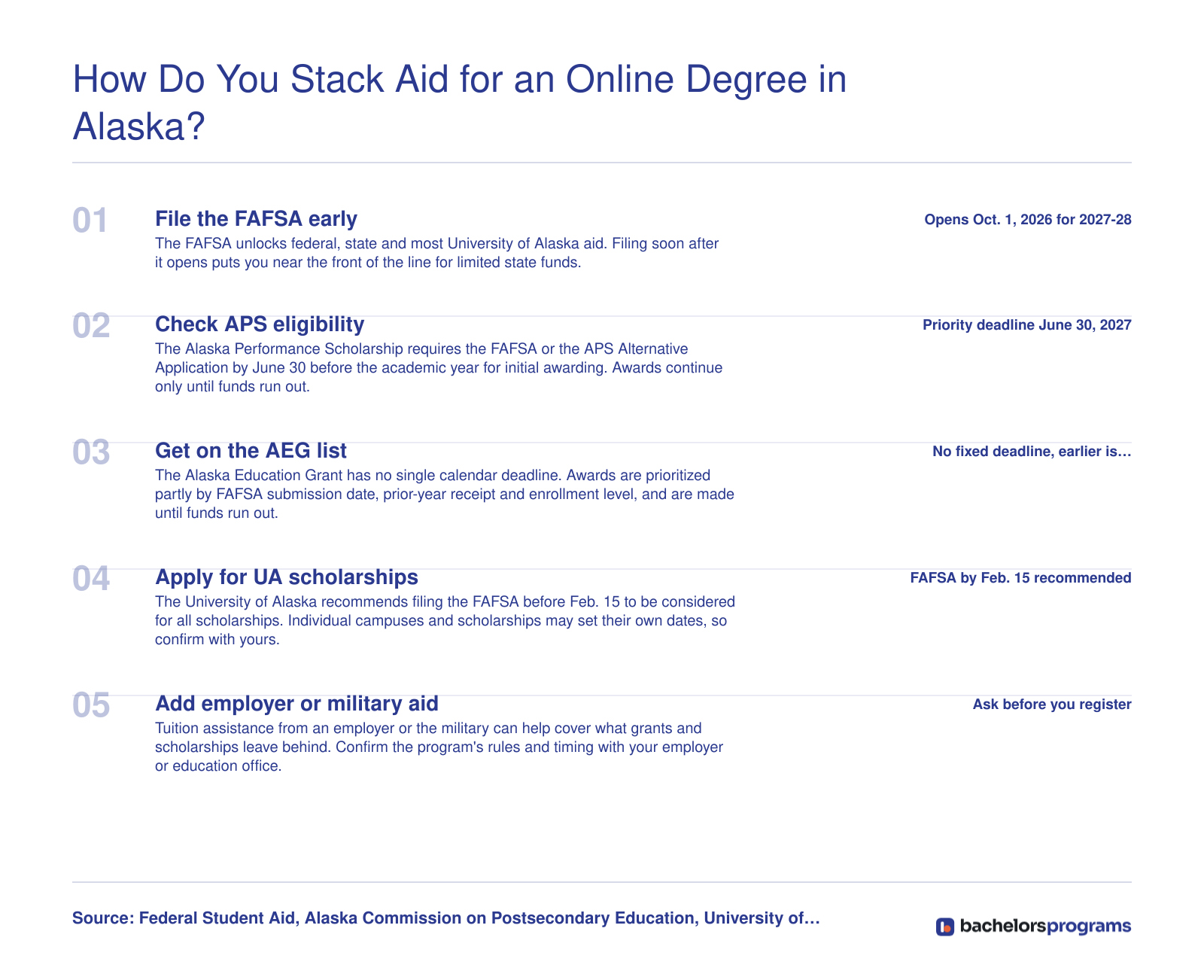
How Do You Stack Aid for an Online Degree in Alaska?
Alaska aid does not run on a single deadline, so the order of your steps matters. State grant funds are awarded until they run out, which means an early FAFSA improves your odds at every level.
Which Bachelor's Degrees Are Truly 100% Online?
A fully online bachelor's degree lets you complete every course through distance delivery, with no required trips to campus. In Alaska, some University of Alaska bachelor's degrees meet that standard, but the three universities apply the label unevenly, so read each program page closely.
Programs Offered Online
University of Alaska Southeast lists several bachelor's degrees as e-learning, including the Bachelor of Business Administration (with concentrations in Accounting, Human Resource Management, and Management and Leadership), the BA in English, the BA in Social Science, and the BA in Integrative Behavioral Health. UAS also lists Elementary Education and Special Education as e-learning. University of Alaska Anchorage labels programs online when they are available fully online, using asynchronous and sometimes synchronous instruction. UAS lists its liberal arts and social science degrees as available both on campus and online, so treat them as flexible rather than automatically remote.
Common In-Person Requirements
"Online" often describes the coursework, not every required activity. Expect hands-on components in fields like these:
- Education: Fieldwork, internships, and supervised student teaching, usually in a school district near you. UAA's Elementary Education A.A.-to-B.A. pathway is explicitly hybrid, mixing face-to-face Anchorage courses with distance courses from UAS.
- Nursing and health: Lectures may be online, but clinicals and labs happen in person.
- Social work and behavioral health: Practicums or field placements.
- Any program: Occasional group meetings or on-site sessions. UAS says e-learning delivery can include group meetings.
How to Verify a Program
1. Read the delivery label on the program page, and note whether it says online, e-learning, or hybrid. 2. Ask an advisor whether any required course is offered only face-to-face. 3. Ask whether practicums, clinicals, or student teaching can be arranged in your home community, and who finds the site. 4. Get the answers in writing before you pay a deposit.
Proctored Exams and Campus Visits
Some instructors require proctored exams, though not every online course does. UAA offers free proctoring to UAA, UAF, and UAS students; you schedule at least 24 hours ahead. UAS also lets e-learning students take exams at a testing center at no charge. Rural students typically use these services or a nearby approved site rather than traveling to a main campus. Confirm which option your instructor accepts at the start of each term.
Transfer Credit and Finishing Your Degree Faster
Whether you start from zero or arrive with credits in hand changes your timeline enormously, and Alaska's transfer rules decide how much of that credit you keep.
Moving Credit Inside the UA System
General education is the easiest place to start. The University of Alaska's 34 transferable general education credits are organized by category, and a category completed at one UA campus satisfies the same category at another even when the courses do not match exactly. UAF and UAS accept intra-UA coursework at D- or better, while courses from outside schools generally need a C- or better. That gap matters: a D earned at a sister campus may count where a D from an out-of-state college will not. UAA reviews transfer credit case by case, and UAS evaluates coursework after admission while keeping each course at its original level.
Residency Sets the Real Ceiling
Transfer, exam, military and prior-learning credit can count toward the 120 credits a UA bachelor's degree requires, but such credit does not count as resident credit. UAF states the clearest rule: 30 credits, including 12 in the major and 3 in a minor, must be earned there. UAA treats credit from other institutions, UAF and UAS included, as nonresident unless it arrives through a collaborative program, where each participating campus's credit counts. Confirm with an advisor how many credits your specific major will accept.
Military, Exams and Prior Learning
- Military training: UAF accepts it as transfer credit but excludes military service from residency. UAA classifies Joint Services Transcript credit as elective and asks students to consult an advisor.
- Exams: UAF accepts AP, CLEP, IB, DSST and language testing; UAA accepts CLEP and DSST. National exam credit is excluded from UAF residency.
- Prior learning: ACE-reviewed training and portfolio review appear at some campuses. Treat the result as elective credit until an advisor rules on it.
How Long It Takes
A 120-credit bachelor's runs about four years at 15 credits per semester. Transfer students who arrive with an associate degree often finish in roughly two years. Part-time pacing at 6 credits a semester stretches the same degree past six years, so pair slower terms with year-round enrollment, including summer sessions, if you want to finish sooner.
Admissions, Start Dates and Technical Requirements
Admission to a University of Alaska bachelor's program is straightforward, but GPA minimums, fees and deadlines differ by campus. Use this checklist to compare UAA, UAF and UAS before you apply.
- High school diploma, GED and GPAUAA requires a high school GPA of at least 2.00 for bachelor's admission. UAF requires a diploma, a 16-credit high school core and a cumulative GPA of 2.5. UAS accepts a 2.50 GPA from an accredited high school or state-certified home school, or a GED.
- Transfer applicants and transcriptsHave college transcripts ready. UAA admits transfer applicants with at least 24 earned credits and a college GPA of 1.75 or higher. UAS requires at least 30 semester credits with a GPA of 2.00 or higher.
- ACT/SAT scoresUAF has not required ACT or SAT scores for any undergraduate degree since December 2023. A qualifying score is still needed for some outside awards, including the Alaska Performance Scholarship. UAS does not require scores but may use them for general education placement.
- Application feesUAA charges no fee for bachelor's applications. UAS charges $50, nonrefundable. UAF charges $50, rising to $75 after the deadline.
- Fall 2026 and Spring 2027 deadlinesFall 2026 deadlines were June 15 at UAF, July 15 at UAA (late deadline August 15) and August 1 at UAS. For Spring 2027, UAF's deadline was November 1, 2026. Late UAF applications are processed in the order received. The UAS deadline is December 1, 2026. UAA's catalog lists November 15 for spring, with a late deadline of December 15.
- Summer termAll three campuses set a May 1, 2026 summer deadline. UAA also accepted late summer applications through June 15.
- Technology and connectivityAsk your program which courses need video, a webcam or online proctoring before you register. This matters most if you rely on satellite or rural internet with limited bandwidth.
- Live vs. self-paced coursesAsynchronous courses let you work on your own schedule. Synchronous courses meet live, typically on Alaska Time, so out-of-state students should confirm meeting times before enrolling.
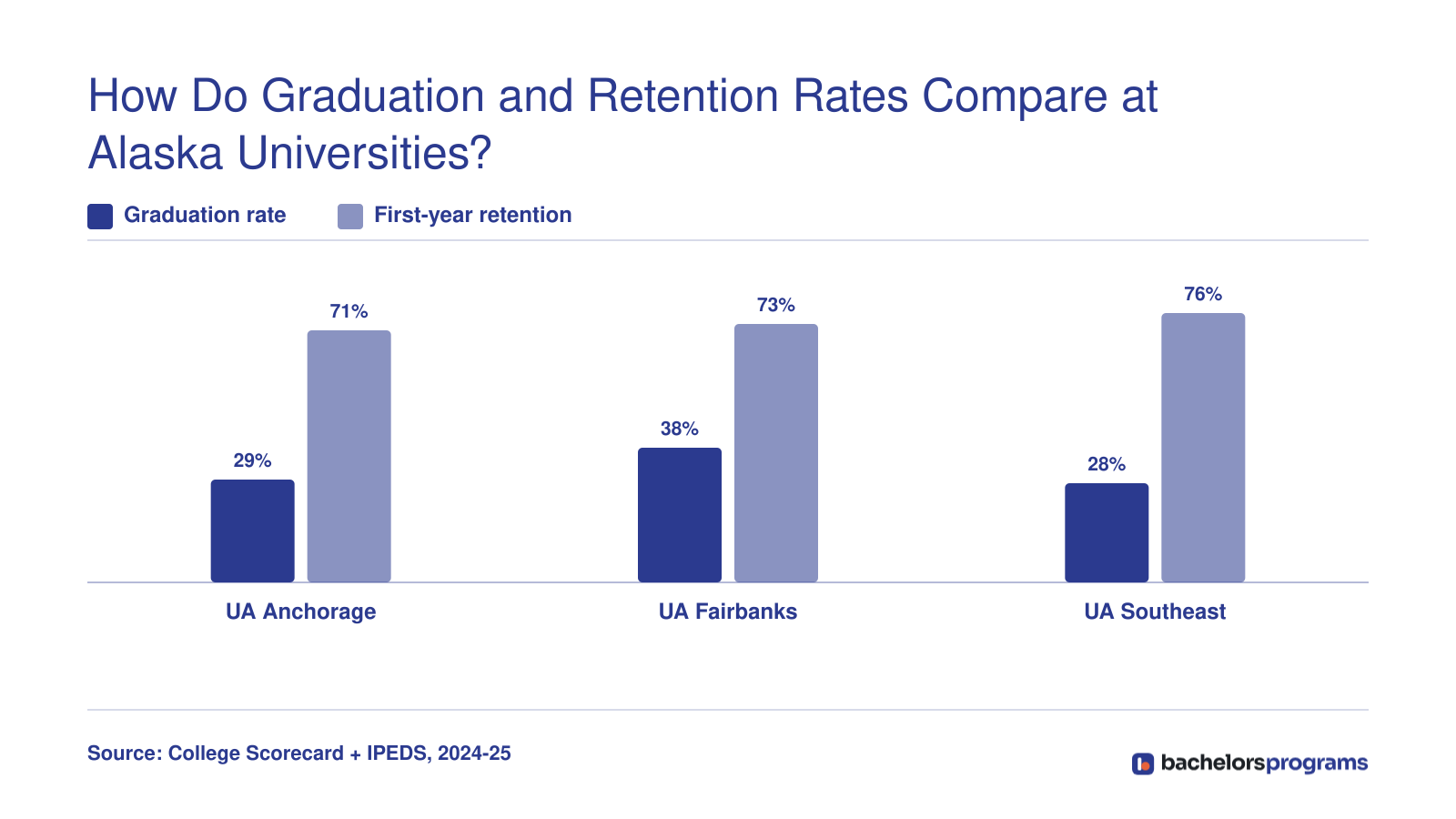
How Do Graduation and Retention Rates Compare at Alaska Universities?
Most first-time, full-time students at the University of Alaska campuses return for a second year (71% at UAA, 73% at UAF and 76% at UAS), but only 28% to 38% graduate within 150% of normal time, while Alaska Pacific University reports a 47% graduation rate. Alaska's rates run low partly because many of its students attend part-time, transfer between schools or work while enrolled. Federal graduation rates also track mainly first-time, full-time students who finish where they started, so they often undercount online, part-time and transfer completers. Ask any program you are considering for its own completion data for online and transfer students.
What Alaska Graduates Earn
Former students of University of Alaska campuses report median earnings in the high $40,000s to low $50,000s a decade after enrolling. University of Alaska Fairbanks comes in at $48,866 and University of Alaska Southeast at $48,475.
How to Choose the Right Online Program in Alaska
Staying inside the University of Alaska system is one bet; enrolling with a national online provider is another. The first trades flexibility for state aid and local ties, the second trades state aid for flat pricing and frequent start dates. Neither wins by default. Four checks settle it.
Start With Accreditation and Real Cost
Check that the program is accredited by the Northwest Commission on Colleges and Universities (NWCCU) or another regional accreditor recognized by the U.S. Department of Education. Programmatic accreditation matters in fields like nursing, teaching and engineering. Then calculate total cost after aid, not sticker tuition: online fees, technology fees, books, and whether out-of-state students pay a premium. A lower tuition line can lose to a higher one that accepts more transfer credit. Ask for the per-credit rate for each term you will actually take.
Delivery and Support
Confirm what "online" means. Some bachelor's completion programs require occasional campus visits, proctored exams, or internships arranged near your home. A weekly live seminar is a different commitment from a self-paced course. Ask about advising, tutoring, library access and technical support, and whether those services keep evening hours for working adults.
If you serve or have served, verify the school is approved for Military Tuition Assistance and GI Bill benefits, and ask how it handles deployments and credit for military training.
Alaska System vs National Online
Staying in the UA system usually keeps you eligible for in-state rates and for the Alaska Performance Scholarship and Alaska Education Grant, which generally require enrollment at an Alaska institution. National online schools may offer flat out-of-state pricing and monthly start dates, but you may surrender state grant eligibility. Weigh that loss against the flexibility.
Your Next Step
Before applying anywhere, request two things from at least two schools: a transfer credit evaluation and a written cost estimate covering one full year. Compare the net numbers side by side, then apply to the one that leaves you with fewer credits to finish and less out of pocket.
Questions to Ask Yourself
Will you qualify for the Alaska Performance Scholarship, and does it change the math between a UA campus and a national online school?
How many of your existing credits (military, community campus, AP) will actually count toward the degree you want?
Does your intended career, such as teaching or nursing, require an Alaska-approved program for licensure?
Colleges in Alaska with the most bachelor's programs
| School | City | Type | Bachelor's programs | Online | Net price / yr | Grad rate |
|---|---|---|---|---|---|---|
| University of Alaska Fairbanks | Fairbanks | Public | 71 | 31 | $10,892 | 38% |
| University of Alaska Anchorage | Anchorage | Public | 68 | 21 | $15,301 | 30% |
| University of Alaska Southeast | Juneau | Public | 23 | 11 | $12,357 | 28% |
| Alaska Pacific University | Anchorage | Private nonprofit | 19 | 17 | $21,616 | 47% |
| Charter College | Anchorage | Private for-profit | 5 | 4 | $34,860 | 56% |
| Alaska Bible College | Palmer | Private nonprofit | 2 | 0 | $17,508 | 38% |
| Ilisagvik College | Barrow | Public | 2 | 2 | $6,743 | 46% |
Program counts are the verified bachelor's listings in our directory; net price is the school-wide average a first-time undergraduate paid after aid, and graduation rate the share finishing within six years (College Scorecard).
Frequently Asked Questions About Online Bachelor's Degrees in Alaska
These answers cover the questions Alaska online students ask most often. Tuition figures come from University of Alaska Anchorage's 2026-27 schedule, and rates can change, so confirm current numbers with the school before you enroll.
Can you get a bachelor's degree completely online in Alaska?
How much does an online bachelor's degree cost in Alaska?
Are online students eligible for financial aid in Alaska?
Can out-of-state students take University of Alaska online courses at a reduced rate?
Does a University of Alaska diploma say "online" if you earned the degree through eLearning?
Compare programs nationwide
Many Alaska residents study online. Every ranked list above has an online lens, or browse every field.
Online bachelor's degrees Browse all fields