Online Colleges and Bachelor's Degree Programs in Minnesota
Every verified bachelor's program at a college in Minnesota: 1,700+ programs at 40+ colleges, with the online options, net price and graduation rates behind each one.

A Minnesota bachelor's degree is 120 credits whether you finish it from a kitchen table in Duluth or a lecture hall in the Twin Cities. Delivery is what differs: some programs run fully online, while others build in campus visits, lab sessions or clinical placements that no screen replaces.
The decisions that move cost and timeline are narrower than a course catalog suggests: total price after aid, how many prior credits transfer, and whether the program holds the accreditation your career requires.
Minnesota employers generally treat a regionally accredited online degree like its on-campus version. Licensed fields do not. Nursing, teaching and social work boards evaluate the program itself, not the format.
Key Points
- The maximum federal Pell Grant for 2026-27 is $7,395.
- Transferring 90 credits leaves just 30, about two full-time semesters.
- Verify Higher Learning Commission accreditation before enrolling in any Minnesota program.
Popular degrees in Minnesota
Bachelor's degrees in Minnesota by field
Business & Management
- Marketing43 programs
- Finance35 programs
- Business Administration32 programs
- Accounting32 programs
- Management27 programs
- Human Resource Management or HR Management23 programs
- Communication23 programs
- Economics20 programs
Science & Engineering
- Biology39 programs
- Chemistry30 programs
- Mathematics29 programs
- Biochemistry25 programs
- Physics17 programs
- Natural Resources or Conservation11 programs
- Anthropology10 programs
- Environmental Science10 programs
Education & Teaching
- Science41 programs
- Elementary Education28 programs
- Secondary Education27 programs
- Mathematics Education26 programs
- Special Education19 programs
- English Education18 programs
- Physical Education12 programs
- Early Childhood Education or Child Development10 programs
Liberal Arts & Humanities
- English30 programs
- Literature or English Literature26 programs
- History25 programs
- Spanish22 programs
- Philosophy20 programs
- Gender & Sexuality Studies11 programs
- Global Studies10 programs
- Native American Studies or American Indian or Indigenous8 programs
Arts & Design
- Art or Art Studies35 programs
- Fine Arts or Studio Art26 programs
- Media Arts or Digital Media21 programs
- Graphic Design19 programs
- Art History12 programs
- Audio & Music10 programs
- Creative Writing10 programs
- Illustration5 programs
Computers & IT
- Computer Science34 programs
- Innovation or Technological Entrepreneurship9 programs
- Cybersecurity8 programs
- Information Technology8 programs
- Software Development & Engineering7 programs
- Computer Engineering7 programs
- Computer Information Systems7 programs
- Artificial Intelligence4 programs
Healthcare
- Exercise & Sports Science23 programs
- Health Sciences15 programs
- Public Health13 programs
- Health Education9 programs
- Nutrition6 programs
- Community Health6 programs
- Health Informatics4 programs
- Speech Pathology4 programs
Communications & Media
- Communications27 programs
- Journalism15 programs
- Public Relations12 programs
- Professional Writing6 programs
- Strategic Communications6 programs
- Communication Disorders4 programs
- Speech Pathology4 programs
- Technical Communication3 programs
Social Work & Social Sciences
- Political Science, Government24 programs
- Social Work23 programs
- Sociology16 programs
- Human Services8 programs
- Public Policy2 programs
- Disability Studies1 program
Nursing
- Bachelor of Science in Nursing31 programs
- Nursing (RN to BSN)15 programs
- Accelerated BSN (ABSN)10 programs
- LPN/LVN to BSN2 programs
Criminal Justice & Law
- Criminal Justice23 programs
- Corrections6 programs
- Criminal Justice Administration6 programs
- Legal Services4 programs
- Legal Studies4 programs
- Criminology3 programs
- Forensic Science3 programs
- Paralegal1 program
Psychology
- General Psychology27 programs
- Applied Psychology4 programs
- Forensic Psychology3 programs
- Health Psychology2 programs
- Child Psychology1 program
- Addiction Psychology1 program
- Applied Behavior Analysis1 program
- Sport Psychology1 program
Religion & Theology
- Christian Studies or Religious Studies11 programs
- Christian Ministry or Ministry Leadership8 programs
Natural & Applied Sciences
- Agriculture or Agricultural8 programs
- GIS and Geoscience7 programs
- Neuroscience3 programs
Counseling
- Substance Abuse Counseling5 programs
- Mental Health Counseling1 program
How Online Bachelor's Degrees Work in Minnesota: Fully Online, Hybrid and Degree Completion
“Online” in Minnesota covers three quite different arrangements, and knowing which one you are looking at prevents most enrollment surprises.
Three formats you will see
- Fully online: Coursework and class meetings happen remotely from start to finish. The University of Minnesota lists Duluth's online bachelor's programs with no on-campus component, and Crookston describes its online programs as asynchronous.1
- Hybrid: Part of the work happens online, part on a campus or at a partner site, usually for labs, clinical placements, student teaching or short residencies. Capella states that residency travel is not covered by its tuition cap, so required travel becomes a real cost line whenever a program demands it.4
- Degree completion: Built for students who arrive with an associate degree or roughly 60 or more credits. Crookston's Applied Health BS, for example, accepts up to 38 clinical credits from radiologic technician, physical therapy assistant, occupational assistant or respiratory therapy coursework, provided the student holds an active practice license.2
Asynchronous vs. synchronous delivery
Asynchronous means you work on your own schedule inside weekly deadlines. Capella's GuidedPath format is described as 24/7 asynchronous learning with weekly milestones, and its FlexPath option appears only in selected programs.5 Synchronous means scheduled live sessions, which effectively sets the shape of your week and your time zone.
Experiential requirements are the other thing to verify. Crookston's Applied Health BS includes a 10-week supervised field experience in a healthcare organization or agency,2 and its Applied Studies BS requires demonstrated technical competencies in an internship setting.3 Neither is described as on-campus, but both require a real placement you have to arrange and complete.
What to check before you apply
Minnesota State campuses such as Metropolitan State, Minnesota State Mankato and St. Cloud State, the University of Minnesota campuses, and private providers like Capella and Concordia University, St. Paul each set their own rules, and requirements differ by major and pathway, so a “100% online” label on a marketing page tells you less than the program requirements page does.
Search the program page for “residency,” “on-site,” “practicum” and “synchronous” before you apply, then get the answer from an advisor in writing. Format alone does not tell you whether a program costs less or finishes faster; ask for a credit-by-credit plan instead.
What an Online Bachelor's Degree Really Costs in Minnesota
The sticker price of an online degree in Minnesota depends as much on per-credit fees as on tuition. A bachelor's degree typically takes 120 credits, so multiplying the per-credit rate by 120 gives a quick estimate of the full-price total.
Published Per-Credit Rates
Two public universities show clear rates:
- Metropolitan State University (2026-27): Undergraduate base tuition is $322 per credit, plus a mandatory technology fee of $14 per credit, for $336 per credit. Over 120 credits, that comes to about $40,320, or $38,640 for tuition alone. The 2026-27 undergraduate catalog lists these figures.1
- Minnesota State University, Mankato: The undergraduate cost per credit chart lists $375.25 in tuition plus $48.39 in fees, or $423.64 per credit. Over 120 credits, that is about $50,837, or $45,030 for tuition alone. The chart does not separate technology fees from course fees, and the academic year behind these figures is not stated, so confirm both on the page before budgeting.2
The gap between the two comes to roughly $10,500 over a full degree. Fees account for much of it.
Other universities in the state, including St. Cloud State, Bemidji State, the University of Minnesota campuses, and private providers such as Bethel, St. Catherine and Concordia St. Paul, set their own rates. Check each school's current bursar page and note the academic year beside every figure you record.
Fees That Inflate the Bill
Per-credit fees add up fast across 120 credits. Look for these line items:
- Technology fees, charged per credit or per term
- Online course or distance-learning fees
- Proctoring fees for remote or test-center exams
- Course materials and software
A $14 fee looks small, but at 120 credits it adds $1,680. A $48 fee adds more than $5,800.
Sticker Price vs. Net Price
The 120-credit total is a ceiling, not a prediction. Net price is what you owe after gift aid, and it is often well below the sticker price. The gap tends to be widest at private nonprofits, which can offer large institutional discounts off a higher list price. A higher-priced private school may therefore cost less than a public one once aid is applied. Compare award letters, not rate sheets, and use the net price calculator on each school's website.
Transfer Credits Cut the Total
You pay per credit, so every accepted credit removes its cost. A student entering with 60 credits pays for roughly half the degree. At Metropolitan State's 2026-27 rate of $336 per credit, that is about $20,160 instead of $40,320, before any aid.1 Before you enroll, ask each school how many credits it will accept.
Minnesota Resident Tuition for Online Students and Out-of-State Rules
Living outside Minnesota does not lock you into the highest tuition rate, but no single rule guarantees resident pricing either. What you pay depends on the campus, how the program is delivered and where you live.
How Minnesota Public Universities Price Online Courses
Minnesota State publishes separate nonresident tuition schedules, and its universities generally charge nonresident rates unless reciprocity or a special rate applies. There is no uniform online undergraduate rate across the system.1 Individual campuses often set their own pricing for 100% online programs, which can differ from the price of online courses taken inside a campus-based program. Minnesota State University, Mankato illustrates the split: its 2026-2027 out-of-state rate of $758.90 per credit ($807.29 with fees) applies to students who are not fully online, and 100% online learners are priced separately. No current flat online undergraduate rate could be confirmed for the University of Minnesota campuses, so check each campus's tuition page for the program you want.
Reciprocity With Wisconsin, North Dakota and Manitoba
Minnesota's tuition reciprocity agreements cover Wisconsin, North Dakota and Manitoba. The South Dakota agreement ended after 2023-24.2 Some campus pages still list South Dakota, so confirm any South Dakota benefit with the school in writing. Key limits for online students:
- Wisconsin: Distance education taken while you remain at home in Wisconsin is not covered.2 Applications go through the Wisconsin Higher Educational Aids Board.
- North Dakota: You apply for reciprocity separately; it can apply at any Minnesota public institution.
- Manitoba: Minnesota State University Moorhead treats Manitoba reciprocity as automatic once residency is reported.
- Uniform-rate programs: Programs that charge every student the same price regardless of residency fall outside reciprocity.
The Midwest Student Exchange Program is a separate regional discount. Ask the school whether it applies to a given online program.
Tuition Rate Is Not Aid Eligibility
Paying a resident-level rate does not make you a Minnesota resident for financial aid. The Minnesota State Grant and North Star Promise are reserved for students who meet state residency rules.
Before enrolling, confirm the program is authorized to enroll students in your home state through SARA. For nursing, teaching or social work, also verify that it meets your state's licensure requirements.
Financial Aid for Online Students: Pell, the Minnesota State Grant and North Star Promise
The maximum federal Pell Grant for the 2026-27 award year is $7,395, covering July 1, 2026 through June 30, 2027.1 That figure anchors almost every aid package an online student in Minnesota will assemble, and the process starts with one form.
File the FAFSA First
The FAFSA is the starting point for Pell, state grants and most institutional aid. Online enrollment does not disqualify you from federal aid as long as your program is offered by an accredited institution and you are enrolled in a degree-seeking capacity. What does change your Pell award is enrollment intensity: students taking fewer credits receive a prorated share rather than the full annual maximum, so a half-time online learner should not budget around the $7,395 figure. Pell eligibility is also capped at the equivalent of 12 full-time terms, roughly six years, which matters if you have stopped and restarted a degree before.1
North Star Promise and the Minnesota State Grant
North Star Promise is the program most likely to change the math for Minnesota residents. For 2026-27, the adjusted gross income threshold is below $80,000 as reported on the FAFSA or the Minnesota Alternative State Financial Aid Application.2 The award is last-dollar: after Pell, the State Grant, scholarships, waivers and other gift aid are applied, North Star Promise covers up to 100 percent of remaining charged tuition and mandatory fees.3 Eligible institutions are the Minnesota State colleges and universities, University of Minnesota campuses, and four Tribal Colleges: Fond du Lac, Leech Lake, Red Lake Nation and White Earth.2 Private nonprofit colleges are not included.
Eligibility steps are straightforward: be a Minnesota resident, enroll at an eligible public or Tribal institution, carry at least one credit, stay current on state and federal loans, meet satisfactory academic progress, and hold no prior bachelor's degree.2 Part-time and evening enrollment qualifies, and nothing in the program rules excludes online coursework at an eligible school. Funding runs up to eight semesters for a four-year degree.3 The 2026-27 application deadline is June 1, 2026.2
The Minnesota State Grant operates alongside it as the state's need-based award; the Office of Higher Education sets award amounts annually, so confirm current figures with your financial aid office rather than assuming last year's numbers.4
Institutional and Employer Aid
For adult learners at private nonprofits, where North Star Promise does not reach, institutional grants and employer tuition benefits often become the largest cost lever. Ask your employer's HR department about annual reimbursement caps before you compare sticker prices. A Minnesota resident under the income threshold attending a public institution online may owe little or nothing in tuition.
Transfer Credits and Faster Paths to Finishing Your Degree
The credits you already earned are worth more in Minnesota than in most states, but only if you confirm two things before you apply: how many will transfer, and how many will actually count toward your major.
The Transfer Curriculum Does the Heavy Lifting
Minnesota's shared general education core, the Minnesota Transfer Curriculum (MnTC), is a 40-credit package designed so that completing it at one public institution satisfies general education requirements at another. At Minnesota State University Moorhead, a completed MnTC fulfills general education outright, and a finished goal area counts as that area even when the rest of the package is unfinished. UMN Crookston goes further: students who complete the full MnTC are exempt from its liberal education requirements.1 Minnesota State's Transfer Pathways work in the other direction, mapping a specific associate degree onto a specific bachelor's major so the block moves as a unit rather than course by course.
The Caps and Residency Rules You Need to Check
No single statewide maximum on transfer credit exists, so the numbers live at the campus and program level. Moorhead accepts technical college credit as a block of up to 16 credits unless an articulated program agreement allows more. Crookston requires at least 30 semester credits earned there, including 15 of the final 30, toward its 120-credit graduation minimum.1 The University of Minnesota evaluates transfer credit only after you are admitted as a degree-seeking student and official transcripts arrive, and it re-evaluates non-traditional credit such as CLEP, AP, IB and military work for content and comparability.2
Exams, Prior Learning and Accelerated Formats
Moorhead accepts CLEP, AP, DSST and IB credit. Crookston awards CLEP credit for most subject exams3 and accepts AP, IB, DSST and military credit, but its Prior Learning Assessment, the portfolio route for work experience, must be requested within one year of matriculation or of completing the experience, and it excludes credit-bearing coursework and standardized exams. Capella University awards CLEP credit following American Council on Education recommendations4 and posts credit for prior learning to the transcript, evaluating prior coursework on applicability, grades and course match.5
The Trap: Transferable Is Not the Same as Applicable
A course can transfer and still leave you short. Ask for an unofficial transcript evaluation before you apply, and ask specifically which credits land inside the major rather than in elective space.
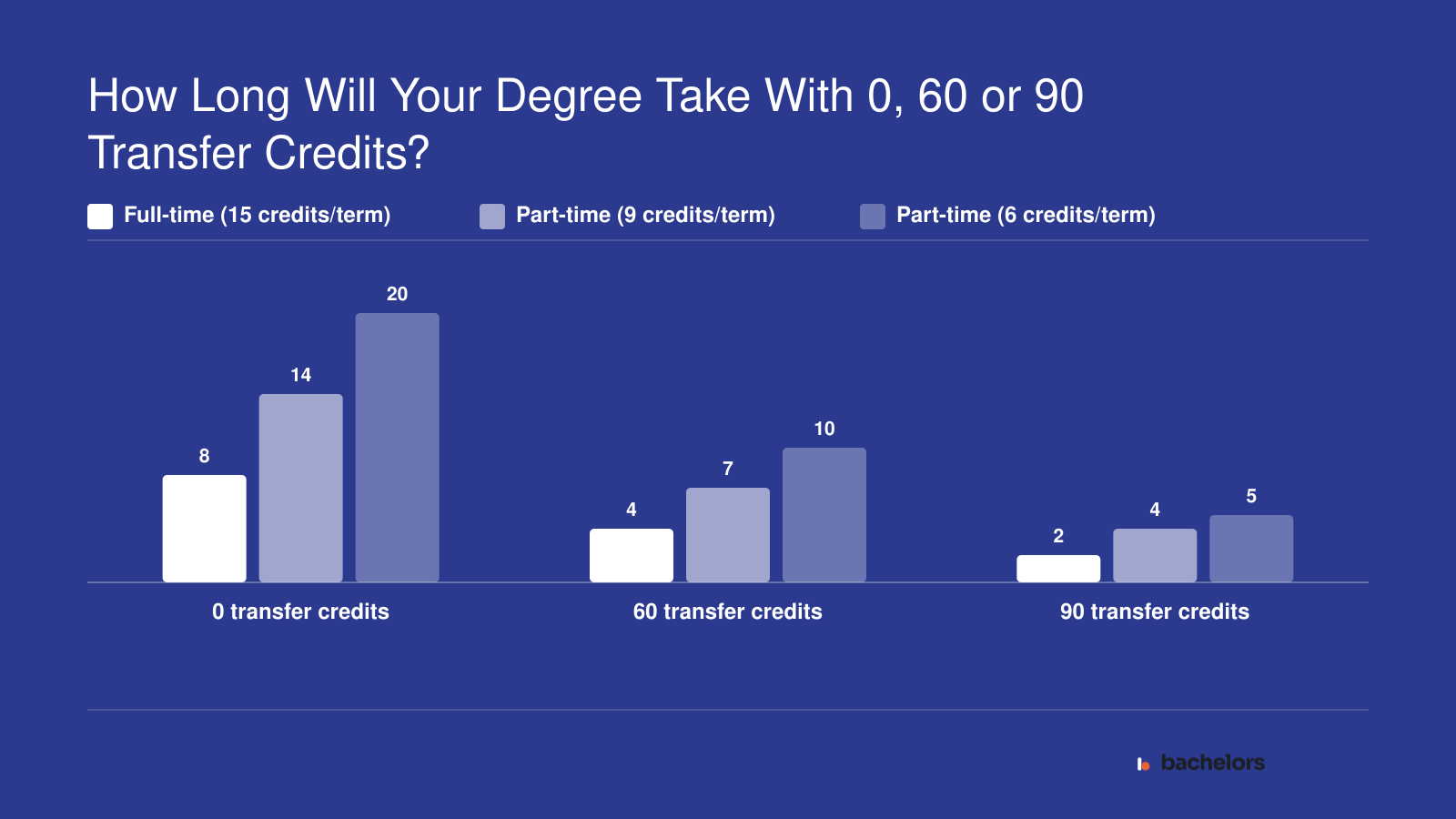
How Long Will Your Degree Take With 0, 60 or 90 Transfer Credits?
On a 120-credit degree, starting with 0, 60 or 90 transfer credits leaves 120, 60 or 30 credits to finish. At 15 credits per term, that is about 8, 4 or 2 semesters. At 6 to 9 credits per term, it is roughly 14 to 20, 7 to 10, or 4 to 5 semesters. Treat these as planning estimates, not guarantees. A school's residency requirement sets how many credits you must earn at that school, which can limit how many of your 90 credits count. Major prerequisites can also add terms.
Accreditation, Licensure and How Employers View Online Degrees
Start With Institutional Accreditation
The Higher Learning Commission (HLC) is the regional accreditor for Minnesota's public institutions and most of its private ones. Confirm a school's status yourself. Search the institution on the HLC website, then cross-check it in the U.S. Department of Education's DAPIP database. If the two disagree, ask the school to explain before you apply.
Programmatic Accreditation for Licensed Fields
Institutional accreditation does not replace program-level review. For licensed careers, check the specific program:
- Nursing (RN-to-BSN): Look for CCNE or ACEN accreditation.
- Social work: Look for CSWE accreditation. Minnesota generally requires a license to practice social work or use the title1, with exceptions such as county or tribal employment, and the Board of Social Work reviews your official transcript for degree, major and conferral date.2
- Teaching: Look for CAEP accreditation or state approval of the preparation program. Applications go through the Minnesota Department of Education's online licensing system.
Programmatic accreditation alone does not guarantee a license, so confirm requirements with the licensing board before you enroll.
Reduced-Credit Bachelor's Degrees
Some schools now offer bachelor's degrees of roughly 90 credits instead of 120. In 2026, HLC approved such programs at Concordia University, St. Paul (Sport Management) and Saint Mary's University of Minnesota (Applied Psychology).3 These are institution-specific approvals, not a blanket permission. Before choosing one, ask graduate programs and any relevant licensing board in writing whether they accept a 90-credit degree. Credit totals can affect admission requirements and transfer.
What Employers See
Diplomas from accredited Minnesota institutions generally do not say "online." Employers and graduate schools look at the school's accreditation, not the delivery format. A degree from an accredited institution carries the same name whether you earned it on campus or from home.
Out-of-State Students
If you live outside Minnesota, do not assume a Minnesota program leads to a license in your home state. Ask the school for its professional licensure disclosure for your state, then confirm with that state's nursing, social work or teaching board. Get the answer in writing before you pay a deposit.
Minnesota Licensure Checks for Online Nursing, Teaching and Social Work Students
Admissions, Graduation Rates and Career Outcomes for Minnesota Graduates
The admissions conversation in Minnesota has shifted from standardized tests to transcript math. At public universities that offer online bachelor's completion programs, the decision usually turns on your cumulative GPA and how many credits you can bring in, not on an ACT or SAT score.
Admissions: GPA and transfer credits, not test scores
Many online completion programs at Minnesota's public universities are built for students who already have some college credit. In practice, admission is often generous, provided you meet a minimum GPA and bring a block of transferable credits, often around the equivalent of an associate degree. Test scores are frequently optional or waived for applicants above a certain age or credit threshold. Open-access admission is common, but completion programs still expect you to be ready for upper-division coursework. Ask whether admission to the major is direct or comes only after prerequisites and a separate application.
Graduation and retention: read the fine print
Graduation rates across Minnesota's public four-year campuses vary by campus and by how the cohort is defined. The clearest current public snapshot for one campus is Minnesota State University, Mankato: 80% of students returned after their first year, and 58% had graduated eight years after attending.1 That cohort covered 7,965 students; 27% transferred elsewhere, 14% withdrew, and 1% remained enrolled.2 Because the window is eight years and transfers are counted separately, the figure is not a clean six-year freshman rate. It can undersell adult students who arrive with credits, stop out, and finish later. The University of Minnesota publishes campus-level figures separately, so compare the campus you would attend rather than a systemwide average.
Career outcomes and the question to ask
For employment and earnings, use the Graduate Employment Outcomes Tool from the Minnesota Department of Employment and Economic Development (DEED) to check bachelor's completers by institution and field, and College Scorecard for median earnings by program. Treat those as field-specific signals, not one statewide average. A program that serves working adults may post modest freshman graduation rates while its online completers finish at a different pace.
The most useful question for an admissions office is narrower: "What is your completion rate for online and transfer students specifically?" A first-time freshman rate says little about a 32-year-old transferring 70 credits. Ask for that number, along with the average time to finish for students who enter with your credit total.
What Minnesota Bachelor's Graduates Earn After Completion
Wage records for graduates of Minnesota institutions show what a bachelor's degree pays in Minnesota jobs.
How to Choose the Right Minnesota Online Program
Choosing by sticker price and choosing by net price produce very different shortlists, and only the second tells you what you will actually pay. Speed works the same way. A program's promise of a fast finish matters far less than how many of your credits it accepts and how its terms are structured.
Budget and Timeline
Compare schools on net price after the Minnesota State Grant, the North Star Promise and any Pell Grant you qualify for, not on published tuition. A school with higher tuition can cost less once aid is applied. North Star Promise eligibility depends on family income and the type of institution, so confirm it for each school you consider.
For timeline, ask two questions. How many of your existing credits will count toward degree requirements rather than just electives? And how long are the terms? Shorter terms, such as seven- or eight-week courses, let you start sooner and keep moving year-round, while a generous transfer policy can remove entire semesters from your plan.
Format Fit
If you work full-time, prioritize asynchronous courses you can complete on your own schedule, with no required campus visits. If your goal is licensure in nursing, teaching or social work, accept that clinicals, student teaching or field placements will happen in person. Then confirm the program holds the approval your career requires.
Support for Adult Learners
Strong online programs build services around working students: dedicated online advisors, tutoring available on evenings and weekends, career services you can reach remotely and several start dates each year. Ask admissions who your advisor will be and how quickly they typically respond.
Final Checklist
- Accreditation: HLC accreditation verified through the commission's directory.
- Transfer: Official transcript evaluation received in writing.
- Cost: Net price calculated after grants.
- Format: In-person requirements confirmed, including orientations, labs and placements.
- Licensure: Licensure disclosure checked for the state where you plan to work.
Colleges in Minnesota with the most bachelor's programs
| School | City | Type | Bachelor's programs | Online | Net price / yr | Grad rate |
|---|---|---|---|---|---|---|
| Minnesota State University-Mankato | Mankato | Public | 89 | 12 | $19,139 | 54% |
| Minnesota State University Moorhead | Moorhead | Public | 87 | 25 | $17,997 | 57% |
| Bemidji State University | Bemidji | Public | 81 | 23 | $15,261 | 48% |
| University of Minnesota-Twin Cities | Minneapolis | Public | 80 | 1 | $16,778 | 85% |
| University of St Thomas | Saint Paul | Private nonprofit | 70 | 0 | $29,155 | 76% |
| University of Minnesota-Duluth | Duluth | Public | 70 | 2 | $18,743 | 65% |
| Saint Cloud State University | Saint Cloud | Public | 69 | 15 | $13,529 | 40% |
| Winona State University | Winona | Public | 68 | 8 | $17,503 | 57% |
| Metropolitan State University | Saint Paul | Public | 65 | 34 | $16,863 | 44% |
| Southwest Minnesota State University | Marshall | Public | 61 | 21 | $15,291 | 45% |
| Bethel University | Saint Paul | Private nonprofit | 58 | 2 | $28,556 | 71% |
| Concordia University-Saint Paul | Saint Paul | Private nonprofit | 57 | 24 | $18,462 | 46% |
| Concordia College at Moorhead | Moorhead | Private nonprofit | 55 | 2 | $24,902 | 61% |
| Hamline University | Saint Paul | Private nonprofit | 53 | 6 | $20,744 | 61% |
| University of Northwestern-St Paul | Saint Paul | Private nonprofit | 48 | 5 | $27,705 | 68% |
Program counts are the verified bachelor's listings in our directory; net price is the school-wide average a first-time undergraduate paid after aid, and graduation rate the share finishing within six years (College Scorecard).
Common Questions About Minnesota Online Bachelor's Degrees
These short answers sum up the main points on formats, transfer credit and state aid. Policies vary by college and change each aid year, so confirm details with the school and the Minnesota Office of Higher Education before you enroll.
Can you get a bachelor's degree entirely online in Minnesota?
How many credits can I transfer into an online bachelor's program in Minnesota?
Can I use the Minnesota State Grant or North Star Promise at a private or out-of-state online college?
Will my diploma say "online" if I complete my degree remotely?
Compare programs nationwide
Many Minnesota residents study online. Every ranked list above has an online lens, or browse every field.
Online bachelor's degrees Browse all fields