Online Colleges and Bachelor's Degree Programs in Massachusetts
Every verified bachelor's program at a college in Massachusetts: 2,550+ programs at 70+ colleges, with the online options, net price and graduation rates behind each one.

Massachusetts schools now offer online or hybrid bachelor's options in most fields, but the price of a credit, eligibility for aid, and the rules for transferring prior coursework vary sharply between public universities, private colleges, and community college partnerships.
The directory of colleges and fields appears elsewhere on this page. Cost, net price, state grants, transfer credit, admissions, and outcomes determine what a degree actually costs you and how fast you finish.
The practical goals are narrow: find the lowest total cost, keep the most transfer credits, and confirm that a program is accredited and truly online. Sticker prices rarely settle any of those questions.
Key Points
- Many Massachusetts online programs charge one per-credit rate regardless of residency.
- Online students can qualify for MASSGrant, Gilbert Grant, and federal Pell aid.
- Transfer credits can cover 60 or more of 120 required credits.
Popular degrees in Massachusetts
Bachelor's degrees in Massachusetts by field
Business & Management
- Marketing68 programs
- Business Administration52 programs
- Finance52 programs
- Management45 programs
- Accounting41 programs
- Economics41 programs
- Communication33 programs
- Entrepreneurship27 programs
Science & Engineering
- Biology51 programs
- Mathematics45 programs
- Chemistry42 programs
- Biochemistry32 programs
- Physics29 programs
- Environmental Science23 programs
- Anthropology19 programs
- Electrical Engineering or Electronics Engineering or Electronic Systems Engineering Technology18 programs
Liberal Arts & Humanities
- English50 programs
- Literature or English Literature47 programs
- History44 programs
- Philosophy29 programs
- Spanish27 programs
- Global Health or Health Studies25 programs
- African and African American Studies17 programs
- Gender & Sexuality Studies17 programs
Arts & Design
- Art or Art Studies52 programs
- Fine Arts or Studio Art39 programs
- Media Arts or Digital Media32 programs
- Graphic Design23 programs
- Art History23 programs
- Audio & Music17 programs
- Creative Writing14 programs
- Game Programming & Development9 programs
Education & Teaching
- Science41 programs
- Early Childhood Education or Child Development26 programs
- Elementary Education24 programs
- Secondary Education20 programs
- Educational Studies or Education Studies17 programs
- Mathematics Education16 programs
- Special Education13 programs
- English Education13 programs
Computers & IT
- Computer Science54 programs
- Innovation or Technological Entrepreneurship23 programs
- Cybersecurity22 programs
- Artificial Intelligence20 programs
- Information Technology16 programs
- Computer Engineering14 programs
- Software Development & Engineering8 programs
- Computer Information Systems8 programs
Social Work & Social Sciences
- Sociology66 programs
- Political Science, Government35 programs
- Human Services14 programs
- Social Work9 programs
- Public Policy4 programs
- Disability Studies1 program
Communications & Media
- Communications35 programs
- Journalism28 programs
- Public Relations20 programs
- Speech Pathology12 programs
- Communication Disorders10 programs
- Social Media6 programs
- Professional Writing4 programs
- Strategic Communications3 programs
Healthcare
- Public Health28 programs
- Health Sciences28 programs
- Exercise & Sports Science21 programs
- Speech Pathology11 programs
- Community Health8 programs
- Nutrition7 programs
- Health Education4 programs
- Respiratory Care Therapy1 program
Criminal Justice & Law
- Criminal Justice32 programs
- Criminology15 programs
- Forensic Science9 programs
- Legal Studies7 programs
- Homeland Security5 programs
- Legal Services4 programs
- Criminal Justice Administration3 programs
- Fire Science or Fire Administration3 programs
Psychology
- General Psychology51 programs
- Applied Psychology6 programs
- Forensic Psychology3 programs
- Health Psychology3 programs
- Clinical Psychology3 programs
- Child Psychology2 programs
- Applied Behavior Analysis2 programs
- Counseling Psychology2 programs
Nursing
- Bachelor of Science in Nursing31 programs
- Nursing (RN to BSN)16 programs
- Accelerated BSN (ABSN)15 programs
- LPN/LVN to BSN4 programs
Natural & Applied Sciences
- Neuroscience14 programs
- Oceanography or Ocean or Marine Biology9 programs
- GIS and Geoscience6 programs
- Agriculture or Agricultural3 programs
Religion & Theology
- Christian Studies or Religious Studies11 programs
- Christian Ministry or Ministry Leadership2 programs
Counseling
- Substance Abuse Counseling2 programs
How Online Bachelor's Degrees Work in Massachusetts: Fully Online, Hybrid, and Out-of-State Providers
You can earn a bachelor's degree fully online in Massachusetts in many fields, but "online" covers several formats, and the label alone will not tell you how much time you must spend in person.
Formats in Plain Terms
- Fully online: All coursework is delivered online, with no required campus sessions for classes.
- Hybrid: Some courses or sessions meet in person, the rest online.
- Asynchronous: Recorded lectures and weekly deadlines you complete on your own schedule.
- Synchronous: Live online classes at set times.
Federal IPEDS data separates students enrolled exclusively in distance education from those taking some, but not all, courses online4. Nationally in 2023-24, 5,346,433 students (27.5%) fell into that blended group4, so mixing formats is common. Before you apply, read each program page for required campus days, proctored exams, residencies, and in-person internships or practicums.
Massachusetts Schools vs. National Online Providers
Your options fall into two groups. Massachusetts-based schools include UMass campuses, state universities, and private nonprofits. National online providers headquartered in other states also enroll Massachusetts residents, often with large catalogs and frequent start dates.
How State Authorization Works
Massachusetts participates in NC-SARA, a reciprocity agreement for online education1. The Massachusetts Department of Higher Education serves as the state's portal entity2 and decides which Massachusetts institutions may join; schools apply through the department rather than directly to NC-SARA. An out-of-state school authorized under SARA by its home state may offer online programs to Massachusetts residents1. If an issue isn't resolved through the school's own process, SARA also gives students a path to file complaints through the school's home-state portal agency.
SARA has limits. Establishing a physical presence here, such as an instructional location or staff office space, triggers Board of Higher Education approval1. Online providers placing students in Massachusetts internships or practicums may need an occupational school license3. SARA also does not guarantee that a degree qualifies you for a professional license.
Licensure-Track Fields Need In-Person Work
Fields like teaching and nursing usually require supervised placements, such as student teaching or clinical hours, completed in person. Confirm that a program meets Massachusetts licensure requirements and can arrange placements near you before you enroll.
What Online Bachelor's Degrees Cost in Massachusetts: Per-Credit Tuition Compared
On-campus pricing in Massachusetts splits by residency, while many online and continuing-education programs charge one rate to everyone. That difference shapes how you compare costs, so start with what the school actually publishes.
Published Per-Credit Rates
- UMass Amherst University Without Walls (public): $470 per credit for University+ undergraduate online courses in 2026. The published material does not show a separate out-of-state online rate. On-campus University-session courses run $740 per credit including an additional fee.
- Northeastern College of Professional Studies (private): $580 per credit hour for 2026-2027, starting Fall 2026.1 Science-lab and writing-lab courses cost $836 per credit hour. Bachelor's completion students who are active-duty military or the spouse of an active service member pay $250 per semester hour. The schedule shows no separate in-state and out-of-state rates.
- Western Governors University (national, private): No per-credit charge. Tuition is a flat $3,825 per six-month term for undergraduate School of Education programs (terms starting on or after January 1, 2026).2 Full-time students take 12 or more competency units for that price. Other WGU bachelor's programs may be priced differently.
I could not confirm current 2026 published online per-credit rates for UMass Lowell Online, UMass Boston, UMass Dartmouth, Fitchburg State, Framingham State, Bridgewater State, Westfield State, Merrimack, or SNHU. Check each school's bursar or continuing-education page before you budget.
Estimated Cost for 120 Credits
These are tuition-only estimates, multiplied out from the published rates:
- UMass Amherst UWW: about $56,400 (120 x $470)
- Northeastern CPS: about $69,600 (120 x $580), more if your degree includes lab or writing-lab courses
For completion programs, multiply the rate by the credits you still need. A student bringing in 60 transfer credits would owe roughly $28,200 at UMass Amherst UWW or $34,800 at Northeastern CPS. WGU's cost depends on how many terms you need, so multiply $3,825 by your expected number of terms.
Fees Are Separate
The sources do not say whether Northeastern's $580 and $836 rates include mandatory fees. Treat technology, registration, and course fees as extra until the school confirms otherwise. The UMass Amherst figure applies to the 2026 academic year, and the Northeastern figures to 2026-2027, so confirm the current schedule before you enroll.
Finding the Cheapest Online Bachelor's Degree in Massachusetts and Whether You Pay In-State Tuition
The cheapest online bachelor's degree in Massachusetts is the one with the lowest total cost to finish, not the lowest sticker price per credit. No single school wins for every student, so use a formula: per-credit rate × credits you still need + fees − grants. A school with a higher rate that accepts more of your credits can beat a cheaper one that makes you repeat courses.
Do Online Students Pay In-State Tuition?
Not automatically. At UMass and the state universities, residency is a tuition classification: you are either a Massachusetts resident or a non-resident.1 In-state status generally requires 12 months of Massachusetts residence before you enter, for reasons other than education. Living in the state while enrolled does not establish residency, and fully online students get no exemption.1 Community colleges use a shorter 6-month standard.1
What you pay depends on each program's own tuition schedule. Some programs charge one flat rate to everyone. The UMass Amherst Isenberg Online MBA is 100% online with the same tuition regardless of residency (a graduate program, but a useful model). Greenfield Community College also charges flat online rates regardless of residency. Its 2026-2027 page lists $26 per credit plus a $221 service fee, or $247 per credit, while another page shows $241, so confirm the current fee schedule.2 Check the program page before assuming either rule.
Students who attended a Massachusetts high school for at least 3 years and graduated (or earned a GED or HiSET) may qualify as High School Completers through the Tuition Equity and Affidavit form.4 Eligibility for state aid, effective August 1, 2026, carries no residency requirement.3
Start at a Community College
Beginning at a community college, using MassEducate where you are eligible, then transferring can lower your total more than chasing the lowest bachelor's-level rate. You pay community college prices for the first two years, and the transfer school only bills the credits that remain.
Watch for Hidden Costs
- Technology fees: often charged per credit or per term.
- Proctoring fees: some online exams require paid proctoring.
- Graduation fees: a one-time charge near the end.
- Lab or practicum fees: added per course in some majors.
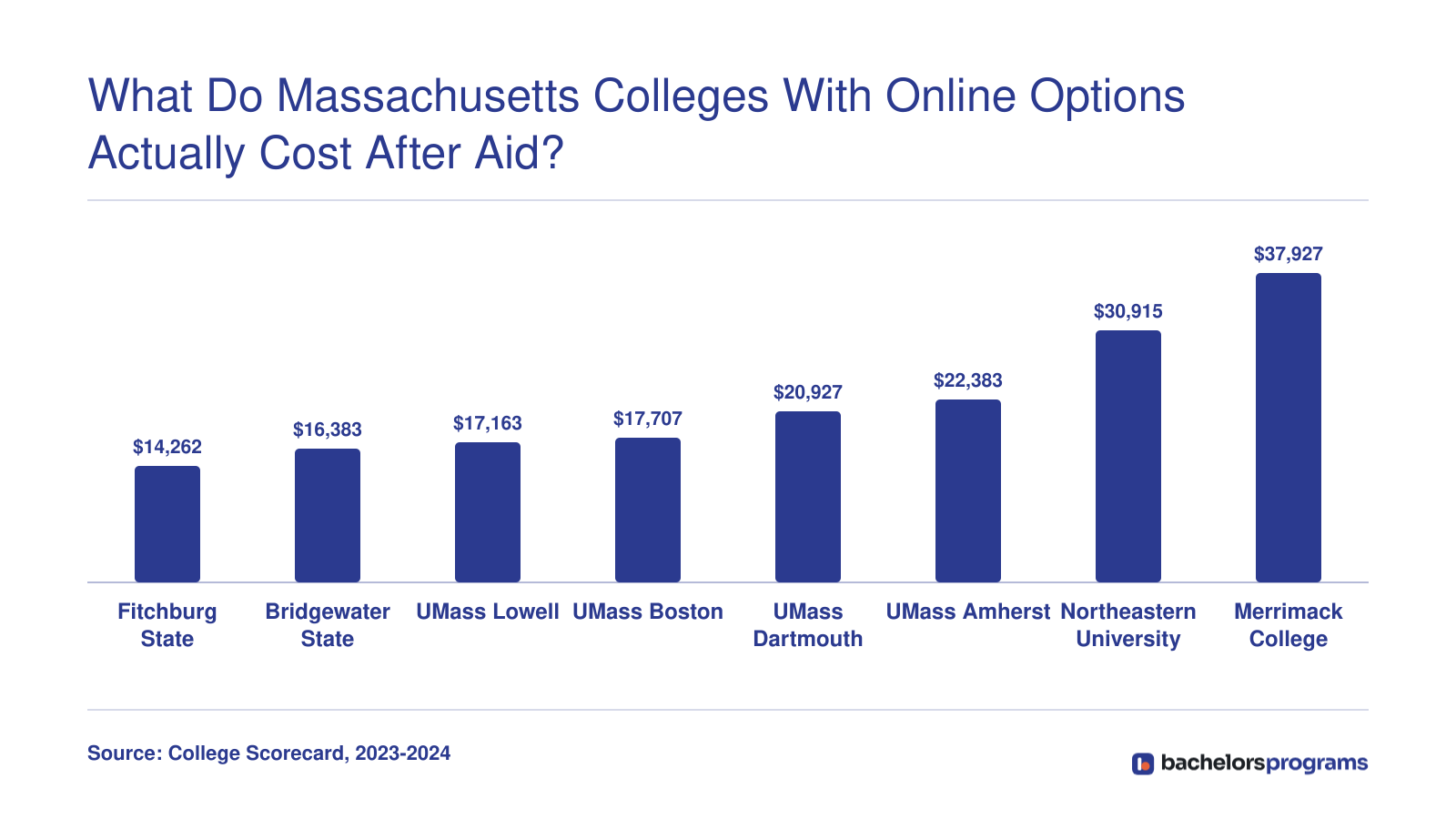
What Do Massachusetts Colleges With Online Options Actually Cost After Aid?
Average net price is what aided students paid in 2023-2024 after grants and scholarships were subtracted from the full cost of attendance, which covers tuition, fees, books, supplies and living costs. It is a College Scorecard average for first-time, full-time undergraduates who received federal financial aid, so adult transfer students, part-time online learners and students who receive no aid may pay noticeably different amounts. Among the schools shown, the state universities and UMass campuses came in between roughly $14,000 and $22,000 a year. Northeastern and Merrimack ran well above that range even after aid.
Financial Aid and Massachusetts State Grants for Online Students: Massgrant, Massgrant Plus, Gilbert Grant, and Pell
Can I use financial aid for an online bachelor's degree? Yes, as long as the school is accredited, eligible for federal Title IV aid, and you are enrolled in an eligible degree program. Fully online students file the same Free Application for Federal Student Aid (FAFSA) as everyone else, and the school builds your award from the result.
Federal Aid and the Pell Grant
The maximum Federal Pell Grant for 2026-27 is $7,395, covering July 1, 2026 through June 30, 2027.1 Your actual award depends on your financial need and enrollment intensity. Pell also matters for state aid, because MASSGrant requires Pell eligibility.2
Massachusetts State Grants
The Massachusetts Office of Student Financial Assistance runs three main programs. Award amounts change by year and by school, so confirm current figures with the school's aid office.
- MASSGrant: Need-based, requires Pell eligibility, and requires full-time enrollment (12 or more credits) in an eligible certificate, associate, or bachelor's program.3 You generally cannot already hold a bachelor's degree.
- MASSGrant Plus: Open to matriculated undergraduates. Families under $85,000 before taxes need at least 6 credits per term, which makes part-time study possible. Families from $85,000 to $100,000 need 12 credits.4
- Gilbert Matching Grant: Aimed at students at eligible private institutions, administered by the school, and tied to full-time enrollment of 12 or more credits.5
All three generally require U.S. citizenship or eligible noncitizen status and at least one year of Massachusetts residency as of the term start. For 2026-27, the published FAFSA deadline for MASSGrant and MASSGrant Plus is June 30, 2026.6 File as early as possible each year, since institutional aid often runs out sooner.
The Out-of-State Catch
State grants are tied to eligible Massachusetts institutions. Published guidelines address enrollment intensity and eligible programs but do not clearly say whether fully online students qualify, so ask each school's aid office directly. A Massachusetts resident enrolled online through an out-of-state school usually cannot use these grants, which can shift the real cost considerably.
Scholarships and Employer Benefits
Many schools offer institutional scholarships for transfer and adult students, sometimes applied automatically at admission. Ask what credit-based or returning-student awards exist. Also check whether your employer offers tuition assistance, and ask HR about annual caps and any required grades or work commitments before you register.
How Many Transfer Credits Can an Online Bachelor's Degree in Massachusetts Accept?
Transfer credits from a community college and credit for what you learned on the job are two different currencies, and Massachusetts colleges do not value them the same way. Most bachelor's programs will take somewhere between 60 and 90 transfer credits, but each campus sets its own ceiling and its own residency rule.
Maximums Vary by Campus and Program
UMass Amherst accepts up to 75 transfer or test credits toward a bachelor's degree and requires at least 45 semester credits in residence, so a substantial share of upper-level work is completed there. Its University Without Walls completion program goes further: up to 75 transfer credits plus up to 30 credits earned through a required prior-learning portfolio. UMass Lowell accepts up to 90 credits, a maximum it describes specifically for coursework from a four-year institution, with a C- minimum grade and regionally accredited coursework required; accepted credits may still fall short of a specific major requirement. Northeastern's bachelor's completion programs accept CLEP and cap prior learning assessment at 30 semester hours.1
MassTransfer and A2B Degree Maps
Massachusetts runs a statewide MassTransfer program to make community college to public university transfer predictable. The MassTransfer Block is a package of general education courses that transfers as a unit, and A2B degree maps show which associate degree at a community college lines up with a specific bachelor's at a state university or UMass campus. Community college graduates who finish an approved associate degree and meet the GPA condition can also qualify for a transfer tuition credit at participating public campuses. Because eligibility terms shift, confirm the current rules with the admissions office before you build a plan around them.
Credit for Prior Learning
- CLEP and DSST: UMass Amherst records CLEP as transfer credit, but you need advisor approval and the Prior Approval for Transfer Coursework form before you register.
- Military training: Massachusetts follows the VALOR Act, and UMass Amherst evaluates ACE-recommended credit documented on the Joint Services Transcript.
- Portfolios: University Without Walls requires a prior-learning portfolio; Northeastern's assessment can draw on approved certificates and training as well as portfolio review.1
- Certifications: usually reviewed case by case as part of prior learning assessment.
Ask Before You Apply
Get an unofficial transcript evaluation before you apply, and ask about each credit: does it count toward major requirements, or only toward electives and the total needed to graduate? That answer changes your timeline more than the headline maximum does.
Public vs Private vs Community College Pathways: Which Route Fits You
No single route is best for every goal, so compare the programs themselves rather than relying on school type. Employer research from Ithaka S+R found a small gap in selection odds between in-person (51.3%) and online (48.7%) bachelor's profiles. It found no statistically significant gap in fields where online study is common. Use the checklist below to test each route against your own target occupation.
| Decision step | Public university route | Private nonprofit route | Community college start (MassTransfer) |
|---|---|---|---|
| 1. Name your target occupation and pay benchmark | Check BLS outlook and wage ranges for the role, then compare them with the public programs that lead to it. | Use the same BLS benchmarks, then check whether private program graduates are likely to land in that wage range. | Confirm the occupation actually requires a bachelor's degree, since some roles need only an associate degree. |
| 2. Confirm required degrees or licenses | Ask whether the program meets the license or credential requirement for your role. | Ask the same question and request the program-specific disclosure in writing. | Verify that your associate coursework counts toward the bachelor's major you plan to finish. |
| 3. Compare completion data | Look up graduation and retention rates in College Navigator, which uses IPEDS 2024-25 data. | Pull the same IPEDS measures and compare them with the school's own published rates. | Review transfer rates on the school website along with IPEDS completion figures. |
| 4. Compare earnings and debt | Use College Scorecard institution-level earnings, debt and repayment measures. | Use the same Scorecard measures, and weigh debt against the earnings shown. | Check Scorecard for both the community college and your intended transfer destination. |
| 5. Compare total cost and time to finish | Compare net price, not sticker price, and ask how many credits you will need after transfer. | Compare net price after institutional aid, and ask for a written credit evaluation. | Add the lower-cost first years to the bachelor's years, and ask how many credits transfer. |
| 6. Test employer perception | Search job postings for required credentials and school names. | Review employer partnership lists and professional association career pages. | Note that 73% of employers surveyed said online learning demands the same or more discipline as classroom study. |
| 7. Ask career services for exact data | Request program-level job placement and internship data. | Ask about recruiting relationships and local employer ties. | Ask which local employers hire transfer graduates and what degree they require. |
Admissions Requirements and Realistic Time to Completion
A bachelor's degree takes 120 credits at most Massachusetts colleges, and that number drives every timeline below.
Typical Admission Standards
First-year applicants to online programs usually need a high school diploma or equivalent and transcripts. Many schools are test-optional, so SAT or ACT scores are often not required. Degree-completion programs look at your college record instead. Expect a minimum transfer GPA (often around 2.0 to 2.5, though it varies by school) and a minimum number of prior credits, commonly 30 to 60. Confirm each school's cutoff directly, since requirements differ by program.
Term Structures and Start Dates
Traditional semesters run about 15 weeks, with fall and spring starts. Many online programs instead use accelerated terms of 7 or 8 weeks, which allow five or six start dates a year. Accelerated terms do not shrink the credit requirement. They compress the work into fewer weeks per course, so you carry a lighter load at a time but complete more terms each year.
Realistic Timelines
The math is credits per term multiplied by terms per year:
- Full-time from zero credits: 15 credits × 2 semesters = 30 credits a year, so 120 credits takes about 4 years.
- Full-time with 60 transfer credits: 60 credits remain, which is about 2 years at the same pace.
- Part-time working adults: 6 credits × 5 accelerated terms = 30 credits a year is possible, but many students take 6 to 9 credits across two or three terms. That stretches 120 credits to roughly 3 to 5 years, depending on how many credits you bring in.
Where Licensure Tracks Slow You Down
Programs leading to a license, such as teaching, add practicums and student-teaching placements that follow a set sequence and often need daytime availability. Part-time students can lose a term or more waiting for the next opening, so map those requirements before you enroll.
Massachusetts Teacher Licensure and Online Bachelor's Degrees
Graduation Rates, Earnings, and Accreditation: Judging Program Quality
Accreditation and federal outcome data are the two checks that separate a legitimate online bachelor's program from a costly detour. Do both before you apply anywhere.
Start with the College Scorecard
The U.S. Department of Education's College Scorecard at collegescorecard.ed.gov publishes institution-level figures for graduation rates, full-time retention rates, and median earnings 10 years after entry. Use it to compare the Massachusetts schools on your shortlist, including UMass Amherst, UMass Lowell, UMass Boston, UMass Dartmouth, Fitchburg State, Bridgewater State, Northeastern University, and Merrimack College.
Read each metric carefully. Retention tracks the share of first-time, full-time students returning the following fall. The published completion rate covers first-time, full-time students at four-year institutions and measures completion at 100% of expected time.1 Earnings reflect students who are working and not enrolled 10 years after entry.2 Data years vary by metric and are labeled on each program page, so confirm the reporting year before you compare two schools.3
Cross-check earnings against the field
A single institutional earnings figure blends every major, so pair it with BLS.gov. The Occupational Outlook Handbook gives national outlook and entry-level education requirements, and OEWS wage data shows pay by occupation and geographic area, which matters in a state where Boston-area wages run well above the statewide average. Professional association salary surveys add a third view. Match credential level and region to the job you actually want.
Confirm accreditation at both levels
The New England Commission of Higher Education (NECHE) is the regional institutional accreditor for Massachusetts colleges and universities, recognized by the U.S. Department of Education.4 UMass Amherst and UMass Lowell are NECHE-accredited, and UMass Lowell was fully reaccredited after its 2023 comprehensive evaluation. Verify status for any other school on its own site.
Institutional accreditation is the floor, not the ceiling. When licensure or certification matters, teaching, nursing, social work, or counseling, confirm program-level accreditation with the relevant professional association. Finish by checking each school's institutional research, consumer information, and program pages for the most current rates and outcomes.
What a Bachelor's Degree Is Worth in Massachusetts
Statewide Massachusetts estimates are not reported in the data reviewed for this guide, so the national figure below serves as a benchmark. Massachusetts earnings may differ.
Checklist for Choosing an Online Bachelor's Program in Massachusetts
Use this list to compare every school on your shortlist the same way before you apply.
- AccreditationConfirm institutional accreditation from NECHE or another recognized accreditor. If your field requires it, also confirm programmatic accreditation.
- Real formatAsk whether the program requires campus visits, proctored exams, live synchronous sessions, or in-person placements, and how often.
- Total cost to finishMultiply the per-credit rate by the credits you still need, then add fees. Compare that figure across schools, not the sticker price.
- State grant eligibilityCheck that the school participates in MASSGrant or the Gilbert Grant. File the FAFSA by the state's priority deadline.
- Transfer evaluation in writingGet the maximum transfer credits, the residency requirement, and how MassTransfer or prior-learning credit applies to you.
- Licensure disclosureFor teaching or nursing, confirm in writing that the program meets Massachusetts licensure requirements.
- OutcomesLook up each school's graduation rate and graduate earnings on College Scorecard.
- Next stepRequest a transcript evaluation and a net price estimate from two or three shortlisted schools, then compare them side by side.
Colleges in Massachusetts with the most bachelor's programs
| School | City | Type | Bachelor's programs | Online | Net price / yr | Grad rate |
|---|---|---|---|---|---|---|
| University of Massachusetts-Amherst | Amherst | Public | 90 | 13 | $22,383 | 83% |
| University of Massachusetts-Lowell | Lowell | Public | 89 | 15 | $17,163 | 65% |
| Northeastern University | Boston | Private nonprofit | 84 | 5 | $30,915 | 91% |
| University of Massachusetts-Dartmouth | North Dartmouth | Public | 83 | 22 | $20,927 | 52% |
| Northeastern University | Boston | Private nonprofit | 74 | 5 | — | — |
| Salem State University | Salem | Public | 72 | 5 | $15,996 | 50% |
| Merrimack College | North Andover | Private nonprofit | 70 | 5 | $37,927 | 70% |
| Westfield State University | Westfield | Public | 68 | 10 | $16,721 | 54% |
| Fitchburg State University | Fitchburg | Public | 66 | 8 | $14,262 | 55% |
| Bridgewater State University | Bridgewater | Public | 66 | 15 | $16,383 | 53% |
| University of Massachusetts-Boston | Boston | Public | 63 | 5 | $17,707 | 49% |
| Stonehill College | Easton | Private nonprofit | 62 | 0 | $33,016 | 76% |
| Boston College | Chestnut Hill | Private nonprofit | 59 | 3 | $41,704 | 91% |
| Framingham State University | Framingham | Public | 57 | 11 | $16,114 | 48% |
| Worcester State University | Worcester | Public | 57 | 3 | $13,381 | 62% |
Program counts are the verified bachelor's listings in our directory; net price is the school-wide average a first-time undergraduate paid after aid, and graduation rate the share finishing within six years (College Scorecard).
Compare programs nationwide
Many Massachusetts residents study online. Every ranked list above has an online lens, or browse every field.
Online bachelor's degrees Browse all fields