Online Colleges and Bachelor's Degree Programs in New York
Every verified bachelor's program at a college in New York: 4,800+ programs at 130+ colleges, with the online options, net price and graduation rates behind each one.

An online bachelor's degree in New York is a 120-credit program taught fully or mostly online by a SUNY campus, a CUNY college, or a private institution. The sector shapes the bill more than the format does: at CUNY's $305 per in-state credit, tuition alone runs about $36,600 before aid.
The college and field lists show where programs exist. They do not show net price, TAP eligibility, or how many prior credits a college will accept.
Those details set the real cost. TAP awards run $1,000 to $5,665 for 2026-27, yet accepted transfer credit remains the biggest single lever on both price and time to degree.
Key Points
- CUNY in-state tuition runs $305 per credit, about $36,600 for 120 credits.
- TAP awards run $1,000 to $5,665 in 2026-27, online students included.
- SUNY Empire State University's transfer credit limits rank among New York's most generous.
Popular degrees in New York
Bachelor's degrees in New York by field
Business & Management
- Marketing121 programs
- Business Administration115 programs
- Management89 programs
- Accounting87 programs
- Economics74 programs
- Finance69 programs
- Communication57 programs
- Digital Media or Digital Marketing46 programs
Science & Engineering
- Biology99 programs
- Mathematics86 programs
- Chemistry77 programs
- Biochemistry69 programs
- Physics57 programs
- Environmental Science51 programs
- Anthropology47 programs
- Electrical Engineering or Electronics Engineering or Electronic Systems Engineering Technology40 programs
Liberal Arts & Humanities
- English82 programs
- Literature or English Literature79 programs
- History77 programs
- Philosophy69 programs
- Spanish66 programs
- Gender & Sexuality Studies34 programs
- African and African American Studies32 programs
- Interdisciplinary Studies27 programs
Arts & Design
- Art or Art Studies96 programs
- Fine Arts or Studio Art79 programs
- Media Arts or Digital Media54 programs
- Graphic Design49 programs
- Art History49 programs
- Audio & Music32 programs
- Creative Writing26 programs
- Game Programming & Development21 programs
Education & Teaching
- Science84 programs
- Secondary Education63 programs
- Elementary Education54 programs
- English Education45 programs
- Mathematics Education45 programs
- Special Education38 programs
- History Education32 programs
- Early Childhood Education or Child Development25 programs
Computers & IT
- Computer Science118 programs
- Cybersecurity36 programs
- Information Technology35 programs
- Innovation or Technological Entrepreneurship31 programs
- Computer Information Systems29 programs
- Artificial Intelligence28 programs
- Computer Engineering24 programs
- Software Development & Engineering18 programs
Social Work & Social Sciences
- Sociology107 programs
- Political Science, Government71 programs
- Social Work35 programs
- Human Services24 programs
- Public Policy13 programs
- Disability Studies3 programs
Communications & Media
- Communications81 programs
- Journalism56 programs
- Public Relations27 programs
- Speech Pathology24 programs
- Communication Disorders21 programs
- Strategic Communications7 programs
- Professional Writing6 programs
- Social Media4 programs
Healthcare
- Public Health43 programs
- Health Sciences35 programs
- Exercise & Sports Science34 programs
- Speech Pathology24 programs
- Nutrition14 programs
- Community Health14 programs
- Health Education13 programs
- Respiratory Care Therapy2 programs
Nursing
- Bachelor of Science in Nursing81 programs
- Nursing (RN to BSN)51 programs
- Accelerated BSN (ABSN)31 programs
- LPN/LVN to BSN7 programs
Criminal Justice & Law
- Criminal Justice45 programs
- Criminology18 programs
- Forensic Science16 programs
- Criminal Justice Administration15 programs
- Legal Studies12 programs
- Legal Services10 programs
- Homeland Security7 programs
- Corrections6 programs
Psychology
- General Psychology81 programs
- Applied Psychology12 programs
- Industrial Organizational Psychology4 programs
- Forensic Psychology2 programs
- Applied Behavior Analysis2 programs
- Developmental Psychology2 programs
Natural & Applied Sciences
- Neuroscience12 programs
- GIS and Geoscience11 programs
- Oceanography or Ocean or Marine Biology8 programs
- Agriculture or Agricultural7 programs
Religion & Theology
- Christian Studies or Religious Studies30 programs
- Christian Ministry or Ministry Leadership4 programs
Counseling
- Substance Abuse Counseling1 program
How Online Bachelor's Degrees Work in New York: SUNY, CUNY, and Private Colleges
A bachelor's degree finished entirely from a laptop in Buffalo and one that blends online courses with Saturday labs on a Long Island campus can carry the same credential, but they ask very different things of your week. Settle two things first: which sector you are shopping in, and which format you are actually signing up for.
The Four Sectors
New York's online bachelor's degrees come from four kinds of institutions. The SUNY system runs SUNY Online as a shared portal across its campuses, with SUNY Empire State University serving as the adult-focused campus built around distance learning. CUNY gathers its offerings through CUNY Online and the CUNY School of Professional Studies, which leans toward adults returning with credits in hand. Private nonprofit colleges, many with online divisions that predate the pandemic, make up the third group. A small for-profit sector rounds out the field, and it warrants the closest scrutiny of accreditation and cost.
Fully Online, Hybrid, and Low-Residency
"Online" is a spectrum. A fully online program holds classes and coursework remotely, though exams may still be proctored. Hybrid programs mix remote instruction with scheduled campus time. Low-residency formats concentrate the in-person requirement into short, intense visits each term. Lab sciences, nursing clinicals, and teaching practicums usually need real hours somewhere in New York, so confirm the format program by program rather than trusting the marketing label.
Who These Programs Are Built For
Most online bachelor's options in the state are degree-completion programs: you arrive with an associate degree or a pile of credits and finish the final two years remotely. Programs that take a student from zero credits to a bachelor's online are less common, particularly in the public systems, so first-time students should ask directly how many credits they can earn remotely.
The sector differences matter most on cost and on transfer credit, so weigh those two before anything else.
What an Online Bachelor's Degree Costs in New York: Tuition per Credit by Sector
The rates below come from CUNY college tuition pages as posted in 2026. Tuition is reset every year, so confirm current figures with each college before you enroll. At $305 per credit in-state, a full 120-credit degree comes to about $36,600 in tuition and a 60-credit transfer finish to about $18,300. Most CUNY fully online programs charge out-of-state students $350 per credit (about $42,000 for 120 credits or $21,000 for 60) instead of the $620 nonresident rate City College lists. Online students still pay a technology fee each term, and several colleges add a $75 online infrastructure fee, so budget for fees on top of tuition.
| College | Sector | In-State Tuition per Credit | Out-of-State Tuition per Credit | Online/Tech Fees | Est. Tuition for 60 Credits |
|---|---|---|---|---|---|
| CUNY School of Professional Studies (CUNY SPS) | Public university | $305 | $350 | Technology fee $62.50 part-time or $125 full-time; online infrastructure fee $75 per term | $18,300 in-state; $21,000 out-of-state |
| CUNY York College | Public university | $305 (online degree programs) | $350 (online degree programs) | Technology fee $62.50 part-time or $125 full-time; online infrastructure fee $75 per term | $18,300 in-state; $21,000 out-of-state |
| CUNY Baruch College | Public university | $305 (fully online degree programs) | $350 (fully online degree programs) | Technology fee $62.50 per semester (fully online programs) | $18,300 in-state; $21,000 out-of-state |
| CUNY John Jay College of Criminal Justice | Public university | $305 (part-time fully online) | $350 (part-time fully online) | Fully online student fees $152.50 part-time or $215 full-time per term, including technology fee of $62.50 or $125 | $18,300 in-state; $21,000 out-of-state |
| CUNY School of Labor and Urban Studies | Public university | $305 (online degree programs) | $350 (online degree programs) | Technology fee $62.50 part-time or $125 full-time per semester | $18,300 in-state; $21,000 out-of-state |
| CUNY City College | Public university | $305 (part-time undergraduate) | $620 | Technology fee $62.50 part-time or $125 full-time; consolidated fee $15 per term | $18,300 in-state; $37,200 out-of-state |
| CUNY Online Degree Programs (systemwide) | Public university system | $305 | $350 (online degree programs) | Technology fee $62.50 part-time or $125 full-time; online infrastructure fee $75 per term where applicable | $18,300 in-state; $21,000 out-of-state |
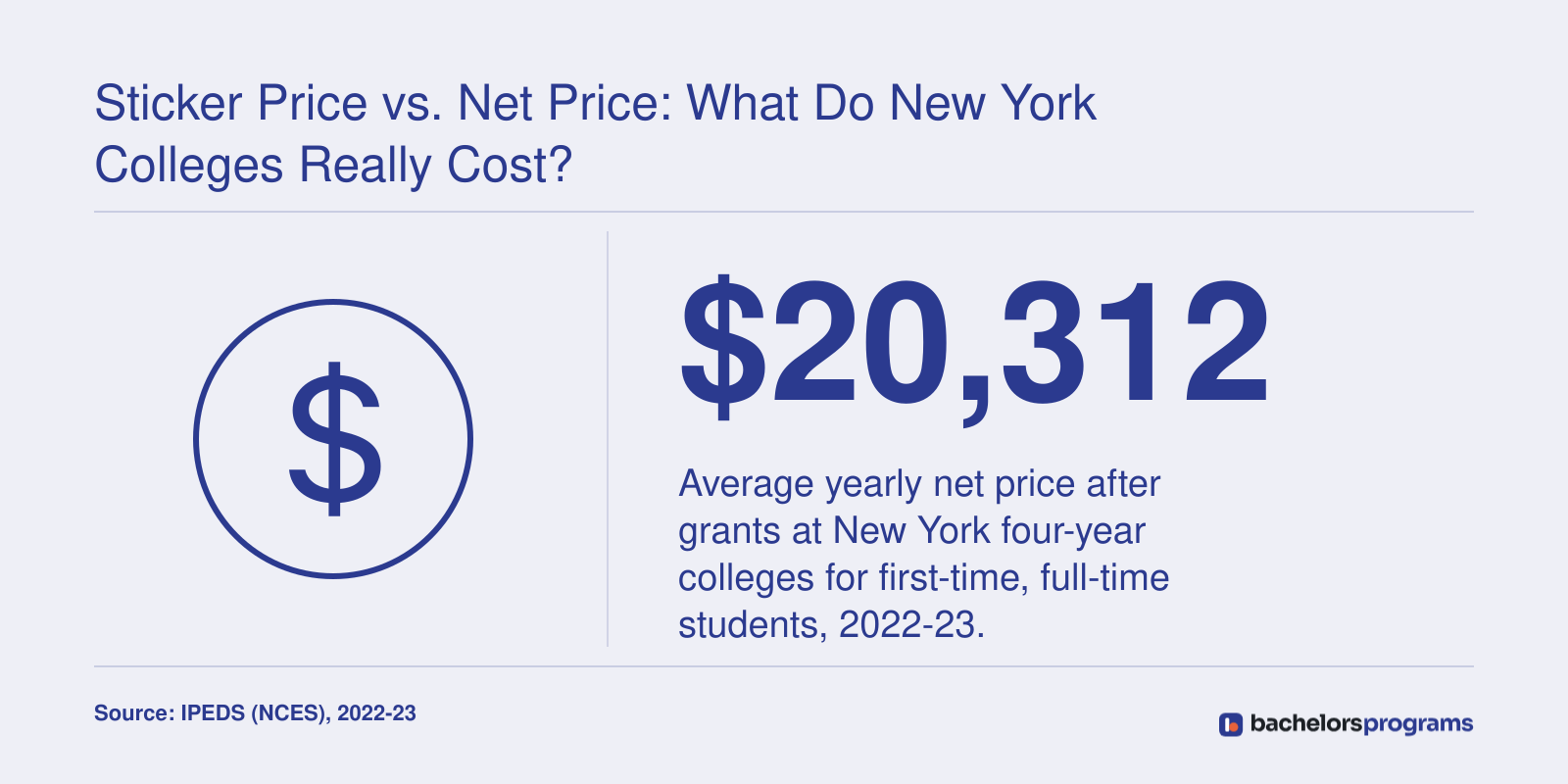
Sticker Price vs. Net Price: What Do New York Colleges Really Cost?
Net price is the cost of attendance after federal, state, local and institutional grants and scholarships, and it is the number that matters when you compare colleges. In 2022-23, New York public four-year colleges listed an average published cost of $8,230 for in-state students and $18,001 for out-of-state students, while the average net price at the state's private nonprofit four-year colleges was $30,454 a year. Private colleges often award their own aid, so a high sticker price can come down more than you might expect. Run each school's net price calculator with your family's income before ruling it out.
Can Online Students Get TAP, Excelsior, or Other New York Grants?
New York's Tuition Assistance Program pays undergraduate awards of $1,000 to $5,665 for 2026-27, and the eligibility tests the Higher Education Services Corporation (HESC) publishes are about the college, the program, and your credit load rather than the room you sit in.1
TAP: the state's main grant
To receive TAP you need to attend an approved New York college in a degree program, have at least $200 in tuition charges per year, be in good academic standing, and establish 12 continuous months of New York residency before enrolling (unless you qualify under the DREAM Act). Income caps are $125,000 for dependent students and for independent students who are married or have dependents, $60,000 for independent married students with no dependents, and $30,000 for independent single students with no dependents.1 Full-time TAP requires 12 applicable credits per semester; students carrying 6 to 11 applicable credits may get a prorated full-time award.1
On the online question, HESC's rules turn on whether the college is approved in New York and the program is registered with the State Education Department, plus your credit load. HESC does not publish a separate online-only rule, so confirm your program's status with the financial aid office before you count on the money.
Part-time aid for working adults
Part-Time TAP exists for students carrying lighter loads, and a separate non-degree part-time program covers 1 to 11 credits per semester at SUNY and CUNY2, with the award scaled to the full-time amount, your tuition, and your credits. HESC's 2026-27 materials do not spell out every part-time threshold, so ask which version fits your enrollment.
Excelsior: last-dollar tuition
Excelsior covers what Pell, TAP, and other grants leave unpaid toward SUNY or CUNY undergraduate tuition, capped at the resident SUNY rate.3 Household federal adjusted gross income must be $125,000 or less. You need 12 credits per term and 30 credits per academic year (24 for Opportunity Program students), must file a TAP application even without a TAP award5, and must apply by August 31, 2026 as a new applicant.4 Recipients generally commit to living and working in New York after graduation for as many years as they received the award. Because the program requires full-time study at a SUNY or CUNY campus, a fully online degree qualifies only if it is one of those degrees taken at that load.
Federal, veteran, and employer aid
- Pell Grants: file the FAFSA; this is the base layer most adult learners leave on the table.
- Veterans: the GI Bill pairs with NYS Veterans Tuition Awards at SUNY, CUNY, private colleges, and vocational schools, open to veterans with 12 months of residency and at least four years of active duty or qualifying combat service, at 12 credits full time or 3 to 11 part time.5
- Employer tuition assistance: many New York employers reimburse part of each term, and it rarely reduces your state award.
Which New York Online Colleges Accept the Most Transfer Credits?
SUNY Empire State University is the clearest answer among New York's online options. It is built around adult and transfer students, and its published limits are among the most generous in the state. Public-system frameworks matter too, but they work differently.
How SUNY and CUNY Frameworks Work
SUNY's systemwide transfer policy is meant to help associate degree credits count toward a bachelor's at another SUNY campus rather than being rejected course by course. Which associate degrees and receiving programs it covers varies, so confirm that your specific pairing qualifies before assuming junior standing.
CUNY Pathways is a general-education framework. Core credits earned at one CUNY college can generally transfer to another. The receiving college, degree, and major still shape how those credits are applied, and no single universal cap or residency minimum applies everywhere.
Caps and Residency at SUNY Empire
Empire requires 120 credits for a bachelor's degree and accepts up to 93 transfer credits, according to its 2026 transfer materials. Students generally complete at least 30 credits in residency. A 2026 agreement with Kingsborough Community College (CUNY) allows up to 79 lower-division credits, including A.A. and A.S. credits, toward specified online bachelor's pathways. That agreement requires 30 residency credits for a 120-credit degree and 31 for a 124-credit degree, plus at least 45 upper-division credits, 24 of them in the concentration.
Ask every school you consider for both numbers: the most it will accept and the least you must earn there.
Prior Learning, Exams, and Military Training
Empire's prior learning assessment covers workplace training, certificates, licenses, military training, exams, and expert evaluation. The rules are strict:
- College-level learning only: Credit is for what you learned, not time on the job.
- No duplication: You cannot earn credit twice for the same material.
- Faculty review: Each request is approved case by case, at a C-equivalent level or better, with no grade or GPA attached.
- Limited portability: The credit may not transfer to another college, and it does not count toward residency.
Empire publishes no single universal prior learning cap. Individualized degree programs allow up to 16 outstanding prior learning credits, with no more than 8 from expert-determined evaluations, and other programs set their own rules. Credit-by-exam options such as CLEP and DSST, and military credit, vary by school and program, so get the figure in writing before you count on it.
Before You Apply
Ask each school on your list for an unofficial transcript evaluation. Then ask how the credits apply, not just whether they are accepted. Credits that land as general electives do little for you if your major requires specific courses. A school that accepts 90 credits but applies half as free electives may leave you with more remaining coursework than one that accepts fewer credits toward your actual requirements.
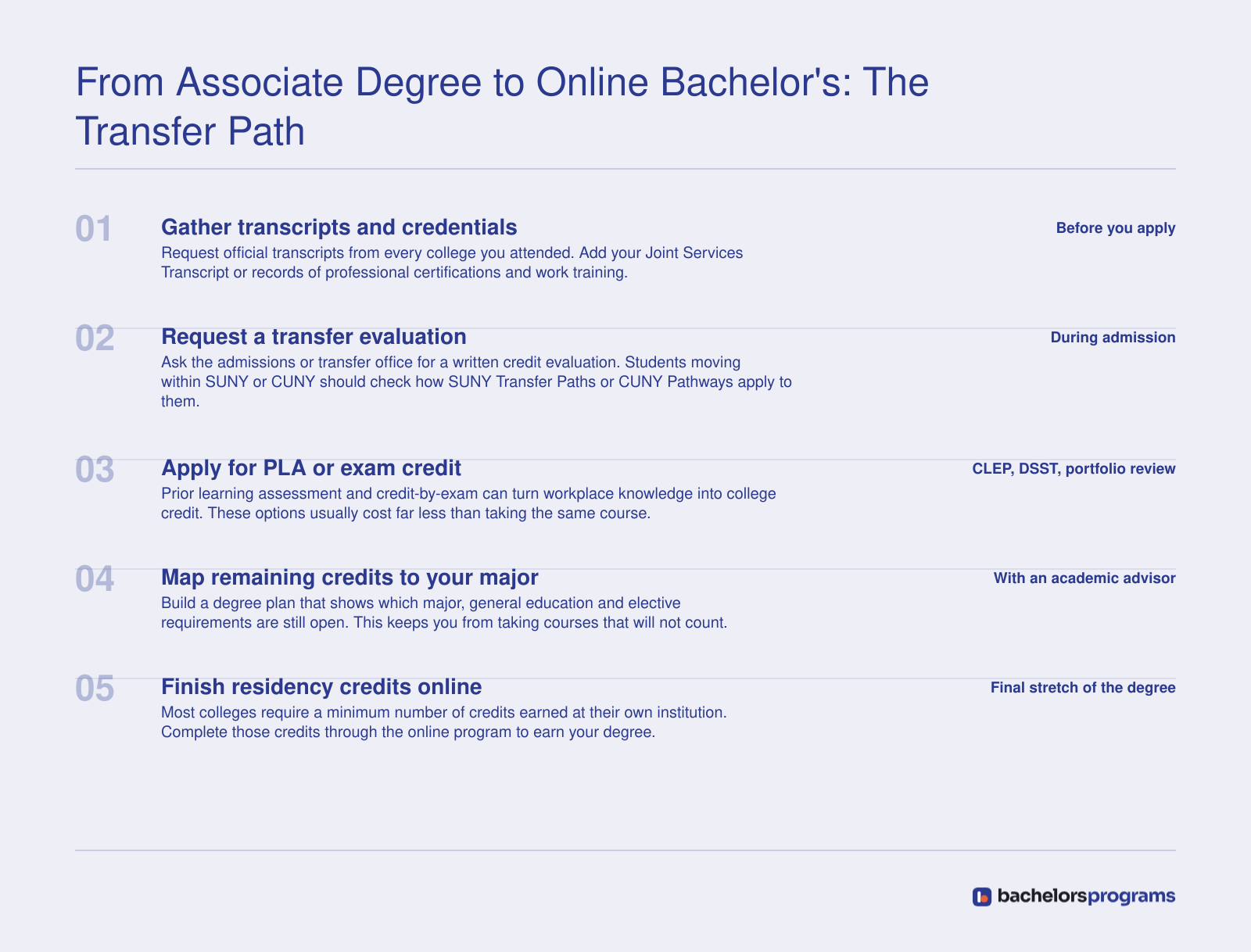
From Associate Degree to Online Bachelor's: The Transfer Path
Applying credits you have already earned is the biggest single way to cut both the cost and the time of an online bachelor's degree in New York. Every course a college accepts is one you do not pay for again. Follow these steps in order so nothing you have earned gets left on the table.
Are Online Bachelor's Degrees From New York Colleges Accredited?
Does an online bachelor's degree from a New York college carry the same accreditation as the campus version?
Yes, when the college itself is legitimate. Accreditation in New York attaches to the institution, and the online degree is the same credential the campus awards. The state's main institutional accreditor is the Middle States Commission on Higher Education, and distance education sits within its scope: a college approved at the bachelor's level can deliver those degrees online.1 The City College of New York, for example, is accredited at the bachelor's level with distance education approved.1 Your diploma and transcript are not marked "online."
New York's Extra Layer
Every degree program offered in the state must also be registered with the New York State Education Department, which publishes the Inventory of Registered Programs.2 Entries list the institution, the exact degree title, the award level, and the delivery format. Match those details precisely, because a college may hold registration for a campus version and a separate entry for the online completion route.
When Programmatic Accreditation Matters
Specialized accreditors review a discipline rather than a whole college, and they matter most where a license or an employer expects them:
- Nursing: CCNE or ACEN, both of which recognize baccalaureate programs delivered at a distance. Nursing programs also need state nursing education approval, so confirm clinical placements and New York licensure eligibility before you enroll.2
- Business: AACSB, ACBSP, or IACBE.
- Education: CAEP, plus state approval if the program leads to teacher certification.
How to Verify in Three Steps
- Institutional check: Confirm the college in the U.S. Department of Education's DAPIP database or in the Middle States directory, and verify that bachelor's level and distance education are both in scope.
- State check: Find the exact program in the state's Inventory of Registered Programs.
- Discipline check: Look up the program in the programmatic accreditor's own directory.
All three should line up before you submit an application.
Admissions, Online Formats, and On-Campus Requirements
The tradeoff in online admissions is not whether you can get in, it is whether the format fits your week. A program that admits you easily but schedules live class at 2 p.m. on a Tuesday is a worse deal for a working adult than one with a few more hoops and a fully flexible calendar.
Getting In: What Most Programs Ask For
Typical admission requirements for a fully online bachelor's program are modest: a high school diploma or GED, and for transfer applicants a minimum college GPA that generally falls between 2.0 and 2.5. Many New York institutions are test-optional for applicants past a certain age or credit count, and rolling admission with several start dates per year is common, though exact deadlines vary by campus and program. CUNY SPS, for example, lists a December 1, 2026 application deadline for its Spring 2027 nursing cohort, which shows how far ahead some programs close.
Asynchronous vs. Synchronous, and Term Length
- Asynchronous: you complete the coursework on your own timetable, meeting weekly deadlines. CUNY SPS describes its classes as available to take at any time. Best for shift workers and parents.
- Synchronous: live sessions at set times, usually evenings. Better for discussion-heavy majors and students who need accountability.
- Accelerated terms: 7- or 8-week sessions let you finish one course at a time and stay enrolled year round. Fifteen-week semesters suit students carrying a full load or using veterans or state aid with enrollment minimums.
The In-Person Pieces People Forget
Not every requirement can be met from a laptop. Proctored exams may be handled by remote monitoring or at a testing center, and the policy is usually set course by course rather than by the institution. Health majors face the biggest commitment: an RN-to-BSN track is built for licensed nurses, while a pre-licensure BSN, such as the hybrid program at Pacific College of Health and Science, delivers didactic work online but requires in-person clinical rotations.1 Education majors should expect field observation and student teaching placements, and science courses may require lab time or a short residency. Confirm these before you apply, not after.
How Long It Takes
Full-time students entering with no credit typically need four years. Part-time learners at one or two courses per term should plan on five to six. Transfer students arriving with an associate degree can often finish in two to two and a half years, depending on how many credits the program accepts and whether clinical or placement hours add time.
Early-Career Earnings for New York Bachelor's Graduates
New York bachelor's programs that report to College Scorecard show a statewide median of $94,582 four years after completion. One year after completion, that median is $79,259.
Graduation Rates, Outcomes, and Choosing the Right Online Program
A six-year graduation rate and an Outcome Measures completion rate can describe the same college and still leave you with two very different impressions. Knowing which number you are reading is the difference between a fair comparison and a misleading one.
Reading the Numbers Without Being Misled
Standard federal Graduation Rates track full-time, first-time students and report completion at 100, 150, and 200 percent of normal time, with 150 percent working out to six years at a four-year school. Students who transfer out, remain enrolled, or stop out are counted separately rather than as completions. That design understates adult-focused institutions, where most students arrive with credits and enroll part-time. IPEDS Outcome Measures casts a wider net, covering all entering degree-seeking undergraduates including transfer-ins and part-timers, and reports awards at four, six, and eight years broken out by Pell status and enrollment intensity. SUNY Empire State College, the state's most transfer-oriented public option, is best judged on that broader framework.
For the 2018 starting cohort, six-year rates ran 75 percent at New York private nonprofit four-year colleges, 64 percent across SUNY, and 52 percent at CUNY, against 65 percent nationally across all sectors.1 Private nonprofit first-year retention was 86 percent for fall 2023 entrants who returned in fall 2024.1 CUNY publishes retention, graduation, and transfer-out figures by college and term on its public dashboards, which is the cleanest way to compare its campuses against each other.
Matching the Program to Your Situation
- Working adults with existing credits: weigh transfer credit acceptance first, then accelerated terms and asynchronous sections that survive a full-time job. Ask how many credits residency rules force you to take at the school itself.
- First-time students: prioritize advising quality, retention rates, and tutoring or career support, since these predict whether you stay enrolled past year one.
The Three Must-Checks
No format decision matters if these fail. Confirm the net price you will actually pay after aid rather than the sticker tuition. Confirm aid eligibility, including whether New York TAP reaches your enrollment intensity. Confirm regional accreditation from an agency the U.S. Department of Education recognizes, because credits and licensure depend on it.
Questions to Ask Yourself
How many of your existing credits will count toward your major rather than electives?
Does the program require clinicals, student teaching, or proctored exams you would need to schedule around work?
Can you carry the full-time load that TAP and Excelsior require, or does part-time study and aid fit your life better?
Colleges in New York with the most bachelor's programs
| School | City | Type | Bachelor's programs | Online | Net price / yr | Grad rate |
|---|---|---|---|---|---|---|
| Syracuse University | Syracuse | Private nonprofit | 91 | 8 | $38,793 | 84% |
| New York University | New York | Private nonprofit | 84 | 2 | $37,050 | 88% |
| University at Buffalo | Buffalo | Public | 84 | 3 | $20,995 | 75% |
| Hofstra University | Hempstead | Private nonprofit | 82 | 0 | $34,176 | 69% |
| Pace University | New York | Private nonprofit | 81 | 6 | $30,892 | 60% |
| University at Albany | Albany | Public | 75 | 15 | $17,167 | 62% |
| Adelphi University | Garden City | Private nonprofit | 73 | 1 | $30,783 | 67% |
| Rochester Institute of Technology | Rochester | Private nonprofit | 73 | 0 | $34,906 | 70% |
| State University of New York at New Paltz | New Paltz | Public | 72 | 1 | $18,809 | 72% |
| CUNY Lehman College | Bronx | Public | 69 | 14 | $3,148 | 51% |
| SUNY Brockport | Brockport | Public | 69 | 7 | $16,353 | 55% |
| Stony Brook University | Stony Brook | Public | 68 | 2 | $18,784 | 76% |
| State University of New York at Cortland | Cortland | Public | 67 | 0 | $22,345 | 68% |
| Siena University | Loudonville | Private nonprofit | 64 | 1 | $33,733 | 75% |
| Mercy University | Dobbs Ferry | Private nonprofit | 64 | 22 | $14,072 | 46% |
Program counts are the verified bachelor's listings in our directory; net price is the school-wide average a first-time undergraduate paid after aid, and graduation rate the share finishing within six years (College Scorecard).
Common Questions About Online Bachelor's Degrees in New York
These answers cover the questions students ask most often before enrolling. Tuition and aid rules change, so confirm current figures with the college and program you are considering.
How long does it take to finish an online bachelor's degree in New York?
Can online students in New York get TAP or other state grants?
Can I enroll in a SUNY or CUNY online program if I live outside New York, and what tuition rate would I pay?
Does my diploma say "online" if I earn my bachelor's degree online from a New York college?
Compare programs nationwide
Many New York residents study online. Every ranked list above has an online lens, or browse every field.
Online bachelor's degrees Browse all fields