Best Accelerated BSN (ABSN) Programs
Compare 460+ accredited Accelerated BSN (ABSN) programs at 440+ colleges, with net price after aid, graduation rates, earnings and debt from IPEDS and the U.S. College Scorecard.

An accelerated BSN compresses 55 to 60 semester credits of nursing coursework into four or five consecutive semesters, with clinical rotations that can run past midnight and travel up to 100 miles from campus. The speed is the draw and the constraint: applicants clear prerequisite grades and entrance exams such as the HESI or TEAS before a clinical seat is offered, and tuition lands on top of a bachelor's degree already paid for.
Delivery ranges from fully in-person cohorts to hybrid programs that move lectures online and keep labs and clinicals in person. Seats are capped by clinical placements, and deadlines fall six to twelve months before a term starts.
Key Points
- 30 prerequisite credits cost about $4,890 in-district, up to $16,140 out-of-state.
- New York University posts the highest median first-year earnings among reporting schools.
- Direct-entry MSN graduates still take the NCLEX-RN and start as RNs.
The 10 Best Accelerated BSN Programs for 2027
Every program below is open to students who already hold a non-nursing bachelor's degree, so you are comparing second-degree pathways rather than traditional four-year tracks. Each card pairs a school with what career changers ask about first: location, delivery format, net price after aid, admission rate, and the program details that shape day-to-day life. Net prices and graduation rates describe each institution as a whole, not the ABSN cohort alone, so read them as context rather than a promise about your own cost or timeline.
University of Florida
#1Gainesville, FL · ~$7,000/yr (est.)
Best for: Florida residents seeking lower-cost second degrees
The University of Florida pairs a flagship public research university with an academic health center, and its accelerated BSN runs at two Florida campuses rather than one. The four-semester track starts each May and leans on the university's health sciences resources for labs and clinical placement. For a second-degree student weighing price against reach, the in-state cost and the size of the Gator health network are the main draws.
- Four intensive semesters with a single May start each year
- CCNE accredited, with campuses in Gainesville and Jacksonville
- Entrance exam required (HESI), though no minimum HESI score is set
- 3.0 GPA minimum and two letters of recommendation
- February 1 application deadline
- Clinical placements may require travel up to 100 miles
- Prerequisites in anatomy, physiology, microbiology, and statistics
- Financial aid and scholarships available
University of North Carolina at Chapel Hill
#2Chapel Hill, NC · ~$12,000/yr (est.)
Best for: Research-focused career changers wanting interprofessional training
Carolina's school of nursing sits inside a public research university known for health sciences, and its ABSN is a four-semester, campus-based track for people who already hold a bachelor's degree. Coursework leans on interprofessional education and undergraduate research, which suits students who want a clinical career with a scholarly foundation. As a public university it offers in-state pricing to North Carolina residents, and the surrounding Research Triangle gives students a dense hospital corridor for rotations.
- Four-semester, on-campus program starting in summer
- CCNE accredited
- Interprofessional education and undergraduate research emphasis
- Prepares students for hospital administration, public health, and nursing education roles
- Team-oriented, patient-centered curriculum
- Financial aid and scholarships available
University of Virginia
#3Charlottesville, VA · $22,000/yr (est. net price)
Best for: Students entering with two years of prerequisites
UVA's accelerated BSN is built for students who arrive with at least two years of college coursework behind them, and it awards 120 credits across two years and two summer sessions. The cohort model and the school's clinical network across central Virginia give students a tight peer group plus a wide set of rotation sites. It fits someone who has already finished the science prerequisites and wants a public university with a small-cohort feel.
- 120 credit hours completed over two years of full-time study
- At least 52 prerequisite credits required before entry
- Two summer sessions built into the schedule
- October 1 application deadline
- Cohort-based structure with clinical rotations across the region
- Interprofessional focus; prepares students for the NCLEX
- ACEN and CCNE accredited
Duke University
#4Durham, NC · ~$30,000/yr (est.)
Duke compresses nursing training into 16 months and 58 credits at a private research university with its own academic medical center. The curriculum threads professional identity, care management, and scholarship through every term, and a bridge pathway exists for Duke undergraduates moving from Trinity College into nursing. Expect small cohorts and a private university price, offset by a name that carries weight in hospital hiring.
- 16-month program totaling 58 credit hours
- 56 clinical hours per credit hour
- Graduate-level elective option available
- Trinity College Bridge pathway for Duke undergraduates
- Threads professional identity, care management, and scholarship
- CCNE accredited; prerequisite courses required
University of Central Florida
#5Orlando, FL · ~$10,000/yr (est.)
UCF is a large public university in Orlando whose nursing college admits accelerated second-degree students three times a year, which is unusual among ABSN programs. The 60-credit curriculum includes an honors thesis option and a relatively accessible 2.5 GPA threshold that widens the applicant pool. For a career changer in central Florida who wants scheduling flexibility and a broad clinical partner network, it is one of the more reachable routes on this list.
- 60 credit hours with fall, spring, and summer start terms
- 2.5 GPA minimum
- Honors undergraduate thesis option
- Equipment fee of $25 to $50 per term
- Mandatory drug screening
- No thesis or capstone required
- Prepares students for NCLEX-RN licensure
Ohio State University
#6Columbus, OH · $17,000/yr (est. net price)
Ohio State's ABSN is a five-semester hybrid track that mixes online coursework with in-person labs and clinicals at the Wexner Medical Center. The university's size supports a deep alumni network and a wide range of specialty rotations, and the 3.0 GPA minimum keeps the bar clear for applicants. It suits a working adult in Columbus who wants a well-regarded public program without relocating.
- Five consecutive semesters, 59 total credit hours
- Hybrid format: online classes plus in-person labs and clinicals
- 3.0 GPA minimum; $60 application fee
- Clinical experiences at the Wexner Medical Center
- Single summer start each year
- Prepares students for NCLEX-RN licensure
Florida International University
#7Miami, FL · ~$9,000/yr (est.)
FIU's accelerated option is a 58-credit, four-semester program taught at the Biscayne Bay Campus and ranks among the more affordable public routes into nursing in South Florida. Admission is competitive and limited-access, and the curriculum feeds directly into graduate study for students who plan to keep climbing. Miami-Dade's hospital systems give students a dense clinical market within commuting distance.
- Four semesters, 58 total credit hours
- Classes held at the Biscayne Bay Campus
- One fall start each year
- Limited-access, competitive admission
- Prepares students for the NCLEX-RN exam
- Eligible for RN licensure and graduate study
University of South Florida
#8Tampa, FL · ~$10,000/yr (est.)
USF runs its accelerated second-degree pathway at three Florida campuses, with two start dates a year and a 16-month completion timeline. The program is explicitly built as a foundation for MSN, DNP, or PhD study, so it draws students who already plan to return for a graduate credential. Multiple campuses and cohorts make it easier for Tampa Bay area residents to find a location that fits.
- 16-month completion timeline
- Two start dates per year, in summer and fall
- Offered on all three USF campuses
- Eight prerequisite courses required
- Apply through NursingCAS
- Foundation for MSN, DNP, or PhD study
- Financial aid and scholarships available
Purdue University
#9West Lafayette, IN · ~$15,000/yr (est.)
Purdue's accelerated nursing BSN is a four-semester, 59-credit program at a large Indiana public university known for its STEM focus. The curriculum emphasizes clinical leadership, quality improvement, and evidence-based practice, and the school positions the degree as a stepping stone to DNP or PhD work. West Lafayette's cost structure and the university's science and health resources set it apart from urban hospital-based ABSNs.
- Four semesters, 59 total credit hours
- Coursework in pathopharmacology, health assessment, and population health
- Specialty content in psychiatric mental health, pediatric, and public health nursing
- Emphasis on clinical leadership and quality improvement
- Prepared as a pathway to DNP or PhD study
San Diego State University
#10San Diego, CA · $15,000/yr (est. net price)
San Diego State's accelerated second bachelor's degree delivers 55 units over roughly 18 months year-round, blending online didactic classes with in-person labs and at least 900 clinical hours. The program's new Chula Vista facility ties it to South Bay healthcare partners and to a region with a persistent nursing shortage. Because it is newly launched, confirm its approval status with the school before you apply.
- 55 units over five semesters, roughly 18 months year-round
- Online didactic classes with in-person labs at the Chula Vista facility
- At least 900 clinical practicum hours
- 3.0 GPA and eight prerequisites; no TEAS required
- $1,362 per unit; $70 Cal State Apply fee
- 8-week summer courses and 16-week fall and spring semesters
- New program; confirm approval status before applying
Cost & outcomes by school
Federal data for the highest-earning Accelerated BSN (ABSN) programs, independent of the ranking above. Earnings are this field's bachelor's graduates four years after completing where the Scorecard reports them, else the school's undergraduate median.
| School | Net price / yr | Grad rate | Earnings | Debt | Grads/yr | Format |
|---|---|---|---|---|---|---|
| Samuel Merritt University CA | — | — | $143,238 | $20,825 | 1,064 | Campus |
| Massachusetts College of Pharmacy and Health Sciences MA | $39,545 | 62% | $125,557 | $25,000 | 1,676 | Campus |
| Georgetown University DC | $40,815 | 95% | $103,494 | $15,500 | 4,462 | Hybrid |
| Villanova University PA | $43,756 | 92% | $100,423 | $25,874 | 4,434 | Campus |
| Duke University NC | $29,612 | 97% | $97,800 | $13,000 | 5,506 | Campus |
| Northeastern University MA | $30,915 | 91% | $92,538 | $24,250 | 12,086 | Hybrid |
| George Washington University DC | $36,586 | 84% | $90,873 | $20,449 | 6,246 | Campus |
| University of Virginia VA | $21,565 | 96% | $86,863 | $17,500 | 10,898 | Campus |
| New York University NY | $37,050 | 88% | $82,509 | $20,500 | 16,368 | Campus |
| Binghamton University NY | $21,620 | 82% | $80,596 | $18,500 | 8,166 | Campus |
| Unitek College CA | $25,179 | 73% | $79,550 | $10,700 | 826 | Hybrid |
| University of Rochester NY | $29,278 | 85% | $79,042 | $21,000 | 4,350 | Campus |
Sources: U.S. Department of Education. Net price, graduation rate, earnings and debt: College Scorecard (earnings and debt for this field's bachelor's graduates where reported, else school-wide); graduates: IPEDS. A dash means no figure is reported.
Cost, debt & payoff
Median earnings of this field's bachelor's graduates (4 yrs after completing, else the school's undergraduate median) vs. their median federal loan debt · U.S. College Scorecard
Across these programs the median graduate earns about $58,354 and finishes with roughly $22,500 in debt — a ratio that clears a common rule of thumb (keep debt below first-year salary). Net price and debt vary widely school to school, so check the per-school figures in the table above before you shortlist.
Who Qualifies for an Accelerated BSN: Eligibility Checklist
ABSN programs are built for career changers, so admission depends on your prior degree and coursework rather than nursing experience. Requirements vary by school, so check each program's current rules.
- A completed non-nursing bachelor's degreeMost programs require a prior bachelor's degree, or its equivalent, in a field other than nursing. Michigan State requires that degree from a regionally accredited institution by the spring before entry. Ask admissions whether they offer any entry path based on prior college credit.
- Minimum GPAPublished minimums generally fall between 2.5 and 3.0, and 3.0 is the most common. St. Edward's lists 2.5, Michigan State 2.75, and Texas Tech and Duquesne 3.0. Indiana sets 2.7 cumulative and 3.0 for prerequisites. Some schools call the figure preferred, and meeting it does not guarantee a seat.
- Science and general prerequisitesExpect anatomy and physiology I and II, microbiology with labs, chemistry, statistics, nutrition, psychology, and lifespan development, usually with a C or better. Recency rules differ by school. Duquesne wants A&P within five years and other sciences within 10, and St. Edward's generally expects prerequisites within five years.
- Entrance exam and clearancesTexas Tech accepts the TEAS or HESI with a composite of 75 or higher, taken within one year in a single sitting. Indiana and St. Edward's require neither exam. Background checks and drug screens are typically required before clinical placements.
- Accreditation and state approvalConfirm the program holds CCNE or ACEN accreditation and state board of nursing approval. Kean University's program, for example, is CCNE-accredited.
- ABSN vs. RN-to-BSNRN-to-BSN programs serve nurses who already hold an RN license. If you are not yet a nurse, the ABSN is the right path.
Inside Our Scoring: What Earned a Spot on This ABSN List
The American Association of Colleges of Nursing defines an accelerated baccalaureate program as one that builds on a prior degree, and that definition sets the entry rule for this list. Every school here had to clear one bar first: it must admit students whose first degree is not in nursing. RN-to-BSN and LPN-to-BSN bridge tracks are out of scope, because they assume an existing license instead of starting a career changer from zero.
What Carried Weight
- Affordability: institution-wide net price after aid, not the sticker tuition a viewbook leads with.
- Outcomes: graduation and retention rates, the most reliable public signal that admitted students actually finish.
- Selectivity: admission rate, read as a proxy for cohort size and advising support rather than prestige.
- Format: whether the school runs online coursework, hybrid, or on-campus-only tracks that fit a working adult's week.
A program that wins on price but leaves clinical placement to a scramble loses ground to one that names its partner hospitals up front.
Where the Numbers Stop
Federal education data is reported institution-wide, or for a school's BSN programs as a whole, so it cannot isolate the accelerated cohort. Treat every published figure as a starting point. Ask each program directly for its first-time NCLEX-RN pass rate, its clinical placement process, and the prerequisite courses that must be finished before orientation. Those answers, more than a position on any list, decide whether a program fits your timeline and budget.
Accelerated BSN Program Cost: Tuition, Net Price, and Aid for Second-Degree Students
Federal aid policy handles a second bachelor's degree awkwardly, and accelerated BSN students feel the pinch more than most. Among the most affordable options in this ranking, CUNY Hunter College reports an institution-wide average net price of about $2,984 after aid; the University of Florida and California State University, Fullerton come in near $6,500. Those figures describe the whole institution, not the ABSN cohort, so treat them as a floor for comparison rather than a tuition quote.
Why Second-Degree Aid Looks Different
Most second-bachelor's students cannot receive Pell Grants, and their federal Direct Loan room is capped by aggregate limits that include whatever they borrowed for their first degree. Dependent undergraduates generally max out at $31,000 in aggregate Direct Loans, while independent students (or dependents whose parents cannot get PLUS) reach $57,500. Annual limits run about $5,500 to $7,500. Prior borrowing usually shrinks what remains, so the out-of-pocket gap can be wider than a program's published aid page suggests.
Funding Paths That Actually Help
The HRSA Nurse Corps Scholarship is the marquee option: it covers tuition, required fees, reasonable educational costs, and a monthly stipend in exchange for at least two years of full-time service at a nurse-shortage facility.1 Other aid can change how the award is calculated.2 The 2026 application window ran from March 10 to April 9 and is now closed, so plan for the next cycle.2 Hospitals and health systems also offer tuition assistance, reimbursement, and loan-repayment agreements, often with a work commitment. Ask each school about ABSN-specific scholarships, and treat private loans as the last resort after federal aid and institutional awards.
Ask for the ABSN Number
Institution-wide net price is a starting point, not the bill. Request the program's full ABSN tuition: per-credit rate or flat cohort price, plus fees, lab costs, and clinical expenses. A school with a modest average net price can still carry a premium ABSN rate.
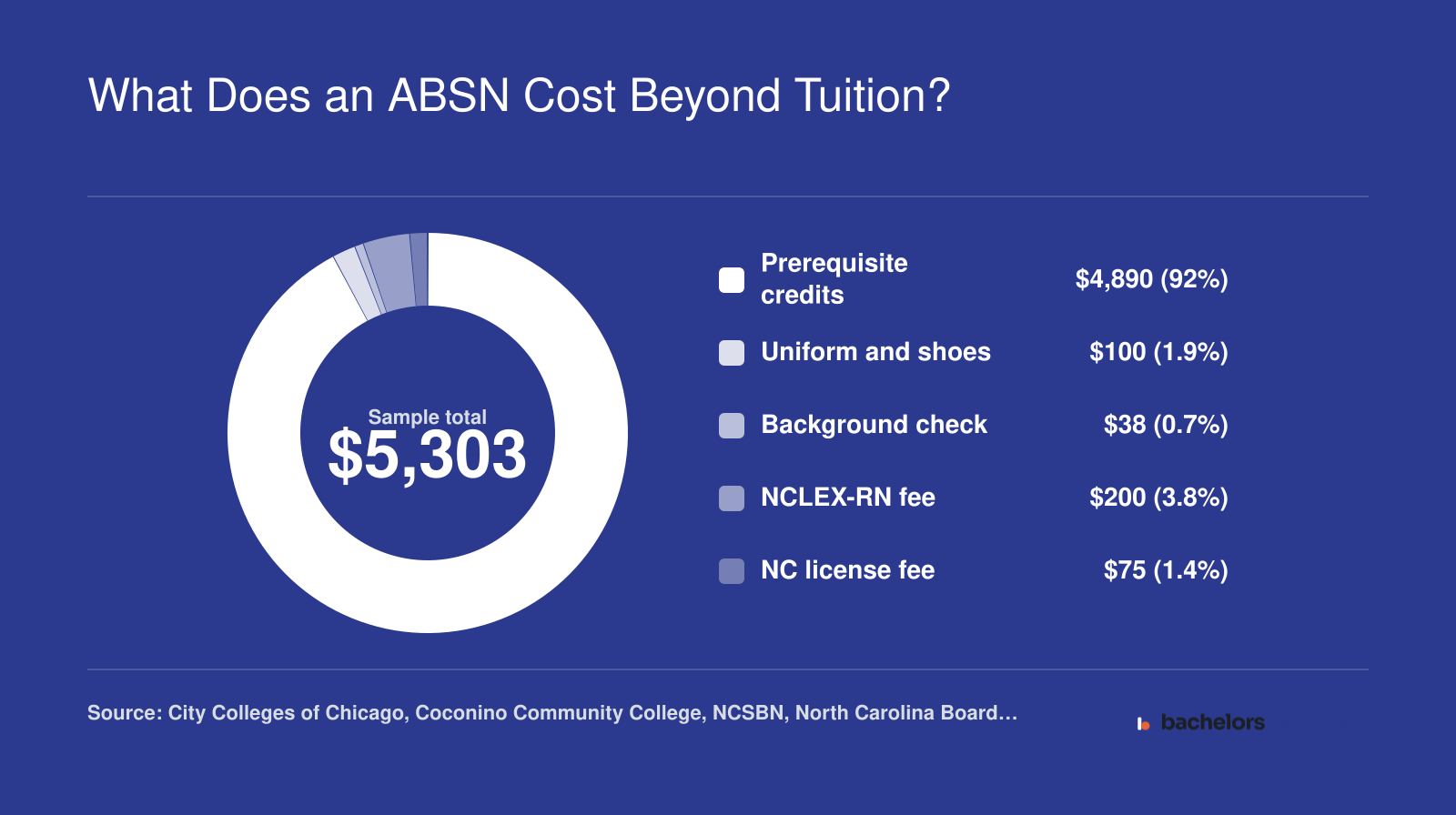
What Does an ABSN Cost Beyond Tuition?
Before day one, you may owe roughly $4,890 for 30 prerequisite credits at in-district community college rates, and up to $16,140 at out-of-state rates. After graduation, the NCLEX-RN registration fee set by NCSBN is $200 (rising to $350 for registrations submitted on or after Feb. 1, 2027), plus a state license fee that varies, such as $75 in North Carolina or $300 for California program graduates. Immunizations, ATI or HESI testing packages, and especially living costs depend on your program, so budget for them separately: because ABSN schedules make full-time work difficult, living expenses are often the largest cost outside tuition.
Related Articles
First-Year Earnings for BSN Completers at Ranked Schools
Among the ranked schools that report first-year outcomes, New York University posts the highest median earnings for nursing bachelor's graduates.
Accelerated BSN vs. Direct-Entry MSN: Time, Cost, and Career Payoff
Both routes are built for people who already hold a non-nursing bachelor's degree, and both lead to the NCLEX-RN. A direct-entry MSN graduate still sits for the NCLEX-RN and starts as a registered nurse. Most do not graduate as nurse practitioners. Financial aid for accelerated nursing programs at both levels is limited, so the cost gap matters.
| Factor | Accelerated BSN | Direct-Entry MSN |
|---|---|---|
| Typical program length | 12 to 18 months | About 15 to 30 months |
| Credential earned | BSN, plus RN license after passing the NCLEX-RN | Master's degree in nursing, plus RN license after passing the NCLEX-RN |
| Typical total tuition | $30,000 to $70,000 (A-State's ABSN total is $20,234) | $60,000 to $120,000 or more (Saint Leo's direct-entry MSN is $52,800 without fees) |
| NCLEX-RN eligibility | At completion of the accelerated nursing segment, typically around 12 to 18 months | Initial RN preparation is completed during the first year; graduates then sit for the NCLEX-RN before practicing |
| Starting role after licensure | Registered nurse in bedside care | Registered nurse, with a CNL-focused degree opening a path to the Clinical Nurse Leader credential |
| CNL credential | Not a standard outcome | Possible after passing the CNL Certification Examination and holding RN licensure, if the program qualifies |
| Direct APRN eligibility | No; the degree prepares you for RN practice only | No for a CNL-focused degree; APRN roles require NP, CNS, CNM, or CRNA education |
| Best fit | The fastest, lowest-cost route to bedside RN work | Students set on CNL, education, or leadership roles who accept a higher cost |
Questions to Ask Yourself
Do you want to start bedside RN work soon, or are you already set on a clinical nurse leader, nurse educator, or leadership track?
Can you take on graduate-level tuition now, or could an employer help pay for an MSN later?
Would you rather have a year or more of RN experience before choosing a specialty?
Accelerated BSN (ABSN) programs by state
Accelerated Nursing Programs for Non-Nursing Majors: Your Questions Answered
Admissions rules for second-degree nursing programs differ from school to school, and no single policy applies everywhere. Use the answers below to build a list of questions for admissions offices and residency coordinators, then confirm every answer with the program itself.
Will an accelerated BSN program accept community college or online prerequisites?
What if my first-degree GPA is below 3.0?
Do nurse residency programs accept accelerated BSN graduates?
What should I ask admissions offices and residency coordinators?
Where can I find reliable information on nursing careers and requirements?
Compare Accelerated BSN (ABSN) programs on the data that matters
Explore more Nursing majors or browse every field of study.
All Nursing programs Browse every field of study