Online Colleges and Bachelor's Degree Programs in Oklahoma
Every verified bachelor's program at a college in Oklahoma: 1,200+ programs at 30+ colleges, with the online options, net price and graduation rates behind each one.

Oklahoma's public universities post online tuition anywhere from roughly $172 to $489 per credit hour before fees, so the sticker price you see first is rarely the price you pay. That spread is the real decision. A degree finished online at a regional university can cost a fraction of the same degree at a research university, and state aid, transfer credit and accreditation rules decide whether the gap widens or closes.
Availability is not the constraint. Public regional universities, the two research universities and private colleges all run online and hybrid bachelor's programs. Cost, transfer and fit are what separate them.
The numbers that decide it are net price after aid, Oklahoma's Promise limits for online study, accreditation checks, how community college credits carry, and what graduates actually earn. The cheap-looking option is not always the cheapest, and the expensive one is not always worth it.
Key Points
- Oklahoma public online tuition spans $172 to $489 per credit hour.
- A completed AA or AS degree satisfies general education at Oklahoma publics.
- Federal aid follows online students, and OTAG covers at most 75% of costs.
Popular degrees in Oklahoma
Bachelor's degrees in Oklahoma by field
Business & Management
- Business Administration40 programs
- Marketing36 programs
- Management23 programs
- Accounting21 programs
- Organizational Leadership21 programs
- Finance18 programs
- Sports Management15 programs
- Communication15 programs
Science & Engineering
- Biology23 programs
- Mathematics22 programs
- Chemistry19 programs
- Biochemistry14 programs
- Engineering Technology9 programs
- Physics9 programs
- Aviation Management8 programs
- Geography7 programs
Education & Teaching
- Secondary Education28 programs
- Science25 programs
- Elementary Education21 programs
- Mathematics Education20 programs
- English Education19 programs
- Early Childhood Education or Child Development14 programs
- Special Education12 programs
- Physical Education10 programs
Arts & Design
- Fine Arts or Studio Art23 programs
- Art or Art Studies21 programs
- Graphic Design17 programs
- Media Arts or Digital Media12 programs
- Audio & Music8 programs
- Art History4 programs
- Interior Design4 programs
- Game Art & Design3 programs
Liberal Arts & Humanities
- English21 programs
- Literature or English Literature20 programs
- History18 programs
- Spanish8 programs
- Philosophy6 programs
- Interdisciplinary Studies6 programs
- General Studies5 programs
- Humanities5 programs
Computers & IT
- Computer Science16 programs
- Cybersecurity8 programs
- Computer Information Systems8 programs
- Artificial Intelligence7 programs
- Information Technology7 programs
- Innovation or Technological Entrepreneurship7 programs
- Software Development & Engineering6 programs
- Computer Engineering6 programs
Communications & Media
- Communications22 programs
- Public Relations8 programs
- Journalism8 programs
- Strategic Communications8 programs
- Communication Disorders5 programs
- Speech Pathology5 programs
- Professional Writing2 programs
- Social Media1 program
Nursing
- Bachelor of Science in Nursing25 programs
- Nursing (RN to BSN)13 programs
- LPN/LVN to BSN11 programs
- Accelerated BSN (ABSN)4 programs
Healthcare
- Exercise & Sports Science15 programs
- Nutrition7 programs
- Public Health7 programs
- Health Sciences7 programs
- Health Education7 programs
- Speech Pathology5 programs
- Community Health3 programs
Social Work & Social Sciences
- Sociology19 programs
- Political Science, Government18 programs
- Social Work7 programs
- Human Services3 programs
- Public Policy2 programs
Criminal Justice & Law
- Criminal Justice14 programs
- Criminal Justice Administration7 programs
- Corrections4 programs
- Legal Services2 programs
- Criminology2 programs
- Legal Studies2 programs
- Fire Science or Fire Administration2 programs
- Homeland Security1 program
Psychology
- General Psychology22 programs
- Sport Psychology2 programs
- Forensic Psychology1 program
- Counseling Psychology1 program
Religion & Theology
- Christian Ministry or Ministry Leadership12 programs
- Christian Studies or Religious Studies4 programs
Natural & Applied Sciences
- Agriculture or Agricultural6 programs
- GIS and Geoscience2 programs
Counseling
- Substance Abuse Counseling1 program
- Behavioral Health Science1 program
How Online Bachelor's Degrees Work in Oklahoma
Online study in Oklahoma is now a standard way to earn a bachelor's degree, and the formats vary more than the word "online" suggests.
Who Offers Online Bachelor's Degrees
Three types of institutions offer most online bachelor's options in the state:
- Public research universities: Large flagship-style campuses that offer online versions of selected majors, often taught by the same faculty as on-campus sections.
- Public regional universities: Schools that serve specific parts of the state and tend to focus on teaching, business, education, nursing and degree completion for adult learners.
- Private nonprofit schools: Often smaller and sometimes faith-affiliated, with set course sequences and close advising, though sticker prices can run higher.
Many programs are hybrid or blended rather than fully online. You might complete most coursework remotely but attend occasional in-person sessions, weekend meetings or on-site labs.
Delivery Format and Term Length
How a course is scheduled matters as much as where it is taught:
- Asynchronous: You watch lectures and submit assignments within weekly deadlines, at whatever hours you choose. This suits shift workers, parents and anyone with an unpredictable week.
- Synchronous: You log in for live class sessions at set times. This works for students who want real-time discussion and can protect a fixed block of hours.
- Accelerated 8-week terms: You take one or two courses at a time in a compressed format, which appeals to working adults who prefer focus over juggling several classes.
- Standard 16-week semesters: Coursework moves at a steadier pace, which helps if you are balancing heavy job or family demands.
Degree Completion vs. Starting Fresh
Degree-completion programs assume you already hold college credit, such as an associate degree or unfinished coursework. They focus on the upper-level courses you still need, so the remaining time depends on how much of your prior credit transfers. Start-from-scratch programs cover the full bachelor's curriculum, typically around 120 credit hours, including general education.
Check for Campus Requirements Before You Enroll
Before committing, ask the program in writing whether any courses, science labs, clinical placements, internships or proctored exams require you to be on campus or at an approved testing site. Even a few required visits can affect travel costs and time off work, so build them into your plan from the start.
What an Online Bachelor's Degree Costs in Oklahoma: Per-Credit Rates Compared
Posted online tuition at Oklahoma public universities runs from $172 per credit hour at Rogers State to $489 at Oklahoma State, but mandatory e-learning fees can reorder that list: Rogers State's $97 per-credit fee pushes its combined rate past Cameron's, while OU Online and Oklahoma State list no separate online fee. Rogers State, Southeastern and UCO charge nonresidents far more online, but Northeastern State's 2025-26 out-of-state online rate ($236.25) sits close to its in-state online rate, so out-of-state students should ask each school whether a single online rate applies regardless of residency. Rates are for the 2026-27 academic year unless marked 2025-26, the 120-credit estimates are simply the in-state rate times 120 (before fees), and transfer credits shrink that total, so confirm current figures with each school's bursar before you budget.
| Institution | Online In-State Rate per Credit | Online Out-of-State Rate per Credit | Online/E-Learning Fees | Est. 120-Credit Tuition (In-State) |
|---|---|---|---|---|
| Rogers State University | $172.00 (2026-27) | $450.00 (2026-27) | $97.00 per credit (2026-27) | $20,640 |
| Cameron University | $180.50 (2026-27) | N/A | $56.00 per credit (2026-27) | $21,660 |
| Southeastern Oklahoma State University | $236.00 (2026-27) | $554.00 (2026-27) | $24.00 per credit (2026-27) | $28,320 |
| Northeastern State University | $245.25 (2026-27) | $236.25 (2025-26) | $32.75 per credit (2026-27) | $29,430 |
| University of Central Oklahoma | $276.90 (2025-26) | $639.80 (2025-26) | $41.27 per credit (2025-26) | $33,228 |
| University of Oklahoma Online Programs | $400.00 (2026-27) | N/A | $0.00 per credit (2026-27) | $48,000 |
| Oklahoma State University | $489.00 (2025-26) | N/A | $0.00 per credit (2025-26) | $58,680 |
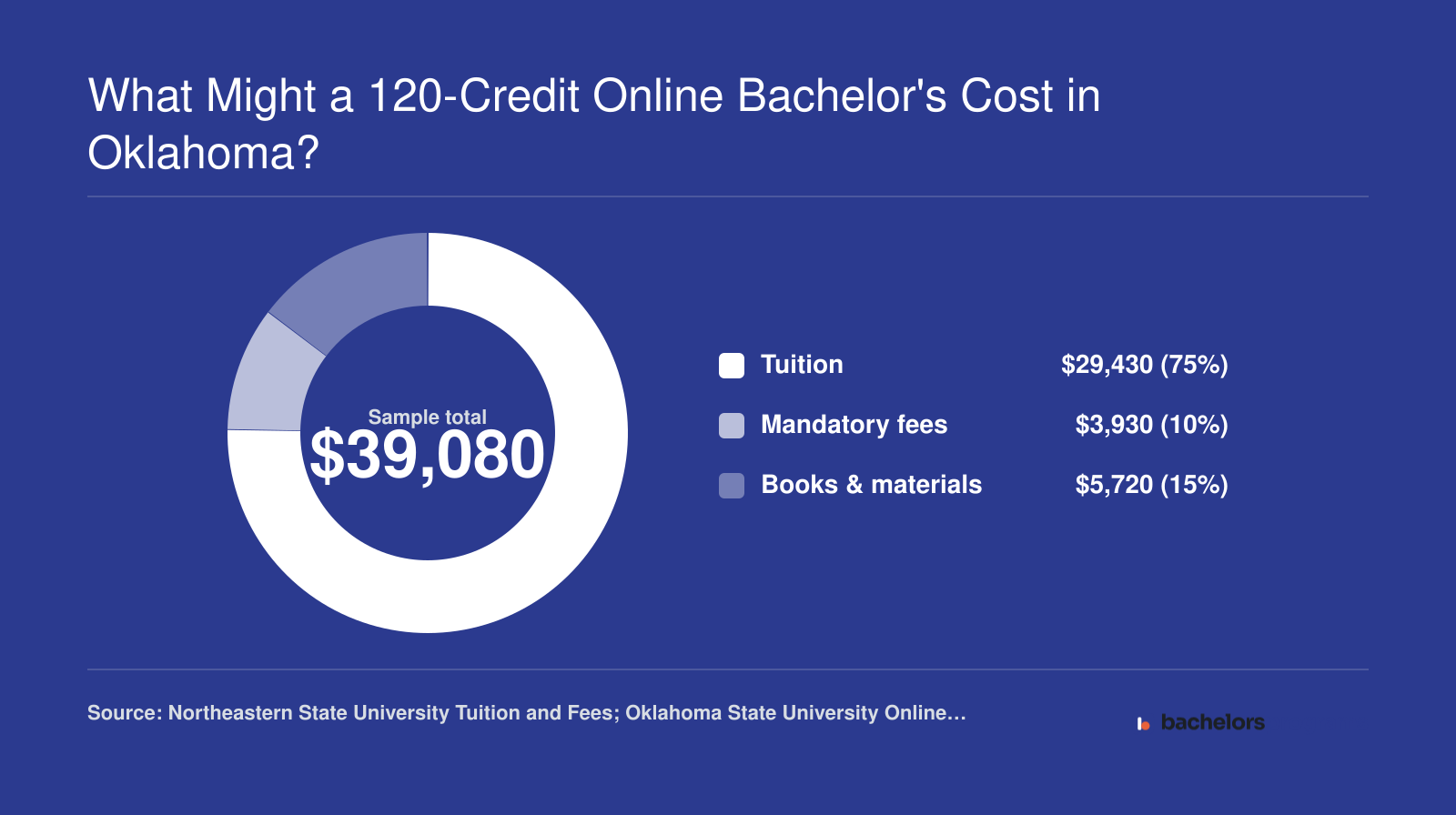
What Might a 120-Credit Online Bachelor's Cost in Oklahoma?
This illustrative estimate prices 120 credits at Northeastern State University's 2026-27 Oklahoma-resident online rate of $245.25 per credit in tuition plus $32.75 per credit in mandatory fees, which bundle technology services and other charges. It then adds four years of Oklahoma State University's $1,430 annual online books and supplies estimate, and it assumes no transfer credit and no rate increases, so treat it as a planning baseline rather than a quote. Online students generally avoid housing and commuting costs, but individual online courses can carry extra fees, such as exam proctoring, that this total does not include.
Finding an Affordable Online Bachelor's in Oklahoma: Net Price Over Sticker Price
What does an online bachelor's degree in Oklahoma actually cost once financial aid is applied? The real cost usually lands far below the published rate, and that gap is the most useful number to compare across programs.
Net Price Beats Sticker Price
Sticker price is the published rate. Net price is the real one: tuition, fees, housing, food and books minus the grants and scholarships a student actually receives. Federal data for Oklahoma's public four-year universities show an average annual net price of $16,151 and a median of $16,187 for full-time, first-time undergraduates in 2022-23.1 Borrowing often comes in lower than families expect. At the University of Science and Arts of Oklahoma in Chickasha, College Scorecard reports an average annual cost of $6,624 for students receiving federal aid, and median total debt after graduation of $21,750, or roughly $231 a month on a standard repayment plan.1
Credits Needed Drive the Total
Per-credit rates get the attention, but credits remaining determine the bill. Suppose an online program charges a flat $300 per credit. A transfer student who arrives with 60 accepted credits needs 60 more, or about $18,000 in tuition. A first-year student starting from zero needs 120, or about $36,000. Identical rate, double the cost. Before you compare rates, ask each school how many credits it will accept and how prior learning or military training is evaluated.
Oklahoma Against the National Picture
Oklahoma's public four-year tuition generally runs below the national average. College Board reports 2025-26 average published tuition and fees of $11,950 nationally2 for public four-year institutions, against $10,246 in Oklahoma, a difference of $1,704, or about 14.3 percent.3 That advantage is real, but published tuition is only the starting line.
Compare the Whole Program, Not One Semester
Feed your own financial details into each school's net price calculator, then build a total: tuition for every credit remaining, fees, any charge for transfer credit review, and the number of terms it will take to finish. A program that looks expensive per credit can cost less overall if it accepts more of your previous coursework.
Financial Aid, Oklahoma's Promise and Military Benefits for Online Students
Federal aid follows you to any eligible online school, but Oklahoma's state aid depends on where you enroll and how early you apply. Plan for both layers.
Federal Aid Comes First
Online students at accredited, Title IV-eligible schools can receive federal aid. The FAFSA is the gateway for Pell Grants, federal loans, work-study and the state grant covered below. Congress sets the Pell maximum each year, so check studentaid.gov for the current 2026-27 figure rather than relying on an older number.
Enrollment intensity matters for part-time online learners. Federal loans generally require at least half-time enrollment, which most schools define as six credit hours in a term. Pell can be paid at lower enrollment levels, but the award shrinks. Ask your school's aid office how it defines half-time for accelerated or seven-week online terms.
Oklahoma's Promise
This program rewards early planning. Students enroll between 8th grade and December 31 of their senior year.1 Family income at application must be at or below $60,000 for one or two dependents, $70,000 for three or four, and $80,000 for five or more.2 While enrolled, income must stay at or below $100,000 each year.2 Students also need at least a 2.50 GPA in the required college-prep courses and overall in grades 9 through 12.1
The award ends after five years, a bachelor's degree, or 129 paid credit hours, whichever comes first.1 The State Regents do not set a blanket rule that online courses always count or never count, so confirm with your school that the courses in your degree plan qualify. Public universities are where the award does the most work. At private schools it applies differently and usually leaves a balance. Check the State Regents' current standards for keeping the award once you are in college.
OTAG: File Early
The Oklahoma Tuition Aid Grant is need-based, and you must file the FAFSA, be an Oklahoma resident, be Pell-eligible and not already hold a bachelor's degree.2 For 2026-27, the maximum is the lesser of 75% of enrollment costs or a cap that depends on the school:3
- Community colleges and technology centers: up to $1,500.
- Regional universities: up to $2,000.
- Research universities: up to $3,000.
The minimum is $100 per payment period.4 Schools must submit claims before June 15, and funds are awarded first come, first served, so your school's own deadline may be earlier.4 File the FAFSA as soon as it opens.
Military and Veteran Benefits
The Post-9/11 GI Bill pays a housing allowance at the standard resident rate to students who are not fully online.5 Students taking only online classes receive up to $1,261 per month in 2026, half the national average.5 Adding at least one in-person class may qualify you for the higher resident rate, so ask a school certifying official before you register.
Active-duty service members can use military Tuition Assistance through their branch. Oklahoma National Guard members may qualify for a state tuition waiver at public institutions, so contact your unit's education officer for current terms.
Institutional Scholarships
The last layer comes from the school itself. Many Oklahoma colleges offer transfer scholarships and adult-learner awards that can be stacked on top of grants. Amounts and criteria vary by school, so ask each admissions office what applies to online students.
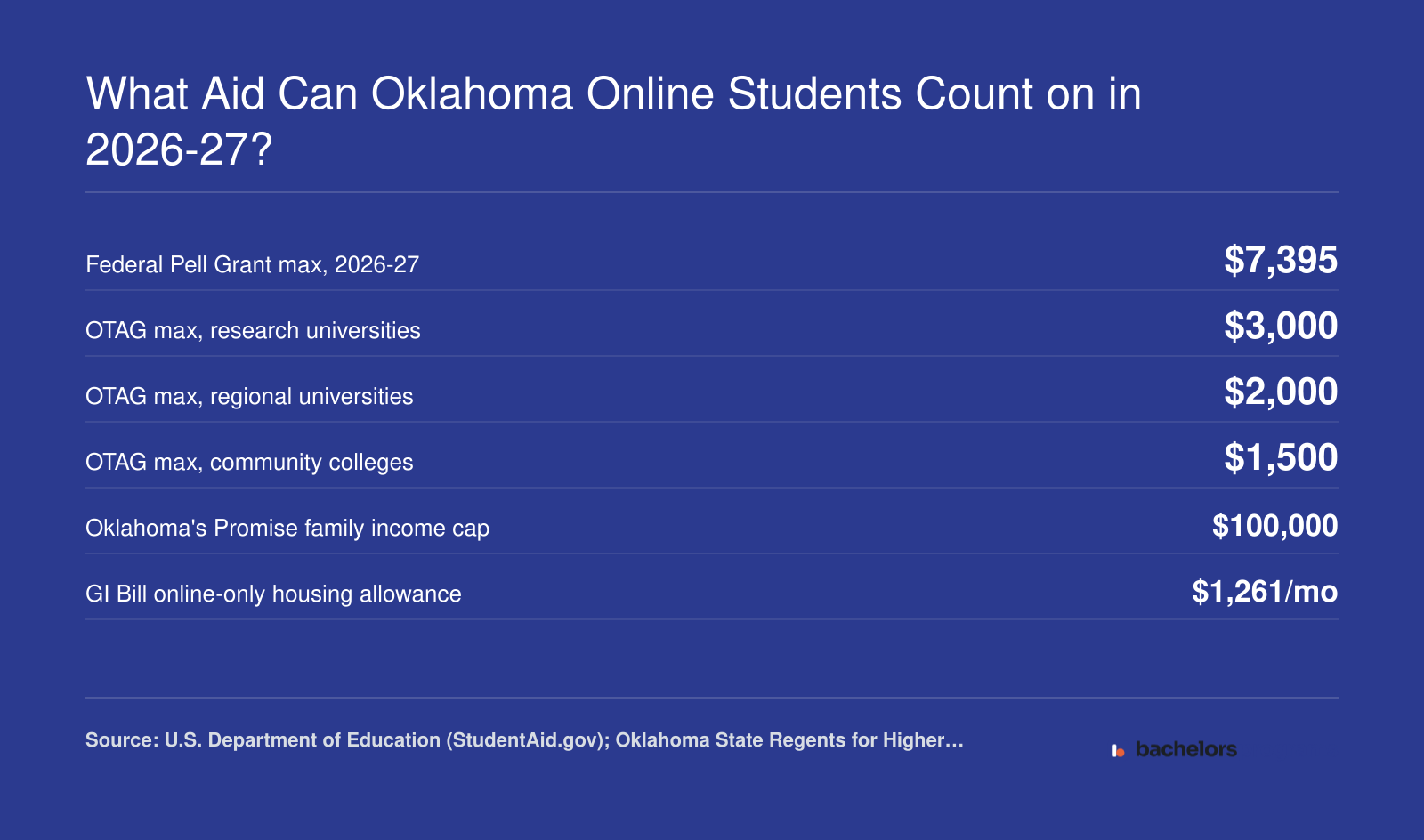
What Aid Can Oklahoma Online Students Count on in 2026?
These are the headline award limits behind the main aid programs Oklahoma bachelor's students use. OTAG awards cannot exceed 75% of enrollment costs, and the Oklahoma's Promise cap is based on FAFSA adjusted gross income. The GI Bill figure is the online-only rate; adding at least one in-person class may qualify you for the higher resident housing allowance.
Accreditation: How to Verify Accredited Online Colleges in Oklahoma
Institutional Accreditation Comes First
Oklahoma's public universities, including the University of Oklahoma, Oklahoma State University and the regional institutions, hold institutional accreditation through the Higher Learning Commission (HLC). That status is what makes a degree portable: it is the baseline the U.S. Department of Education requires before a school can disburse federal student aid, the test most other colleges apply when they evaluate transfer credits, and what employers and graduate schools typically mean when they ask whether a degree came from an accredited institution. Northwestern Oklahoma State University traces its institutional accreditation to the North Central Association of Colleges and Schools, the predecessor body to the HLC, so confirm current status in the directory rather than assuming.1
Program Accreditation to Check
Institutional accreditation does not automatically cover a specific professional program. Look for a second, program-level seal:
- RN-to-BSN: the Commission on Collegiate Nursing Education (CCNE) or the Accreditation Commission for Education in Nursing (ACEN). Oklahoma examples include CCNE-accredited online RN-to-BSN programs at the University of Oklahoma and Northwestern Oklahoma State University, and an ACEN-accredited online RN-BSN at Oklahoma City University.2
- Business: AACSB or ACBSP.
- Teacher education: CAEP.
A Three-Step Verification Method
1. Search the HLC directory for the institution itself. 2. Check the U.S. Department of Education's DAPIP database for the school's accreditation and any state approvals. 3. Search the program accreditor's own directory (CCNE, ACEN, AACSB, ACBSP, CAEP) for the specific degree.
Red Flags
Be wary of schools holding only national accreditation, unaccredited diploma mills, and any program described as "in candidacy" or "applicant" status. Southeastern Oklahoma State University, for instance, has pursued initial CCNE accreditation for its online RN-to-BSN; applying does not guarantee approval. Until it is granted, treat that program's status as pending.
Transfer Credits and Oklahoma Community College Pathways
Oklahoma makes it relatively straightforward to carry community college work into a bachelor's program, but the details depend on the degree you finish and the school where you finish it.
The AA/AS guarantee
A completed Associate of Arts or Associate of Science from an Oklahoma public college satisfies the receiving public institution's freshman and sophomore general education requirements, which the State Regents describe as 37 lower-division hours.1 Some universities require more than 37 hours and may add upper-division general education, so check the destination catalog. Associate of Applied Science degrees are not covered because they typically carry fewer general education hours. If you transfer before finishing an AA or AS, general education credit generally applies only to courses that match the receiving institution's courses.
Caps and residency
There is no single credit total that transfers everywhere. Oklahoma does not set a single systemwide maximum on community college transfer credit.1 Individual universities and programs may impose their own limits, so ask before you enroll. Residency rules are the bigger constraint: bachelor's degrees require 120 hours, including 30 hours earned at the degree-granting institution, and 15 of the final 30 hours or 50% of the major must be in residence.1 Program-specific policies can add further limits.
Check equivalencies first
The Oklahoma Course Transfer Matrix lists about 7,900 courses across 48 disciplines for 2026-27 and is updated annually.2 Equivalencies are guaranteed at participating institutions, including some private colleges in the 2026-27 update, for the academic year listed and the year you completed the course.2
Reach Higher and prior learning
Reach Higher degree-completion pathways require at least 18 credit hours toward an associate and a 2.0 GPA.4 Students complete general education and remedial requirements; those admitted provisionally must finish remedial work within two semesters or 24 credit hours.5 The final 15 credit hours must come from an Oklahoma institution participating in Reach Higher associate completion, including the 12 community colleges and two technical branches.5 Prior-learning credit earned at an Oklahoma State System institution transfers on the same basis as regular study.3 Ask about CLEP exams, military training evaluated through ACE, and portfolio assessment.
Before you apply, ask the school you are considering for an unofficial transcript evaluation. It shows how your credits will land while you can still adjust your plans.
Oklahoma RN Licensure for RN-to-BSN Students
Admissions Requirements and Start Dates to Expect
Admission rules for online bachelor's programs in Oklahoma vary by institution and program. The thresholds below come from published policies at Oklahoma public universities. Treat them as reference points and confirm each with the admissions office of the school you choose.
- Freshman standardsFirst-time students are typically judged on high school GPA and ACT or SAT scores. OSU-Oklahoma City, for example, cites a State Regents placement benchmark of a 3.0 unweighted GPA and an ACT composite of 19. Research universities may set higher bars.
- Adult admissionOU Online's degree-completion track admits students who are at least 25 by the first day of class or at least five years past high school graduation or a GED.
- Transfer thresholdApplicants with 7 or more college credits earned after high school are usually treated as transfers. OSU-Oklahoma City requires a 1.7 minimum transfer GPA and eligibility to re-enroll at your last school. OU applicants with fewer than 24 credits must also meet freshman requirements.
- Degree-completion eligibilityOU Online's adult completion degrees require at least 60 prior credit hours and a 2.0 GPA. Other completion programs set their own credit and time-out-of-school rules.
- RN-to-BSN prerequisitesExpect to need an active, unencumbered RN license plus a minimum GPA set by the program.
- Start dates and deadlinesOU Online runs 8-week courses with five starts a year: August, October, January, March and June. Its summer 2026 8-week terms began May 18 and June 15. Apply at least 14 days before your start date, and meet FAFSA and Oklahoma's Promise deadlines regardless of term.
What Oklahoma Bachelor's Graduates Earn
Early-career pay for Oklahoma bachelor's graduates rises with experience.
Graduation Rates, Outcomes and Choosing the Right Online Program
A school's headline graduation rate and its completion rate for students like you are not the same number, and the gap matters more online than on campus.
Reading Graduation and Retention Rates
The University of Oklahoma reports an 85.6% six-year graduation rate for its 2014 entering cohort. That total includes 67.5% who finished in the college where they started and another 18.2% who graduated from a different college within OU. It is a strong result, but it tracks first-time, full-time freshmen, who are usually not the students enrolling in online degree completion programs.
First-year retention, the share of bachelor's-seeking students who return for a second year, is another useful signal. You can look it up for Oklahoma's public universities on the federal College Scorecard. Comparing schools on the same measure and the same year matters, so pull every figure from one source.
If you study part-time or bring in prior credits, standard six-year rates may not reflect your experience at all. Ask admissions for completion rates among transfer and part-time students and how long those students typically take to finish. A school that tracks and shares those numbers tends to take adult learners seriously.
Where Oklahoma Graduates Work
The Oklahoma State Regents' 2024 Employment Outcomes Report found that 79.8% of bachelor's graduates from the state's public institutions in the 2022-2023 class were working in Oklahoma one year later.1 Among Oklahoma residents with bachelor's degrees, that share reached 90.9%.1 Five years out, 71% of all graduates from the 2018-2019 class were still employed in the state.1 These are statewide figures, not school-by-school results, but they suggest that a degree from an Oklahoma public institution is a practical route into the state's workforce.
Choosing by Your Starting Point
- Working adults with prior credits: Prioritize degree completion programs with generous transfer policies and a flat per-credit online rate. The goal is the fewest remaining credits at a predictable price.
- First-time students: Start with an affordable public university and confirm whether you qualify for Oklahoma's Promise, which accepts enrollment from 8th grade through December 31 of senior year. Then compare net price, not sticker price.
- Military learners: Pair federal Tuition Assistance with a school that awards credit for military training through your Joint Services Transcript, and ask whether it offers dedicated military advising.
Your Next Step
Shortlist two or three schools accredited by the Higher Learning Commission. Run each one's net price calculator using your real household income, then request a transcript evaluation before you apply. With an estimated net cost, a count of accepted credits and a clear number of credits left to complete, you can compare offers side by side and choose the program that fits your budget, schedule and goals.
Colleges in Oklahoma with the most bachelor's programs
| School | City | Type | Bachelor's programs | Online | Net price / yr | Grad rate |
|---|---|---|---|---|---|---|
| Oklahoma State University | Stillwater | Public | 110 | 11 | $17,447 | 68% |
| University of Oklahoma | Norman | Public | 84 | 13 | $15,300 | 75% |
| Northeastern State University | Tahlequah | Public | 83 | 21 | $12,710 | 35% |
| University of Central Oklahoma | Edmond | Public | 82 | 3 | $18,309 | 37% |
| East Central University | Ada | Public | 67 | 13 | $8,683 | 34% |
| Southwestern Oklahoma State University | Weatherford | Public | 67 | 8 | $14,459 | 40% |
| University of Tulsa | Tulsa | Private nonprofit | 59 | 3 | $15,000 | 72% |
| Oral Roberts University | Tulsa | Private nonprofit | 58 | 40 | $25,365 | 57% |
| Oklahoma Baptist University | Shawnee | Private nonprofit | 55 | 7 | $20,958 | 52% |
| Oklahoma Christian University | Edmond | Private nonprofit | 51 | 3 | $21,872 | 56% |
| Southeastern Oklahoma State University | Durant | Public | 50 | 15 | $8,039 | 32% |
| Cameron University | Lawton | Public | 46 | 10 | $10,912 | 31% |
| Oklahoma City University | Oklahoma City | Private nonprofit | 43 | 1 | $22,857 | 65% |
| Northwestern Oklahoma State University | Alva | Public | 41 | 9 | $10,104 | 30% |
| Southern Nazarene University | Bethany | Private nonprofit | 40 | 5 | $22,084 | 51% |
Program counts are the verified bachelor's listings in our directory; net price is the school-wide average a first-time undergraduate paid after aid, and graduation rate the share finishing within six years (College Scorecard).
Compare programs nationwide
Many Oklahoma residents study online. Every ranked list above has an online lens, or browse every field.
Online bachelor's degrees Browse all fields