Online Colleges and Bachelor's Degree Programs in Kansas
Every verified bachelor's program at a college in Kansas: 1,300+ programs at 30+ colleges, with the online options, net price and graduation rates behind each one.

What does an online bachelor's degree in Kansas actually cost? Sticker rates at the state's public universities spread from about $260 to $436 per credit, and the gap widens once grants, transfer credit and part-time pacing enter the picture. The Regents institutions run some of the largest online undergraduate operations in the region, so availability is rarely the obstacle.
What separates one path from another is the credit-transfer math, the format's real weekly demands, and whether state need-based aid reaches a distance learner. Kansas has shifted its grant money toward need and workforce priorities, and that shift decides more outcomes than a tuition table does.
Key Points
- Online tuition at Kansas public universities runs $259.75 to $435.71 per credit.
- Kansas Regents list 132 systemwide transfer courses as of summer 2026.
- File the FAFSA: Kansas state aid now favors need-based grants.
Popular degrees in Kansas
Bachelor's degrees in Kansas by field
Business & Management
- Business Administration40 programs
- Marketing33 programs
- Management30 programs
- Accounting26 programs
- Finance20 programs
- Organizational Leadership19 programs
- Sports Management18 programs
- Human Resource Management or HR Management17 programs
Education & Teaching
- Elementary Education27 programs
- Secondary Education26 programs
- Science23 programs
- Mathematics Education21 programs
- Physical Education20 programs
- English Education18 programs
- History Education17 programs
- Early Childhood Education or Child Development9 programs
Science & Engineering
- Biology26 programs
- Mathematics22 programs
- Chemistry21 programs
- Biochemistry16 programs
- Physics11 programs
- Electrical Engineering or Electronics Engineering or Electronic Systems Engineering Technology9 programs
- Geosciences5 programs
- Mechanical Engineering5 programs
Liberal Arts & Humanities
- English25 programs
- Literature or English Literature22 programs
- History20 programs
- Spanish12 programs
- General Studies9 programs
- Philosophy7 programs
- Global Health or Health Studies6 programs
- Humanities3 programs
Arts & Design
- Fine Arts or Studio Art24 programs
- Art or Art Studies21 programs
- Graphic Design16 programs
- Media Arts or Digital Media16 programs
- Audio & Music7 programs
- Game Programming & Development6 programs
- Digital Photography5 programs
- Art History5 programs
Computers & IT
- Computer Science27 programs
- Cybersecurity12 programs
- Information Technology8 programs
- Innovation or Technological Entrepreneurship8 programs
- Computer Information Systems7 programs
- Software Development & Engineering5 programs
- Artificial Intelligence5 programs
- Computer Engineering3 programs
Nursing
- Bachelor of Science in Nursing29 programs
- Nursing (RN to BSN)14 programs
- LPN/LVN to BSN8 programs
- Accelerated BSN (ABSN)7 programs
Healthcare
- Exercise & Sports Science17 programs
- Health Sciences15 programs
- Public Health8 programs
- Health Education6 programs
- Speech Pathology4 programs
- Respiratory Care Therapy2 programs
- Nutrition1 program
- Health Informatics1 program
Communications & Media
- Journalism18 programs
- Communications17 programs
- Public Relations8 programs
- Communication Disorders4 programs
- Speech Pathology4 programs
- Strategic Communications2 programs
- Business Communications1 program
Social Work & Social Sciences
- Sociology25 programs
- Political Science, Government11 programs
- Social Work9 programs
- Human Services8 programs
Criminal Justice & Law
- Criminal Justice16 programs
- Criminal Justice Administration9 programs
- Forensic Science6 programs
- Corrections5 programs
- Criminology5 programs
- Security Management2 programs
- Legal Studies2 programs
- Fire Science or Fire Administration2 programs
Psychology
- General Psychology28 programs
- Applied Psychology2 programs
- Child Psychology1 program
- Addiction Psychology1 program
- Industrial Organizational Psychology1 program
- Clinical Psychology1 program
Religion & Theology
- Christian Ministry or Ministry Leadership12 programs
- Christian Studies or Religious Studies8 programs
Natural & Applied Sciences
- Agriculture or Agricultural5 programs
- GIS and Geoscience4 programs
- Neuroscience2 programs
Counseling
- Substance Abuse Counseling7 programs
How Online Bachelor's Degrees Work in Kansas: Fully Online, Hybrid, and Degree Completion
Flexibility is usually why a working adult picks an online bachelor's degree in Kansas, but it is not absolute: the format decides how much of your week still belongs to a campus, a clinical site, or a fixed class time.
The Three Formats You Will Run Into
- Fully online: coursework delivered remotely with no required campus visits, though some programs still expect proctored exams.
- Hybrid: a mix of online classes and on-campus or live synchronous sessions, common in lab sciences, education, and health fields.
- Degree completion: programs built for students who arrive with roughly 60 credits, usually an associate degree or a block of transfer coursework, and finish only the upper-division major.
The In-Person Requirements That Get Glossed Over
Education majors should expect a student teaching semester in a Kansas school. Nursing and allied health programs carry clinical or practicum hours arranged with local facilities. Business and social science majors may face an internship. Proctored exams can require an approved testing site or monitoring software, sometimes at your own cost.
Synchronous vs. Asynchronous Classes
Synchronous courses meet at a set time, which matters if you work rotating shifts or live in another time zone. Asynchronous courses post weekly deadlines but leave the hours to you. Many Kansas programs blend both, so check the delivery mode per course, not just per program.
Verify Before You Apply
One call saves a semester: ask an advisor directly whether any course requires a campus visit, a local placement, or a proctored exam before you submit an application. Also confirm whether the program accepts out-of-state students, since Kansas institutions participate in interstate distance-education agreements and licensure-track programs may have state-specific restrictions.
What an Online Bachelor's Degree Costs in Kansas: Per-Credit Tuition at Public Universities
Online per-credit tuition at the Kansas public universities with published rates runs from $259.75 at Wichita State University to $435.71 at Kansas State University Global Campus. Over a 120-credit bachelor's degree, that works out to roughly $31,170 to $52,285 in tuition alone, before fees, books, or any aid.
Per-Credit Rates and 120-Credit Estimates
- Wichita State University: $259.75 per credit hour, or about $31,170 for 120 credits (2025-2026 published rates).4
- Fort Hays State University: $275.65 per credit hour, or about $33,078 for 120 credits (Fall 2026 to Summer 2027).1
- Kansas State University Global Campus: $435.71 per credit hour, or about $52,285 for 120 credits (Fall 2026 to Summer 2027).5
The Wichita State figure comes from an earlier academic year than the other two, so expect it to move. Confirm current rates on each school's bursar or tuition page before you budget.
In-State vs. Out-of-State Online Rates
Out-of-state students get no penalty at these three schools. Fort Hays State charges one online rate to every student regardless of location.3 Kansas State Global Campus publishes the same rate for residents and non-residents. Wichita State sets online majors at the resident rate. If you live outside Kansas, that makes these programs far cheaper than on-campus out-of-state tuition would be.
Fees Change the Total
Tuition is not the full bill. Wichita State adds a Campus Infrastructure and Support Fee of $20.58, a Technology Fee of $1.00, and a Transportation Fee of $0.75 per credit hour.4 That is $22.33 per credit, or about $2,680 across 120 credits, which lifts the Wichita State total to roughly $33,850, above Fort Hays State's $33,078 for the same 120 credits. The Fort Hays State schedule lists its online rate as applying to all students and shows no separate mandatory online fee.2 The Kansas State Global Campus figures reviewed here don't break out fees, so ask the school for a full cost estimate.
Private Colleges
Private Kansas colleges usually charge more per credit for online coursework than the public universities. Many offset that with institutional scholarships and discounts, so the price you actually pay can land much closer to the public figures. That gap between published price and what students actually pay is where the comparison gets useful.
Most Affordable Online Colleges in Kansas: Why Net Price Beats Sticker Price
The honest answer to "which Kansas online college is the most affordable?" is that it depends on net price, meaning what a student pays after grants. Sticker price alone can mislead.
What Net Price Actually Measures
The federal IPEDS average net price starts with total cost of attendance and subtracts the average federal, state, local and institutional grant and scholarship aid.1 It applies to first-time, full-time, degree-seeking undergraduates who receive grant aid. For public schools, it uses in-state tuition. That is not the same as an online adult student, who is often part-time, transferring in, and living off campus. Treat any net price figure as a rough guide, not a quote. The most recent federal reports cover 2021-22 through 2023-24, so check College Navigator for the latest numbers on each school.2
Public vs. Private in Kansas
Several public universities enroll large numbers of students away from campus, including Fort Hays State, Kansas State, the University of Kansas, Wichita State and Emporia State. Pittsburg State and Washburn report smaller groups. Private options with online students include Friends, Baker and Ottawa. Exact net price and grant-share figures for each Kansas school belong in College Navigator, where you can compare them directly.
A private college with a high sticker price can land close to a public school once institutional aid is applied. Heavy discounting is common for traditional-age freshmen. Part-time adult learners often receive less of that institutional aid, so the private discount may not reach them, and a public university's in-state per-credit rate can end up cheaper.
How to Find Your Real Cost
- Run the net price calculator: Every school must post one. Use it, but remember it assumes a full-time student.
- Ask for an online-specific estimate: Contact financial aid and request a written aid estimate as an online, part-time or transfer student.
- Ask about fees and credits: Confirm per-credit tuition, technology fees, and how many of your prior credits will be accepted.
For most Kansas adults, a public university's online rate is the best starting point. Private schools are worth pricing out, but only after you see an estimate built for your situation.
Financial Aid, Kansas State Grants, and Military Benefits for Online Students
Kansas has quietly reweighted state aid toward need-based and workforce grants, making the FAFSA the most important form an online student files. That shift matters: most money available to distance learners in the state flows through federal and state need analysis, not through the online program itself.
Federal Aid Runs Through the FAFSA
Online students at accredited Kansas colleges qualify for federal aid on the same terms as students on campus, Pell Grants included. The catch is enrollment status: federal loans usually require at least half-time enrollment, so a single course per term may not qualify you for them. Ask the aid office how your online load is counted before you budget around loan funds.
Kansas Grants Worth Checking
- Kansas Comprehensive Grant: Kansas residents enrolled full-time at eligible Kansas institutions for 2026-2027, need-based, and awarded through the FAFSA with no separate state application. Awards range from $100 to $4,000 at public institutions and $200 to $10,000 at private ones.
- Kansas Career Technical Workforce Grant: Kansas residents accepted into an eligible career and technical program. Awards are $1,000 at 12 or more credit hours, $800 at 7 to 11, and $500 at 3 to 6, renewable up to four semesters. FAFSA priority date: April 1; state aid application priority: May 1.
- Kansas Promise Scholarship: aimed mainly at two-year institutions and specific career fields, so it rarely fits a four-year online bachelor's.
State materials do not spell out how exclusively online enrollment is treated, so confirm with the financial aid office that your credits count toward full-time status.
Military and Veteran Benefits
Post-9/11 GI Bill students taking every course online get the housing allowance at 50% of the national average, capped at $1,198 a month in 2026, and generally need a rate of pursuit above 50%. Add one in-person class and the full residential rate applies.1 The Kansas Military Service Scholarship covers tuition and required fees at public Kansas institutions for qualifying residents with at least 90 days of hostile-fire service after September 11, 2001, up to eight undergraduate semesters. K-State Global Campus and Fort Hays State are among the public universities that publish military tuition rates and extend in-state pricing to service members; confirm current terms with each campus.
Campus Awards and Timing
Institutional scholarships for transfer students and online learners are smaller, but they stack with state and federal aid. File the FAFSA early: some Kansas grants are first-come and funding-limited, and a missed priority date can cost you an award.
Transfer Credit and Degree Completion Options in Kansas
As of summer 2026, the Kansas Board of Regents lists 132 courses approved for Systemwide Transfer, up from 130. Each one moves between Kansas public institutions as an equivalent course.
How Systemwide Transfer Works
Complete an approved course at any Kansas public university, community college or technical college, and any public institution offering an equivalent course will accept it. Courses outside that list may still transfer, but not automatically, so confirm with the receiving school. That school also decides whether lower-division work counts toward upper-division requirements, and you remain responsible for meeting its program requirements.
The systemwide general education framework adds a second layer. It groups general education into seven buckets, and Washburn University participates alongside the public universities, community colleges and technical colleges. If you finish all seven buckets at one participating institution, the receiving school generally will not require more general education, apart from approved major-specific or institution-specific exceptions. With partial completion, an official transcript evaluation decides where your courses land, and an approved transfer course counts toward its matching bucket.
Credit Limits and Admission
Kansas law sets a transfer admission floor. Residents with at least 24 transferable credit hours and a cumulative 2.0 GPA from an accredited college must be admitted to state universities, subject to limited exceptions.1 Admission is not a promise that all 24 credits will apply to your degree.
Caps on total transfer credit, limits on hours from two-year colleges, and the number of credits you must complete at the degree-granting school vary by institution. Confirm current 2026 rules directly with the registrar at Fort Hays State, Wichita State, K-State Global Campus, Emporia State or Washburn. When comparing completion-friendly schools, request an unofficial transcript evaluation before you apply. A school's written evaluation of your own credits tells you more than any ranked list.
Starting Without an Associate Degree
You do not need an associate degree to earn an online bachelor's in Kansas. You can enroll as a first-time freshman or transfer in with partial credit. Many schools also award credit for prior learning, passing CLEP exam scores, and military training documented on a Joint Services Transcript. Acceptance policies differ, so verify each one in writing. Every credit that applies shortens your time to degree and reduces the number of courses you pay for.
Admissions Requirements for Kansas Online Bachelor's Programs
Kansas public universities sort applicants into three groups: first-time freshmen, transfer students and adult learners. Your group decides which documents and minimums apply.
- Confirm freshman standardsIf you are entering straight from high school, check the university's current GPA and ACT criteria for first-time freshmen on its admissions page before you apply.
- Know the 24-credit lineAt Wichita State and K-State Online, fewer than 24 completed college hours puts you on the freshman pathway. Twenty-four or more makes you a transfer applicant.
- Check the adult learner pathAt Wichita State, applicants 21 or older with fewer than 24 hours need a 2.00 cumulative GPA on prior college work, plus a high school diploma or an overall GED score of 680. Those with no college work need only the diploma or GED.
- Order official transcriptsRequest transcripts from every college attended. At Wichita State, applicants with 24 or more hours send a high school transcript only if they are seeking federal aid.
- Time your application feeDuring Kansas Apply Free Days, October 5–9, 2026, Kansas residents could apply fee-free by 5 p.m.
- Plan around rolling admissionWichita State reviews online applications on a rolling basis, opening July 1. Some scholarships close earlier, so apply early.
- Ask about start datesConfirm each school's term calendar. At Wichita State, timing depends on your intended semester and processing time.
Graduation Rates and Outcomes for Kansas Online Students
Federal outcome data now tracks part-time and transfer students, not just first-time freshmen, which matters for online learners who rarely follow a traditional path. Knowing where each metric lives lets you compare Kansas schools on your own terms.
Start With Federal Data Tools
Search any Kansas school in College Navigator, the U.S. Department of Education's public window into IPEDS data. Four tabs and sections matter most:
- Retention and Graduation Rates: Shows the first-year retention rate and the six-year graduation rate (150% of normal time) for a specific entering cohort.
- Outcome Measures: Found in the same tab, it reports eight-year award rates that include part-time and transfer-in students.
- Enrollment: Breaks out how many undergraduates study exclusively through distance education.
- Cohort year: Check it every time. Fort Hays State's 2022 IPEDS feedback report, for example, measured retention for the fall 2020 entering class and graduation for the 2015 cohort.
College Scorecard offers a faster summary. It shows Wichita State with 68% of students returning after their first year, and its "Fields of Study" view lets you compare earnings by major.
Check Kansas Board of Regents Reports
The Kansas Board of Regents posts annual performance reports for state universities, Washburn University, and community and technical colleges, with AY 2025 and AY 2024 editions listed. The Board also runs academic program reviews that apply minimum completion thresholds, such as 10 undergraduate completions. Kansas State and the University of Kansas fall in the 2025 review year, Wichita State in 2026, and Emporia State, Fort Hays State, and Pittsburg State in 2027. For school-specific detail, search the school name plus "institutional research" or "consumer information."
Connect Outcomes to Careers
Use the Bureau of Labor Statistics Occupational Outlook Handbook for national pay and job outlook by occupation, then check professional associations in your field for licensure and credential requirements. Compare those against program-level earnings and any licensure exam pass rates the school publishes.
Questions to Ask Admissions or the Registrar
- Do you report graduation rates separately for fully online students?
- How many students completed this specific online program last year?
- What share of online students transfer in, and how do they fare?
- Where do you publish licensure pass rates and employment outcomes for this major?
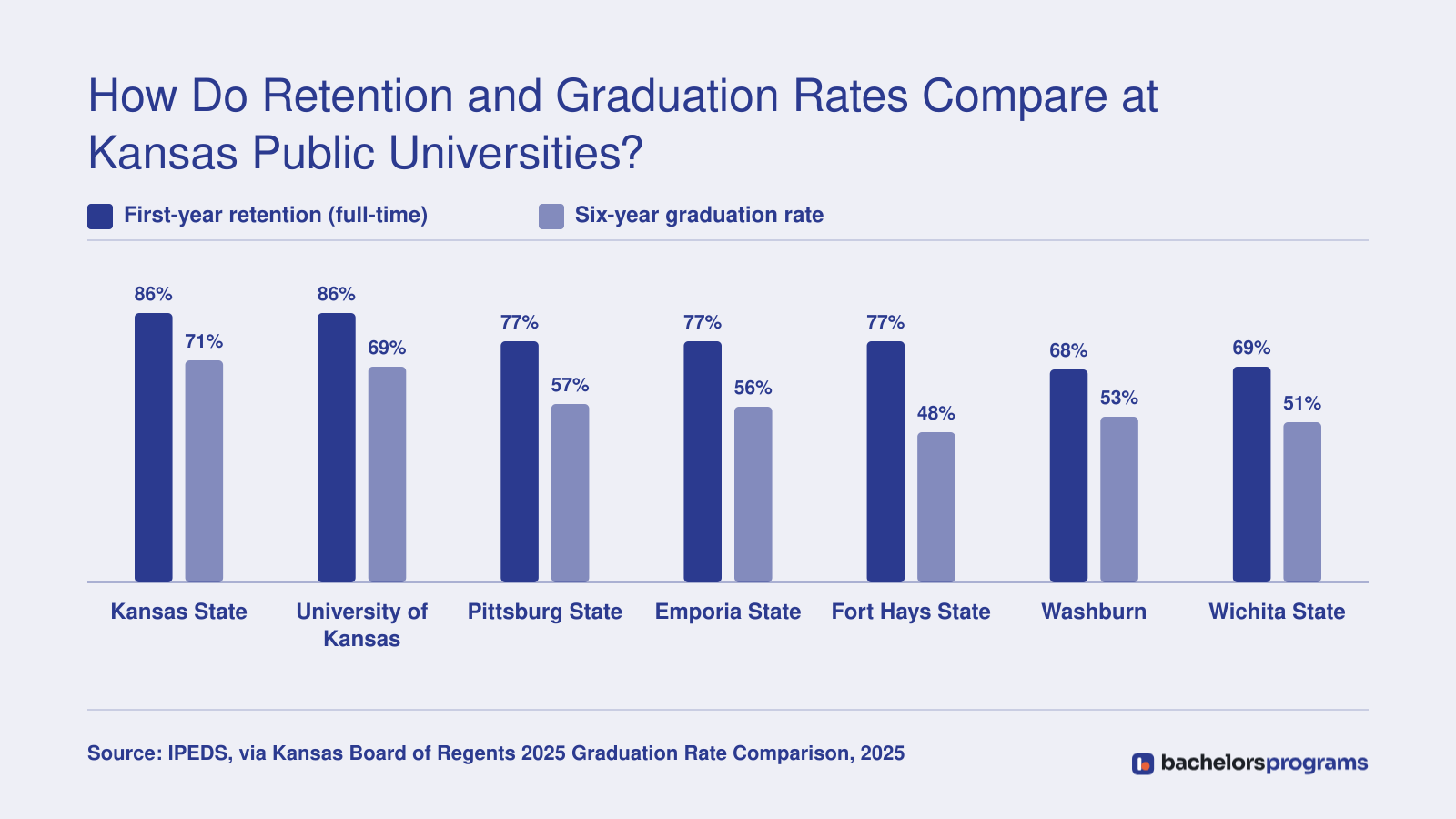
How Do Retention and Graduation Rates Compare at Kansas Public Universities?
Retention shows the share of full-time freshmen who return for a second fall. The six-year graduation rate shows how many finish a bachelor's degree within six years. These 2025 figures come from the Kansas Board of Regents graduation rate comparison, based on federal IPEDS data, and cover first-time, full-time students rather than online-only learners. Use them as a campus-wide signal, not a direct measure of online outcomes.
Kansas Teacher Licensure Through an Online Degree
How to Choose the Right Kansas Online College
Choosing an online college means running every school through the same short set of tests, so a polished website never outweighs the facts that decide your outcome. Run all four before you apply anywhere.
Run the Four Core Checks
- Accreditation: Confirm the school is regionally accredited by the Higher Learning Commission, which covers Kansas institutions.
- Licensure: If your career needs a license, such as teaching or nursing, verify the program is approved for it before you enroll.
- Cost: Compare total cost per credit, including technology, online course, and other mandatory fees, not tuition alone.
- Transfer credit: Get a written evaluation of what will transfer before you commit a dollar.
Match the Format to Your Life
Asynchronous classes free you from set meeting times; only the weekly deadlines are fixed. Synchronous classes meet at set times, which suits students who want structure but can clash with shift work. Check term length too: shorter terms let you take fewer courses at once but move faster. Then ask whether any on-campus requirements, such as labs, proctored exams, or student teaching, are realistic given where you live.
Look at Student Support
Online students need services built for them. Ask whether you get a dedicated advisor, online tutoring, remote library access, career services, and tech support during evening and weekend hours. Strong support often separates students who finish from those who stall.
Your Next Step
Shortlist two or three schools. Run each net price calculator, and request transcript evaluations from all of them at the same time. Side by side, you will see the real price and the real time to finish, and the best fit is usually clear.
Colleges in Kansas with the most bachelor's programs
| School | City | Type | Bachelor's programs | Online | Net price / yr | Grad rate |
|---|---|---|---|---|---|---|
| University of Kansas | Lawrence | Public | 111 | 22 | $18,059 | 69% |
| Wichita State University | Wichita | Public | 108 | 19 | $13,194 | 51% |
| Fort Hays State University | Hays | Public | 95 | 58 | $12,569 | 48% |
| Kansas State University | Manhattan | Public | 95 | 21 | $19,406 | 71% |
| Washburn University | Topeka | Public | 81 | 16 | $15,280 | 53% |
| Emporia State University | Emporia | Public | 65 | 11 | $16,261 | 56% |
| Pittsburg State University | Pittsburg | Public | 57 | 5 | $15,784 | 57% |
| Ottawa University-Ottawa | Ottawa | Private nonprofit | 53 | 36 | $27,963 | 28% |
| Baker University | Baldwin City | Private nonprofit | 50 | 10 | $25,301 | 58% |
| Friends University | Wichita | Private nonprofit | 46 | 10 | $27,715 | 43% |
| MidAmerica Nazarene University | Olathe | Private nonprofit | 46 | 9 | $32,165 | 54% |
| McPherson College | McPherson | Private nonprofit | 46 | 1 | $26,441 | 34% |
| Benedictine College | Atchison | Private nonprofit | 42 | 0 | $27,891 | 62% |
| Southwestern College | Winfield | Private nonprofit | 42 | 11 | $29,824 | 36% |
| Newman University | Wichita | Private nonprofit | 42 | 16 | $19,971 | 53% |
Program counts are the verified bachelor's listings in our directory; net price is the school-wide average a first-time undergraduate paid after aid, and graduation rate the share finishing within six years (College Scorecard).
Compare programs nationwide
Many Kansas residents study online. Every ranked list above has an online lens, or browse every field.
Online bachelor's degrees Browse all fields