Online Colleges and Bachelor's Degree Programs in Montana
Every verified bachelor's program at a college in Montana: 370+ programs at 12 colleges, with the online options, net price and graduation rates behind each one.

Montana covers roughly 147,000 square miles, and outside Billings, Bozeman, Missoula, and Great Falls, the nearest four-year campus can be hours away. Geography is why the Montana University System leans on fully online and hybrid bachelor's completion, especially for working adults finishing a degree part time.
Most of the decision comes down to four questions: what actually runs fully online, what the bill comes to after grants and waivers, how prior credits transfer between campuses, and what applying requires.
Directories that sort colleges and fields are the easy part. The harder work is reading delivery format and net price plainly, because the cheapest published tuition is rarely the cheapest degree.
Key Points
- Net price at Montana's two flagship universities runs near $18,000 yearly.
- Online tuition isn't automatically cheaper; savings come from skipping housing costs.
- Studying part-time can cost you eligibility for Montana state grants.
Popular degrees in Montana
Bachelor's degrees in Montana by field
Science & Engineering
- Biology12 programs
- Chemistry8 programs
- Mathematics7 programs
- Natural Resources or Conservation6 programs
- Environmental Science5 programs
- Biochemistry4 programs
- Geosciences3 programs
- Engineering Technology3 programs
Business & Management
- Business Administration17 programs
- Management9 programs
- Accounting4 programs
- Finance4 programs
- Marketing4 programs
- Communication3 programs
- Statistics3 programs
- Sustainability or Environmental Management3 programs
Education & Teaching
- Elementary Education9 programs
- Science8 programs
- English Education7 programs
- Secondary Education7 programs
- Mathematics Education7 programs
- History Education6 programs
- Physical Education6 programs
- Early Childhood Education or Child Development5 programs
Liberal Arts & Humanities
- History6 programs
- Literature or English Literature6 programs
- English5 programs
- Philosophy4 programs
- Spanish3 programs
- Interdisciplinary Studies3 programs
- General Studies2 programs
- Humanities2 programs
Arts & Design
- Art or Art Studies7 programs
- Fine Arts or Studio Art6 programs
- Graphic Design2 programs
- Audio & Music2 programs
- Creative Writing2 programs
- Media Arts or Digital Media2 programs
- Digital Photography1 program
- Game Art & Design1 program
Healthcare
- Exercise & Sports Science5 programs
- Public Health5 programs
- Health Sciences4 programs
- Health Education4 programs
- Nutrition1 program
- Speech Pathology1 program
Social Work & Social Sciences
- Sociology9 programs
- Political Science, Government5 programs
- Social Work2 programs
Computers & IT
- Computer Science8 programs
- Cybersecurity2 programs
- Software Development & Engineering2 programs
- Information Technology1 program
- Innovation or Technological Entrepreneurship1 program
- Computer Engineering1 program
- Computer Information Systems1 program
Communications & Media
- Communications7 programs
- Public Relations3 programs
- Journalism2 programs
- Social Media1 program
- Communication Disorders1 program
- Speech Pathology1 program
- Strategic Communications1 program
Nursing
- Bachelor of Science in Nursing8 programs
- Nursing (RN to BSN)4 programs
- Accelerated BSN (ABSN)3 programs
Criminal Justice & Law
- Criminology3 programs
- Criminal Justice3 programs
- Criminal Justice Administration2 programs
- Paralegal1 program
- Legal Services1 program
- Forensic Science1 program
- Legal Studies1 program
Psychology
- General Psychology8 programs
- Forensic Psychology1 program
Natural & Applied Sciences
- Agriculture or Agricultural4 programs
- GIS and Geoscience2 programs
- Applied Science1 program
Fully Online, Hybrid, or Course-Only: How Montana Bachelor's Programs Actually Work
MSU Northern advertises programs delivered fully online, with a bachelor's degree designed to take eight semesters for students carrying 15 or more credits each term.1 That description raises the first question Montana applicants have to answer: what "online" actually means at the program level, because the label covers at least three different experiences.
Three formats, one word
- Fully online: No campus visits required. Coursework, exams, and advising all happen at a distance.
- Hybrid: Most instruction is online, but the degree still requires something in person. That might be a lab, a clinical rotation, a supervised practicum, or a short residency.
- Course-only online: Individual classes are offered online inside a degree that is otherwise built for on-campus students. You can take a semester of coursework remotely, but you cannot finish the credential that way.
Search results blur all three because a school's marketing page files any program with online sections under one heading. The distinction lives on the individual program page, not the general online landing page.
What Montana campuses offer
UM Western runs Project REAL, a fully online bachelor's in Elementary Education, though it is built for people already working in a local school, so employment in a classroom is part of the arrangement.2 MSU Northern lists programs it describes as fully online.1 MSU Bozeman's online undergraduate list includes Liberal Studies Quaternity Online and Pre-Liberal Studies Online. MSU Billings also appears in Montana University System online listings.
Teacher preparation is where the hybrid reality shows up most clearly. University of Montana teacher education candidates must complete CPR and First Aid training in person, secure a school placement, complete clinical experience and student teaching, and attend four seminars. The program does not allow concurrent coursework during student teaching. Nursing, laboratory sciences, and counseling tracks carry similar in-person obligations at most institutions.
Term length and time to finish
Montana University System materials promote an eight-week course structure, in which online and face-to-face classes wrap up in eight weeks rather than a traditional 16-week semester. Shorter terms let you take fewer classes at once while still moving at full-time speed. Separately, ask whether classes are asynchronous (recorded, complete on your own schedule) or synchronous (live sessions at set times), because that determines whether the degree fits around a job.
A bachelor's degree runs 120 credits, roughly four years at full-time pace, and faster if you arrive with transfer credit. Before you apply, open the specific program page and confirm the format in writing. The school's general online page is marketing; the program page is the contract.
Accreditation: What to Verify Before You Enroll
A flexible online program saves nothing if the credential fails when you apply for aid, transfer credits, or send a résumé. Accreditation is what makes that possible, and in Montana it is easy to check.
Institutional Accreditation
The Northwest Commission on Colleges and Universities (NWCCU) is the regional accreditor for Montana. Its 2026 directory lists Montana State University-Bozeman, Montana State University-Billings, Montana State University-Northern, the University of Montana-Missoula, the University of Montana Western, Helena College University of Montana, and Rocky Mountain College as accredited.2 Carroll College states that its NWCCU accreditation covers all degree levels, both onsite and online.3
This matters in three ways. Federal financial aid requires an accredited institution. Receiving schools usually accept credits only from accredited ones. And employers and graduate programs generally treat an unaccredited degree as a red flag.
Programmatic Accreditation
Institutional approval covers the whole school. Programmatic accreditation covers a single degree, and it matters most when the field has a licensing gate or a professional standard. Look for CCNE or ACEN in nursing, CAEP in education, ABET in engineering, and AACSB or ACBSP in business. Carroll's nursing program, for example, is accredited by the Commission on Collegiate Nursing Education and approved by the Montana State Board of Nursing.1
State Authorization and Licensure Limits
A program can be fully accredited and still not qualify you for a license in every state. Montana belongs to NC-SARA, and Montana State University has been a SARA institution since 2015, which lets it offer distance education across the member states. SARA does not cover professional licensure, though. Licensing boards set their own rules, and online coursework, internships, or clinical placements in another state may need separate approval.
Every school publishes a professional licensure or state authorization disclosure page. Read it for your home state before you apply, especially if you may move after graduating.
A Quick Verification Check
- NWCCU directory: Search the school by name and confirm its status and next evaluation date.
- DAPIP: Look the school up in the U.S. Department of Education's Database of Accredited Postsecondary Institutions and Programs.
- Program page: For nursing, education, or engineering, confirm the programmatic accreditor by name.
Montana Teacher Licensure and Online Education Degrees
What an Online Bachelor's Degree in Montana Costs
Online study in Montana is not automatically cheaper than sitting in a classroom, and in some cases it costs slightly more. The savings usually come from skipping housing, meal plans, and commuting, not from a lower tuition line. These rates come from each university's published schedules, and they change every year, so confirm them before you budget.
Per-Credit Tuition at Schools With Published Rates
- MSU Bozeman (online-only, Fall 2026/Spring 2027): $298.45 per credit for residents. The regular on-campus resident rate is the same, so tuition itself is not marked up for online students.
- MSU Northern (2026): $232.73 per credit, with a flat $2,792.76 per semester for 12 to 18 credits.1 The school bills by semester hour.2 Check which residency category the posted rate covers.
- MSU Billings (FY2026-27): The online-only schedule lists program-specific add-on charges of $20.09 to $77.09 per credit hour, or $241 to $925 per semester, on top of base tuition.3 Look up the base rate for your program.
For UM Online, UM Western, and Montana Tech, check each school's current tuition page for resident and nonresident rates. Do not assume a rate from another campus carries over, since each institution sets its own schedule.
Online Fees Are Billed Separately
Fees can add a few hundred dollars a year. At MSU Bozeman, online-only students pay a $30 registration fee per semester, a $4.10 per-credit computer fee, and an $82.80 per-semester IT fee. A 12-credit resident semester comes to $3,743.40. At MSU Northern, a $4.46 per-credit academic facilities fee (capped at $53.56 per semester) applies to the Havre campus and distance sites alike.1
Estimating 120 Credits
At MSU Bozeman's online-only resident rate, 120 credits taken at 12 per term over ten semesters comes to roughly $37,400 including those fees. MSU Northern's posted per-credit rate works out to about $27,900 in tuition for 120 credits, before fees, if that rate applies to you. Treat both as planning estimates. Your total will shift with credit load, transfer credit, and program-specific charges.
Nonresidents and WUE
Whether MSU Bozeman publishes a separate nonresident online-only schedule is unclear, so ask the school whether online rates differ by residency. Students from western states may qualify for the Western Undergraduate Exchange (WUE), which sets tuition at a reduced share of the nonresident rate. MSU Bozeman's regular WUE schedule lists tuition of $447.70 per credit, plus fees. That schedule is not labeled online-only, so confirm with admissions that WUE applies to your online program before counting on it.
Financial Aid, State Grants, and Scholarships for Online Students
The cheapest way to finish a Montana bachelor's degree online is often to stretch it out, one or two courses per term. That same part-time pace can quietly disqualify you from the state grants that would lower the bill. Aid rules, not tuition rates, decide much of what you actually pay.
Federal Aid Starts With the FAFSA
Online students at accredited Montana schools generally qualify for the same federal aid as students on campus. File the FAFSA and have the result sent to your school's aid office. The Pell Grant pays up to $7,395 for the 2026-27 award year to undergraduates with exceptional financial need who have not yet earned a bachelor's degree, and the amount scales with enrollment intensity, so a half-time load generally draws about half. Direct Loans also require at least half-time enrollment, which matters if you plan to take a single course at a time.
Montana Aid and the Full-Time Trap
- Baker Grant (Montana Tuition Assistance Program): need-based, for Montana residents with prior-year work income, and it requires full-time enrollment. Part-time online learners do not qualify.
- Montana Higher Education Grant: need-based, for Montana resident undergraduates; confirm the minimum enrollment with the aid office.
- MUS Honor Scholarship: a merit award within the Montana University System; ask how it treats online and part-time schedules before you count on it.
- Montana American Indian Waiver: covers tuition only, prorated by credit load, so part-time study qualifies; requires FAFSA, Montana residency, tribal documentation, and satisfactory academic progress.
- Tribal Homeland Scholarship Waiver: waives the nonresident portion of tuition for nonresidents with Montana tribal lineage, also prorated by credit load.
Veterans and Service Members
The Post-9/11 GI Bill covers tuition and fees and adds a housing allowance, but fully online study pays a reduced rate, closer to half the national average. Montana's State Veteran Tuition Waiver is a last-dollar award covering remaining in-state tuition after other aid for honorably discharged residents who have exhausted VA benefits; apply by the third week of your first semester, and note that flat-fee courses are excluded. Guard members should ask about tuition assistance through the Montana National Guard.
File Early, Ask Locally
Submit the FAFSA as soon as it opens, then ask the campus aid office which institutional scholarships are open to online and adult students. Those awards are where part-time learners most often find money, and their deadlines frequently land earlier than the federal ones.
Transfer Credits and Degree-Completion Paths in the Montana University System
Transferring into a Montana bachelor's program usually means carrying credits from one public campus to another, and the Montana University System has written rules for how that works. Knowing those rules before you apply can save you a semester or more of repeated coursework.
Common Course Numbers and the MUS Core
A course offered under the statewide common course numbering system, completed at one MUS campus, must be accepted by another campus as if you had taken it there1. Montana State University treats courses with the same code, number, and title as direct equivalents when they were taken at a MUS institution within 15 years of MSU enrollment, though published sources do not confirm that every campus applies the same recency window.
For lower-division general education, transfer students can satisfy the requirement through the receiving campus's own program, through the 30-credit MUS Core (six categories), or through a transferable Associate of Arts or Associate of Science1. Policy pages describe the Core threshold as both "more than 20" credits and "at least 20," so confirm the number with your destination campus. Below that threshold, you complete the receiving campus's general education, and any Core courses you brought should still be reviewed for possible application.
Associate Degrees and the Applied Science Route
The A.A. and A.S. are built for transfer: at least 60 semester credits with approved general education under Board Policy 301.10. Once awarded, they transfer as a block meeting lower-division general education, and you will not be asked to complete additional 100- or 200-level general education at another MUS campus2. Individual courses may still be applied to specific receiving requirements at the receiving institution's discretion.
The Associate of Applied Science generally is not a transfer degree, because its related instruction often is not general education, and it is typically evaluated course by course. The Bachelor of Applied Science exists as the exception: some four-year campuses apply most or all A.A.S. credits as the first two years and build general education into the junior and senior years3. There is no general block-transfer guarantee for an A.A.S.
What Counts as Credit for Prior Learning
AP, IB, and CLEP exams, military training, and portfolio review can all reduce the credits you need. At MSU, academic departments decide CLEP awards, and military training documented on a Joint Services Transcript can earn up to 30 elective credits, a campus-level practice rather than a confirmed system-wide cap.
Two Questions to Ask Early
Before you apply, request an unofficial transcript evaluation so you know where you stand. Then ask how many credits must be earned in residence at the degree-granting campus. Two-year starting points such as Flathead Valley Community College, Great Falls College MSU, Missoula College, and the tribal colleges all feed into bachelor's completion, but the residency minimum is set by the school that awards the degree.
Questions to Ask Yourself
Does your major require in-person labs, clinicals, or student teaching, and can you travel to a Montana campus for them?
Will your existing credits apply through the MUS Core, or only as electives?
Do you qualify for resident tuition, WUE, or a flat online rate?
Which Montana grants require full-time enrollment that you may not maintain?
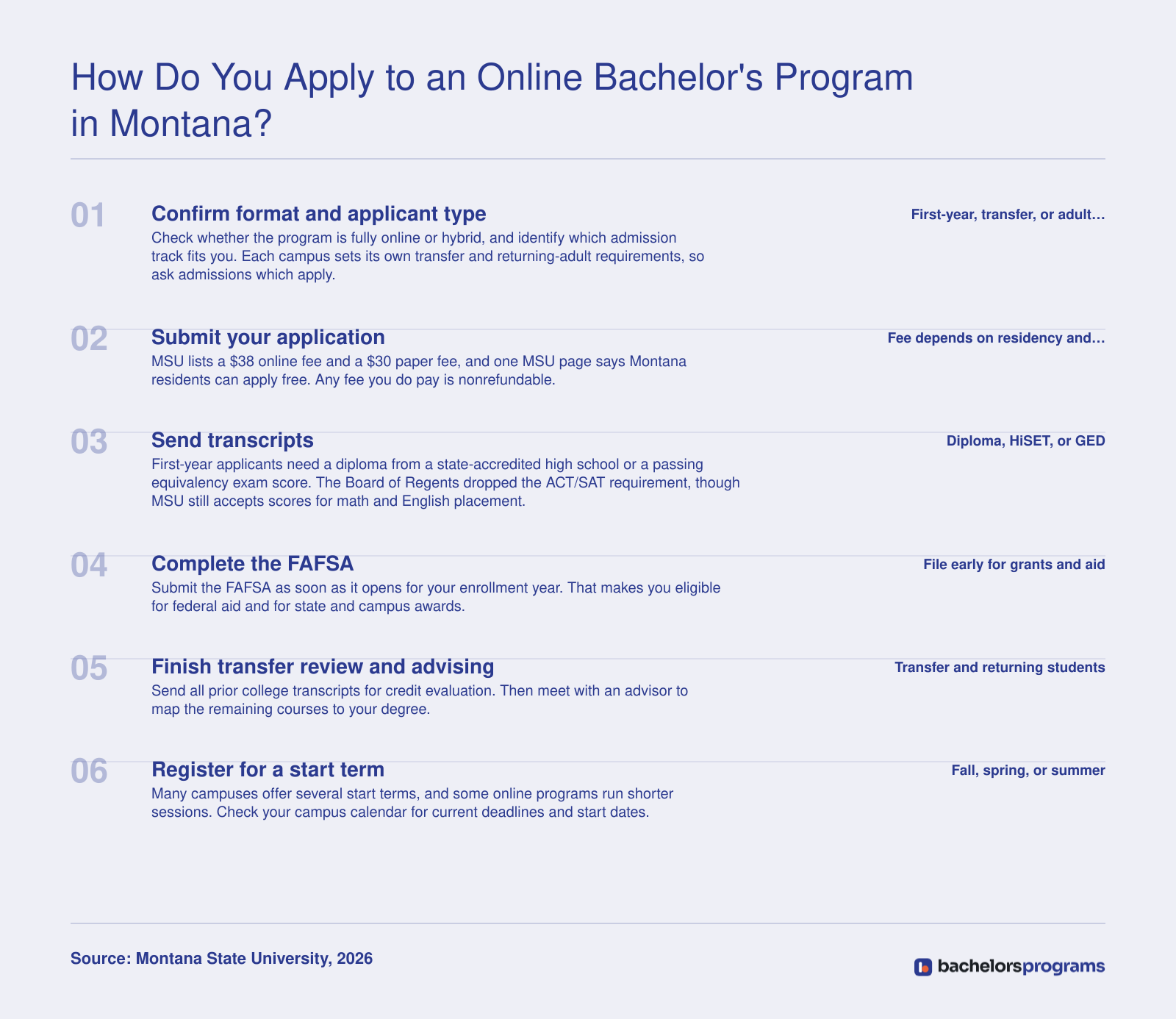
How Do You Apply to an Online Bachelor's Program in Montana?
Applying to a Montana public university online follows a predictable order, though fees, deadlines, and start dates are set campus by campus. The steps below draw on Montana State University's published admissions rules. Confirm the details with the specific campus you choose.
Graduation, Retention, and Career Outcomes for Montana Bachelor's Graduates
A low sticker price only pays off if you finish, so completion rates deserve as much weight as tuition when you compare Montana programs. Published outcome data for the state's public universities is uneven, but what is available gives you a starting point.
What the Completion Numbers Show
Montana State University's action plan, published through the Montana University System, reports a baseline first-to-second-year retention rate of 72% and a six-year graduation rate of 48% for all incoming students.1 The university set goals of 85% retention and 60% six-year graduation by 2026.1 The plan does not specify which entering class those baselines describe, so treat them as a starting point rather than this year's results.
At the University of Montana Western, federal IPEDS data shows a 51.0% graduation rate within 150% of normal time for the 2018 entering cohort, which equals six years for a four-year degree.2 For the University of Montana and other campuses, check each school's IPEDS profile on College Navigator or the Montana University System's graduation-rates dashboard for current campus-level figures.3
How to Read the Data as an Online Student
The traditional IPEDS graduation rate counts only first-time, full-time students. Many online learners in Montana are working adults, part-time students, or transfers finishing a degree they started elsewhere, and that headline number leaves them out. The newer IPEDS Outcome Measures data covers full-time and part-time students, including those who transferred in, and reports completion at four, six, and eight years. If you plan to study part-time or bring in credits, those figures describe students more like you. Ask admissions whether the online program tracks its own completion, since campus-wide rates blend online and on-campus results.
Connecting a Degree to Montana Jobs
The Montana Department of Labor and Industry reports that 3,464 Montanans trained through Registered Apprenticeship in 2025 across 65 high-demand occupations, including registered nurses, electricians, and childcare providers.4 That list is not limited to bachelor's-level jobs, but it signals where the state's labor shortages sit. Healthcare, teaching, business, and information technology are commonly cited areas of need in rural states like Montana. Several of these fields lead to state licensure, so confirm a program meets Montana requirements before enrolling.
A degree from a Montana University System campus also carries name recognition with regional employers, hospitals, and school districts, an advantage if you plan to build your career in Montana.
Early-Career Earnings for Montana Bachelor's Graduates
A bachelor's degree is linked to a clear earnings gain in Montana.
Montana Public Universities vs. National Online Universities
Most Montana residents comparing online bachelor's degrees weigh a Montana University System (MUS) campus against a large national online university. Neither is automatically cheaper or faster. The better fit depends on where your credits already sit, your career goal, and how much structure you want.
Where Montana Public Options Tend to Win
- Resident tuition: MUS campuses offer in-state rates, though some online programs use a separate per-credit price, so compare the full cost after aid rather than the headline rate.
- Credit transfer: Courses from Montana two-year colleges and other MUS campuses are built to move within the system, which can shorten a degree-completion path.
- State aid: Montana grant and scholarship programs are generally tied to in-state schools. Confirm eligibility before assuming aid follows you to an out-of-state provider.
- Licensure alignment: Teaching, nursing, and social work programs are designed around Montana licensing rules and in-state placements.
- Local recognition: Employers in Billings, Missoula, Bozeman, and smaller communities know these schools and often recruit their graduates.
- Support: Advisors and career staff understand the Montana job market.
If you already hold MUS credits or are aiming for a state license, an in-state program is usually the stronger starting point.
When a National Provider Makes Sense
A large national online university can fit better if the major you want isn't offered online in Montana, if you need monthly or rolling start dates instead of a semester calendar, or if you prefer competency-based pacing that lets you advance as soon as you demonstrate mastery. Before enrolling, ask how the school evaluates MUS transcripts, whether its licensure-track programs meet Montana requirements, and what Montana students actually pay after aid.
How Employers View Online Degrees
The research on employer perception is encouraging but not conclusive. In an Ithaka S+R study of hiring decisions, online bachelor's candidates were selected 48.4 percent of the time, compared with 51.6 percent for in-person candidates, a narrow gap. A College Transitions survey of employers that had hired online business graduates found that all of them paid those graduates the same salary as peers with in-person credentials. Neither study is specific to Montana, so treat the findings as a general signal rather than a guarantee.
Verify Accreditation Either Way
Montana's public universities are accredited by the Northwest Commission on Colleges and Universities (NWCCU). Any national provider you consider should hold recognized institutional accreditation too. Confirm it through the U.S. Department of Education or the Council for Higher Education Accreditation before you apply, because unaccredited credits may not transfer and federal aid may not apply.
Colleges in Montana with the most bachelor's programs
| School | City | Type | Bachelor's programs | Online | Net price / yr | Grad rate |
|---|---|---|---|---|---|---|
| The University of Montana | Missoula | Public | 76 | 10 | $16,784 | 48% |
| Montana State University | Bozeman | Public | 72 | 0 | $22,499 | 57% |
| Montana State University Billings | Billings | Public | 46 | 19 | $16,524 | 30% |
| Carroll College | Helena | Private nonprofit | 39 | 0 | $23,960 | 69% |
| Rocky Mountain College | Billings | Private nonprofit | 31 | 0 | $19,751 | 48% |
| University of Providence | Great Falls | Private nonprofit | 26 | 12 | $17,649 | 28% |
| Montana Technological University | Butte | Public | 25 | 0 | $16,481 | 58% |
| Montana State University-Northern | Havre | Public | 24 | 6 | $12,664 | 41% |
| The University of Montana-Western | Dillon | Public | 22 | 2 | $16,558 | 51% |
| Salish Kootenai College | Pablo | Public | 16 | 2 | $7,945 | 28% |
| Blackfeet Community College | Browning | Private nonprofit | 1 | 1 | $5,410 | 62% |
| Montana Bible College | Billings | Private nonprofit | 1 | 0 | — | — |
Program counts are the verified bachelor's listings in our directory; net price is the school-wide average a first-time undergraduate paid after aid, and graduation rate the share finishing within six years (College Scorecard).
Compare programs nationwide
Many Montana residents study online. Every ranked list above has an online lens, or browse every field.
Online bachelor's degrees Browse all fields