Best RN to BSN Programs
Compare 860+ accredited RN to BSN programs at 840+ colleges, with net price after aid, graduation rates, earnings and debt from IPEDS and the U.S. College Scorecard.

A working RN with an associate degree has little slack: a few hours between shifts, an employer reimbursement cap, and a school whose accreditation has to hold up with graduate programs and hiring managers. Per-credit pricing alone swings from $212 at the University of Central Florida to $635 at Chamberlain University. Completion windows run from 10 months at Chamberlain to as long as two and a half years at Wisconsin-Madison.
Online, hybrid, and campus formats all appear here; the best fit depends less on prestige than on how many credits transfer and where you can complete clinical hours.
Program accreditation, CCNE or ACEN, is the first thing graduate admissions offices check.
Key Points
- Your associate degree and RN license often cover around 90 credits.
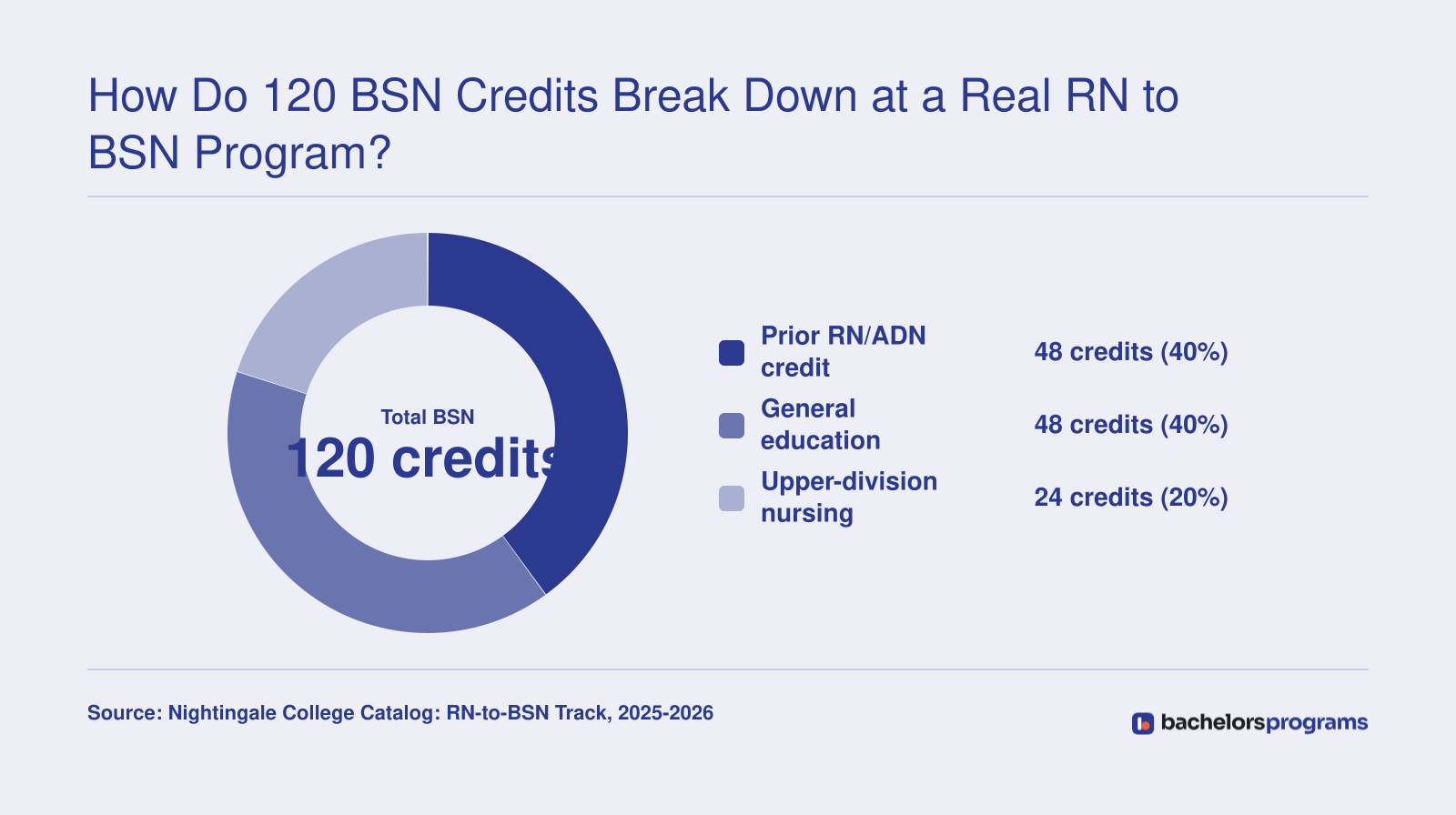
- Nightingale College's 120-credit BSN includes 48 credits granted for prior RN education.
- Estimate true cost: remaining credits times per-credit rate, plus fees.
The 10 Best RN to BSN Programs, Ranked
Ten programs made this list because they hold up on what working nurses actually weigh: what the degree costs after aid, how many students finish, and whether the schedule survives a full patient load. Every entry is a genuine BSN completion route for licensed RNs, with format, location, and an approximate average net price after aid shown on each card so you can compare like with like. Where a school's 2026-2027 admissions window is open or paused, we say so.
World Mission University
#1Los Angeles, CA · ~$16,000/yr (est.)
Best for: Working RNs wanting a compact clinical core
A small private institution in Los Angeles, World Mission University keeps its RN to B.S. in Nursing lean: 31 nursing credits layered onto a 126-credit bachelor's degree. Nurses arrive with an associate degree and an active license and transfer in the rest, so the program concentrates on upper-level clinical and community coursework. A capstone and community health field practice round out the degree, and coursework can be completed online.
- 31 nursing course credits within a 126-credit degree
- 2.0 GPA, associate degree, and active RN license required
- $11,100 total tuition for the nursing major courses
- Capstone project plus community health field practice
- Transfer credits accepted; foreign degrees need a WES evaluation
- $300 application fee, with a waiver possible
Centra College
#2Lynchburg, VA · ~$13,000/yr (est.)
Best for: Virginia nurses inside hospital-based health systems
Centra College is a hospital-affiliated school in Lynchburg, Virginia, and its RN-BSN program is built for nurses already licensed in the state. The online curriculum runs about 12 months full-time or two years part-time, and graduates leave with the BSN credential. Because the college sits inside the Centra Health system, students in that region may find clinical and capstone placements closer to home.
- 100% online, open to Virginia residents only
- Full-time finish in 12 months across 3 semesters
- Part-time track runs 2 years across 6 semesters
- Post-licensure program for nurses who already hold an RN license
- Fall entry deadline June 30; spring deadline October 31
- Median nursing graduates earn $80,832 one year out, $91,634 at four years
University of Florida
#3Gainesville, FL · ~$4,800/yr (est.)
Best for: Florida RNs needing part-time online study
The University of Florida is a large public research university in Gainesville, and its RN to BSN runs through UF Online as a part-time, fully online route for Florida-licensed nurses. Coursework builds on clinical experience in leadership, evidence-based practice, and health policy, with 90 clinical hours split between virtual simulation and independent community placements. The College of Nursing's BSN program was reported as Florida's top-ranked and No. 12 nationally in one recent ranking.
- 100% online, part-time curriculum for Florida-licensed RNs
- 90 clinical hours: virtual simulation plus community placements
- 2.8 GPA minimum and prerequisite courses required
- Two start dates per year, spring and fall
- Active Florida RN license, background check, and drug screening
- Median nursing graduates earn $73,711 one year out, $79,839 at four years
University of Virginia
#4Charlottesville, VA · $22,000/yr (est. net price)
The University of Virginia is a highly selective public university whose RN to BSN is a part-time, two-year hybrid: online coursework plus monthly in-person classes at Charlottesville, Richmond, or Fairfax. The 30-credit curriculum covers informatics, pathophysiology, research, leadership, and population health, with no direct clinical hours to arrange. Six in ten recent graduates paid no tuition, according to the school, and need-based aid is designed to meet full need.
- Part-time, two-year hybrid with monthly in-person classes
- Online classes plus sessions in Charlottesville, Richmond, or Fairfax
- 30 credit hours; 42 credits awarded for prior coursework
- No direct clinical hours required
- One start per year, in fall; employer tuition reimbursement supported
- Peer mentoring pairs each student with a working nurse
- Median nursing graduates earn $75,220 one year out, $86,653 at four years
Chamberlain University-Missouri
#5St. Louis, MO · ~$31,000/yr (est.)
Chamberlain University is a national nursing-focused institution, and its Missouri site anchors an RN to BSN option that runs entirely online. The program is built for speed: most RNs arrive with 77 proficiency credits already banked and complete the remaining 45 credits in as few as 10 months. Rolling admissions and no entrance exam make it one of the quicker programs to get started in.
- 122 total credits, with 77 proficiency credits for RNs
- 45 credits to complete; up to 15 transfer credits accepted
- Finish in as few as 10 months, 100% online
- $635 per credit; roughly $13,335 with tuition savings applied
- 2.0 GPA, nursing diploma or ADN, and active RN license
- Rolling admissions; no entrance exam required
- Median nursing graduates earn $83,188 one year out, $96,132 at four years
Bolivar Technical College
#6Bolivar, MO · ~$28,000/yr (est.)
Bolivar Technical College is a small private college in Bolivar, Missouri, with an RN to BSN completion program delivered online in 8-week terms. The format is self-directed, with virtual clinical simulations standing in for some site-based hours, and the college advertises a 5:1 student-to-faculty ratio. Students can finish in about a year, which makes it a practical choice for nurses who want the credential without pausing work.
- 100% online, self-directed, with 8-week course terms
- Finish in as little as one year
- 5:1 student-to-faculty ratio with virtual clinical simulations
- Unencumbered RN license and 2.00 CGPA required
- $50 application fee; no entrance exam
- Prerequisite science courses with labs required
University of Wisconsin-Madison
#7Madison, WI · ~$17,000/yr (est.)
The University of Wisconsin-Madison is a large public research university, and its BSN@Home route lets RNs complete the baccalaureate online through the UW System. Courses run asynchronously in 7- or 14-week terms, with one half-day campus meeting and a capstone clinical of roughly 135 hours. Students take at least 31 credits at $452 each, and the part-time pacing supports nurses working full schedules.
- At least 31 BSN@Home credits at $452 per credit
- Asynchronous online terms of 7 or 14 weeks
- One half-day campus meeting plus a capstone clinical of about 135 hours
- Part-time friendly: one to two courses per semester
- Fall and spring starts, with an optional summer term
- Median nursing graduates earn $75,513 one year out, $85,579 at four years
Ohio State University
#8Columbus, OH · $17,000/yr (est. net price)
Ohio State University is a large public research university in Columbus, and its online RN to BSN is one of the shorter completion routes on this list: 24 credits across eight courses, finished in 12 to 15 months. Classes are asynchronous and no textbooks are required, and clinical work happens through projects in the student's own community. Spring 2027 applications opened Aug 1, 2026 and close Nov 30, 2026.
- 24 credit hours across 8 courses; finish in 12 to 15 months
- Asynchronous online classes; no textbooks to purchase
- Spring 2027 applications open Aug 1 and close Nov 30, 2026
- 2.0 GPA minimum; $60 application fee
- Full-time and part-time tracks with spring, summer, fall starts
- Clinical projects completed in your own community
- Median nursing graduates earn $71,175 one year out, $81,795 at four years
University of Central Florida
#9Orlando, FL · ~$10,000/yr (est.)
The University of Central Florida is a large public university in Orlando, and its RN to BSN is fully online with clinical practice completed in the student's home community. The 120-credit degree includes a 62-credit nursing core and a capstone, with multiple starts each year. Concurrent ASN to BSN tracks with Valencia and Seminole State let local students move straight through from the associate degree.
- $212 per credit in state; 120 total credit hours
- Fully online; clinical practice completed in your home community
- 62 credits in the nursing core
- Fall, spring, and summer starts
- Concurrent ASN to BSN tracks with Valencia and Seminole State
- 2.5 GPA to stay in the program; background check required
- Median nursing graduates earn $73,765 one year out, $83,737 at four years
Florida International University
#10Miami, FL · ~$9,000/yr (est.)
Florida International University is a large public university in Miami with a fully online, cohort-based RN to BSN that finishes in about a year. The curriculum pairs 33 upper-division credits with 27 credits earned through clinical proficiency evaluation, so nurses get credit for skills they already use on the job. Cohorts enter in spring, with the next start in January 2027.
- Fully online, cohort-based, one year across 3 semesters
- 33 upper-division credits plus 27 credits by clinical proficiency evaluation
- 60 lower-division ASN credits accepted toward the 120 total
- Spring start; next cohort begins January 2027
- Spring application window runs Aug 15 to Nov 15
- Separate FIU and NursingCAS applications; $30 fee
- Median nursing graduates earn $78,671 one year out, $98,635 at four years
Cost & outcomes by school
Federal data for the highest-earning RN to BSN programs, independent of the ranking above. Earnings are this field's bachelor's graduates four years after completing where the Scorecard reports them, else the school's undergraduate median.
| School | Net price / yr | Grad rate | Earnings | Debt | Grads/yr | Format |
|---|---|---|---|---|---|---|
| Samuel Merritt University CA | — | — | $143,238 | $20,825 | 1,064 | Online |
| Massachusetts College of Pharmacy and Health Sciences MA | $39,545 | 62% | $125,557 | $25,000 | 1,676 | Online |
| Chamberlain University-Missouri MO | $30,716 | 100% | $92,405 | $20,919 | 130 | Online |
| Chamberlain University-Michigan MI | $28,045 | 100% | $92,405 | $20,919 | 278 | Online |
| Chamberlain University-Virginia VA | $33,199 | 100% | $92,405 | $20,919 | 288 | Online |
| George Washington University DC | $36,586 | 84% | $90,873 | $20,449 | 6,246 | Online |
| University of Virginia VA | $21,565 | 96% | $86,863 | $17,500 | 10,898 | Hybrid |
| Binghamton University NY | $21,620 | 82% | $80,596 | $18,500 | 8,166 | Online |
| University of Rochester NY | $29,278 | 85% | $79,042 | $21,000 | 4,350 | Online |
| San Jose State University CA | $13,760 | 69% | $78,988 | $15,000 | 12,936 | Hybrid |
| University of Washington-Bothell Campus WA | $12,319 | 65% | $78,466 | $14,615 | 3,000 | Hybrid |
| University of Washington-Tacoma Campus WA | $10,163 | 63% | $78,466 | $14,615 | 2,728 | Hybrid |
Sources: U.S. Department of Education. Net price, graduation rate, earnings and debt: College Scorecard (earnings and debt for this field's bachelor's graduates where reported, else school-wide); graduates: IPEDS. A dash means no figure is reported.
Cost, debt & payoff
Median earnings of this field's bachelor's graduates (4 yrs after completing, else the school's undergraduate median) vs. their median federal loan debt · U.S. College Scorecard
Across these programs the median graduate earns about $52,581 and finishes with roughly $21,500 in debt — a ratio that clears a common rule of thumb (keep debt below first-year salary). Net price and debt vary widely school to school, so check the per-school figures in the table above before you shortlist.
Behind the List: What Earned a School Its Spot
Low cost and flexibility are easy to find. Low cost, flexibility, and a degree that pays off rarely come together, and that tradeoff shaped which schools appear here.
What Moved a School Up
- Net price after aid: the average amount students actually pay once grants and scholarships come off the sticker price.
- Graduation and retention: how many students stay enrolled and finish, a sign the school supports people through to the degree.
- Earnings and debt: what nursing graduates earn and borrow in federal loans, where those figures are published.
- Format options: whether you can study online, on campus, or in a mix that fits a shift schedule.
Where the Numbers Fall Short
Graduation rates cover the whole institution, not RN to BSN students alone, and working nurses finishing a degree differ from first-time freshmen. Net price is an average, so your own bill may land higher or lower. Where a program's earnings aren't reported, the school was judged on everything else.
Accreditation Was the Entry Ticket
Every program here holds nursing accreditation from a recognized body such as CCNE, ACEN, or CNEA. That's a floor, not extra credit: without it, graduate nursing schools and many employers may not recognize your BSN, so an unaccredited program wasn't worth ranking at any price.
Use the list to build a shortlist, then confirm per-credit pricing and transfer policy directly with each school before you apply.
RN to BSN Program Cost: Per-Credit Rates, Fees, and the Real Total
What will an RN to BSN actually cost once transfer credits and fees are counted? Start with the credits you still need, not the school's headline price. Multiply them by the per-credit rate.
Per-Credit Rates and the Real Total
Public programs typically charge about $300 to $500 per credit, while private schools run roughly $500 to $1,200. Among the schools here, University of Texas at Arlington lists $257 per credit and a program total of $8,995. UCF lists $212 per credit, but its track covers a full 120-credit degree, so the nursing core is only part of the bill. Western Governors University skips per-credit pricing for a flat term rate: one 2026 figure puts it at about $5,325 per six months, though sources disagree. World Mission University advertises $11,100 in total tuition.
For a 30-credit completion, $300 per credit lands near $9,000, $500 near $15,000, and $1,000 near $30,000. Online programs overall tend to total between about $9,900 and $30,000, so a quote far outside that band deserves questions.
Fees the Quote Leaves Out
Per-credit rates rarely include everything. Ask about technology fees, graduation fees, background checks, and clinical compliance tracking. Application fees vary too: $30 at FIU, $60 at Ohio State, $300 at World Mission University (waivers possible). One example elsewhere: Phoenix charges $170 per course.
Net Price Is a Starting Point
The net price figures here, about $1,300 at Texas A&M University-Central Texas, $4,815 at the University of Florida, describe the whole institution. They reflect aid for mostly traditional students, not an RN to BSN quote. Treat them as a rough signal, then request a program-specific estimate.
Ways to Lower the Bill
- Employer reimbursement: Many hospitals help with tuition, so ask HR before you enroll.
- Pell eligibility: Part-time RNs may qualify, so file the FAFSA.
- Residency: Public schools often charge in-state rates to residents, and some online programs charge one flat rate to everyone. Confirm which applies to you.
Lowest Net Price Picks Among Ranked Schools
These schools report the lowest average net price after grants and scholarships among the programs ranked on bachelorsprograms.com, based on 2024 IPEDS and College Scorecard figures from the U.S. Department of Education. Keep in mind that net price is a school-wide average across all undergraduates, not a quote for the RN to BSN track. Your real cost depends on how many credits transfer in from your associate degree and what aid you qualify for, so request a transcript evaluation and a financial aid estimate before you commit.
| School | Location | Format | Avg. Net Price After Aid | In-State Tuition & Fees | Why It Stands Out |
|---|---|---|---|---|---|
| Texas A&M University-Central Texas | Killeen, TX | Online | $1,300 | $7,363 | The CCNE-accredited program requires 30 nursing credit hours, offers full-time and part-time options, and can be finished in as little as one calendar year. |
| CUNY Hunter College | New York, NY | Online coursework with in-person clinicals | $2,984 | $7,382 | Nursing major classes run fully online, and the 45 clinical hours take place at New York City community sites. Credit for prior learning is accepted, and applicants need a 3.2 GPA. |
| University of Florida | Gainesville, FL | Online | $4,815 | $3,876 | Coursework is 100 percent online, with spring and fall starts and an 85 percent institutional graduation rate. Applicants need an active Florida RN license. |
Transfer Credits, Residency Minimums, and a Realistic Timeline
An RN to BSN program is the final stretch of a standard 120-credit bachelor's degree, and you usually bring most of those credits with you. Your associate degree, general education courses, and RN license often cover around 90 credits. That leaves roughly 30 credits of upper-level nursing work.
How Your ADN and License Count
Policies differ in the details:
- West Coast University: Accepts up to 90 credits. That includes as many as 39 in general education and 51 in lower-level nursing, with the nursing credits documented by your RN license.
- Drexel University: Caps transfer at 135 of 180 quarter credits (about 90 semester credits) and requires a C or better in each course.
- Liberty University: Awards 39 credit hours for the RN license and accepts up to 75 percent of the degree in transfer.
- Arkansas State University: Typically moves ADN or diploma coursework and a current license over as a block.
Residency Sets a Floor
Schools also require a minimum number of credits earned with them. Ohio State requires at least 30 of its 120 credits in residence, along with a general education seminar and a citizenship requirement. Its 4-credit transfer cap applies only to courses from another RN to BSN program, not to your ADN. Residency rules put a floor under both your timeline and your tuition, however many credits you bring.
Advertised vs. Realistic Timelines
Advertised timelines of 9 to 12 months assume three things: full-time study, a complete transfer package, and no missing prerequisites. Keiser notes that eligible RNs typically finish in 12 months. Ohio State lists 12 months full-time but 18 months (four semesters) part-time, and Arkansas State University lists anywhere from 10 to 24 months. A gap in statistics, chemistry, or English composition can add a term or more before upper-level courses open.
Three formats produce the fastest finishes: competency-based models that let you advance once you show mastery, accelerated 7- or 8-week terms, and year-round starts that skip long summer breaks.
How Do 120 BSN Credits Break Down at a Real RN to BSN Program?
At Nightingale College, the 120-credit BSN has three parts: 48 lower-division nursing credits granted at enrollment for your prior RN education, 48 general education credits that transfer coursework can satisfy, and 24 upper-division nursing credits taken in the program. Other schools divide the total differently: National University applies up to 21 credits for the NCLEX-RN, and SUNO notes that some students may need electives to reach 120. The upper-division nursing core is usually around 30 credits (30 at the University of Oklahoma and UW-Green Bay, 31 at New Mexico Northern and SUNO), and because you complete it inside the program, it sets the minimum length of your degree.
Related Articles
Questions to Ask Yourself
Can your own unit host the community health practicum, or will the school have to place you?
Do rotating shifts rule out any program with scheduled live sessions?
Is your state on the program's authorized enrollment list?
Would seven-week accelerated terms actually fit your life, or is a 16-week term more realistic?
The advertised per-credit price is not your bill. How many credits you still need to earn is what actually decides both your total cost and your timeline.
RN to BSN programs by state
RN to BSN Questions We Hear Most
Quick answers on speed, transfer credit, and employer funding. Policies vary by school and by employer, so confirm specifics with each admissions office and your HR department.
Which online RN to BSN formats let you finish fastest?
How many credits transfer into an RN to BSN program?
Can hospital tuition reimbursement cover an RN to BSN, and what strings are attached?
Compare RN to BSN programs on the data that matters
Explore more Nursing majors or browse every field of study.
All Nursing programs Browse every field of study