Online Colleges and Bachelor's Degree Programs in Illinois
Every verified bachelor's program at a college in Illinois: 2,900+ programs at 70+ colleges, with the online options, net price and graduation rates behind each one.

Online delivery is now routine at Illinois public universities, but pricing rules are anything but uniform. At the University of Illinois Springfield, students in online programs taking only online courses pay one e-tuition rate regardless of residency. Elsewhere, per-credit charges, fees, transfer limits and aid eligibility can shift the real cost considerably.
Program lists show where degrees exist, not what they cost after aid, whether MAP applies, or how many community college credits transfer through the Illinois Articulation Initiative.
In licensed fields such as nursing and teaching, an online degree is only as valuable as its approval for Illinois licensure.
Key Points
- University of Illinois Springfield charges online-only students one rate, resident or not.
- The Illinois Articulation Initiative moves community college credits toward online degree completion.
- Illinois MAP Grant aid hinges on residency, enrolling campus and credit load.
Popular degrees in Illinois
Bachelor's degrees in Illinois by field
Business & Management
- Marketing76 programs
- Business Administration55 programs
- Finance48 programs
- Accounting44 programs
- Management43 programs
- Communication34 programs
- Economics33 programs
- Human Resource Management or HR Management32 programs
Science & Engineering
- Biology56 programs
- Mathematics54 programs
- Chemistry44 programs
- Biochemistry38 programs
- Physics28 programs
- Natural Resources or Conservation20 programs
- Anthropology19 programs
- Environmental Science18 programs
Education & Teaching
- Science58 programs
- Secondary Education48 programs
- Elementary Education43 programs
- English Education38 programs
- Special Education34 programs
- History Education33 programs
- Mathematics Education33 programs
- Early Childhood Education or Child Development30 programs
Arts & Design
- Art or Art Studies54 programs
- Fine Arts or Studio Art53 programs
- Graphic Design38 programs
- Media Arts or Digital Media26 programs
- Audio & Music24 programs
- Art History21 programs
- Creative Writing16 programs
- Digital Photography8 programs
Liberal Arts & Humanities
- English51 programs
- Literature or English Literature43 programs
- History39 programs
- Spanish32 programs
- Philosophy31 programs
- Global Studies15 programs
- Gender & Sexuality Studies14 programs
- Global Health or Health Studies13 programs
Computers & IT
- Computer Science72 programs
- Cybersecurity23 programs
- Innovation or Technological Entrepreneurship20 programs
- Computer Information Systems19 programs
- Artificial Intelligence16 programs
- Information Technology15 programs
- Software Development & Engineering11 programs
- Computer Engineering10 programs
Communications & Media
- Communications46 programs
- Journalism41 programs
- Communication Disorders16 programs
- Public Relations15 programs
- Speech Pathology14 programs
- Strategic Communications9 programs
- Professional Writing7 programs
- Social Media1 program
Social Work & Social Sciences
- Sociology54 programs
- Political Science, Government40 programs
- Social Work24 programs
- Public Policy15 programs
- Human Services9 programs
- Disability Studies1 program
Healthcare
- Health Sciences32 programs
- Exercise & Sports Science27 programs
- Public Health21 programs
- Speech Pathology15 programs
- Nutrition12 programs
- Health Education9 programs
- Community Health6 programs
- Health Informatics3 programs
Nursing
- Bachelor of Science in Nursing57 programs
- Nursing (RN to BSN)28 programs
- Accelerated BSN (ABSN)17 programs
- LPN/LVN to BSN7 programs
Criminal Justice & Law
- Criminal Justice27 programs
- Criminology15 programs
- Criminal Justice Administration12 programs
- Legal Services8 programs
- Forensic Science6 programs
- Paralegal4 programs
- Legal Studies4 programs
- Fire Science or Fire Administration2 programs
Psychology
- General Psychology51 programs
- Applied Psychology4 programs
- Industrial Organizational Psychology3 programs
- Developmental Psychology3 programs
- Forensic Psychology2 programs
- Clinical Psychology2 programs
- Health Psychology1 program
- Counseling Psychology1 program
Natural & Applied Sciences
- GIS and Geoscience9 programs
- Agriculture or Agricultural9 programs
- Neuroscience9 programs
Religion & Theology
- Christian Studies or Religious Studies13 programs
- Christian Ministry or Ministry Leadership7 programs
Counseling
- Behavioral Health Science5 programs
- Substance Abuse Counseling1 program
How Online Bachelor's Degrees Work in Illinois: Online, Hybrid and What Still Happens on Campus
A college-wide "online" label tells you almost nothing about how a specific degree is delivered, so read each program page before you rely on it.
Three Delivery Models
- Fully online: Every course, advising session and exam happens remotely, though some require a proctor.
- Mostly online: Coursework is remote, with occasional campus visits for orientation, labs or a capstone.
- Hybrid: Online and classroom sessions are mixed on a regular schedule, often weekly or every other week.
Live Classes or Self-Paced
Synchronous courses meet at set times by video. They suit learners who want discussion and quick feedback from instructors. Asynchronous courses let you work through lectures and assignments by weekly deadlines, which fits shift workers and parents with unpredictable hours. Many programs combine both, so check each course.
Requirements That Stay In Person
Some parts of a degree cannot be moved online. Watch for:
- Proctored exams at a testing center or through remote monitoring software.
- Clinical placements in nursing, arranged near where you live.
- Student teaching in education, usually a full semester in a school.
- Field practicums in social work, with supervised hours at an agency.
Several Illinois public universities run online degree-completion programs built for transfer students and working adults, letting you bring existing credits and finish the upper-division coursework remotely.
Ask Admissions Before You Apply
1. Are any courses, exams or orientations required on campus, and how many visits does the full degree need? 2. Are classes live at set times, or can I complete them on my own schedule? 3. Who arranges clinical, student-teaching or practicum placements, and can they happen near my home?
What Online Bachelor's Degrees Cost at Illinois Public Universities
Paying a university's online rate for all 120 credits is a very different bill from paying it for the last 60. Most online students in Illinois arrive as transfer or degree-completion students, so the 60-credit estimate is the more realistic one.
Per-Credit Rates With Published Figures
The rates below are for 2025-26, and each 60-credit estimate simply multiplies the per-credit figure by 60.
- Governors State University: $373 tuition plus $75 in mandatory online fees, or $448 per credit.1 A 60-credit completion costs about $26,880.
- University of Illinois Urbana-Champaign: $433 per credit base rate for applicable online sections, or about $25,980 for 60 credits before fees.2 The registrar's schedule does not give a full fee total, so the real figure will be higher.
- Southern Illinois University Edwardsville: $443.30 per semester hour in combined undergraduate tuition and fees, or about $26,598 for 60 credits.3 This is the standard part-time rate, not an online-specific one, so confirm the online price before budgeting.
Several other public universities offer online bachelor's programs without publishing a comparable per-credit schedule. Check each bursar or online-program tuition page directly.
The Cheapest Online Bachelor's Degree in Illinois
Of the schools with clear numbers, Governors State has the lowest all-in online rate. That is not a definitive ranking of every public university, though. The University of Illinois Springfield charges a separate e-tuition rate for admitted online-program students. It bundles mandatory fees, assessments and online academic support, so compare it on total cost rather than headline tuition.
The largest saving usually comes before any of these rates apply. Completing the first 60 credits at an Illinois community college, then transferring, typically costs far less than the same credits at a four-year school. Pair that with one of the lower online rates above for the final 60.
Fees Other Guides Skip
Sticker tuition is rarely the full bill. Governors State's $75 per credit in fees covers online instructional support, health and wellness and other charges1, which is why its total sits well above its tuition. Look for these on any school's fee page:
- Online course or distance-learning fees
- Technology or instructional support fees
- Proctoring charges for exams, sometimes billed per test
- Per-term fees that apply even at low credit loads
A flat online rate that folds fees into tuition makes comparison easier, so ask whether one applies.
Private Nonprofit Programs
Private nonprofit universities generally charge more per credit than the public options above. Request each school's current online undergraduate rate and any transfer-credit discount in writing before comparing.
Do Out-of-State Students Pay More for Online Tuition at Illinois Universities?
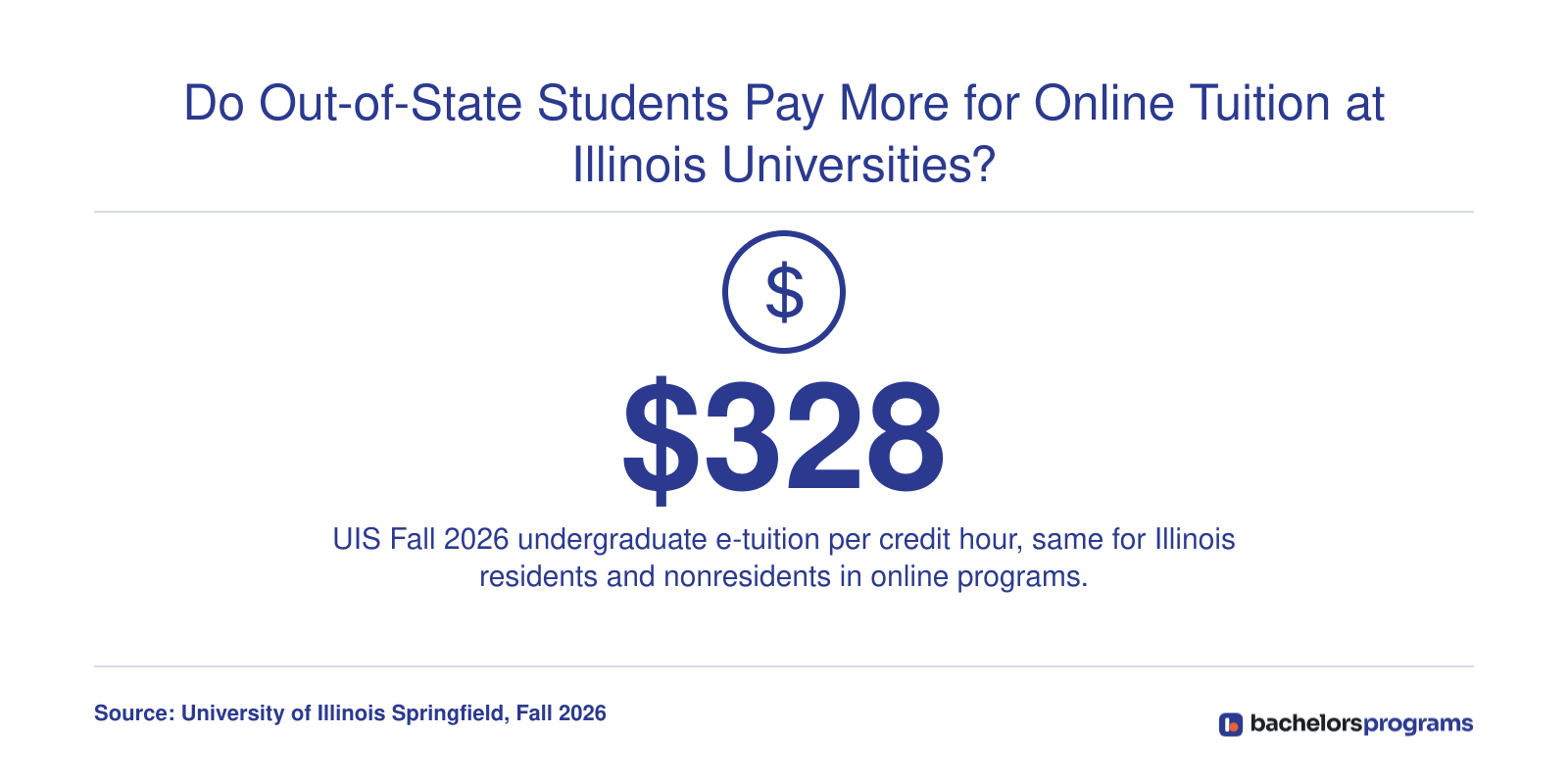
At the University of Illinois Springfield, students admitted to an online degree program who take only online courses pay one e-tuition rate whether or not they live in Illinois, so out-of-state learners effectively pay the in-state price. The Fall 2026 rate shown here, $328.25 per credit hour plus a $45 per-credit online academic support fee, applies to non-guaranteed undergraduates. Guaranteed-tuition cohorts pay different rates (Summer 2026 entrants were listed at $386 per credit hour), and taking a non-online course can trigger nonresident pricing. At UIUC, some fully online programs charge residents and nonresidents the same rate, while a few set separate rates. Before you assume a residency discount or surcharge, ask NIU, SIUE, Illinois State, Eastern Illinois, Western Illinois and Governors State for their current online tuition schedules.
Net Price, the Illinois MAP Grant and Other Aid for Online Students
The cheapest sticker price in Illinois is rarely the cheapest degree, and online study adds a wrinkle: the aid that lowers your bill depends on where you live, which campus you enroll through and how many credits you carry.
Sticker Price vs. Net Price
Published tuition is the sticker price. Net price is what students actually pay once grants and scholarships are applied, and it often lands well below the published figure. Every Illinois college that receives federal aid runs a net price calculator on its site. Run the calculator for each school on your list before comparing tuition side by side.
How MAP Works for Online Students
The Illinois Monetary Award Program is the state's need-based grant for undergraduates, and it does not exclude online enrollment.2 You need Illinois residency (12 continuous months before the academic year, with Illinois as your true, fixed and permanent home)3, admission to a MAP-approved Illinois institution or eligible Illinois campus, financial need, and no bachelor's degree yet. Part-time students qualify at a minimum of 3 credit hours and must stay enrolled at least that long through the school's refund and withdrawal period.1 MAP pays tuition and mandatory fees up to an annual maximum ISAC sets each year, and lifetime eligibility caps at the equivalent of 135 semester credit hours. Because funds are limited, returning recipients who file by ISAC's annual priority deadline get paid first, and the money can run out.2 Out-of-state students are excluded; at multi-state institutions, only the Illinois campus can award MAP. Undocumented Illinois students who cannot file the FAFSA may use the state's Alternative Application for Illinois Financial Aid.
Other Illinois Aid Worth Checking
AIM HIGH, offered through the state's 12 public four-year universities, covers full-time undergraduate cost of attendance for students who attended an Illinois high school, with household income at or below eight times the federal poverty guideline and a 135-credit lifetime cap.4 The Illinois Veteran Grant covers tuition and mandatory fees for four academic years at public two- or four-year colleges; it requires 15 years of Illinois residency and at least one year of active duty.5 Pell Grants, employer tuition assistance and military benefits stack on top of state aid, which matters most for working adults completing a degree part time.
File Early, Not Late
The most useful thing you can do is submit the FAFSA as soon as it opens. MAP funds go to the earliest filers, so filing early puts you ahead of applicants who wait.
Online Colleges in Illinois That Accept Transfer Credits
Transfer credit shapes the cost and the length of an Illinois bachelor's degree more than any other single factor. The question is not whether an online program takes credits from somewhere else, but how many, from where, and what still has to be earned at the school granting the degree.
The Illinois Articulation Initiative
The Illinois Articulation Initiative (IAI) is the statewide framework behind those transfers. More than 100 Illinois institutions participate, and an approved General Education Core Curriculum course transfers to satisfy the corresponding requirement at receiving schools.1 Finish the full GECC at a community college and you generally do not repeat lower-division general education after you transfer. An associate degree built on that core usually covers the same ground, though it is worth confirming with a degree audit that your specific associate includes the complete package.
Western Illinois University goes further: an AA or AS from any regionally accredited U.S. college satisfies its general education requirement and guarantees admission, with extra associate credits able to count toward the major or electives.2 UIS describes its transfer policy as generous and points students to Transferology to see how courses land before applying.3
Residency Requirements and Transfer Caps
Policies differ by program, major and accreditation, so treat any single number as program-specific rather than university-wide. Governors State's online BA in Interdisciplinary Studies requires 30 credits from the university and can be finished in as few as two semesters, though the figure applies to that program, not to every major there.4 Do not assume one Illinois public's cap carries over to the next; ask each school directly for its community-college limit, total transfer limit, and minimum residency credits.
Partnerships and Prior Learning
Concordia University Chicago runs 3+1 partnerships, where three years at a community college are followed by a final year at the university, often online.5 The label alone does not guarantee all 90 community-college credits transfer, so verify course by course. Credit for prior learning, CLEP and AP exams, and military credit can shave additional terms off a degree.
With roughly 60 credits in hand, a full-time online completion program typically runs about two years. Accelerated 7- or 8-week terms can shorten that calendar time; part-time enrollment stretches it.
The Fastest Low-Cost Route to an Illinois Bachelor's Degree
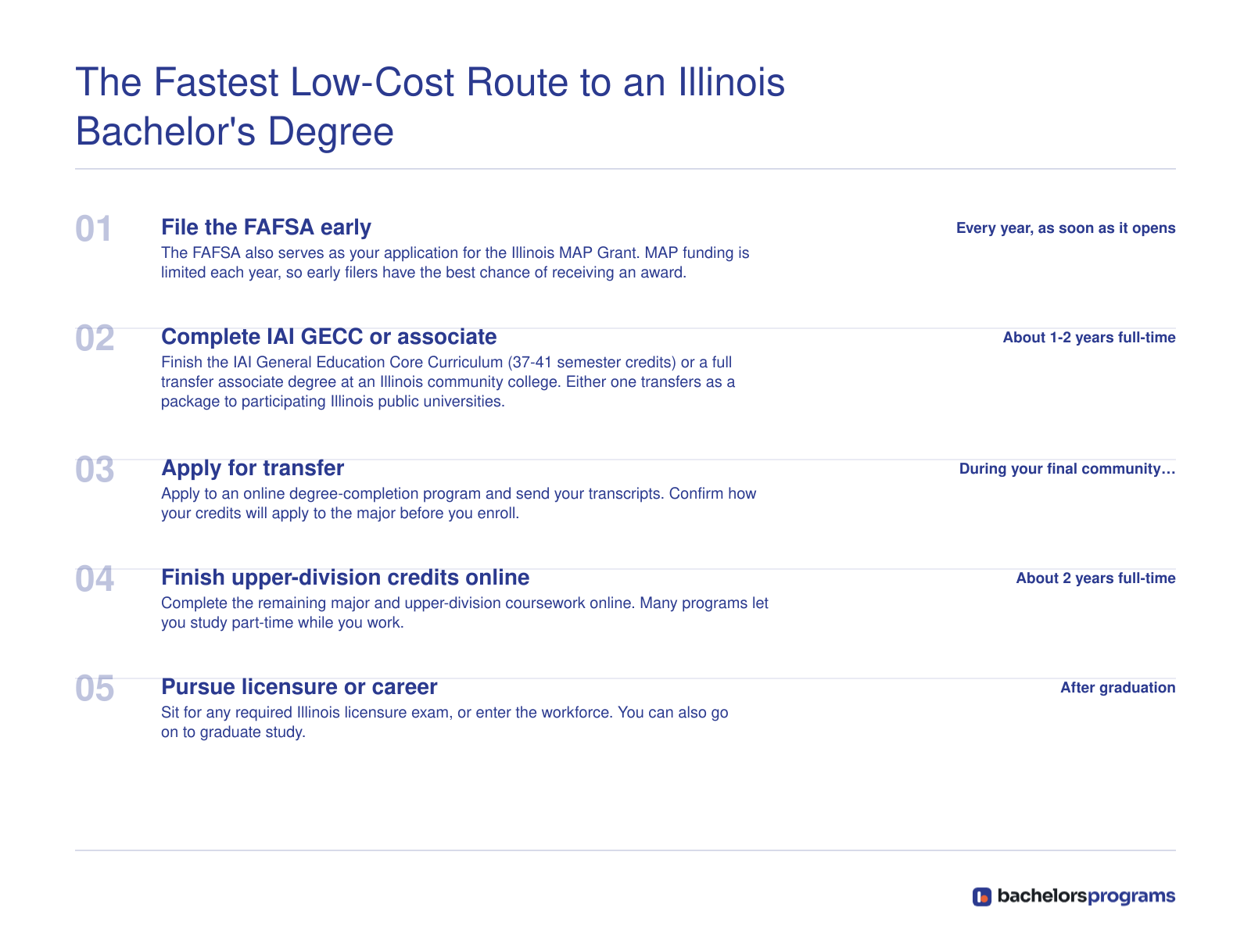
For most Illinois residents, the cheapest and quickest path to a bachelor's degree starts at a community college and ends in an online degree-completion program. You take lower-division credits at community college tuition rates, and the Illinois Articulation Initiative lets those credits transfer as a block. That leaves only upper-division coursework at university prices, so you avoid repeating classes and adding semesters.
Admissions Requirements and Deadlines for Online Students in Illinois
Most online bachelor's students in Illinois apply as transfer or returning adult applicants. Policies differ by school and by program, so treat the details below as a starting checklist and confirm current rules with each admissions office.
- Minimum transfer GPAUIS, NIU and Governors State each set a 2.0 cumulative minimum for transfer applicants. UIS calculates it from all transferable coursework, including attempted credits. Some Governors State programs require a higher GPA.
- Transferable credit hoursGovernors State expects at least 24 college credit hours. At UIS, applicants with fewer than 24 semester hours must also submit first-year credentials. NIU reviews applicants with 12 to 24 earned credits against first-year requirements.
- Official transcripts and good standingPlan to send official transcripts from every college you attended. NIU also requires good standing at your last institution.
- Transfer credit limitsUIS accepts up to 90 transfer hours combined and requires at least 30 hours completed at UIS.
- Fees and program prerequisitesCheck each school's application fee and ask about waivers. Some programs add their own prerequisites. RN-to-BSN tracks, for example, typically require an active RN license.
- Freshman applicants and testingUIS generally looks for about a 2.5 GPA from freshman and adult learners, though this varies by program. Illinois law lets applicants to public universities decide whether to submit SAT or ACT scores. Confirm any program-specific exceptions with the school.
- Deadlines and start datesUIS describes its online undergraduate admission as rolling, but most programs list cutoffs of August 10, 2026, for Fall and December 28, 2026, for Spring 2027. NIU's deadlines are May 15 for Summer, August 1 for Fall and December 1 for Spring.
- Adult learner tipIf you have work experience, military training or professional certifications, ask each school whether it awards credit for prior learning before you apply.
Outcomes: Graduation Rates and Earnings at Illinois Online-Offering Universities
Outcomes are where recruiting language gives way to record. For Illinois, the most usable public numbers come from the federal College Scorecard and from each university's own reporting. Read every one of them as institution-wide: they describe all undergraduates at the school, not the students who specifically studied online.
Graduation and retention
- Northern Illinois University: 64% of first-time students return for a second year.1 Its eight-year outcome cohort shows 64% graduated, 24% transferred to another institution and 11% withdrew.
- Southern Illinois University Carbondale: a 62% graduation rate in published reporting.
- Illinois State University: 65%.
- Eastern Illinois University: 47%.
Definitions move between campuses. SIUE's 2026 fact book, for instance, lists 90% retention and 75% six-year graduation as institutional goals rather than achieved results2, and its methodology notes that students counted in graduation rates are not also counted in retention rates. Ask an admissions office which cohort and year a rate covers before you rank schools on it.
Retention is the earliest reliable signal. A university that loses a third of its first-year class is telling you something about advising, scheduling and cost, and online students lean harder on all three.
Earnings and what employers actually see
Federal data puts Northern Illinois graduates' median annual earnings at $64,583.1 Earnings are published for defined windows after entry, so compare campuses using the same window rather than mixing them.
An Illinois public university diploma does not indicate delivery format. Online graduates hold the same transcript and the same degree as the students who sat in the lecture hall, and employers see no distinction.
Where outcomes really diverge is by major. A nursing or accounting bachelor's and a studio art bachelor's from the same campus post very different earnings, far more than online versus on-campus ever will. Pull the program-level earnings for your intended field on College Scorecard before you commit.
Earnings Snapshot for Illinois Bachelor's Graduates
A bachelor's degree carries real earning power in Illinois, whether you earn it on campus or online.
How to Choose the Right Illinois Online College for Your Situation
Online degrees are no longer a niche option in Illinois, so the real question is fit, not availability. The best school depends on what you are bringing to the table.
Match the School to Your Profile
- Community college graduates: Favor public completion programs that honor the Illinois Articulation Initiative (IAI), since a finished general education core should transfer as a block.
- Working adults: Look for asynchronous courses in 8-week terms and a clear policy on credit for prior learning, which can shorten the path.
- Out-of-state learners: Seek schools that charge one flat e-tuition rate, so residency does not inflate the bill.
- Licensure seekers: Confirm the program is approved in Illinois and ask what placement support exists for clinicals or field hours.
A Short Checklist
Before you commit, verify each of these in writing:
- Delivery format, including any required campus visits or proctored exams
- Total cost of the credits you will still need after transfer
- MAP grant eligibility for your enrollment type
- The school's transfer credit cap
- Regional accreditation, plus programmatic accreditation where it applies
- Graduation and earnings outcomes on College Scorecard
Get a Transfer Evaluation First
Request an unofficial transfer credit evaluation from two or three schools before you apply. Most admissions offices will do this for free if you send transcripts. That one number, the credits accepted, drives both your final cost and how long you will take to finish. Two schools with similar sticker prices can differ by a full year of coursework once credits are counted, so let the evaluations, not the brochures, break the tie.
Questions to Ask Yourself
How many of your credits will transfer under IAI, and how many upper-division credits will you still pay for?
Will you take enough credit hours each term to qualify for the MAP grant?
Does your target career need in-person placements in Illinois that the program can arrange near you?
If you live outside Illinois, does your chosen school charge one flat online rate or an out-of-state premium?
Colleges in Illinois with the most bachelor's programs
| School | City | Type | Bachelor's programs | Online | Net price / yr | Grad rate |
|---|---|---|---|---|---|---|
| Southern Illinois University-Carbondale | Carbondale | Public | 115 | 20 | $13,297 | 62% |
| DePaul University | Chicago | Private nonprofit | 113 | 15 | $30,902 | 68% |
| University of Illinois Urbana-Champaign | Champaign | Public | 107 | 3 | $14,355 | 85% |
| University of Illinois Chicago | Chicago | Public | 89 | 5 | $10,974 | 62% |
| Illinois State University | Normal | Public | 87 | 3 | $19,398 | 65% |
| Loyola University Chicago | Chicago | Private nonprofit | 86 | 4 | $36,079 | 73% |
| Western Illinois University | Macomb | Public | 85 | 15 | $12,937 | 45% |
| Eastern Illinois University | Charleston | Public | 84 | 8 | $12,786 | 47% |
| Lewis University | Romeoville | Private nonprofit | 83 | 9 | $17,028 | 67% |
| Northern Illinois University | Dekalb | Public | 83 | 7 | $13,391 | 49% |
| Olivet Nazarene University | Bourbonnais | Private nonprofit | 80 | 11 | $20,729 | 61% |
| Southern Illinois University Edwardsville | Edwardsville | Public | 78 | 12 | $14,889 | 57% |
| Bradley University | Peoria | Private nonprofit | 72 | 0 | $22,719 | 76% |
| Elmhurst University | Elmhurst | Private nonprofit | 66 | 4 | $24,185 | 70% |
| Governors State University | University Park | Public | 63 | 8 | $12,329 | 22% |
Program counts are the verified bachelor's listings in our directory; net price is the school-wide average a first-time undergraduate paid after aid, and graduation rate the share finishing within six years (College Scorecard).
Frequently Asked Questions About Online Colleges in Illinois
These answers cover the questions Illinois online students ask most often about cost, aid, timelines and credibility. Rates and policies are program-specific, so confirm current figures with each school before you apply.
What is the cheapest online bachelor's degree in Illinois?
Can out-of-state students pay in-state tuition for online degrees in Illinois?
Can I get the MAP grant for an online degree in Illinois?
How long does it take to finish an online bachelor's degree in Illinois?
Are online degrees from Illinois universities respected by employers?
Compare programs nationwide
Many Illinois residents study online. Every ranked list above has an online lens, or browse every field.
Online bachelor's degrees Browse all fields