Online Colleges and Bachelor's Degree Programs in Missouri
Every verified bachelor's program at a college in Missouri: 2,300+ programs at 60+ colleges, with the online options, net price and graduation rates behind each one.

Online bachelor's tuition at Missouri private universities with published rates runs about $427 to $635 per credit hour, which puts a 120-credit degree between roughly $51,000 and $76,000 before transfer credits or aid. Public campuses price differently, and that is where most of the confusion starts.
Three questions come up repeatedly: what the degree really costs, whether online students get in-state rates, and whether Missouri grants apply when no one sets foot on campus. School and degree listings appear elsewhere on the page. The sections here deal with cost, net price, aid, transfer, admissions and outcomes.
The answers differ by campus, so two students in the same virtual course can pay very different bills.
Key Points
- Missouri private universities charge about $427 to $635 per online credit hour.
- A completed CORE 42 block of 42-plus credits transfers as one unit.
- In fall 2024, 21.2% of Missouri students studied exclusively online.
Popular degrees in Missouri
Bachelor's degrees in Missouri by field
Business & Management
- Marketing74 programs
- Business Administration60 programs
- Accounting44 programs
- Management42 programs
- Finance41 programs
- Communication29 programs
- Sports Management27 programs
- Healthcare Administration or Healthcare Management26 programs
Education & Teaching
- Secondary Education48 programs
- Science37 programs
- Elementary Education36 programs
- English Education31 programs
- Early Childhood Education or Child Development29 programs
- Mathematics Education28 programs
- Special Education27 programs
- Physical Education24 programs
Science & Engineering
- Biology42 programs
- Mathematics40 programs
- Chemistry31 programs
- Biochemistry27 programs
- Physics20 programs
- Environmental Science15 programs
- Natural Resources or Conservation15 programs
- Engineering Technology14 programs
Arts & Design
- Art or Art Studies36 programs
- Fine Arts or Studio Art34 programs
- Graphic Design28 programs
- Media Arts or Digital Media21 programs
- Audio & Music14 programs
- Art History12 programs
- Creative Writing9 programs
- Digital Photography8 programs
Liberal Arts & Humanities
- English36 programs
- Literature or English Literature34 programs
- History32 programs
- General Studies16 programs
- Philosophy16 programs
- Spanish15 programs
- Global Health or Health Studies13 programs
- Global Studies12 programs
Computers & IT
- Computer Science47 programs
- Cybersecurity25 programs
- Information Technology17 programs
- Computer Information Systems15 programs
- Innovation or Technological Entrepreneurship13 programs
- Artificial Intelligence11 programs
- Software Development & Engineering7 programs
- Data Analytics7 programs
Communications & Media
- Communications47 programs
- Journalism26 programs
- Strategic Communications16 programs
- Public Relations13 programs
- Communication Disorders10 programs
- Speech Pathology9 programs
- Professional Writing8 programs
- Social Media3 programs
Nursing
- Bachelor of Science in Nursing51 programs
- Nursing (RN to BSN)32 programs
- Accelerated BSN (ABSN)15 programs
- LPN/LVN to BSN11 programs
Healthcare
- Exercise & Sports Science30 programs
- Health Sciences27 programs
- Public Health11 programs
- Nutrition10 programs
- Speech Pathology10 programs
- Respiratory Care Therapy5 programs
- Community Health5 programs
- Health Education2 programs
Social Work & Social Sciences
- Sociology30 programs
- Political Science, Government27 programs
- Social Work18 programs
- Human Services9 programs
- Public Policy4 programs
Criminal Justice & Law
- Criminal Justice25 programs
- Criminal Justice Administration13 programs
- Criminology11 programs
- Forensic Science8 programs
- Corrections4 programs
- Legal Studies3 programs
- Legal Services2 programs
- Homeland Security2 programs
Psychology
- General Psychology36 programs
- Forensic Psychology2 programs
- Applied Behavior Analysis2 programs
- Sport Psychology2 programs
- Developmental Psychology2 programs
- Applied Psychology1 program
- Health Psychology1 program
- Industrial Organizational Psychology1 program
Natural & Applied Sciences
- Agriculture or Agricultural20 programs
- GIS and Geoscience7 programs
- Applied Science4 programs
- Oceanography or Ocean or Marine Biology4 programs
- Neuroscience1 program
Religion & Theology
- Christian Ministry or Ministry Leadership12 programs
- Christian Studies or Religious Studies9 programs
Counseling
- Behavioral Health Science5 programs
- Mental Health Counseling1 program
How Online Bachelor's Degrees Work in Missouri
Online delivery has stopped being a single product, and the label on a program page often hides how much of the degree actually happens off campus.
What the Labels Mean
A fully online program delivers all coursework through the internet, with no required trip to campus. A hybrid program mixes online and in-person sessions. Distance education is the broader category: any instruction where students and instructors are in different places, including online, correspondence and some video-based courses. Colleges apply these terms inconsistently, so "online" on a program page does not always mean zero campus time. Read the program's requirements page, not just the headline.
Live Sessions or Your Own Schedule
Synchronous courses run live video sessions on a fixed weekly schedule, which suits students who want structure, deadlines and real-time discussion. Asynchronous courses let you complete lectures and assignments on your own schedule within weekly due dates, which usually fits working adults and parents with unpredictable hours. Many programs blend both, so check each course, not only the degree.
What to Verify Before You Enroll
- Exams: Ask whether tests are proctored online, which may require a webcam and a scanned room, or at an approved testing center near you.
- Residencies: Confirm any required campus orientation, weekend residency or capstone visit, and budget for travel.
- Hands-on requirements: Nursing, education and social work degrees require clinicals, practicums or student teaching in person, usually arranged near where you live. Ask who finds the placement.
- Login times: Find out whether the program requires attendance at specific hours.
Eight-Week Terms vs. 16-Week Semesters
Many online programs run accelerated eight-week terms, while traditional semesters last about 16 weeks. The total credit hours needed for a bachelor's degree are the same, but a single three-credit course in an eight-week term packs roughly twice the weekly workload into half the time. Taking one or two courses per term is common for students with full-time jobs. A 16-week schedule spreads the work out but keeps you enrolled in each class longer. Pick the pace you can sustain for the full length of the degree.
How Much an Online Bachelor's Degree Costs in Missouri
Among the Missouri private universities with usable published rates, online bachelor's tuition runs from about $427 to $635 per credit hour. Over the 120 credits a typical degree requires, that works out to roughly $51,000 to $76,000 before transfer credits, discounts or books. Those two ends come from Columbia College and Park University, and rates change every year, so confirm them on each school's tuition page before budgeting.
What Two Private Schools Charge
- Columbia College: Online undergraduate tuition is listed at $427 per credit hour.4 Multiplied across 120 credits, that is about $51,240 in tuition alone. The listing does not specify an academic year or any required online fee, so treat it as a starting point.
- Park University (2026-27): Online undergraduate tuition is $575 per credit hour.1 Add a $25 First Day Access fee and a $35 university fee per credit, and the real rate is $635 per credit.1 Across 120 credits, that is $76,200 before other charges.2
Park also lists a $250 per-credit rate for eligible military students.3 It is not clear whether the per-credit fees still apply at that rate, so ask the admissions office for an itemized figure.
Some private nonprofits set a separate online rate instead of applying their on-campus sticker price. Always look up the online tuition page rather than the headline tuition figure. Public universities set online rates under a different set of rules, so keep the two sectors separate in your comparison.
Costs Beyond Tuition
Park's per-credit fees show how much a line item can matter: $60 in fees on 120 credits adds $7,200 to the bill. When comparing schools, ask about each of these:
- Technology or online course fees, charged per credit or per term
- Proctored exam fees, if any courses use a proctoring service
- Books or digital materials (Park's First Day Access fee is one way a school bundles these)
- Graduation or diploma fees
Researched dollar amounts for proctoring and graduation fees at these schools were not available, so get them in writing from the school.
Why Transfer Credits Change the Real Bill
The 120-credit total overstates the cost for anyone who arrives with credits. A student bringing 60 credits pays for roughly half the degree. At Park's $635 all-in rate, the remaining 60 credits come to about $38,100. At Columbia's $427 tuition rate, they come to about $25,620 before any fees. These are estimates built from the per-credit figures, not published degree totals, and they assume every transferred credit counts toward your major and general education requirements. Ask for a written transfer evaluation before you commit, since that evaluation sets the number of credits you actually pay for.
Online Tuition at Missouri Public Universities: Per-Credit Rates and Residency Rules
Two pricing models sit behind most online bachelor's degrees in Missouri: a flat e-tuition rate that every online student pays regardless of address, or a resident rate with a nonresident charge layered on top. Which model a campus uses can swing a 120-credit total by tens of thousands of dollars, so confirm the rule before you compare sticker prices.
The clearest 2026-2027 numbers
Mizzou Online prices its bachelor's programs individually rather than publishing one universal undergraduate rate. For 2026-2027, several programs list $621.50 per credit, while Economics and Sports Analytics list $707.50. Multiplied across 120 credits, that is roughly $74,580 and $84,900.
- Standard programs: $621.50 per credit, about $74,580 at 120 credits
- Economics and Sports Analytics: $707.50 per credit, about $84,900 at 120 credits
- Summer undergraduate: $401.30 to $458.60 per credit, depending on program
Summer sessions are the cheapest per-credit option Mizzou publishes, which makes them a practical way to trim cost rather than a full-degree rate. Out-of-state students should also budget a nonresident fee of $134.20 per credit where it applies1, which pushes the $621.50 rate to about $755.70 per credit, or roughly $90,684 across 120 credits. Mizzou also charges an information technology fee, and course fees are assessed per credit and vary by program.
Full-time students hit a plateau
Part-time enrollment of 1 to 11 credits is billed per credit. At 12 to 18 credits, Mizzou switches to a semester plateau of $7,453.00 for programs priced at $621.50, or $8,484.80 at $707.50. Beyond 18 credits, the plateau applies plus a per-credit charge for each additional hour. A student finishing in four years therefore pays closer to eight plateau semesters than a straight rate times 120, so the per-credit total is a ceiling, not a forecast.
Residency rules vary by campus
Other public universities in Missouri set their own online pricing, and the rules are not uniform: some extend resident tuition to all online undergraduates, some charge a single flat rate, and some add a nonresident charge like Mizzou's. Because program-level pricing is common, check the tuition page for the exact program you want, especially completion degrees such as RN-to-BSN that are often priced separately from general bachelor's offerings.
What Missouri Students Pay After Aid: Average Net Price Compared
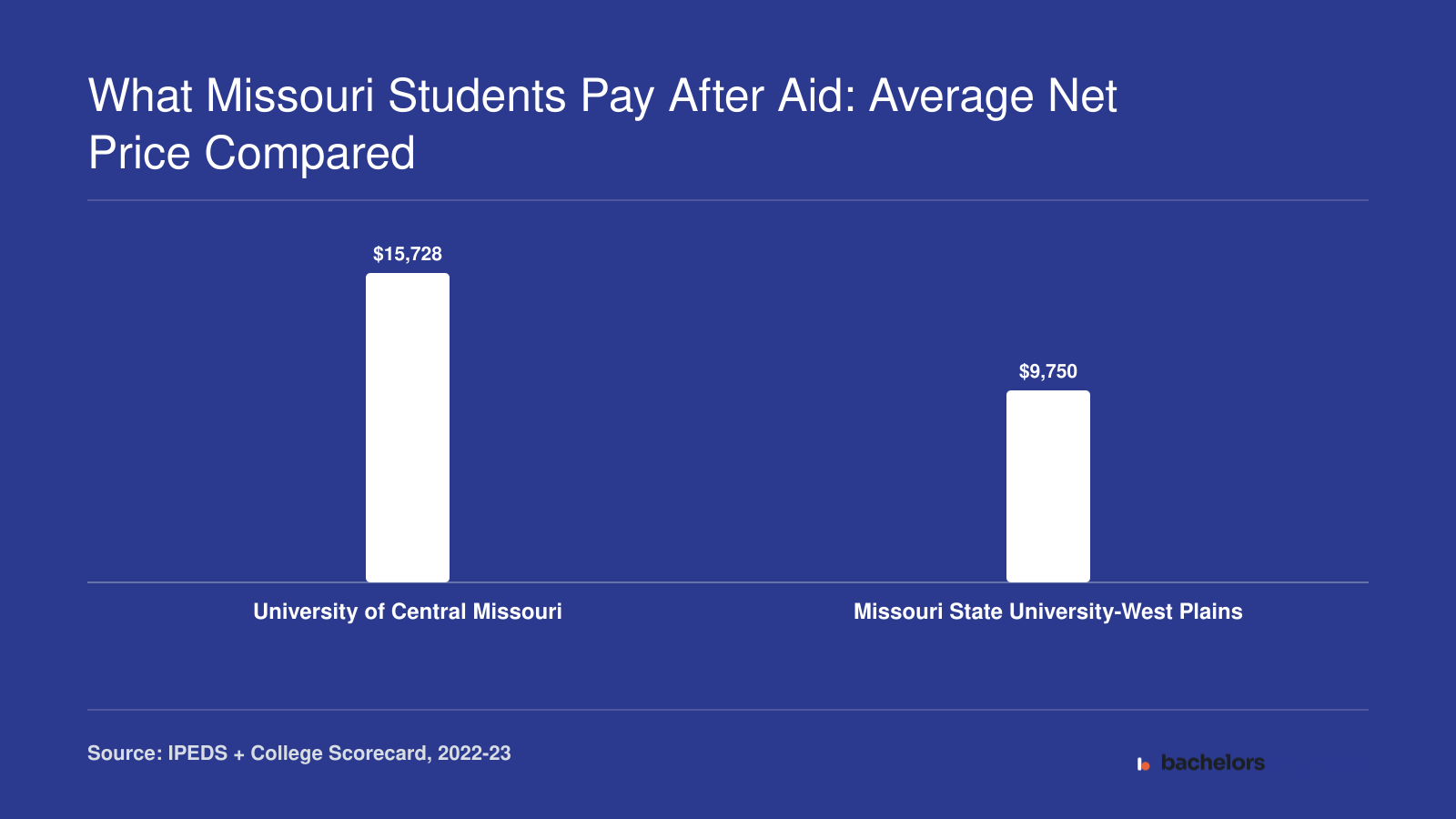
Federal net price is the average cost after grants and scholarships, and it is reported for first-time, full-time undergraduates, so adult, transfer and online students may pay a different amount. The University of Central Missouri shows the gap between sticker price and net price: its 2023-24 cost of attendance was about $34,009, while its average net price in 2022-23 federal data was $15,728. Private nonprofits can land in a similar range, with third-party program listings putting Park University near $16,013, though that figure is not confirmed as an institution-wide average and is not charted here.
Financial Aid for Online Students: FAFSA, Missouri Grants and Military Benefits
Federal aid follows an online student exactly as it follows someone sitting in a classroom in Columbia; Missouri state aid does not. That split explains why two people in the same virtual course can face very different bills, and it is the first thing to sort out before comparing tuition rates.
Federal Aid Travels With the Student
Pell Grants, federal student loans and campus-based aid depend on the college, not the delivery format. If the school is accredited and participates in federal programs, a fully online bachelor's degree qualifies for the same aid as an on-campus one. The maximum Pell Grant for the current award year is $7,395 for a full-time, full-year student; awards scale to enrollment intensity, so someone taking two courses per term receives a prorated share. File at studentaid.gov.
Missouri Grants Depend on Residency and Full-Time Status
Access Missouri, the state's main need-based grant, requires Missouri residency, U.S. citizenship or permanent residency, undergraduate standing, a Student Aid Index at or below $12,000, and full-time enrollment (12 semester hours, 8 quarter hours, or 6 semester hours for students whose documented disability limits their load) at a participating Missouri school. Awards range from $500 to $1,700 at public two-year colleges and from $1,750 to $3,500 at public four-year universities, State Technical College of Missouri, private colleges and approved virtual schools. The FAFSA priority date is Feb. 1.1
Bright Flight goes to the top 5% of Missouri ACT or SAT takers. For 2026 high school graduates, the statutory maximum is $3,000 at ACT 32 or above, with a $1,000 tier around ACT 30 to 31; no FAFSA is required, enrollment must be full-time, awards split between fall and spring, and final amounts depend on legislative funding.
Because every one of these programs pairs Missouri residency with attendance at a participating Missouri school, out-of-state students studying online generally cannot use them. A+ and Fast Track are also state-administered; confirm current amounts, deadlines and whether a specific online program qualifies with the Missouri Department of Higher Education and Workforce Development, since published details shift with each legislative session.
Military and Employer Money
The Post-9/11 GI Bill treats online study differently. A student with no in-person classes receives a monthly housing allowance set at 50% of the national average, roughly $1,198 per month in 2026.2 Adding a single in-person course can restore the standard rate tied to the school's location. Department of Defense Tuition Assistance typically caps at $250 per semester credit hour with a $4,500 annual ceiling, and Missouri schools with large military populations, including Columbia College and Park University, publish reduced per-credit rates for service members. Employer tuition assistance is the most overlooked source of all; ask human resources before assuming you are on your own.
Transfer Credit Rules and Faster Ways to Finish
Transfer in Missouri has shifted from course-by-course haggling toward a statewide framework that treats completed general education as a portable block.
How MoTransfer and CORE 42 Work
CORE 42 is a block of at least 42 credit hours of general education, adopted by Missouri's public two-year and four-year institutions beginning in 2018-2019.1 A student who completes it at one public institution has met the receiving public university's entire general education requirement, with exceptions for some professional degrees and program-specific requirements. A student who transfers early still gets credit for each CORE 42 course completed.2
The companion MOTR system guarantees one-to-one transfer for individual courses that carry the same MOTR number, even without the full block.3 The state's Approved MOTR Equivalent Course Database is the official record.4 A qualifying Associate of Arts is built for transfer and satisfies lower-division general education. An applied degree such as an AAS is not guaranteed to do the same, so confirm before you enroll.
How Many Credits Transfer Into an Online Bachelor's Degree?
Missouri has no single statewide cap. Missouri State University, for example, sets no limit on transfer credits, but you must still meet its minimum-residence and upper-division requirements. No published caps were confirmed for Columbia College, Park University or the University of Central Missouri. Many bachelor's programs nationally accept roughly half or more of a degree in transfer and require a set number of credits, often around 30, to be earned at the degree-granting school. Treat that as a typical range, not a Missouri rule, and get a written evaluation from each school.
Students who finish an associate degree after transferring can use reverse transfer.5 With at least 15 credit hours earned at a qualifying two-year college, you can send four-year credits back to earn that associate degree.
Credit for Prior Learning
Most online-focused schools evaluate credit beyond the classroom, though limits vary by school and program:
- Exams: CLEP and DSST scores may earn credit when they meet the school's minimum scores.
- Military training: Service schools and occupations are typically reviewed using ACE credit recommendations.
- Portfolios and certifications: Some schools assess documented work experience or professional certifications for credit.
Faster Terms, Lower Cost
Eight-week terms starting throughout the year let you stack courses back to back instead of waiting for a semester to open. The savings come in two forms. Every credit that transfers or is earned by exam is a credit you do not pay for at the university's per-credit rate. Fewer terms also means fewer months of enrollment, which can reduce fees and bring a paycheck-boosting degree sooner. Ask each school how many prior-learning credits it allows alongside transfer credit, since they often share one overall limit.
How Does the Community College-to-Online Bachelor's Path Work in Missouri?
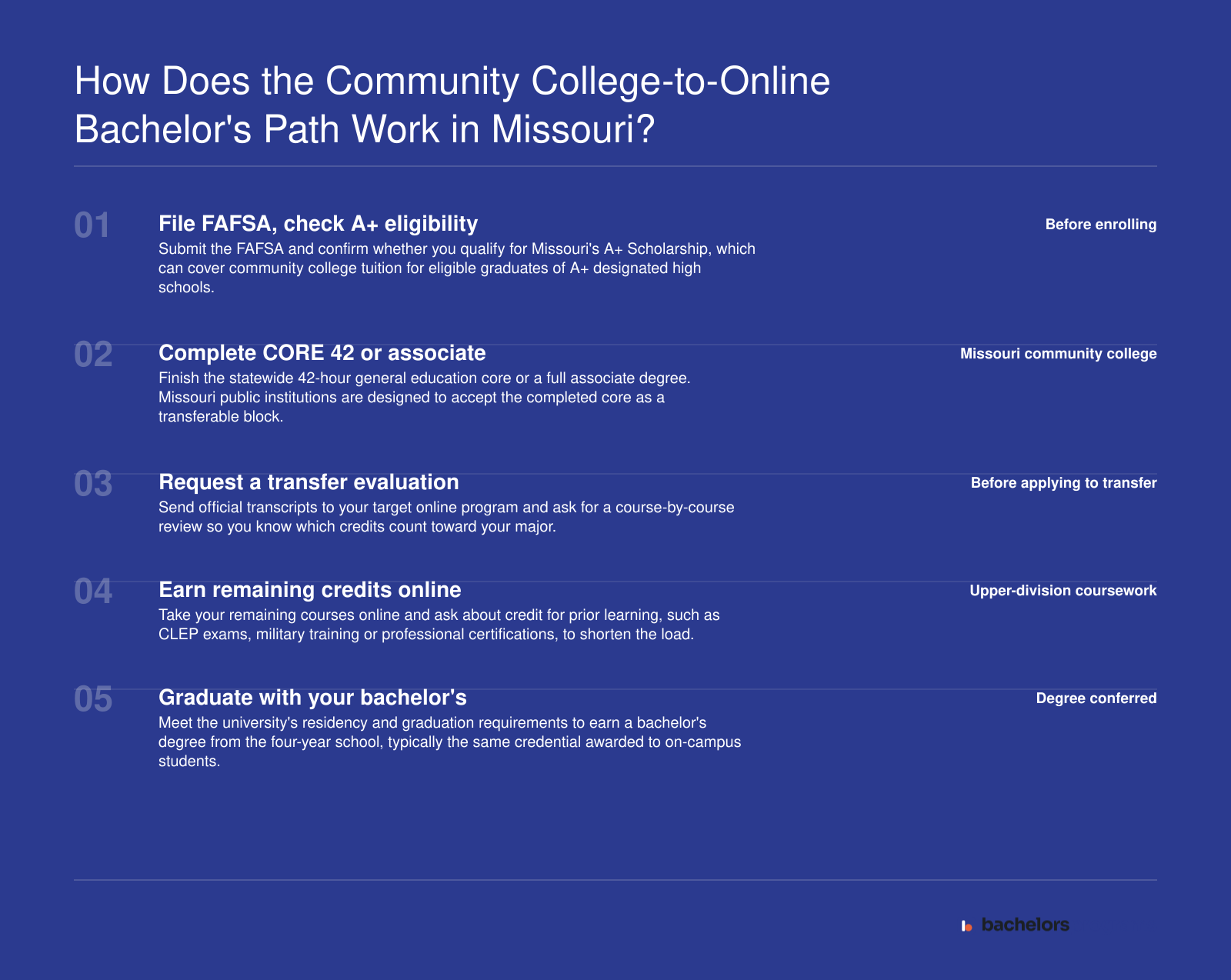
Starting at a Missouri community college and finishing online is one of the most practical ways to lower the total cost of a bachelor's degree. This route can reduce the number of credits billed at university rates, because lower-division coursework is completed at community college prices before you transfer.
Admissions, Accreditation and State Authorization Checklist
Before you apply, confirm that a program fits your background and that the school holds the approvals that protect your aid, credits and future license.
- Meet the entry requirements for your applicant typeFirst-time students usually need a high school diploma or GED, official transcripts and a minimum GPA. Transfer and adult applicants submit college transcripts, and many adult online programs are test-optional. Requirements vary by school, so check each program's admissions page.
- Plan around rolling admission and multiple start datesMany online programs accept applications year-round and offer several starts per year. Applying four to eight weeks before a term leaves time for transcripts and financial aid to clear.
- Verify institutional accreditationThe Higher Learning Commission accredits many Missouri colleges, including the University of Missouri, but not every school in the state. Confirm current status in HLC records or the school's accreditation statement. Recognized accreditation affects federal aid eligibility and whether other colleges accept your credits.
- Check programmatic accreditation where it appliesLook for CCNE or ACEN for nursing, AACSB or ACBSP for business, and CAEP for teacher education. These approvals often matter for licensure and graduate school.
- Confirm state authorization if you live outside MissouriMissouri participates in SARA, and the Department of Higher Education and Workforce Development approves participating schools each year. Search NC-SARA's institution listing. Then read the program's professional licensure disclosures, because SARA participation does not guarantee that a licensure pathway is approved in your state.
Graduation, Retention and Career Outcomes for Online Learners
In fall 2024, 21.2% of Missouri postsecondary students were enrolled exclusively in distance education, and another 28.9% took some but not all courses online.1 Only 49.9% took no distance courses at all. Nationally, 53.8% of students were exclusively distance based on federal data covering 5,615 Title IV institutions.1 Those figures are provisional, and the federal data system allows later revisions, so treat them as a snapshot rather than a final count.2
What the Numbers Miss
The familiar federal graduation rate follows first-time, full-time students who start at one college and finish at the same one. Many adult online learners are part-time, transfer in with prior credits, or stop out and return. They often fall outside that cohort entirely.
IPEDS Outcome Measures gives a fuller picture because it includes part-time and transfer-in students.3 Institution-level Outcome Measures could not be confirmed for large online schools such as Columbia College, Park University, Missouri State University-Springfield or the University of Central Missouri, so no rates for them appear here. You can look up each school's figures in the federal College Navigator tool or ask the admissions office directly.
One more limit applies. Most outcome data does not separate online graduates from on-campus graduates. A school's published rate may blend both groups.
Four Takeaways
- Online is mainstream in Missouri: Roughly half of students took at least one distance course in fall 2024.
- Check the cohort: A graduation rate for first-time, full-time students says little about a part-time adult transferring in.
- Prefer broader measures: Outcome Measures figures reflect more student types than the standard rate.
- Ask for program-level detail: Overall numbers can hide wide differences between majors and formats.
Questions to Ask Schools
- What is the first-year retention rate for students in this specific online program?
- What share of transfer students finish, and how long does it typically take them?
- Do you report completion for part-time and online students separately?
- What job placement or employer outcome data exists for my major?
A school that answers these plainly is usually tracking its online learners. Vague replies are worth noting.
The Earnings Gap a Bachelor's Degree Can Close in Missouri
A bachelor's degree is linked to a sizable pay advantage for working adults in Missouri.
How to Choose an Online College in Missouri
What should you check before you enroll in an online bachelor's degree program in Missouri? The answer depends on which constraint is tightest for you: money, time, transfer credits or support. Rank your priorities first, then run one concrete check against each.
If Cost Matters Most
Compare net price, not sticker tuition. Every Missouri college that receives federal aid must post a net price calculator, and running it with your actual financial situation takes about ten minutes. Confirm whether you qualify for the resident per-credit rate, since some Missouri public universities charge nonresident online students more. Then verify state aid: the Access Missouri Financial Assistance Program requires a FAFSA on file and qualifying enrollment status, and the A+ Scholarship can carry transferable credit into a bachelor's program.
If Speed Matters Most
Ask how many credits the school will accept in transfer and whether it awards credit for prior learning, such as military training or industry certifications. Eight-week terms let you stack two sessions per semester, but only if courses run year-round and seats are actually available in your sequence. Compare total credits required to graduate, not just the per-credit price.
If You Are Transferring
Confirm that the school accepts the Missouri CORE 42 general education block as a completed package rather than reviewing it course by course. Then ask about residency credit requirements: many colleges require a minimum number of upper-level credits earned with them, which caps how much transfer credit can count toward the degree.
If You Need Support
Ask specifically about online advising, tutoring and career services, and whether those are staffed separately for distance students or shared with the campus office. A short email to the online division tells you how quickly anyone answers.
Red Flags to Walk Away From
- No institutional accreditation from the Higher Learning Commission, the regional accreditor for Missouri schools.
- Vague answers about in-person requirements for labs, clinicals or proctored exams.
- No NC-SARA participation if you live outside Missouri, which affects complaint resolution and field placements.
- Pressure to enroll or pay before you receive a written transfer evaluation.
Build Your Shortlist
Narrow your options to three or five programs, then run the net price calculator and request a written transfer evaluation from each before you commit a deposit.
Colleges in Missouri with the most bachelor's programs
| School | City | Type | Bachelor's programs | Online | Net price / yr | Grad rate |
|---|---|---|---|---|---|---|
| Missouri State University | Springfield | Public | 117 | 26 | $17,613 | 58% |
| University of Central Missouri | Warrensburg | Public | 106 | 37 | $14,462 | 54% |
| University of Missouri | Columbia | Public | 105 | 16 | $20,268 | 75% |
| Northwest Missouri State University | Maryville | Public | 91 | 23 | $16,244 | 54% |
| Lindenwood University | Saint Charles | Private nonprofit | 88 | 51 | $19,638 | 49% |
| University of Missouri-St Louis | Saint Louis | Public | 86 | 29 | $15,071 | 57% |
| Saint Louis University | Saint Louis | Private nonprofit | 86 | 8 | $24,398 | 80% |
| Southeast Missouri State University | Cape Girardeau | Public | 85 | 7 | $15,882 | 58% |
| Park University | Parkville | Private nonprofit | 73 | 50 | $21,032 | 38% |
| Webster University | Saint Louis | Private nonprofit | 70 | 19 | $27,047 | 64% |
| University of Missouri-Kansas City | Kansas City | Public | 69 | 4 | $13,310 | 56% |
| Washington University in St Louis | St. Louis | Private nonprofit | 69 | 3 | $21,786 | 94% |
| Maryville University | Saint Louis | Private nonprofit | 65 | 33 | $22,066 | 66% |
| Southwest Baptist University | Bolivar | Private nonprofit | 59 | 7 | $21,677 | 55% |
| Missouri Southern State University | Joplin | Public | 58 | 9 | $12,007 | 42% |
Program counts are the verified bachelor's listings in our directory; net price is the school-wide average a first-time undergraduate paid after aid, and graduation rate the share finishing within six years (College Scorecard).
Compare programs nationwide
Many Missouri residents study online. Every ranked list above has an online lens, or browse every field.
Online bachelor's degrees Browse all fields