Online Colleges and Bachelor's Degree Programs in Georgia
Every verified bachelor's program at a college in Georgia: 2,300+ programs at 60+ colleges, with the online options, net price and graduation rates behind each one.

Published online tuition at Georgia public universities runs from about $159 to $603 per credit hour in 2026. Across 120 credits, that gap can exceed $50,000. Georgians can choose University System of Georgia schools, private colleges or national online providers, and each treats pricing, HOPE eligibility and transfer credit differently.
HOPE and Zell Miller funds can cover distance-learning classes, though GPA rules and hour caps still apply. A program labeled online may also require on-site labs or clinicals.
Transfer credit is often the largest cost lever. A completed USG core can cover most general-education requirements, but only if the receiving school accepts it.
Key Points
- Online credits at Georgia public universities cost about $159 to $603 each.
- HOPE and Zell Miller awards can cover online coursework in Georgia.
- For 2025-2026, 23 of 25 USG schools waived SAT or ACT scores.
Popular degrees in Georgia
Bachelor's degrees in Georgia by field
Business & Management
- Business Administration85 programs
- Marketing63 programs
- Management49 programs
- Accounting43 programs
- Logistics & Supply Chain Management31 programs
- Finance31 programs
- Communication27 programs
- Healthcare Administration or Healthcare Management23 programs
Science & Engineering
- Biology54 programs
- Mathematics44 programs
- Chemistry37 programs
- Biochemistry21 programs
- Physics20 programs
- Environmental Science12 programs
- Engineering Technology12 programs
- Anthropology11 programs
Education & Teaching
- Science56 programs
- Secondary Education52 programs
- Elementary Education37 programs
- Special Education26 programs
- English Education24 programs
- History Education23 programs
- Mathematics Education20 programs
- Physical Education12 programs
Liberal Arts & Humanities
- English46 programs
- History38 programs
- Literature or English Literature37 programs
- Spanish20 programs
- Interdisciplinary Studies19 programs
- Philosophy16 programs
- Global Health or Health Studies12 programs
- General Studies8 programs
Arts & Design
- Art or Art Studies46 programs
- Fine Arts or Studio Art39 programs
- Media Arts or Digital Media27 programs
- Graphic Design20 programs
- Audio & Music19 programs
- Art History15 programs
- Creative Writing10 programs
- Illustration7 programs
Computers & IT
- Computer Science30 programs
- Cybersecurity24 programs
- Information Technology21 programs
- Innovation or Technological Entrepreneurship12 programs
- Computer Information Systems11 programs
- Software Development & Engineering9 programs
- Artificial Intelligence9 programs
- Data Analytics5 programs
Healthcare
- Health Sciences27 programs
- Exercise & Sports Science25 programs
- Public Health22 programs
- Health Education9 programs
- Health Informatics6 programs
- Speech Pathology6 programs
- Nutrition5 programs
- Respiratory Care Therapy4 programs
Communications & Media
- Communications51 programs
- Journalism19 programs
- Public Relations14 programs
- Speech Pathology6 programs
- Communication Disorders5 programs
- Strategic Communications4 programs
- Social Media3 programs
- Professional Writing2 programs
Criminal Justice & Law
- Criminal Justice42 programs
- Criminal Justice Administration20 programs
- Forensic Science12 programs
- Homeland Security9 programs
- Legal Studies5 programs
- Criminology4 programs
- Legal Services3 programs
- Corrections3 programs
Social Work & Social Sciences
- Sociology36 programs
- Political Science, Government30 programs
- Social Work13 programs
- Human Services9 programs
- Public Policy6 programs
Nursing
- Bachelor of Science in Nursing44 programs
- Nursing (RN to BSN)26 programs
- Accelerated BSN (ABSN)16 programs
- LPN/LVN to BSN6 programs
Psychology
- General Psychology47 programs
- Forensic Psychology1 program
- Applied Psychology1 program
- Addiction Psychology1 program
- Applied Behavior Analysis1 program
- Sport Psychology1 program
- Counseling Psychology1 program
Natural & Applied Sciences
- GIS and Geoscience9 programs
- Agriculture or Agricultural5 programs
- Neuroscience4 programs
- Oceanography or Ocean or Marine Biology4 programs
Religion & Theology
- Christian Studies or Religious Studies15 programs
- Christian Ministry or Ministry Leadership6 programs
Counseling
- Behavioral Health Science2 programs
- Substance Abuse Counseling1 program
How Online Bachelor's Degrees Work in Georgia
Three Types of Providers
Georgians earning a bachelor's degree online usually choose from three kinds of institutions:
- USG public universities: Member institutions of the University System of Georgia run their own online programs, and some also share programs through USG eCampus. Under the eMajor model, several USG schools pool faculty and courses to deliver one online degree. You enroll at a home institution but may take classes taught by instructors from other system campuses.
- Georgia private nonprofits: Independent colleges in the state offer their own online and degree completion programs. They typically charge one tuition rate regardless of residency and often keep class sizes small.
- National online universities: Large out-of-state schools that enroll students nationwide. They tend to offer frequent start dates and flexible pacing, but Georgia residency earns you no tuition advantage there.
What the Delivery Labels Mean
Program pages use a handful of labels, and schools do not define them the same way:
- Fully online: All coursework is delivered online, either asynchronously (on your own schedule) or synchronously (live sessions at set times).
- Hybrid: A blend of online courses and scheduled in-person sessions on campus.
- Online with requirements: Coursework is online, but the program requires proctored exams, short residencies, clinical placements, student teaching or internships completed in person.
A "100% online" label in marketing copy does not guarantee you will never visit a campus or an approved testing or field site. Programs in fields such as nursing, education and social work build in supervised local experience by design. Ask an admissions counselor to confirm every in-person requirement in writing before you enroll.
How Online Tuition Is Set
Some USG online programs charge a separate online rate, often called eTuition, instead of the standard in-state or out-of-state rate. For Georgia residents, that rate may differ from on-campus tuition. Out-of-state students often come out ahead, because eTuition is typically set below the nonresident campus rate. Those per-credit rates vary widely from one Georgia public university to the next.
Online Tuition per Credit at Georgia Public Universities
What does an online credit hour actually cost at a Georgia public university? Published rates for 2026 run from about $159 to $603 per credit, depending on the school, the program and your residency.
Published Per-Credit Rates
- Kennesaw State University (Fall 2026, Spring 2027 and Summer 2027 schedule): $192 per credit for the online tuition schedule, and $603 per credit for out-of-state students on the eTuition rate.1
- USG eMajor (2026): $201 per credit for in-state and out-of-state students alike. eMajor states that this rate includes textbooks and tutoring.2
- Georgia Southern's eMajor Bachelor of Information Technology (2026): $201 per credit, the same eMajor rate, delivered entirely online.3
- USG eCampus eCore (2026 brochure): $159 per credit for eCore courses, with free digital textbooks advertised.4 This covers individual courses rather than a full degree, so it is not a degree-length rate.
Turning Per-Credit Rates Into a Tuition Total
Most bachelor's degrees require about 120 credits, so multiplying the rate by 120 gives a rough tuition-only figure. At Kennesaw State's in-state online rate of $192, that is about $23,040. At the eMajor rate of $201, it is about $24,120. Because eMajor includes books and tutoring, its total may sit closer to Kennesaw State's once you add materials to the $192 figure.
Out-of-state students at Kennesaw State pay the $603 eTuition rate, which works out to roughly $72,360 over 120 credits. Under eMajor, the price does not change by residency, and eMajor reports no out-of-state fees on its online courses.2 For a student living outside Georgia, that gap is large.
These totals assume you take all 120 credits at the school. Transfer credits reduce the number of credits you pay for.
Mandatory Fees Per Term
Tuition is only part of the bill. Kennesaw State lists $594 in student fees per term on its published online schedule.1 If you took about 12 credits per term over ten terms, fees would add roughly $5,940 to the tuition estimate. Part-time students who stretch a degree over more terms will pay more in fees.
Fee structures differ by campus, so check each school's bursar or tuition page for the current term schedule before you budget. Rates are reset each academic year, and the figures above reflect what the schools published for 2026 and the terms noted.
Sticker Price vs. Net Price: What a Georgia Online Degree Really Costs
A low per-credit rate looks like the cheapest path, but the number that matters is what you pay after aid. Sticker price is the published tuition and fees. Net price is what remains after subtracting grants and scholarships, and it is the better basis for comparing schools.
Net Price Anchors in Georgia
Published averages for University System of Georgia schools show how much the two can differ. Georgia Southwestern State University averages $12,019 a year, Kennesaw State University $15,048, and Georgia Southern University $15,267.1 These figures cover federal aid recipients across the whole institution and include living costs, books, supplies and fees. They are not online-only numbers, so treat them as a rough guide to how far aid can reduce a bill, not a quote for your program.
Estimating a 120-Credit Degree
Multiply the per-credit rate by 120 to get the full tuition bill. At an in-state public university, that rate is the figure to check first on the school's online tuition page. Private nonprofits and national online providers set their own rates and often price by program, so get the current per-credit figure in writing before you compare. Then subtract expected grants, and subtract again for any credits you can bring in. Halving the credits you must pay for cuts the total more than any small difference in rate.
Costs That Are Easy to Miss
- Proctoring: University of West Georgia lists live virtual proctoring at roughly $20 to $40 per exam, while Respondus LockDown Browser can cost nothing. West Georgia Technical College charges no proctoring fee when you test with Respondus or at a campus library.2
- Technology and hardware: You may need a compatible computer, webcam, microphone and reliable internet. Some schools also flag technology upgrades as a possible expense.
- Textbooks: Digital course materials are often billed separately from tuition.
- Graduation fees: Ask what the school charges to apply for and receive your diploma.
The Takeaway
Georgia residents who transfer in 60 credits and use HOPE can cut total cost the most. That combination shrinks both the credits you pay for and the rate you pay on the rest.
HOPE, Zell Miller and Federal Aid for Online Students
Georgia's HOPE Scholarship is a merit award funded by the state lottery, and it can pay for online coursework. The Georgia Student Finance Commission allows HOPE, the HOPE Grant and the Zell Miller Grant for distance-learning classes as long as every other eligibility rule is met.1 There is no separate online-only GPA, residency rule or reduced award rate.
Residency and Enrollment Conditions
You generally need 24 consecutive months of Georgia residency immediately before the first day of class in the term you are entering.2 Military personnel, spouses and dependents are classified under separate rules. If your situation is unclear, have the school's financial aid office confirm your residency classification in writing before you register.
GPA, Hour Caps and Timeline Limits
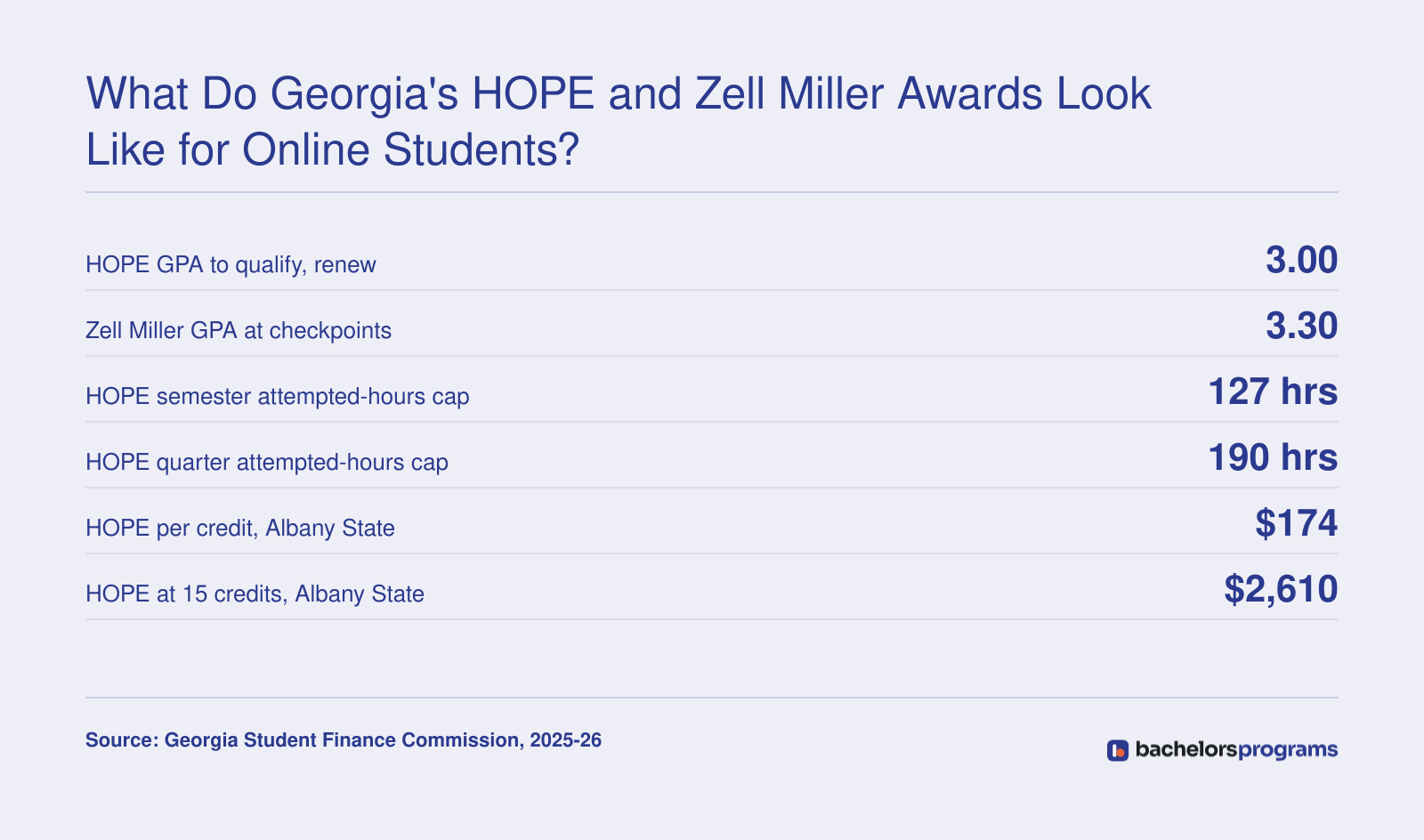
HOPE requires a GSFC-calculated 3.00 high school HOPE GPA and a 3.00 cumulative college GPA.1 The award ends at 127 attempted semester hours (190 quarter hours), at 127 combined paid hours, or when you earn a bachelor's degree, whichever comes first.2 Paid hours include prior HOPE or Zell Miller awards and Accel funding through 2011. Adults returning after a long gap often discover that credits attempted years ago still count against that ceiling.
Zell Miller is a separate scholarship with its own requirements. Do not assume its thresholds match HOPE's 3.00 standard; confirm them with GSFC or your school.
What HOPE Does Not Cover
The HOPE Grant pays for certificate and diploma programs, not bachelor's degrees. It requires a 2.00 cumulative college GPA and stops after 63 semester hours (95 quarter hours).3 Other state aid may apply: the DREAMS Scholarship, for example, is open to Georgia residents enrolled at least half-time in an associate or bachelor's program and carries a work and financial toolkit requirement.4
Federal Aid Basics
File the FAFSA to be considered for the Pell Grant, federal loans and work-study. Your program must be at an accredited, Title IV-eligible school, and the school must approve your online enrollment for aid purposes. HOPE awards at USG schools are paid per credit hour up to 15 hours per term, so the amount depends on your institution and course load rather than one flat rate.5
What Do Georgia's HOPE and Zell Miller Awards Look Like for Online Students?
These are the core Georgia Student Finance Commission figures to know before you enroll online. GPA rules and hour caps come from the 2026 HOPE and Zell Miller regulations, and the Albany State award example comes from the FY 2026 award table for the 2025-26 award year. Award rates vary by school, so check your own institution's per-credit rate.
Fully Online or Not? What to Verify Before You Apply
Can I really finish this Georgia bachelor's degree without ever setting foot on campus? Sometimes yes, but a program listed as online may still carry in-person requirements. The University System of Georgia uses "fully online" to mean a complete degree can be earned online.1 Its pages do not break that down further, so the details are yours to confirm.
Questions for an Admissions Advisor
Ask these before you apply, and get the answers in writing if you can:
- Campus visits: Is any orientation, residency or on-campus session required?
- Exams: Are tests proctored, and can they be taken remotely or only at an approved site?
- Field work: Does the degree require an internship, practicum, student teaching or clinical hours?
- Placement: Who arranges the site, and can it be near where you live?
- Schedule: Are classes asynchronous, or do some meet at set times?
Programs Where Fieldwork Is Common
Some degree types often include hands-on components even when coursework is online: education degrees with student teaching, RN-to-BSN programs with clinical or practicum hours, and social work programs with field placements. eMajor, the USG's online degree platform, lists Special Education and RN to BSN, and says courses are taught completely online with no required face-to-face meetings with instructors.2 That describes class delivery. The pages reviewed do not say whether fieldwork or clinical hours can be done remotely, so ask. Financial Technology is a similar case: delivery varies by offering and includes online, fully online and hybrid formats.3 The University of Georgia does not offer a fully online bachelor's degree, though some of its courses are online.4
Reading a Program Page
Look for plain delivery language, such as "fully online" or a stated percentage of the program delivered online (95-100% is a common benchmark for a mostly or fully online degree). Then check the catalog's degree requirements for words like practicum, field experience, clinical, capstone site or proctored. If you live outside Georgia, look for a state authorization statement showing the school can enroll students from your state, and ask about it for any program with a placement.
Last, remember that synchronous sessions can limit flexibility. A degree can be fully online and still expect you to log in at set times each week.
Transferring Credits Into a Georgia Online Bachelor's Program
Core IMPACTS Replaces Areas A-F
The University System of Georgia (USG) now uses Core IMPACTS in place of the older Areas A-F.1 Students must complete it for an AA, AS, nexus, BA or BS degree. The framework spans six domains: written communication (6 credit hours), arts, humanities and ethics (6), technology, mathematics and sciences (7), mathematics and quantitative skills (3), political science and U.S. history (3), and social sciences (3).1
A completed Core IMPACTS course at one USG institution, or through eCore, earns full credit at another USG school when the student stays in the same major.2 Transfer works by domain, not by guaranteed course-to-course match. If credit hours differ, extra credit should land in a domain where the receiving school needs more. Field-of-study courses also carry full credit within the same major.2
TCSG to USG Pathways
The Technical College System of Georgia (TCSG) and USG maintain an active articulation agreement.3 USG transfer-admission materials list 28 general education courses that move between TCSG colleges and USG institutions.4 Certain TCSG degrees also map to specific programs at specific USG schools, and the active articulation directory shows them.
Two cautions apply. Courses not on the approved lists have no systemwide transfer rule.3 An articulated course, however, is not guaranteed to satisfy a particular major's prerequisite or graduation requirement. Confirm the exact fit with the receiving school before you enroll. The Georgia Transfer College Credit Transfer Tool lets you check how courses move among USG institutions.5
Credit Caps and Residency
The USG materials reviewed here do not set one systemwide maximum for transfer credits or a single minimum number of residency hours for a bachelor's degree. Those limits can come from the receiving university, the program, an accreditor or separate Board of Regents rules. Ask each school for its figures in writing.
Routes for Adult Learners
USG institutions must offer evaluation of prior learning, including military experience, and credit that is recorded must count toward a degree. Accepted exams include AP, IB, CLEP and DSST.6 Credit for prior learning rests on verifiable college-level learning, so work experience alone is not awarded credit.6 No systemwide cap on this credit exists.
- Military credit: Service training and experience are eligible for evaluation.
- eMajor: The BS in Organizational Leadership and BS in Criminal Justice offer credit for prior learning, with post-training evaluations done in advance.7
- Degree completion: Students with 60 or more credits should ask each school how its completion programs apply earlier coursework.
Admissions, Deadlines and Benefits for Military Students
For the 2025-2026 cycle, 23 of 25 University System of Georgia institutions waived SAT or ACT scores for applicants1, a policy that matters most to adult learners and transfer students returning after time away from school.
Access-Mission and Selective Campuses
At Georgia Gwinnett College, transfer applicants need a 2.00 GPA2. Priority deadlines are May 1 for fall, November 1 for spring and April 1 for summer, with a final fall application date of July 8 and documents due July 15. Georgia College & State University sets a 2.5 GPA for most majors and 3.0 for nursing and education, with June 1 and November 1 deadlines and an application fee waiver for applicants who bring 30 transferable semester hours3. Selective universities raise the bar. The University of Georgia requires at least 30 transferable credits and, for the 2026 cycle, a 3.50 GPA for applicants with 30 to 59 hours and 3.20 for those with 60 or more4. Its transfer deadline is March 1, the application opens January 22, and the fee is $705.
Start Terms and Timing
Online programs often admit students in several terms a year. Some run rolling admission; others publish a firm deadline and a separate document deadline. Missing the document date can cancel an otherwise complete application, so confirm the current term's dates on the school's site before you pay a fee.
Military and Veteran Applicants
Georgia Military College Online awards $2,000 per year to service members, veterans, spouses and dependents. Eligible students can also apply GI Bill benefits or Tuition Assistance, though the two are not always used together. Many Georgia public campuses extend in-state tuition to active-duty service members, veterans and some family members. Eligibility rules vary by campus, so ask the school's military office to confirm your rate. Verify deadlines each term, since military-friendly policies and start dates can change.
Questions to Ask Yourself
Will you be charged the in-state rate, the out-of-state rate or eTuition, and does that change your total cost?
How many of your attempted credit hours count against the HOPE cap?
Do your TCSG or previous college credits transfer as core credits or only as electives?
Does your intended major require student teaching, clinicals or a practicum in person?
Graduation Rates, Outcomes and Accreditation
Check a Georgia online program's completion record and its accreditation yourself before you send a deposit. Both are public, and both take about twenty minutes to confirm.
Start with the two federal tools
Open College Scorecard (collegescorecard.ed.gov) and look up each Georgia school you are considering. Note the six-year graduation rate and the share of first-year students who return. Then pull the same institution up in IPEDS College Navigator (nces.ed.gov/collegenavigator), which breaks retention out by full-time and part-time status. Comparing two or three online-friendly campuses side by side in the same tool is more useful than reading any single number in isolation, because both sites apply identical definitions across institutions.
Ask for the online and part-time cohort
The federal rates usually describe an institution's overall undergraduate body, not its distance learners specifically. Go next to usg.edu and to each university's "Institutional Research," "Data," or "Consumer Information" page, and hunt for tables that disaggregate retention and graduation by delivery mode or enrollment intensity. The University System of Georgia has committed to calculating time to degree, retention, graduation and degrees conferred on an annual cycle2, so campuses often post more detail than the federal summary shows. If you cannot find an online or part-time cohort figure, email admissions and request it in writing. A program that tracks its distance students will answer; one that only sends you back to a marketing page has told you something too.
Confirm accreditation covers your program
Search the SACSCOC member directory at sacscoc.org and read the institution's own accreditation statement. SACSCOC accredits associate through doctoral degrees and explicitly covers coursework delivered at a distance1, which is why eCore credits, taught by faculty at SACSCOC-accredited institutions, transfer within the University System of Georgia and to most regionally accredited schools elsewhere. Verify that your specific online college or program sits under that accreditation, not just the parent university, and check separately for programmatic accreditation in fields like nursing or business.
Finally, test any career claim against the Bureau of Labor Statistics Occupational Outlook Handbook (bls.gov/ooh) and the relevant professional association rather than the brochure.
What a Bachelor's Degree Is Worth in Georgia
In Georgia, a bachelor's degree is tied to a clear pay advantage over a high school diploma alone.
Georgia Public Universities vs. National Online Schools: Which Is Best for You?
The choice between a Georgia public university and a national online school comes down to four practical questions: where you live, how many credits you already hold, whether you qualify for state aid, and whether your major requires labs, clinicals or other in-person work. There is no single best online college in Georgia. Usually there is a best fit for your situation, decided on those four points rather than on brand name.
When In-State Public Wins
For most Georgia residents, the stronger starting point is the state's own online offerings through the University System of Georgia and the Technical College System of Georgia. Three reasons drive that recommendation:
- Cost: In-state rates apply to online students at public colleges, and state grants can cut the bill further.
- Transfer: Credits earned inside the system tend to move cleanly, and core coursework completed at a TCSG college generally carries into a USG bachelor's program under the state's transfer pathways.
- Credibility: A Georgia employer reading a Georgia public university on a resume knows exactly what it represents.
If you hold HOPE or Zell Miller eligibility, or you have already accumulated credits in the system, staying in state usually protects both your money and your transcript.
When a National Online School Makes Sense
National online universities earn their place in specific cases: you need frequent start dates rather than a semester calendar, you want competency-based pacing that lets you finish faster, your intended major is not offered fully online by a Georgia public institution, or you are likely to move out of state before finishing. If any of those apply, verify two things before you enroll: that the school holds regional accreditation, and how it treats transfer credit in writing. A generous transfer policy can matter more than a lower sticker price.
Your Next Step
Pick two or three programs and compare them side by side on per-credit cost, the number of your existing credits they will accept, and any required in-person components. Then submit the FAFSA, which every school on your list will use to build your aid offer.
Colleges in Georgia with the most bachelor's programs
| School | City | Type | Bachelor's programs | Online | Net price / yr | Grad rate |
|---|---|---|---|---|---|---|
| Kennesaw State University | Kennesaw | Public | 102 | 45 | $15,048 | 52% |
| Georgia Southern University | Statesboro | Public | 89 | 30 | $15,267 | 55% |
| University of Georgia | Athens | Public | 88 | 0 | $13,936 | 90% |
| University of West Georgia | Carrollton | Public | 87 | 23 | $12,786 | 44% |
| Mercer University | Macon | Private nonprofit | 81 | 20 | $23,847 | 70% |
| Georgia State University | Atlanta | Public | 81 | 14 | $15,931 | 53% |
| Valdosta State University | Valdosta | Public | 71 | 13 | $10,945 | 42% |
| University of North Georgia | Dahlonega | Public | 68 | 15 | $9,823 | 37% |
| Augusta University | Augusta | Public | 67 | 3 | $13,787 | 49% |
| Middle Georgia State University | Macon | Public | 65 | 29 | $12,361 | 25% |
| Columbus State University | Columbus | Public | 60 | 24 | $13,115 | 42% |
| Clayton State University | Morrow | Public | 56 | 11 | $8,365 | 40% |
| College of Coastal Georgia | Brunswick | Public | 52 | 11 | $15,261 | 26% |
| Morehouse College | Atlanta | Private nonprofit | 51 | 1 | $39,013 | 59% |
| Georgia College & State University | Milledgeville | Public | 50 | 0 | $20,686 | 64% |
Program counts are the verified bachelor's listings in our directory; net price is the school-wide average a first-time undergraduate paid after aid, and graduation rate the share finishing within six years (College Scorecard).
Compare programs nationwide
Many Georgia residents study online. Every ranked list above has an online lens, or browse every field.
Online bachelor's degrees Browse all fields