Online Bachelor's Degree Programs
Degrees delivered fully online or in a hybrid format. Each field's list keeps the same scoring as the main ranking and drops everything campus-only.
A bachelor's degree is built on roughly 120 semester credits, and public universities increasingly bill online students a flat rate near $356 per credit, in state or out. The label on the program page tells you far less than the policies behind it: whether "fully online" hides a lab weekend, whether the accreditor holds federal recognition, how many transfer credits actually post, and what fees sit outside tuition. The majors and program links sit above; the work here is evaluation. Flat rates look generous until a school accepts a third of your credits, which is where the real price gets decided.
Key Points
- Check accreditation in public databases; it takes about ten minutes.
- Online credits at public universities average a reported $356 in-state.
- "2-year" degrees usually assume heavy transfer credit toward 120 total credits.
Business & Management
Science & Engineering
Education & Teaching
Liberal Arts & Humanities
Arts & Design
Computers & IT
Communications & Media
Social Work & Social Sciences
Healthcare
Criminal Justice & Law
Psychology
Natural & Applied Sciences
Religion & Theology
Counseling
What 'Online Bachelor's Degree' Actually Means
"Fully online" and "mostly online" read like the same phrase on a search results page. They are not. The first means you never need to set foot on campus. The second can hide a lab weekend, a proctored exam site, or a full semester of supervised field placement.
Three Labels, Three Realities
- Fully online: Coursework, discussion, and assessment all happen remotely, including exams.
- Hybrid (blended): A defined share of the work happens in person, whether a weekly lab, an orientation residency, or clinical hours.
- Mostly online: Classes are remote, but the program requires campus visits or an in-person practicum, internship, or student teaching block.
Nursing, teaching, social work, and the health sciences are the usual homes of that third label. Scan the admissions page for the words "residency," "clinical placement," "field experience," or "proctored," because those signal a face-to-face obligation the online label does not mention.
Asynchronous vs. Synchronous
Asynchronous courses let you work to weekly deadlines at whatever hour fits your life. Synchronous courses meet live at set times, often evenings, and usually count attendance. For a working adult with a shift schedule or children at home, that scheduling detail shapes the degree more than the delivery format does. Ask how many live sessions a typical course requires and whether they are recorded.
Decoding the Letters
BA and BS are the standard arts and science degrees. BAS (Bachelor of Applied Science) and BGS (Bachelor of General Studies) are built for transfer students and adult learners who arrive with earned credits or a technical background. BPS (Bachelor of Professional Studies) tends to bundle applied, career-focused coursework.
At most accredited schools, the online version carries the same diploma and transcript as the campus version. The differences sit in format, pacing, and how easily you reach advising, tutoring, and career services. Confirm those before you commit.
How to Verify Accreditation Before You Apply
Accreditation is the one credential claim you should never take on a school's word alone. Every legitimate online bachelor's program can be checked against public databases in about ten minutes.
A Four-Step Verification Walkthrough
1. Find the accreditor named on the school's website, usually in the footer or an "About" page. Write down its exact name. 2. Search the school's exact legal name in the U.S. Department of Education's Database of Accredited Postsecondary Institutions and Programs (DAPIP). Open the record and confirm the accreditor, status, effective dates, scope, and location. Also check the list of USDE Recognized Accrediting Agencies, because "accredited" alone does not prove the accreditor is recognized. 3. Look up the school and its accreditor in the CHEA Directories, then use CHEA's chart of recognized accrediting organizations to see whether the accreditor holds CHEA recognition, USDE recognition, or both. 4. Confirm the school appears on the accreditor's own website. If records disagree, contact both the school and the accreditor before drawing conclusions. A mismatch is a reason to ask questions, not proof of fraud.
Institutional vs. Programmatic Accreditation
Institutional accreditation covers the college as a whole. The agencies that grant it were formerly called "regional" accreditors. Programmatic accreditation covers a specific professional program, such as ABET for engineering, AACSB for business, CCNE for nursing, CAEP for teacher preparation, or CSWE for social work2. It can be required for licensure or certain jobs, so check with the relevant licensing board or employer. One does not prove the other, so verify the exact program, campus, and online format.
Watch the Transfer Trap
Credits from nationally accredited schools often do not transfer to regionally accredited ones. There is no universal rule, so ask any school you might transfer into, or apply to for graduate study, whether it will accept the credits before you enroll.
Diploma-Mill Red Flags
Federal Trade Commission and Department of Education guidance points to these warning signs1:
- Life experience only: Legitimate colleges may award some credit for experience, but not an entire degree.
- Flat pricing: A single fee per degree, rather than tuition by credit or term.
- Speed: Degrees in days, weeks, or months, or several degrees in one year.
- No real academic work: No coursework, exams, or contact with professors.
- Unverifiable accreditor: An accrediting body missing from the Department of Education and CHEA databases, or a school name that closely resembles a well-known college.
What an Online Bachelor's Degree Really Costs
Public universities have pushed flat online rates across state lines for several years now, which makes your residency a smaller factor in price than it once was.
Two Price Tiers, Not One
In 2025-26 data collected by U.S. News, average online bachelor's tuition came to $356 per credit at the 140 public institutions assessed and $542 per credit at the 115 private ones. That is roughly $10,680 and $16,260 for a 30-credit year of tuition alone, before any fees or living costs. Individual listings run wider in both directions: $175 per credit at Sterling College, $370 at National University, $409 at the University of Houston, $563 at Ferris State.
The Flat Online Rate
Many public universities charge one "e-rate" to online students regardless of where they live. If you are out of state, that usually beats the nonresident price. If you are in state, it can cost more than the resident rate you would pay on campus. Online is not automatically cheaper, so compare the online rate against your own in-state rate before assuming anything.
What the Sticker Leaves Out
- Distance and technology fees: frequently charged per credit or per term on top of tuition, and sometimes bundled so they are hard to see.
- Proctoring: requirements vary and a separate charge is often not itemized. National University and Ferris State report no proctored exams, Houston requires proctoring in some courses, and Sterling proctors some exams.
- Course materials: access codes and digital textbooks are rarely included in tuition.
- Graduation and transcript fees: small amounts that arrive at the end.
The Only Math That Matters
Multiply the per-credit rate by the credits you still need, then add fees. A 120-credit degree at $356 per credit is about $42,720 in tuition; at $542 it is roughly $65,040. Every transfer credit accepted removes one multiple of that rate, which is why a written credit evaluation matters more than the advertised number.
For context, published tuition and fees at public four-year institutions averaged $11,950 in 2025-26, up $340, or 2.9%, from the year before, though that figure describes full-time undergraduates generally rather than online per-credit pricing.1
Accredited schools that participate in federal Title IV programs enroll online students in federal aid on the same terms as campus students, so the FAFSA, Pell Grants, and federal loans remain available to you.
Where the Money Goes: An All-in Cost Breakdown
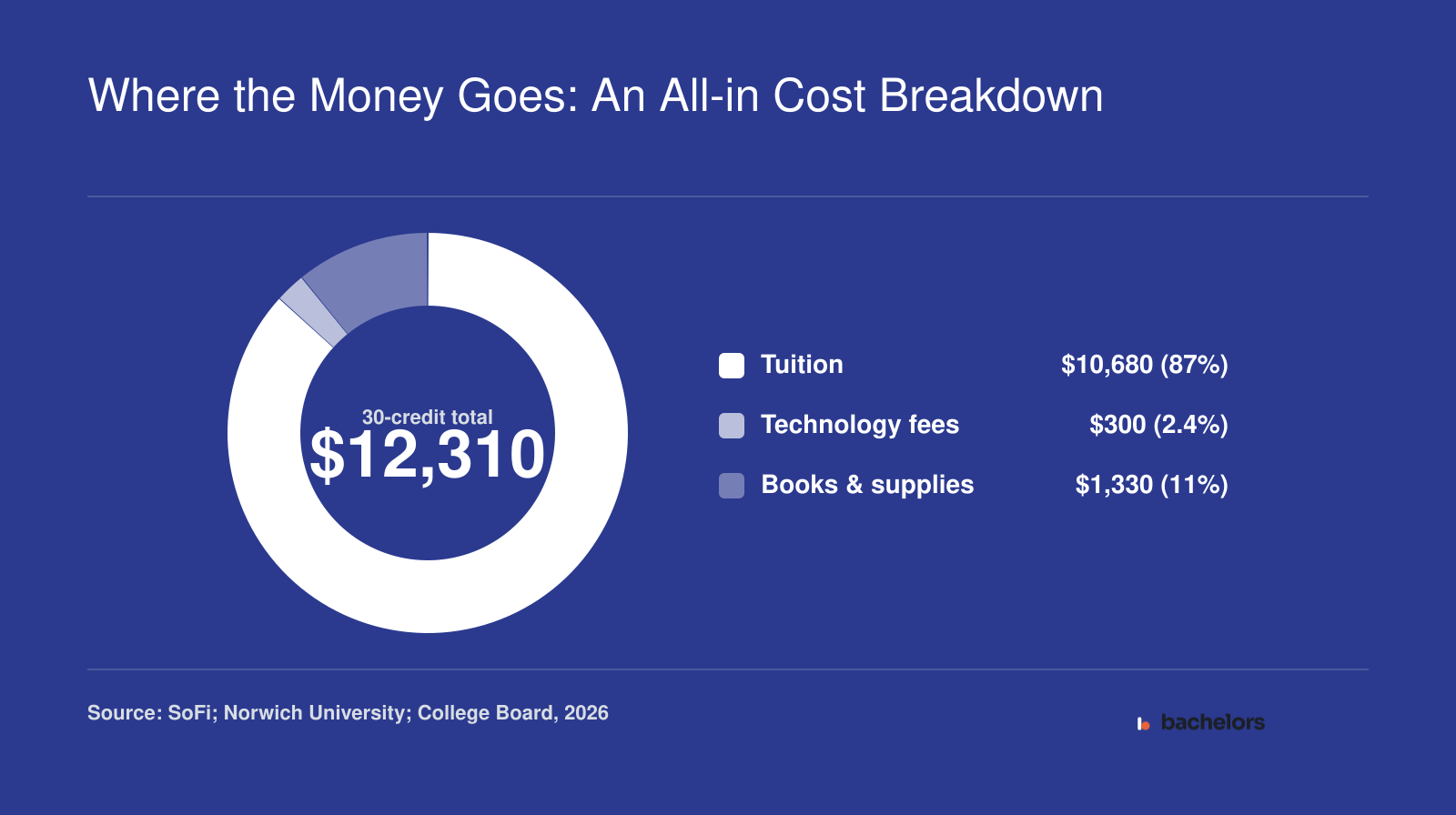
This sample assumes 30 credits left to finish, billed at $356 per credit, a reported average in-state rate for online programs at public universities. Fees use Norwich University's $150 per-term technology charge across two terms, and books use the College Board's $1,330 annual allowance for public four-year colleges. Library, proctoring, and graduation fees are not included. Replace each figure with the school's own published rates: a per-credit fee like UTEP's combined $100 online and technology charge would add $3,000 to the same 30 credits.
Transfer Credits, Prior Learning, and Finishing Faster
How Many Credits You Can Bring
A bachelor's degree is usually built on about 120 semester credits, and many colleges accept a large share of that from elsewhere. Trident University International, for example, requires 120 semester credits and accepts up to 90 transferred, with no more than 30 of those earned through prior learning assessment.1 That is one institution's policy, not a national standard. Acceptance depends on the course itself, your grade, how old the credit is, the accreditor behind it, and whether the course fits your major.
Residency is the second gate. Schools require a defined block of credits earned with them, often upper-division or major coursework, and that minimum varies. Spokane Community College and Spokane Falls Community College will evaluate prior learning before you enroll but post the credit only after you complete 10 quarter credits in residence.2 If a school reports in quarter credits, convert to semester credits before you compare offers.
Community College and Articulation Agreements
Ask directly whether the school publishes a block-transfer or guaranteed-admission agreement with your community college. A completed associate degree can sometimes satisfy the whole lower-division half of a bachelor's, which is a stronger promise than a course-by-course review.
Military Training, Exams, and Portfolios
- Military: credit usually starts with your Joint Services Transcript and the American Council on Education recommendations attached to it. Northern Arizona University and the University of Wisconsin-Parkside both review JST and ACE records, but an ACE recommendation does not obligate a college to award credit.3
- Exams: CLEP, DSST, AP, and IB are mapped through equivalency tables. Northern Arizona University caps combined exam credit at 60 units, Spokane colleges award elective credit for AP scores of 3 or higher, and the University of Wisconsin-Parkside recognizes DSST in 38 subject areas.4
- Portfolios: a prior-learning portfolio documents college-level learning and maps it to specific course outcomes. WICHE's PLA Boost study tracked more than 230,000 adult students in 2020.5
Get the Evaluation Before You Apply
Request an unofficial transcript review first, then ask the specific question: which credits will count toward my major requirements rather than general electives? Run that review at two or three schools. The gap between 60 accepted credits and 90 is often a full year of tuition.
How Long Does an Online Bachelor's Really Take?
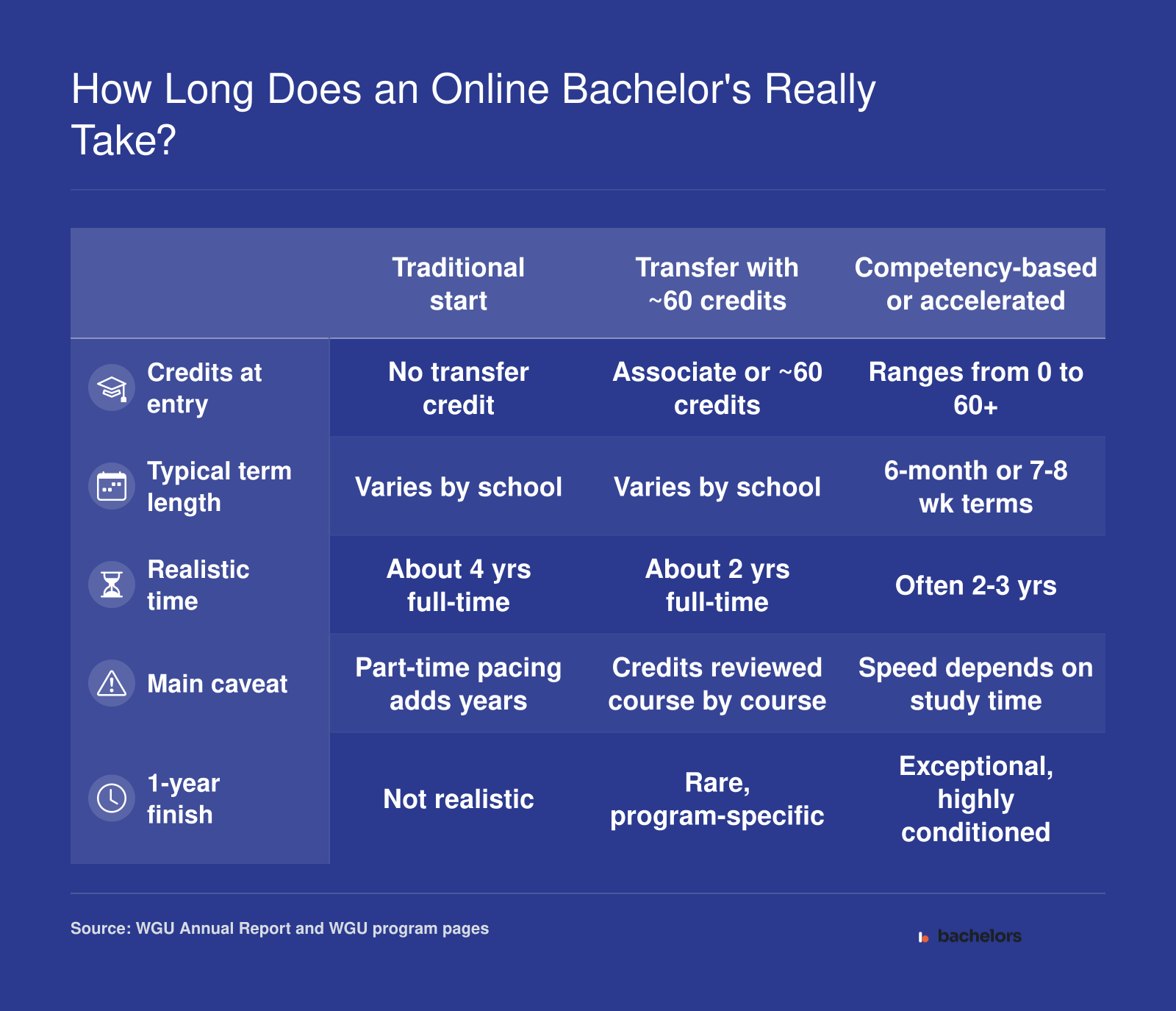
Advertised "2-year" and "1-year" bachelor's degrees usually assume heavy transfer credit, full-time pacing, or year-round 7-8 week terms. They are not the typical experience. Shorter terms compress the calendar, but the credits and coursework stay the same. Even at WGU, a competency-based school, the program-wide median completion time is 24 months and a separately reported average is 2.5 years. Results vary widely by major.
Reading an Admissions Page: Hidden Catches to Check
A program can be marketed as fully online and still carry requirements that affect your schedule, budget, or eligibility for a license. Check these points on the admissions page, or ask an advisor in writing, before you apply.
- Live (synchronous) sessionsFind out whether any classes meet at set times, how often they meet, and which time zone the schedule uses.
- Residencies, orientations, and capstone visitsAsk how many on-campus visits are required and whether travel and lodging costs fall on you.
- Clinicals, practicums, internships, and student teachingAsk whether the school places you or you must find your own site. Supervised placements can also trigger separate approval rules in your state.
- State authorizationConfirm the school is authorized to enroll students in the state where you live. NC-SARA is a voluntary reciprocity agreement among participating states, and some states add their own requirements on top of it.
- Licensure disclosuresFor nursing, teaching, social work, and counseling, find the program's professional licensure disclosure for your state. Federal rules require schools to provide it before you enroll, based on where you live. NC-SARA has no effect on licensing, and only your state's licensing board decides whether you qualify.
- Course rotationCheck whether required courses are offered only once a year. Missing one can push back your graduation date.
- Proctored examsAsk whether exams use online proctoring software or require a visit to a testing center.
Is an Online Bachelor's Degree Worth It? Outcomes and Employer Views
Whether it is worth it comes down to outcomes, and those depend far more on the school, the major, and whether you finish than on whether you sat in a classroom or logged in.
Completion Rates
Federal IPEDS data put completion within 100% of normal time, roughly four years, at about 49% for the 2016 cohort of bachelor's-seeking students at four-year institutions1. That figure covers every delivery mode; no national dataset reports a separate online-only rate, so treat an advertised "online graduation rate" with care until you know what it measures. What the enrollment data does show is that part-time adult learners, who make up a large share of online students, finish at lower rates than full-time residential students. Ask an admissions office for its completion rate for online students and the median time to degree, and get the answer in writing.
Borrowing and Debt
Borrowing varies sharply by sector. Graduates of for-profit colleges have historically borrowed more and defaulted at higher rates than graduates of public institutions, and for-profits enroll a disproportionate share of online students. Public universities and community college baccalaureate programs generally leave students with the least debt. Federal Direct Loan limits also cap what dependent undergraduates can borrow, which means a modestly priced online program can often be finished without private loans.
The Earnings Picture
In 2025, median weekly earnings were $1,578 for bachelor's degree holders and $966 for high school graduates, a premium of about 63% according to BLS2. Unemployment ran 2.5% for bachelor's holders against 4.2% for high school graduates in 20243. Those are medians across all fields and ages 25 and over, not a causal estimate, and they do not separate online from campus graduates. A nursing or IT bachelor's from a regionally accredited online program tracks with that field's earnings; a generic degree from an unfamiliar school may not.
What Employers Weigh
A 2025 Strada-Gallup survey of 1,139 adults involved in hiring found that 77% would consider a candidate without a degree and 62% had hired one, with skills and work experience outranking degree prestige4. No current national survey isolates views of online versus in-person degrees, but accreditation status and the school's reputation are what a recruiter actually checks. Use College Scorecard field-of-study pages to see median earnings and typical debt for graduates of the specific program, then compare the same field at other schools.
Employers look at the school and its accreditation, not the delivery format. A bachelor's degree earned online from an accredited institution carries the same weight as the same degree earned on campus.
Support Services and Policies That Affect Online Students
With so many accredited online bachelor degree programs competing on price, the support services attached to a degree have become a tiebreaker between a workable program and an isolating one. Ask any admissions office whether tutoring, advising, and career help exist and the answer is always yes. The useful question is whether those services are staffed for online students or borrowed from the campus.
Confirm the Service, Not the Campus Version
Get each of these confirmed in writing, with the online delivery method named:
- Advising: a named advisor assigned to online students, not a general call center.
- Tutoring and writing: live online sessions plus a writing center that accepts drafts by upload.
- Career services: resume review and job-search help you can access remotely.
- Library: database access, article delivery, and interlibrary loan, not just a login page.
- Tech support: 24/7 coverage, because a platform outage the night before a deadline is a real problem.
Accommodations and the Paperwork Clock
Disability accommodations are requested through the accessibility office, and the process can run remotely, but start before the first term. Documentation review takes weeks, and retroactive approval for an exam you already missed is rarely granted. Ask who the online contact is and what the turnaround time looks like.
Refunds, Withdrawals, and Repeats
Accelerated terms compress the calendar: dropping a course in week two can mean a third of the term is gone. Refund schedules are written as percentages of the term, not weeks. Withdrawing can also trigger a return of federal aid funds, leaving a balance you owe, and it counts against the pace of completion your aid requires. Ask how many repeats are allowed and whether a failed course still counts as attempted.
Four Questions Worth Asking
- "Who is my advisor, and how do I reach them directly?"
- "What happens to my aid if I drop a course in week three?"
- "How do online students request accommodations, and how long does it take?"
- "Can you send me the refund and withdrawal schedule in writing?"
Vague answers are a warning sign. If a counselor cannot name the process, the process is probably improvised.
Questions to Ask Yourself
Can you attend live sessions on a set schedule, or do you need fully asynchronous courses?
Does your target field require programmatic accreditation or a state license, and does this program qualify where you live?
How many of your existing credits will a written evaluation actually count toward your major?
Can your schedule handle 7 to 8 week accelerated terms, or would standard semesters fit better?
A Shortlisting Checklist for Comparing Programs (Including International Students)
An October application to one obvious favorite is the easy path. Comparing three or four finalists on the same written evidence costs a week and can save several thousand dollars.
Sequence the Questions
Order your checks by how fast they disqualify a program, not by how interesting they are.
- Accreditation and state authorization: confirm the institutional accreditor is recognized and that the school may enroll students where you live. Nothing else matters if this fails.
- All-in cost after transfer credits: price the degree on the courses you have left, not sticker tuition for four years.
- Format fit: synchronous seminars, asynchronous modules, or a mix. Match the schedule to your real week.
- Support and outcomes: advising, tutoring, disability services, and completion and earnings data.
Compare Finalists Side by Side
Settle on three or four programs, then collect the same three documents from each: a run through the school's net price calculator, a written transfer evaluation listing exactly which credits apply, and the program's College Scorecard outcomes. Line them up in one table. A program that will not put a transfer evaluation in writing before you apply is telling you something.
Applying From Outside the U.S.
Fully online study from abroad generally requires no F-1 visa, because you are not entering the country to study.1 If the program includes any period on the U.S. campus, you need an F or M visa before you travel, which means an SEVP-certified school, SEVIS registration and the I-901 fee, and Form I-20.2
If you are already in the U.S. on F-1 status, count carefully: no more than one online or distance class, or 3 credits, may count toward your full course of study per term.3 Language-study students get none.4
International Admissions Requirements
Expect an English proficiency test unless you qualify for an exemption. One 2026 policy sets TOEFL iBT at 100 or IELTS at 7, and waives the test after three full-time academic years in a designated country, excluding ESL and online coursework.5 A course-by-course evaluation from WES or ECE is often required for credentials earned outside the U.S., with the applicant paying the fee.6 Before you apply, confirm the program accepts students residing in your country and which tuition rate applies to non-residents.