Cheapest Online Bachelor's Degrees
The online programs in each field, re-ordered by net price after aid, lowest first, so the cheapest way into each field is at the top. Graduation rate and earnings still show on every card.
A "cheapest" claim means little until you know what unit it is quoted in. Schools advertise per credit, per term, per year, or as a flat rate, and a 120-credit bachelor's degree can land far apart depending on which number you start from. WGU's six-month term and a public university's per-credit rate do not compare directly.
The major-by-major list above this article already shows the lowest-priced options, so this guide does not repeat it. What matters is how to judge any low price: total cost to finish, what an admissions page actually discloses, whether accreditation holds up, and whether cheap programs graduate students into better jobs.
A low sticker price only helps if you finish the degree.
Key Points
- WGU charges about $3,825 per six-month term; private nonprofits average $45,000 yearly.
- Check accreditation status first, because a low price proves nothing about legitimacy.
- Bachelor's holders earn about $612 more weekly than high school graduates.
Business & Management
Science & Engineering
Education & Teaching
Liberal Arts & Humanities
Arts & Design
Computers & IT
Communications & Media
Social Work & Social Sciences
Healthcare
Criminal Justice & Law
Psychology
Natural & Applied Sciences
Religion & Theology
Counseling
What "Cheapest" Actually Means: Sticker Price vs. Total Degree Cost
Online colleges now advertise price in so many different formats that two schools can both claim to be the cheapest while charging very different amounts to finish. Learning the vocabulary is the first step in comparing them fairly.
The Six Pricing Metrics
- Per-credit rate: The charge for each credit hour, which is how most schools bill online courses.
- Annual tuition: A yearly figure that assumes a typical full-time load, often 24 to 30 credits.
- Total program price: The school's estimate for the whole degree, which may or may not include fees.
- Net price after aid: The figure that remains after grants and scholarships come off, before any loans.
- Flat-rate subscription per term: One fixed charge for a set period, with as many courses as you can complete in that window.
- Competency-based or assessment fees: Charges tied to proving mastery of a skill, sometimes billed per assessment and sometimes bundled into a term rate.
Do the Conversion Yourself
Put every school on the same footing. Take the per-credit rate and multiply it by the credits you still need. A full bachelor's degree usually requires 120 credits, so subtract any transfer credit you can document. Then add the per-term fees (technology, student services, proctoring) multiplied by the number of terms you expect to enroll.
For subscription models, flip the math: multiply the term price by the number of terms it will realistically take you to finish. A low flat rate only pays off if your pace matches what the school assumes.
Why Net Price Can Reorder the List
Sticker price ignores aid, and aid can be large. A school with a higher published rate but generous institutional grants may cost less than a bargain-priced school that offers nothing. Net price is also personal, since it depends on your income, your Pell Grant eligibility, and any employer tuition benefits. Use each school's net price calculator, and ask the admissions office what aid online students actually receive, because some awards are limited to on-campus enrollment.
The Rule to Remember
Compare total out-of-pocket cost to finish, not the headline rate. A figure only counts if it covers the credits you still need, the fees you will actually be charged, and the aid you are likely to receive.
How Much an Online Bachelor's Degree Costs: Typical Ranges by School Type
Published prices run from about $3,825 per six-month term at a flat-rate online school like WGU to about $45,000 per year at the average private nonprofit four-year college, a gap of nearly $150,000 over a full four-year degree. The College Board averages below (2025-26) cover all undergraduates, not online students alone. The College Board's newest for-profit tuition figures date to 2023-24, so that sector is left out of this table. Every 120-credit total is a rough estimate for a student starting with zero credits and studying full time for four years (eight six-month terms at WGU), so transfer credit or a faster pace can lower the real figure considerably.
| Pricing Model | Typical Per-Credit or Per-Term Rate | Estimated Total Tuition (120 Credits) | What to Watch |
|---|---|---|---|
| Public four-year, in-state | $11,950 per full-time year in average published tuition and fees (College Board, 2025-26) | About $47,800 over four years | Applies to state residents only. Many public universities charge out-of-state online students more, so ask whether a separate e-rate or online rate applies and what it costs. |
| Private nonprofit four-year | About $45,000 per full-time year in average published tuition and fees (College Board, 2025-26) | About $180,000 over four years | This is a sticker price. Institutional grants often reduce what students actually pay, so compare net price, not the published rate. |
| Flat-rate, competency-based (WGU teaching and education programs) | $3,825 per six-month term (WGU, 2026) | About $30,600 for eight terms | Total cost depends on how many terms you need. Finishing in fewer terms lowers the total, and taking longer raises it. |
| Flat-rate, competency-based (WGU B.S. Information Technology Management) | $3,850 per six-month term (WGU, 2026-27) | About $30,800 for eight terms | Tuition is billed per term, not per credit, so completing more courses in a term does not raise the price. |
| Flat-rate, competency-based (WGU B.S. Health and Human Services; B.S. AI Infrastructure and Operations) | $4,425 per six-month term (WGU, 2026 and 2026-27) | About $35,400 for eight terms | Rates differ by program within the same school. WGU reports average yearly bachelor's tuition of about $8,300 across its programs. |
| Flat-rate, degree completion (WGU RN to BSN) | $5,325 per six-month term (WGU, terms starting on or after January 1, 2026) | N/A (designed for licensed RNs who already hold prior nursing credit) | Charged at a flat rate every six months, not per credit hour. Total cost depends on how many terms it takes to finish. |
How to Verify a Low Price on an Admissions Page
A low advertised rate is only the starting point. Before you compare schools, confirm each of these items on the school's own pages so you are comparing like for like.
- Per-credit or per-term rate, and whether it is lockedCheck the bursar or tuition-and-fees page for the current year's rate and whether it is charged per credit or as a flat term price. Look for any guarantee that the rate holds through graduation, since some boards approve increases each spring for the fall.
- Mandatory and distance-learning feesLook on the same fees page for online or distance charges. Tennessee adds a $100-per-credit Online Support Fee for students in fully online programs, and Cincinnati lists a $26.20-per-credit distance-learning fee.
- Technology feesConfirm how the fee is billed. Old Dominion charges $30 per credit for online courses, Tennessee charges $18 per credit capped at $150 per semester, and Northern Iowa charges $48 per course.
- Books and course materialsCheck the bookstore or billing page for inclusive-access charges added automatically to your bill, and whether you can opt out.
- Residency rules for online tuitionRead the tuition page for whether out-of-state online students pay the in-state rate or a nonresident or supplemental rate.
- Transfer-credit limits and residency requirementsFind the graduation requirements in the catalog for the maximum transfer credits and the minimum credits you must complete at the school.
- Promotional or first-term discountsConfirm in writing when any discount ends and what the rate becomes afterward.
- Retake, withdrawal, and refund policiesFind the registrar's or bursar's refund schedule and any charges for repeating a course.
- Competency-based pace requirementsIn the catalog or student handbook, check the minimum competency units required per term and what happens to your enrollment, aid, and cost if you fall behind.
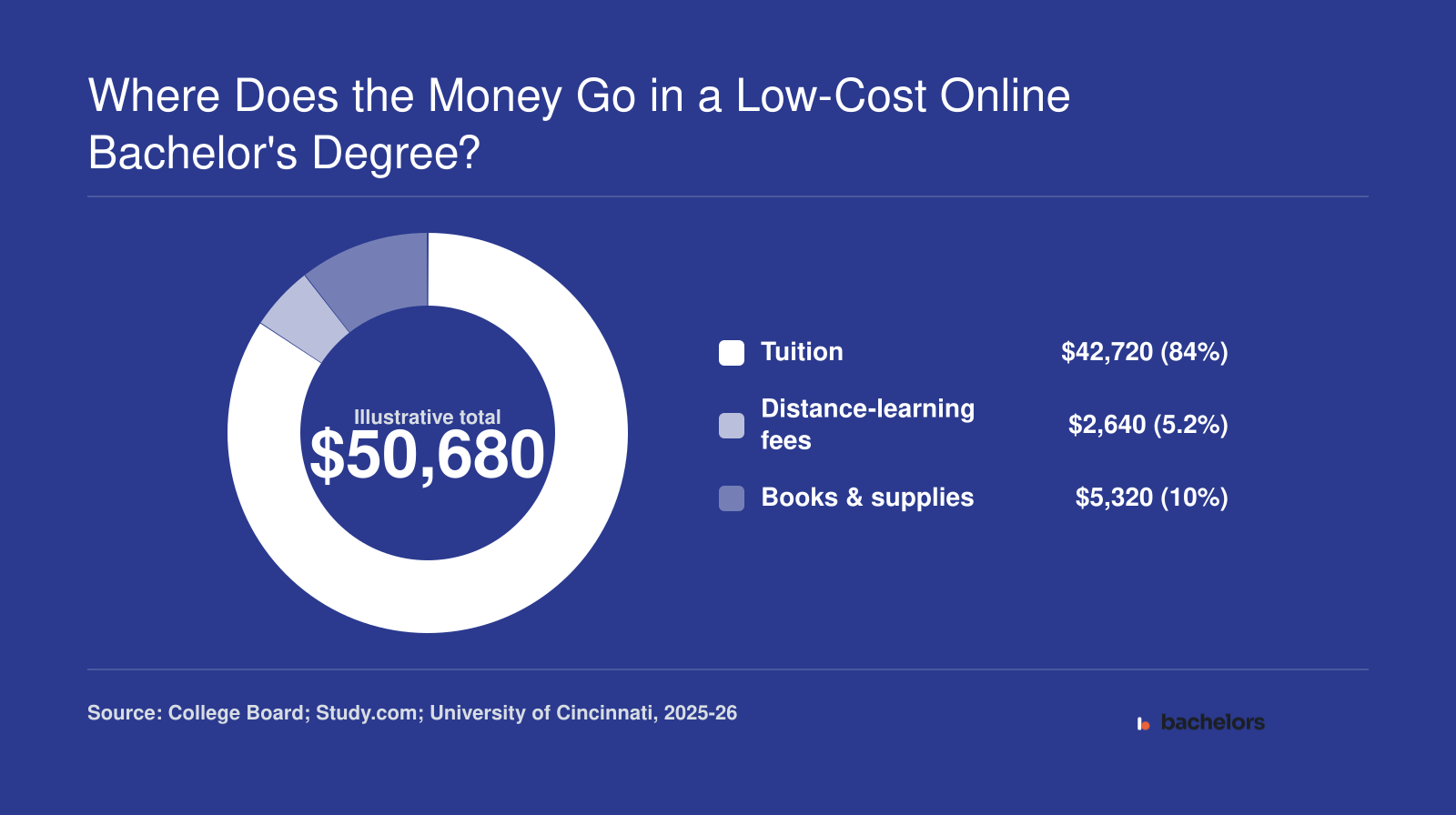
Where Does the Money Go in a Low-Cost Online Bachelor's Degree?
This illustrative example prices a 120-credit online degree at the 2025-26 average in-state online rate for public universities ($356 per credit), adds the University of Cincinnati's published distance-learning fee of $22 per credit for part-time students, and uses the College Board's $1,330 annual books-and-supplies estimate for public four-year colleges over four years. In this example, fees and materials add nearly $8,000, about 19% more than advertised tuition alone. Technology charges, residency, and per-credit versus per-semester billing vary by school, so check each fee schedule before comparing prices.
Cheapest Accredited Online Bachelor's Degrees: Accreditation Checks That Matter
A college can hold institutional accreditation, programmatic accreditation, both, or a credential no federal body recognizes at all. Price does not sort schools into real and fake; accreditation status does.
Institutional, regional, and national
The U.S. Department of Education does not accredit colleges.1 Private agencies do, and the federal test is whether the Secretary of Education recognizes the agency. What students still call "regional" accreditation is now generally described as institutional accreditation, while "national" describes an agency's scope rather than a quality ranking. Both types of agency can be recognized.
The distinction matters downstream. Credits from a nationally accredited school have no automatic right to transfer; the receiving college decides, and it may accept them only as electives while excluding major, general education, or residency requirements.4 Graduate admissions works the same way: the graduate school or department decides, case by case, with no universal federal rule.4 A federal rule meant to limit credit denials based on an institution's recognition type takes effect July 1, 2027, so it is not the controlling standard in 2026.6
Two databases, two jobs
Start with DAPIP, the Department of Education's database, which lists institutions and programs reported by recognized accrediting and state agencies.2 Search the exact name and likely alternates, then confirm the record covers the specific campus or program you are applying to and that the agency listed accredits that entity. DAPIP is not audited and can be incomplete or stale, so cross-check against the accreditor's own directory.2
CHEA's directory is separate, covering institutions and programs accredited by CHEA-recognized bodies.3 The two tools are not interchangeable.5 Use both, and compare what you find to the school's own disclosure page. An accreditation mill usually shows up as an agency name you cannot find in either database, or a claim that accreditation is "pending" with no recognized agency attached.
Programmatic accreditation for licensed fields
Institutional accreditation covers the whole college. Programmatic accreditation covers one program, and for licensing-track majors it is often the credential that counts: ABET for engineering and computing, AACSB for business, CCNE for nursing, CSWE for social work. Confirm state licensure requirements and the program's own status before you enroll.
Are cheap online degrees legitimate?
Price tells you nothing about legitimacy. A low-cost degree from an institutionally accredited college is a real degree; an expensive one from an unrecognized school is not worth the paper. Verify accreditation first, then compare cost.
Cheap Doesn't Always Mean Cheapest: Transfer Credits, Pace, and Residency
A bachelor's degree price is the cost of the credits you still need, not the credits the school advertises. Most bachelor's degrees require 120 credits, so every credit you bring in or skip changes the total.
Transfer Credit and Prior Learning
An associate degree can cover roughly half of a bachelor's, often about 60 credits. Transfer limits are set by each school and often by major, with no national rule. Public universities commonly cap transfer credit somewhere between 60 and 90 credits, and a 60-credit cap is especially common for credits from two-year colleges.
Two more rules matter:
- Residency credits: Many schools require at least 30 credits from the school itself, even for fully online students. Some also require the final 30 to 45 credits there, or 25 to 30 percent of the degree.
- Combined caps: Credit from CLEP, DSST, military training, and portfolio review may count toward the same limit as college transfer credit, unless the school states separate limits.
A school can advertise 90 transfer credits and still require 30 of its own. Ask for a written evaluation, since accepted credit can still land as general electives instead of satisfying your major.
Pace: Flat Rate vs. Per Credit
In flat-rate programs, your pace sets the price. Say a school charges $4,000 for a six-month term with unlimited courses. A student who finishes 12 credits per term pays about $333 per credit. One who finishes 24 pays about $167. In a per-credit program at $300 per credit, those same 12 credits cost $3,600 whether you take six months or a year. Flat rates reward speed. Per-credit pricing rewards nothing but a lower rate. Be honest about how many hours a week you can spend on coursework.
Residency and Special Rates
Public universities price online students differently. Some charge every online student one e-rate regardless of home state. Others apply the usual resident and nonresident schedules online. Check which applies before comparing, because the gap can be large.
Two discounts may help, though neither is automatic:
- WICHE WUE: The Western Undergraduate Exchange lets residents of WICHE states and territories pay up to 150 percent of resident tuition at participating public institutions. WICHE reports average annual savings of $13,060 for 2026. Not every online program takes part, and some limit it by major, student type, or transfer status.
- Military and veteran rates: Many schools offer reduced tuition for service members, veterans, or families. Ask the admissions office for the current terms.
The Warning
A low per-credit rate means little if the school rejects your credits. Paying $250 per credit for 30 extra credits you did not need can erase the savings of a cheaper-looking program. Get the credit evaluation before you enroll.
Cost vs. Outcomes: Graduation Rates, Debt, and Earnings
Is a cheap online bachelor's degree still worth it if you never finish? That is the question a low per-credit price does not answer. Credits earned without a diploma carry little weight with employers, and they often lose value again when you transfer, because a new school may accept only part of what you completed. The cheapest degree on paper becomes the most expensive one you paid for and cannot use.
Reading completion rates fairly
A school's published graduation rate may not describe students like you. The traditional federal measure tracks full-time, first-time students who stay at the same institution, and it reports completion at 100% and 150% of normal time (six years for a bachelor's).1 It excludes part-time entrants and anyone who started college somewhere else, which is exactly the profile of many online learners.1
The broader federal Outcome Measures data includes part-time and non-first-time students and reports completion at four, six, and eight years.1 College Scorecard uses an eight-year window for degree-granting schools, counting entering students who graduate regardless of enrollment status or prior college experience.2 When you compare schools, compare the same measure.
Three numbers to look up
- Completion rate that includes part-time and transfer students: ask for the Outcome Measures figure, not only the first-time, full-time rate.
- Median federal debt: the median federal loan debt at separation for federal borrowers who graduate or withdraw, drawn from Direct, FFEL, and Grad PLUS loans.3 It is not total borrowing, so treat it as a floor rather than a full picture.
- Median earnings: reported for federally aided students who are employed and not enrolled, using entry and exit cohorts.3
No single national completion or debt average for online institutions is reliable enough to quote, because the population is too varied. Look up each school individually on College Scorecard and hold it to the same three numbers as every other option on your list.
The Bachelor's Degree Earnings Premium
Bachelor's degree holders out-earn high school graduates by about $612 a week at the median, and they face lower unemployment (2.8% vs. 4.3%).
Is an Online Bachelor's Degree Worth It?
An online bachelor's degree is worth it when three things line up: the school is accredited, the total cost is one you can pay without wrecking your finances, and you actually finish. When any of those three fails, the math changes fast.
The evidence on employer acceptance is broadly encouraging, with real caveats.
What Employers Actually Say
Survey data points to wide but not universal acceptance. In the 2024 National Association of Colleges and Employers survey of 255 employers, 87.4% of those that tracked degree modality had hired online-degree graduates, and every employer in that group reported paying the same starting salary as for in-person hires. A 2023 SHRM survey found 79% of organizations had hired someone with an online degree in the prior 12 months; more than half said they saw no difference when experience was equal. Acceptance was much warmer at entry level (43%) than at executive level (15%).
Not every study is as positive. In a 2026 Ithaka S+R experiment with 543 recruiters and hiring managers, an in-person degree was selected 51.6% of the time versus 48.4% for an online degree, a modest penalty of roughly 2.5 percentage points once other traits were held constant. Work experience and skills mattered far more than delivery format.
One practical point: diplomas and transcripts from most accredited schools do not state "online." Employers are mostly judging the institution and its accreditation, not the modality.
Where Cheap Degrees Go Wrong
The risk cases are specific. Unaccredited schools, or nationally accredited ones, can stall you if graduate school is the goal. Licensing-track majors (nursing, teaching, social work, accounting) need the right programmatic accreditation and supervised clinical hours, and a bargain program without them may not lead to a license. And a low completion rate means the cheapest sticker price can still be the most expensive path, because unfinished credits rarely transfer cleanly.
The Verdict
A low-cost, accredited degree you complete is usually strong value. A cheap degree you abandon is not, and no tuition figure fixes that.
Questions to Ask Yourself
Are you starting from zero credits, or bringing transfer credit with you?
Can you hold a steady pace for the next two to four years?
Does your employer offer tuition assistance you have not claimed?
Have you checked your own state's public online in-state rate first?
How to Choose: A Decision Framework by Student Situation
The cheapest online bachelor's degree for you depends on what you bring to the start line. Credits, residency, licensing goals, and pace each change which pricing model wins. Use the rows below to find your situation, then check the major list above for specific fields.
| Student situation | Pricing model most likely to be cheapest | Biggest cost risk | First thing to verify |
|---|---|---|---|
| No prior credits | Low per-credit tuition at an in-state public school, or a school with a low fixed rate per term if you can take a full load | Extra semesters from dropped courses or a slow pace, plus fees added on top of the advertised rate | The full per-credit rate and every mandatory fee, on the school's official tuition page |
| Associate degree or 60+ transfer credits | Per-credit tuition at a school that accepts most of your credits, often a public institution with transfer agreements | Credits that transfer as electives and do not count toward your major, so you retake courses | A written transfer credit evaluation showing how many credits apply to your specific degree |
| Eligible for in-state public tuition | In-state per-credit public tuition, which is often lower than out-of-state or private rates | Losing the in-state rate through residency rules, or an online rate that differs from the on-campus rate | Whether the school charges in-state residents a separate online rate, and the residency rules for that rate |
| Licensing-track major (nursing, teaching, social work) | Per-credit tuition at a regionally accredited public program approved for your state's licensure | A program that does not meet your state's requirements, forcing added coursework, plus clinical, student-teaching, and exam costs | Programmatic accreditation and state approval for licensure where you plan to work, plus how placements are arranged |
| Working adult who can move quickly | Flat-rate tuition per term, where extra courses cost nothing more, or accelerated terms with transfer-friendly credit policies | Paying a full term rate while completing few courses, which makes a flat rate costly | How many credits you can realistically finish per term, and whether the rate is fixed or billed per credit |
Cheapest Online Bachelor's Degrees: Common Questions
These answers cover the questions students ask most about low-cost online degrees. Prices and benefits change, so confirm current figures with the school or employer before you commit.