Best Finance Degree Programs
Compare 1,200+ accredited Finance programs at 1,000+ colleges, with net price after aid, graduation rates, earnings and debt from IPEDS and the U.S. College Scorecard.

Which bachelor's degree in finance delivers strong earnings without leaving a graduate buried in loans? Most schools award a Bachelor of Science (B.S.) in Finance, but what students pay for it varies widely.
Among the top schools here, average annual net price runs from $3,033 at Baruch College to $19,857 at the University of Texas at Austin, a gap of roughly $16,800 a year.
Price does not track outcomes neatly. Banking and analyst employers recruit on internship access, quantitative training, and alumni networks, so a lower-cost public program can compete with a pricier one.
Key Points
- Lowest net price: Texas A&M University-Central Texas, at $1,300 yearly.
- Online tuition runs $306 per credit (LSU Shreveport) to $600 (Oklahoma).
- College Scorecard data drives rankings: net price, completion, debt, and earnings.
Best Finance Schools for a Bachelor's Degree: Our Top 10
The ten schools below earn their places on outcomes: what students actually pay after aid, how many finish the degree, how much they borrow, and what they earn once they are working. Each card covers what the finance major requires and how students gain real experience before they graduate.
CUNY Bernard M Baruch College
#1New York, NY · $7,000 – $15,000/yr (est.)
Best for: New York City finance career starters
Baruch College is a public institution in Manhattan where business is the center of gravity, and its Zicklin School of Business houses the finance major. Students get a low net price alongside access to New York's banking, asset management, and insurance employers. Classes are campus-based, and the college's alumni base is concentrated in the city's financial firms.
- Campus-based BBA in Finance through the Zicklin School of Business
- 8 finance courses total, including 5 electives in finance, economics, or insurance
- At least three of the electives must be at the 4000 level
- CFA Institute University Affiliation Program aligned to the CFA Candidate Body of Knowledge
- Internship credit available to qualified seniors
- 2.0 GPA in major courses required to graduate
- Combined BBA/MS pathway for students continuing to graduate study
- Median earnings of $54,991 one year after finishing; median debt $11,000
University of Florida
#2Gainesville, FL · ~$7,000/yr (est.)
Best for: Internship-focused business students
The University of Florida is a large public flagship in Gainesville, and finance sits inside the Heavener School of Business. The program is built around career readiness: a required 150-hour internship, dedicated career coursework, and a comprehensive exam before graduation. Undergraduates still have room for study abroad, leadership roles, and research.
- 120 credit hours with prerequisite coursework and a 2.0 GPA minimum
- 150-hour internship required before senior year
- 6 credits of career readiness coursework built into the degree
- CAPSIM comprehensive exam required for graduation
- Coursework in financial markets, security analysis and valuation, and risk management
- Study abroad, student leadership, and undergraduate research opportunities
- Median earnings of $70,663 one year after finishing; median debt $17,954
Florida State University
#3Tallahassee, FL · ~$11,000/yr (est.)
Best for: Aspiring portfolio managers
Florida State University runs a finance program built around practice as much as theory. Students work with the Student Investment Fund and a dedicated trading room, while organizations such as The Finance Society and Willow Partners add professional networking. A combined bachelor's and master's path is available for students who want to keep going after the bachelor's degree.
- Four-year BS in Finance with a combined bachelor's/master's pathway
- Student Investment Fund and Trading Room for hands-on portfolio work
- Coursework in corporate financial management, investments, and multinational finance
- Student organizations include The Finance Society and Willow Partners
- Closing Bell Speaker Series brings industry practitioners to campus
- Scholarships available within the program
- Median earnings of $56,516 one year after finishing; median debt $18,162
Ohio State University
#4Columbus, OH · $17,000/yr (est. net price)
Ohio State's Fisher College of Business offers direct admission to the finance specialization, so students start the major without a second application. Internships are close to universal here, with more than 90% of finance students completing one, and a Finance Honors track serves high achievers. Fisher's Global Business office supports study abroad, and the coursework maps to CFA and CFP preparation.
- Average beginning salary reported at $62,162 for graduates
- Over 90% of finance students complete internships
- Finance Honors track available for high-achieving students
- Study abroad through Fisher's Global Business office
- Coursework in corporate finance, capital budgeting, options and futures, and global finance
- Preparation for CFA or CFP licensure
- Median earnings of $65,181 one year after finishing; median debt $20,500
University of Georgia
#5Athens, GA · ~$14,000/yr (est.)
The University of Georgia's Terry College of Business runs a finance major with a strong placement record, with more than 200 students placed in internships, including at large investment banks. The curriculum leans quantitative, covering derivatives, mergers and acquisitions, trading strategies, and financial modeling. A large alumni network and the university career center support the job search in banking and corporate finance.
- Coursework in derivatives, mergers and acquisitions, trading strategies, and financial modeling
- Career tracks include investment banking analyst, sales and trading, and credit analysis
- More than 200 students placed in internships
- Internship placements reported at firms including Goldman Sachs and JP Morgan
- Case-study approach connects asset pricing and risk assessment to practice
- Scholarships and financial aid available to majors
- Median earnings of $67,444 one year after finishing; median debt $20,299
University of Maryland-College Park
#6College Park, MD · $16,000/yr (est. net price)
The University of Maryland's Robert H. Smith School of Business offers finance as a campus major with advising through its Office of Undergraduate Programs. In summer 2026 the school launched the Smith Banking Fellows Program with the Maryland Bankers Association, placing selected sophomores and juniors in paid internships at participating Maryland banks. Coursework covers corporate finance, investment management, banking, and financial analysis.
- Smith Banking Fellows Program launched summer 2026 with the Maryland Bankers Association
- Fellows receive advanced coursework, paid summer bank internships, and industry-led development
- Coursework spans corporate finance, investment management, banking, and financial analysis
- Emphasis on analytical and decision-making skills for the financial industry
- Advising through the Office of Undergraduate Programs
- Median earnings of $75,689 one year after finishing; median debt $19,500
Florida International University
#7Miami, FL · ~$9,000/yr (est.)
Florida International University is a large public university in Miami whose business school serves a mix of traditional and working students. The finance degree is offered on campus and online, and the school markets itself on value, with recognition from Kiplinger's and U.S. News. Finance courses require a C or better to count toward the degree.
- 120 credit hours; finance courses require a grade of C or higher
- Online BBA in Finance option for working students
- Coursework in commercial bank management, securities analysis, and international financial management
- Career paths include financial analyst, portfolio analyst, and risk manager
- Recognized for value by Kiplinger's and U.S. News
- Median earnings of $51,633 one year after finishing; median debt $18,835
University of Washington-Seattle Campus
#8Seattle, WA · ~$14,000/yr (est.)
The University of Washington's Foster School of Business places finance inside its Department of Finance and Business Economics. Faculty research spans asset pricing, household finance, and machine learning applications, and the department publishes the Journal of Financial and Quantitative Analysis. Seattle's employer base in banking, technology, and asset management gives students a nearby market for internships.
- Department publishes the Journal of Financial and Quantitative Analysis
- Coursework in asset pricing, corporate finance, governance, fintech, and behavioral finance
- Faculty research includes mergers, household finance, and machine learning in finance
- Seattle location near finance, technology, and asset management employers
- Quantitative methods paired with applied market coursework
- Median earnings of $63,500 one year after finishing; median debt $14,208
The University of Texas at Austin
#9Austin, TX · ~$20,000/yr (est.)
UT Austin's business school offers a rigorous finance major for students aiming at banking, investment, and corporate finance roles. Undergraduates choose between the general finance track and an Energy Finance, Law and Science option that covers oil and gas law and energy risk. Exceptional students can apply to the one-year Financial Analyst Program and work closely with faculty and industry professionals.
- 120 semester hours
- Two options: general Finance, or Energy Finance, Law and Science
- Energy option covers oil and gas law and energy risk
- One-year Financial Analyst Program with faculty and industry professionals
- Financial Analyst Program can be combined with either finance option
- Core coursework in accounting, financial analysis, and risk management
- Median earnings of $81,844 one year after finishing; median debt $20,500
University of Wisconsin-Madison
#10Madison, WI · ~$17,000/yr (est.)
The University of Wisconsin-Madison's School of Business offers finance as a campus major with an emphasis on both theory and application. Students can follow the general finance path or the named Finance, Investment, and Banking track. Coursework reaches into fintech, international finance, and risk management, and school advising supports the path to graduation.
- Coursework in forecasting, capital structure, and risk management
- Covers international finance and financial technology topics
- Prepares students for corporate finance, banking, investments, and fintech roles
- Emphasizes the theory of finance alongside practical application
- Median earnings of $68,681 one year after finishing; median debt $21,500
- Named investment banking track inside the finance major
- 120 credit hours, fall start, 3.0 GPA minimum
- Prerequisite courses plus a capstone required
- Pre-Business 101 workshop required before the major
- Coursework in security analysis, valuation, and financial risk management
- Four-year completion plan published for the track
Cost & outcomes by school
Federal data for the highest-earning Finance programs, independent of the ranking above. Earnings are this field's bachelor's graduates four years after completing where the Scorecard reports them, else the school's undergraduate median.
| School | Net price / yr | Grad rate | Earnings | Debt | Grads/yr | Format |
|---|---|---|---|---|---|---|
| University of Pennsylvania PA | $28,699 | 97% | $202,069 | $12,999 | — | Campus |
| Washington University in St Louis MO | $21,786 | 94% | $185,551 | $19,500 | 154 | Campus |
| University of Notre Dame IN | $26,780 | 95% | $160,313 | $19,000 | 307 | Campus |
| Georgetown University DC | $40,815 | 95% | $152,744 | $15,750 | 238 | Campus |
| Boston College MA | $41,704 | 91% | $147,746 | $18,000 | 456 | Campus |
| Wake Forest University NC | $28,719 | 89% | $145,996 | $19,500 | 143 | Campus |
| Massachusetts Institute of Technology MA | $20,111 | 96% | $143,372 | $14,768 | — | Campus |
| Southern Methodist University TX | $40,892 | 84% | $133,852 | $19,439 | 261 | Campus |
| The University of Texas at Austin TX | $19,857 | 89% | $132,075 | $20,500 | 433 | Campus |
| Brigham Young University UT | $15,564 | 81% | $129,879 | $11,625 | 196 | Campus |
| Tulane University of Louisiana LA | $39,949 | 86% | $129,850 | $21,250 | 363 | Campus |
| Babson College MA | $40,514 | 93% | $123,938 | $20,000 | — | Campus |
Sources: U.S. Department of Education. Net price, graduation rate, earnings and debt: College Scorecard (earnings and debt for this field's bachelor's graduates where reported, else school-wide); graduates: IPEDS. A dash means no figure is reported.
Cost, debt & payoff
Median earnings of this field's bachelor's graduates (4 yrs after completing, else the school's undergraduate median) vs. their median federal loan debt · U.S. College Scorecard
Across these programs the median graduate earns about $65,651 and finishes with roughly $22,989 in debt — a ratio that clears a common rule of thumb (keep debt below first-year salary). Net price and debt vary widely school to school, so check the per-school figures in the table above before you shortlist.
How We Ranked Bachelor's in Finance Programs
The U.S. Department of Education's College Scorecard and the Integrated Postsecondary Education Data System (IPEDS) supply every figure behind this ranking. Most finance rankings never explain what they measure. Every input comes from the latest federal releases available at publication, so you can check any number against the public record yourself.
What We Measured
Five groups of factors determine where a school lands:
- Graduate earnings and debt: Median earnings and borrowing for finance completers. Higher earnings help a school, and so does lower debt.
- Return on investment: Earnings measured against debt. A program that pays off faster scores better.
- Net price: The average cost after grants and scholarships. Lower is better.
- Graduation and retention: How many students return after their first year and finish a degree. Higher rates help.
- Access: The share of students receiving Pell grants. A higher share rewards schools that enroll and support lower-income students.
Two Levels of Data
The figures do not all describe the same group of students. Earnings and debt apply only to people who completed a bachelor's degree in finance at that school. Graduation rates, retention, and net price cover the entire institution, including students in every other major. A school with strong finance outcomes can still post an ordinary campus-wide graduation rate, and the reverse also happens. Read each number with its scope in mind.
What This Ranking Leaves Out
Federal data cannot capture prestige, the strength of a school's corporate or Wall Street recruiting pipeline, or the quality of teaching in finance courses. Those factors can shape your first job offer as much as cost does. Research alumni networks, on-campus recruiting, and student-managed investment funds on your own, then weigh them alongside the numbers here.
What a Bachelor's Degree in Finance Covers
A B.S. in Finance usually splits into two layers. The first is a business core: financial and managerial accounting, micro and macroeconomics, business statistics, and management. The second is the finance core, typically corporate finance, investments, and financial markets and institutions. Upper-level electives then let you specialize.
Common Concentrations and Where They Lead
Many of the schools on this list publish concentrations, so compare them before you apply.
- Corporate finance: Budgeting, capital planning, and valuation, leading toward financial analyst and corporate treasury roles.
- Investments: Portfolio theory and securities analysis, aimed at asset management, research, and trading support.
- Financial planning: Retirement, tax, and estate topics, built for client-facing advisory work.
- Fintech: Data, automation, and digital payments, suited to analytics and product roles at banks and startups.
Finance vs. Related Majors
Financial economics is more theory- and math-heavy, and it is often housed in the economics department rather than the business school. It suits students leaning toward research or doctoral study. General economics is broader, focused on how markets and policy work rather than how firms and investors make decisions.
Accounting is a different track. It centers on recording and auditing financial information and is the standard route to the CPA license, while finance focuses on using that information to allocate capital and manage risk.
One Practical Tip
Check whether the program requires calculus and a programming or modeling course, such as Python or advanced Excel. Employers increasingly expect quantitative skills, and a curriculum that builds them gives you a clear edge in the job search.
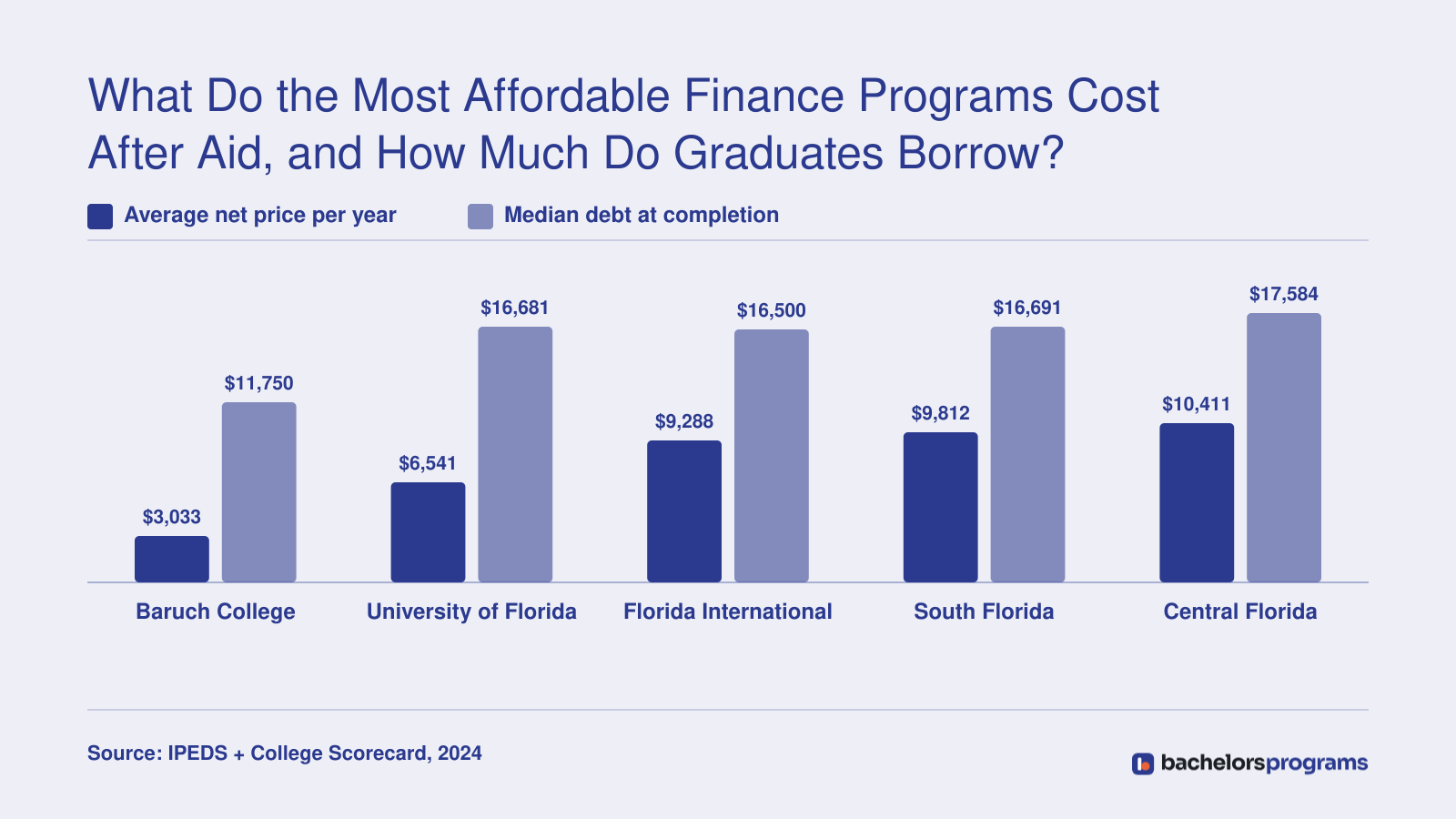
What Do the Most Affordable Finance Programs Cost After Aid, and How Much Do Graduates Borrow?
Texas A&M University-Central Texas posts the lowest average net price here at $1,300 a year, but it does not report program-level debt for finance graduates, so it is left off the chart below. Among the other low-cost public schools, Baruch College pairs a $3,033 net price with the smallest median debt, $11,750, or about $125 a month on a 10-year repayment plan. At the University of Florida, Florida International University, the University of South Florida, and the University of Central Florida, median debt falls between $16,500 and $17,584, which works out to roughly $175-$186 a month. Those payments sit against median first-year earnings of $49,906-$70,663 for finance graduates of these programs. Net price is an approximate average that federal data reports for aided in-state students at public schools, not a personal quote, so your own cost will depend on your aid package. Every school in this comparison is public, which helps explain why most yearly net prices land under about $10,500.
Finance Graduate Earnings and Career Outcomes
Entry-level finance hiring now screens for spreadsheet modeling and data fluency on day one, which has widened the pay gap between programs that build those skills and those that stop at theory. Federal earnings records for finance bachelor's graduates at these schools show how wide that spread gets, and how fast pay climbs in the first five years of work.
How pay grows from year one to year five
At Washington University in St. Louis, finance graduates report a median of $102,814 one year after completing the degree and $190,811 five years out. Georgetown moves from $106,218 at one year to $152,931 at five, and Notre Dame from $99,222 to $138,141. Public flagships start lower and still post solid five-year gains: Illinois goes from $75,381 to $118,286, Maryland from $75,689 to $116,598, Wisconsin from $68,681 to $106,484, and Florida from $70,663 to $101,867. BYU graduates report $83,876 at one year and $118,744 at five. The pattern matters more than any single figure: the first job is rarely the ceiling, and the five-year number is the one worth planning around.
Signals that the outcome is reliable
Two numbers tell you whether graduates actually land work. Employment one year after completion sits above 93 percent at every program listed above, topping out near 99 percent at Wisconsin and 98 percent at BYU. The share of completers earning above 150 percent of the federal poverty line runs from roughly 93 percent at Florida to 100 percent at Washington University. Strong earnings paired with weak employment would be a warning; here, both hold.
Where graduates start
Typical first roles include financial analyst, credit analyst, corporate finance associate, commercial and investment banking analyst, and junior positions on advisory teams. The Bureau of Labor Statistics lists a bachelor's degree as the typical entry requirement for personal financial advisors (median wage $99,580 in May 2023), credit analysts ($79,940), budget analysts ($84,940), and financial managers ($156,100), the role many analysts move into after several years. Demand across business and financial occupations remains steady rather than spiky.3
Is a finance degree worth it?
Compare the monthly loan payment to first-year pay. Florida graduates carry a typical payment near $177 a month against $70,663 in first-year median earnings, about three percent of gross monthly income. BYU's typical payment of $123 against $83,876 is lower still. Even at Texas, where the payment runs $217, first-year earnings of $81,844 absorb it comfortably.
What Financial Analysts Earn Nationally
Financial analyst is one of the most common roles for graduates with a bachelor's degree in finance, and the federal wage data shows strong pay potential.
Related Articles
Online vs. On-Campus Finance Degrees
Among the online programs here, per-credit tuition runs from $306 at LSU Shreveport to $644-$692 at Penn State World Campus, and LSU Shreveport and Oklahoma each require 120 credits. Most programs in this ranking are campus-based. Florida International University is the one flagged as online, and its program notes an online BBA in Finance with 120 total credit hours.
Cost, Credits, and Pace
Southern Utah University charges $315 per credit1 and Champlain College Online $342. St. Cloud State is $385.67, University of Wisconsin-Parkside $473, and University of Minnesota Crookston $483.70. Fees can add to these rates. Northwest Missouri State ($368) adds a per-course fee, and UW-Whitewater's $433 is a 2026-27 "starts at" rate.2
Completion time is less standardized. Southern Utah advertises "as few as 3 years," and Champlain lists 40 months. Online courses are typically asynchronous, so you can work around a job, but a faster pace depends on how many credits you bring in.
Transfer Credit Limits
Transfer policy can cut both cost and time. Southern Utah, Champlain, Parkside, and St. Cloud State each accept up to 90 credits, and Northwest Missouri State up to 82.4 St. Cloud warns that exact transferable credits vary under AACSB course rules.3 LSU Shreveport caps community-college-type credit at 60 and requires at least 18 college-level hours to enter. Oklahoma's online BBA is degree-completion and requires at least 24 college credits earned after high school.5 Oklahoma, Whitewater, and UT Permian Basin publish no numerical maximum, so ask an advisor before you apply.
The Networking Trade-Off
On-campus students usually have easier access to recruiting events, student investment funds, and finance clubs. Online students can still build connections through virtual advising and alumni networks, but it takes more deliberate effort.
Are AACSB-Accredited Online Finance Degrees Available?
Yes. Oklahoma, LSU Shreveport, UW-Whitewater, Southern Utah, UT Permian Basin, St. Cloud State, and Parkside list AACSB accreditation for their online programs. Northwest Missouri State lists ACBSP instead, and Champlain's AACSB status is not confirmed on its official pages.
Questions to Ask Yourself
Do you need on-campus recruiting access, or an online schedule that fits around a full-time job?
Is your goal the CFP or the CFA?
How many prior or community college credits can you transfer?
Would a lower net price at a public school outweigh a higher one-year earnings figure at a pricier private school?
Finance programs by state
Finance Degree FAQs
These answers draw on the findings above and on general guidance. Curricula, accreditation scope, and state rules vary, so confirm details with each school and your state board before you commit.
Is a finance degree worth it?
What is the difference between a finance degree and a financial economics degree?
Are there AACSB-accredited online finance degree programs?
Should you double major or minor in accounting alongside finance, and how does that affect CPA eligibility versus CFA plans?
Compare Finance programs on the data that matters
Explore more Business & Management majors or browse every field of study.
All Business & Management programs Browse every field of study