Online Colleges and Bachelor's Degree Programs in Washington
Every verified bachelor's program at a college in Washington: 1,200+ programs at 50+ colleges, with the online options, net price and graduation rates behind each one.

A fully online bachelor's in Washington and a campus seat at the same public university rarely carry the same price tag. Eastern Washington University publishes a single $268 per-credit online rate, while Central Washington University's online rates run higher and split by residency: $611.92 per credit for residents, $1,776.14 for nonresidents.
What most Washington students actually pay depends on state aid. A family of four earning up to $83,500 qualifies for the full Washington College Grant in 2026-27, with partial awards reaching $139,500.
Transfer shapes the timeline. The revised Direct Transfer Agreement, approved in May 2026 and effective that September, moves a community college associate degree into junior standing, cutting the remaining coursework to roughly two years.
Key Points
- Eastern Washington University charges one general $268 per-credit online rate.
- Washington College Grant: full awards reach families of four earning $83,500 (2026-27).
- Washington's revised Direct Transfer Agreement took effect in September 2026.
Popular degrees in Washington
Bachelor's degrees in Washington by field
Business & Management
- Management41 programs
- Business Administration39 programs
- Marketing30 programs
- Accounting25 programs
- Finance15 programs
- Economics14 programs
- Communication13 programs
- Entrepreneurship10 programs
Science & Engineering
- Mathematics19 programs
- Chemistry19 programs
- Biology18 programs
- Environmental Science17 programs
- Physics16 programs
- Biochemistry14 programs
- Natural Resources or Conservation14 programs
- Mechanical Engineering10 programs
Education & Teaching
- Science29 programs
- Elementary Education22 programs
- Special Education13 programs
- Mathematics Education13 programs
- Early Childhood Education or Child Development12 programs
- Secondary Education11 programs
- Educational Studies or Education Studies8 programs
- English Education7 programs
Liberal Arts & Humanities
- English22 programs
- History16 programs
- Literature or English Literature16 programs
- Spanish12 programs
- Philosophy10 programs
- Gender & Sexuality Studies10 programs
- Interdisciplinary Studies7 programs
- Global Health or Health Studies6 programs
Arts & Design
- Art or Art Studies24 programs
- Fine Arts or Studio Art17 programs
- Graphic Design10 programs
- Media Arts or Digital Media10 programs
- Audio & Music9 programs
- Creative Writing9 programs
- Art History6 programs
- User Experience4 programs
Computers & IT
- Computer Science31 programs
- Cybersecurity12 programs
- Information Technology10 programs
- Innovation or Technological Entrepreneurship10 programs
- Software Development & Engineering9 programs
- Computer Engineering7 programs
- Artificial Intelligence6 programs
- Data Analytics3 programs
Communications & Media
- Communications23 programs
- Journalism14 programs
- Strategic Communications6 programs
- Public Relations5 programs
- Speech Pathology4 programs
- Professional Writing1 program
- Technical Communication1 program
- Communication Disorders1 program
Social Work & Social Sciences
- Sociology19 programs
- Political Science, Government13 programs
- Social Work9 programs
- Human Services6 programs
- Public Policy6 programs
- Disability Studies1 program
Nursing
- Bachelor of Science in Nursing25 programs
- Nursing (RN to BSN)10 programs
- LPN/LVN to BSN6 programs
- Accelerated BSN (ABSN)3 programs
Healthcare
- Exercise & Sports Science9 programs
- Public Health9 programs
- Health Sciences5 programs
- Nutrition3 programs
- Speech Pathology3 programs
- Community Health3 programs
- Health Education3 programs
- Health Informatics2 programs
Psychology
- General Psychology21 programs
- Forensic Psychology2 programs
- Sport Psychology2 programs
- Applied Psychology1 program
- Health Psychology1 program
- Counseling Psychology1 program
Criminal Justice & Law
- Criminology5 programs
- Criminal Justice5 programs
- Criminal Justice Administration2 programs
- Corrections1 program
- Forensic Science1 program
- Legal Studies1 program
- Fire Science or Fire Administration1 program
Natural & Applied Sciences
- Oceanography or Ocean or Marine Biology5 programs
- GIS and Geoscience4 programs
- Agriculture or Agricultural3 programs
- Neuroscience3 programs
Religion & Theology
- Christian Studies or Religious Studies8 programs
- Christian Ministry or Ministry Leadership3 programs
Counseling
- Substance Abuse Counseling2 programs
- Behavioral Health Science2 programs
How Online Bachelor's Degrees Work in Washington: Fully Online vs. Hybrid
You can complete a Washington online bachelor's degree mostly or entirely at a distance, but the label covers three delivery models. Fully online courses meet asynchronously or in live virtual sessions, with no classroom attendance. Hybrid programs blend online coursework with required campus time. Campus-based programs sometimes post individual courses online without changing their attendance expectations.
When "online" still means showing up
A marketing page describes the format, not every requirement inside it. A program advertised as online may still ask you to attend an orientation, complete lab science or simulation hours, finish a practicum, clinical, internship, or student-teaching placement, and take proctored exams at a testing center or through remote proctoring software. Field placements are the usual sticking point in Washington, because a required placement inside the state can trigger authorization questions for an out-of-state provider.3
Residency and state authorization
Washington residency for tuition follows a domicile test, not a delivery mode. Under RCW 28B.15.012, a financially independent student generally needs 12 months of Washington domicile immediately before the term begins, established primarily for non-educational reasons.1 You carry the burden of proving that intent, and online students get no separate exception. Washington also participates in NC-SARA through the Washington Student Achievement Council, which lets approved institutions enroll students across member states.2 If you move mid-program, ask how that affects your standing. Out-of-state online-only providers generally do not need Washington authorization unless they keep a physical presence here or require field placements in the state.3
Three questions for admissions
- In-person requirements: Which courses, orientations, labs, or placements require me to be in Washington or on campus?
- Proctoring: How are exams supervised, and is there a cost or a testing-center trip?
- Placement rules: Who finds my placement site, and can it be near my home?
Ask admissions to confirm each answer in writing before you enroll.
Online Tuition per Credit at Washington Public Universities (2026)
Online tuition at Washington public universities does not always follow the resident versus nonresident split used on campus. Eastern Washington University's published table shows one general $268 per-credit online rate, while Central Washington University's one-credit online schedules list $611.92 for residents (2026 summer) and $1,776.14 for nonresidents (2026-27). To estimate tuition, multiply the per-credit rate by the credits you still need: a transfer student with 90 of a quarter-system school's typical 180 credits remaining would pay about $24,120 at $268 per credit (90 x $268), and a semester-system degree of about 120 credits works the same way on a smaller credit count. Treat these figures as starting points, because published schedules can list tuition and fees separately, and confirm current rates for Western Washington University and UW Professional & Continuing Education directly with each school.
| School | Online Program or Campus | Resident Rate per Credit | Nonresident Rate per Credit | Notable Fees |
|---|---|---|---|---|
| Washington State University | WSU Global Campus (2026-27) | $346.50 tuition component; published schedule also lists separate service and activity and building operating charges | $333.50 tuition component; published schedule also lists separate service and activity and building operating charges | No mandatory Global Campus fees at this time |
| Central Washington University | University Centers & Online, undergraduate | $611.92 for 1 credit (2026 summer resident schedule) | $1,776.14 for 1 credit (2026-27 nonresident schedule) | Mandatory technology fee; confirm current amount with CWU |
| Eastern Washington University | Undergraduate Online Learning (2026-27) | $268.00 (general undergraduate online rate) | $268.00 (same general undergraduate online rate; confirm with EWU) | Per-term fee of $30 per quarter or $45 per semester |
What an Online Bachelor's Degree Really Costs in Washington: Sticker Price vs. Net Price
The price a Washington university publishes is rarely the price a Washington student pays.
Sticker Price: Per-Credit Rates vs. Flat-Rate Terms
Public universities such as Washington State University, Central Washington University, Eastern Washington University and Western Washington University typically charge online students by the credit. Your total tuition depends on how many credits you still need and whether you qualify for resident rates. Start with the per-credit table above, multiply by your remaining credits, then add fees, books and technology costs.
Private nonprofits often price differently. Western Governors University charges a flat rate for each six-month term.1 For terms starting in 2026, it lists these undergraduate tuition rates:
- Technology: $3,725 per term1
- Education: $3,825 per term2
- Business: $3,850 per term, plus a $200 e-books and resources fee3
- Health: $4,210 per term4
Students carrying 12 or more competency units pay the full rate and can complete as many courses as they manage in that term at no added cost.5 WGU reports average yearly bachelor's tuition of $8,3001, so finishing in four years at that average would mean roughly $33,200 in tuition. Faster students pay less. City University of Seattle, another private nonprofit, sets its own rates, so check its current published schedule.
Net Price: The Number That Matters
Net price is the full cost of attendance, tuition, fees, books and living expenses, minus whatever grants and scholarships cover. The U.S. Department of Education's College Scorecard and the federal IPEDS database publish average net price for each institution, broken out by family income. Read those averages with care. They generally reflect first-time, full-time undergraduates who receive aid, not online or transfer students specifically.
Washington's state aid is generous for lower-income residents. Many eligible students at public universities pay little or no tuition once the Washington College Grant and the federal Pell Grant are applied.
Transfer Students Pay for About Half the Degree
Most Washington community college graduates finish an associate degree of about 90 quarter credits, roughly half of the 180 quarter credits a bachelor's typically requires. If those credits transfer in full, you pay university rates for only the remaining two years. At WGU's average yearly tuition, two years would come to about $16,600, far below a four-year sticker estimate.
Run Your Own Numbers
Colleges that take federal aid must post a net price calculator on their websites. Use it at each school on your list, enter your real income and expected transfer credits, and compare the results side by side before you apply.
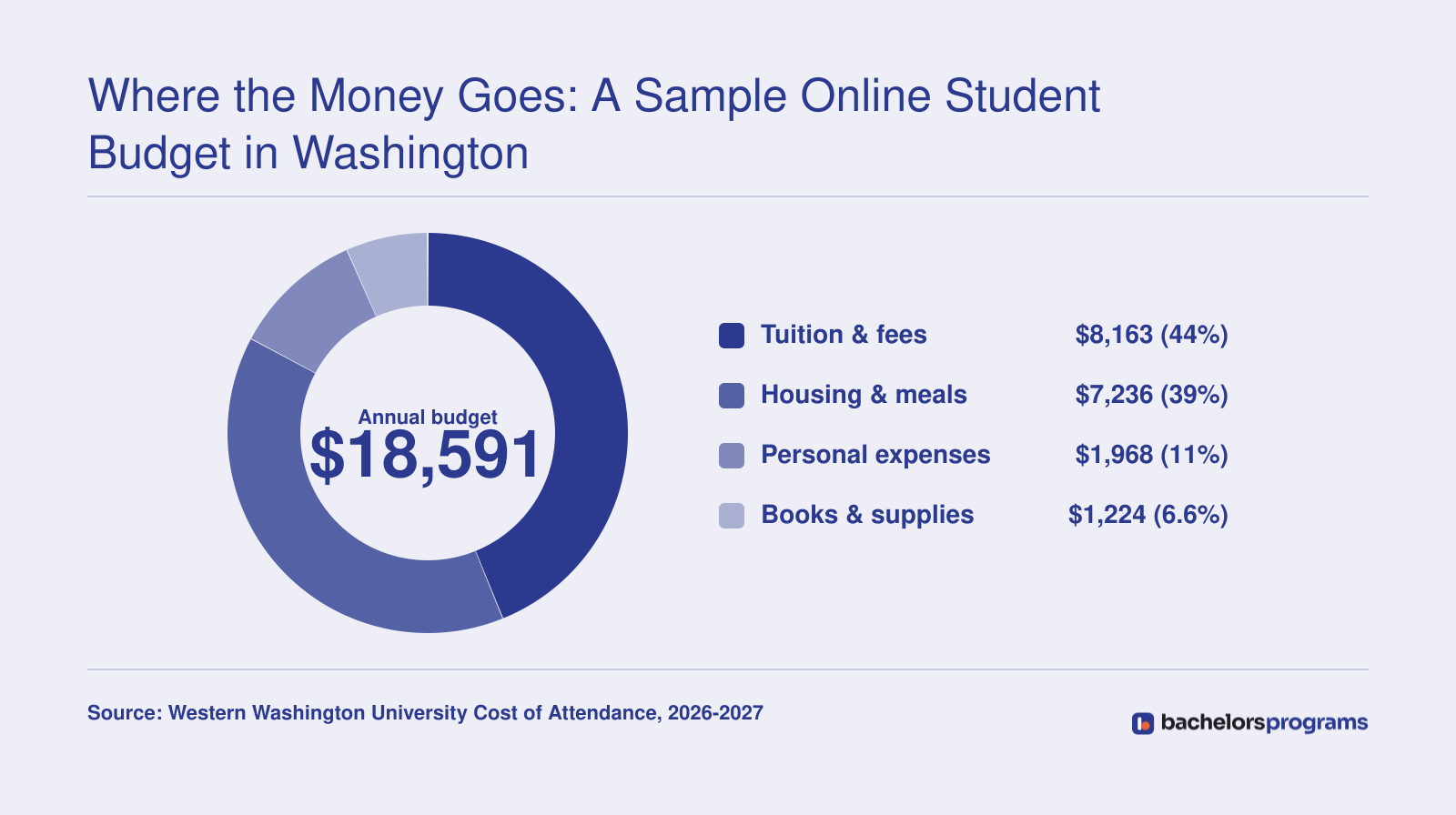
Where the Money Goes: A Sample Online Student Budget in Washington
Western Washington University's 2026-2027 cost of attendance includes a separate budget for full-time online Extended Education undergraduates, shown here for a student living with parents (the off-campus version raises housing and meals to $16,893). Online students avoid commuting and on-campus housing charges but still pay for books, a computer, and internet, and WWU folds those costs into books and supplies and personal expenses rather than a separate technology line. Financial aid can be applied against the full cost of attendance, not just tuition.
Financial Aid for Online Students: Washington College Grant, College Bond, and WASFA
A Washington family of four earning up to $83,500 qualifies for the full Washington College Grant in 2026-27, and partial awards extend to $139,500.1 For a single-person household, the full-award cap is $43,500 and the partial cap is $72,500. Eligibility runs up to 100% of state median family income, and awards vary by income, family size and program.2
Can the Washington College Grant Cover Online Study?
Often, yes, but the school and program decide. The grant follows the student to participating institutions and approved programs, so an online bachelor's at a participating college can qualify. State sources do not lay out one rule for every online or part-time program, so ask the school's financial aid office how your enrollment level affects the award. There is no application deadline and no separate form: you file the FAFSA or WASFA.3 Washington residents, including undocumented students, can qualify.
The College Bound Scholarship
College Bound is the state's early-commitment scholarship. Students typically enter in 7th or 8th grade at a Washington school, and family income must fall below 65% of state median family income.4 To keep it, a student must:
- Finish high school: Graduate from a Washington high school or approved homeschool program, or earn a GED before age 21, with a 2.0 GPA.
- Apply every year: Complete the FAFSA or WASFA beginning senior year and annually after.
- Enroll on time: Start at a participating institution within one year of graduating.
- Stay eligible: Meet residency and income rules, with no felony convictions.
College Bound can cover online, summer and study-abroad enrollment at participating schools.5 Use is limited to six years, 18 quarters or 12 semesters, or until a first bachelor's degree, whichever comes first. The amount is set after other state aid, including the Washington College Grant.
FAFSA vs. WASFA
The FAFSA is the default. The Washington Application for State Financial Aid (WASFA) serves state residents who cannot or choose not to file it, including many students affected by immigration status. Both 2026-27 and 2027-28 applications are open.6 No single statewide WASFA priority date exists, so check each school's own cutoff for institutional aid, and file early since some awards run out.
Military Benefits and Institutional Aid
The GI Bill covers online and independent-study courses, and the Post-9/11 GI Bill pays tuition for online courses at the same rate as in-person ones.7 For 2026, the tuition cap at private institutions is $30,908.34.8 The Yellow Ribbon Program helps with out-of-state, private and graduate tuition, and the University of Washington Seattle participates.9 Washington also offers tuition waivers for some veterans and National Guard members, but terms differ by school and service record, so confirm them with the school's veterans office before budgeting. Many colleges add their own scholarships and grants, which you can request through the same aid office.
Transferring From a Washington Community College to an Online Bachelor's
The Direct Transfer Agreement was rewritten this year: the revision was approved in May 2026 and takes effect September 2026.1 For online students, that makes the community college route a predictable way to start a bachelor's.
The DTA Associate Degree
The DTA is built on 90 quarter credits (60 semester credits) and is the most widely used pathway.1 Completed in full, it satisfies lower-division general education at all Washington public four-year institutions and generally brings junior standing on admission.2 Up to 15 credits of professional/technical coursework can count within it.5 Students who began the earlier DTA before September 2026 may still be able to finish it, but the Washington Student Achievement Council advises confirming timelines with your college.1
AS-T, MRPs, and Technical Degrees
The Associate in Science-Transfer (AS-T) suits science and engineering majors. It carries fewer general education courses so you can finish more lower-division major work before transferring. Track 2 covers engineering, physics, and atmospheric sciences.2 Only 5 professional/technical credits may count toward it.5
Major Related Programs (MRPs) add a major-specific plan on top of the DTA or AS-T. Ten are active: Biology, Business, Computer Science, Construction Management, Math Education, Music, Nursing, Pre-Nursing, Engineering, and Engineering Technology.3 Eight are DTA-based and two are AS-T-based. Offerings vary by college, and if a university does not participate in an MRP, it treats the degree as a basic DTA or AS-T.
If you hold a technical associate degree that is not a DTA, look at applied bachelor's (BAS) pathways, which are designed to build on career-technical credentials. Ask the receiving program how your coursework will be applied.
How Many Credits Count
Statewide, the DTA, AS-T, and MRP pathways generally deliver 90 transferable quarter credits.5 Limits after that depend on the receiving school. Eastern Washington University accepts up to 135 quarter credits in total toward a bachelor's.4 Washington State University Global Campus accepts approved transferable associate degrees from Washington, Oregon, Idaho, California, Arizona, and Hawaii. Its 30-credit cap applies to military coursework, not community college credit. Always check each online program's own transfer and residency rules.
Three Ways to Avoid Losing Credits
- Confirm DTA completion: Make sure the degree is actually awarded, not just nearly done, so the general education block transfers as a unit.
- Request a transfer credit evaluation: Ask the online program for one before you enroll, so you know what applies to your degree.
- Match major prerequisites early: Check the target program's prerequisites in your first year, and choose an MRP or AS-T track if one fits your major.
Admissions Requirements and Deadlines for Online Programs
At Washington State University Global Campus, Central Washington University, Eastern Washington University and Western Governors University, adult learners do not apply under a separate category. If you have earned college credit after high school, you apply as a transfer student. If you have not, first-time rules apply.
- First-time and low-credit applicantsWSU Global Campus asks applicants with fewer than 40 quarter or 27 semester credits for a final high school transcript. EWU treats applicants with fewer than 40 transfer credits as freshmen, and they must meet freshman requirements, including a 2.0 college GPA.
- Transfer GPA and credit thresholdsCWU guarantees admission with 40 transferable credits and a 2.5 GPA, or with an associate degree and a 2.0 GPA. WSU Global Campus applies WSU's standard transfer requirements. EWU accepts up to 135 quarter credits in transfer.
- WGU's program-based modelWGU sets no universal minimum GPA, so you meet the requirements of the program you choose. Transcripts from every college you attended, plus AP, CLEP or DSST results, are reviewed for transfer credit.
- Official transcriptsOrder official transcripts from every institution early. At WSU Global Campus, the August fall date is also the transcript deadline.
- Testing policiesTesting rules differ by school, and application materials at some schools may still include test scores. Ask admissions whether scores are required for your entry term.
- Start dates and deadlinesWSU Global Campus deadlines vary by session start. CWU admits on a rolling basis with priority dates for each term. WGU has no application deadlines, and transcripts and payment are due in the month before your intended start.
- FAFSA or WASFA timingFile the FAFSA or WASFA while you apply, not after you are admitted, so your aid offer is ready before your start date.
- Program-specific extrasSome majors add prerequisite courses, essays or background checks on top of general admission. Confirm these with the department before you apply.
Accreditation, Licensure, and Program Requirements to Verify
A degree that leads to a license is checked differently from one that does not, and the difference matters before you apply. Start with accreditation, then look at what your career field demands.
Institutional Accreditation
Most Washington colleges and universities are regionally accredited by the Northwest Commission on Colleges and Universities (NWCCU). This is the accreditation that supports credit transfer, federal financial aid eligibility, and employer recognition. To confirm a school's status, search its name on the NWCCU website, then cross-check it in the U.S. Department of Education's database of accredited postsecondary institutions. Do not rely on the school's own marketing page alone.
Programmatic Accreditation
Institutional accreditation covers the whole school. Programmatic accreditation covers one degree, and some fields expect it:
- Business: AACSB accreditation signals a rigorous business program.
- RN-to-BSN: Look for CCNE or ACEN accreditation, since many employers and graduate nursing programs require it.
- Engineering technology: ABET accreditation is the standard credential.
Licensure and Non-Licensure Tracks
A general business or communications degree rarely requires anything beyond a diploma. Education, nursing, and social work are different. These fields may require a state-approved program, and the coursework is only part of the picture. Ask any school whether its program meets Washington's requirements, and whether your placement would count toward licensure here if you live in another state.
Practicums, Internships, and Proctoring
Online does not always mean no in-person time. Student teaching, clinical hours, and field placements usually happen at a site near you. Ask each school who arranges the placement: some have placement coordinators, while others expect you to find a site and secure approval. Get that answer in writing, because a self-arranged placement can add months.
Proctoring varies by course. Some programs use online proctoring software that records you through a webcam and monitors your screen. Others use testing centers or allow open-book assessments. Ask which applies, and check that your computer and internet connection meet the technical requirements.
Washington Teacher Certification for Online Education Majors
Outcomes: Graduation Rates, Employment, and Earnings in Washington
No single outcomes figure tells the whole story: graduation, retention and earnings shift with cohort, program and method, so check current data at the source. Treat any snapshot below as a starting point.
Graduation and Retention at Washington's Public Universities
For Washington State University, Central Washington University, Eastern Washington University, and Western Washington University, start with College Scorecard and the IPEDS Data Center. Both report six-year graduation rates and first-year retention. IPEDS defines retention as the share of first-time, degree-seeking undergraduates who persisted in or completed their program at the same institution one year later.3 At four-year schools, that counts only first-time students seeking a bachelor's or equivalent.
Then cross-check each university's institutional research or consumer-information page. These pages show how the school defines its cohort, which matters because many online students transfer in and may not appear in first-time figures at all. The Washington Student Achievement Council also publishes retention data.3
Earnings of Bachelor's Holders in Washington
To compare bachelor's holders with high school graduates, use two sources:
- Washington ERDC: Its High School Graduate Outcomes Dashboard reports median (50th percentile) earnings for employed residents, with data through 2024.1 It classifies degrees as the highest earned within eight years of high school, and it does not show wages beyond 15 years after graduation.1
- Census ACS: Table S1501 on data.census.gov covers educational attainment and earnings. One 2024 5-year result lists $80,000 in median earnings for bachelor's holders2, but check that the geography is Washington before you quote it.
ERDC generally finds that credential holders out-earn high school graduates and that the gap tends to widen over time. When you compare statewide and regional figures, account for degree field, age, and local labor-market conditions. A recent graduate in a slow market will look different from a mid-career worker.
Occupation-Specific Outlook
Statewide medians hide big differences between careers. The Bureau of Labor Statistics at BLS.gov fills that gap with three tools:
- Occupational Outlook Handbook: Duties, typical education, and growth outlook by occupation.
- OEWS wage data: Wages by occupation and region.
- Employment Projections: Expected openings and growth.
Pair those with professional associations in your field for credential requirements. Also check each school's career-services or alumni-outcomes page for where graduates actually land. Ask whether the numbers cover online students specifically or the whole campus.
Bachelor's Degree Earnings in Washington
A bachelor's degree is linked to higher earnings in Washington.
Colleges in Washington with the most bachelor's programs
| School | City | Type | Bachelor's programs | Online | Net price / yr | Grad rate |
|---|---|---|---|---|---|---|
| Central Washington University | Ellensburg | Public | 97 | 28 | $18,476 | 54% |
| Western Washington University | Bellingham | Public | 88 | 2 | $21,193 | 65% |
| Washington State University | Pullman | Public | 87 | 17 | $14,971 | 61% |
| University of Washington-Seattle Campus | Seattle | Public | 87 | 1 | $14,091 | 85% |
| Eastern Washington University | Cheney | Public | 68 | 9 | $13,886 | 44% |
| Gonzaga University | Spokane | Private nonprofit | 64 | 1 | $35,119 | 86% |
| Seattle University | Seattle | Private nonprofit | 55 | 0 | $34,662 | 76% |
| Walla Walla University | College Place | Private nonprofit | 53 | 0 | $23,329 | 60% |
| Whitworth University | Spokane | Private nonprofit | 53 | 3 | $26,534 | 71% |
| Pacific Lutheran University | Tacoma | Private nonprofit | 50 | 1 | $19,589 | 69% |
| Saint Martin's University | Lacey | Private nonprofit | 46 | 5 | $28,119 | 52% |
| University of Washington-Bothell Campus | Bothell | Public | 41 | 6 | $12,319 | 65% |
| Seattle Pacific University | Seattle | Private nonprofit | 41 | 0 | $24,488 | 62% |
| University of Washington-Tacoma Campus | Tacoma | Public | 36 | 4 | $10,163 | 63% |
| Heritage University | Toppenish | Private nonprofit | 29 | 5 | $14,598 | 54% |
Program counts are the verified bachelor's listings in our directory; net price is the school-wide average a first-time undergraduate paid after aid, and graduation rate the share finishing within six years (College Scorecard).
Common Questions About Online Bachelor's Degrees in Washington
These answers cover the questions Washington students ask most often about residency, state aid, and where to find fully online programs. Policies change by school and by program, so confirm specifics with the college before you enroll.
Is online tuition the same for Washington residents and out-of-state students?
Can I use the Washington College Grant for online programs?
Which Washington colleges offer fully online bachelor's degrees?
What happens to my in-state tuition if I move out of Washington mid-program?
Compare programs nationwide
Many Washington residents study online. Every ranked list above has an online lens, or browse every field.
Online bachelor's degrees Browse all fields