Online Colleges and Bachelor's Degree Programs in Connecticut
Every verified bachelor's program at a college in Connecticut: 1,050+ programs at 20+ colleges, with the online options, net price and graduation rates behind each one.

Connecticut treats the online bachelor's degree as a completion tool, not a starting point. Charter Oak State College, the online college inside the CSCU system, is built around students who arrive with credits already earned, and its tuition and transfer rules are shaped by that assumption.
The tension is cost and logistics. Published tuition rarely matches what a student pays after federal and state aid, and the word "online" still hides required clinical hours in nursing and social work. Accreditation, not format, decides whether a degree qualifies you for a Connecticut license.
Key Points
- Charter Oak State College is Connecticut's public, fully online degree-completion college.
- A completed CSCU Transfer Ticket associate degree transfers as a block.
- Net price usually falls far below sticker price, especially at private colleges.
Popular degrees in Connecticut
Bachelor's degrees in Connecticut by field
Business & Management
- Marketing27 programs
- Business Administration22 programs
- Finance20 programs
- Management16 programs
- Accounting15 programs
- Economics14 programs
- Communication13 programs
- Sports Management12 programs
Science & Engineering
- Biology22 programs
- Mathematics20 programs
- Chemistry17 programs
- Biochemistry14 programs
- Anthropology13 programs
- Environmental Science11 programs
- Physics11 programs
- Mechanical Engineering10 programs
Liberal Arts & Humanities
- English19 programs
- Literature or English Literature17 programs
- History16 programs
- Spanish16 programs
- Philosophy12 programs
- General Studies10 programs
- Global Health or Health Studies9 programs
- Interdisciplinary Studies7 programs
Arts & Design
- Fine Arts or Studio Art18 programs
- Art or Art Studies16 programs
- Media Arts or Digital Media12 programs
- Graphic Design11 programs
- Art History10 programs
- Audio & Music9 programs
- Illustration6 programs
- Game Art & Design4 programs
Education & Teaching
- Science14 programs
- Early Childhood Education or Child Development10 programs
- Elementary Education10 programs
- English Education8 programs
- Secondary Education8 programs
- Mathematics Education7 programs
- Special Education6 programs
- History Education5 programs
Computers & IT
- Computer Science21 programs
- Cybersecurity9 programs
- Software Development & Engineering8 programs
- Innovation or Technological Entrepreneurship7 programs
- Computer Engineering6 programs
- Computer Information Systems6 programs
- Artificial Intelligence5 programs
- Data Analytics4 programs
Social Work & Social Sciences
- Sociology19 programs
- Political Science, Government17 programs
- Social Work9 programs
- Human Services4 programs
- Public Policy1 program
Healthcare
- Health Sciences15 programs
- Exercise & Sports Science12 programs
- Public Health9 programs
- Nutrition5 programs
- Community Health2 programs
- Speech Pathology1 program
- Respiratory Care Therapy1 program
- Health Education1 program
Nursing
- Bachelor of Science in Nursing23 programs
- Accelerated BSN (ABSN)13 programs
- Nursing (RN to BSN)8 programs
- LPN/LVN to BSN1 program
Communications & Media
- Communications13 programs
- Journalism13 programs
- Public Relations5 programs
- Professional Writing4 programs
- Communication Disorders3 programs
- Strategic Communications3 programs
- Speech Pathology2 programs
- Social Media1 program
Criminal Justice & Law
- Criminal Justice11 programs
- Criminology6 programs
- Criminal Justice Administration4 programs
- Corrections3 programs
- Homeland Security3 programs
- Forensic Science3 programs
- Legal Services2 programs
- Legal Studies2 programs
Psychology
- General Psychology21 programs
- Industrial Organizational Psychology2 programs
- Applied Behavior Analysis2 programs
- Forensic Psychology1 program
- Applied Psychology1 program
- Sport Psychology1 program
Natural & Applied Sciences
- Neuroscience6 programs
- Oceanography or Ocean or Marine Biology6 programs
- GIS and Geoscience3 programs
- Agriculture or Agricultural1 program
Counseling
- Mental Health Counseling1 program
How Online Bachelor's Degrees Work in Connecticut
Online learning in Connecticut is no longer a side offering, and the label on a school's website now tells you less than the course schedule does. Before comparing programs, know what each format actually means.
Three Delivery Formats
- Fully online: Every course runs through the internet, with no required campus visits.
- Hybrid: Most work is online, but some scheduled in-person sessions are required, such as weekend labs or evening meetings.
- On-campus with online electives: The degree is built for in-person study, and a few courses can be taken remotely.
Schools often blur these under a single "online program" label, so check the program's requirements page for residencies, proctored exams, clinicals, or internships.
Synchronous vs. Asynchronous
Synchronous courses meet live at set times. Asynchronous courses let you watch lectures and submit work on your own schedule, within deadlines. For working adults and parents, this distinction often matters more than the format label. A fully online program with mandatory Tuesday-night live sessions can be harder to manage than a hybrid program with three Saturday meetings a semester.
Who Provides Online Degrees
The public options start with Charter Oak State College, Connecticut's public online college built around degree completion and transfer credit. The four state universities inside the CSCU system, Central, Eastern, Southern, and Western Connecticut State, offer online and hybrid options, as does UConn in selected areas. Private nonprofit colleges and for-profit providers round out the field, with wide variation in cost, format, and student support.
Diplomas and Accreditation
At the same accredited school, an online diploma is generally identical to the on-campus one. Transcripts and degree titles typically do not distinguish between them. What matters is accreditation. For New England schools, regional accreditation comes from the New England Commission of Higher Education (NECHE), and it is the baseline to confirm before you apply. It affects credit transfer, federal financial aid eligibility, and how employers and graduate programs view your degree.
Which Connecticut Colleges Offer Fully Online Bachelor's Degrees
A fully online bachelor's degree lets you finish every course from home, with no required trips to campus. In Connecticut, the clearest public example is Charter Oak State College, which is built around online degree completion. Its official pages describe its courses as 100% online, and its Business Administration bachelor's is one listed example. Another Charter Oak page says "many programs" are fully online, so confirm the exact major you want rather than assuming every one qualifies.
Other Connecticut Options
Connecticut's public universities (Central, Eastern, Southern, and Western Connecticut State, plus UConn) and private nonprofits such as the University of New Haven, Sacred Heart, and Albertus Magnus all offer online coursework in some form. The official sources reviewed here do not confirm whether any given bachelor's can be completed entirely online. For those schools, treat the delivery as "online or hybrid" until the program page says otherwise. That is a gap in what we can verify, not proof that fully online options are absent.
A 3-Step Verification Method
- Read the program page: Look for residency or on-campus requirements, usually listed under admissions, curriculum, or program details.
- Ask admissions directly: Ask about proctored exams, required orientation, and whether any session must be attended in person.
- Confirm where hands-on work happens: For internships, practicums, or clinicals, ask whether you arrange a site near home or must use one the school assigns.
Spotting Hidden In-Person Requirements
Some programs advertised as "online" still require a campus orientation, proctored testing at an approved site, or a capstone presentation given in person. Watch for phrases like "hybrid," "blended," "low-residency," "on-campus intensive," "synchronous sessions," and "proctored at a testing center." If a page says "online" but lists a residency or capstone requirement, ask for the details in writing before you apply. Programs also change, so check that your major is still offered for the current academic year.
Online Bachelor's Programs That Still Require Clinicals, Internships, or Campus Visits
Online coursework does not always mean a fully remote degree: nursing, social work, education, and some social science majors in Connecticut build in supervised hours at a hospital, agency, school, or community organization. Many of these placements can be arranged near where you live, and Charter Oak State College, for example, has RN-to-BSN students identify their own practice sites and mentors. Rules on site approval, supervisor credentials, and scheduling differ by program, so confirm in writing how and where your placement will happen before you enroll.
| Program Type | Example CT Provider | Typical Delivery | In-Person Component | Can Be Completed Locally? |
|---|---|---|---|---|
| RN-to-BSN (Nursing: RN/ADN to BSN) | Charter Oak State College | 100% online coursework | Two on-ground practicum experiences (NUR 320 and NUR 495); NUR 320 requires 40 hours of clinical practice over one semester | Yes. Students identify their own practice sites and site-based mentors and set up agreements with those sites |
| Social Work (BA) | Central Connecticut State University | N/A | Minimum of 680 field hours, including a 400-hour internship in the final year | Placements are in human-service agencies; the final internship is at a vetted partner organization supervised by an MSW-level social worker |
| Sociology (BS) | Central Connecticut State University | N/A | 4-credit internship class with a placement at a local organization | Yes. Past placements include Hands on Hartford, the New Britain YWCA, and the Hospital for Special Care in New Britain |
| Education | Charter Oak State College | N/A | Internship of at least 120 hours in one setting over 15 weeks | Not specified in the catalog; confirm site selection with the college |
Sticker Price vs. Net Price: What Connecticut Students Actually Pay
What will a Connecticut online bachelor's degree actually cost once financial aid is applied? The answer usually sits far below the published tuition figure, and the gap is largest at private colleges.
Net price is the number that matters
Sticker price is what a college publishes. Net price is the full cost of attendance, tuition, fees, housing, books, and living expenses, minus grants and scholarships. At Trinity College, 67% of undergraduates receive institutional grant aid; at Connecticut College, that share reaches 100%. Those figures describe those two colleges only, not private colleges as a group, but they show how heavily private nonprofits discount their published price.
What the numbers look like
A 2026 statewide compilation puts Connecticut's median net price at roughly $21,634 across degree-granting institutions. Campus-level figures for 2021-22 show the spread: CT State Community College near $11,513, Central Connecticut State University at $16,857, UConn at $25,097, Trinity College at $34,832, and Fairfield University at $48,095. These are individual campus figures rather than public-versus-private averages, and because the year is older, current costs will run higher. Pell participation varies by campus too: 14% at Connecticut College and 15% at Trinity.
Do online students pay in-state rates?
At CSCU institutions, in-state tuition generally requires permanent Connecticut residence for at least 12 months before enrollment, and moving to the state solely to attend college does not satisfy that requirement. Students whose permanent state changes can file a Residency Reclassification Application at any time. Do not assume an online program carries its own residency exception. Ask each school in writing whether it charges a flat online rate regardless of your state; a single published rate is often easier to compare than a tuition table.
Run the calculator, then ask about your category
Every federal-aid college posts a net price calculator. Use it, but read the fine print: most calculators model first-time, full-time freshmen living on campus, not adult transfer students studying online. Ask a financial aid counselor to work through your actual numbers as a transfer applicant bringing prior credits.
Questions to Ask Yourself
Do you need a program you can finish without setting foot on campus, or could you handle a few in-person sessions or a local clinical placement?
Are you comparing per-credit rates, or the total cost after your transfer credits are applied?
If you live outside Connecticut, does the school charge you an out-of-state online rate or a single flat rate?
Have you run the net price calculator using your real income and transfer credits, not freshman defaults?
Financial Aid and Connecticut State Grants for Online Students
Federal aid follows the student, while Connecticut state aid follows the rules of each program. A Pell Grant or federal loan generally works the same whether you study on campus or online at an eligible school. State grants can hinge on residency, enrollment intensity, and the type of institution you attend. That is why online students should verify state eligibility early instead of assuming it carries over.
Start With the State Program Pages
Connecticut's best-known undergraduate programs are the Roberta B. Willis Scholarship, which has need-based and merit-based components, and PACT, the state's free community college program. Both are described through the Connecticut Office of Higher Education at ctohe.org. Go to that source rather than a third-party summary, because award rules and funding levels can change from year to year.
When you search, pair each exact program name with specific terms:
- Eligibility: residency, income, and academic requirements
- Award amount: current maximums and how awards are calculated
- Enrollment intensity: full-time versus part-time rules
- Online students: whether distance enrollment qualifies
Ask Your School's Financial Aid Office
The financial aid office at your Connecticut college or university applies these rules to real students, so it is the best place to confirm how they affect you. Ask direct questions. Do part-time students qualify? Does an online-only program count the same as on-campus enrollment? Are out-of-state students enrolled online eligible for any state funds? If you drop below full time, how is the award prorated? Get the answers by email so you have a record.
This matters most for working adults, who often enroll part time online. A state award built around full-time enrollment may shrink or disappear at a lighter course load.
File the FAFSA and Confirm Deadlines
Nearly every state and institutional award starts with the FAFSA. File it at StudentAid.gov, which also lists federal aid deadlines. Connecticut sets its own priority date for state aid, and individual schools may set earlier ones. Confirm the current state deadline on the Connecticut Office of Higher Education site or with your school's aid office rather than trusting a date you saw elsewhere.
Your Aid Checklist
- Review state pages: read the Roberta B. Willis Scholarship and PACT pages at ctohe.org
- Contact the aid office: ask about part-time, online, and out-of-state eligibility
- File the FAFSA: submit at StudentAid.gov as soon as it opens
- Confirm deadlines: check both the state priority date and your school's date
- Apply early: state funds can be limited, and late filers risk missing out
Transferring Credits Into an Online Bachelor's Program in Connecticut
Community college credits do transfer in Connecticut, and the state's Transfer Ticket makes it the most predictable route into a bachelor's degree.
How the Transfer Ticket Works
The CSCU Transfer Ticket is a program-to-program guarantee. A student who completes a designated associate degree at CT State Community College and moves into the matching bachelor's major at Central, Eastern, Southern, or Western Connecticut State University, or at Charter Oak State College, has the associate credits applied to that pathway. Only 60 credits then remain on a standard 120-credit bachelor's degree.
Three conditions apply:
- Follow the curriculum: The guarantee depends on completing the designated Transfer Ticket associate and entering the corresponding major.
- Credits, not courses: Some pathways include open electives, and a few may run past 60 credits when course values require it.
- Admission is not universal: The guarantee covers the designated program only. The Social Work ticket, for example, does not guarantee BSW acceptance, and a second application with a higher GPA may be required.
UConn sits outside the Transfer Ticket. Private nonprofit colleges set their own transfer rules, so ask each one for a written credit evaluation.
Caps, Residency, and Prior Learning
Every degree-granting school requires some credits to be earned with it, and many set a ceiling on transferable credits. Published limits differ by institution and program, so confirm both numbers before you apply rather than relying on a general rule.
Credit for prior learning can shorten the path further. Charter Oak is known for options such as portfolio assessment, CLEP and DSST exams, ACE-evaluated military training, and some professional licenses. Caps may apply to each category, and whether they stack is something to verify with an advisor, in writing.
What the Credits Are Worth
Here is an illustration, not a quoted rate. Suppose a program charges $400 per credit (a hypothetical figure). A full 120-credit degree would cost $48,000 in tuition. With 60 credits already completed, the remaining 60 cost about $24,000, roughly half. You also save about two years of full-time study, or longer if you attend part-time.
Fees and per-credit rates differ by school, so substitute the real rate from each program you compare.
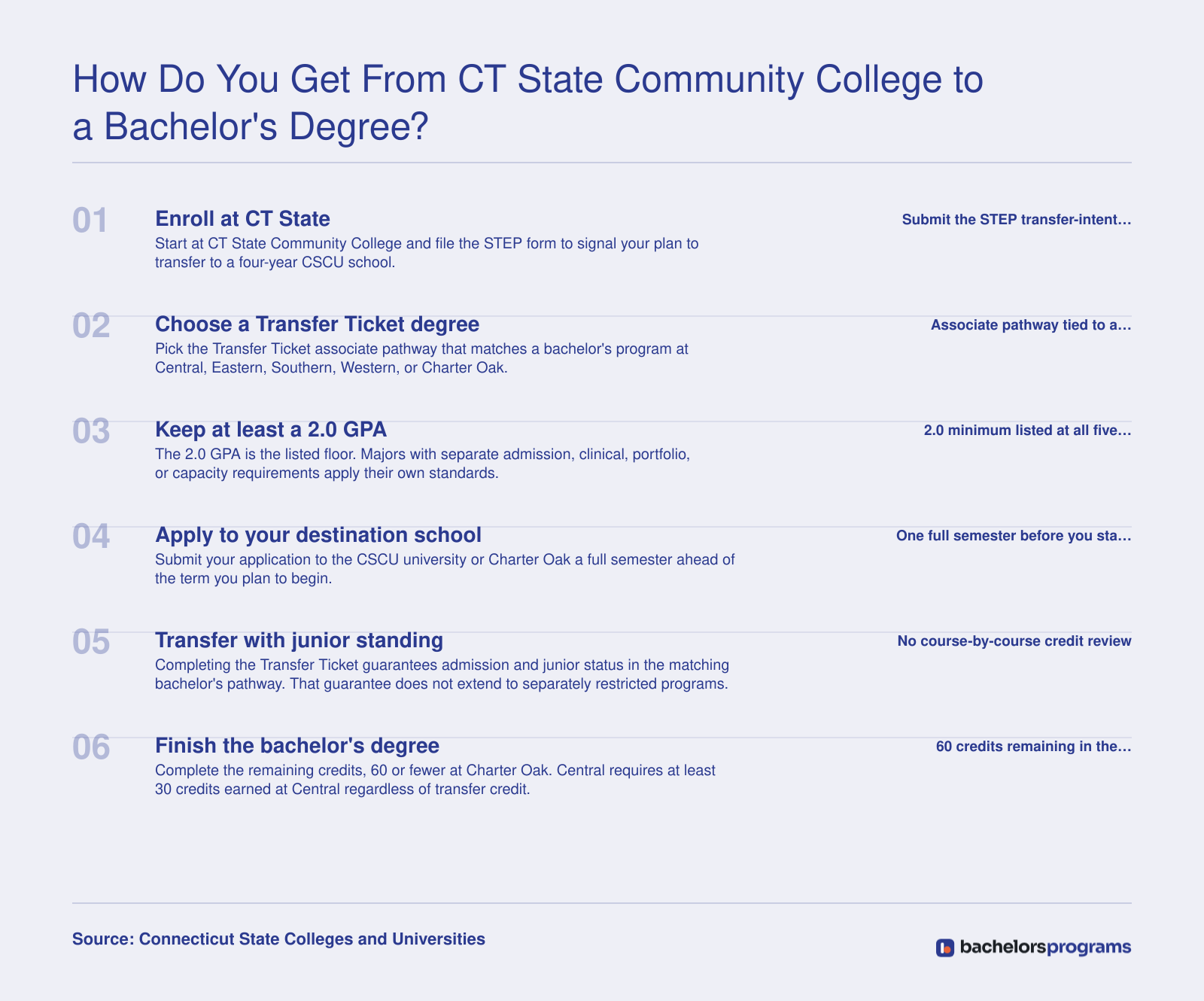
How Do You Get From CT State Community College to a Bachelor's Degree?
The Transfer Ticket route lets CT State students move into a matching bachelor's program at a Connecticut State University or Charter Oak State College. A completed Transfer Ticket associate degree transfers as a block, without a course-by-course review, and is designed to leave only 60 credits in the matched bachelor's.
Admissions, Deadlines, and Residency Requirements
Online and on-campus applicants in Connecticut face similar core requirements. The main differences are timing and which pathway you qualify for. Confirm each item with the college before you apply.
- High school diploma or GEDBachelor's programs expect proof that you finished high school, either through a diploma or a GED. Transfer and returning students should also request official transcripts from every college they have attended.
- Degree-completion entry rulesCharter Oak State College runs fully online programs built for working and returning adults, and it offers credit for prior learning. Its minimum transfer credits and other entry conditions can change, so check the current requirements with admissions.
- Test scoresMany colleges no longer require SAT or ACT scores, but policies vary by school and program. Confirm before paying to send scores.
- Connecticut Automatic Admissions ProgramThis program is open to current Connecticut graduating seniors with a 3.0 weighted or 2.75 unweighted GPA. You apply through the Common App with an official transcript, and the application fee, essays and recommendation letters are waived. The 2026 participants are Central, Eastern, Southern and Western Connecticut State, Albertus Magnus, Mitchell, Bridgeport, Hartford, New Haven and Saint Joseph. Charter Oak and CT State Community College are not on the list. For 2027-28 entry, apply by May 1, 2027. Some majors may ask for more information.
- Application timingCentral Connecticut State uses rolling admissions with preferred deadlines. First-year applicants should apply by May 1 for fall or December 1 for spring. Transfer applicants should apply by June 1 for fall or December 1 for spring. Charter Oak offers six start dates a year.
- Residency proofIn-state tuition at CSCU colleges depends on proving Connecticut residency. Ask the registrar which documents your college accepts.
Completion Time, Graduation Rates, and Outcomes by Sector
How Long a Bachelor's Degree Takes
A bachelor's degree is typically 120 credits. Full-time students usually finish in about four years. Degree completers who bring in roughly 60 transferred credits can often finish in two years or less, while part-time students take longer, depending on how many courses they carry each term. Many online programs use accelerated 7- or 8-week terms, which lets you take fewer courses at once and still move through the calendar quickly. That changes how the work is paced. It does not automatically shorten the degree, and the data here does not show that online students finish faster or earn more than on-campus peers.
What Connecticut Graduation Data Shows
Public flagship figures look strong. UConn's FY2026 fact sheet reports 92% first-year retention at the main campus, a 75% four-year graduation rate, and an 84% six-year rate.2 Among students who graduate within six years, the average time to degree is 4.1 years. Another UConn report rounds the retention and six-year figures slightly lower, so treat the exact percentages as approximate.
Charter Oak State College, the state's online-focused public option, serves a different population. Its College Scorecard profile shows 62% of students returning after the first year.1 Across an eight-year window covering 1,348 students, 62% graduated, 25% withdrew, 13% transferred, and 1% were still enrolled.1
Comparable current figures are not available here for the other Connecticut State University campuses, nor reliable ones for private nonprofit and for-profit providers. Check each school's College Scorecard or IPEDS College Navigator page before comparing.
Why Standard Rates Can Mislead
The conventional graduation rate tracks first-time, full-time students who start in the fall. Many online learners are transfers or part-timers, so they fall outside that measure. IPEDS Outcome Measures is a better gauge. It follows four cohorts, including part-time and transfer-in students, and reports results at 6 and 8 years.3 When you compare schools, look for the outcome measures, and keep in mind that a school with a high share of transfers may show a lower rate for reasons unrelated to quality.
What Connecticut Bachelor's Graduates Earn
Charter Oak State College, Connecticut's public online college, offers one of the clearest earnings benchmarks in the state.
How to Choose: Public, Private Nonprofit, or For-Profit
The lowest sticker price and the best fit are rarely the same school, and in Connecticut that gap is usually settled by two questions: how many credits you can bring with you, and whether your field requires programmatic accreditation. Public, private nonprofit, and for-profit institutions each solve a different problem, so match the sector to your situation before you compare tuition lines.
Start With the Public Route
Charter Oak State College and the CSCU institutions are built for adults returning to finish a degree. Per-credit costs sit at the low end, transfer credit and prior-learning assessment are routine rather than exceptional, and the state's transfer pathways give community college graduates a defined route into a bachelor's program. If you already carry credits and your field has no unusual clinical requirements, this is the option to beat.
Private Nonprofit: Pay for Fit, Not Prestige
Private colleges list higher tuition, but many award substantial institutional aid, which can pull net price close to public levels for the right applicant. What you are usually buying is a specific program, a cohort model, or a stronger alumni network in your field. Ask each one for a net price estimate instead of accepting the published rate as your cost.
For-Profit: Verify First, Enroll Second
Treat this sector as one to check rather than one to rule out. Confirm institutional accreditation from a federally recognized body such as NECHE, then confirm programmatic accreditation wherever a license depends on it: CCNE or ACEN for an RN-to-BSN, CAEP for education, CSWE for social work. Watch for pressure to enroll quickly, vague answers about transfer credit, no published net price, heavy reliance on private loans, and unclear clinical or internship placement.
Support Services and Your Next Step
Online students need a dedicated advisor rather than a general call center, plus online tutoring, career services, and a placement office that coordinates clinical or field hours instead of leaving you to find them.
Shortlist two or three schools and request two documents from each before you apply: a transfer credit evaluation and a written net price estimate. Compare what those documents say, not what the brochures promise.
Colleges in Connecticut with the most bachelor's programs
| School | City | Type | Bachelor's programs | Online | Net price / yr | Grad rate |
|---|---|---|---|---|---|---|
| Central Connecticut State University | New Britain | Public | 84 | 15 | $16,857 | 48% |
| University of Connecticut | Storrs | Public | 83 | 1 | $25,097 | 83% |
| Southern Connecticut State University | New Haven | Public | 83 | 3 | $20,857 | 50% |
| University of New Haven | West Haven | Private nonprofit | 70 | 0 | $34,192 | 63% |
| Sacred Heart University | Fairfield | Private nonprofit | 69 | 31 | $46,174 | 74% |
| University of Hartford | West Hartford | Private nonprofit | 65 | 1 | $30,282 | 54% |
| Fairfield University | Fairfield | Private nonprofit | 63 | 0 | $48,095 | 84% |
| Western Connecticut State University | Danbury | Public | 61 | 3 | $17,604 | 52% |
| Quinnipiac University | Hamden | Private nonprofit | 61 | 1 | $40,675 | 76% |
| Eastern Connecticut State University | Willimantic | Public | 57 | 0 | $21,067 | 58% |
| Albertus Magnus College | New Haven | Private nonprofit | 44 | 2 | $34,028 | 52% |
| University of Saint Joseph | West Hartford | Private nonprofit | 40 | 0 | $27,989 | 64% |
| Post University | Waterbury | Private for-profit | 39 | 36 | $21,634 | 25% |
| Yale University | New Haven | Private nonprofit | 37 | 0 | $23,777 | 96% |
| Trinity College | Hartford | Private nonprofit | 34 | 0 | $34,832 | 84% |
Program counts are the verified bachelor's listings in our directory; net price is the school-wide average a first-time undergraduate paid after aid, and graduation rate the share finishing within six years (College Scorecard).
Compare programs nationwide
Many Connecticut residents study online. Every ranked list above has an online lens, or browse every field.
Online bachelor's degrees Browse all fields