Online Colleges and Bachelor's Degree Programs in Indiana
Every verified bachelor's program at a college in Indiana: 2,500+ programs at 50+ colleges, with the online options, net price and graduation rates behind each one.

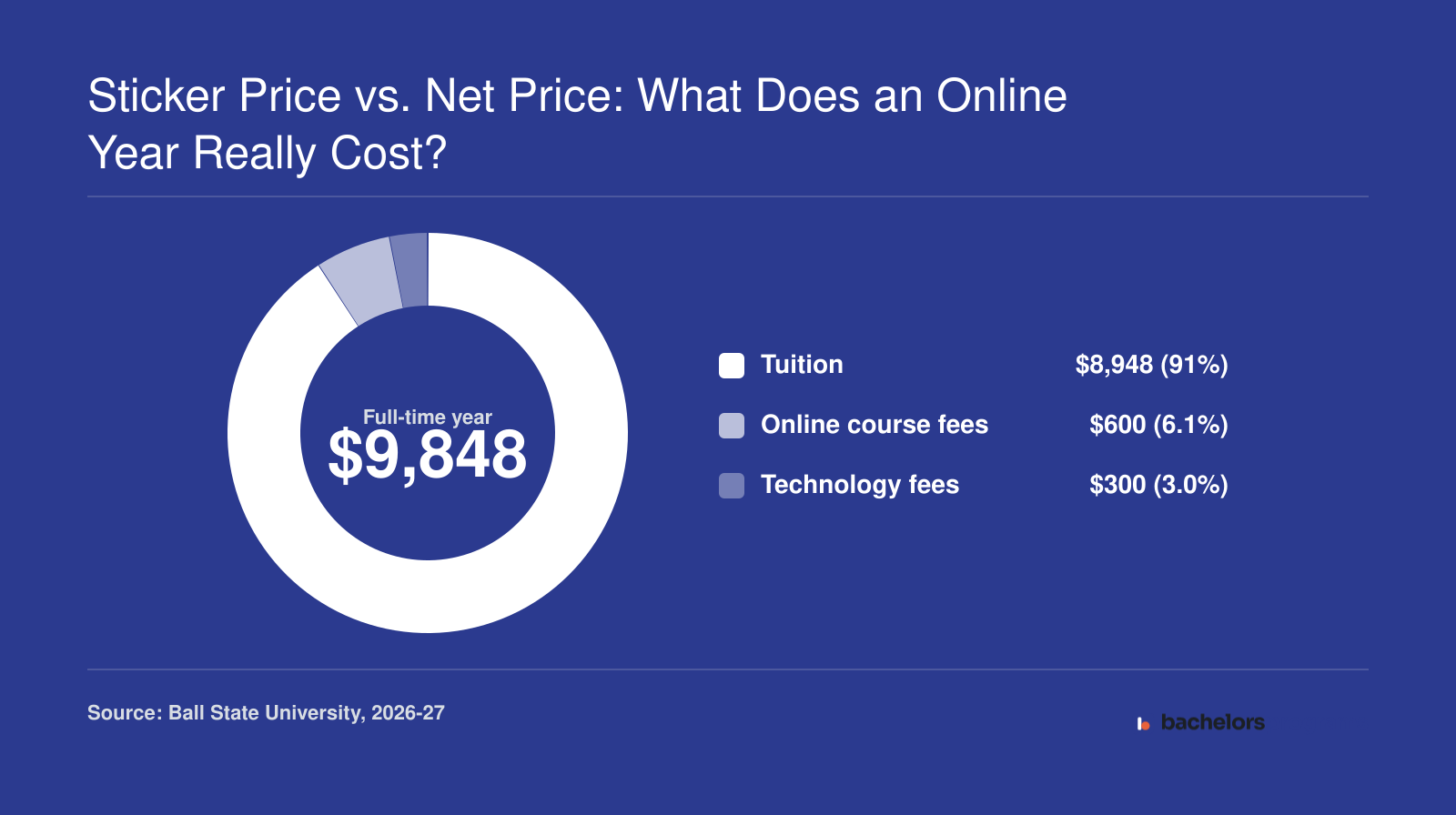
An Indiana resident taking 12 online credits a semester at Ball State in 2026-27 pays about $9,848 a year in published tuition and fees. Most bachelor's degrees in the state require 120 semester credits. For an adult or recent graduate who won't relocate, those two figures frame the choice: what a year costs and how many years it takes.
Net price after grants often runs below sticker price. Some programs never require a campus visit, while others add on-campus sessions or clinical placements. Transfer credit from an associate degree can shorten the timeline considerably.
The common trap is aid. Federal grants follow the student, but Indiana state aid depends on the school, the program and your credit load.
Key Points
- A full-time Ball State resident pays about $9,848 yearly (2026-27).
- Federal aid follows you; Indiana aid hinges on school and credit load.
- Expect 120 semester credits, or 180 quarter credits at Purdue Global.
Popular degrees in Indiana
Bachelor's degrees in Indiana by field
Business & Management
- Business Administration59 programs
- Marketing56 programs
- Finance42 programs
- Accounting40 programs
- Management36 programs
- Communication32 programs
- Logistics & Supply Chain Management30 programs
- Sports Management26 programs
Science & Engineering
- Biology49 programs
- Mathematics38 programs
- Chemistry38 programs
- Biochemistry33 programs
- Physics27 programs
- Environmental Science23 programs
- Mechanical Engineering17 programs
- Anthropology16 programs
Education & Teaching
- Science47 programs
- Elementary Education37 programs
- Secondary Education35 programs
- Mathematics Education28 programs
- Special Education27 programs
- English Education25 programs
- History Education18 programs
- Early Childhood Education or Child Development15 programs
Arts & Design
- Art or Art Studies60 programs
- Fine Arts or Studio Art45 programs
- Media Arts or Digital Media33 programs
- Graphic Design26 programs
- Audio & Music15 programs
- Art History13 programs
- Creative Writing12 programs
- Game Programming & Development11 programs
Liberal Arts & Humanities
- English43 programs
- History35 programs
- Literature or English Literature31 programs
- Spanish30 programs
- Philosophy20 programs
- General Studies16 programs
- Interdisciplinary Studies15 programs
- Global Studies15 programs
Computers & IT
- Computer Science57 programs
- Cybersecurity22 programs
- Computer Engineering17 programs
- Computer Information Systems15 programs
- Artificial Intelligence14 programs
- Information Technology11 programs
- Software Development & Engineering10 programs
- Innovation or Technological Entrepreneurship10 programs
Communications & Media
- Communications52 programs
- Journalism36 programs
- Public Relations18 programs
- Professional Writing8 programs
- Strategic Communications8 programs
- Speech Pathology7 programs
- Communication Disorders6 programs
- Social Media2 programs
Social Work & Social Sciences
- Sociology43 programs
- Political Science, Government32 programs
- Social Work25 programs
- Human Services11 programs
- Public Policy3 programs
- Disability Studies1 program
Healthcare
- Exercise & Sports Science26 programs
- Health Sciences24 programs
- Public Health15 programs
- Health Education11 programs
- Speech Pathology7 programs
- Community Health6 programs
- Nutrition4 programs
- Respiratory Care Therapy3 programs
Nursing
- Bachelor of Science in Nursing52 programs
- Nursing (RN to BSN)20 programs
- Accelerated BSN (ABSN)18 programs
- LPN/LVN to BSN4 programs
Criminal Justice & Law
- Criminal Justice36 programs
- Forensic Science14 programs
- Criminology11 programs
- Criminal Justice Administration6 programs
- Paralegal3 programs
- Legal Services3 programs
- Corrections3 programs
- Homeland Security3 programs
Psychology
- General Psychology43 programs
- Addiction Psychology4 programs
- Applied Behavior Analysis4 programs
- Industrial Organizational Psychology3 programs
- Sport Psychology1 program
- Clinical Psychology1 program
Religion & Theology
- Christian Ministry or Ministry Leadership14 programs
- Christian Studies or Religious Studies12 programs
Natural & Applied Sciences
- Applied Science8 programs
- GIS and Geoscience7 programs
- Agriculture or Agricultural4 programs
- Neuroscience4 programs
- Oceanography or Ocean or Marine Biology3 programs
Counseling
- Substance Abuse Counseling8 programs
How Online Bachelor's Degrees Work in Indiana
Indiana's established colleges are accredited by the Higher Learning Commission (HLC), and confirming that approval is the first step before you apply. Accreditation affects whether credits transfer, whether federal and state aid applies, and whether employers and graduate schools accept the degree.
Three Sectors, Three Cost Structures
Indiana online degrees come from three kinds of institutions, and the sector shapes what you pay and what you can transfer.
- Public universities: State-supported schools generally charge the lowest tuition, especially to residents. They also tend to have the most established transfer pathways with Indiana's community college system.
- Private nonprofits: Sticker prices run higher, but institutional scholarships can narrow the gap. Transfer policies vary by school, so ask for a written credit evaluation.
- For-profits: Enrollment is often flexible and fast, but tuition can be higher, and other schools may be less willing to accept the credits. Check accreditation closely.
Who Approves What
The Indiana Commission for Higher Education reviews and approves new degree programs at public institutions. Its approval signals that a program meets state standards. It does not replace institutional accreditation, which is why HLC status remains the baseline check.
One Diploma, Different Price Tags
Many Indiana public universities deliver online degrees through dedicated online units. Those units may set their own per-credit rates, technology fees or distance-education fees, so two students earning the same degree can pay different totals depending on how they enroll. Compare the full cost per credit, not just the headline tuition.
Out-of-State Students
Indiana participates in NC-SARA, the interstate agreement that lets students in other member states enroll in Indiana online programs. Professional licensure rules still vary by state, and later sections cover those caveats.
Online College Tuition in Indiana: Per-Credit Rates at Major Universities
Online tuition in Indiana is not one uniform price. Purdue Global charges a single per-credit rate no matter where you live, the University of Southern Indiana bills nonresidents in online-only courses its resident rate plus a $50 delivery fee, and Ball State keeps separate in-state and out-of-state rates with online and technology fees on top. The lowest published undergraduate rates below are IU's $288 resident rate for its Infosys Online program and USI's $299.19, but net price after grants and scholarships can change which school is actually cheapest for you. All figures are 2025-26 published rates, so confirm current tuition on each school's bursar page before you budget.
| School | Sector | In-State Per Credit | Out-of-State Per Credit | Online/Distance Fee | Notes |
|---|---|---|---|---|---|
| IU Online (Infosys Online undergraduate) | Public university | $288.00 | N/A | N/A | IU's distance-education rate sheet lists $288 per credit hour as the resident undergraduate rate for Infosys Online. A general IU Online nonresident rate and any separate online fee are not shown in the published sheet, so check IU's bursar page for your specific program. |
| University of Southern Indiana (online-only courses) | Public university | $299.19 | $349.19 | $50.00 per credit hour (nonresidents only) | Beginning fall 2025, nonresidents taking online-only courses pay the resident rate plus a $50 online-learning delivery fee, far below USI's standard nonresident rate of $727.23. In-state, online-only and Kentucky reciprocity students pay $299.19. USI lists accelerated online undergraduate programs separately at $345 per credit hour. |
| Ball State Online | Public university | $346 | $578 | $25 per credit hour | Ball State's online undergraduate table also adds a technology fee of $100 for 1 to 6 credits or $150 for 7 to 18 credits, so the true per-credit cost runs higher than the base rate. |
| Purdue Global | Private nonprofit university | $371.00 per quarter credit hour | $371.00 per quarter credit hour | N/A | One flat undergraduate online rate regardless of residency. Purdue Global bills by quarter credit hour, a smaller unit than a semester credit (roughly two-thirds), so its rate is not directly comparable to semester-based schools. |
| Purdue Fort Wayne | Public university | N/A | $578 | N/A | Purdue's undergraduate tuition schedule lists $578 per credit as basic tuition plus the nonresident fee for online, distance-education, off-campus or short-term courses. A Fort Wayne-specific in-state online rate is not published in that schedule. |
Sticker Price vs. Net Price: What Does an Online Year Really Cost?
An Indiana resident taking 12 online credits per semester at Ball State in 2026-27 pays about $9,848 a year in published tuition and fees, before books, program fees and course materials. Net price, what you pay after grants and scholarships, is often lower than this sticker price, so run each school's net price calculator instead of relying on published rates alone. Online students usually skip housing costs, but cost-of-attendance budgets still include allowances (Indiana State lists $1,290 for books and supplies and $2,140 for personal expenses), and those budgets cap how much total aid, including loans, a school can package for you.
Financial Aid and Indiana State Grants for Online Students
Federal aid follows the student. Indiana state aid follows the school, the program and your credit load. That split matters most for online learners: a bachelor's degree delivered entirely at a distance can qualify fully for Pell Grants and still fall outside a state grant if the program or your enrollment pattern misses the rules.
The Four Indiana Programs at a Glance
- Frank O'Bannon Grant: need-based aid for Indiana residents attending an eligible Indiana college. Awards scale with financial need and the number of credits you carry, so part-time enrollment usually produces a smaller award than full-time study.
- 21st Century Scholars: for income-eligible Hoosiers who apply and enroll in 7th or 8th grade. Covers up to 100% of tuition for four years at an eligible Indiana college.3 Scholars must clear the Scholar Success Program benchmarks, which generally include finishing a required number of credit hours each year, holding a minimum college GPA and filing the FAFSA annually. Online courses count toward those credits as long as your school records them.
- Workforce Ready Grant: for independent students, based on FAFSA dependency status, pursuing high-demand certificates at Ivy Tech Community College, Vincennes University or approved providers. Covers up to 100% of tuition, requires the FAFSA plus an extra ScholarTrack form, and is limited by funding.2
- Adult Student Grant: for adults starting or completing an associate degree, bachelor's degree or certificate. Renewable, up to $2,000.3 Apply as soon as possible after October 1; awards are made while money remains.
State guidance for 2026-27 does not spell out separate rules for exclusively online study, and enrollment-intensity thresholds are not published in one place.2 Treat eligibility as program-specific and get it confirmed in writing.
The Deadline That Decides Your Award
Indiana's 2026-27 FAFSA priority deadline is April 15, 2026, with the filing window open from October 1, 2025.1 Some campuses set earlier dates of their own. Missing the state deadline can forfeit O'Bannon and 21st Century funds even though federal Pell money may still be there.
Before you enroll, ask the financial aid office whether your specific online program is state-aid eligible and whether your planned credit load clears the intensity requirement.
Fully Online vs. Hybrid: Which Indiana Programs Require Campus Visits
Yes, you can earn a bachelor's degree 100% online in Indiana in many fields, but the format is set by the program, not the school. Indiana University's online FAQ, for example, separates courses with no campus visits or scheduled class times from other online courses that may use live video or require an on-campus meeting. Teaching, nursing and some lab science programs typically add in-person work even when the coursework is online.
| Factor | 100% online (no campus visits) | Online with live or on-site pieces | Fields that typically add in-person work |
|---|---|---|---|
| Campus visits | None. IU Online describes its 100% online courses as requiring no campus visits. | Some courses require at least one campus meeting, such as an orientation or an exam. | Required for field placements. WGU teaching programs include in-classroom observation and student teaching. |
| Live session requirements | No scheduled class times. Instructors set due dates. | May use live video at set times or require login on specified days. | Varies by program. Ask whether seminars or check-ins meet live. |
| Exam proctoring | Exams are not taken on campus. Ask whether remote proctoring is used and what it requires. | An on-campus exam is possible in some courses, so check each course description. | Some licensure-track programs use proctored assessments. Confirm the details with the program. |
| Clinicals or student teaching | Not required in coursework alone. Some degrees still include an internship, so check whether it must be in person. | Depends on the degree and the course. | Nursing (RN-to-BSN clinical hours), education (student teaching) and some lab sciences. WGU student teaching is full-time and supervised, for a minimum of 12 to 20 weeks. |
| Schedule flexibility | Highest. Most IU Online classes are asynchronous, but assignment and exam deadlines still apply. | Moderate. Fixed meeting times or login days limit when you can work. | Lowest during placements. Full-time student teaching is hard to combine with a job. |
| How to confirm before applying | Look for "100% online" or "no residency" language on the program page. IU Online lists its Health Sciences, B.S. (120 credit hours) as 100% online. | Read each course description for live meeting, login or on-campus exam notes. | Ask how placements are arranged. WGU, for example, uses a Placement Specialist to arrange a local school. |
Questions to Ask Yourself
Can you attend scheduled live sessions in Eastern or Central time?
Can you complete required placements in your own Indiana county?
Are you comfortable with webcam-proctored exams, or would you rather use a testing center?
How Long Does an Online Bachelor's Degree Take in Indiana?
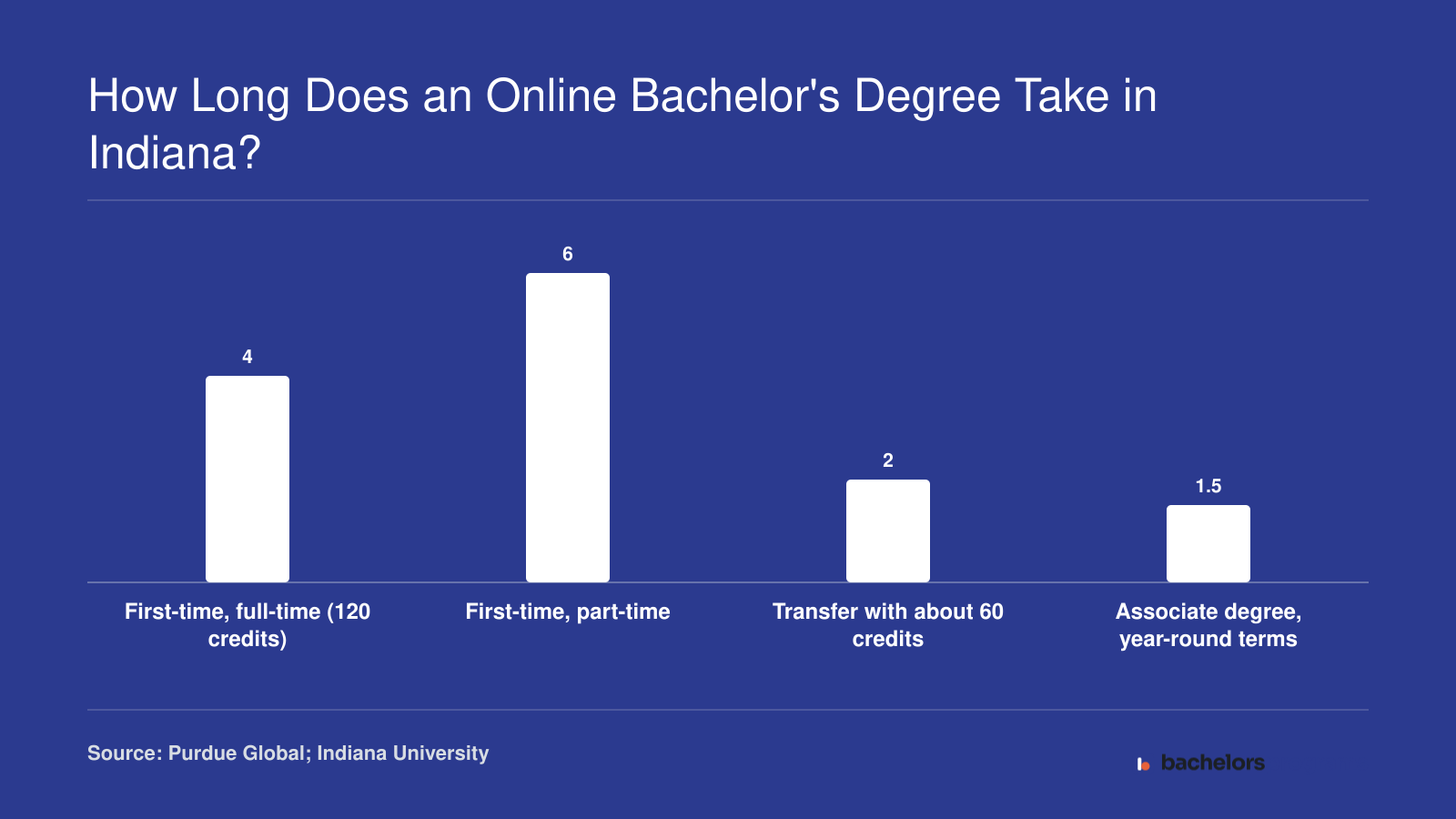
Most online bachelor's degrees in Indiana are built on 120 semester credits. IU Online lists 120 credits for programs such as its online accounting degree, and Purdue Global's 180 quarter credits equal the same total. Term structure shapes your pace: Purdue Global runs 10-week terms with up to 12 start dates a year, and IU Online schedules fall, spring and summer courses with as many as six start months in some programs, so students who enroll year-round can finish sooner. The bars below are estimates that assume steady, consecutive enrollment and satisfactory progress. They are not guarantees. Part-time pacing commonly stretches a degree to 5-6 years or more. Competency-based models and prior-learning credit can shorten the timeline for experienced adults. Purdue Global reports that its 2024-2025 bachelor's graduates with eligible prior learning averaged 85 credits, though results vary by program and by which credits are accepted.
Transfer Credit, Prior Learning and Military Credit in Indiana
Indiana has mapped its transfer system in detail, and online students who plan ahead can carry most of an associate degree into a bachelor's without losing credits.
The Core and the Pathways
Indiana College Core, administered through the Commission for Higher Education, is a 30-credit general education block. Complete it at one Indiana public institution and it transfers as a unit to another, though the receiving school still evaluates courses outside the core, and admission, major and degree requirements stay separate. Transfer Single Articulation Pathways go further: an eligible Ivy Tech or Vincennes associate degree in a mapped program grants junior standing in the matching bachelor's at a public four-year, generally followed by 60 more credits.1 The guarantee covers that pathway only, not every course you have taken. Ivy Tech counts coursework from Fall 2014 forward toward a pathway and reviews prior credit only for grades of C- or higher, on official transcripts.2
Caps, Residency and Prior Learning
Limits vary by institution. IU Online accepts up to 64 credits from a community college and 90 from a four-year university, with the major's school or department deciding how accepted credit applies. Indiana State accepts up to 90 transfer credits and requires at least 30 earned through the university.3 Credit for prior learning is defined at the state level but administered school by school, so CLEP exams, portfolio assessments, industry certifications and documented workplace training are all worth asking about directly. Ivy Tech's own rules limit prior learning credit to technical coursework, so do not assume it will satisfy general education or residency.
Military Credit
Indiana statute requires evaluation of military training.4 Indiana State awards 8 to 14 credits for basic training and length of service, accepts the Joint Services Transcript or a DD214, and caps combined military service credit at 63, with ACE recommendations yielding to university policy.3
Do This Before You Apply
Get an unofficial evaluation of your transcripts before you apply, and use Transfer IN to see how specific courses map to your target program.
Admissions, Graduation Rates and Career Outcomes for Online Students
What Admissions Usually Require
Most online bachelor's programs in Indiana ask for a high school diploma or GED and official transcripts. Transfer applicants are often held to a minimum GPA, which varies by school and program, so check each department's published standard. Many schools are test-optional, though some programs still use scores for placement or scholarships. Rolling admissions and several start dates a year are common in online formats, which means you rarely have to wait for a single fall deadline.
What Graduation and Retention Data Can Tell You
College Navigator, the NCES tool built on IPEDS data, reports graduation rates, retention rates and the share of students enrolled in distance education for schools such as Purdue Global, Ball State, Indiana State, Indiana University and Indiana Wesleyan. The current figures come from the 2024-25 reporting cycle. Be cautious in reading them: the graduation rates cover a school's overall entering cohorts, and online-specific rates are rarely published. A school with a large online population may post very different numbers from one that is mostly on campus, so treat these figures as context rather than a prediction of your own outcome. Ask admissions staff directly for completion data on the specific online program.
How Employers View the Degree
Diplomas generally do not say "online," and transcripts typically list the same degree title as the campus version. Employers tend to focus on regional accreditation and the reputation of the institution, so a degree from an accredited Indiana university carries the same recognition regardless of delivery format.
Licensure Limits for Out-of-State Students
Portability is where online students most often get caught. Nursing, teaching, social work and counseling licenses are issued state by state, and completing a program in Indiana does not guarantee you can be licensed elsewhere. Purdue Global and Purdue University both state that licensure is not guaranteed, and requirements can include exams, background checks, supervised experience and clinical hours.5 Purdue Global notes that its education programs are not approved for licensure1, while Indiana University's interactive map covers educational requirements only and does not verify individual eligibility.4 Ball State says requirements vary by field2 and lists state authorization across all states, D.C. and U.S. territories.3
Before you enroll, find the school's professional licensure disclosure page, look up your home state, and confirm the details with that state's licensing board.
Indiana Licensure for Graduates of Online Teaching and Nursing Programs
How to Choose and Verify an Online Program in Indiana
Run every program through these checks before you apply. Our advice: choose a nonprofit or public school that accepts your transfer credits and qualifies for Indiana grants over the one with the lowest sticker price.
- Institutional accreditationConfirm the school's accreditation with the Higher Learning Commission, which accredits most Indiana colleges, or search the U.S. Department of Education's DAPIP database.
- Programmatic accreditationLook for CCNE or ACEN for nursing, AACSB or ACBSP for business, and CAEP for education programs.
- Indiana state aid eligibilityAsk whether the school takes part in Indiana's state aid programs, including 21st Century Scholars, and whether online students qualify.
- Format requirements in writingGet written confirmation of any on-campus residencies, proctored exams, clinical placements or student-teaching placements.
- Transfer evaluationRequest an unofficial credit evaluation before you pay an application fee.
- Support for remote studentsMake sure you can get online tutoring, advising, career services and disability services without coming to campus.
- All-in costAsk admissions for the full per-credit cost, including online and technology fees.
Colleges in Indiana with the most bachelor's programs
| School | City | Type | Bachelor's programs | Online | Net price / yr | Grad rate |
|---|---|---|---|---|---|---|
| Ball State University | Muncie | Public | 126 | 13 | $14,940 | 62% |
| Purdue University | West Lafayette | Public | 123 | 0 | $14,600 | 83% |
| Indiana University-Indianapolis | Indianapolis | Public | 96 | 15 | $11,668 | 55% |
| Indiana University-Bloomington | Bloomington | Public | 85 | 0 | $16,264 | 80% |
| University of Indianapolis | Indianapolis | Private nonprofit | 79 | 4 | $21,602 | 56% |
| Indiana Wesleyan University | Marion | Private nonprofit | 78 | 31 | $22,866 | 67% |
| Butler University | Indianapolis | Private nonprofit | 77 | 0 | $36,041 | 80% |
| Indiana University-Southeast | New Albany | Public | 73 | 39 | $7,888 | 39% |
| University of Southern Indiana | Evansville | Public | 71 | 10 | $12,923 | 48% |
| Indiana State University | Terre Haute | Public | 68 | 14 | $10,873 | 43% |
| Purdue University Fort Wayne | Fort Wayne | Public | 68 | 9 | $13,171 | 36% |
| Valparaiso University | Valparaiso | Private nonprofit | 66 | 1 | $18,578 | 70% |
| University of Evansville | Evansville | Private nonprofit | 63 | 2 | $18,499 | 65% |
| Trine University | Angola | Private nonprofit | 62 | 14 | $25,355 | 64% |
| Indiana University-Kokomo | Kokomo | Public | 60 | 15 | $3,968 | 46% |
Program counts are the verified bachelor's listings in our directory; net price is the school-wide average a first-time undergraduate paid after aid, and graduation rate the share finishing within six years (College Scorecard).
Common Questions About Online Bachelor's Degrees in Indiana
These answers cover the questions Indiana online students ask most often about price, aid, residency and records. Policies change by school and by year, so confirm specifics with your school's bursar and financial aid office before you enroll.
Is online tuition the same as on-campus tuition in Indiana?
Do online students qualify for Indiana state financial aid?
Can I use the 21st Century Scholars award if I enroll part-time online after starting full-time?
Can I live outside Indiana and still pay in-state rates for an Indiana online program?
Does an Indiana online degree say "online" on the diploma or transcript?
Compare programs nationwide
Many Indiana residents study online. Every ranked list above has an online lens, or browse every field.
Online bachelor's degrees Browse all fields