Online Colleges and Bachelor's Degree Programs in Louisiana
Every verified bachelor's program at a college in Louisiana: 1,200+ programs at 30+ colleges, with the online options, net price and graduation rates behind each one.

Published online undergraduate tuition at Louisiana's public universities runs from $184 to $400 per credit hour, or roughly $22,080 to $48,000 in tuition across a 120-credit bachelor's degree before fees. Two students can earn the same credential online, and one can pay more than twice what the other does.
TOPS complicates the math. The award follows the institution and your credit load rather than the course format, and part-time enrollment can put it out of reach. The LSU, UL System and Southern campuses all maintain large online catalogs, so an in-state option usually exists.
Cost per credit, not delivery mode, is what separates a modestly priced Louisiana degree from an expensive one.
Key Points
- Louisiana public online tuition runs $184 to $400 per credit hour.
- UL Lafayette's 2026-2027 cost-of-attendance budget totals $26,771 for full-time study.
- TOPS coverage depends on your school and credit load, not format.
Popular degrees in Louisiana
Bachelor's degrees in Louisiana by field
Business & Management
- Marketing39 programs
- Business Administration38 programs
- Accounting23 programs
- Finance23 programs
- Management22 programs
- Human Resource Management or HR Management12 programs
- Communication11 programs
- Healthcare Administration or Healthcare Management10 programs
Science & Engineering
- Biology22 programs
- Mathematics22 programs
- Chemistry18 programs
- Physics17 programs
- Engineering Technology13 programs
- Biochemistry11 programs
- Electrical Engineering or Electronics Engineering or Electronic Systems Engineering Technology10 programs
- Natural Resources or Conservation8 programs
Education & Teaching
- Science36 programs
- Secondary Education22 programs
- Elementary Education17 programs
- English Education15 programs
- Mathematics Education14 programs
- Early Childhood Education or Child Development10 programs
- Physical Education10 programs
- History Education9 programs
Liberal Arts & Humanities
- English24 programs
- History21 programs
- Literature or English Literature18 programs
- General Studies11 programs
- Humanities9 programs
- Philosophy7 programs
- Spanish7 programs
- Global Health or Health Studies6 programs
Arts & Design
- Fine Arts or Studio Art20 programs
- Art or Art Studies15 programs
- Graphic Design11 programs
- Audio & Music9 programs
- Media Arts or Digital Media8 programs
- Art History5 programs
- Digital Photography4 programs
- Game Programming & Development3 programs
Computers & IT
- Computer Science26 programs
- Computer Information Systems9 programs
- Cybersecurity8 programs
- Information Technology8 programs
- Innovation or Technological Entrepreneurship8 programs
- Cloud Computing5 programs
- Artificial Intelligence5 programs
- Computer Engineering5 programs
Communications & Media
- Communications29 programs
- Journalism16 programs
- Public Relations10 programs
- Communication Disorders6 programs
- Speech Pathology6 programs
- Strategic Communications5 programs
- Professional Writing3 programs
- Social Media1 program
Nursing
- Bachelor of Science in Nursing28 programs
- Nursing (RN to BSN)17 programs
- Accelerated BSN (ABSN)10 programs
- LPN/LVN to BSN8 programs
Healthcare
- Health Sciences12 programs
- Public Health10 programs
- Exercise & Sports Science9 programs
- Nutrition8 programs
- Speech Pathology7 programs
- Health Education7 programs
- Health Informatics2 programs
- Respiratory Care Therapy2 programs
Social Work & Social Sciences
- Sociology20 programs
- Political Science, Government17 programs
- Social Work9 programs
- Public Policy2 programs
Criminal Justice & Law
- Criminal Justice16 programs
- Forensic Science7 programs
- Criminal Justice Administration6 programs
- Legal Studies3 programs
- Paralegal2 programs
- Legal Services2 programs
- Criminology2 programs
- Homeland Security1 program
Psychology
- General Psychology18 programs
- Applied Behavior Analysis2 programs
- Forensic Psychology1 program
Natural & Applied Sciences
- Agriculture or Agricultural8 programs
- Oceanography or Ocean or Marine Biology4 programs
- Applied Science3 programs
- GIS and Geoscience2 programs
- Neuroscience2 programs
Religion & Theology
- Christian Studies or Religious Studies6 programs
- Christian Ministry or Ministry Leadership3 programs
Counseling
- Substance Abuse Counseling2 programs
What an Online Bachelor's Degree Costs at Louisiana Public Universities
Published online undergraduate tuition at these Louisiana public universities runs from $184 to $400 per credit hour, or about $22,080 to $48,000 in tuition alone across a standard 120-credit degree. Fees are listed separately because they change the real price: LSU Online's $5 distance fee adds about $600 over 120 credits, while Southern University's $30 per-credit fee adds about $3,600. Rates were checked between May and October 2026 and are reset each fall, so confirm the current figure on each school's bursar or tuition page before you budget.
| University | Online Per-Credit Tuition | Online/Distance Fee | Est. 120-Credit Tuition | Same Rate for Out-of-State? | Source (Checked) |
|---|---|---|---|---|---|
| Louisiana State University (LSU Online) | $184 | $5.00 per credit hour | $22,080 | Yes, same per-credit rate regardless of residence, no out-of-state charges | LSU Online Distance Learning tuition and fees page (Oct. 2026) |
| Northwestern State University of Louisiana | $225 | N/A | $27,000 | N/A | Northwestern State Military & Veteran Programs page (May 2026) |
| Southeastern Louisiana University | $375 | N/A | $45,000 | Yes, qualifying distance learners are exempt from non-resident fees | Southeastern Online FAQs (Oct. 2026) |
| Southern University and A&M College | $395 | $30.00 per credit hour | $47,400 | N/A | Southern University published online tuition (June 2026) |
| Louisiana Tech University (Tech Online) | $400 | $0 (flat rate, no fees) | $48,000 | N/A | Tech Online published rate (Sept. 2026) |
Public, Private Nonprofit, and For-Profit Online Degrees: How Total Cost Compares
The advertised rate is not the price you actually pay, and in online bachelor's programs the gap can run to thousands of dollars. Louisiana students weighing a private nonprofit in New Orleans against a national online provider are choosing between two pricing models: a published per-credit rate and a flat term that rewards speed.
Per-Credit Pricing at a Louisiana Private Nonprofit
Loyola University New Orleans publishes $480 per credit for online undergraduate study in 2026-2027, which at a typical 120-credit bachelor's comes to about $57,600 before institutional aid.1 It is the clearest published online rate among Louisiana's private nonprofits; several others with online programs do not post a separate online undergraduate rate, so ask for a written cost sheet instead of assuming the campus rate applies.
National Providers: Per-Credit Versus Flat Term
Southern New Hampshire University lists $354 per credit for 2026-2027, or $1,062 per course, about $42,480 across 120 credits before books and resources.2 WGU bills by six-month term instead: roughly $3,760 to $5,325 for most undergraduate programs plus a $200 resource fee3, and $3,825 per term for School of Education programs starting in 2026.4 A term covers as much coursework as you finish, so graduating faster lowers the total. University of Phoenix lists $426 per credit, but enrollment after November 2, 2026 bills $1,458 per three-credit course once the $180 resource fee is added.5
What Actually Moves the Total
Three variables move the number more than the published rate:
- Transfer credit: Every accepted credit removes a course you pay for. Request a preliminary evaluation before you enroll.
- Term length and pace: Flat-term models reward acceleration; per-credit models do not.
- Institutional aid: Military, employer, and alumni discounts can cut a published rate. Confirm in writing whether TOPS or state aid applies to your specific online program.
A higher sticker price can shrink once institutional aid lands, so compare net price rather than the advertised tuition.
The Cheapest Online Bachelor's Paths in Louisiana
What is the cheapest way to earn an online bachelor's degree in Louisiana? Among the public university rates identified, LSU's distance learning rate of $184 per credit hour is the lowest, while LSU Alexandria's $353 applies only to a specific group. Its roughly $353 per credit starting Fall 2026 ($290 tuition plus per-credit fees) applies to declared students in 100%-online accelerated bachelor's programs. Those programs run 90 credits, which puts the total near $31,770 before any additional charges, including a $50 course fee whose frequency is unclear.
How the Public Rates Compare
UL Lafayette charges $380 per credit for most online degree programs, with no out-of-state fees at that rate. That is $1,140 per three-credit course and $45,600 for 120 credits, tuition only. A 2026 review put LSU Online near $445 per credit in 2025-26, or $53,400 for 120 credits, though that figure may not cover every LSU Online bachelor's. LSU Online also says each system campus sets its own costs, so there is no systemwide online rate. Check the program page itself.
The Lowest-Cost Route: Community College First
The cheapest overall path usually starts at a Louisiana Community and Technical College System (LCTCS) campus. Bossier Parish Community College lists $138.96 per credit for 2025-262, and Delgado's 2026-27 catalog summary shows the same rate. At that rate, 120 credits come to $16,675.20 in tuition alone. Finish general education there, then transfer into a public online completion program so the university bills fewer credits. Confirm in advance that each course transfers, because credits that do not count erase the savings.
Fees Can Reorder the List
Per-credit rates are not the whole bill. BPCC adds a $40 online course fee once per semester2, which lifts a three-credit online course from $416.88 to $456.88. Delgado bills an access fee each semester, and some online classes charge per exam. Residency matters too: a flat online rate with no out-of-state surcharge, as at UL Lafayette, can beat a lower base rate that adds nonresident charges. Add every fee before you rank the options.
Accelerated Formats as a Cost Lever
Accelerated eight-week terms can lower total cost if you can handle more credits per year, since you finish sooner and pay fewer terms of recurring fees. LSUA's 90-credit accelerated structure works this way.1 Competency-based formats can do the same, but no Louisiana competency-based rate surfaced, so verify availability and pricing with each school.
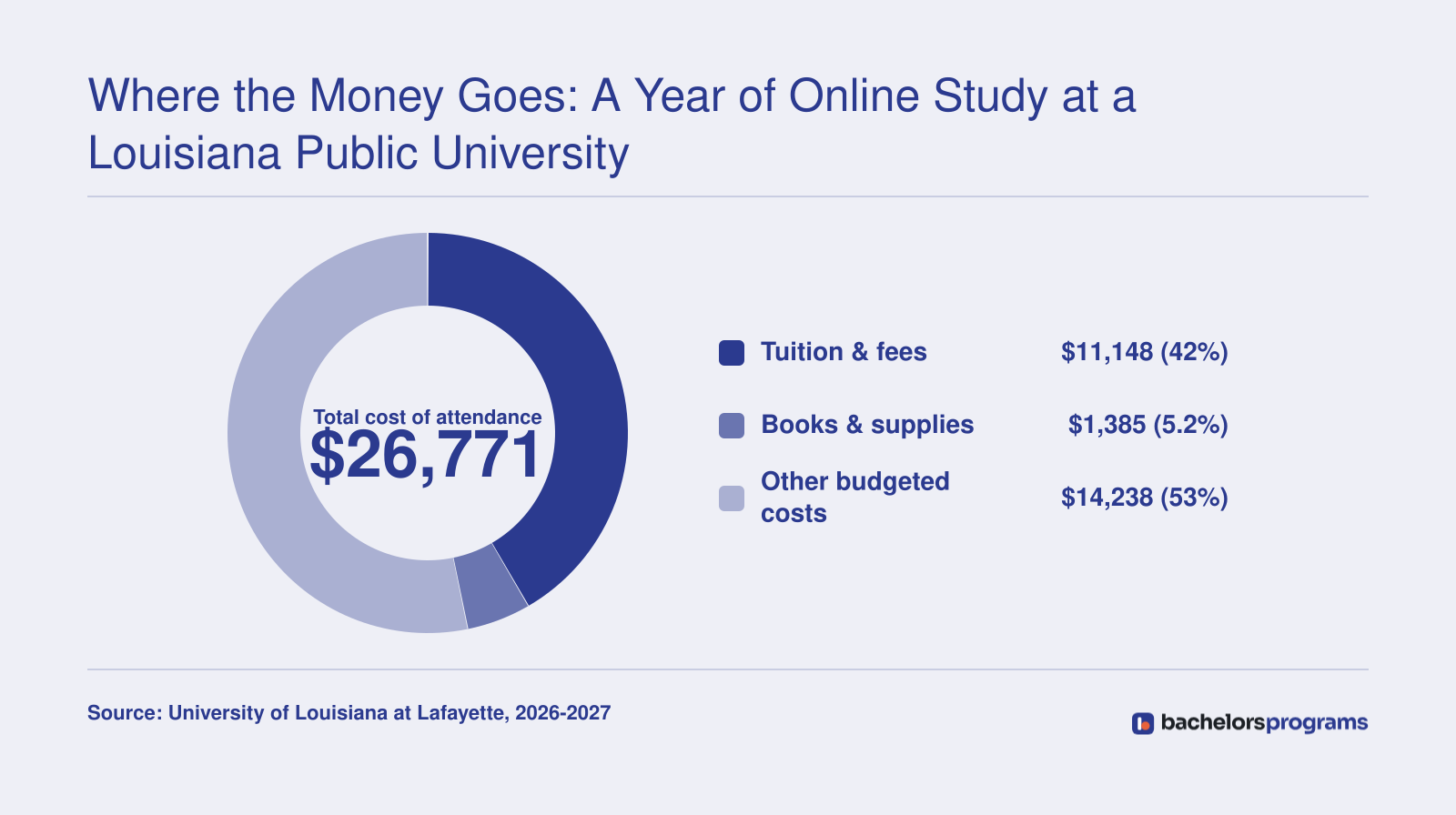
Where the Money Goes: A Year of Online Study at a Louisiana Public University
UL Lafayette's published 2026-2027 cost-of-attendance budget, based on 12 credit hours each in fall and spring, totals $26,771: $11,148 for tuition and fees, $1,385 for books and supplies, and $14,238 in other budgeted costs. The budget has no separate technology line. The online rate of $380 per credit already includes a $30-per-credit distance-learning fee and comes to $11,400 for 30 credits, and some courses may require paid proctoring, which typically runs $8-$40 per exam at retail rates. These figures are the sticker price; your net price, what remains after grants and scholarships, is usually lower.
Financial Aid, TOPS, and State Grants for Online Students
Can TOPS pay for an online degree in Louisiana? It depends less on the format of your courses than on where you enroll, how many credits you carry, and how long it has been since you finished high school.
How TOPS treats online and part-time enrollment
TOPS awards (Opportunity, Performance, Honors, and Tech) pay tuition at eligible Louisiana institutions, but the program has historically been built around full-time enrollment, a continuing college GPA, and a limit on how long after high school graduation a student can claim and keep the award. That structure matters for online students in two ways. First, if your online program is offered by an eligible Louisiana public or participating private institution, delivery mode is generally not the obstacle; enrollment intensity is. Second, dropping below full-time, which many working adults do when they take two courses a semester, is the most common reason an otherwise eligible student loses or suspends a TOPS award.
The specific credit-hour thresholds, GPA minimums, deadlines, and the window of initial eligibility after high school are set by the Louisiana Office of Student Financial Assistance and have been revised more than once. Before you build a budget around TOPS, confirm the current rules directly with LOSFA and with the school you plan to attend. Adults returning to finish a degree years after high school should ask specifically whether any remaining eligibility exists at all, since the time limits are the usual barrier for that group.
The Louisiana GO Grant
The GO Grant is the state's need-based award, and its rules are more forgiving for online learners. To qualify you must be a Louisiana resident, file the FAFSA, receive a Pell Grant, and attend an eligible Louisiana institution at least half-time, which means six credit hours at a semester school or four at a quarter school. Annual awards currently range from $300 to $3,000. There is no separate age restriction, so an adult returning online can qualify, but only by meeting those same residency, FAFSA, Pell, institution, and half-time conditions.
Federal aid and the Pell Grant
Everything starts with the FAFSA. For the 2026-27 award year, the maximum Pell Grant is $7,3952, though your actual award depends on your Student Aid Index, your school's cost of attendance, and whether you attend full-time, part-time, or for a partial year. Part-time students receive proportionally less than the full-time scheduled award, and students enrolled less than half-time generally see the smallest awards. Pell has no age limit and is open to undergraduates who have not already earned a bachelor's degree.1 Eligibility is capped at 12 full-time-equivalent terms (roughly six years), and in certain situations, such as an extra term in a year, a student may receive up to 150 percent of the scheduled award.1
Transfer Credit and Degree Completion Paths in Louisiana
The more credits you bring to an online degree, the less you pay and the faster you finish, but how many of them count depends on the receiving campus as much as on state policy. Plan around both.
The Louisiana Transfer Degree and Gen Ed Matrix
Louisiana's community colleges offer the Louisiana Transfer Degree (the AALT and ASLT), a roughly 60-credit associate degree built to move into a public four-year university. It works alongside a statewide general education articulation matrix, which is meant to keep core courses such as English and college algebra interchangeable among public campuses. Exact course lists, grade minimums, and which majors each version suits change over time, so confirm the current rules with the Board of Regents or your transfer adviser before you enroll.
Some two-year offerings are built around the same goal. LSU Eunice's 30-credit online Certificate of General Studies, for example, is designed to satisfy transfer requirements at Louisiana's public four-year institutions and can be finished in about 12 months.
Credit for Prior Learning and Transfer Caps
CLEP, AP, military transcripts (JST), and portfolio assessment can all earn credit, but each campus sets its own acceptance rules, so ask for a written evaluation. Caps vary:
- LSU Shreveport (online BGS): Accepts up to 90 transfer credits, with no more than 60 from a two-year institution. Students must complete 30 of their last 40 term hours in residence.
- UL Lafayette (online BGS): Requires an associate degree or at least 45 college credits, plus a 2.25 GPA. The program totals 120 credits, including 39 of general education.
Degree Completion for Adults With Some College
General Studies is the usual route for adults with scattered credits. UL Lafayette's online Bachelor of General Studies lets students choose a concentration, such as Business Studies or Behavioral Science. Enrollment periods run throughout the year, and the listed rate is $380 per credit. LSU Shreveport and ULM also offer online general studies degrees.1 Compete LA, a UL System initiative announced in 2019, offered free coaching for adult learners. Check whether it still operates in its original form.
How Long It Takes
A first-time, full-time student typically needs about four years to complete 120 credits. A student who transfers in 60 credits can often finish in about two years of full-time study. Part-time schedules stretch that out. Programs with 8-week terms and several start dates a year let you carry fewer courses at a time and still finish more each year, which can shorten the timeline. Your adviser's credit evaluation will show how many of your credits apply to your degree, and that is the number to build your schedule around.
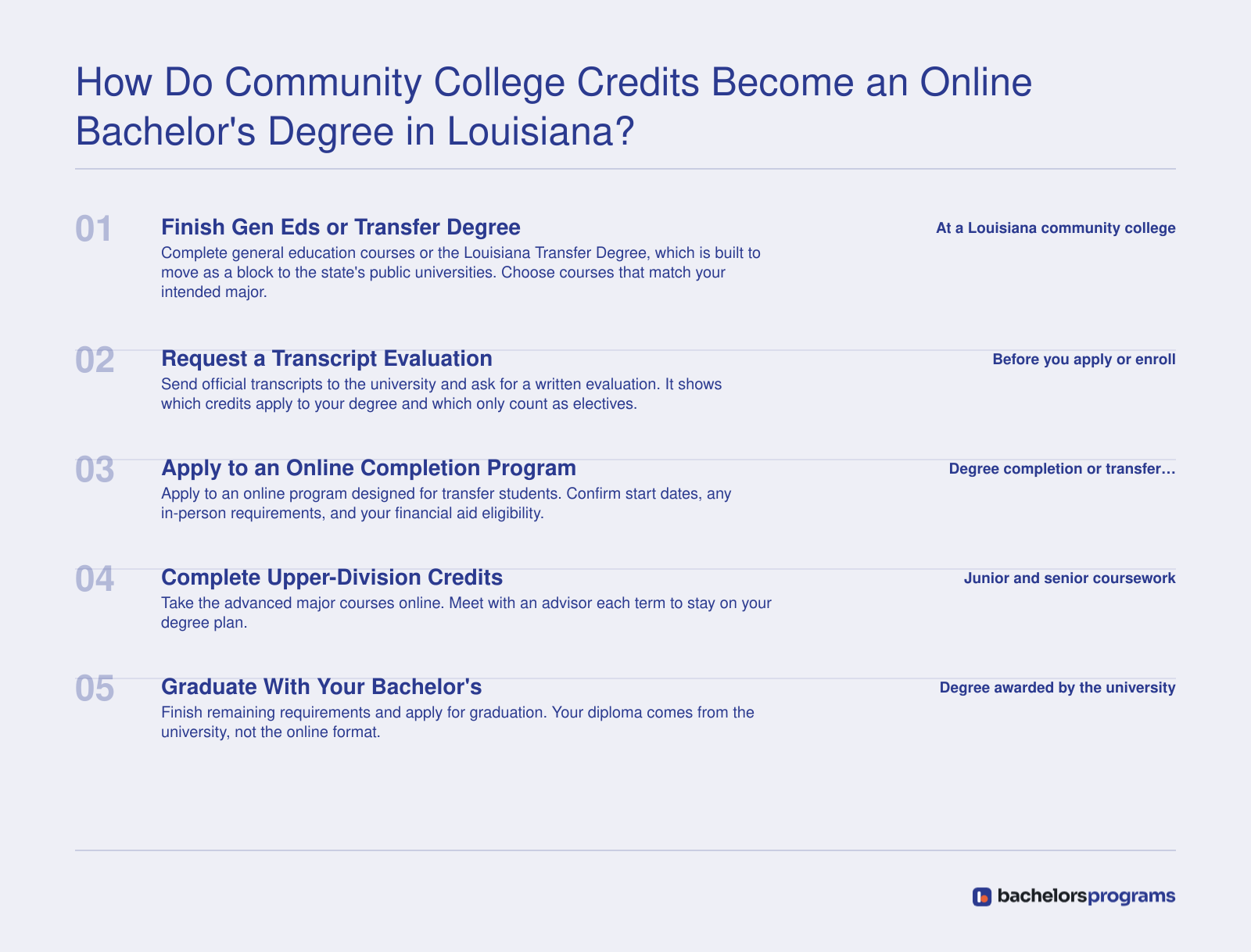
How Do Community College Credits Become an Online Bachelor's Degree in Louisiana?
The transfer route works best when each step happens in order. The most important one is the second: get a written credit evaluation from your target university before you enroll, so you know which courses count and what you still owe.
Online Formats, Start Dates, and In-Person Requirements
Online delivery in Louisiana comes in two basic forms. Asynchronous courses let you work through lectures and assignments on your own schedule within weekly deadlines. Synchronous courses meet at set times through live video. Many programs blend the two, and some add a proctored exam or a workplace component, so "online and hybrid" is a more accurate label than "100% online" for many degrees. ULM does describe its RN-to-BSN as 100% online4, but even that program ties coursework to current RN employment.
Accelerated Terms Versus 16-Week Semesters
A traditional semester runs about 16 weeks, with one or two start points a year and a steady pace across several courses. Accelerated terms compress a course into a shorter window and offer more entry points. LSU Online is the clearest example in the state: its catalog lists 8-week terms in fall and spring, 5.5-week summer terms, and six starts a year.1 Its bachelor's page cites seven-week terms, so confirm the exact length for your program before you plan around it.
Shorter terms mean fewer courses running at the same time but a faster pace in each. Aid timing follows the term structure, and enrollment thresholds are measured per session. LSU Online's catalog, for veterans' benefits, counts 6 credit hours per 8-week session as full-time and 3 as half-time.1 Find out how disbursement works for your term length and credit load. ULM's Fast-Track RN-to-BSN lists $200 per credit hour for the remaining 30 credit hours, but its sources do not describe term length or individual start dates.2
Where In-Person Work Shows Up
No single statewide rule governs this, so check each program. Common patterns include:
- Nursing: ULM's RN-to-BSN requires documented current RN employment in an approved practice setting before its practice courses.3 LSU Online lists an RN-to-BSN through LSUA, but the sources reviewed do not give clinical hours or site rules.
- Proctored exams: Northwestern State says online courses may require proctored exams, with details in the syllabus5, and offers proctoring at its Alexandria campus.6 LSU supports remote proctoring through ProctorU, and students pay any fee when it is used.7 LSU Continuing Education's term courses require proctored exams.8
- Education and health programs: Student teaching and practicums are typically in person at a school or clinical site. Ask each program for its hours and placement process.
Out-of-State Students
If you live outside Louisiana and want a licensure-track program such as nursing or teaching, confirm the school is authorized to serve students in your state through SARA, and ask whether your state's licensing board will accept the program, before you enroll.
Louisiana Teacher Certification After an Online Education Degree
Admissions Requirements for Louisiana Online Bachelor's Programs
Online applicants at Louisiana public universities generally face the same standards as on-campus students. LSU's 2026 catalog says admission rules are identical regardless of format. Thresholds still differ by school and program, so confirm each one with the admissions office.
- Freshman GPA by pathwayLSU Online lists different minimums depending on the program. One pathway asks first-time freshmen for a 3.0 GPA, and another accepts a 2.0.
- Core curriculum and test scoresLSU Online's Business Administration degree requires the high school Core curriculum and a 2.0 high school GPA. Applicants also need either an ACT composite of 20 or a Core GPA of 2.0.
- Transfer admissionUnder one LSU Online pathway, transfer applicants need at least 18 college-level credits and a 2.0 GPA. Another pathway sets the transfer GPA at 2.5.
- English and math readinessBusiness Administration allows no more than one developmental course. Ask how your English and math placement will be determined before you apply.
- Official transcriptsFreshmen submit all high school transcripts. Transfer students submit transcripts from every college attended.
- Returning adultsIf you left college years ago, ask whether you apply as a transfer student or for readmission. Plan to send all prior college records either way.
- Deadlines and 8-week startsULM's fall 2026 second 8-week deadline was October 9. Its deadlines close at 4:00 p.m. CT, or 11:00 a.m. CT on Fridays. LSU Online's Business Administration program lists a December 14, 2026 deadline for a January 11, 2027 start. Some programs set earlier deadlines or admit only in certain terms.
What Louisiana Bachelor's Graduates Earn
A bachelor's degree from a Louisiana public university can more than double what a high school diploma typically earns in the state.
Accreditation, Graduation Rates, and Career Outcomes
College Scorecard lists a 56% graduation rate for the University of Louisiana at Lafayette, one of the state's largest public universities.1 Treat that as a reference point, not a statewide average. Rates vary by campus, admissions selectivity, and student mix, so check each school you are considering.
Accreditation: Institutional and Programmatic
Louisiana's public universities hold institutional accreditation from the Southern Association of Colleges and Schools Commission on Colleges (SACSCOC). That is the baseline. It affects federal financial aid eligibility and whether other schools will accept your credits.
Some fields also need programmatic accreditation, especially where a license is involved:
- Nursing: CCNE or ACEN accreditation, which state boards and employers often expect.
- Education: CAEP accreditation, which matters for teacher preparation and certification.
- Business: AACSB accreditation, a mark of quality that many employers recognize.
An online program should hold the same accreditation as its on-campus counterpart. Confirm that the specific degree is covered, not just the university.
Graduation Rates and Online Completion
Institution-level graduation rates are available through IPEDS and Louisiana Board of Regents reports. Completion data for online students alone is much thinner. IPEDS does track students enrolled exclusively in distance education, and nationally that was 25.9% of undergraduates (about 4.9 million students) in fall 2022.2 Louisiana's own share is not something to assume from that figure.
Since online-only completion is hard to find, check the school's overall graduation rate, then ask the admissions office directly how online students fare.
Debt Against Earnings
College Scorecard shows median federal debt of $22,902 for University of Louisiana at Lafayette undergraduate borrowers who complete their degree.1 Scorecard also displays a slightly higher reported debt figure of $23,961, so check which measure you are looking at when comparing schools.1 Debt of roughly this size is a useful benchmark. Set it beside the earnings Scorecard reports for your intended major, and you get a rough sense of whether the degree pays for itself. A program with similar debt but weaker earnings in its field is a harder bargain.
A Quick Quality Checklist
- Verify the school's accreditation on the CHEA database or the school's own accreditation page, and confirm any programmatic accreditation your career requires.
- Look up the school and program on College Scorecard to compare graduation rate, debt, and earnings.
- Ask the admissions office about retention and completion for online students specifically.
- Ask whether the program meets licensure requirements in Louisiana and in any state where you plan to work.
These four checks take less than an hour and can keep you from enrolling in a program that costs too much or leaves you ineligible for licensure.
Colleges in Louisiana with the most bachelor's programs
| School | City | Type | Bachelor's programs | Online | Net price / yr | Grad rate |
|---|---|---|---|---|---|---|
| Louisiana State University and Agricultural & Mechanical College | Baton Rouge | Public | 112 | 16 | $19,151 | 69% |
| University of Louisiana at Lafayette | Lafayette | Public | 82 | 9 | $13,530 | 53% |
| Southeastern Louisiana University | Hammond | Public | 81 | 6 | $13,154 | 45% |
| McNeese State University | Lake Charles | Public | 74 | 13 | $12,493 | 47% |
| Tulane University of Louisiana | New Orleans | Private nonprofit | 65 | 18 | $39,949 | 86% |
| Louisiana Tech University | Ruston | Public | 64 | 4 | $11,864 | 64% |
| Loyola University New Orleans | New Orleans | Private nonprofit | 60 | 13 | $23,696 | 59% |
| Southern University and A & M College | Baton Rouge | Public | 60 | 4 | $20,077 | 27% |
| University of Louisiana at Monroe | Monroe | Public | 57 | 15 | $13,466 | 54% |
| Nicholls State University | Thibodaux | Public | 56 | 16 | $12,947 | 54% |
| Northwestern State University of Louisiana | Natchitoches | Public | 56 | 19 | $13,606 | 43% |
| Grambling State University | Grambling | Public | 55 | 3 | $19,809 | 36% |
| Louisiana State University-Shreveport | Shreveport | Public | 55 | 9 | $7,022 | 38% |
| Louisiana State University at Alexandria | Alexandria | Public | 50 | 30 | $7,065 | 34% |
| Louisiana Christian University | Pineville | Private nonprofit | 40 | 7 | $13,113 | 44% |
Program counts are the verified bachelor's listings in our directory; net price is the school-wide average a first-time undergraduate paid after aid, and graduation rate the share finishing within six years (College Scorecard).
Compare programs nationwide
Many Louisiana residents study online. Every ranked list above has an online lens, or browse every field.
Online bachelor's degrees Browse all fields