Online Colleges and Bachelor's Degree Programs in Arizona
Every verified bachelor's program at a college in Arizona: 890+ programs at 40+ colleges, with the online options, net price and graduation rates behind each one.

An online bachelor's degree in Arizona means a four-year degree earned mostly or entirely through distance coursework, offered by public universities such as Arizona State, the University of Arizona and Northern Arizona, and by large private providers. The state has some of the biggest online enrollments in the country, but the sticker price rarely tells you what you will pay. Residency rules, transfer credit and aid eligibility can move the total by thousands of dollars.
Cost, aid, transfer credit, admissions and outcomes are where Arizona's online programs differ most.
In practice, the credits you bring in often matter more than the school's brand.
Key Points
- ASU Online charges $580 per credit regardless of Arizona residency.
- Sixty Maricopa credits cost roughly $5,820 at in-county rates.
- A unified Arizona general education curriculum begins with the 2026 catalog year.
Popular degrees in Arizona
Bachelor's degrees in Arizona by field
Business & Management
- Business Administration23 programs
- Marketing17 programs
- Management16 programs
- Healthcare Administration or Healthcare Management15 programs
- Accounting14 programs
- Logistics & Supply Chain Management13 programs
- Human Resource Management or HR Management10 programs
- Project Management10 programs
Science & Engineering
- Natural Resources or Conservation11 programs
- Biology10 programs
- Biomedical Science or Pharmacology8 programs
- Anthropology7 programs
- Data Science7 programs
- Environmental Science6 programs
- Electrical Engineering or Electronics Engineering or Electronic Systems Engineering Technology6 programs
- Software Engineering6 programs
Arts & Design
- Fine Arts or Studio Art17 programs
- Art or Art Studies14 programs
- Graphic Design6 programs
- Media Arts or Digital Media6 programs
- Digital Photography5 programs
- Audio & Music5 programs
- Game Programming & Development4 programs
- User Experience4 programs
Education & Teaching
- Elementary Education14 programs
- Early Childhood Education or Child Development13 programs
- Science13 programs
- Secondary Education12 programs
- Special Education8 programs
- English Education6 programs
- History Education6 programs
- Mathematics Education6 programs
Liberal Arts & Humanities
- English11 programs
- Literature or English Literature7 programs
- History6 programs
- Global Health or Health Studies6 programs
- Spanish5 programs
- Interdisciplinary Studies5 programs
- Native American Studies or American Indian or Indigenous5 programs
- Philosophy4 programs
Computers & IT
- Computer Science11 programs
- Cybersecurity10 programs
- Software Development & Engineering7 programs
- Information Technology7 programs
- Artificial Intelligence6 programs
- Innovation or Technological Entrepreneurship6 programs
- Data Analytics4 programs
- Computer Engineering3 programs
Nursing
- Bachelor of Science in Nursing23 programs
- Nursing (RN to BSN)14 programs
- Accelerated BSN (ABSN)6 programs
- LPN/LVN to BSN3 programs
Healthcare
- Public Health7 programs
- Nutrition6 programs
- Health Sciences6 programs
- Exercise & Sports Science4 programs
- Speech Pathology4 programs
- Health Informatics2 programs
- Medical Studies2 programs
- Healthcare Compliance & Regulations2 programs
Psychology
- General Psychology14 programs
- Industrial Organizational Psychology5 programs
- Sport Psychology4 programs
- Forensic Psychology3 programs
- Applied Psychology3 programs
- Addiction Psychology2 programs
- Positive Psychology2 programs
- Child Psychology1 program
Criminal Justice & Law
- Criminal Justice11 programs
- Homeland Security4 programs
- Forensic Science4 programs
- Legal Services3 programs
- Criminology3 programs
- Criminal Justice Administration2 programs
- Legal Studies2 programs
- Fire Science or Fire Administration2 programs
Social Work & Social Sciences
- Sociology12 programs
- Social Work5 programs
- Political Science, Government5 programs
- Public Policy5 programs
- Human Services2 programs
- Disability Studies2 programs
Communications & Media
- Speech Pathology5 programs
- Journalism5 programs
- Technical Communication4 programs
- Communications3 programs
- Communication Disorders3 programs
- Strategic Communications3 programs
- Public Relations2 programs
- Business Communications2 programs
Natural & Applied Sciences
- GIS and Geoscience4 programs
- Agriculture or Agricultural4 programs
- Neuroscience3 programs
- Oceanography or Ocean or Marine Biology3 programs
Counseling
- Substance Abuse Counseling4 programs
- Mental Health Counseling3 programs
- Behavioral Health Science1 program
How Online Bachelor's Degrees Work in Arizona: Fully Online, Hybrid and Everything Between
A fully online degree and a hybrid degree can both carry the word "online" in a catalog, but they ask very different things of your calendar. Knowing which mode a program uses makes every catalog page easier to read.
The Three Delivery Modes
- Fully online, asynchronous: Lectures are recorded and assignments have weekly deadlines, but no set meeting times. This suits shift workers and parents.
- Online with scheduled live sessions: Coursework is remote, but some classes meet by video at set hours. Expect a firmer weekly schedule and more discussion.
- Hybrid: Most work is online, but you must be on campus on specific days, such as a weekend each month or certain labs.
What "Online" Still Requires in Person
Many online programs carry in-person pieces: science labs, clinical placements, student teaching or internships. These can usually be completed near home, often at a site you arrange with the school's placement staff, but not always. Some programs require you to use approved partner sites or travel for a short intensive. Ask for the placement policy in writing before you apply.
Can You Finish Without Visiting Campus?
For many business, psychology and liberal arts majors, yes. Coursework, exams (often proctored remotely) and capstones can all be handled from home. For nursing, education and lab-science majors, rarely. Those fields build in supervised hands-on hours, so expect at least some physical presence in a hospital, classroom or lab.
Term Length and Pacing
Session structure shapes the experience as much as delivery mode does. Many Arizona online programs use accelerated terms of about 7.5 weeks, while a traditional semester runs 15 weeks.
- Shorter terms: You take fewer classes at once, usually one or two, and finish each quickly. Pacing is intense, and a missed week costs more, but you can focus on one subject at a time.
- Full semesters: You carry several classes at once at a slower weekly pace, which can feel steadier if your work hours are predictable.
Working adults often favor the shorter terms because a single demanding course is easier to schedule around a job. Starts are also more frequent, so you rarely wait long to begin.
ASU Online vs Arizona Online vs NAU Online: Per-Credit Tuition Compared
The key finding: ASU Online charges online undergraduates the same $580 per credit whether or not they live in Arizona, and the published tuition schedules for Arizona Online and NAU's online programs do not list separate resident and nonresident rates either, so out-of-state students generally pay the same sticker price as residents. The 120-credit column is our estimate of tuition for a full degree, calculated from each school's published per-credit or annual rate before fees, grants or transfer credit, with per-credit, per-course or annual fees listed separately in the notes. Rates change every academic year and can differ by program (nursing and engineering are often priced higher), so confirm the current figure on each school's official tuition page before you compare offers.
| Institution | Resident Per-Credit Tuition | Nonresident Per-Credit Tuition | Est. 120-Credit Tuition | Notable Fees or Notes |
|---|---|---|---|---|
| Arizona State University (ASU Online) | $580 | $580 | $69,600 | Adds an undergraduate college fee of $21 per credit (about $2,520 over 120 credits). ASU's Summer 2026 online undergraduate schedule lists $648 total for one credit, and program fees may also apply. Source: ASU's Summer 2026 and Fall 2026 online undergraduate tuition schedules. |
| University of Arizona Online (Arizona Online) | $525 | $525 | $63,000 | Arizona Online's undergraduate admissions page publishes $525 per credit. It does not list a resident and nonresident difference, a mandatory fee amount, or the academic year the rate applies to. |
| Northern Arizona University (NAU Online) | N/A (flat annual rate of $12,000) | N/A (flat annual rate of $12,000) | About $48,000 (four full-time years at $12,000) | Mandatory fees of $540 per year. NAU's 2026-27 tuition and fees schedule for Statewide and Online undergraduates shows no separate resident and nonresident online rate. |
| University of Arizona Global Campus (UAGC) | $460 | $460 | $55,200 | Technology fee of $115 per course (about $4,600 if 120 credits are earned in 40 three-credit courses). No resident and nonresident difference listed. Source: UAGC's 2026-2027 cost of attendance and tuition pages. |
| Grand Canyon University (GCU Online) | Not published | Not published | About $44,160 (four academic years at $11,040) | Undergraduate tuition of $11,040 per academic year plus a technology fee of $920 per academic year, per GCU's 2026-27 cost of attendance. No per-credit rate or residency distinction published. |
Paying Less Than Sticker Price: Financial Aid, Arizona Grants and Military Benefits
Arizona's tuition promise programs were designed around campus attendance, and that original design still governs what online students can claim in 2026. Federal aid is the part that travels cleanly to a distance program; state gift aid is where the rules get specific. Here is what actually applies.
Federal aid works the same way online
If you enroll in an accredited degree program, online delivery does not change your federal eligibility. File the FAFSA, and you are evaluated for the Pell Grant and federal student loans on the same basis as a student sitting in a Tempe classroom. The maximum Pell award has recently held at $7,395 per year for students with the highest demonstrated need, with partial awards scaling down from there. Enrollment intensity still matters: Pell is prorated below full-time, and federal loans generally require at least half-time enrollment, so a one-course-per-term pace can shrink or eliminate aid.
Arizona state programs: read the campus fine print
The Arizona Promise Program covers remaining tuition and fees after Pell and other gift aid for qualifying residents, but it carries real restrictions: a 2.50 minimum GPA, an April 1 deadline, and full-time enrollment of at least 12 credits.1 ASU limits the award to in-person degree students at its four campuses, which means ASU Online students are not eligible.2 The University of Arizona's 2026 terms restrict the grant to main campus enrollment. NAU's treatment of its online students is not spelled out in the public program rules, so ask that financial aid office directly rather than assuming.
AzLEAP is the more flexible option. It is need-based and administered by participating Arizona institutions, requires Pell eligibility and at least half-time enrollment, and pays up to $2,500 per year, though the average award runs closer to $1,000.3 Confirm with your campus whether your specific online program is included. Future teachers should also ask about the Arizona Teachers Academy, which requires the FAFSA, applies to initial teacher certification programs, and obligates one year of Arizona teaching for each year funded.4
Military and veteran paths
Arizona statute grants in-state tuition classification at public universities and community colleges to armed forces members stationed in the state under orders, to their spouses and dependents, and to users of transferred Post-9/11 GI Bill benefits.5 That residency classification is separate from how the VA calculates your federal benefit, and Yellow Ribbon participation varies by school and by program, so verify both with the school certifying official before enrolling.
Estimate, then compare
Published per-credit rates tell you almost nothing about what you will pay. Every school receiving federal aid must post a net price calculator. Run it at each school on your shortlist, then confirm the output with an aid counselor.
How Much Do 60 Credits Cost at Maricopa or Pima Before You Transfer?
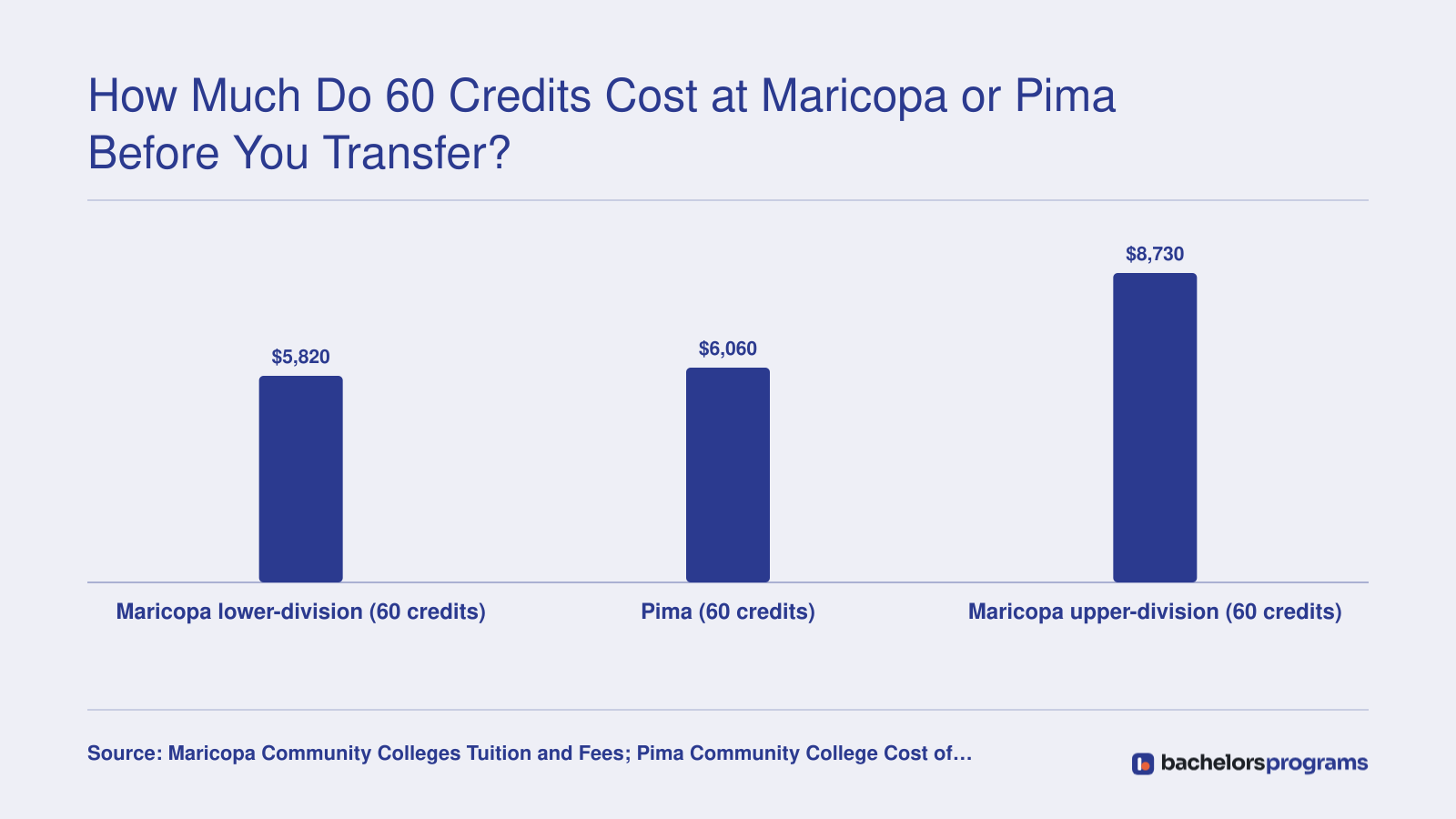
Sixty credits at in-county rates come to roughly $5,820 at Maricopa's lower-division rate of $97 per credit and about $6,060 at Pima's average tuition-and-fee figure of $101 per credit. Maricopa also charges a $15 registration fee each semester, and both districts can add course or materials fees. Compare these totals with 60 credits at the university online rates in the tuition table above. In-county rates apply only to Arizona residents, and online courses may carry different fees. Some Arizona community colleges now offer select bachelor's degrees, and Maricopa bills upper-division courses at $145.50 per credit.
Transferring Credits Into an Arizona Online Bachelor's Program
Arizona's transfer pipeline is in the middle of its biggest structural change in years. Starting with the 2026 catalog year, the state's public universities and community colleges fold three separate general education blocks into one unified Arizona General Education Curriculum, so students no longer have to guess which version of AGEC their destination school expects.
How the AGEC Block Moves
AGEC is a 32 to 35 credit lower-division general education package completed at an Arizona public community or tribal college.1 Finish it with a C or better in every course and it transfers as a block, satisfying the receiving university's lower-division general education requirements instead of being evaluated course by course. Two conditions matter: it must be completed at an Arizona public community or tribal college, and it must be certified on your official transcript. The University of Arizona's guarantee depends on that certification.
AGEC clears general education only. It does not replace major prerequisites, program-specific admission requirements, or upper-division coursework, and requirements plus course choices vary by community college and by destination degree.
Check Courses Before You Commit
The AZTransfer Course Applicability System shows how a specific course at your community college is treated at ASU, NAU or the University of Arizona. Treat it as a first screen, not a final answer. A course can be accepted for transfer credit and still count only as an elective; at ASU, the academic unit decides whether a transferred course satisfies a degree requirement. Confirm applicability with an advisor in the major before you enroll, not after.
Pathways and Guaranteed Admission
Arizona Transfer Pathway agreements are sequenced 2+2 curricula naming the coursework for a particular bachelor's degree. ASU's MAPP, branded MyPath2ASU and built with Maricopa Community Colleges, publishes more than 300 course-by-course pathways with guaranteed admission, online options, and reverse transfer for students who move before finishing an associate degree. NAU maintains its own articulation agreements with partner colleges.
How Many Credits Actually Transfer
There is no single statewide cap. Limits depend on the institution, college, major and degree type. One rule is clear: at ASU, an Associate of Applied Science from a regionally accredited institution can transfer 60 credit hours toward a Bachelor of Applied Science.2 That is an AAS-to-BAS rule, not a blanket 60-credit ceiling for every bachelor's degree, so ask your target university what it will accept before you build a schedule around an assumption.
Accreditation and Licensure: Checks to Run Before You Enroll
Accreditation is the first filter for any online degree, and you can verify it yourself in a few minutes. Arizona's public universities and its large private online providers, including Grand Canyon University and University of Arizona Global Campus, are generally accredited by the Higher Learning Commission (HLC). Don't rely on a school's marketing page, though. Confirm current status directly.
How to Verify Institutional Accreditation
- HLC directory: Search the school's name on the HLC website and read its accreditation status and any recent actions.
- U.S. Department of Education database: Look up the school in the federal Database of Accredited Postsecondary Institutions and Programs to confirm the accreditor is federally recognized.
Institutional accreditation affects federal aid eligibility, credit transfer, and how employers and graduate schools view your degree.
Programmatic Accreditation for Regulated Fields
A second layer applies to fields tied to a license. For nursing, look for CCNE or ACEN. CCNE's Arizona directory lists nursing programs at Arizona State University, Northern Arizona University, and the University of Arizona, plus the RN-to-BSN at University of Arizona Global Campus. For education, ask whether the teacher-preparation program is approved by the state and whether it holds CAEP accreditation. Institutional accreditation does not substitute for either one.
Keep in mind that nursing accreditation measures educational quality. It does not decide whether you can sit for the licensing exam. That decision belongs to the state board.
State Authorization and Licensure Disclosures
If you live outside Arizona, a program approved here may not lead to a license in your state. Most Arizona schools participate in NC-SARA, a reciprocity framework that simplifies authorization for distance education. It does not determine licensure eligibility and does not guarantee you can take the NCLEX.
For programs leading to a licensed profession, schools must publish a disclosure for each state saying whether the program meets requirements, does not meet them, or is undetermined. Find it, read the entry for the state where you plan to work, and then call that state's licensing board. The Arizona State Board of Nursing, for example, requires its own approval for out-of-state pre-licensure and advanced-practice programs operating in Arizona. A disclosure is helpful, but the board's answer is the one that counts.
Arizona Nursing and Teaching Licensure for Online Graduates
Admissions Requirements and Start Dates for Online Students in Arizona
Arizona's public universities set admission standards for online students that are close to their campus standards. Use this checklist to gather documents early, and confirm current details with each admissions office, since requirements and fees can change by term.
- High school GPA or competency requirementsASU Online uses a competency model: at least a 2.00 GPA in each required high school subject area. Alternate routes include top 25% class rank or ACT/SAT thresholds, which differ for Arizona residents and nonresidents.
- Minimum transfer GPAASU generally expects a 2.50 cumulative GPA from transfer students, or 2.00 with an associate degree from a regionally accredited school. Applicants with fewer than 24 transferable credits may also need to meet first-year requirements. At NAU, a 2.00 college GPA gives a good chance of admission but does not guarantee it.
- Official transcriptsExpect to submit a high school diploma or GED record. Arizona Online asks transfer applicants without an associate degree for an official high school or GED transcript showing the graduation date.
- Application feeASU Online lists a $75 fee and Arizona Online lists $65. Check for fee waivers before you pay.
- Test-optional statusASU does not require the ACT or SAT for general admission. Scores may still be used for course placement, and some majors may require them.
- Start dates and deadlinesASU Online admits on a rolling basis with multiple starts each year. Arizona Online offers two sessions per term and sets fixed deadlines: December 1, 2026 for Spring 2027 Session I, February 15, 2027 for Session II, and April 1 and June 15, 2027 for the two Summer sessions.
- Competitive majors such as nursingAdmission to the university does not guarantee entry to a major. Nursing and similar programs often require higher GPAs, specific prerequisite courses and a separate application, so review those requirements before you apply.
Graduation Rates, Net Price and Career Outcomes at Arizona's Online-Serving Universities
The graduation, net price and earnings figures Arizona's online-serving universities report each answer a narrower question than they appear to.
What the federal database shows
College Scorecard is the clearest public source, but each figure covers a specific population and year. For the University of Arizona, the 2022-23 vintage reports a 68% six-year graduation rate, an average annual net price of $16,674 for federal aid recipients, and median earnings of $59,979 ten years after entry.1
Earnings are measured only for former students who were working and not enrolled a decade after they started, so the number describes completers and near-completers in the workforce, not everyone who ever registered.4
Why online adult learners get misread
Retention and graduation rates on Scorecard and in federal IPEDS data mostly track first-time, full-time students who arrive straight from high school.2 Part-time adult learners who transfer credits, stop out for a semester, or enroll in a fully online program fall outside that population, which means published rates can understate the outcomes of the students most likely to enroll online.
University of Arizona Global Campus illustrates the reporting problem: its Scorecard page displays 19% under a combined "Graduation & Retention" label, without separating the two measures.3 Ask the admissions office which population sits behind that figure and whether an online-only rate exists.
Questions to ask about any ranking claim
- Population: first-time full-time students, all entrants, or online-only learners?
- Cohort year: which entering class, and has the methodology changed since?
- Measure: graduation, first-year retention, or a blended institutional metric?
Arizona State, NAU and Grand Canyon each publish their own Scorecard records, but the reporting years and cohorts differ, so compare like with like before drawing conclusions.
Median Earnings for Arizona Public University Graduates
Among Arizona's public universities, the University of Arizona posts the highest median earnings in the latest College Scorecard data.
How to Choose the Best Online College in Arizona for You
For a working adult arriving with 45 transferable credits, the deciding factor is usually price per credit by residency; for a first-time freshman, it is whether the program was designed for fully online study from day one. ASU Online, Arizona Online at the University of Arizona and NAU Online each publish a single online rate with no resident or nonresident split, so the identical degree can cost very different amounts depending on which public university you choose.
Match the Program to Your Starting Point
- First-time freshmen: accreditation plus first-year support matter most. Look for online orientation, assigned advising and tutoring built for students with no prior college credits, and check that the school's net price calculator reflects online enrollment rather than a dorm-based estimate.
- Community college transfers: applicability beats volume. Maricopa or Pima credits should map to named major requirements before you commit, not land as elective hours that delay graduation.
- Working adults with some college: aid eligibility and pace. Confirm whether prior coursework, military training or evaluated work experience counts, and whether you can enroll part time without losing grant eligibility.
- Military and veterans: confirm how tuition assistance and GI Bill benefits interact with per-credit rates, ask about Yellow Ribbon participation, and clarify residency rules for active duty stationed elsewhere.
- Budget-first students: compare net price after grants, not sticker tuition, and verify Arizona state grant and institutional scholarship rules for online learners.
When "Best" Means Hybrid
Your major can overrule your format preference. Nursing, teaching and other licensed fields require supervised clinical hours or student teaching, so the realistic version is hybrid with in-state placement sites. Business, information technology, psychology and liberal studies travel more comfortably into fully online formats.
Three Steps Before You Enroll
- Run the net price calculator at two or three schools and compare the out-of-pocket figure, not the published rate.
- Request a written transfer credit evaluation mapped to your intended major.
- For regulated majors, get the licensure disclosure for Arizona in writing before the first tuition payment.
The best online college in Arizona is the one whose price, credit policy and format fit your starting point, so verify all three in that order.
Colleges in Arizona with the most bachelor's programs
| School | City | Type | Bachelor's programs | Online | Net price / yr | Grad rate |
|---|---|---|---|---|---|---|
| Arizona State University | Tempe | Public | 165 | 108 | $14,967 | 68% |
| Arizona State University | Scottsdale | Public | 136 | 102 | — | — |
| Northern Arizona University | Flagstaff | Public | 107 | 28 | $14,158 | 61% |
| University of Arizona | Tucson | Public | 105 | 29 | $16,674 | 68% |
| Grand Canyon University | Phoenix | Private nonprofit | 84 | 62 | $22,472 | 44% |
| The University of Arizona Global Campus | Chandler | Public | 43 | 43 | $31,266 | 11% |
| University of Phoenix-Arizona | Phoenix | Private for-profit | 35 | 35 | $13,520 | 21% |
| Ottawa University-Surprise | Surprise | Private nonprofit | 30 | 19 | $33,393 | 18% |
| Dine College | Tsaile | Public | 30 | 0 | $6,057 | 13% |
| Embry-Riddle Aeronautical University-Prescott | Prescott | Private nonprofit | 20 | 3 | $40,287 | 68% |
| Arizona Christian University | Glendale | Private nonprofit | 19 | 10 | $32,839 | 40% |
| Bryan University | Tempe | Private for-profit | 13 | 13 | $20,834 | 41% |
| University of Advancing Technology | Tempe | Private for-profit | 13 | 12 | $28,522 | 35% |
| Prescott College | Prescott | Private nonprofit | 12 | 4 | $22,583 | 56% |
| Yavapai College | Prescott | Public | 11 | 10 | $8,683 | 34% |
Program counts are the verified bachelor's listings in our directory; net price is the school-wide average a first-time undergraduate paid after aid, and graduation rate the share finishing within six years (College Scorecard).
Online Colleges in Arizona: Frequently Asked Questions
These answers cover the questions Arizona online students ask most often about residency pricing, campus visits, diplomas and switching formats. Policies change, so confirm details with your program's advisor before you enroll.
Is online tuition the same for Arizona residents and nonresidents?
Can I complete an Arizona online bachelor's degree with no campus visits?
Does my diploma say "online" if I graduate from ASU Online, Arizona Online or NAU Online?
Can I switch between online and on-campus enrollment at an Arizona public university?
Compare programs nationwide
Many Arizona residents study online. Every ranked list above has an online lens, or browse every field.
Online bachelor's degrees Browse all fields