Online Colleges and Bachelor's Degree Programs in Oregon
Every verified bachelor's program at a college in Oregon: 850+ programs at 20+ colleges, with the online options, net price and graduation rates behind each one.

Can you finish a bachelor's in Oregon without moving or quitting your job? Usually, yes. Most Oregon public universities use quarters, with about 180 credits for a bachelor's, and an associate degree can cover a large share if the credits transfer cleanly.
The program listings show what is available in the state. Choosing among them turns on four questions: net price after aid, state grant eligibility, how much transfer credit a program accepts, and how "online" it really is.
Timing matters too. Oregon Opportunity Grant money is limited and awarded in priority order, so a late FAFSA or ORSAA can cost an otherwise eligible student money.
Key Points
- Verify NWCCU accreditation: it affects federal aid and credit transfer.
- Starting at an Oregon community college is the biggest cost-saving lever.
- File FAFSA or ORSAA early, since Oregon Opportunity Grant money is limited.
Popular degrees in Oregon
Bachelor's degrees in Oregon by field
Business & Management
- Marketing34 programs
- Business Administration28 programs
- Accounting18 programs
- Management15 programs
- Finance13 programs
- Economics12 programs
- Communication11 programs
- Healthcare Administration or Healthcare Management10 programs
Science & Engineering
- Biology17 programs
- Mathematics16 programs
- Anthropology12 programs
- Biochemistry12 programs
- Chemistry12 programs
- Environmental Science9 programs
- Physics9 programs
- Natural Resources or Conservation9 programs
Liberal Arts & Humanities
- History15 programs
- Literature or English Literature14 programs
- English12 programs
- Philosophy10 programs
- Spanish10 programs
- Global Studies8 programs
- Interdisciplinary Studies7 programs
- Gender & Sexuality Studies6 programs
Arts & Design
- Art or Art Studies19 programs
- Media Arts or Digital Media13 programs
- Fine Arts or Studio Art13 programs
- Audio & Music11 programs
- Graphic Design8 programs
- Creative Writing8 programs
- Art History7 programs
- Illustration3 programs
Education & Teaching
- Science19 programs
- Elementary Education12 programs
- Special Education8 programs
- Secondary Education8 programs
- Mathematics Education5 programs
- Early Childhood Education or Child Development4 programs
- Physical Education4 programs
- English Education3 programs
Social Work & Social Sciences
- Sociology19 programs
- Political Science, Government14 programs
- Social Work6 programs
- Human Services4 programs
- Public Policy2 programs
Computers & IT
- Computer Science18 programs
- Artificial Intelligence5 programs
- Cybersecurity4 programs
- Data Analytics4 programs
- Computer Engineering4 programs
- Innovation or Technological Entrepreneurship3 programs
- Computer Information Systems3 programs
- Software Development & Engineering2 programs
Healthcare
- Public Health11 programs
- Exercise & Sports Science9 programs
- Health Sciences7 programs
- Health Education4 programs
- Speech Pathology2 programs
- Community Health2 programs
- Health Informatics1 program
- Respiratory Care Therapy1 program
Communications & Media
- Communications13 programs
- Journalism8 programs
- Public Relations4 programs
- Professional Writing3 programs
- Communication Disorders2 programs
- Speech Pathology2 programs
Nursing
- Bachelor of Science in Nursing15 programs
- Nursing (RN to BSN)5 programs
- Accelerated BSN (ABSN)3 programs
Psychology
- General Psychology14 programs
- Forensic Psychology2 programs
- Applied Psychology1 program
- Developmental Psychology1 program
- Counseling Psychology1 program
Natural & Applied Sciences
- Neuroscience7 programs
- GIS and Geoscience4 programs
- Agriculture or Agricultural3 programs
- Oceanography or Ocean or Marine Biology3 programs
Criminal Justice & Law
- Criminal Justice6 programs
- Criminology5 programs
- Criminal Justice Administration4 programs
- Fire Science or Fire Administration1 program
How Online Bachelor's Degrees Work in Oregon: Fully Online vs. Hybrid
Online degrees promise flexibility, but "online" does not always mean you never set foot on campus. The label covers several formats, and the differences affect your job, your budget, and your schedule.
Three Formats, Plainly Defined
- Fully online: Every course is delivered over the internet, with no required campus meetings.
- Hybrid: Some coursework happens online and some on campus or at a set location.
- Online with residency: Most work is remote, but you must attend one or more on-site sessions.
Courses also differ in timing. Synchronous classes meet live at scheduled times. Asynchronous classes let you finish lectures and assignments on your own schedule, within weekly deadlines.
In-Person Requirements That Surprise Students
Oregon State Ecampus is a useful example. Its "100 percent online" label means no required in-person meetings. Even so, individual courses may include proctored exams, field work, local resource visits, program-related internships, or a site-based lab class. Some science courses use interactive lab kits instead.
Proctored exams are set course by course. Oregon State says students cannot be required to sit an in-person exam. You may use its online proctoring service or arrange an approved in-person proctor. With online proctoring, you can test from any quiet location with internet. If you use another proctor, the exam cannot be taken in a private residence and must happen in a professional proctored setting.
Internships vary by program. The online Public Policy bachelor's requires PPOL 410, a supervised work experience. Its "residency" rule is academic: at least 45 of your last 75 credits must come from Oregon State, online or on campus.
Published rules for the other Oregon public universities were harder to confirm, so check each school directly.
What to Check Before You Enroll
Read the program page for words like "residency," "on-site," or "practicum." Then ask an advisor to confirm every requirement in writing, including exam rules for specific courses.
Be especially careful with licensure-track majors. Nursing (RN-to-BSN), education, and some engineering programs almost always include a local placement, even when the coursework is online.
Accredited Online Colleges in Oregon: What to Verify Before You Apply
The Northwest Commission on Colleges and Universities (NWCCU) is the regional accreditor behind Oregon's public universities and most of its nonprofit private colleges. That matters for three practical reasons: eligibility for federal financial aid, whether another school will accept your credits, and whether a graduate program will recognize your degree.
Institutional vs. Programmatic Accreditation
Institutional accreditation applies to the entire institution. Programmatic accreditation covers a single degree and often decides whether you can be licensed or hired in a field. Look for the right one:
- Business: AACSB
- Nursing: CCNE or ACEN
- Engineering and computing: ABET
- Teaching: approval from Oregon's Teacher Standards and Practices Commission (TSPC) for educator programs
A school can hold NWCCU accreditation and still lack the programmatic credential your career requires.
A Three-Step Verification Routine
- Step 1: Search the NWCCU directory for the school's current accreditation status.
- Step 2: Look up the school and its accreditor in the U.S. Department of Education's DAPIP database.
- Step 3: If the school is based outside Oregon, confirm it is authorized to enroll Oregon residents. Out-of-state schools need approval from the HECC Office of Degree Authorization (ODA) or must participate in SARA, the interstate reciprocity agreement. Oregon is a SARA state, and HECC is its portal agency.1
ODA is a regulatory office, not an accreditor.2 Accreditation alone does not give a school the right to enroll Oregon residents, so you need both checks.
Red Flags
Walk away if the school's accreditor is not recognized by the Department of Education or CHEA. Accreditation mills often use official-sounding names. Also check whether the school is currently on probation or under sanction. That status can change, so read the accreditor's own notices rather than relying on a school's marketing page. If your program includes clinical placements or internships, ask whether they fall under the school's Oregon authorization as well.
How Much Does an Online Bachelor's Degree Cost in Oregon?
The rates below are published 2026-27 sticker prices for online undergraduate courses: tuition per credit, any online or distance fee, and the credit system, since a quarter credit is worth about two-thirds of a semester credit (George Fox charges by the semester hour, while the public universities here charge by the quarter credit). For a rough comparison of tuition plus per-credit fees, finishing the last 90 quarter credits after transfer runs about $22,500 at Southern Oregon to about $36,800 at Oregon State Ecampus, with George Fox near $29,900 for the equivalent 60 semester hours, and starting from zero at 180 quarter credits roughly doubles that, to about $45,000 to $73,600. These are sticker prices before grants and scholarships, so check each school's official tuition page for the current rate and run its net price calculator to estimate what you would actually pay.
| School | Online Tuition per Credit | Credit System | Online/Distance Fees | Nonresident Online Rate |
|---|---|---|---|---|
| Oregon State University Ecampus | $409.00 per credit (2026-27) | Quarter | $15 per credit, included in the $409 rate | $409.00 per credit (same Ecampus online rate) |
| Portland State University | $384.00 per credit (2026-27) | Quarter | $0.00 | Not reported |
| Western Oregon University | $384.00 per credit (2026-27) | Quarter | $0.00 | Not reported |
| Southern Oregon University | $228.00 per credit (2026-27) | Quarter | $22.00 per credit | Not reported |
| Eastern Oregon University | $309.02 per credit (2026-27) | Quarter | $25.00 per credit | Not reported |
| Oregon Institute of Technology | $348.00 per credit (2026-27) | Quarter | $65.00 per online course | Not reported |
| George Fox University | $499.00 per semester hour (2026-27) | Semester | No online course fee | Not reported |
Resident vs. Nonresident Tuition for Oregon Online Students
Oregon's online bachelor's programs do not share one tuition policy, and the difference between a flat online rate and a residency-based rate can run to thousands of dollars a year. Out-of-state students should confirm which model a program uses before applying.
Flat-Rate Online Pricing
Oregon State University's Ecampus charges the same per-credit rate to online undergraduates regardless of where they live: $409 per credit for 2026-2027, including a $15-per-credit distance education fee that applies whether or not a student also takes classes on a physical campus. Oregon State lists an estimated annual cost of about $15,726, or roughly $5,242 per term. Students who become eligible for resident classification pay the resident rate starting the next term, not mid-term.1
Other Oregon public universities price online study differently. The University of Oregon states that tuition and mandatory fees depend on residency classification, student classification, credit load, major, and first term enrolled, so its online costs cannot be assumed to match a flat Ecampus rate. Check the specific program's published rate rather than assuming a statewide standard.
Where WUE Fits
Western Undergraduate Exchange discounts generally target on-campus students, and Oregon law excludes distance education and self-support courses from certain nonresident tuition-reduction provisions. Treat WUE as unavailable for an online program unless the university confirms otherwise for that specific program and term.
Oregon Residency Basics
Residency for tuition purposes generally requires Oregon domicile for 12 consecutive months before the term begins, with the primary purpose being something other than education. A lease, Oregon employment, a state driver's license or ID, and tax records help document the claim. Moving to Oregon to attend college does not by itself lower your rate, and OSU recommends submitting the residency affidavit at least 30 days before classes start.1
Compare Against Home
Before enrolling, put the Oregon online rate beside your home state's in-state online options. A flat Oregon rate can beat a nonresident charge elsewhere, or lose badly to your own public system.
The Cheapest Ways to Earn an Online Bachelor's in Oregon
Start with the change that saves the most, then add the smaller ones. Here is the order that typically saves the most.
1. Complete General Education at an Oregon Community College
The 2026-27 Oregon Promise benchmark puts average full-time community college tuition in the state at $4,716 a year.1 Compare that with the per-credit online rate at the university you plan to finish at (see the tuition table above), and multiply the gap by the roughly two years of general education you can complete first. For most students this is the largest single saving. Confirm the credits transfer before you enroll.
2. Use Oregon Promise If You Qualify
Oregon Promise is a last-dollar state grant, so it pays after Pell and Oregon Opportunity Grant aid. Full-time awards for 2026-27 run from $2,280 to $4,716, depending on credits, your college's tuition, and other grants.1 Key points:
- Who qualifies: Recent Oregon high school or GED graduates with a 2.0 GPA (or GED score of 145), 12 months of Oregon residency, and no more than 90 college credits.1
- What it covers: Community college tuition only, up to 12 credits per term, minus a $50 copayment each term.2 Fees are excluded.
- Timing: Enroll within six months of graduation and file the FAFSA or ORSAA. The Class of 2026 deadline was June 1, so check OSAC for your own cycle.3
- Limit: It does not follow you to a university, including its online programs.
3. Shrink the Credit Count
Every course you test out of or get credit for is tuition you never pay.
- Credit for prior learning: Many schools award credit for work or training experience.
- CLEP or AP: Qualifying scores can replace introductory courses.
- Military credit: Service training and experience may count toward electives or major requirements.
4. Finish Faster and Get Help from Your Employer
Taking a full load, where your finances and schedule allow, cuts the number of terms you pay for. Ask your employer's HR office about tuition benefits, which can offset a large share of the remaining bill.
Where to Begin
For most students, the order is community college first, then Oregon Promise if you are eligible, then credit by exam or experience, then a full course load and employer aid. Avoid assuming any one school is the cheapest. Total cost depends on how many credits transfer and what aid you receive.
How Do You Get From an Oregon Community College to an Online Bachelor's?
Many Oregon students finish a bachelor's online by starting at a community college. The path below shows the typical order and the approximate quarter-credit milestones, based on a bachelor's total of about 180 quarter credits.
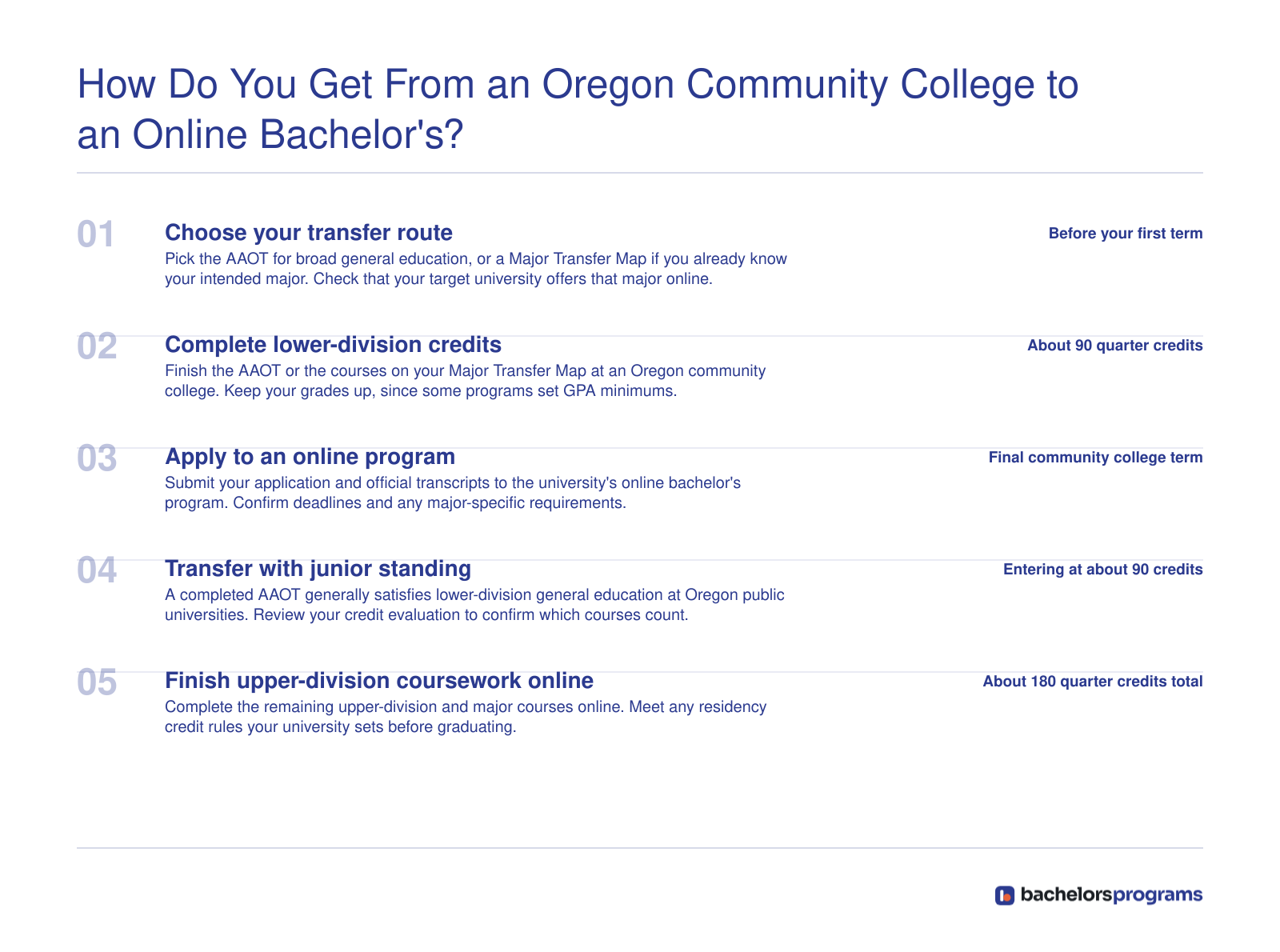
Transfer Pathways: Finishing Your Bachelor's Online After an Oregon Associate Degree
Oregon's transfer system has moved from a single statewide degree to a layered set of maps, and which one you hold now changes what a university must honor. The shift traces to HB 2998 in 2017, now codified in ORS 350.395 to 350.429, which pushed the state's colleges and universities to build transfer agreements beyond the associate degree.1
What Each Credential Actually Guarantees
The Associate of Arts Oregon Transfer and the Associate of Science Oregon Transfer do one thing well: complete one, gain admission to a public university, and you register with junior standing.1 They do not lock in a major, and there is no single statewide course list, since requirements vary by degree type and by college catalog.
The Core Transfer Map covers at least 30 credits, eight courses in practice.2 Finish the full map and gain admission, and the block transfers to any Oregon public and counts toward that school's core bachelor's requirements. It does not promise that every course lands inside your chosen major.
Major Transfer Maps run about 90 credits, including the core. Complete one in a subject the receiving university participates in, and you arrive with junior standing and credit toward that specific major. Coverage is not universal: no map exists for every major, and the guarantee runs only to participating institutions.
Credit Limits and Residency Rules
Uniformity stops at the credit cap. At the University of Oregon, 124 community college credits count toward a degree total, with no more than 90 from an international junior college; coursework from four-year institutions has no maximum. Community college credit is lower-division only, so it cannot satisfy upper-division graduation requirements. UO also requires at least 45 credits in residence after 120 total for a 180-credit degree, with parallel thresholds for longer programs.3 Its admission floors are 2.25 for residents, 2.50 for nonresidents, and 2.00 for AAOT or ASOT in Business holders.4 Those are UO's rules, not a statewide standard.
The "Finish in Two Years" Claim
Two-year completion usually assumes a full-time load, a major that matches your map, and no prerequisite gaps. A missing lab sequence or business core course can add terms.
Before you apply, ask the university to evaluate your transcripts unofficially. It shows which credits land in the major and which become electives, and that is the figure worth planning around.
Questions to Ask Yourself
Will my community college credits count toward this specific major, or only toward general electives?
Does my intended major require labs, clinicals, or student teaching I can complete near home?
Am I paying a flat online rate, or a nonresident rate I could avoid?
Will a part-time schedule cost me Oregon Opportunity Grant eligibility?
Financial Aid and Oregon State Grants for Online Students
Oregon runs its need-based grant program through the Higher Education Coordinating Commission (HECC), and the rules that decide whether you qualify are reset each award year. Treat any dollar figure you see on a forum or an older article as a starting question, not an answer, and confirm the current terms at the source.
Verify Oregon Opportunity Grant Details at the Source
Award amounts, income limits, enrollment-intensity rules and the list of eligible institutions all live on HECC's pages and on OregonStudentAid.gov. If you plan to study part time, ask specifically how enrollment intensity affects your award, since part-time eligibility is one of the rules applicants most often misread. Confirm as well that the Oregon college offering your online program is an eligible institution before you count on state money in your budget.
FAFSA or ORSAA: Confirm Which One You File
Students who are eligible for federal aid file the FAFSA at StudentAid.gov. Students who are not eligible for federal aid, including some undocumented students and others covered under state rules, may file the Oregon Student Aid Application, known as the ORSAA, through OregonStudentAid.gov. Filing rules and dates are set for each cycle, so check the official HECC and OSAC pages before you apply rather than working from last year's deadline.
Ask the Program About Institutional Aid
Eligibility for school-based aid, part-time enrollment rules and internal deadlines can vary by institution. Contact the financial aid office of the online program you are considering, and read the school's own aid pages, so you know what the college requires in addition to the state application.
Track OSAC Scholarship Deadlines
OSAC administers state scholarship programs, and its application instructions and deadlines are posted at OregonStudentAid.gov/OSAC. Put those dates on your calendar early, then call or email OSAC or HECC directly if anything on the page is unclear. A short conversation with an official source is worth more than any secondhand summary of award amounts or filing windows.
Admissions Checklist for Oregon Online Bachelor's Programs
Use this list to prepare before you apply. Oregon State University Ecampus details are included where they are published. Confirm every requirement directly with Portland State, Eastern Oregon or any other school you're considering.
- Applicant categoryOSU Ecampus has no separate adult-learner track. Apply as a first-year, transfer or returning student based on your prior college history.
- Transfer vs. first-year requirementsOSU Ecampus transfer applicants generally need at least 24 quarter or 16 semester credits of graded, transferable coursework from an institutionally accredited school. Ask each school for its minimum GPA.
- Official transcriptsRequest official transcripts from every college you attended, plus your high school if you're applying as a first-year student.
- Deadlines and term startsFor Winter 2027, OSU Ecampus suggests applying by Nov. 1, 2026. The final deadline is Dec. 8, 2026, and classes start Jan. 4, 2027. Ask other schools whether they admit on a rolling or term-based schedule.
- Test-optional statusCheck each school's current SAT/ACT policy, especially if you're applying as a first-year student.
- English proficiencyIf English isn't your first language, ask which tests and minimum scores each school accepts.
- Online advisingOSU Ecampus Student Services (800-667-1465, Mon–Fri, 8 a.m.–4 p.m. PT) helps with advising, registration, orientation and transcript submission.
- Veterans and military benefitsOSU Ecampus waives the application fee for active-duty service members, reservists and veterans. Its certifying officials help with VA education benefits (541-737-0747, [email protected]).
- Oregon veteran resourcesAsk your school how campus veteran services connect with state-level help from the Oregon Department of Veterans' Affairs.
- Online tutoring and library accessConfirm that remote tutoring and digital library databases are available to online students.
Debt, Earnings, and What Outcomes Mean for Oregon Online Learners
How much debt do Oregon graduates actually carry, and do their earnings justify it? The fastest way to answer that for any school on your list is to pull its federal outcomes data and compare schools on identical measures.
Start With College Scorecard
The U.S. Department of Education's College Scorecard reports median federal student debt and median earnings by school. Portland State shows how the numbers read. Typical total federal debt for undergraduate borrowers who complete is $19,489, and typical yearly earnings 10 years after entering are $62,060.1 Its page also lists a 59% graduation rate.1
Know what those figures include. Scorecard debt counts only federal loans borrowed at that institution, so private loans and any debt from a community college you attended first are left out.2 Earnings cover federally aided students who are working and no longer enrolled, so they reflect aid recipients rather than every graduate.
How to Compare Oregon Schools
Look up Oregon State, Eastern Oregon, Southern Oregon, Western Oregon, and Oregon Tech on Scorecard yourself, since the figures change as new data is released.
- Match the fields: Compare completer debt with completer debt, not with the figure for all borrowers who left.
- Drill into programs: Scorecard reports field-of-study earnings for many majors, which tells you more than a schoolwide median.
- Ask about Pell outcomes: If you expect a Pell Grant, ask the school's institutional research office for graduation rates among Pell recipients.
- Run the net-price calculator: Each university's calculator, followed by a call to its financial aid office, shows what you would likely need to borrow.
Confirm Field-Specific Earnings
School medians lag the job market. For current wages and job outlook by occupation, use the Bureau of Labor Statistics at BLS.gov. If your career requires a license, as teaching and nursing do, contact the relevant Oregon licensing board or professional association for credential requirements and salary context. For statewide policy and funding updates, check reports from the Oregon Higher Education Coordinating Commission.3
A common benchmark: keep total expected borrowing at or below the starting salary you can realistically expect in your field.
Colleges in Oregon with the most bachelor's programs
| School | City | Type | Bachelor's programs | Online | Net price / yr | Grad rate |
|---|---|---|---|---|---|---|
| Oregon State University | Corvallis | Public | 94 | 50 | $19,604 | 70% |
| Portland State University | Portland | Public | 73 | 14 | $9,552 | 53% |
| University of Oregon | Eugene | Public | 72 | 0 | $22,182 | 72% |
| Western Oregon University | Monmouth | Public | 56 | 8 | $17,237 | 47% |
| University of Portland | Portland | Private nonprofit | 54 | 1 | $28,210 | 80% |
| Linfield University | McMinnville | Private nonprofit | 53 | 10 | $26,536 | 71% |
| George Fox University | Newberg | Private nonprofit | 52 | 9 | $31,679 | 72% |
| Southern Oregon University | Ashland | Public | 51 | 15 | $16,732 | 43% |
| Eastern Oregon University | La Grande | Public | 46 | 32 | $17,148 | 43% |
| Pacific University | Forest Grove | Private nonprofit | 40 | 0 | $35,273 | 67% |
| Oregon Institute of Technology | Klamath Falls | Public | 40 | 11 | $15,706 | 54% |
| Corban University | Salem | Private nonprofit | 40 | 3 | $28,035 | 61% |
| Willamette University | Salem | Private nonprofit | 37 | 0 | $25,121 | 71% |
| Bushnell University | Eugene | Private nonprofit | 35 | 6 | $20,789 | 56% |
| Warner Pacific University | Portland | Private nonprofit | 28 | 8 | $25,629 | 49% |
Program counts are the verified bachelor's listings in our directory; net price is the school-wide average a first-time undergraduate paid after aid, and graduation rate the share finishing within six years (College Scorecard).
Compare programs nationwide
Many Oregon residents study online. Every ranked list above has an online lens, or browse every field.
Online bachelor's degrees Browse all fields