Online Colleges and Bachelor's Degree Programs in Michigan
Every verified bachelor's program at a college in Michigan: 2,200+ programs at 50+ colleges, with the online options, net price and graduation rates behind each one.

A Michigan bachelor's degree can carry a published price of roughly $12,500 a year at a public university or more than $33,000 at a private nonprofit, and an online label does not flatten that gap.
Programs marketed as "online" still differ on transfer credit limits, required campus visits, and whether state aid follows you. Which institutions offer which programs is easy to look up; what separates a $30,000 degree from a $60,000 one is credit evaluation, net price, aid eligibility, and whether the schedule fits an adult working full time.
Key Points
- Michigan public universities averaged about $12,524 in published tuition for 2023-24.
- Completing the Michigan Transfer Agreement requires at least 30 approved semester credits.
- Confirm Higher Learning Commission accreditation before enrolling in any Michigan online program.
Popular degrees in Michigan
Bachelor's degrees in Michigan by field
Business & Management
- Marketing63 programs
- Business Administration50 programs
- Accounting39 programs
- Finance36 programs
- Management36 programs
- Logistics & Supply Chain Management26 programs
- Human Resource Management or HR Management26 programs
- Sports Management25 programs
Science & Engineering
- Mathematics40 programs
- Biology39 programs
- Biochemistry28 programs
- Chemistry28 programs
- Physics24 programs
- Environmental Science21 programs
- Electrical Engineering or Electronics Engineering or Electronic Systems Engineering Technology21 programs
- Engineering Technology18 programs
Education & Teaching
- Science41 programs
- Elementary Education33 programs
- Secondary Education29 programs
- Mathematics Education25 programs
- Early Childhood Education or Child Development23 programs
- English Education22 programs
- Special Education20 programs
- History Education11 programs
Arts & Design
- Art or Art Studies35 programs
- Fine Arts or Studio Art32 programs
- Graphic Design21 programs
- Media Arts or Digital Media18 programs
- Art History14 programs
- Audio & Music13 programs
- Game Programming & Development12 programs
- Creative Writing11 programs
Liberal Arts & Humanities
- English33 programs
- Literature or English Literature30 programs
- History28 programs
- Philosophy23 programs
- Spanish22 programs
- African and African American Studies10 programs
- General Studies9 programs
- Gender & Sexuality Studies9 programs
Computers & IT
- Computer Science47 programs
- Cybersecurity24 programs
- Computer Engineering18 programs
- Artificial Intelligence15 programs
- Information Technology14 programs
- Computer Information Systems14 programs
- Innovation or Technological Entrepreneurship10 programs
- Software Development & Engineering9 programs
Communications & Media
- Communications34 programs
- Journalism23 programs
- Public Relations10 programs
- Professional Writing10 programs
- Speech Pathology9 programs
- Communication Disorders7 programs
- Strategic Communications6 programs
- Social Media4 programs
Social Work & Social Sciences
- Sociology40 programs
- Political Science, Government26 programs
- Social Work24 programs
- Human Services7 programs
- Public Policy4 programs
Healthcare
- Exercise & Sports Science27 programs
- Health Sciences16 programs
- Public Health14 programs
- Nutrition10 programs
- Speech Pathology9 programs
- Health Education7 programs
- Respiratory Care Therapy4 programs
- Community Health4 programs
Nursing
- Bachelor of Science in Nursing42 programs
- Nursing (RN to BSN)19 programs
- Accelerated BSN (ABSN)11 programs
- LPN/LVN to BSN4 programs
Criminal Justice & Law
- Criminal Justice22 programs
- Criminal Justice Administration10 programs
- Paralegal4 programs
- Legal Services4 programs
- Corrections4 programs
- Criminology4 programs
- Forensic Science3 programs
- Legal Studies3 programs
Psychology
- General Psychology33 programs
- Child Psychology1 program
- Applied Psychology1 program
- Industrial Organizational Psychology1 program
- Sport Psychology1 program
- Clinical Psychology1 program
- Developmental Psychology1 program
- Counseling Psychology1 program
Religion & Theology
- Christian Ministry or Ministry Leadership12 programs
- Christian Studies or Religious Studies11 programs
Natural & Applied Sciences
- GIS and Geoscience8 programs
- Neuroscience5 programs
- Agriculture or Agricultural2 programs
How Online Bachelor's Programs Work in Michigan: Fully Online, Hybrid, and Out-of-State Access
Can you earn a fully online bachelor's degree in Michigan without ever setting foot on campus? Often the answer is yes, but the word "online" on a program page does not promise zero campus visits.
Four Delivery Labels Worth Knowing
- Fully online: every course is delivered remotely, with no required campus attendance.
- Hybrid: most work happens remotely, but some sessions, labs, or site visits are in person.
- Synchronous: you attend live class meetings at set times, usually by video.
- Asynchronous: no fixed class times; you work through modules and deadlines on your own schedule.
What Hides Inside an "Online" Degree
Proctored exams are the most common hidden requirement. Some schools require you to test at an approved site or with remote proctoring software. Beyond that, look for clinical hours, student teaching, practicums, internships, and orientation or residency weekends. Ask the program to confirm in writing which components, if any, require you to be physically present, and where.
Licensure Programs and Out-of-State Access
Michigan is an NC-SARA member in 2026, which lets participating institutions serve students across state lines.1 SARA has no effect on professional licensure requirements, and programs that lead to a license must disclose state by state whether they meet those requirements.2 Education is the clearest example: the Michigan Department of Education says the State Board does not approve educator-licensure programs offered by out-of-state institutions.5 A SARA institution may offer distance education to Michigan teacher candidates, but SARA participation alone does not authorize recommending those candidates for Michigan licensure.5 Individuals can still apply through the Michigan Online Educator Certification System and pay the required evaluation fee.
What Out-of-State Students Pay
Wayne State generally uses resident and nonresident schedules rather than one universal online rate.3 The nonresident portion is waived only for students in programs offered online in their entirety and identified as eligible in the annual tuition regulations.3 Nonresident lower-division tuition is $1,351.26 per credit and upper-division is $1,609.98 per credit in 2026-27.3 Wayne State's Good Neighbor policy is a separate residency benefit: eligible undergraduates from Indiana, Illinois, Wisconsin, Minnesota, New York, Ohio, Pennsylvania, and Ontario pay Michigan resident tuition plus 10%.4 Confirm your specific program's rate in writing before you enroll.
What an Online Bachelor's Degree Costs in Michigan: Sticker Price vs. Net Price
Start With Published Tuition
Michigan's public four-year universities reported an average published undergraduate tuition of about $12,524 for 2023-24, with a median closer to $14,190.1 Private nonprofit colleges in the state averaged roughly $33,150, median $32,580.1 Spread across a typical 30-credit year, that is about $420 per credit at a public university and around $1,100 at a private nonprofit, roughly $50,000 public and $130,000 private for a 120-credit bachelor's degree at sticker. Treat those per-credit figures as rough conversions, not quoted rates: online programs price themselves individually, and some charge a flat online rate regardless of residency. One University of Michigan School of Public Health online program, for example, lists $1,382 for the first credit hour and $1,197 for each additional credit for Michigan residents in 2025-26, plus mandatory fees of $166.19 per term.2 Published rates vary that widely by school and program.
Net Price Is the Number That Matters
Sticker price is what a school advertises. Net price is what students actually pay after grants and scholarships are subtracted. Across Michigan four-year institutions, the average net price for full-time, first-time undergraduates receiving aid was about $19,144, with a median near $19,005.1 Among Michigan public universities specifically, the median average net price came in around $12,759, below the national public figure of $14,226. Individual campuses diverge sharply: University of Michigan-Flint has been reported at roughly $7,007, UM-Ann Arbor at $14,362, and Michigan State at $21,322. A 2026 compilation put the median net price for a selected group of Michigan private colleges at $20,301, which is a useful reference point but not a statewide private average.
Fees Online Students Underestimate
- Distance-learning or technology fees: often charged per credit on top of tuition, sometimes replacing campus fees rather than adding to them.
- Proctoring: remote exam monitoring can carry a per-exam charge in testing-heavy majors.
- Digital materials: inclusive-access textbook programs bill per course and are frequently non-optional.
One offset: the average housing and food charge at Michigan four-year institutions runs about $14,015 a year, a cost many online students avoid entirely.1
Count the Credits You Still Need
Transfer and degree-completion students rarely pay for 120 credits. Bring in 60 credits from a community college and the per-credit rate applies to half the degree. For most returning students, how many credits a school accepts moves the final bill more than the rate itself.
Sample Online Tuition Rates at Michigan Public and Private Nonprofit Universities
These are published sticker prices for the 2026-2027 academic year (Spring Arbor's online figures are its most recent posted 2025-2026 rates), before any grants or scholarships, so run each school's net price calculator to see what you would actually pay. The public universities below charge roughly $520 to $700 per credit online, while Davenport's private nonprofit rate is above $1,000. Mandatory online fees are not itemized in these published schedules, so ask each school for a full cost breakdown.
| Institution | Sector | Online Per-Credit Tuition | Resident vs. Nonresident Rate | Mandatory Online Fees | Est. Tuition for 60 Transfer-Completion Credits |
|---|---|---|---|---|---|
| Wayne State University | Public | $589.96 (lower division); $700.14 (upper division), resident rates | Out-of-state portion waived for eligible programs offered entirely online, so those students pay the resident rate | N/A | About $38,923 (28 lower-division and 32 upper-division credits at published rates) |
| Central Michigan University | Public | $519 (U.S. resident, lower level, fewer than 56 credit hours) | One U.S. resident rate; international students pay $900 per credit; no separate Michigan nonresident rate published | N/A | $31,140 (60 credits at the lower-level rate; upper-level rate may differ) |
| Ferris State University | Public | $534 (freshman/sophomore); $582 (junior/senior), U.S. residents and Canada | Same rate for all U.S. residents and Canada; international students pay $872 or $928 | N/A | $34,920 (60 credits at the junior/senior rate) |
| Davenport University | Private nonprofit | $1,059 (Michigan residents) | Michigan-resident online rate published; a non-Michigan online rate is not listed | N/A | $63,540 (60 credits at the Michigan-resident rate) |
| Spring Arbor University Online | Private nonprofit | $499 or $810, depending on course (2025-2026) | Rate varies by course, not by residency | Rates and fees vary by program | N/A (cost depends on course mix) |
Financial Aid, State Grants, and Scholarships for Michigan Online Students
For Michigan online students, financial aid now depends less on where you study than on how many credits you carry. Online students at accredited, Title IV-eligible colleges file the same FAFSA and draw from the same federal pool as classroom students.
Federal Aid Follows the FAFSA
The Federal Pell Grant tops out at $7,395 for 2026-27.1 Part-time students can qualify, though the award scales down with enrollment intensity, and the program caps you at 12 full-time-equivalent terms, roughly six years of study.1 Online study is not categorically excluded, but the program and the institution must be otherwise eligible for federal aid.
The Enrollment-Intensity Trap
Michigan's own awards are less forgiving. The Michigan Achievement Scholarship pays up to $5,500 a year for five years, $27,500 total, but it requires full-time enrollment as your institution defines it, along with a Student Aid Index at or below $30,000, a 2023-or-later high school completion, Michigan residency since July 1 of the prior year, and enrollment within 15 months. The Tuition Incentive Program sets a floor of six credit hours per term and a four-year clock.3 A working adult taking one course a term can be Pell-eligible and still locked out of both. Before you commit, get written confirmation of how your program defines full-time and whether its online format meets that standard.
Reconnect Is a Launchpad, Not a Degree
Michigan Reconnect covers tuition for Pell-eligible certificate and associate programs at participating community and Tribal colleges.4 Applicants must be at least 21, a Michigan resident for one year, and hold no qualifying college degree; a 2026 change opened the program to ages 21 to 24.5 It does not pay for a bachelor's, but it can erase the first two years, which then transfer into an online completion program.
Employer, Military, and Scholarship Money
A large share of adult online learners pay with employer tuition assistance and veterans benefits. Ask HR whether the school qualifies, whether funds go to you or directly to the institution, and whether reimbursement arrives only after grades post, which affects cash flow. Veterans should confirm GI Bill eligibility for the specific online program, and Michigan National Guard members have state tuition assistance worth checking. Institutional and departmental scholarships are often open to online students on the same terms as campus students, so ask before assuming a distance program is excluded.
Michigan State Aid Programs at a Glance
The table below summarizes the main state and federal aid programs Michigan students are likely to consider when planning an online bachelor's degree, based on MI Student Aid materials from the Michigan Department of Treasury and general federal aid rules. Online eligibility is rarely spelled out in official program summaries, so confirm with both MI Student Aid and your school's financial aid office before you count on an award for a fully online program. Ages, income limits, and award amounts change from year to year, so check MI Student Aid for current terms.
| Program | Who Qualifies | Award Amount | Usable at Four-Year Schools? | Online Enrollment Eligible? |
|---|---|---|---|---|
| Michigan Achievement Scholarship (university pathway) | Students who earned a high school diploma, certificate of completion, or equivalency certificate in 2023 or later. They must file the FAFSA and have a Student Aid Index of 30,000 or less. They must be a U.S. citizen, permanent resident, or approved refugee, and a Michigan resident since July 1 of the prior year (dependent students' parents must also meet this). They must enroll full time as undergraduates within 15 months of graduating. | Up to $5,500 per year for up to five years | Yes. Usable at Michigan public universities, private colleges and universities, and community college four-year degree programs. | Not specified in official eligibility materials. Full-time enrollment at an eligible Michigan institution is required, so confirm with your school. |
| Michigan Reconnect | Adults at least 25 years old at the time of application. Other criteria apply, so check MI Student Aid for the full list. | Covers tuition at an in-district community college and offers a large tuition discount at an out-of-district community college. No fixed dollar amount is stated. | No four-year benefit is described. The program centers on community college attendance, which can serve as a first step before transfer. | Not specified. Confirm with your community college. |
| Tuition Incentive Program (Phase I and Phase II) | Generally, students with a qualifying Medicaid eligibility history who meet program deadlines. Verify current criteria with MI Student Aid. | Varies by phase. Phase I focuses on tuition and mandatory fees for early college coursework, and Phase II offers capped support toward a bachelor's degree. Confirm current amounts. | Generally yes, through Phase II. Verify with MI Student Aid. | Not specified. Confirm with your school. |
| Federal Pell Grant | Undergraduates with financial need, as determined by the FAFSA, who have not yet earned a bachelor's degree | Varies by financial need and enrollment intensity. The federal maximum is set each award year. | Yes, at accredited schools that participate in federal aid | Generally yes, for eligible programs at participating accredited schools |
Transferring Credits Into an Online Bachelor's Degree in Michigan
The Michigan Transfer Agreement
The Michigan Transfer Agreement (MTA) is the statewide tool for moving general education credit from a community college to a four-year school. You complete at least 30 semester credits of approved college-level coursework, earn a 2.0 or higher in each course, and take at least 1 credit at the institution that awards the MTA.1 Participating Michigan colleges and universities then accept that block as satisfying part of their lower-division general education requirements.
The Michigan Transfer Network's published distribution includes:
- English: one composition course plus a second course in composition or communications.
- Mathematics: one course in College Algebra, Statistics, or Quantitative Reasoning.
- Social sciences: two courses from two different disciplines.
Other categories fill out the 30 credits, so confirm the full list with your community college adviser. Know the limits, too. The MTA covers only part of general education and does not satisfy major prerequisites. A business or nursing completion program may still require specific accounting, science, or math courses before upper-division work begins.
How Many Credits Will Transfer?
There is no single statewide answer. Each university sets its own ceiling on community college credit and its own residency requirement, meaning the minimum credits you must earn at a four-year institution or at the degree-granting school. Eastern Michigan University, for example, requires at least 60 credits from a four-year college or university unless a formal articulation agreement waives that rule.4 Check the catalog for the specific online program, since completion programs and on-campus majors do not always follow identical policies.
Credit From Outside the Classroom
Depending on the school, you may also earn credit through:
- CLEP and AP exams: qualifying scores can replace introductory courses.
- Military training: the Joint Services Transcript documents service experience that schools evaluate for credit.
- Prior learning assessment: some universities award credit for a portfolio showing college-level learning from work.
Accepted exams, minimum scores, and credit limits differ by institution, and some schools count this credit toward the same transfer cap.
The Fastest Route for Associate-Degree Holders
If you hold or are finishing an associate degree, start with MiTransfer Pathways. These multi-institution agreements map an associate degree into a bachelor's degree in the same field. As of April 2026, the Michigan Transfer Network listed 59 participating institutions (28 community colleges, 15 public universities, and 16 independent colleges) across 10 program areas2, while a 2026 state overview describes 60 institutions involved in building new pathways.3 Individual 2+2 and degree-completion agreements between a community college and a university can also spell out exactly which courses count, so you know where you stand before you enroll.
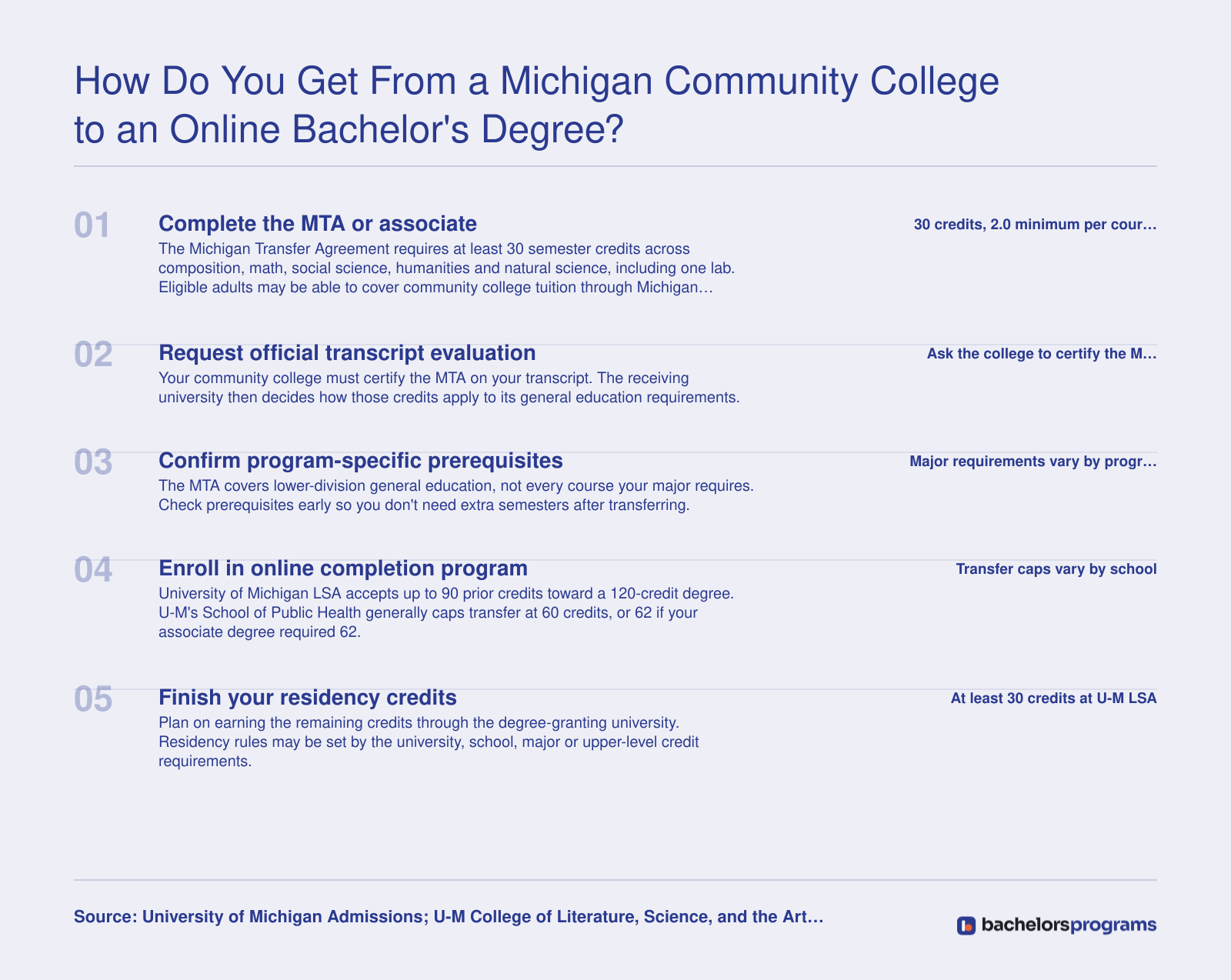
How Do You Get From a Michigan Community College to an Online Bachelor's Degree?
The most common route to a Michigan bachelor's degree starts at a community college and finishes online at a four-year university. Credit limits differ by school and even by college within a university, so treat these figures as planning benchmarks and confirm them with your target program.
Admissions Requirements and Start Dates for Michigan Online Programs
Admission to an online bachelor's program in Michigan generally follows the university's standard undergraduate rules. Central Michigan University and Wayne State University show how the requirements and calendars can differ.
- TranscriptsTransfer applicants to Central Michigan send all college transcripts. Applicants with fewer than 24 college credits must also send high school transcripts.
- Transfer GPA and creditsWayne State expects at least 24 transferable credits and a 2.5 combined cumulative GPA across every college you have attended. Associate degree holders may be admitted with a 2.0 or higher.
- Test scoresCentral Michigan is test-optional for first-time students, though SAT or ACT scores can strengthen admission and merit aid chances. Scores are required for homeschooled applicants and for students whose high schools do not issue grades.
- Multiple start datesCMU Online starts classes six times a year. Apply at least one month before your intended start.
- Term deadlinesWayne State uses set entry terms. Deadlines are August 15 for fall, December 1 for winter, and April 1 for spring/summer.
- Scholarship timingCMU's transfer priority scholarship deadlines are March 1 for summer or fall entry and December 1 for spring.
- Program extrasAsk whether your major adds prerequisites, a portfolio, a higher GPA, or other requirements. Also confirm its technology requirements before you apply.
Accreditation, Graduation Rates, and What Quality Looks Like
Start With Institutional Accreditation
Michigan's degree-granting colleges should be accredited by the Higher Learning Commission (HLC), the institutional accreditor recognized by the U.S. Department of Education.1 The University of Michigan, Central Michigan University, Michigan Technological University, and Montcalm Community College all list HLC as their accreditor.1 This matters in three ways. Federal financial aid generally requires an accredited school. Other colleges are far more likely to accept your credits. And employers and graduate programs routinely screen for it.
Check Programmatic Accreditation for Your Major
Institutional accreditation covers the whole school. Some fields also have a separate accreditor for the specific program:
- Nursing: CCNE or ACEN. Michigan Tech's baccalaureate nursing program, for example, is CCNE-accredited.2 State approval from Michigan LARA is a separate requirement and does not replace programmatic accreditation.
- Business: AACSB or ACBSP. Central Michigan's College of Business Administration holds AACSB accreditation.3
- Education: CAEP. Not every teacher-preparation program carries it, so ask what approval or accreditation the specific program has.
- Counseling: CACREP. Confirm the exact program is listed, since the school's general accreditation does not guarantee it.
Reading Graduation and Retention Rates
College Scorecard, run by the U.S. Department of Education, publishes graduation rates, average annual cost, and median earnings for each school. Search the school by name, open its profile, and compare the completion figure with similar Michigan institutions. MI School Data also offers state-level postsecondary information.
Treat these numbers cautiously. Institution-wide rates are usually built around first-time, full-time students who start in the fall. Adult learners who study online, part time, or transfer in midstream may be counted differently or left out. I did not find a published Michigan figure that isolates online students, so a school's overall rate is a rough signal at best.
Three Quality Checks Worth Making
Rankings are a weak substitute for direct questions. Try these instead:
- Verify the accreditor yourself: Look the school up on the HLC site, and the program on the programmatic accreditor's directory if your field requires one.
- Ask for outcomes of students like you: Request completion and job-placement data for online or part-time transfer students, and note whether the school can produce it.
- Confirm credit and licensure fit: Get a written credit evaluation, and for nursing, teaching, or counseling, ask whether the online program meets Michigan licensure requirements.
A school that answers these plainly and in writing is usually a better bet than one with a higher ranking and vague replies.
How to Choose the Right Michigan Online College for Your Situation
Most Michigan online students face the same tradeoff: the lowest price versus the program that actually fits their schedule, credits, and career plans. The cheapest option on paper can cost more if it rejects half your transfer credits or requires campus visits you cannot make.
There Is No Single Best Online College in Michigan
The honest answer to which online college in Michigan is best is that it depends on you. The right school accepts the most of your existing credits, costs the least after grants and scholarships, delivers coursework on a schedule you can keep, and meets any licensure requirements in your field. A program that suits a working nurse finishing a degree may be a poor match for a recent high school graduate.
A Decision Path by Reader Type
- Working adults: Look for asynchronous courses in 7- or 8-week terms, which let you take one or two classes at a time around a job. Ask your employer whether it offers tuition assistance and how it pays out.
- Transfer students: Confirm the school honors the Michigan Transfer Agreement, and find out the maximum number of transfer credits it accepts toward a bachelor's degree.
- Career changers: Prioritize programmatic accreditation in fields such as nursing, social work, education, or business, and ask how the school arranges clinical placements, practicums, or student teaching near where you live.
- Out-of-state students: Verify that the school is authorized to enroll online students in your state, and request the actual online tuition rate. Some schools charge one rate for all online students, while others still apply nonresident pricing.
Public vs. Private Nonprofit Trade-Offs
Michigan's public universities usually post a lower sticker price, especially for state residents. Private nonprofit colleges often list higher tuition but sometimes offer larger institutional grants, more frequent start dates, and faster admissions decisions. The only way to know which is cheaper for you is to compare offers side by side after aid is applied.
Your Pre-Enrollment Checklist
Before you commit to any program, bachelorsprograms.com recommends working through these steps:
- Credit evaluation: Get a written transcript evaluation that shows exactly which courses transfer and how they apply to your degree.
- Net price: Compare what you will pay after grants and scholarships, not the published tuition.
- Accreditation: Verify that the school is accredited by the Higher Learning Commission, the institutional accreditor for Michigan colleges.
- In-person requirements: Ask exactly which orientations, labs, residencies, or placements require you to show up in person, and how often.
Colleges in Michigan with the most bachelor's programs
| School | City | Type | Bachelor's programs | Online | Net price / yr | Grad rate |
|---|---|---|---|---|---|---|
| Grand Valley State University | Allendale | Public | 109 | 10 | $16,317 | 67% |
| Wayne State University | Detroit | Public | 109 | 9 | $12,766 | 58% |
| Western Michigan University | Kalamazoo | Public | 109 | 9 | $15,273 | 58% |
| Michigan State University | East Lansing | Public | 106 | 1 | $19,680 | 81% |
| Eastern Michigan University | Ypsilanti | Public | 104 | 37 | $15,407 | 46% |
| Central Michigan University | Mount Pleasant | Public | 99 | 19 | $17,597 | 59% |
| Ferris State University | Big Rapids | Public | 85 | 42 | $8,624 | 47% |
| Northern Michigan University | Marquette | Public | 74 | 6 | $14,085 | 52% |
| Oakland University | Rochester Hills | Public | 72 | 1 | $9,120 | 58% |
| Michigan Technological University | Houghton | Public | 71 | 0 | $14,182 | 68% |
| University of Michigan-Flint | Flint | Public | 71 | 20 | $7,007 | 40% |
| Andrews University | Berrien Springs | Private nonprofit | 66 | 6 | $12,547 | 72% |
| Madonna University | Livonia | Private nonprofit | 66 | 13 | $17,755 | 60% |
| Adrian College | Adrian | Private nonprofit | 65 | 5 | $25,368 | 48% |
| University of Michigan-Dearborn | Dearborn | Public | 64 | 19 | $9,492 | 58% |
Program counts are the verified bachelor's listings in our directory; net price is the school-wide average a first-time undergraduate paid after aid, and graduation rate the share finishing within six years (College Scorecard).
Compare programs nationwide
Many Michigan residents study online. Every ranked list above has an online lens, or browse every field.
Online bachelor's degrees Browse all fields