Online Colleges and Bachelor's Degree Programs in Rhode Island
Every verified bachelor's program at a college in Rhode Island: 530+ programs at 12 colleges, with the online options, net price and graduation rates behind each one.

An online bachelor's in Rhode Island is a plain tradeoff: the cheapest path starts at the Community College of Rhode Island and finishes with a transfer, while a fully online university program bills you at the university's per-credit rate. URI Online lists $654 per credit for 2026-2027, plus a $16 per-credit online fee.
Public options are few (URI, Rhode Island College and CCRI), so the real variables are net price after aid such as RI Promise, transfer credit, and whether a degree-completion or RN-to-BSN track fits a work schedule.
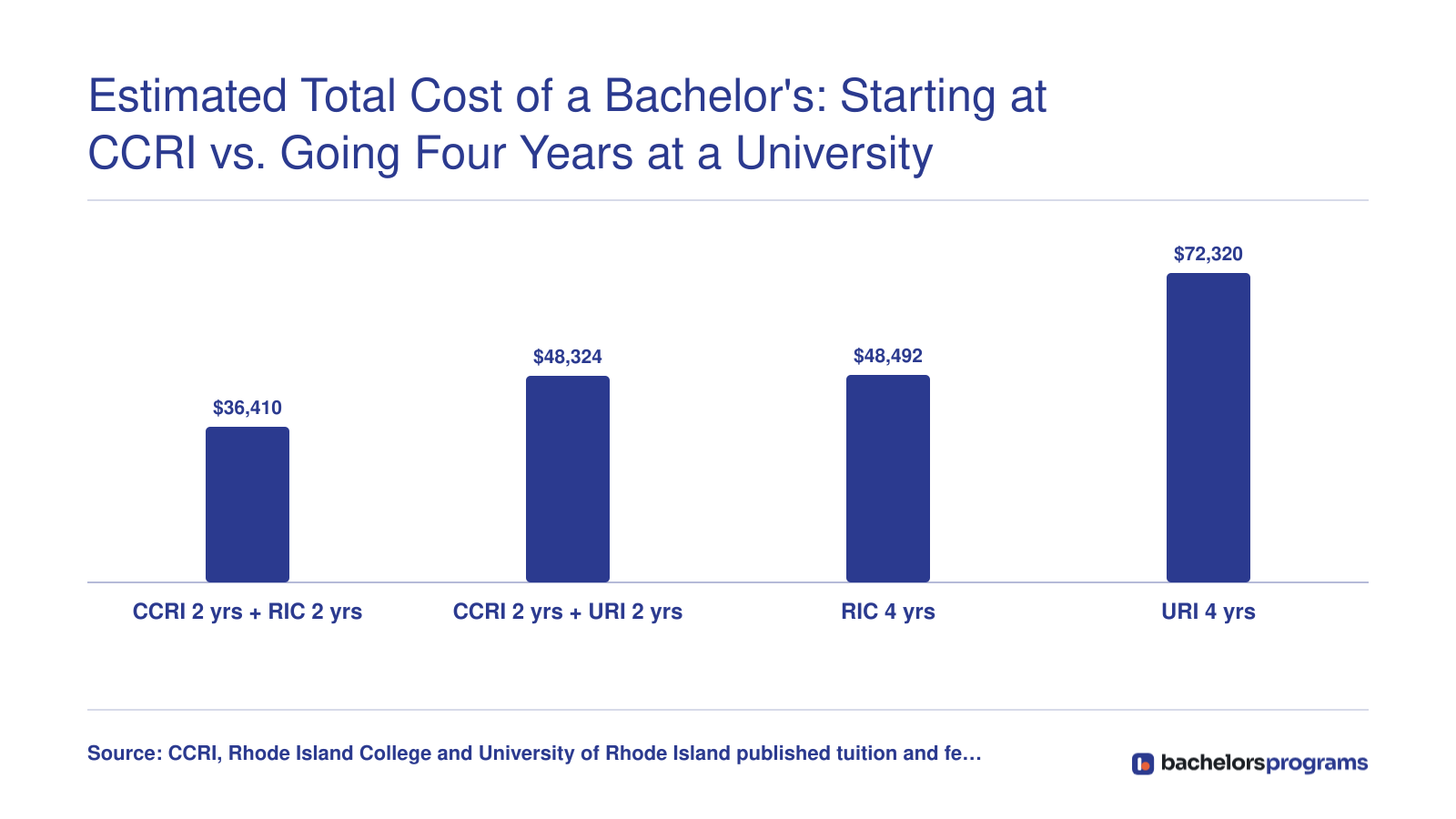
The transfer math is hard to ignore. Starting at CCRI and finishing at RIC runs an estimated $36,410 in tuition and fees, about $12,000 less than four years at RIC.
Key Points
- URI Online charges $654 per credit plus a $16 online fee for 2026-2027.
- A CCRI-to-RIC route cuts estimated tuition and fees to $36,410.
- Joint admissions guarantees 60 CCRI credits apply toward URI or RIC degrees.
Popular degrees in Rhode Island
Bachelor's degrees in Rhode Island by field
Business & Management
- Marketing16 programs
- Finance12 programs
- Business Administration8 programs
- Accounting8 programs
- Entrepreneurship8 programs
- Communication7 programs
- Management7 programs
- Economics7 programs
Science & Engineering
- Chemistry12 programs
- Biology8 programs
- Mathematics7 programs
- Anthropology6 programs
- Biochemistry6 programs
- Natural Resources or Conservation6 programs
- Environmental Science5 programs
- Physics5 programs
Arts & Design
- Art or Art Studies13 programs
- Fine Arts or Studio Art9 programs
- Media Arts or Digital Media7 programs
- Creative Writing6 programs
- Graphic Design5 programs
- Art History5 programs
- Audio & Music4 programs
- Digital Photography3 programs
Liberal Arts & Humanities
- History7 programs
- Spanish7 programs
- Philosophy6 programs
- Literature or English Literature6 programs
- English5 programs
- African and African American Studies4 programs
- Global Health or Health Studies4 programs
- Gender & Sexuality Studies3 programs
Education & Teaching
- Science13 programs
- Elementary Education8 programs
- English Education5 programs
- Secondary Education5 programs
- History Education5 programs
- Mathematics Education5 programs
- Early Childhood Education or Child Development4 programs
- Special Education3 programs
Computers & IT
- Computer Science13 programs
- Innovation or Technological Entrepreneurship5 programs
- Cybersecurity4 programs
- Artificial Intelligence4 programs
- Computer Engineering4 programs
- Software Development & Engineering2 programs
- Information Technology2 programs
- Computer Information Systems2 programs
Communications & Media
- Communications10 programs
- Public Relations5 programs
- Professional Writing2 programs
- Social Media2 programs
- Communication Disorders2 programs
- Speech Pathology2 programs
- Journalism2 programs
- Strategic Communications2 programs
Social Work & Social Sciences
- Sociology9 programs
- Political Science, Government7 programs
- Social Work3 programs
- Public Policy2 programs
- Human Services1 program
Healthcare
- Exercise & Sports Science4 programs
- Public Health4 programs
- Health Sciences4 programs
- Nutrition2 programs
- Speech Pathology2 programs
- Community Health2 programs
- Health Education2 programs
- Health Informatics1 program
Nursing
- Bachelor of Science in Nursing7 programs
- Nursing (RN to BSN)4 programs
- Accelerated BSN (ABSN)2 programs
Criminal Justice & Law
- Criminal Justice5 programs
- Criminology2 programs
- Legal Studies2 programs
- Paralegal1 program
- Legal Services1 program
- Criminal Justice Administration1 program
- Forensic Science1 program
Psychology
- General Psychology9 programs
Natural & Applied Sciences
- Oceanography or Ocean or Marine Biology2 programs
- Agriculture or Agricultural1 program
- Neuroscience1 program
Counseling
- Behavioral Health Science1 program
How Online Bachelor's Study Works in Rhode Island: Fully Online, Hybrid and Asynchronous
Can you earn a bachelor's degree in Rhode Island without ever visiting campus? Sometimes, but the options are narrower than the word "online" suggests.
Three Formats, Defined
- Fully online: All coursework and requirements happen remotely, with no campus visits.
- Hybrid: Most work is online, but some sessions or meetings take place in person.
- Asynchronous: No fixed login times. You complete work on your own schedule, though deadlines still apply.
For working adults and out-of-state students, the distinction decides whether a program is realistic at all. One required evening on campus can rule out someone with a night shift or a long drive.
What Rhode Island Actually Offers
Few Rhode Island bachelor's programs are fully online from start to finish. Much of what gets marketed as online is hybrid or built for degree completion, meaning you arrive with credits already earned.
The University of Rhode Island's online undergraduate options are completion degrees. Its Bachelor of Interdisciplinary Studies is fully online, uses accelerated 7-week courses and generally expects at least 45 college credits. The Early Childhood Care and Education B.S. and the RN-to-BS in Nursing are also fully online. The Strategic Communication B.A. is an online completion degree with 7-week or 14-week courses. URI lets students manage weekly time at their own pace, but most instructors set weekly and term deadlines, so expect flexibility rather than total self-direction.
Johnson & Wales University describes its JWU Online programs, including bachelor's degrees, as fully online, with most courses lasting seven weeks and some running 15.1 Its "on your time" language does not guarantee every course is asynchronous.
Check current formats directly with Rhode Island College, Roger Williams, Salve Regina, and Providence College's School of Continuing Education. CCRI does not award bachelor's degrees, though it is a common starting point.
Ask Before You Enroll
Get written answers on whether practicums, clinicals, orientations or proctored exams require a trip to campus. A single mandatory visit changes the math for anyone outside commuting range.
What Online Bachelor's Degrees Cost in Rhode Island: Per-Credit Tuition and Fees
For 2026-2027, URI Online charges $654 per credit for its online bachelor's and degree-completion programs, the same as URI's published in-state part-time undergraduate rate, plus a $16 per-credit online fee. URI Online does not publish a separate out-of-state online rate, so no reduced rate for out-of-state online learners is documented, while Rhode Island College's Bachelor of Professional Studies lists $383 per credit in-state. Figures come from URI's part-time tuition and fees page, URI Online's tuition pages and Rhode Island College's Bachelor of Professional Studies and tuition pages. Per-credit price is only the sticker rate: a full 120-credit degree at $654 comes to $78,480 in tuition plus $1,920 in online fees, while a 60-credit completion program at the same rate totals $39,240 plus $960, and 60 credits at RIC's $383 rate total $22,980 before fees.
| Institution | In-State Per-Credit Tuition | Out-of-State Per-Credit Tuition | Mandatory/Online Fees | Same Rate as On-Campus? |
|---|---|---|---|---|
| University of Rhode Island, on-campus undergraduate part-time rate (2026-2027) | $654 | $1,556 | N/A | On-campus benchmark rate |
| URI Online, Bachelor of Interdisciplinary Studies degree completion (2026-2027) | $654 | Not separately published | $16 per credit online fee | Yes, matches URI's $654 in-state part-time rate |
| URI Online, accelerated bachelor's and degree-completion programs (2026-2027) | $654 | Not separately published | $16 per credit online fee | Yes, matches URI's $654 in-state part-time rate |
| Rhode Island College, Bachelor of Professional Studies (2026-2027) | $383 | Not published | $9.42 per credit (maximum $113) | Not confirmed by the college's published rates |
Estimated Total Cost of a Bachelor's: Starting at CCRI vs. Going Four Years at a University
Starting at CCRI for 60 credits and finishing the last 60 at Rhode Island College brings estimated tuition and fees to $36,410. That is about $12,000 less than four years at RIC and roughly half the $72,320 for four years at URI. These estimates use 2026-27 in-state rates for full-time fall and spring terms (60 + 60 credits for the CCRI-first paths, 120 credits for the four-year paths). They assume no tuition increases and that every CCRI credit transfers. They exclude housing, books, lab and course fees, and URI's student health insurance charge. They are sticker-price estimates, not net price after financial aid. Rhode Island's tuition-free associate option for recent high school graduates could lower the CCRI portion further, but confirm your eligibility and any remaining fees with CCRI.
Net Price, Financial Aid and Rhode Island State Grants for Online Students
Rhode Island's best-known tuition programs were built for students who start college straight out of high school, and that design shapes who benefits most in 2026.
RI Promise at CCRI
RI Promise remains available for 2026-2027 and covers tuition at the Community College of Rhode Island for an associate degree. Eligibility is tightly sequenced:
- Residency and age: You must be a Rhode Island resident and younger than 19 when you finish high school or a GED. Students who are 19 to 21 in their graduation year may appeal, but the approval standard is not published.
- Timing: You enroll at CCRI immediately after high school, with a narrow exception for up to one semester elsewhere.
- Credits: At least 6 credits each fall and spring, and at least 24 first-year credits (30 is recommended), on a two-year track.
- Paperwork: An annual FAFSA and a graduation commitment.
CCRI's materials do not expressly exclude online courses, but they also do not confirm that a fully online schedule qualifies. Confirm that with the college before you plan around it. Part-time students must use winter or summer terms to reach the first-year credit total, and the sources do not say whether Promise pays for those sessions.
Hope Scholarship at RIC
The Hope Scholarship at Rhode Island College is still current and makes the last two years of a four-year degree tuition-free. It is for first-time students who enter RIC right after high school, stay enrolled full time (at least 12 credits), keep at least a 2.5 GPA, reach 60 credits by junior year, and file the FAFSA every year. Online study is not addressed, and no part-time exception is established.
Federal Aid and State Grants
Pell Grants and federal loans require the FAFSA and a program at an accredited, Title IV-eligible school. The Rhode Island Supplemental Grant, formerly the State Grant, goes to Pell recipients who are Rhode Island residents enrolled at least half-time (6 credits at CCRI).1 It has no single statewide maximum, and awards depend on each school's funding.
Sticker Price vs. Net Price
Sticker price is the published tuition. Net price is what remains after grants and scholarships. Before comparing programs, put your own numbers into each school's net price calculator.
Where the Gaps Are
Adult completers and returning students usually fall outside both Promise and Hope because of the immediate-enrollment and first-time-student rules. Out-of-state online learners miss every Rhode Island program, since each requires state residency. For these students, Pell, institutional aid and employer tuition benefits matter most.
Transfer Pathways: From CCRI to an Online Bachelor's at URI or RIC
The Joint Admissions Agreement between CCRI, URI and Rhode Island College, signed January 14, 2026, guarantees that at least 30 general education credits transfer and that at least 60 credits apply to a specified bachelor's program once you finish the associate degree. The credits count toward degree requirements, not just as loose electives.
Who Qualifies and What You Get
The agreement is built for first-time college students who enroll with fewer than 30 college-level credits.1 CCRI also bars prior college attendance. You must follow an approved transfer track, finish the associate degree within five years, and keep a cumulative GPA of at least 2.40.1
In return, the application fee is waived and you receive conditional acceptance.1 Scholarships at URI and RIC are tied to your CCRI GPA, and URI offers up to a 30% tuition discount by GPA. The agreement does not waive major-specific requirements, and the receiving school still decides admission and credit under its standard criteria.
Credit Caps and Residency Rules
The published sources do not give one university-wide transfer maximum for URI. URI does not accept remedial, developmental or vocational courses. RIC publishes a 90-credit transfer maximum, but it also requires at least 45 credits earned at RIC. On a 120-credit degree, that normally leaves no more than 75 credits to come from elsewhere. Treat that as a practical ceiling, not an official cap. Ask each school's transfer office for the number that applies to your major.
Can I Get College Credit for Work Experience in Rhode Island?
Often, yes, though the rules differ by school.
- URI: Credit for prior learning covers standardized exams, military experience, certifications and portfolio review.
- RIC: Documented college-level learning from workplace training, armed-service training, law-enforcement training, community service, self-education or artistic development can earn credit, but only when it clearly fits your degree program. RIC accepts CLEP credit, though it does not count toward the 45-credit residency requirement.
- CCRI: The sources reviewed here do not spell out its policies, so confirm them with its advising office before you pay for any exam.
Award amounts, CLEP score thresholds and fees vary, so get them in writing before you rely on them.
A Practical Tip
Meet a transfer advisor at CCRI and at your target school before your final CCRI year, ideally earlier. Electives are where credits most often go unused. An advisor can steer them toward your intended major so they count toward the degree and not just toward the associate.
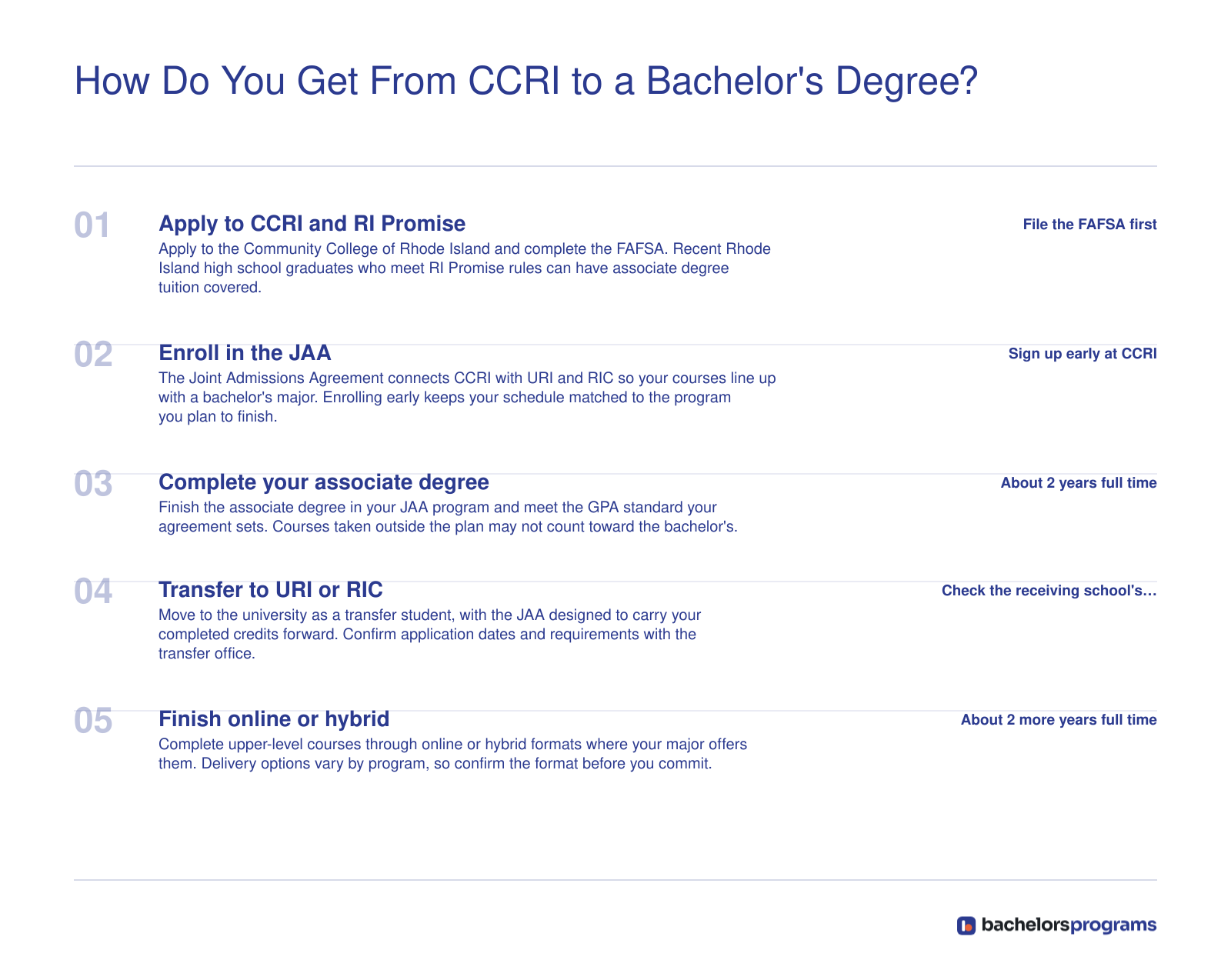
How Do You Get From CCRI to a Bachelor's Degree?
For most Rhode Island students, starting at the Community College of Rhode Island and transferring is typically the lowest-cost way to earn a bachelor's degree. Community college tuition runs well below university rates, and eligible recent high school graduates may pay no tuition at all through RI Promise. The Joint Admissions Agreement (JAA) then helps those lower-cost credits count toward a bachelor's at the University of Rhode Island or Rhode Island College, so you pay university prices only for the final two years.
Degree Completion and RN-to-BSN Options for Adult Learners at RIC and URI
Rhode Island College and the University of Rhode Island split the adult-completion work: RIC runs a cohort-based Bachelor of Professional Studies for students outside nursing, while both institutions offer RN-to-BSN tracks for licensed working nurses.
Inside RIC's Bachelor of Professional Studies
The BPS is built for adults 25 and older with at least five years of documented full-time work or military training, 24 or more regionally accredited college credits, and a 2.00 GPA. Applicants short of 24 credits may be considered conditionally if they hold an RIC certificate carrying 15 or more credits. Coursework is online and asynchronous, delivered in 7-week sessions, though the 2026-2027 catalog lists 8-week terms, so confirm the calendar with an advisor before you commit. The program page names two concentrations, Organizational Leadership and Social Services, each paired with a certificate of undergraduate study; the catalog adds Strategic Communication and Educational Foundations. RIC reports that 80% of students finish in two years or less, and tuition runs $383 per credit for 2026-2027.
RIC and URI RN-to-BSN compared
- RIC: 30 semester hours of nursing coursework online, plus at least 40 general education credits and 120 total, with up to 90 transfer credits accepted. No traditional clinical rotations. Fall or spring entry, and as little as 12 months once general education and total-credit requirements are satisfied. Apply as a transfer student and be admitted before starting nursing courses.
- URI: fully online Bachelor of Science in Nursing with 7-week accelerated courses and 120 credits. Requires a 2.6 GPA, an associate degree or diploma from an ACEN-accredited nursing program, and an unrestricted U.S. RN license; it serves nurses licensed in Rhode Island, Connecticut, Massachusetts, New Jersey and New York.
Both programs list online delivery, but neither states plainly that every course is free of scheduled live sessions, so ask for a sample syllabus and the meeting pattern. Adults with some college and no degree should ask URI's online enrollment staff which completion options fit their transcript.
Fit the program around your shifts
Working nurses should ask HR two questions: whether the employer offers tuition reimbursement, and whether that money is paid per credit with a passing-grade requirement. Then compare start dates: 7-week accelerated terms turn over quickly, and a program with frequent entry points is easier to time around a rotating hospital schedule than one with two admission cycles a year.
Rhode Island RN Licensure for RN-to-BSN Students
Admissions, Deadlines and Rolling Enrollment for Online Bachelor's Programs
URI and Rhode Island College both evaluate online and degree-completion applicants mainly as transfer students. Here is what to have ready and when to apply.
- High school credentialURI waives the high school transcript for associate degree holders. RIC requires a final high school transcript only if you have fewer than 24 college credits.
- Official transcriptsSend transcripts from every college you attended, even if you expect no credit from them.
- Minimum creditsURI's online Strategic Communication completion program requires 45 earned credits. RIC treats 24 or more credits as a transfer application and evaluates fewer under first-year standards.
- Minimum GPAURI Strategic Communication requires a 2.5, or a 2.4 with an associate degree. RIC requires a 2.0 with 24 or more credits. Both schools also require good academic standing.
- Transfer credit capRIC accepts up to 90 comparable credits from regionally accredited schools, with grades of C or higher.
- Application fee$65 for URI Strategic Communication and $50 for RIC transfer applicants.
- URI deadlinesSpring: December 15 (priority) and January 1 (regular). Fall: May 1 (priority) and July 31 (regular). Plan around these dates instead of counting on rolling admission.
- RIC deadlinesJuly 15 for fall and December 15 for spring. One RIC page lists November 15 for spring transfers, so aim for the earlier date.
- Start terms and pacingURI Online courses run fully online in accelerated 7-week sessions. RIC's online Bachelor of Professional Studies is now accepting applications for Spring 2027.
- How to applySince Spring 2026, all URI applications go through the Slate portal.
- Aid timingRIC's March 15 FAFSA date is a financial aid priority deadline, not an admissions deadline.
Outcomes, Accreditation and Student Support at Rhode Island Colleges
Outcomes and accreditation separate a credible online bachelor's program from a costly mistake, and Rhode Island publishes sources for both. Work through them in order before you compare tuition or request transcripts.
Start With the Federal Data
Begin at College Navigator, the consumer-facing search tool from the National Center for Education Statistics. Look up the University of Rhode Island, Rhode Island College, and the Community College of Rhode Island by name, then open each school's graduation and retention section. The current outcome-measure release is labeled IPEDS 2024-2025 and was published in January 2026, so confirm you are reading the newest figures rather than an archived page.1
Use IPEDS itself for definitions and downloadable data. Six-year graduation means completion within 150 percent of normal time.1 For four-year institutions, first-year retention tracks first-time bachelor's-seeking students who re-enroll the following fall. For CCRI, a two-year institution, the retention measure also counts students who complete a program by that fall.
Verify Accreditation, Institution and Program
Institutional accreditation is the baseline for federal aid and for transferring credits. NECHE, recognized by the U.S. Department of Education, accredits institutions as a whole, including online offerings.2 Rhode Island College is a NECHE member, first accredited in 1958, continued in accreditation in April 2022, with its next comprehensive evaluation scheduled for fall 2030.3 Check the NECHE directory directly for URI's and CCRI's current status and review dates.
For nursing programs, verify program-level accreditation through the Commission on Collegiate Nursing Education's official directory, then confirm the same program and campus on the school's own accreditation page. General claims like "accredited nursing program" are not enough.
Confirm Online Support and Ask Specific Questions
Go to each college's official site and look for pages aimed at online students: academic advising, tutoring, library access, disability services, technology help, and career services. Then email admissions or the online-learning office to confirm that fully online students can use each service.
Pre-Enrollment Checklist
- Federal data: Compare six-year graduation and first-year retention in College Navigator; use IPEDS for definitions.
- Accreditation: Confirm NECHE status for the institution and CCNE status for nursing, by program and campus.
- Support: Ask which advising, tutoring, library, disability, tech, and career services are available fully online.
- Career context: Use the Bureau of Labor Statistics for occupational outlook and Rhode Island wage data.
How to Choose the Right Online Program in Rhode Island
Four practical questions narrow the choice in Rhode Island: how many college credits you already hold, whether you qualify for in-state pricing, whether you need a license at the end, and whether you can attend anything in person. Answer those first and the list shrinks quickly, because the state's public options serve distinct starting points rather than one universal path.
If you are starting from zero
Recent high school graduates and anyone putting cost ahead of everything else should look at the Community College of Rhode Island first. RI Promise covers tuition for eligible recent graduates, and the Joint Admissions Agreement guarantees students who complete an associate degree 60 credits toward a bachelor's at Rhode Island College or the University of Rhode Island, though the receiving school still decides admission. Declare your JAA intent early, meet with an advisor at both ends, and pick courses that map to your intended major so nothing is wasted at transfer.
If you already have credits
Adults returning with partial credit should compare Rhode Island College's Bachelor of Professional Studies against degree completion options at URI. Both are designed for students who stopped out, not for first-time freshmen. Ask explicitly about prior learning assessment, military credit and credit by exam. Every credit you document is tuition you do not pay and a term you do not sit through, so push the evaluation before you enroll rather than after.
If you are a working nurse or live out of state
- Nurses: Compare RN-to-BSN options on three things: whether coursework is fully asynchronous, what the clinical or practicum requirement actually involves and where it can be completed, and whether your employer offers tuition reimbursement that favors one school over another.
- Out-of-state learners: Confirm the program is fully online and not a hybrid with campus residencies, ask what the out-of-state online per-credit rate is, and verify the school is authorized to enroll students in your state and that the degree meets your state's licensure rules if you need one.
Three things to do this week
1. Run the net price calculator on each school's site using your real financial information, not the sticker price. 2. Request an unofficial transfer credit evaluation before you apply, so you know your actual remaining credit count. 3. Confirm the next start term and its application cutoff, since online programs often open multiple terms a year.
Colleges in Rhode Island with the most bachelor's programs
| School | City | Type | Bachelor's programs | Online | Net price / yr | Grad rate |
|---|---|---|---|---|---|---|
| University of Rhode Island | Kingston | Public | 96 | 5 | $21,440 | 73% |
| Rhode Island College | Providence | Public | 80 | 3 | $9,478 | 48% |
| Roger Williams University | Bristol | Private nonprofit | 65 | 4 | $37,999 | 69% |
| Salve Regina University | Newport | Private nonprofit | 52 | 2 | $36,967 | 77% |
| Providence College | Providence | Private nonprofit | 51 | 0 | $48,523 | 86% |
| Brown University | Providence | Private nonprofit | 47 | 0 | $25,184 | 96% |
| Bryant University | Smithfield | Private nonprofit | 46 | 0 | $41,219 | 80% |
| Johnson & Wales University | Providence | Private nonprofit | 44 | 13 | $31,027 | 55% |
| Johnson & Wales University | Providence | Private nonprofit | 23 | 22 | $20,252 | — |
| New England Institute of Technology | East Greenwich | Private nonprofit | 17 | 4 | $36,483 | 60% |
| Rhode Island School of Design | Providence | Private nonprofit | 8 | 0 | $50,507 | 89% |
| Roger Williams University School of Law | Bristol | Private nonprofit | 1 | 0 | — | — |
Program counts are the verified bachelor's listings in our directory; net price is the school-wide average a first-time undergraduate paid after aid, and graduation rate the share finishing within six years (College Scorecard).
Compare programs nationwide
Many Rhode Island residents study online. Every ranked list above has an online lens, or browse every field.
Online bachelor's degrees Browse all fields