Best Communications Degree Programs
Compare 1,400+ accredited Communications programs at 900+ colleges, with net price after aid, graduation rates, earnings and debt from IPEDS and the U.S. College Scorecard.

A communications bachelor's costs between roughly $6,600 and $13,800 a year after grants and scholarships at the schools ranked here. The earnings that follow diverge almost as widely: median pay two years after graduation runs from about $58,000 to $74,400.
Admission is the second filter. A few programs take fewer than one in ten applicants; others admit nearly everyone. Some cap the major itself, requiring a separate application once enrolled.
The trade-off is price against completion: a low net price means little if the graduation rate lags.
Key Points
- UNC, UCLA, and Florida State lead, each graduating over 85 percent.
- After aid, those leaders average roughly $11,300 to $12,500 a year.
- Online bachelor's degrees typically require 120 credits, about four years full time.
The 10 Best Communications Schools for 2027
Three schools separate from the rest on the measures that matter most here: North Carolina, UCLA, and Florida State each pair an average net price between roughly $11,300 and $12,500 after aid with a graduation rate above 85 percent. Each card below covers format, concentrations, and the single strongest data point for that school. Graduation rates are institution-wide rather than program-specific, and net price is an average after aid, so your own cost will depend on residency, housing, and the aid package you are offered.
University of North Carolina at Chapel Hill
#1Chapel Hill, NC · ~$12,000/yr (est.)
Best for: Students seeking flexible media study pathways
UNC Chapel Hill rewrote its undergraduate communication curriculum in 2024, replacing a fixed sequence with five flexible pathways that run from interpersonal communication to media art to rhetoric and advocacy. Students can add a New Media Track, an honors thesis, or internships at WUNC Radio and Television, and the campus runs its own student television station. The department also operates a Hollywood internship program for students aiming at entertainment and screenwriting work. Carolina pairs a 91 percent graduation rate with an average net price near $11,700 after aid, and communication graduates report a median salary above $70,000 four years into their careers.
- Five interdisciplinary pathways, from media art to rhetoric and advocacy
- 30 credit hours in the major with a 2.0 GPA minimum
- New Media Track, honors program, and independent study options
- Hollywood internship program, plus internships at WUNC Radio and TV
- Student-run television station (STV) for production experience
- Tracks: Communication and Everyday Life; Media Arts, Performance, and Critical Practice
University of California-Los Angeles
#2Los Angeles, CA · $13,000/yr (est. net price)
Best for: High-achievers aiming at media and law
UCLA's communication major is one of the most selective routes on this list, with limited enrollment by application inside a university that admits about 9 percent of applicants overall. Undergraduates work through four core areas (mass communication, interpersonal dynamics, communication technology, and political and legal communication) and finish a required practicum. The campus posts a 93 percent graduation rate, and the surrounding Los Angeles media market supplies internship and early-career options that few programs can match. Average net price after aid runs about $12,500.
- At least 45 units, including seven lower-division courses
- Four core areas: mass, interpersonal, technology, political and legal
- Required practicum course for hands-on experience
- Limited enrollment by application; selective admission
- AP credit can replace some prerequisite coursework
- Transfer applicants have specified pathway requirements
Florida State University
#3Tallahassee, FL · ~$11,000/yr (est.)
Best for: Cost-conscious undergrads who want in-person study
Florida State offers its communication degree as a BA or BS in Communication and Digital Media Studies through the College of Communication and Information, taught in person in Tallahassee. The 120-credit program keeps 30 credits in the major, requires a minor outside communication, and pairs four core courses with advanced electives. A 2.00 GPA and 52 completed credits are needed to progress, so the path is predictable rather than competitive. It carries the lowest net price of the top three, near $11,300 after aid, alongside an 86 percent graduation rate.
- 120 total credit hours, with 30 in the major
- Minor outside communication required
- Foreign language through the 2200 level
- MMC2000 Mass Media Communication is the prerequisite
- 2.00 GPA and 52 credit hours needed to progress
- Four core courses plus 9 to 18 hours of advanced electives
- In person in Tallahassee; no online option
Stanford University
#4Stanford, CA · $10,000 – $15,000/yr (est.)
Stanford's Department of Communication treats the field as a social science, asking how journalism shapes political life and how media technology changes culture. The major runs from a core sequence through intermediate and advanced coursework, with quantitative and qualitative research methods woven through. Optional internships, advanced research projects, an honors track, and a coterminal master's in Media Studies give students several ways to extend the degree. Admission is extremely selective at roughly 4 percent of applicants, and the university graduates 92 percent of students within six years.
- Core, intermediate, and advanced course sequence
- Quantitative and qualitative research methods training
- Optional internships and advanced research projects
- Honors program and a coterminal master's in Media Studies
- Focus on journalism, media psychology, and technology and culture
University of Maryland-College Park
#5College Park, MD · $16,000/yr (est. net price)
Maryland lets communication majors stay general or specialize in health and science communication, media and digital communication, political communication and public advocacy, or public relations. The curriculum is built in six parts, from foundations and research methods through applied courses and electives, and every course counted toward the major needs a C- or better. The College Park location supports internships across Washington, D.C., with past placements at Edelman, iHeartMedia, NBCUniversal, and the Maryland General Assembly. Students can also add a double major in information science.
- Four specializations, including public relations and political communication
- Six-part curriculum: foundations, methods, society, theory, applied, electives
- C- or better required in every course counted for the major
- Double major available with Information Science
- Internship placements include Edelman, iHeartMedia, and NBCUniversal
- Study abroad coursework in global communication
- Community Dialogues Facilitator Badge available
University of California-Davis
#6Davis, CA · $10,000 – $15,000/yr (est.)
UC Davis frames communication as an applied social science, pairing foundations in anthropology, psychology, and sociology with upper-division work in communication theory, mass media effects, and digital media. Internships span broadcast and print outlets, health campaigns, advertising, and public relations, and undergraduates can pursue research or global learning. Alumni have landed at employers such as Apple, Yelp, and the California State Assembly. The campus graduates 86 percent of students within six years, and average net price after aid sits near $14,700.
- Social science foundations in anthropology, psychology, and sociology
- Upper-division work in communication theory and mass media effects
- Internships in broadcast, print, health campaigns, advertising, or PR
- Undergraduate research and global learning opportunities
- Alumni employers include Apple and the California State Assembly
University of Washington-Seattle Campus
#7Seattle, WA · ~$14,000/yr (est.)
Washington's communication major is capacity-constrained: students apply after completing COM 200 and a second 200-level course with a 2.5 GPA, and the department admits in fall, winter, and spring. Two curricular options let students choose general communication or journalism and public interest communication. The Seattle campus sits in a media and technology hub, and graduates move into business, journalism, and media roles. The university graduates 85 percent of students within six years, with an average net price after aid near $14,100.
- Two options: Communication, or Journalism and Public Interest Communication
- Capacity-constrained major: apply after COM 200 and a second 200-level course
- 2.5 GPA minimum to apply
- Admits fall, winter, and spring quarters
- Transfer students can apply jointly in spring
- About 570 undergraduates in the major
California State University-Fullerton
#8Fullerton, CA · $7,000 – $20,000/yr (est.)
Cal State Fullerton runs a large, practical communications program with concentrations in public relations, advertising, and journalism. Every route totals 120 units and requires both a capstone and a field internship, and public relations students can run campaigns through a student agency. Fullerton's Orange County location opens internship sites across Orange and Los Angeles counties. Admission is comparatively accessible at roughly 91 percent, and the average net price after aid is the lowest on this list at about $6,600.
- Capstone in public relations management
- Crisis communications and entertainment public relations electives
- Principles and Ethics of Public Relations coursework
- Student-run agency option for campaign work
- Blends creative strategy with market research
- Capstone: Advertising Campaigns or the AAF Competition
- Prepares students for account executive, brand manager, or copywriter roles
- 72 units required outside communications
- Hands-on multimedia skills training
- Internship course required
- Prepares students for anchor, journalist, or producer roles
- Ethics emphasis with a global media perspective
Ohio State University
#9Columbus, OH · $17,000/yr (est. net price)
Ohio State's communication major runs three specializations through a School of Communication equipped with multimedia classrooms, multiplatform labs, and a podcasting studio. Internships, alumni networking, and faculty mentoring are built into the student experience, and the Columbus campus puts students close to state government, agencies, and a large media market. The university admits about 61 percent of applicants and graduates 88 percent of students within six years. Average net price after aid is about $17,300, the highest among the public universities on this list.
- Multimedia classrooms, multiplatform labs, and a podcasting studio
- Internships plus alumni networking and faculty mentoring
- Curriculum pairs communication theory with hands-on practice
- Tracks: Communication Analysis and Engagement; Communication Technology; Strategic Communication
University of Illinois Urbana-Champaign
#10Champaign, IL · ~$14,000/yr (est.)
Illinois offers a communication BA with six concentration areas, among them communication and health, rhetoric and public discourse, and mediated technology. The four-year curriculum mixes theory with practice, covering persuasion, conflict resolution, and data-driven decision making, and students can earn academic credit for internships. Graduates move into public relations, marketing, human resources, and government, or continue to law, medical, or graduate school. The university graduates 85 percent of students within six years, with an average net price after aid around $14,400.
- Six concentration areas, including communication and health
- Internships available for academic credit
- Coursework in persuasion, conflict resolution, and data-driven decisions
- Four-year program blending theory and practice
- Prepares students for PR, marketing, government, or law school
Cost & outcomes by school
Federal data for the highest-earning Communications programs, independent of the ranking above. Earnings are this field's bachelor's graduates four years after completing where the Scorecard reports them, else the school's undergraduate median.
| School | Net price / yr | Grad rate | Earnings | Debt | Grads/yr | Format |
|---|---|---|---|---|---|---|
| Stanford University CA | $13,807 | 92% | $124,080 | $12,000 | 22 | Campus |
| Carnegie Mellon University PA | $31,944 | 94% | $114,862 | $21,750 | — | Campus |
| University of Pennsylvania PA | $28,699 | 97% | $114,266 | $15,000 | 80 | Campus |
| Rensselaer Polytechnic Institute NY | $36,228 | 84% | $102,051 | $23,750 | 11 | Campus |
| Northwestern University IL | $29,167 | 95% | $93,541 | $17,687 | 71 | Campus |
| Vanderbilt University TN | $15,846 | 94% | $91,565 | $14,000 | 22 | Campus |
| Cornell University NY | $28,690 | 95% | $88,463 | $14,400 | 71 | Campus |
| Washington University in St Louis MO | $21,786 | 94% | $86,182 | $17,500 | — | Campus |
| Drexel University PA | $38,509 | 78% | $84,648 | $25,325 | — | Campus |
| New Jersey Institute of Technology NJ | $16,504 | 73% | $84,276 | $21,000 | — | Campus |
| Boston College MA | $41,704 | 91% | $83,586 | $18,000 | 207 | Campus |
| University of California-Los Angeles CA | $12,548 | 93% | $82,511 | $14,000 | 251 | Campus |
Sources: U.S. Department of Education. Net price, graduation rate, earnings and debt: College Scorecard (earnings and debt for this field's bachelor's graduates where reported, else school-wide); graduates: IPEDS. A dash means no figure is reported.
Cost, debt & payoff
Median earnings of this field's bachelor's graduates (4 yrs after completing, else the school's undergraduate median) vs. their median federal loan debt · U.S. College Scorecard
Across these programs the median graduate earns about $53,851 and finishes with roughly $23,250 in debt — a ratio that clears a common rule of thumb (keep debt below first-year salary). Net price and debt vary widely school to school, so check the per-school figures in the table above before you shortlist.
How We Ranked These Communications Schools
A famous name is not the same as a good return on your money, and this list favors the return. The ranking rests on measurable outcomes.
What Goes Into the Ranking
Four inputs carry the most weight, and each one answers a practical question:
- Net price: the average cost after grants and scholarships, not the sticker tuition.
- Graduation and retention: how many students finish, and how many come back after the first year.
- Median earnings: what communications graduates earn after completing the program.
- Median federal debt: the typical loan balance for graduates who borrowed.
Where the Numbers Come From
Outcomes come from the U.S. Department of Education's College Scorecard. School-level figures reflect the 2024 snapshot, and program earnings and debt draw on the 2022 outcomes data, the most recent available for these programs.
We measure earnings at the program level wherever we can. A campus-wide figure blends engineers, nurses, and every other major together. A program-level figure shows what communications graduates earn, the number you are actually trying to predict.
Limits Worth Knowing
- Graduation and retention rates cover the whole school, not only communications majors.
- Net price varies by family income, so your own cost may land well above or below the average shown.
- Some programs have no published earnings, usually because too few graduates were tracked. Those schools are judged on the other inputs.
Many rankings are built on reputation surveys, where academics and administrators rate their peers. That tells you about prestige. This approach tells you what students paid, whether they finished, what they earned, and what they owed. Use it as a starting point, then check each program's own requirements and costs before you apply.
Best Online Communications Degree Programs
Can you earn a communications bachelor's fully online, and how long does it take? Yes. For most students that means about four years of full-time study for 120 credits, less with transfer credit.
Online Options, Kept Separate
Every school in the main ranking above offers its program on campus, so none of those listings is fully online. The online options below come from separate programs:
- University of Oklahoma: online BA in Communication with 8-week asynchronous courses.
- University of Cincinnati: online BA in Communication, delivered asynchronously.
- UMass Global: online BA in Communications and Media, described as instructor-led.
- Franklin University, Youngstown State, University of Maryland Global Campus: online communication bachelor's programs.
- University of Phoenix: five-week asynchronous courses.
- Maryville University: fully online, with a four-year timeline.
Synchronous vs. Asynchronous
Synchronous classes meet live at set times. Asynchronous classes let you complete lectures and assignments on your own schedule, within weekly deadlines. For working adults, asynchronous usually fits shift work and family obligations better. Delivery can vary by course and instructor, so ask any program how often live sessions are required before you enroll.
How Long It Really Takes
Accelerated terms of five to eight weeks shorten the time per course, not the 120-credit total. Transfer credit is the bigger lever. Cincinnati, UMass Global, Franklin, Youngstown State, and Maryland Global Campus each accept up to 90 transfer credits, which is 75% of the degree. Franklin reports an average of 61 transfer credits. Oklahoma lists 24 to 36 months for its degree-completion students, Youngstown State says as few as 12 months2, and UMass Global says as few as 10 remaining courses with enough applicable credit. Phoenix estimates that 15 prior credits could save 25 weeks and $7,290.1 Each school decides which credits count toward your major, so request an evaluation first.
What Online Students May Miss
Online students often lack access to campus media labs, studio equipment, and student newspapers. Strong programs compensate with remote internships and portfolio work such as published writing, video, podcasts, and campaign plans. Ask to see examples of recent student portfolios.
Most Affordable Communications Degree Programs After Aid
Sticker price tells only part of the story, so these schools are sorted by average annual net price after grants and scholarships (U.S. Department of Education, IPEDS and College Scorecard), alongside median debt for communications graduates and the estimated monthly payment on a 10-year plan. Net price is an average across students who receive aid, so your own cost may be higher or lower depending on family income. Low cost does not mean weak results: each of these public universities graduates about 70 percent or more of its students, and FIU leads at 74 percent.
| School | Location | Program | Avg. Net Price After Aid (per year) | In-State Tuition & Fees | Median Program Debt | Est. Monthly Payment (10-Year) | Graduation Rate |
|---|---|---|---|---|---|---|---|
| CUNY Bernard M Baruch College | New York, NY | Intercultural & International Communication BA | $3,033 | $7,464 | $7,500 | $80 | 72% |
| California State University-Fullerton | Fullerton, CA | Communications, Public Relations Concentration, B.A. | $6,555 | $7,470 | $13,000 | $138 | 70% |
| Florida International University | Miami, FL | Bachelor of Arts in Communication Arts | $9,288 | $6,565 | $17,234 | $183 | 74% |
Related Articles
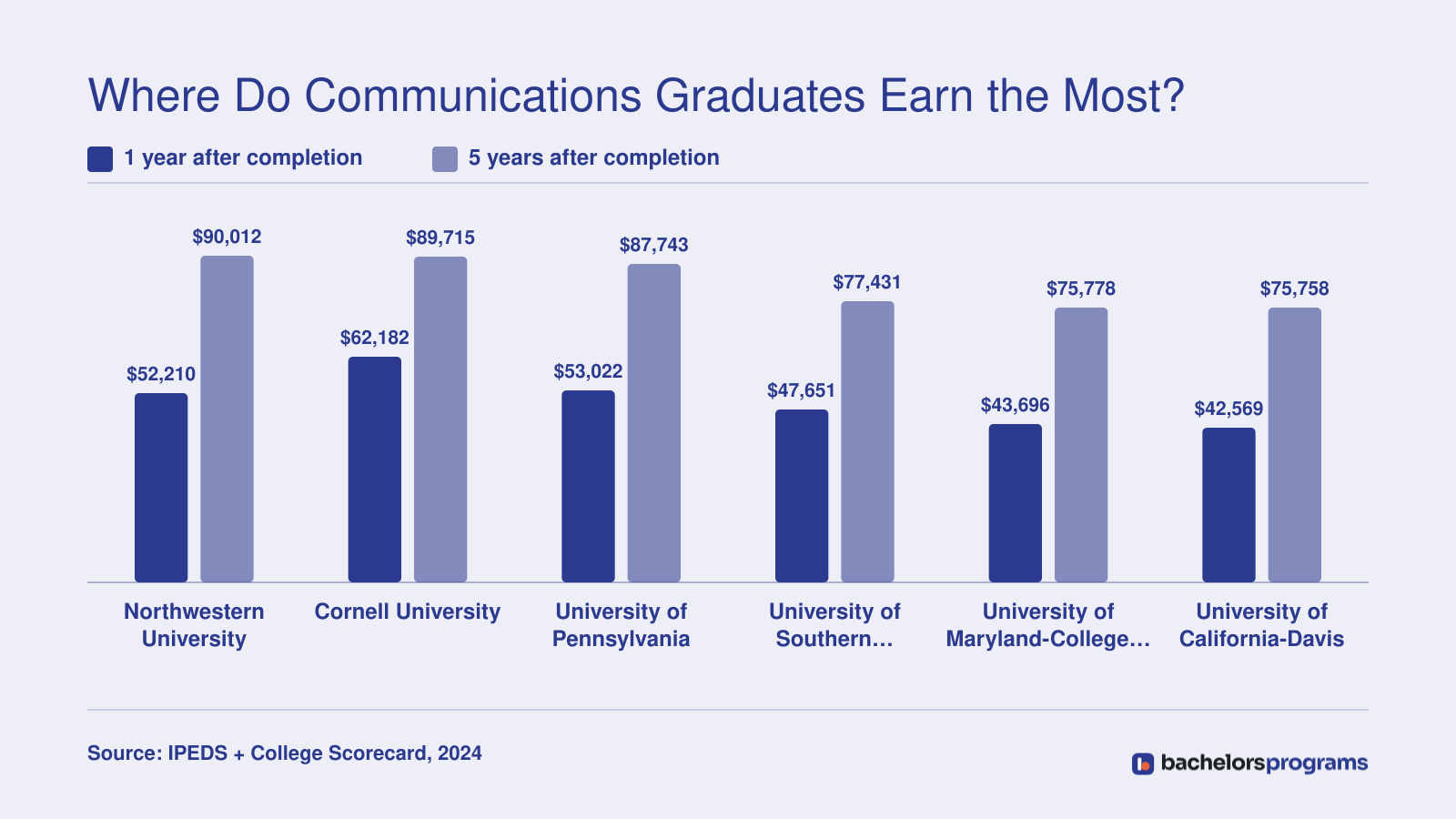
Where Do Communications Graduates Earn the Most?
These figures show the median earnings of communications bachelor's completers at each school, not of every graduate on campus. Each bar is labeled by how long after finishing the degree earnings were measured. Pay at these programs climbs sharply between the first year and the fifth, led by Northwestern University at $90,012 five years out.
Questions to Ask Yourself
Do you want to tell stories yourself, or shape how an organization tells its story?
Are you comfortable with tight deadlines and freelance-style work, or do you prefer a corporate or agency structure?
Do you want a degree that also opens doors to marketing and HR, or one built for newsrooms and studios?
Does the school have the equipment, publications, or agency partnerships your concentration needs?
What to Look for in a Communications Program
Use this checklist to compare programs on the factors that most directly affect your job prospects after graduation.
- Institutional accreditationConfirm the school holds institutional accreditation from a recognized accreditor. It affects credit transfer, financial aid eligibility, and how employers view your degree.
- Internship structurePolicies vary. Ohio University's Scripps College requires every journalism major to complete at least 200 contact hours with one employer, approved in advance by a faculty mentor. Syracuse Newhouse recommends internships, but that credit does not count toward graduation, so plan for extra credits.
- Portfolio-building courseworkLook for capstones or campaign courses that produce press releases, pitches, social content, clips, or a reel. Entry-level PR portfolios typically include three to five pieces.
- Student media or agencyA campus newspaper, radio or TV station, or student-run PR firm gives you finished work to show employers.
- Faculty and alumniSeek instructors with industry experience and an active alumni network that helps with internships and first jobs.
- Employer-valued skillsNACE's 2026 survey ranks written communication third among the skills employers value, behind problem-solving and teamwork.
The name on the diploma opens the first conversation, but the portfolio you build and the experience behind it carry every conversation after that. Weigh what you learn against what you pay.
Communications programs by state
Communications Degree FAQs
These answers cover the questions prospective students ask most about communications degrees, from timelines to visas. Requirements vary by school, so confirm details with each program you are considering.
How long does it take to earn a bachelor's in communications?
Are communications degrees worth it?
What is the best degree for communications: a BA, a BS, or a specialized degree like journalism or PR?
Can international students enroll in communications programs, and do online programs qualify for student visas?
Compare Communications programs on the data that matters
Explore more Communications & Media majors or browse every field of study.
All Communications & Media programs Browse every field of study