Online Colleges and Bachelor's Degree Programs in Ohio
Every verified bachelor's program at a college in Ohio: 3,600+ programs at 110+ colleges, with the online options, net price and graduation rates behind each one.

Ohio's public universities publish separate per-credit rates for online courses, and those numbers rarely match the in-state campus rate on the same tuition page. Two students can enter the same program, file the same FAFSA and pay thousands apart, because residency rules, distance fees and grant eligibility move the bill.
The work is comparison: per-credit price against net price, credits a school will actually accept, admission terms, and whether live sessions or in-person placements fit your week. Accreditation decides the rest. A degree without the right regional or programmatic approval limits where it travels, however convenient the format.
Key Points
- The Higher Learning Commission accredits Ohio colleges; verify it before enrolling.
- Filing the FAFSA unlocks Pell Grants and state aid for online students.
- Ohio's SARA membership allows cross-state online study but grants no licensure reciprocity.
Popular degrees in Ohio
Bachelor's degrees in Ohio by field
Business & Management
- Marketing98 programs
- Business Administration90 programs
- Management63 programs
- Finance53 programs
- Accounting52 programs
- Communication48 programs
- Sports Management45 programs
- Logistics & Supply Chain Management37 programs
Science & Engineering
- Biology58 programs
- Chemistry50 programs
- Biochemistry46 programs
- Mathematics44 programs
- Physics31 programs
- Environmental Science30 programs
- Engineering Technology28 programs
- Anthropology24 programs
Liberal Arts & Humanities
- English68 programs
- Literature or English Literature65 programs
- History56 programs
- Philosophy30 programs
- Spanish27 programs
- Gender & Sexuality Studies22 programs
- Global Studies19 programs
- Global Health or Health Studies18 programs
Arts & Design
- Art or Art Studies60 programs
- Fine Arts or Studio Art59 programs
- Media Arts or Digital Media41 programs
- Graphic Design35 programs
- Audio & Music26 programs
- Art History24 programs
- Creative Writing21 programs
- Game Programming & Development11 programs
Education & Teaching
- Science74 programs
- Elementary Education49 programs
- Special Education42 programs
- Secondary Education35 programs
- Early Childhood Education or Child Development32 programs
- Mathematics Education28 programs
- English Education26 programs
- Educational Studies or Education Studies13 programs
Computers & IT
- Computer Science67 programs
- Cybersecurity50 programs
- Artificial Intelligence20 programs
- Information Technology20 programs
- Computer Information Systems19 programs
- Data Analytics18 programs
- Innovation or Technological Entrepreneurship15 programs
- Computer Engineering15 programs
Communications & Media
- Communications80 programs
- Journalism32 programs
- Public Relations23 programs
- Professional Writing16 programs
- Communication Disorders12 programs
- Speech Pathology12 programs
- Strategic Communications11 programs
- Social Media1 program
Nursing
- Bachelor of Science in Nursing86 programs
- Nursing (RN to BSN)45 programs
- Accelerated BSN (ABSN)25 programs
- LPN/LVN to BSN15 programs
Social Work & Social Sciences
- Sociology67 programs
- Social Work46 programs
- Political Science, Government42 programs
- Human Services12 programs
- Public Policy2 programs
Healthcare
- Exercise & Sports Science41 programs
- Health Sciences34 programs
- Public Health28 programs
- Nutrition16 programs
- Speech Pathology14 programs
- Health Education12 programs
- Respiratory Care Therapy8 programs
- Community Health6 programs
Criminal Justice & Law
- Criminal Justice46 programs
- Criminology24 programs
- Criminal Justice Administration23 programs
- Forensic Science12 programs
- Corrections10 programs
- Cybercrime8 programs
- Legal Services5 programs
- Paralegal4 programs
Psychology
- General Psychology66 programs
- Sport Psychology9 programs
- Clinical Psychology4 programs
- Industrial Organizational Psychology3 programs
- Forensic Psychology2 programs
- Applied Psychology2 programs
- Addiction Psychology1 program
Natural & Applied Sciences
- Neuroscience8 programs
- GIS and Geoscience7 programs
- Agriculture or Agricultural7 programs
- Applied Science4 programs
- Oceanography or Ocean or Marine Biology2 programs
Religion & Theology
- Christian Studies or Religious Studies15 programs
- Christian Ministry or Ministry Leadership12 programs
Counseling
- Substance Abuse Counseling4 programs
How Online Bachelor's Degrees Work in Ohio
The Higher Learning Commission, the regional accreditor based in Chicago, oversees institutional accreditation for Ohio colleges, and that single credential shapes almost everything about an online degree's value. Before you compare formats or prices, know the three types of programs you will see.
Three Formats You Will Encounter
- Fully online: Coursework, exams and advising happen remotely, with no required campus visits.
- Hybrid: Most classes are online, but you attend in person for labs, residencies, clinical placements or occasional weekend sessions.
- Degree completion: Built for students who already hold college credits or an associate degree and want to finish the last 60 or so credits of a bachelor's.
Completion programs are often the most flexible on how prior credit is counted, which makes them a natural fit for adults returning to school.
Why Accreditation Matters
Institutional accreditation is a quality check by an outside body. For you, it affects three practical things. Federal financial aid is available only at accredited schools. Other colleges are far more likely to accept your credits if you transfer or pursue a master's degree. Employers and graduate admissions offices treat the degree as legitimate. Confirm a school's status on the accreditor's website before you apply, and be wary of any program that cannot point to one.
What Different Ohio Schools Emphasize
The emphasis varies by type of institution. Public universities tend to offer broad online catalogs, often with accelerated terms of seven or eight weeks. Regional campuses frequently focus on completion pathways and on bridging two-year credentials into four-year degrees close to home. Private nonprofit colleges commonly stress small online cohorts, adult-friendly scheduling and generous credit for work or military experience.
At an accredited Ohio school, online students earn the same diploma as those on campus, and the transcript generally does not say how you attended. That equivalence leaves two real questions standing: what you will pay, and what the degree is worth.
Ohio Online College Tuition: Per-Credit Rates at Public and Private Universities
Online study in Ohio buys flexibility, but it does not automatically buy a discount. The advertised per-credit rate is only the starting number; residency rules, distance-learning fees and program-specific charges decide what actually hits your bill.
Published Per-Credit Rates
Two Ohio publics post clear online undergraduate pricing for the 2026-2027 academic year:
- Ohio University eCampus: $349 per credit for Ohio residents and $359 per credit for non-residents. Both figures bundle tuition plus the general fee, which makes comparison easier than at schools that itemize everything separately.
- Ohio State Online: an instructional fee of $538.38 per credit for part-time enrollment (1 to 11 credits), or $6,460.50 for a full-time 12 to 18 credit load, for Columbus-campus online degree programs.
Ohio State notes that total cost varies by degree program and enrollment level, so the instructional fee alone is not your full bill. In its prior-year 2025-2026 schedule, the university also listed a general fee of $23.79 per credit alongside the same distance-learning and non-resident charges.1
Residency Surcharges and Add-On Fees
Ohio University's online pricing narrows the resident gap to $10 per credit, close to a flat rate. Ohio State applies a $100 per-semester distance learning fee to online students and a $200 per-semester non-resident surcharge, which is far smaller than a traditional out-of-state differential but still real money across eight semesters.
Program fees matter too. At Ohio University eCampus, expect a $3 per-credit student information system and network fee (capped at $33) and a $3 per-credit career and experiential learning fee (capped at $36). Business majors pay an extra $25 per credit on nine core courses, and correctional education coursework carries a $100 per-credit premium.
Do Online Students Pay On-Campus Rates?
It depends entirely on the institution. Some Ohio universities price online coursework separately, with its own rate and a distance fee replacing campus-based charges. Others run online credits through the standard tuition schedule and simply add a technology fee. Ask the bursar's office directly whether your program bills at an online rate or the main undergraduate rate.
Estimating Your Total
Multiply the per-credit rate by the credits you still need. A full 120-credit degree at $349 runs roughly $41,880 before fees; a completion student with 60 credits left pays about $20,940. At $538.38, 30 remaining credits comes to roughly $16,151.
These rates apply to 2026-2027 and are reset annually. Verify every figure on the school's official tuition page before you budget.
From Sticker Price to Net Price: Estimating What You'll Actually Pay
What does an online bachelor's degree in Ohio actually cost after grants and scholarships? The answer starts with a distinction that trips up many applicants: published tuition is the sticker price, while net price is what students paid after grant and scholarship aid. Loans do not lower net price; they only spread the bill over time.
Sticker Price Versus Net Price
The U.S. Department of Education's College Scorecard publishes average net prices by institution and income bracket, and it is the fastest place to compare Ohio schools. At Ohio State University's main campus, the average net price for full-time, first-time students who received aid was about $17,269 in 2024-25. That average hid a wide income range: roughly $6,061 for families earning under $30,000 and $27,873 for families above $110,000. Regional publics can land lower. Ohio University-Eastern Campus reported about $3,897 in 2022-23. Private colleges often publish much higher tuition than students actually pay. Kettering College, a private institution, reported an average net price of about $4,048 in 2022-23 after grants and scholarships, a reminder that the sticker can overstate the real cost. One 2022-23 compilation of Ohio four-year institutions put the average net price near $18,793 and the median near $19,575. Different sources use different institution sets, so treat any statewide figure as a rough benchmark.
Treat these as benchmarks, not quotes. Scorecard net prices mainly reflect first-time, full-time students and a prior year's aid policies. Adult learners, part-time students and transfer students should use each college's net price calculator, which estimates what similar students paid after grants and scholarships but is not a guaranteed offer.
Costs the Tuition Line Misses
Online budgets often omit:
- Technology fees: campus software, learning-management and online-course fees.
- Proctoring fees: some courses charge per exam or per course for remote proctoring.
- Books and course materials: digital access codes can cost as much as print texts.
- Travel: hybrid residencies, labs or clinical placements may require trips to campus.
Financial Aid, State Grants and Scholarships for Ohio Online Students
Two online students can face the identical tuition bill and pay wildly different amounts. The difference usually comes down to one thing: whether they filed the FAFSA. Skip it and you are limited to whatever the college offers on its own. File it and Pell Grants, federal loans and Ohio's state grant programs all open up.
Federal Aid Begins With the FAFSA
Ohio colleges that participate in Title IV federal aid disburse Pell Grants and Direct Loans to online students on the same terms as campus students, as long as the specific program is eligible. There is no separate online application. File the FAFSA every year, list every Ohio school you are considering, and file early, because state grant funds are finite. File even if you are certain your income disqualifies you: the FAFSA is the application for Ohio state aid, not just federal aid.
The Ohio College Opportunity Grant
OCOG is Ohio's main need-based grant for residents working toward an associate degree, a first bachelor's degree or a nursing diploma at an eligible Ohio or Pennsylvania institution. For 2026-27, a student needs a Student Aid Index of $3,750 or less and household income at or below $96,000, along with a FAFSA on file, an eligible institution and satisfactory academic progress.1 Maximum awards are $4,000 at public universities, $5,000 at private nonprofits, $2,000 at private proprietary schools and $600 at Pennsylvania colleges.1 Full-time, three-quarter, half-time and one-quarter-time enrollment all count, for up to 10 semesters or 15 quarters combined with the Ohio Instructional Grant.2
Online study is not excluded.1 Eligibility follows the institution and program rather than campus attendance, so confirm that your program is Title IV eligible and state-approved. One catch: OCOG is calculated after Pell, so at lower-cost community colleges where maximum Pell already covers tuition, the grant often pays nothing unless you are a foster youth, a veteran, or enrolled in a third term.2
Stacking Military, State and Employer Aid
- Ohio National Guard Scholarship: covers 100% of tuition for eligible members at participating public colleges; at private colleges it pays 100% of the state public-college average tuition.3 Online availability is decided case by case, so ask the school.
- War Orphans and Severely Disabled Veterans' Children Scholarship: for children and spouses of service members killed in designated combat zones; in 2025-26 it covered 100% of instructional and student-fee charges at public colleges and $10,672 a year at private institutions.4
- Veterans' federal benefits: the GI Bill and Yellow Ribbon can sit alongside Ohio aid, and federal veterans' education benefits are a recognized exception to the Pell-first rule.4 Ohio's veterans guidance also addresses in-state tuition treatment.
- Institutional and employer money: many Ohio colleges run separate scholarships for online and transfer students, and employers frequently reimburse per credit. Ask both before you borrow.
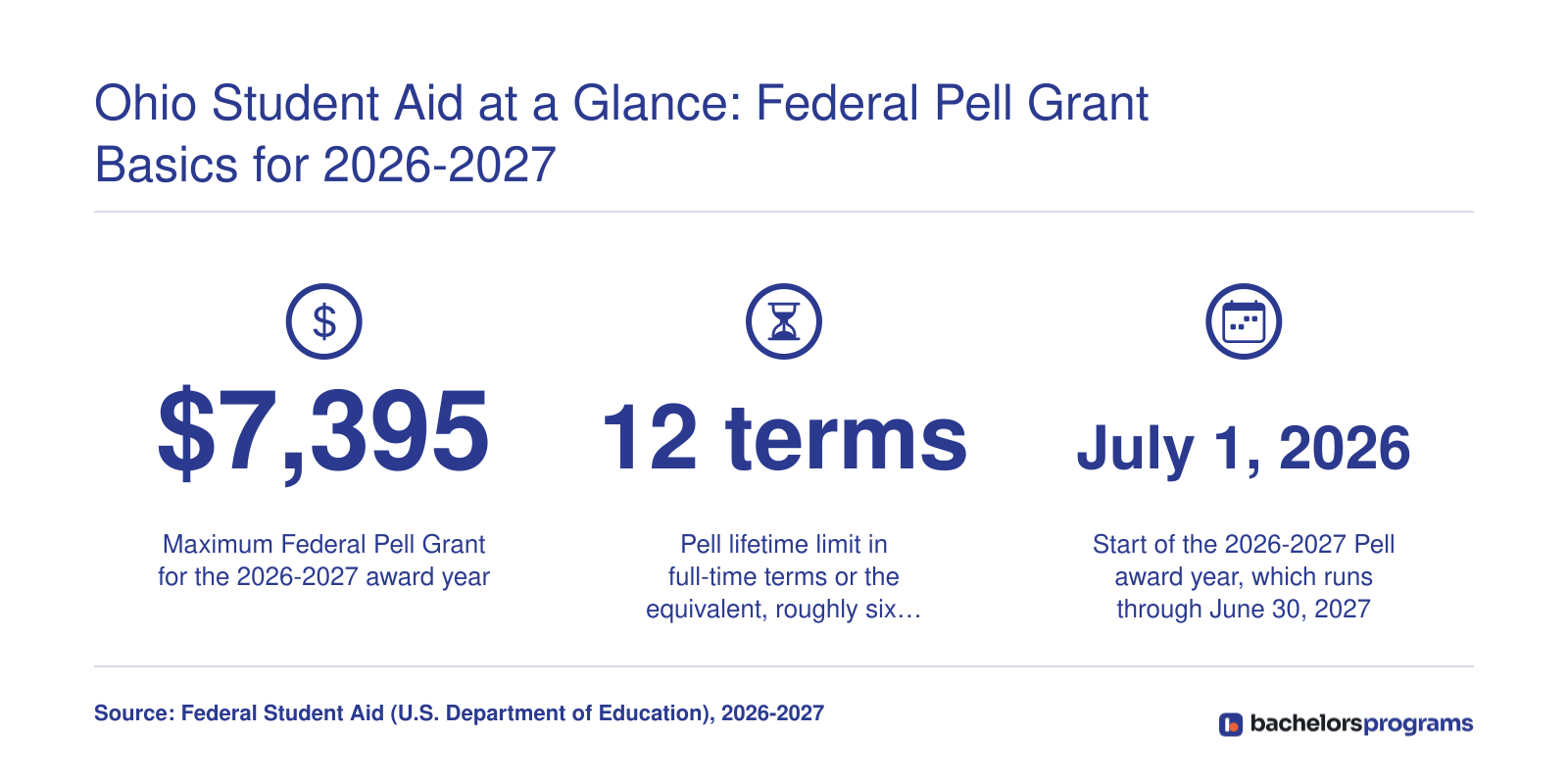
Ohio Student Aid at a Glance: Federal Pell Grant Basics for 2026
For Ohio students in an online bachelor's program, the Federal Pell Grant is the starting point for grant aid. Your actual award depends on your Student Aid Index, your school's cost of attendance and whether you enroll full- or part-time. The Pell maximum, Ohio College Opportunity Grant amounts and Ohio's state aid deadlines are reset every award year, so confirm current figures with Federal Student Aid, the Ohio Department of Higher Education and your school's financial aid office before you file the FAFSA.
Transfer Credits and Online Degree-Completion Pathways in Ohio
Transferring credits saves real time and money, but a credit that transfers is not always a credit that counts toward your major. Ohio's statewide framework makes the first part easier. The second part still takes a careful review at each school.
Ohio's Statewide Transfer Framework
Ohio Transfer 36 is a block of 36 to 40 semester hours of general education that moves among Ohio public colleges and universities. It includes at least 3 hours of English composition, 3 of math, statistics or logic, 6 of arts and humanities, 6 of social and behavioral sciences, and 6 of natural sciences.
Transfer Assurance Guides (TAGs) work course by course. They guarantee that foundational, pre-major courses transfer and apply to comparable programs, provided you meet the course and grade conditions. Career-Technical Assurance Guides (CTAGs) can award credit for approved high school or career-center technical pathways, though that credit may not satisfy every bachelor's requirement.
These guarantees cover transferability. A receiving program can still require specific courses, extra general education, or major prerequisites.
How Many Credits Can You Transfer?
There is no single Ohio-wide cap. Each school sets its own limits on accepted credits, upper-division coursework, grade minimums and course age. Typical policies limit how much can come from two-year colleges and require a minimum number of credits earned at the degree-granting school.
Ohio University's 2026 catalog shows what a residency rule looks like. Bachelor's students must earn at least 30 semester credit hours while enrolled there, and OHIO Online courses count. At least 50% of the coursework for each major concentration, minor or certificate must also be completed in residence. Other schools set their own numbers, so ask for a written credit evaluation before you apply.
Associate-to-Bachelor's and Completion Routes
Students with an associate degree often enter a bachelor's program as juniors. Many online degree-completion programs are built for this, so finishing in about two years of full-time study is common, provided your credits apply to the major. Completing Ohio Transfer 36 at a community college first is a practical way to protect your general education credit.
Prior Learning Credit
Some credit can come from outside the classroom:
- Military training: Ohio's MTAGs cover qualifying military training, experience and coursework, including ACE-recognized learning and Community College of the Air Force credit.
- Exams: CLEP is one option, and DSST is another at schools that accept it. Credit depends on the exam and the school's policy.
- Portfolios and certifications: Some schools review portfolios or industry certifications, but policies vary widely.
How Long Will It Take?
Starting from scratch, a bachelor's degree takes roughly four years of full-time study. Many completion students finish in 18 to 24 months, depending on how many credits transfer. Accelerated terms of 5 to 8 weeks can shorten the timeline further, since you can fit in more courses per year.
Asynchronous, Synchronous and Hybrid: Comparing Online Formats
The flexibility that draws many students to online study can shrink quickly once a program adds live sessions, proctored exams or in-person placements. Before you compare tuition, check which format a program actually uses, because the label alone does not tell you.
Asynchronous Programs
Asynchronous courses let you work through lectures and assignments at your own pace, provided you meet weekly or term deadlines. Ohio University describes its online undergraduate degrees as asynchronous, and Cleveland State University says its online programs are offered primarily asynchronously.1 "Primarily" matters here. It does not guarantee that every activity is self-paced, so ask whether a given program schedules live meetings, group work or timed exams.
Synchronous and Hybrid Formats
Synchronous courses meet online at set times. Hybrid models add some on-campus time. Joyce University's Ohio nursing programs show the mix: depending on the course, delivery may be synchronous or asynchronous, and the program includes three on-campus immersion experiences and three start dates a year.2
What to Compare Before You Apply
- Schedule: Asynchronous suits work and family commitments best. Synchronous requires you to be available at fixed times.
- Residency: Ohio University's eCampus degrees are presented as fully online, but hybrid programs such as Joyce's require campus visits. Confirm travel expectations in writing.
- Proctoring: At Ohio University, proctoring depends on the course and instructor. Where it is enabled, Proctorio lets you test on your own device, and from July 1, 2026 the student-paid fee is $3 per exam.
- Starts and terms: Start dates vary by school. Joyce lists three a year, while Cleveland State's Accelerated BSN admits twice a year.1 Ask each school about term length and accelerated options, since the sources reviewed here do not confirm them for every program.
Clinicals and Field Placements
Nursing, education and social work programs often require in-person clinicals, student teaching or field placements even when the coursework is asynchronous. Cleveland State's Accelerated BSN is a useful benchmark: 69 credit hours, 734 clinical hours, 201 lab hours, two residency experiences and a 16-month, four-semester full-time structure. That reflects one nursing program, not every online degree, so do not assume the same load elsewhere.
If your field involves licensure, ask who arranges your placement, whether it must be near campus, and whether you can complete it while working. Those answers often decide whether an online program is workable.
Admissions Requirements and Deadlines for Ohio Online Programs
Requirements vary by school and program, so check each university's own pages. Ohio University and Ohio State publish detailed 2026 online admissions rules, which make useful benchmarks.
- First-time studentsSubmit a high school transcript or GED. Ohio University Online is test-optional: ACT and SAT scores are not required, but you may send them. It sets no fixed minimum GPA and reviews class rank, coursework, work experience and talent together.
- Transfer and adult studentsAt Ohio University, you count as a transfer student once you have more than 9 semester (12 quarter) hours after high school. You need at least a 2.0 cumulative GPA to be considered, and the application fee is $50. If you have fewer than 20 semester hours, send your high school transcript too.
- Rolling admission and start datesOhio University Online admits on a rolling basis for fall, spring and summer. Priority dates are June 15, November 15 and March 15, and official transcripts are due about two weeks later. Confirm that your program starts in the term you want.
- Selective programs such as nursingRN-to-BSN programs add licensure rules. Ohio University requires: - an active, unencumbered RN license - an associate degree or nursing diploma - a 2.0 GPA - the equivalent of ENG 1510 Ohio State requires an active, unrestricted license. Its November 30, 2026 deadline is for the March 3, 2027 start.
- Documents to gatherPrepare these before you apply: - your FAFSA - official transcripts from every college you attended - military records if you have service credit - proof of Ohio residency if you are claiming in-state rates At Ohio University, transfer students seeking merit scholarships must apply for fall and be admitted by May 15.
Licensure and State Authorization for Ohio Online Students
Graduation Rates, Career Outcomes and Whether Employers Respect Online Degrees
A graduation rate tells you what share of students finish within a set window; a retention rate tells you what share come back after their first year. Read together, they are the closest thing to a public track record an online program has, even though both measures come with real caveats.
What the Ohio Numbers Show
College Scorecard's latest release reports a 69% graduation rate at Ohio University, against a 59% midpoint for four-year colleges, drawn from a cohort of roughly 14,070 students.1 Cleveland State University's most recent IPEDS-based figures show 69% retention, a 31% four-year graduation rate and 49% at six years. A gap that wide between the four-year and six-year numbers is common at urban public universities, where students often study part time, stop out for a term, or transfer in with credits that reset the clock.
The definitions matter when you compare schools. Scorecard now counts a student as graduated if they finish at the same institution within eight years, regardless of enrollment status or earlier college experience, so its rate is not directly comparable to a four-year IPEDS figure.2 Retention numbers for four-year schools cover bachelor's-seeking students and report full-time and part-time students separately.2 Part-time and transfer students are exactly the population online programs serve, so ask an admissions office how its online cohort specifically performs instead of leaning on the all-student number.
Do Employers Care Whether a Degree Was Online?
Rarely in the way applicants worry about. Diplomas from accredited Ohio universities generally do not distinguish online from on-campus study, and a transcript shows the institution and the coursework, not the delivery format. Hiring managers tend to weigh regional accreditation, the school's reputation in the field, and whether the program included an internship, clinical placement or capstone project. College Scorecard lists median earnings of $70,528 for Ohio University graduates, an institution-level outcome for federal aid recipients rather than a statewide average for every bachelor's holder in Ohio.1
Weigh Cost Against Earnings
Judge return on investment on total net cost rather than sticker price, and measure it against the extra earnings a degree delivers over a career. Two applicants can pay very different amounts for the same credential depending on transfer credits and aid, which is why net price and transfer pathways matter as much as any graduation statistic.
Ohio Bachelor's Degree Earnings Premium
A bachelor's degree is tied to a clear earnings advantage for Ohio workers.
How to Choose the Right Ohio Online Program
Pick an Ohio online program by credit acceptance and verified accreditation first, and let everything else follow. A polished website and a low advertised rate mean little if the school discards half of your coursework or the degree does not lead where you need to go.
Priority Order
Work through your options in this sequence:
- Accreditation and licensure fit: Confirm regional accreditation, then check any program-specific accreditation or licensure requirements for your field. This is the one factor you cannot fix later.
- Total net cost after transfer credit: Judge each school by what you will pay for the credits you still need, not by the headline tuition figure.
- Format fit: Decide whether asynchronous, scheduled or hybrid delivery matches your work and family life.
- Student support: Look at advising, career services and tech support, since online students lean on these more than they expect.
Your Next Step
Before you apply anywhere, request an unofficial transfer credit evaluation from two or three schools. Then feed those credit counts into each college's net price calculator. Put the results side by side. The differences are often larger than the gap between sticker prices.
Final Checklist
- Per-credit rate and all fees verified in writing or on the school's bursar page
- FAFSA filed so you are considered for the Ohio College Opportunity Grant (OCOG)
- Transfer credits confirmed in writing, not just by phone
- Format, exam proctoring and any on-campus requirements understood
- Start date chosen, with aid and registration deadlines in mind
The cheapest Ohio online bachelor's is usually the one that accepts the most of your existing credits.
Colleges in Ohio with the most bachelor's programs
| School | City | Type | Bachelor's programs | Online | Net price / yr | Grad rate |
|---|---|---|---|---|---|---|
| University of Cincinnati | Cincinnati | Public | 112 | 27 | $25,648 | 75% |
| Kent State University | Kent | Public | 111 | 23 | $20,787 | 64% |
| Ohio University | Athens | Public | 107 | 18 | $21,637 | 66% |
| Ohio State University | Columbus | Public | 102 | 4 | $17,339 | 88% |
| Bowling Green State University | Bowling Green | Public | 100 | 7 | $24,022 | 64% |
| Miami University | Oxford | Public | 97 | 6 | $28,384 | 80% |
| University of Toledo | Toledo | Public | 97 | 16 | $17,249 | 57% |
| University of Dayton | Dayton | Private nonprofit | 82 | 0 | $29,533 | 80% |
| Youngstown State University | Youngstown | Public | 81 | 19 | $12,767 | 51% |
| University of Akron | Akron | Public | 80 | 18 | $13,946 | 52% |
| Cleveland State University | Cleveland | Public | 78 | 5 | $14,764 | 51% |
| Xavier University | Cincinnati | Private nonprofit | 76 | 1 | $32,997 | 69% |
| Wright State University | Dayton | Public | 70 | 3 | $15,415 | 42% |
| Case Western Reserve University | Cleveland | Private nonprofit | 66 | 0 | $41,190 | 87% |
| Mount Vernon Nazarene University | Mount Vernon | Private nonprofit | 65 | 19 | $22,421 | 68% |
Program counts are the verified bachelor's listings in our directory; net price is the school-wide average a first-time undergraduate paid after aid, and graduation rate the share finishing within six years (College Scorecard).
Compare programs nationwide
Many Ohio residents study online. Every ranked list above has an online lens, or browse every field.
Online bachelor's degrees Browse all fields