Best Bachelor of Social Work (BSW) Programs
Compare 650+ accredited Bachelor of Social Work (BSW) programs at 580+ colleges, with net price after aid, graduation rates, earnings and debt from IPEDS and the U.S. College Scorecard.

In social work, the price of a degree says little about what it delivers. Among the schools here, average net price after aid runs from $1,300 to $19,857 a year, while first-year earnings for completers sit in a narrow band, $35,345 to $42,925.
That gap makes cost and completion the real filters. Programs come online, hybrid, and on campus, but every format ends in supervised field hours, so flexibility only goes so far.
Cheaper does not mean weaker, and pricier does not mean better paid. The BSW's real value is licensure eligibility and a shortcut into an MSW.
Key Points
- Texas A&M University-Central Texas carries an average net price of $1,300.
- Cal State Long Beach BSW completers lead first-year median earnings at $42,925.
- Forty states, plus D.C. and three territories, license bachelor's-level social workers.
The 10 Best BSW Programs Ranked for 2027
Every school below had to show it delivers a social work degree students can afford, finish, and put to work in the field. Past that bar, the ten split sharply on delivery: some teach the whole degree online or in a hybrid format, while others keep classes on campus and route students into nearby agencies for the practicum. Read the format and the program notes on each card for credit counts, admission thresholds, and placement hours before you shortlist.
World Mission University
#1Los Angeles, CA · ~$16,000/yr (est.)
Best for: Christian students exploring social services
World Mission University is a small Christian institution in Los Angeles, and its social work degree carries that identity throughout: a Bachelor of Arts built on 126 credits, including 30 in Bible and theology alongside 27 in social work. Coursework covers human behavior, social welfare policy, multicultural practice, and research methods, and students complete two field practicums before graduating. The school graduates 71% of its students, and the cohort here is intentionally small, so advising stays personal.
- 126 semester credits over four years
- 39 general education credits plus 30 Bible and theology credits
- 27 social work credits and 10 field education credits
- Two required field practicums
- Minimum 2.0 GPA; transfer credits accepted
- 42 credits must be completed at WMU
- Emphasis on multicultural practice and social welfare policy
- Prepares students to continue into graduate study
University of Illinois Urbana-Champaign
#2Champaign, IL · ~$14,000/yr (est.)
Best for: Online learners wanting a research university
The University of Illinois Urbana-Champaign runs a CSWE-accredited BSW both on campus and online, which makes it one of the few major research universities on this list that a distance learner can actually use. The degree covers social work theory, human behavior, social policy, research methods, and a field practicum, with 120 credits required and 60 of them completed at Illinois. The school graduates 85% of its students, and about 93% of BSW graduates report being employed or enrolled in graduate school after finishing.
- CSWE accredited
- 120 total credit hours; 60 completed at Illinois
- Field practicum built into the degree
- About 93% of graduates employed or in graduate school
- 2.5 GPA minimum plus social service experience
- Online and on-campus delivery options
- Pathway to MSW advanced standing
- Coursework in policy, research methods, and human behavior
Texas A&M University-Central Texas
#3Killeen, TX · under $5,000/yr (est.)
Best for: Child welfare workers seeking stipend support
Texas A&M University-Central Texas in Killeen is a public university built around transfer students, and its CSWE-accredited BSW reflects that: 120 credits, transfer pathways from community colleges, and advisor guidance from the point of admission. The child welfare concentration comes with a Title IV-E Child Welfare Stipend, which supports students heading into protective services, adoption, and family support work. Placements happen in public social service agencies, and the program prepares graduates for licensure and entry-level generalist practice.
- CSWE accredited
- 120 total credit hours
- 2.5 GPA minimum for admission
- Three application deadlines per year
- Generalist practice framework
- Transfer pathways from community colleges
- Prepares students for social work licensure
- Child Welfare concentration
- Title IV-E Child Welfare Stipend available
- Placements in public social service agencies
- Prepares for child protective services and adoption work
- Active Phi Alpha honor society chapter
University of Central Florida
#4Orlando, FL · ~$10,000/yr (est.)
The University of Central Florida in Orlando runs its CSWE-accredited BSW as a limited-access major, so students apply after roughly two years of prerequisites and enter a cohort that includes a required internship in a community agency. Electives stretch across child welfare, addictions, aging, health services, immigration, and LGBTQ populations, letting students shape the degree toward a practice area. The school graduates 78% of its students, and the curriculum leans on social justice, human rights, and culturally responsive practice with individuals, families, groups, and communities.
- CSWE accredited
- Limited-access major; apply after the second year
- 2.5 GPA minimum
- Prerequisites include biology, psychology, sociology, and government
- Required internship in a community agency
- Electives in child welfare, addictions, aging, and immigration
- Emphasis on social justice and culturally responsive practice
Ohio State University
#5Columbus, OH · $17,000/yr (est. net price)
Ohio State's social work bachelor's is the online route into a large public research university, delivered mostly asynchronously with a few evening live classes and a final-year field placement arranged near the student's own community. Students enter with 30 to 90 prior credits and finish the 120-credit degree in about two years, which suits transfer students and working adults. The school graduates 88% of its students, and the program prepares graduates to sit for the licensure exam and to pursue an MSW with advanced standing.
- CSWE accredited
- 120 total credit hours
- Online coursework with a few evening live classes
- 400-hour in-person field placement near your community
- Enter with 30 to 90 credits; 2.0 GPA minimum
- Full-time and part-time options; about two years to finish
- Prepares for the licensure exam and MSW advanced standing
- Multiple start dates each year
The University of Texas at Austin
#6Austin, TX · ~$20,000/yr (est.)
UT Austin's BSW is a 122-credit professional degree that starts service learning in the first semester and ends with a 400-hour practicum supervised by licensed social workers. The extras set it apart: an honors research program, Go Global study abroad, and SWEEP mentoring for first-year students. The school graduates 89% of its students, and the degree doubles as a foundation for graduate study in law, public health, or medicine.
- CSWE accredited
- 122 total credit hours
- 400-hour practicum supervised by licensed social workers
- Service learning begins in the first semester
- Honors research program for BSW students
- Go Global study abroad options
- SWEEP mentorship for first-year students
- Prepares for licensure and direct entry into human services
CUNY Hunter College
#7New York, NY · ~$3,000/yr (est.)
Hunter College's Silberman School of Social Work runs a practice-based BSW on a cohort model, with two years of field practicum at 14 hours a week in New York City agencies. Students choose between Child Welfare and Care Coordination concentrations, and the program is built to feed directly into frontline agency work or an MSW. The school graduates 57% of its students overall, and the cohort structure plus scholarship and work-study support help students stay on track.
- CSWE accredited
- Concentrations in Child Welfare and Care Coordination
- Cohort-based structure with student-led events
- Two years of field practicum, 14 hours per week
- 2.8 GPA minimum; two letters of recommendation
- Fall start; apply by March 30
- Scholarships and work-study support available
- Transfer students apply to Hunter first
University of South Florida
#8Tampa, FL · ~$10,000/yr (est.)
USF offers the social work bachelor's in two forms: a Tampa campus cohort and a Sarasota-Manatee online cohort that mixes live and self-paced classes, both running four semesters in lockstep. The final semester is a 460-hour in-person placement, and a Child Welfare Certification Pathway is available for students aiming at that field. The school graduates 77% of its students, and graduates can move into an MSW with advanced standing.
- CSWE accredited
- Four-semester, lock-step program; 41 credit hours
- Tampa campus cohort or Sarasota-Manatee online cohort
- Synchronous and asynchronous online coursework
- 460-hour in-person field placement in the final semester
- Child Welfare Certification Pathway available
- Distance learning fee of $30 per credit
- Background check required before placement
Florida International University
#9Miami, FL · ~$9,000/yr (est.)
FIU's social work bachelor's centers on urban practice in Miami, with two supervised internships at community partners such as clinics, schools, and nonprofits, and small classes throughout. The upper-division curriculum covers ethics, human rights, mental health, child welfare, and policy, and optional public health coursework lets students sharpen a specialty. The school graduates 74% of its students, and eligible graduates can fast-track into FIU's MSW advanced standing program.
- CSWE accredited
- 60 upper-division credit hours
- Two supervised internships with community partners
- Small classes and personalized advising
- Bonus public health coursework
- Advanced standing into FIU's MSW
- Practice focus on urban communities
California State University-Long Beach
#10Long Beach, CA · $7,000 – $20,000/yr (est.)
Cal State Long Beach runs its BASW as a two-year upper-division program with daytime and evening schedules, which suits transfer students and working adults across the Los Angeles area. Fieldwork is built in twice: an 80-hour placement in the junior year and a 450-hour senior placement in a community agency. The school graduates 69% of its students, and the degree prepares graduates for entry-level practice, case management, or an MSW with advanced standing.
- CSWE accredited
- Two-year upper-division program starting in fall
- 80-hour junior placement and 450-hour senior field work
- Daytime and evening schedules
- 2.5 GPA minimum; two letters of recommendation
- Prerequisites include biology, psychology, and statistics
- Prepares for MSW advanced standing
Cost & outcomes by school
Federal data for the highest-earning Bachelor of Social Work (BSW) programs, independent of the ranking above. Earnings are this field's bachelor's graduates four years after completing where the Scorecard reports them, else the school's undergraduate median.
| School | Net price / yr | Grad rate | Earnings | Debt | Grads/yr | Format |
|---|---|---|---|---|---|---|
| University of Southern California CA | $32,740 | 92% | $92,498 | $18,000 | 11,988 | Campus |
| University of California-Berkeley CA | $13,481 | 93% | $92,446 | $13,000 | 22,468 | Campus |
| University of Portland OR | $28,210 | 80% | $82,804 | $21,370 | 1,716 | Campus |
| New York University NY | $37,050 | 88% | $82,509 | $20,500 | 16,368 | Campus |
| University of Illinois Urbana-Champaign IL | $14,355 | 85% | $81,054 | $19,500 | 19,784 | Campus |
| Binghamton University NY | $21,620 | 82% | $80,596 | $18,500 | 8,166 | Campus |
| San Jose State University CA | $13,760 | 69% | $78,988 | $15,000 | 12,936 | Campus |
| University of Washington-Seattle Campus WA | $14,091 | 85% | $78,466 | $14,615 | 19,444 | Campus |
| University of Washington-Tacoma Campus WA | $10,163 | 63% | $78,466 | $14,615 | 2,728 | Campus |
| George Mason University VA | $17,915 | 68% | $76,343 | $19,500 | 12,566 | Campus |
| The University of Texas at Austin TX | $19,857 | 89% | $75,121 | $20,500 | 21,946 | Campus |
| Stony Brook University NY | $18,784 | 76% | $74,502 | $18,228 | 10,526 | Campus |
Sources: U.S. Department of Education. Net price, graduation rate, earnings and debt: College Scorecard (earnings and debt for this field's bachelor's graduates where reported, else school-wide); graduates: IPEDS. A dash means no figure is reported.
Cost, debt & payoff
Median earnings of this field's bachelor's graduates (4 yrs after completing, else the school's undergraduate median) vs. their median federal loan debt · U.S. College Scorecard
Across these programs the median graduate earns about $53,755 and finishes with roughly $22,750 in debt — a ratio that clears a common rule of thumb (keep debt below first-year salary). Net price and debt vary widely school to school, so check the per-school figures in the table above before you shortlist.
Behind the List: The Cost, Completion, and Outcome Data Weighed
A BSW program's real cost is the net price a typical student pays after grants and scholarships, not the published tuition. That figure, along with completion and earnings data, tells you more than a prestigious name.
The Numbers That Matter
Average net price is what a typical student actually pays after aid. The institution-wide graduation rate shows whether students who start actually finish, and retention shows whether they return for year two. The federal College Scorecard adds the payoff side: what social work graduates earn a few years out and how much they borrowed. Admissions selectivity gives context for how demanding a program is, but it is not a quality score by itself.
Where the Data Stops
Most of these figures are school-wide averages, so they describe the institution as much as the BSW. Earnings appear only where enough graduates report, which means some programs have no usable number. Read a gap as a gap, not as a zero.
What Makes a BSW the Best Fit
The best BSW program for you combines three things: CSWE accreditation, a net price you can carry without ruinous debt, and a completion rate that suggests students finish. Prestige matters less than those basics. Accreditation is a gatekeeper, not a bonus: without it, state licensure and advanced-standing master's pathways can close.
BSW Tuition Comparison: Where Net Price Lands Lowest
Published in-state tuition and fees at these three public universities sit near $7,400 a year, and out-of-state rates run from $15,332 to $17,154. The average net price after grants and scholarships drops to $1,300 at Texas A&M University-Central Texas and to about $3,000 at the two CUNY campuses. Private schools often post higher sticker prices but can narrow the gap through institutional aid, so compare net price, not tuition alone. Federal aid also helps. The maximum Federal Pell Grant for 2026-27 is $7,395. Graduates who work full time for a government agency or a 501(c)(3) nonprofit can pursue Public Service Loan Forgiveness on their Direct Loans after 120 qualifying payments, and those payments do not have to be consecutive. Ask each program about scholarships (Hunter advertises them). Net price is an average across aided students, not a personal quote.
| School | Location | In-State Tuition and Fees | Out-of-State Tuition and Fees | Average Net Price | Median Graduate Debt |
|---|---|---|---|---|---|
| Texas A&M University-Central Texas | Killeen, TX | $7,363 | $17,154 | $1,300 | $17,750 |
| CUNY Hunter College | New York, NY | $7,382 | $15,332 | $2,984 | $11,000 |
| CUNY Lehman College | Bronx, NY | $7,410 | $15,360 | $3,148 | $10,950 |
Online, Hybrid, or On-Campus: Which BSW Format Fits?
Can you earn a BSW online without ever setting foot in an agency? The coursework, often yes. The field hours, no. Every format ends the same way: supervised practice in an agency.
How the Three Formats Compare
- Online: The most flexible schedule, and the usual choice for working adults. Online does not always mean asynchronous. UCF's online BSW requires a few live virtual practice-class meetings; Western Carolina holds synchronous video seminars; the University of Victoria builds synchronous sessions into SOCW 312A.
- Hybrid: Online coursework paired with set in-person days. Western Carolina's BSW field seminar meets Fridays in Cullowhee, and students are unavailable to field instructors during class.
- On-campus: A fixed weekly schedule, placements typically arranged through the school's existing agency relationships, and a cohort of mostly traditional-age students.
How Online Students Get Placed
Online students complete field hours at an approved agency in their own community. Programs generally use one of three models: school-arranged placement, a student-proposed agency, or employment-based placement. The last is conditional, usually allowed only when the work offers new learning distinct from your regular job duties and qualified supervision.
Many programs have a field coordinator who vets agencies, secures affiliation agreements, confirms insurance and supervisor credentials, and monitors your hours. Nothing starts until the program approves the site. Proximity is not guaranteed either. UCF arranges placements within a student's region, not necessarily the closest agency. Western Carolina requires approved distance students to complete at least one interview with an agency in Western North Carolina as a backup.
Watch for State Restrictions
Some online programs limit enrollment by state because of field placement logistics or authorization rules. Confirm your state is accepted before you invest time in an application.
Which Format Fits Whom
Transfer students with an associate degree often do best online or hybrid. They tend to be balancing work and family, and the flexibility matters most when general education credits are already done. Ask how many credits the program accepts and whether it offers a degree-completion pathway. First-time freshmen usually benefit from on-campus study: fixed structure, faculty access, and a school-placed field experience.
Related Articles
CSWE Accreditation and the 400-Hour Field Requirement
A school can claim it offers a BSW; CSWE listing that BSW as accredited is what counts. Most state licensing boards require a degree from a CSWE-accredited program, and MSW programs generally require one before they will grant advanced standing. A degree without it can limit both your license options and your shortcut to a master's.
How to Verify a Program
A school's own website, regional accreditation, or state authorization is not proof. The Council on Social Work Education's Directory of Accredited Programs (also called the Program Directory) is the record that matters.
- Search: Look up the institution name, program name, or a former name if the school has rebranded.
- Match the program: Confirm the BSW itself has a record, not just the university or its MSW.
- Read the status: Programs are listed as accredited or as candidacy. Candidacy means the program is working toward accreditation and does not yet have full accreditation, so ask the school how it plans to protect graduates if the outcome changes.
- Follow up: If you cannot find the program, CSWE says it may not be accredited. Contact CSWE directly to confirm.
The 400-Hour Field Requirement
Under the 2022 Educational Policy and Accreditation Standards, every BSW program must provide at least 400 hours of field education. Field seminar and simulated practice do not count toward that minimum, so the hours must come from a real practice setting. CSWE sets the floor, and many programs require more, so check each school's number.
Fitting the Practicum Into Your Schedule
Most programs place the practicum in the senior year, often across two semesters alongside a field seminar. Expect roughly 13 to 15 hours a week over that stretch, though schedules vary. Field hours are typically unpaid. Budget for reduced work hours, transportation, and possibly background checks or other placement costs, and ask early how the program supports students who hold jobs.
BSW Licensure by State and ASWB Bachelors Exam Pass Rates
Bachelor's-level social work licensure is a state credential that lets BSW graduates use a protected title and practice at the generalist level. Many states offer one. Forty states, plus D.C. and three territories, license at the bachelor's level, under titles such as LBSW (Alabama, Alaska, Arizona, Illinois, Texas, Oregon, Pennsylvania, Wisconsin), LSW (Arkansas, Nevada), or LSWA in D.C.1
Where Bachelor's Licensure Is Not Available
Ten states do not license social workers at the bachelor's level: California, Colorado, Connecticut, Florida, Georgia, Montana, New York, Rhode Island, Vermont, and Washington.2 Graduates there can still work in social services, but without a bachelor's-level license. Even where a license exists, scope of practice, supervision rules, and eligibility vary by jurisdiction, so confirm details with your state board before choosing a school.3
The ASWB Bachelors Exam
The Association of Social Work Boards (ASWB) administers the Bachelors exam, the standard test for bachelor's-level licensure. It measures entry-level knowledge across generalist practice areas, including human development, assessment, intervention, and professional ethics. Most licensing states require a passing score, usually alongside a CSWE-accredited degree.
ASWB's most recent published first-time pass rate for the Bachelors exam in Texas is 70.4%, from its 2025 summary covering 2,741 exams administered there. That means roughly three in ten first-time test-takers did not pass, so exam preparation matters. We found no separate 2026 figure.
School-Level Pass Rates and the Path to Clinical Practice
Pass rates for individual schools are rarely published. Ask each program directly what share of graduates sit for the exam and pass, and whether the curriculum includes exam prep. A school that tracks this will usually answer readily. A vague reply tells you something too.
Clinical practice sits beyond the bachelor's license. Diagnosing and treating clients independently requires an MSW plus supervised post-degree hours, which is why many BSW graduates look at advanced standing master's programs next.
An unaccredited BSW closes the door to licensure and advanced standing, so confirm CSWE accreditation before you compare tuition, format, or anything else on a program's page.
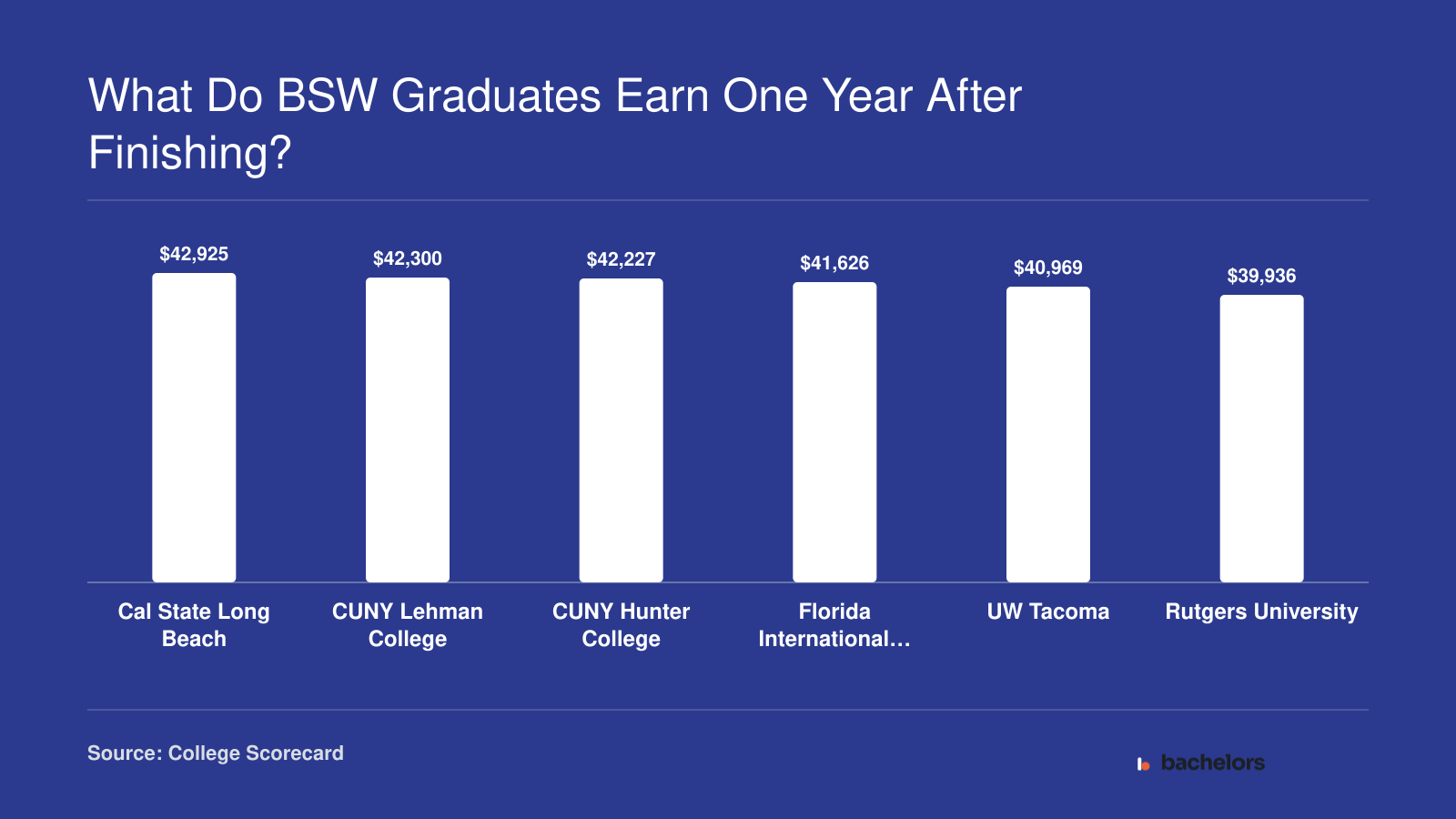
What Do BSW Graduates Earn One Year After Finishing?
These figures show median earnings one year after finishing the program, reported for the BSW itself at each school rather than for the university as a whole. Early-career pay is tightly clustered: Cal State Long Beach leads at $42,925 and Rutgers sits at $39,936, a gap of roughly $3,000. Because first-year salaries land so close together, net price and debt will usually separate these schools more than starting pay. Use this chart to confirm that a program's graduates find paid work, then compare cost.
Questions to Ask Yourself
Does your state license bachelor's-level social workers, or will practicing the way you want require an MSW?
Can your life absorb 400 or more unpaid field hours, and will the school help you land a nearby placement?
Do you plan to enter an advanced-standing MSW, and will your target BSW keep that door open?
Will your likely first job qualify for Public Service Loan Forgiveness?
Bachelor of Social Work (BSW) programs by state
Compare Bachelor of Social Work (BSW) programs on the data that matters
Explore more Social Work & Social Sciences majors or browse every field of study.
All Social Work & Social Sciences programs Browse every field of study