Online Colleges and Bachelor's Degree Programs in Vermont
Every verified bachelor's program at a college in Vermont: 330+ programs at 8 colleges, with the online options, net price and graduation rates behind each one.

Which Vermont colleges offer fully online bachelor's degrees? Fewer than most searchers expect, and the short list gets muddier once "online" turns out to mean hybrid, with required on-site hours or local clinical placements.
The main players are Vermont State University, Champlain College Online, the University of Vermont, and the Community College of Vermont, the low-cost on-ramp for students who finish a bachelor's later. All four hold NECHE accreditation.
What separates these options is format, per-credit cost, VSAC aid, CCV transfer rules, start dates and outcomes, not marketing. Residency matters less than it used to: Vermont State charges Online-Only students $402 per credit for 2026-27, in state or out.
Key Points
- At $402 per credit for 2026-27, Vermont State's online-only rate ignores residency.
- Champlain College Online accepts up to 90 transfer credits toward a bachelor's.
- Before enrolling, confirm NECHE accreditation, held by Vermont State, Champlain and UVM.
Popular degrees in Vermont
Bachelor's degrees in Vermont by field
Science & Engineering
- Biology7 programs
- Mathematics6 programs
- Environmental Science5 programs
- Geosciences5 programs
- Chemistry5 programs
- Natural Resources or Conservation5 programs
- Anthropology4 programs
- Engineering Technology4 programs
Business & Management
- Business Administration11 programs
- Marketing6 programs
- Human Resource Management or HR Management5 programs
- Accounting4 programs
- Finance3 programs
- International Business3 programs
- Analytics3 programs
- Economics3 programs
Arts & Design
- Art or Art Studies8 programs
- Media Arts or Digital Media5 programs
- Fine Arts or Studio Art5 programs
- Audio & Music4 programs
- Art History4 programs
- Graphic Design3 programs
- architecture or architectural3 programs
- Creative Writing2 programs
Liberal Arts & Humanities
- History7 programs
- Literature or English Literature6 programs
- English5 programs
- Spanish4 programs
- Philosophy3 programs
- Global Studies3 programs
- Gender & Sexuality Studies2 programs
- Humanities1 program
Education & Teaching
- Science8 programs
- Elementary Education5 programs
- Secondary Education5 programs
- Special Education4 programs
- Physical Education3 programs
- Early Childhood Education or Child Development2 programs
- English Education1 program
- History Education1 program
Computers & IT
- Computer Science7 programs
- Computer Information Systems4 programs
- Cybersecurity3 programs
- Software Development & Engineering2 programs
- Information Technology2 programs
- Data Analytics2 programs
- Artificial Intelligence1 program
- Web Development1 program
Healthcare
- Health Sciences5 programs
- Exercise & Sports Science3 programs
- Nutrition3 programs
- Public Health3 programs
- Health Education2 programs
- Speech Pathology1 program
- Community Health1 program
Social Work & Social Sciences
- Sociology8 programs
- Political Science, Government5 programs
- Social Work3 programs
- Human Services1 program
Communications & Media
- Journalism7 programs
- Communications6 programs
- Public Relations1 program
- Communication Disorders1 program
- Speech Pathology1 program
- Strategic Communications1 program
Criminal Justice & Law
- Criminology4 programs
- Criminal Justice3 programs
- Corrections1 program
- Criminal Justice Administration1 program
- Legal Studies1 program
- Fire Science or Fire Administration1 program
Psychology
- General Psychology4 programs
- Applied Psychology2 programs
- Forensic Psychology1 program
Nursing
- Bachelor of Science in Nursing3 programs
- Nursing (RN to BSN)2 programs
- Accelerated BSN (ABSN)1 program
Natural & Applied Sciences
- Agriculture or Agricultural1 program
- Neuroscience1 program
Which Vermont Colleges Offer Fully Online Bachelor's Degrees?
Most people searching for online colleges in Vermont want flexibility, but "online" means three different things depending on which college you ask. The institution that fits you depends less on the label in its marketing than on how much of the degree you can actually finish without driving to a campus.
Vermont State University
Vermont State Online defines online coursework as classes taught fully online, and its catalog places purely online bachelor's degrees next to others labeled "Also available online" and still others scheduled in person or in person-plus at Castleton, Johnson, Lyndon and Randolph. Professional Studies, B.S. is described as fully online, with start dates running from August 2026 through May 2027, and Vermont State also runs online completion degrees in nursing, dental hygiene, early childhood education and applied business for students who already hold technical credits. Because the same degree can appear in several formats, confirm the modality on the program page, not the university page.
Champlain College Online
Champlain's online division is built for adult learners and spans associate degrees, bachelor's degrees and certificates. Several of its bachelor's degrees, Integrated Studies, Data Science and Artificial Intelligence, Finance, and Criminal Justice, are listed as 100% online, generally at 120 credits and roughly 40 months at two courses per term, with up to 90 transfer credits accepted in Criminal Justice. Online undergraduate tuition for Fall 2026 through Summer 2027 is $342 per credit, or $1,026 for a three-credit course.
UVM and CCV
UVM's online and continuing education offerings sit inside a much larger campus catalog, so program-level format needs checking. CCV awards associate degrees and certificates; treat it as the launch point into a bachelor's completion, not a bachelor's grantor.
Three formats, one question
- Fully online: no required campus visits.
- Mostly online: online courses plus required labs, clinicals or practicums.
- Campus program with online courses: a residential degree that happens to offer some classes remotely.
Fully Online vs. Hybrid: What to Verify Before You Apply
An "online" label can mean anything from 100% remote coursework to online classes paired with required on-site hours, and nursing, dental hygiene and education programs typically require local clinical, practicum or classroom placements even when every course is online. Before you apply, ask admissions four questions: Are any sessions synchronous (live at set times)? Are there on-site requirements such as clinicals, labs, practicums, student teaching, internships, residencies or proctored exams? Will the school help arrange placements near your home? Is the program authorized to enroll students in your state if you live outside Vermont? The table below draws only on official program pages; where a page does not spell out in-person elements, confirm directly with the school.
| Institution | Program Area | Delivery Format | In-Person Requirements |
|---|---|---|---|
| Vermont State University | Nursing: Online Degree Completion, B.S.N. (RN-to-BSN) | All theoretical coursework online; can be completed in 18 months | Yes: 225 hours of precepted nursing experiences, which may be completed where the student works |
| Vermont State University | Dental hygiene: Online Degree Completion, B.S. | Available online | Not specified on program page; ask admissions about any clinical or on-site components |
| Vermont State University | Education: Early Childhood Education Online Completion, B.S. | Online program | Not specified on program page; ask admissions about practicum or field placement requirements |
| Vermont State University | Business: Applied Business Degree Completion, B.S. | Online program | Not specified on program page; confirm with admissions |
| Vermont State University | Psychology: Psychological Science, B.A. | Also available online | Not specified on program page; confirm with admissions |
| Champlain College Online | Integrated studies: Integrated Studies Bachelor's Degree | 100% online | Not specified on program page; confirm with admissions |
| Champlain College Online | Business management: Business Management Bachelor's Degree | 100% online | Not specified on program page; confirm with admissions |
| Champlain College Online | Psychology: Applied Psychology Bachelor's Degree | 100% online | Not specified on program page; confirm with admissions |
Accreditation for Online Bachelor's Programs in Vermont
Institutional accreditation is the first thing to confirm, and in Vermont it usually means NECHE. Vermont State University, Champlain College, the University of Vermont and the Community College of Vermont all hold accreditation from the New England Commission of Higher Education.1 An online bachelor's degree from one of these schools carries the same institutional accreditation as the same degree earned on campus. That matters because institutional accreditation is what makes a school eligible for federal financial aid and what most graduate schools and employers expect.
Where Program Accreditation Matters
Programmatic accreditation sits on top of institutional accreditation and is specific to a field. Nursing is the clearest example. ACEN and CCNE are the two main nursing accreditors, but Vermont State University's online RN-to-BSN holds continuing accreditation from NLN CNEA. The program is designed for students who already hold an RN license and an associate degree in nursing. If you compare online RN-to-BSN options, confirm which body accredits the specific track.
For dental hygiene, CODA is the relevant accreditor. For teacher licensure, ask whether the program is approved by the Vermont Agency of Education and leads to the endorsement you need. In business, ACBSP and AACSB are the recognized programmatic accreditors. Do not assume a business degree holds either one just because the college is regionally accredited.
Verify in Two Steps
- Check the NECHE directory: confirm the institution's current accreditation status and any recent review activity.
- Check the programmatic accreditor's directory: search ACEN, CCNE, NLN CNEA, CODA, ACBSP, AACSB or the Vermont Agency of Education for the specific program.
Be cautious with out-of-state online schools that market heavily to Vermonters. Ask whether the school is authorized to enroll Vermont residents, often through NC-SARA, and confirm that the specific program holds the accreditation your license or employer requires.
Online Tuition per Credit at Vermont Colleges (2026)
Vermont's public online tuition has moved away from the in-state discount: Vermont State University now publishes one per-credit rate whether a student lives in Vermont or not, and Champlain College Online does the same. That matters for adult learners comparing degree-completion costs: once mandatory fees are added, the gap between public and private online pricing in Vermont is narrower than sticker prices suggest.
Published Per-Credit Rates, 2026
- Vermont State University (online-only undergraduate programs): $402 per credit for Vermont residents, $402 per credit for non-residents.
- Champlain College Online (undergraduate): $342 per credit for Vermont residents, $342 per credit for non-residents.
- University of Vermont and Community College of Vermont: online and continuing-education study is priced on separate schedules, so confirm the current per-credit rate with each bursar's office before you build a budget.
Every rate above is a published academic-year figure as of fall 2026.
Fees Stay Separate
Vermont State University adds a $31-per-credit online technology fee on top of tuition, which brings the effective rate to $433 per credit. That is roughly 8 percent above the tuition line, and it compounds across a full year of study. Champlain's published per-credit tuition is the basis for its degree-completion estimate below. Ask the admissions office whether a per-term online or student services fee applies to your start term, since those are usually billed separately from tuition.
The 60-Credit Comparison
The degree-completion comparison below assumes 60 upper-division credits, the typical remainder of a bachelor's degree after an associate degree. Method: multiply the per-credit rate by 60, then add mandatory per-credit online fees.
- Vermont State University: $402 x 60 = $24,120 in tuition, plus $31 x 60 = $1,860 in online technology fees, for about $25,980.
- Champlain College Online: $342 x 60 = $20,520 in tuition, with any per-term fees confirmed separately.
Champlain comes in about $5,460 below Vermont State on that basis. Both totals assume continuous enrollment at the published rate, and either school can revise tuition annually, so treat them as planning figures rather than a locked quote.
Do Vermont Residents Pay Less for Online Programs?
It depends on the school. Residency does not uniformly lower online tuition in Vermont.
- Vermont State University: Online-Only programs charge Vermont and out-of-state students the same $402 per credit for 2026-27. Programs outside that schedule may use other rates, so confirm yours.
- Community College of Vermont: There is no online exception. In-state tuition is $290 per credit, and out-of-state students pay $399 unless they qualify for residency, which requires one continuous legal year in Vermont, or for a regional program.
- University of Vermont: Residency is set at admission and rarely changes. The 2026-27 cost materials list out-of-state tuition of $46,655 plus a $3,058 comprehensive fee, and they do not show a universal in-state online undergraduate rate.1
- Champlain College Online: As a private college, it charges one rate regardless of residency, so Vermont residents get no in-state discount.
Net Price Matters More Than Sticker Price
Net price is the per-credit rate multiplied by the credits that remain, minus grants and any employer tuition assistance. Transfer credits help most because they shrink the credit count itself.
A Worked Example
Take a Vermonter pursuing the Professional Studies, B.S. at Vermont State, using the 2026-27 rates above and leaving out fees.
- Starting all 120 credits at the Online-Only rate: 120 x $402 = $48,240.
- Completing 60 credits at CCV, then 60 online at Vermont State: (60 x $290) + (60 x $402) = $17,400 + $24,120 = $41,520.
That is about $6,720 less, and it assumes every CCV credit transfers into the program. A student who does not qualify as a Vermont resident would pay $399 per credit at CCV, which narrows the gap considerably.
Regional Discounts
The New England Board of Higher Education's Tuition Break is open to permanent residents of Connecticut, Maine, Massachusetts, New Hampshire, Rhode Island and Vermont. Eligibility depends on the approved program or major, not on whether it is online. CCV charges NEBHE students its in-state rate of $290 per credit, and Vermont State lists NEBHE tuition at $16,632, which is 150 percent of in-state general tuition. At UVM, eligibility is program-specific and requires at least one applicable course per semester.2 Check the approved list for your home state before counting on the discount.
What Vermont Bachelor's Graduates Earn
Earnings data offers a useful reality check on the value of a Vermont degree. Keep in mind that these figures cover all students at each institution, not online students specifically.
Financial Aid and VSAC Grants for Online and Part-Time Students
Where a student lives and how many credits they take shape aid eligibility as much as whether a class meets on campus. Students in eligible online programs at accredited Vermont schools can use federal aid the same way on-campus students do, because eligibility turns on a school's Title IV approval, not on delivery format. The starting point is the FAFSA, which opens access to Pell Grants and federal loans.3 Part-time enrollment does not bar you from federal aid, but loans generally require at least half-time enrollment, so check your school's credit threshold before registering for a single course.3
What VSAC Offers
The Vermont Student Assistance Corporation (VSAC) administers the Vermont Grant, which is based on need as VSAC determines it. Full-time means at least 12 credits per semester, and part-time means fewer than 12.2 Students in 2025-2026 received between $1,000 and $15,350, depending on need, school cost, timing and available funding.1 VSAC has not published a 2026-2027 minimum or maximum, so treat those numbers as a reference point only.
A few rules matter in practice:
- Residency: You generally need to be a Vermont resident for one year before classes begin.2
- Timing: Awards go out first-come, first-served while funds last.1 No fixed 2026-2027 deadline is published, so apply early.
- Duration: Full-time grants run up to 10 semesters, until you earn a first bachelor's degree.2
- School eligibility: The program must be Title IV approved.1 The grant can be used at approved schools in or outside Vermont.
VSAC also lists part-time and non-degree training options, including the Advancement Grant, plus scholarships. Current part-time amounts, deadlines and online-specific rules are not clearly published, so confirm them with VSAC directly before budgeting around them.
Out-of-State Online Students
If you live outside Vermont and enroll in a Vermont school online, do not count on VSAC grants. Residency is the main barrier. Federal aid is the more realistic source for you.
Other Ways Adults Cut Costs
Ask HR about tuition assistance, since many employers reimburse part of a degree.
Vermonters starting at the Community College of Vermont (CCV) should also look at 802Opportunity, which is active in 2026. It covers tuition and the CCV administrative fee for Vermont residents with family adjusted gross income of $100,000 or less, when combined with Pell and Vermont Grant funds.4 It applies to full- or part-time students pursuing an associate degree or certificate who do not already hold a bachelor's degree. Students apply to CCV, file the FAFSA and submit the Vermont Grant application, and the award is automatic.4 CCV says 32 programs can be completed fully online, but confirm that your specific program qualifies.4 Books and living costs are not established as covered.
Transferring CCV Credits to Vermont State and Other Degree-Completion Options
Transferring from a Vermont community college into a bachelor's program works best when you follow a published pathway rather than assembling credits course by course.
The CCV to Vermont State pathway
Community College of Vermont and Vermont State University are sister institutions sharing a common transcript, and that relationship shortens the handoff. CCV's Liberal Studies associate degree opens 65 transfer pathways, including 2+2 agreements designed so graduates need only 60 additional credits to finish the bachelor's. The Vermont Transfer Guarantee adds guaranteed admission for applicants with a 2.0 GPA; anyone applying with 18 or fewer credits also needs a college-preparatory high school curriculum as determined by Vermont State Admissions. Confirm how your major counts individual courses, because agreements still carry grade and residency conditions.
Where the caps differ
- Champlain College Online: up to 90 credits toward a bachelor's, counting prior college work, professional training, certifications and on-the-job learning, accepted at Champlain's discretion.
- Champlain on-campus: up to 75 transfer credits from another accredited college, for comparable courses graded C or higher, with 45 credits completed at Champlain including 15 upper-level hours in the major.
- University of Vermont: 30 CCV transfer pathways confer junior status. Ask UVM for a written credit evaluation rather than assuming a number.
Credit for prior learning
CCV accepts credit from accredited colleges, prior learning assessment, CLEP and DANTES exams, AP, and certain vocational programs, and requires at least 15 credits in residence for the associate degree. Champlain Online folds certifications and workplace learning into its 90-credit allowance. Ask how military training is evaluated and what documentation each school wants.
The first move for adults with some college, no degree
Ask for a preliminary credit review before you apply. It shows your remaining credits and cost, and it tells you whether a portfolio or exam option can close the gap.
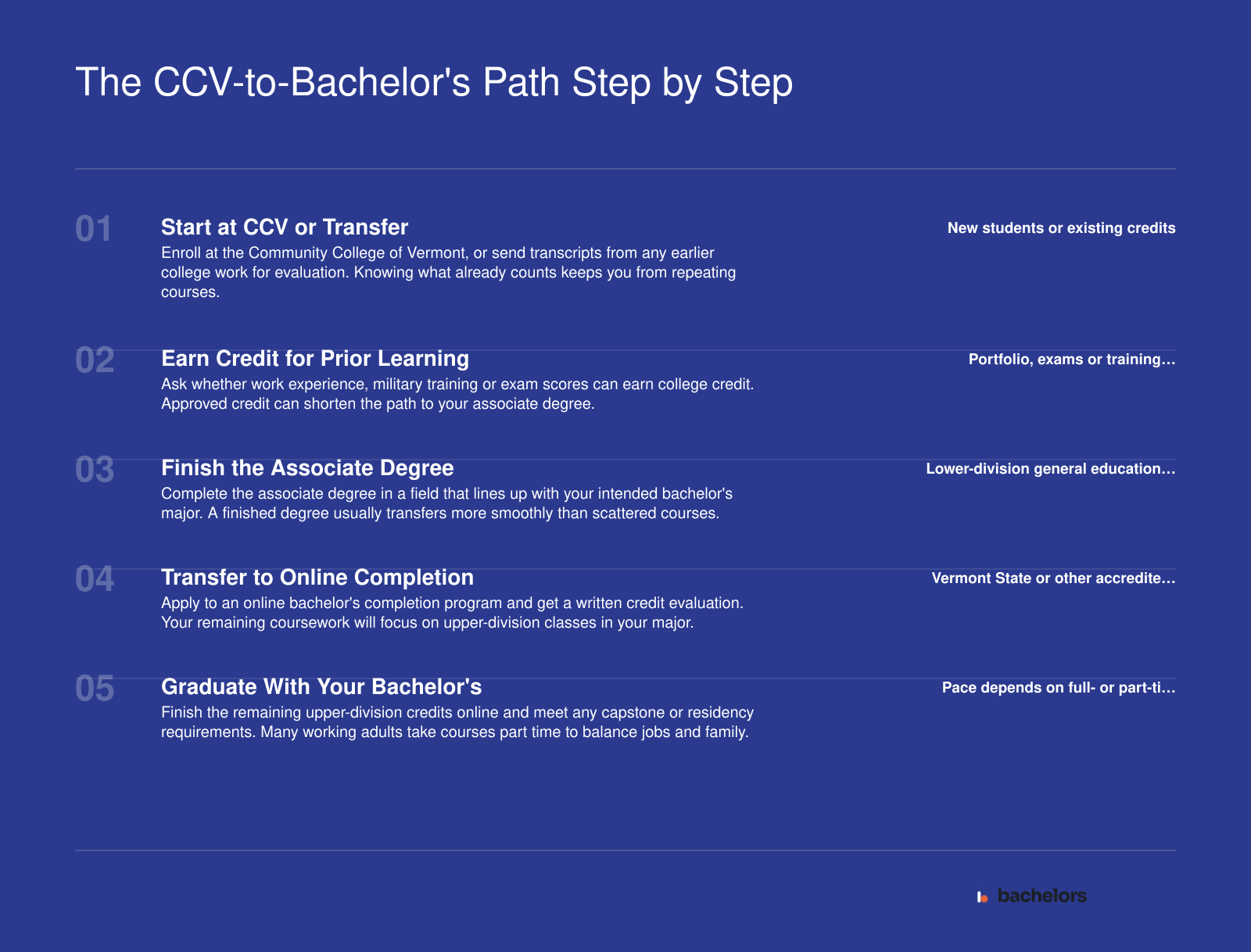
The CCV-to-Bachelor's Path Step by Step
Many Vermont students reach a bachelor's degree in stages, starting at the Community College of Vermont and finishing online. The order below shows the common route, but credit rules and requirements vary by program, so confirm each step with an advisor at both schools before you enroll.
Admissions, Start Dates and How Long an Online Degree Takes
Champlain College Online accepts up to 90 transfer credits toward a 120-credit bachelor's degree, the figure that shortens your timeline most. Admission there is test-optional, with a recommended minimum 2.5 GPA and case-by-case exceptions for applicants who show potential; the review weighs your academic foundation, readiness for online learning, and fit with the program.
What You Need to Apply
Vermont State University asks for an online application, a fee or approved waiver, and an official high school transcript or GED-equivalency scores. The recommended college-prep background is four years of English, three of math, three to four social sciences, and two to three lab sciences. The stated profile is a high school B average (roughly 3.0), while transfer applicants need a 2.0 cumulative GPA. Personal statements and recommendation letters are optional for most programs, though specific programs may require letters, test scores, or Accuplacer placement.
Term Structures and Start Dates
Most Champlain online undergraduate courses run in accelerated seven-week terms, with some offered only in 15-week sessions, so your schedule depends on the program. Students may take one course per term or two to three, capped at three courses or nine credits without program-director approval. Most programs run six terms a year.
Vermont State uses rolling admission for most programs, with review beginning in September for spring and November for fall. Published online starts include March 16, 2026, August 22, 2026, October 19, 2026, and January 19, 2027. Availability varies by program, so confirm your specific major's calendar.
Doing the Credit Math
At 15 credits per semester, 120 credits takes four years. Arrive with 60 transferable credits and you are looking at roughly two years. At Champlain, two courses per seven-week term across six terms averages out to a 120-credit bachelor's in about 40 months, depending on transfer credit. Part-time study at one course per term stretches that considerably.
Questions to Ask Yourself
Have you had your prior credits evaluated before you apply?
Can you complete clinicals, student teaching or labs near home?
Will you enroll at least half-time each term?
Do your work shifts fit 7-week terms or a standard semester?
Choosing the Right Fit: Transfer Students, Working Adults and First-Time Students
Which Vermont online path fits your situation? The answer depends mostly on your existing credits, the time you can give each week, and how much a private-college price tag matters.
Transfer Students and CCV Graduates
If you already hold an associate degree or a pile of credits from the Community College of Vermont, two things matter most: articulation agreements and the per-credit cost of the credits that remain. A written agreement tells you which courses count toward your major rather than landing as general electives. Vermont State University is often the lowest-cost in-state finish, so price it first, then compare other degree-completion options against it.
Working Adults
When a job and family set your schedule, look for accelerated terms, several start dates a year, and credit for prior learning that can shorten the degree. Champlain College Online is built for this profile and has a long record serving adult students. It is a private college, though, so expect private-college pricing and weigh what its flexibility is worth to you against a public alternative.
First-Time College Students
If you are starting from scratch, consider beginning at CCV. Lower costs and hands-on support can make the first year less risky, and credits can move on to a bachelor's program later. Fully online study suits self-directed learners best. First-time online students tend to finish at lower rates than classroom peers, so be honest about how well you manage deadlines without a set class meeting.
Your Next Step
Before you commit to any program, do three things:
- Compare net price: Look at what you would actually owe once grants and scholarships are applied, not the published tuition rate.
- Confirm the format in writing: Ask whether any in-person, residency or proctored-exam requirements apply.
- Request a transfer evaluation: Get an official credit review so you know exactly what remains before you enroll.
Colleges in Vermont with the most bachelor's programs
| School | City | Type | Bachelor's programs | Online | Net price / yr | Grad rate |
|---|---|---|---|---|---|---|
| Vermont State University | Randolph | Public | 72 | 36 | $18,212 | 47% |
| University of Vermont | Burlington | Public | 71 | 1 | $19,343 | 79% |
| Norwich University | Northfield | Private nonprofit | 52 | 13 | $22,257 | 60% |
| Champlain College | Burlington | Private nonprofit | 48 | 26 | $35,860 | 65% |
| Saint Michael's College | Colchester | Private nonprofit | 43 | 1 | $25,239 | 73% |
| Middlebury College | Middlebury | Private nonprofit | 34 | 0 | $31,483 | 91% |
| Bennington College | Bennington | Private nonprofit | 12 | 0 | $30,947 | 71% |
| Landmark College | Putney | Private nonprofit | 7 | 0 | $56,954 | 43% |
Program counts are the verified bachelor's listings in our directory; net price is the school-wide average a first-time undergraduate paid after aid, and graduation rate the share finishing within six years (College Scorecard).
Compare programs nationwide
Many Vermont residents study online. Every ranked list above has an online lens, or browse every field.
Online bachelor's degrees Browse all fields