Online Colleges and Bachelor's Degree Programs in Florida
Every verified bachelor's program at a college in Florida: 2,900+ programs at 110+ colleges, with the online options, net price and graduation rates behind each one.

Florida's public higher education system runs one of the country's largest distance-education operations: the state university system and the Florida College System both deliver substantial online coursework. The practical question for a working adult in Tampa or Jacksonville is narrower: can you finish a respected bachelor's degree without uprooting your life, and what will it actually cost?
The word "online" carries no single meaning here. Some programs are fully remote; others still fold in labs, clinical hours or proctored exams on campus. Below that sits the money question, where published tuition and net price diverge sharply, and state aid such as Bright Futures can change the arithmetic.
One constraint holds regardless of school: Florida's cheapest route runs through the 2+2 articulation agreement, and arriving with transferable credits compresses both cost and calendar more than any delivery format does.
Key Points
- Florida's 2+2 route: an A.A. guarantees admission to a state university.
- Finishing online in two years requires roughly 60 transferable credits.
- Compare net price, not sticker price; Bright Futures can cover online study.
Popular degrees in Florida
Bachelor's degrees in Florida by field
Business & Management
- Business Administration86 programs
- Management75 programs
- Marketing72 programs
- Accounting49 programs
- Finance44 programs
- Healthcare Administration or Healthcare Management41 programs
- Logistics & Supply Chain Management38 programs
- Entrepreneurship33 programs
Science & Engineering
- Biology41 programs
- Mathematics32 programs
- Chemistry32 programs
- Physics28 programs
- Biochemistry22 programs
- Anthropology18 programs
- Electrical Engineering or Electronics Engineering or Electronic Systems Engineering Technology18 programs
- Mechanical Engineering16 programs
Education & Teaching
- Science70 programs
- Secondary Education50 programs
- Elementary Education49 programs
- Special Education34 programs
- Early Childhood Education or Child Development23 programs
- Mathematics Education23 programs
- English Education22 programs
- History Education10 programs
Arts & Design
- Fine Arts or Studio Art38 programs
- Art or Art Studies37 programs
- Media Arts or Digital Media31 programs
- Graphic Design27 programs
- Audio & Music21 programs
- Art History12 programs
- Game Art & Design10 programs
- Creative Writing9 programs
Computers & IT
- Computer Science51 programs
- Cybersecurity35 programs
- Information Technology35 programs
- Computer Information Systems22 programs
- Artificial Intelligence21 programs
- Software Development & Engineering18 programs
- Innovation or Technological Entrepreneurship15 programs
- Computer Engineering15 programs
Liberal Arts & Humanities
- English31 programs
- History29 programs
- Literature or English Literature28 programs
- Philosophy23 programs
- Interdisciplinary Studies20 programs
- Humanities16 programs
- Spanish15 programs
- Global Health or Health Studies14 programs
Nursing
- Bachelor of Science in Nursing90 programs
- Nursing (RN to BSN)64 programs
- Accelerated BSN (ABSN)23 programs
- LPN/LVN to BSN9 programs
Communications & Media
- Communications55 programs
- Journalism33 programs
- Public Relations28 programs
- Communication Disorders7 programs
- Professional Writing5 programs
- Strategic Communications5 programs
- Speech Pathology4 programs
- Social Media3 programs
Criminal Justice & Law
- Criminal Justice34 programs
- Criminal Justice Administration14 programs
- Criminology12 programs
- Legal Services10 programs
- Legal Studies10 programs
- Forensic Science9 programs
- Homeland Security7 programs
- Fire Science or Fire Administration7 programs
Healthcare
- Health Sciences33 programs
- Exercise & Sports Science22 programs
- Public Health19 programs
- Respiratory Care Therapy9 programs
- Health Informatics6 programs
- Health Education6 programs
- Speech Pathology4 programs
- Nutrition3 programs
Social Work & Social Sciences
- Sociology34 programs
- Political Science, Government30 programs
- Social Work15 programs
- Human Services9 programs
- Public Policy3 programs
- Disability Studies2 programs
Psychology
- General Psychology47 programs
- Applied Behavior Analysis5 programs
- Forensic Psychology4 programs
- Clinical Psychology4 programs
- Industrial Organizational Psychology3 programs
- Applied Psychology2 programs
- Counseling Psychology2 programs
- Child Psychology1 program
Natural & Applied Sciences
- Oceanography or Ocean or Marine Biology32 programs
- GIS and Geoscience8 programs
- Agriculture or Agricultural5 programs
- Neuroscience3 programs
Religion & Theology
- Christian Studies or Religious Studies16 programs
- Christian Ministry or Ministry Leadership9 programs
Counseling
- Mental Health Counseling3 programs
How Online Bachelor's Degrees Work in Florida
In Florida, "online" describes how a course is delivered, not whether you will ever have to show up in person. Before comparing schools, learn which format a program actually uses.
Three Formats You Will See
- 100% online: Every course and degree requirement is completed remotely, with no required campus visits.
- Hybrid: Most coursework is online, but some sessions meet on-site, such as weekend labs or an in-person orientation.
- Online with in-person requirements: Classes run online, yet the degree includes clinicals, student teaching, internships or proctored exams at a physical location.
The same label can mean different things at different schools. One college may call a program online when only the lectures are remote. Another reserves the term for degrees with zero travel. A school's online label usually describes its courses, not every requirement attached to the degree.
Where Florida Online Programs Come From
Florida's public universities run dedicated online units that handle enrollment, advising and course delivery for remote students. Beyond individual schools, FloridaShines, operated by the Florida Virtual Campus, lets students search online courses offered across the state's public institutions. That statewide search helps when you need a specific course or want to compare options before committing.
How to Confirm a Program Is Truly Online
- Format field: Check the program page for a "delivery" or "format" listing rather than relying on marketing headlines.
- Hidden requirements: Scan the catalog for any residency, immersion or orientation that must be completed on campus.
- Written confirmation: Ask an advisor by email whether any course, exam or practicum requires travel, and keep the reply.
If You Live Outside Florida
Out-of-state students should confirm the program is authorized in their state of residence. Most Florida schools participate in NC-SARA, the national reciprocity agreement for distance education, which simplifies enrollment across state lines. Participation does not mean every program is cleared everywhere, though, particularly programs that lead to a professional license. Review the school's state authorization page before you apply.
Fully Online Bachelor's Degrees With No Campus Visits: What Can Force You Onto Campus
A fully online bachelor's degree and a bachelor's degree you can finish without ever driving to campus are not always the same promise. Many Florida programs deliver coursework, advising and exams entirely at a distance; a smaller group folds in a clinical, internship or lab that has to happen at a physical site. The difference rarely shows up in the marketing line, so it helps to know which program areas carry that extra piece.
Where the in-person requirement usually sits
- Business, psychology, criminal justice and IT: coursework and exams, with proctoring often the only logistics question.
- Education: UCF's online Bachelor of Science in Career and Technical Education culminates in a mentored internship in a real-world setting, so placement rules matter.
- Health sciences with labs: UF Online runs applicable labs through virtual experiments, home kits and other online activities rather than a campus lab.
- Nursing RN-to-BSN: clinical hours are the usual sticking point, so confirm the arrangement with the department before you apply.
Proctored exams: remote first, but read the syllabus
UF Online uses Honorlock proctoring for online exams. FIU lists Honorlock virtual proctoring, an approved proctoring center, or the FIU campus as accepted options1, and its testing centers take in-person appointments at the Modesto Maidique and Biscayne Bay campuses.2 Remote proctoring is common, but an individual course can still require an approved testing center, so check each syllabus rather than the program overview.
In person does not always mean on campus
An internship or practicum can often be arranged with a partner organization near your home. UCF directs students to ask success coaches, advisors or program coordinators what location and scheduling rules apply. That answer decides whether "in person" means a commute across town or a trip to Orlando.
Ask before you enroll
- Does this specific degree include any face-to-face activity, synchronous exam or lab beyond virtual options?
- Does the program require an internship or practicum, and will it approve a local placement?
- Which exams are proctored, and is remote proctoring supported for every course?
- Does any orientation, training or assessment require travel to campus?
Cost and Net Price: What Florida Students Actually Pay
A Florida bachelor's degree has two price tags: the sticker price a school publishes and the net price that remains after grants and scholarships. Net price is the one to compare. Federal net price figures subtract federal, state and institutional grant aid from the full cost of attendance (tuition, fees, books, supplies, housing, food and other expenses).2 They describe full-time, first-time students who received grant aid, and public schools are measured at the lower of their in-state or in-district rate, so treat any posted figure as a benchmark, not a quote.
How the Sectors Compare
Florida College System schools, the state colleges that grant bachelor's degrees, generally charge the lowest per-credit tuition in the state. State universities usually cost more per credit but remain affordable for residents. Private nonprofits post higher sticker prices, though institutional aid can narrow the gap considerably. For-profit schools often carry the highest net prices. Because averages vary widely by school and by student, check each college's net price calculator rather than relying on a sector label.
Fees Online Students Overlook
- Distance learning fees: Often charged per credit hour on top of tuition.
- Technology fees: Common at both public and private schools.
- Proctoring fees: Some online exams require paid remote proctoring services.
- Textbooks and access codes: Digital course materials can add a meaningful amount each term.
Residency and Out-of-State Rates
To qualify for in-state tuition, you generally must establish legal residence in Florida for at least 12 months before classes begin, with documentation. Nonresidents should look closely at online programs, since some charge out-of-state students less than the standard on-campus nonresident rate.
The Excess Credit Hour Surcharge
Florida law requires state universities to add a surcharge equal to 100% of tuition for credits attempted beyond 120% of your degree's requirements.1 For a 120-credit degree, that line falls at 144 attempted credits, though each university calculates its own program thresholds. Changing majors repeatedly or dropping courses can push you over. One incentive works in your favor: a first-time-in-college student who finishes a bachelor's within four years can receive a refund of the surcharge on up to 12 credit hours.1
Financial Aid, Bright Futures and Florida State Grants for Online Students
Can you use Bright Futures and federal student aid for a Florida bachelor's degree you complete entirely online? In most cases, yes, as long as the college is an eligible Florida institution and you meet the enrollment and residency conditions attached to each program. Aid follows the school and the student, not the delivery format.
Federal Aid Follows the Institution
Federal Pell Grants, Direct Loans, and campus-based aid flow to students enrolled in degree programs at institutions that participate in federal aid programs, whether the coursework is seated or online. Your award usually comes down to your FAFSA results, your enrollment intensity (full-time, three-quarter or half-time), and your progress toward satisfactory academic standing in a degree-seeking program.
How Bright Futures Works for Online Students
Bright Futures is administered by the Florida Office of Student Financial Assistance and paid through the financial aid office of the institution you attend, so the school's eligibility and your registration record drive the award.
- Enrollment minimum: at least 6 non-remedial semester hours per term, measured at drop/add.1
- Award levels: Florida Academic Scholars covers 100 percent of tuition and applicable fees at public institutions; Florida Medallion Scholars covers 75 percent.1
- Renewal: no renewal application is required. Your institution reports grades and hours, and renewal is evaluated at the end of the spring term.2
Need-Based Florida Aid: FSAG and EASE
The Florida Student Assistance Grant is need-based, requires a FAFSA, and generally asks for Florida residency plus at least 6 credit hours per term.3 Awards range from roughly $200 to $3,260 depending on need and available funding.4 Students at eligible private nonprofit Florida colleges should also check the Effective Access to Student Education grant, which is state-funded and tied to residency and need.
The Trap Adult Learners Hit
Bright Futures initial eligibility is tied to high school graduation, and a student who does not receive funding right after high school has five years to apply for reinstatement.1 If you finished high school long ago, plan on federal aid, FSAG, institutional scholarships, and employer tuition assistance instead. File the FAFSA as early as you can each year, and ask your school's aid office about transfer-specific and adult-learner scholarships.
Transfer Pathways From Florida State Colleges to Online Bachelor's Programs
Florida's 2+2 system is a promise written into state policy: complete your lower-division coursework at one of the state's 28 Florida College System institutions, then finish the upper-division years at one of the 12 State University System universities, including through programs delivered fully online.1 The currency of that promise is the Associate in Arts degree.
What the A.A. Guarantees, and What It Does Not
An A.A. from a Florida public state college guarantees admission to a state university, and its 60 credits must be accepted in full, 36 of general education plus 24 electives.1 It does not guarantee a particular campus, a particular major, or a limited-access program such as nursing or engineering, and it does not automatically satisfy every prerequisite for the major. Aim your electives at the common prerequisites for the bachelor's program you want, which are published in the state's Common Prerequisites Manual.
Why the Course Numbers Match
The Statewide Course Numbering System gives comparable courses the same number at public institutions, so a course carrying a given number at a state college should transfer with equivalent content to a university.2 The 36-credit general education block spans communication, mathematics, social sciences, humanities, and natural sciences.3 Once that block is certified, no additional general education is required, and another Florida public institution cannot add to it after you transfer.3 That is the practical reason to finish the A.A. before leaving: transfer early and you may be asked to complete general education requirements you assumed were settled.
The A.S. Route and Partnership Agreements
An Associate in Science is workforce-focused and does not carry the same blanket guarantee. Certain A.S. degrees are designated for statewide articulation into Bachelor of Applied Science programs, but acceptance depends on the specific A.S., its designation, the receiving university, and the program's requirements. Partnerships cover some of the rest of the ground. DirectConnect to UCF, for example, guarantees UCF admission to A.A. and statewide-articulated A.S. holders from partner state colleges, again without promising a specific major.4 Students apply once they reach 45 earned credits.5
Protecting Your Credits Before You Apply
- Finish the prerequisites: complete the common program prerequisites for your intended major, not just the general education core.
- Get an evaluation in writing early: request a degree audit or unofficial transfer evaluation before applying, so problems surface while you can still adjust your schedule.
- Confirm the A.A. is awarded: the guarantee attaches to the completed degree, not to accumulated credit hours.
- Ask about residency rules: upper-division residency requirements vary by institution and program, so check with the receiving department directly.
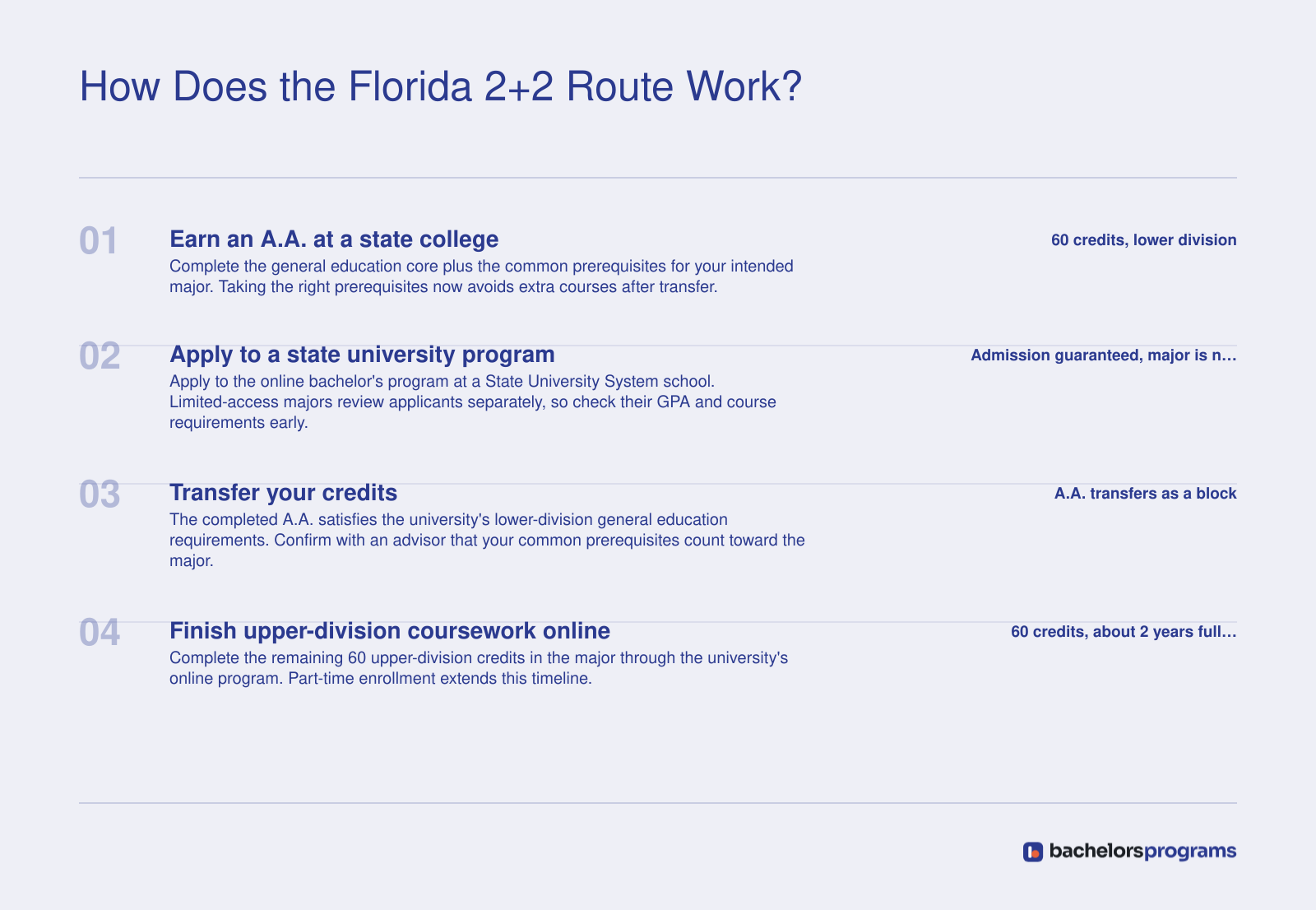
How Does the Florida 2+2 Route Work?
Florida's 2+2 route lets students finish the first half of a bachelor's degree at a state college and the second half online through a state university. Under the statewide articulation agreement, an A.A. guarantees admission to the university, not to a specific limited-access major, which may set its own GPA, prerequisite or audition requirements.
How Long Does It Take to Finish an Online Bachelor's Degree in Florida?
Can you finish an online bachelor's degree in Florida in two years? Only if you arrive with roughly 60 transferable credits already on your transcript. For everyone else, the calendar is set by how many credits you carry per term, and a few structural rules.
The 120-credit baseline
Florida's public universities generally build bachelor's degrees around at least 120 unduplicated credit hours, and individual programs add major, prerequisite and upper-division requirements on top. Florida State requires 120 credits and the final 30 in residence, a rule worth checking before you assume transfer credit shortens your path.1
Four common timelines
- Full-time: about 15 credits each fall and spring puts you near four years. UWF's online B.S. in Public Health estimates 48 months.
- Part-time: six credits a semester stretches toward a decade before summer terms; nine credits each fall and spring lands near six years and eight months.
- Transfer with an A.A.: roughly 60 applicable credits usually means about two more years full time, though residency requirements can add a term.
- Accelerated: shorter sessions do not shorten the degree by themselves. They let you stack more courses into a year.
Terms and start dates
Many programs run standard 16-week semesters with fall, spring and summer starts, as at the University of North Florida.2 Others mix 8- and 16-week courses, like UWF, which lists part-of-term starts such as Aug. 17 and Oct. 12, 2026, while noting that dates vary by program. UF Online admits three times a year and lets students choose full- or part-time status. Some accelerated adult formats use 7-week terms with six starts annually.3
What can shorten the clock
CLEP and AP exams, dual enrollment credit earned in high school, and prior learning assessment for military or workplace training all reduce the credits left to earn, often by a full semester or more.
Aid puts a floor under your pace
Bright Futures and federal aid generally require at least half-time enrollment, commonly six credit hours a term. Drop below that and you risk the award, which is why very slow part-time schedules and generous aid packages rarely coexist.
Florida RN-to-BSN Online: Licensure Requirements to Know
Admissions, Graduation Rates and Outcomes
Admission to an online bachelor's program in Florida works much like admission to the same program on campus, and the outcomes show up in public state data. Where you land depends on whether you apply as a first-year student or a transfer.
Typical Admissions Requirements
First-year applicants generally submit a high school transcript, and many Florida universities also weigh test scores or a GPA threshold. Transfer applicants usually need an associate degree or a set number of completed credits, plus a minimum college GPA. That minimum varies by school and often by major, so confirm it on the program page rather than assuming one number. Test requirements and deadlines differ too. Some online programs admit on a rolling basis with several start dates a year, while others keep fixed deadlines for each term. Competitive majors, nursing among them, may add their own prerequisites.
Graduation and Retention in Context
The Florida State University System reports a first-time-in-college four-year graduation rate of 66%, against a 2026-27 Board of Governors benchmark of 47%.2 Those figures describe full-time students starting as freshmen, which is not the typical online learner.
Schools built around working adults tend to show lower completion numbers. St. Petersburg College, a state college with 18,950 undergraduates, illustrates this.1 Among 15,810 students tracked eight years after enrolling, 37% graduated, 24% transferred, 1% were still enrolled, and 38% withdrew.1 Part-time enrollment, stop-outs and transfers to other schools all pull those rates down without necessarily signaling a weak program. Check each school's College Scorecard page for its own figures.
What Graduates Earn and Whether Employers Care
The Board of Governors tracks full-time employed bachelor's graduates using state unemployment insurance wage records. One year out, the system median is $52,600, up $10,600 over five years.3 By institution:
- University of West Florida: $54,600
- Florida International University: $52,200
- University of Central Florida: $52,100
- University of South Florida: $49,800
These figures exclude the self-employed, military personnel and anyone earning below minimum wage. The Board's longer baccalaureate follow-up study counts all working graduates, so its numbers are lower and not directly comparable. It found just over 90% employed in Year 1, about 93% by Year 5 and 97% by Year 10.4 Median wages were $36,600 in Year 1 and $47,500 in Year 5, or $52,800 for those who earned an additional credential.4
On the employer question, diplomas from Florida public universities generally do not say "online." Employers tend to care more about the school's accreditation and the degree itself than about how the classes were delivered. Confirm that any school you consider holds regional accreditation before you apply.
What Florida Bachelor's Graduates Earn
Florida's public universities track how their bachelor's graduates do in the state's job market, which gives a useful benchmark for any online degree you are considering.
How to Choose an Online College in Florida
Florida's online market has split into two tiers: public universities and state colleges offering bachelor's programs at in-state rates, and national providers that market heavily to Florida residents at higher prices. Sorting between them comes down to a few checks done in the right order.
Work Through the Basics in Order
- Accreditation: Confirm the school is regionally accredited. Most Florida public and private nonprofit colleges hold accreditation from the Southern Association of Colleges and Schools Commission on Colleges (SACSCOC), which keeps your degree and credits portable.
- True-online status: Ask in writing whether any course, orientation, exam or practicum requires you to be on campus or at a set location. "Online" on a program page does not always mean zero visits.
- Net price: Ignore sticker tuition. Use each school's net price calculator to see what you would actually pay, and include distance-learning fees in per-credit comparisons.
- Transfer fit: If you hold an associate degree or prior credits, ask how many will count toward the major, not just toward electives.
Get Licensure Answers in Writing
Teaching, nursing and counseling-track degrees carry an extra step. Before enrolling, require written confirmation that the program meets licensure requirements in Florida, or in your home state if you live elsewhere. A specific answer from the academic department is more reliable than a general statement on a webpage.
Check the Fit for Working Adults
Program structure matters as much as cost when you are balancing a job or family. Compare:
- Start dates (several entry points per year versus fall-only)
- Term length (accelerated seven- or eight-week terms versus full semesters)
- Asynchronous coursework versus scheduled live sessions
- Online tutoring, advising and career services that online students can actually reach
Be Careful With High-Cost For-Profits
Some for-profit schools offer convenient formats, but the total bill can run far higher than a Florida state college bachelor's. Line up net price, graduation rate and median debt for any for-profit option against a Florida College System bachelor's in the same field; the federal College Scorecard publishes all three. If the for-profit cannot beat the public option on outcomes, the convenience may not justify the debt.
Your Next Step
Shortlist two or three programs. Request a transfer evaluation from each so you know exactly how many credits remain, and file the FAFSA early, since it drives both federal aid and Florida state grants. With those answers in hand, the right choice is usually clear.
Colleges in Florida with the most bachelor's programs
| School | City | Type | Bachelor's programs | Online | Net price / yr | Grad rate |
|---|---|---|---|---|---|---|
| University of Central Florida | Orlando | Public | 114 | 35 | $10,411 | 78% |
| Florida International University | Miami | Public | 113 | 41 | $9,288 | 74% |
| University of Miami | Coral Gables | Private nonprofit | 101 | 3 | $37,244 | 84% |
| University of South Florida | Tampa | Public | 100 | 11 | $9,812 | 77% |
| University of Florida | Gainesville | Public | 98 | 19 | $6,541 | 91% |
| University of North Florida | Jacksonville | Public | 96 | 4 | $10,154 | 69% |
| Florida Atlantic University | Boca Raton | Public | 91 | 30 | $8,752 | 63% |
| University of West Florida | Pensacola | Public | 90 | 25 | $9,364 | 59% |
| Florida State University | Tallahassee | Public | 85 | 7 | $11,297 | 86% |
| Florida Gulf Coast University | Fort Myers | Public | 82 | 6 | $12,568 | 57% |
| Florida Agricultural and Mechanical University | Tallahassee | Public | 68 | 4 | $13,739 | 53% |
| The University of Tampa | Tampa | Private nonprofit | 66 | 0 | $36,211 | 64% |
| Saint Leo University | Saint Leo | Private nonprofit | 63 | 32 | $21,293 | 45% |
| Barry University | Miami | Private nonprofit | 61 | 8 | $22,613 | 38% |
| Nova Southeastern University | Fort Lauderdale | Private nonprofit | 60 | 10 | $30,371 | 63% |
Program counts are the verified bachelor's listings in our directory; net price is the school-wide average a first-time undergraduate paid after aid, and graduation rate the share finishing within six years (College Scorecard).
Common Questions About Online Bachelor's Degrees in Florida
These answers cover the questions Florida online students ask most often. Policies vary by university, so confirm the details with the school you are considering.
Are online degrees from Florida colleges respected by employers?
Can out-of-state students enroll in a Florida online bachelor's program, and do they pay out-of-state tuition?
Does my diploma say "online" if I graduate from a Florida university's online program?
Can I switch from on-campus to online at the same Florida university without reapplying?
Compare programs nationwide
Many Florida residents study online. Every ranked list above has an online lens, or browse every field.
Online bachelor's degrees Browse all fields