Online Colleges and Bachelor's Degree Programs in North Dakota
Every verified bachelor's program at a college in North Dakota: 490+ programs at 15 colleges, with the online options, net price and graduation rates behind each one.

Moving to Grand Forks or Fargo versus studying from home: for most adults, that is the real choice. North Dakota makes the second path practical, since most online bachelor's options come from the 11 public North Dakota University System (NDUS) campuses, plus a few private colleges.
The harder question is whether the degree is respected and affordable. Format, out-of-state rates, aid, transfer credit, accreditation, pace, admissions and graduation odds all affect that answer.
At the University of North Dakota, residency no longer sets the price: $432.45 per online credit for 2026-27, roughly $51,894 in tuition across 120 credits.
Key Points
- UND charges $432.45 per online credit for 2026-27, regardless of residency.
- North Dakota's State Grant covers up to eight full-time semesters.
- All 11 NDUS institutions share common transfer rules, easing community college credit.
Popular degrees in North Dakota
Bachelor's degrees in North Dakota by field
Business & Management
- Marketing19 programs
- Business Administration17 programs
- Management11 programs
- Accounting8 programs
- Finance8 programs
- Sports Management5 programs
- Human Resource Management or HR Management5 programs
- Communication5 programs
Education & Teaching
- Science19 programs
- Elementary Education11 programs
- Secondary Education11 programs
- English Education10 programs
- Physical Education9 programs
- Early Childhood Education or Child Development8 programs
- History Education7 programs
- Mathematics Education6 programs
Science & Engineering
- Biology13 programs
- Chemistry8 programs
- Natural Resources or Conservation7 programs
- Environmental Science6 programs
- Mathematics6 programs
- Mechanical Engineering4 programs
- Biochemistry4 programs
- Electrical Engineering or Electronics Engineering or Electronic Systems Engineering Technology3 programs
Liberal Arts & Humanities
- English8 programs
- Literature or English Literature8 programs
- History7 programs
- General Studies6 programs
- Global Health or Health Studies4 programs
- Spanish3 programs
- Native American Studies or American Indian or Indigenous3 programs
- Philosophy2 programs
Computers & IT
- Computer Science12 programs
- Cybersecurity6 programs
- Computer Information Systems4 programs
- Software Development & Engineering3 programs
- Information Technology3 programs
- Artificial Intelligence2 programs
- Computer Engineering2 programs
- Innovation or Technological Entrepreneurship1 program
Communications & Media
- Communications10 programs
- Communication Disorders3 programs
- Speech Pathology3 programs
- Journalism3 programs
- Strategic Communications3 programs
- Public Relations2 programs
- Social Media1 program
Healthcare
- Exercise & Sports Science8 programs
- Health Education6 programs
- Health Sciences3 programs
- Speech Pathology3 programs
- Nutrition2 programs
- Public Health1 program
- Respiratory Care Therapy1 program
Nursing
- Nursing (RN to BSN)7 programs
- Bachelor of Science in Nursing7 programs
- LPN/LVN to BSN5 programs
- Accelerated BSN (ABSN)1 program
Arts & Design
- Graphic Design4 programs
- Art or Art Studies4 programs
- Fine Arts or Studio Art4 programs
- Audio & Music2 programs
- Fashion Design1 program
- Art History1 program
- Media Arts or Digital Media1 program
- Illustration1 program
Social Work & Social Sciences
- Human Services6 programs
- Social Work5 programs
- Political Science, Government4 programs
- Sociology3 programs
Criminal Justice & Law
- Criminal Justice8 programs
- Criminal Justice Administration2 programs
- Forensic Science1 program
- Fire Science or Fire Administration1 program
Psychology
- General Psychology7 programs
- Applied Psychology1 program
- Addiction Psychology1 program
Religion & Theology
- Christian Studies or Religious Studies2 programs
- Christian Ministry or Ministry Leadership1 program
Counseling
- Substance Abuse Counseling2 programs
How Online Bachelor's Degrees Work in North Dakota
A Business Analytics BBA in North Dakota usually comes from one of the public North Dakota University System (NDUS) campuses, takes four years, and puts most or all coursework on the internet instead of in a classroom. How "online" a program really is varies more than most applicants expect.
Three Ways to Study Online
- Fully online programs: All required courses run remotely, with no campus visits. UND lists its Rehabilitation and Business Analytics BBA as asynchronous with no campus visits.
- Hybrid programs: Most coursework is online, but some parts happen in person. UND's biomedical engineering core courses can be completed online, yet students spend one to two summer weeks on campus for lab work.
- Online courses within an on-campus degree: Residential students take individual online classes for scheduling flexibility, but the degree itself isn't built for distance learners.
Live Sessions vs. On-Demand Coursework
Asynchronous courses let you watch lectures and submit work whenever you like, so long as you meet the weekly deadlines, a format that suits adults working full-time or on shift schedules. Synchronous courses meet live at set times, usually by video. Many programs mix both. UND's Business Analytics BBA combines asynchronous and synchronous classes without requiring a campus visit. If your work hours are fixed, ask how many live sessions each course requires and in which time zone they run.
On-Site Requirements to Check
Hands-on fields often carry in-person obligations. UND's petroleum engineering degree uses asynchronous classes but requires two one-week labs on campus. Its chemical engineering program schedules required labs in condensed two-week summer sessions. Programs leading to licensure, such as nursing or teaching, typically involve clinical hours or student teaching, and some courses may use proctored exams. Ask whether these can be completed near home.
Where to Start Looking
The NDUS "Apply Online" page identifies Minot State, Mayville State and NDSU among campuses with online undergraduate options, and UND offers fully online bachelor's degrees in several fields. Valley City State, Dickinson State and Bismarck State are also NDUS campuses. Check each school's catalog directly to confirm which bachelor's degrees are offered online and how they're delivered.
Online Tuition and Fees at North Dakota Public Universities
UND and NDSU charge online undergraduates the same per-credit rate regardless of residency, but North Dakota sets no flat online rate systemwide, and tuition still varies by institution, program and credit load.
UND: A Base Rate Plus a Required Online Fee
For 2026-27, the University of North Dakota lists undergraduate online base tuition at $432.45 per credit. Online tuition is charged per credit regardless of residency and is not capped at 12 credits, so part-time students and out-of-state students pay the same base rate. A mandatory online fee of $79.59 per credit sits on top of that, and mandatory fees are capped at 12 credits per semester, so the fee does not simply multiply across a full degree. A few programs price separately: online Business is $475.61 per credit and online Nursing is $519.14 per credit for North Dakota residents. At the base rate, 120 credits of tuition comes to roughly $51,894, an estimate that excludes the online fee, books and materials, and any savings from transferred credit.
NDSU: One Flat Rate for Online-Only Programs
North Dakota State University charges the same 2026-27 rate whether a student lives in-state or not: $430.47 in base tuition plus $71.70 in student fees, or $502.17 per credit. For its approved online-only undergraduate programs, that works out to about $51,656 in tuition across 120 credits, or roughly $60,260 once the per-credit student fees are included. NDSU caps tuition for fully online undergraduate programs at 13 credits for students with North Dakota residency; the cap does not extend to other residency statuses.
Where to Verify the Remaining Rates
Minot State, Dickinson State, Valley City State, Mayville State and Bismarck State each set their own online rates, and a distance or technology fee may be folded into the published per-credit figure rather than listed as a separate line. Pull the current academic year's tuition page for the specific program rather than the campus-wide summary, confirm whether the quoted number is tuition alone or tuition plus the online fee, then run the 120-credit multiplication yourself so every comparison sits on the same basis.
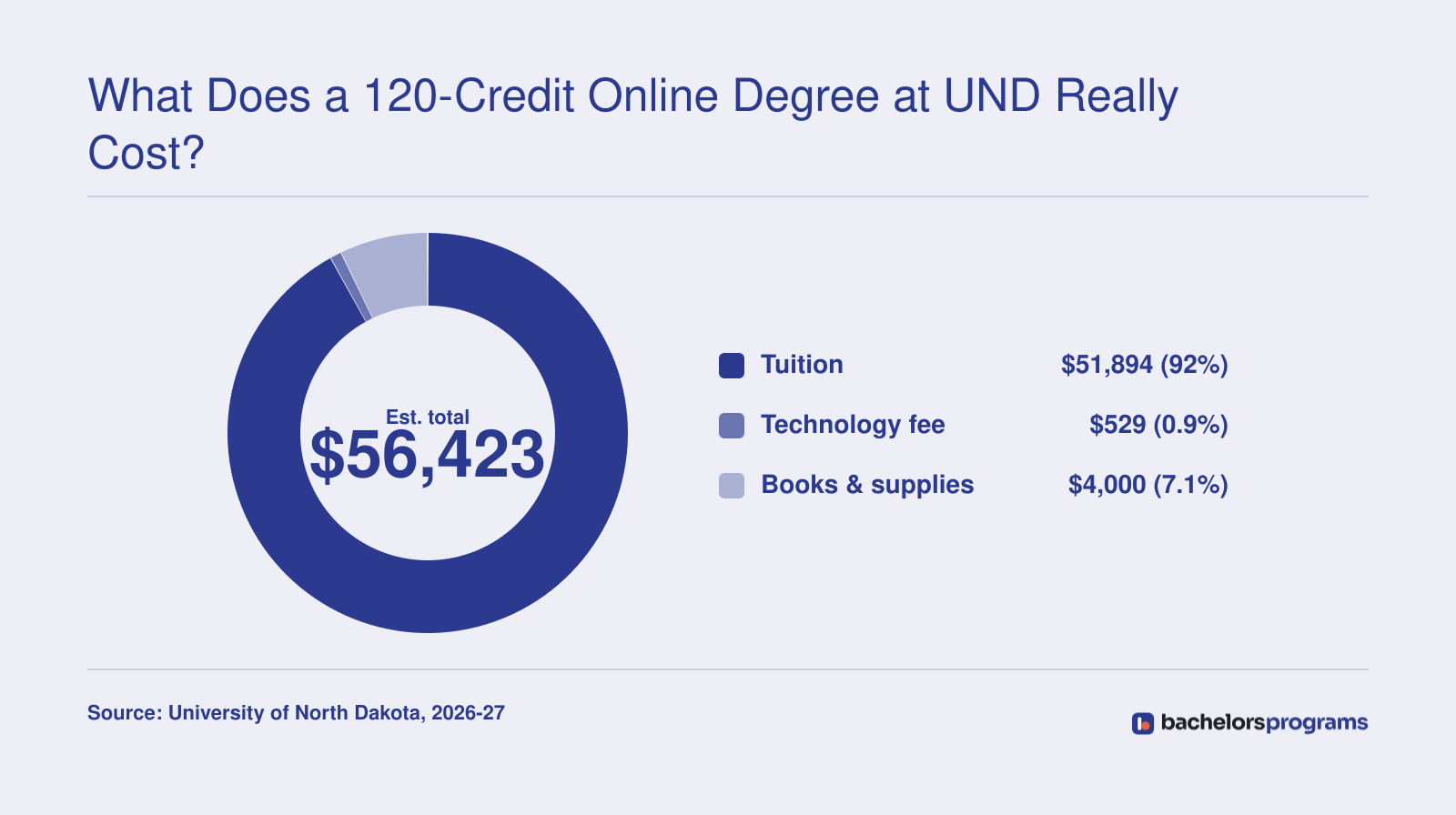
What Does a 120-Credit Online Degree at UND Really Cost?
At the University of North Dakota's 2026-27 online rate of $432.45 per credit, charged regardless of residency, tuition for 120 credits comes to $51,894. This estimate assumes 12 credits per semester over 10 semesters (five academic years) and adds UND's $105.84 annual technology fee and its $800 annual estimate for books and supplies. Students taking fewer than 12 credits in a semester pay a $79.59 per-credit student fee instead, and UND notes that fees vary by program. Nursing majors should budget about $3,000 a year for books and supplies, and engineering majors about $1,400. Transfer credits and credit for prior learning can cut the tuition slice substantially, since every 3 credits you bring in saves about $1,297.
Do Out-of-State Online Students Pay In-State Tuition in North Dakota?
Not automatically. North Dakota does not publish one statewide flat online undergraduate rate, and online delivery by itself does not reclassify an out-of-state student as a resident.1 North Dakota University System tuition is set by residency category: North Dakota residents, Minnesota residents, residents of South Dakota, Montana, Manitoba and Saskatchewan, other out-of-state students, and international students. The rate also depends on the institution, the program and the credit load, so two online bachelor's programs can carry different prices within the same system.1
Where the discounts come from
Minnesota residents may qualify for the Minnesota-North Dakota reciprocity fee, but that depends on program approval, available space and meeting the application deadline. WUE lets undergraduates from WICHE states pay 150 percent of resident tuition at participating campuses, which is a reduced nonresident rate, not in-state tuition. MSEP works similarly through MHEC: participating colleges in select Midwestern states charge eligible students no more than 150 percent of in-state resident tuition. Neither exchange is guaranteed for every online program, major or campus, and you should not assume you can stack MSEP with Minnesota reciprocity.
Sticker price versus net price
The published tuition rate is the sticker price. Net price is what students actually pay after grant and scholarship aid, and College Navigator reports it for each institution.2 Look up the University of North Dakota, North Dakota State University and Minot State University there to compare current average net prices for first-time, full-time undergraduates. Those figures give you a more realistic sense of cost than the quoted online rate alone.
Get the rate in writing
Ask the admissions or bursar's office to confirm, in writing, the exact per-credit rate for your program and residency category. Some high-demand online programs carry differential tuition, and fees can vary by course format. If you are a Minnesota resident, ask whether the reciprocity application covers your online program and term before you enroll. A short email can prevent a costly surprise.
Financial Aid, North Dakota State Grants and Military Benefits
North Dakota's State Grant caps eligibility at eight semesters or twelve quarters of full-time study, and it accepts students enrolled at least quarter time.
Federal Aid Starts With the FAFSA
One form, the Free Application for Federal Student Aid, reaches Pell Grants, federal Direct Loans and work-study at any accredited, Title IV-eligible college. Your credit load matters: Pell and loan amounts scale with enrollment intensity, so a half-time online student receives less than a full-time one. File as early in the cycle as you can.
North Dakota State Grants and Scholarships
- State Grant: need-based and nonrepayable, for North Dakota residents who are first-time undergraduates in an eligible program at a qualifying in-state institution. The FAFSA is the application and must be renewed annually. Funding is limited, and the university system urges families to file when the FAFSA opens, generally Oct. 1. Ask the aid office whether a fully online schedule satisfies the quarter-time test before you count on the money.
- North Dakota Scholarship: new awards go to 2025 graduating seniors and later classes, are applied for through the Department of Public Instruction, and require a 2.75 GPA plus full-time enrollment, with a narrow exception for a final term before graduation. Academic and career and technical education scholarship recipients from earlier years keep their remaining eligibility under the former programs.
Military and Veteran Benefits
- Post-9/11 GI Bill: online-only enrollment pays 50% of the national average housing allowance for an E-5 with dependents, so adding even one in-person or hybrid course can raise the total.1
- Yellow Ribbon: confirm participation through the VA's comparison tool rather than assuming a school takes part.
- Tuition assistance: Department of Defense Tuition Assistance covers courses for active-duty members, while North Dakota National Guard tuition assistance pays up to the highest NDUS tuition and fees for comparable courses and requires a form each semester.2
- Dependents waiver: the state veterans' dependents tuition waiver covers full tuition for dependents of veterans killed in action, missing in action, held as prisoners of war, or 100% service-connected disabled.3
Benefits rarely stack automatically. Talk to the school's veteran services office and financial aid counselor before you register, so the GI Bill, state grant and tuition assistance are sequenced instead of duplicated.
Transfer Credits and Community College Pathways in North Dakota
Transfer works more predictably in North Dakota than in many states, because the public campuses operate as one university system. That structure gives students in all 11 North Dakota University System (NDUS) institutions a common starting point for moving credits.
How GERTA Moves General Education
The General Education Requirement Transfer Agreement (GERTA) lets an approved general education package transfer as a block among NDUS campuses, five tribal colleges and one private university. If you complete general education at a participating school (for coursework finished after 1996), the receiving school treats your lower-division general education as done. GERTA does not guarantee that every course, major prerequisite or upper-division requirement carries over. Program-specific articulation agreements handle those, and the receiving campus's minimum grade rules still apply.
Credit Limits, Residency and Grades
NDUS does not publish one systemwide cap on transfer credits or a uniform rule for how many credits you must earn at the degree-granting university. Each campus sets those limits and its minimum transfer grade. Ask three questions early: how many transfer credits count toward the degree, how many must be completed at that school, and what grade a course needs. "Residency" on tuition forms refers to tuition classification, not this academic requirement.
Credit for Prior Learning
NDUS recognizes credit by exam through AP, CLEP, IB, DSST and Cambridge International, using a system schedule of scores and course equivalencies. A passed CLEP or DSST exam usually costs far less than tuition for the same course. Military experience can also count: NDUS maintains a Military GERTA procedure, so ask how your campus evaluates the Joint Services Transcript and whether it uses American Council on Education recommendations. Portfolio assessment has no systemwide policy, so confirm whether your target school offers it.
Two-Year to Four-Year Pathways
Bismarck State College, Lake Region State College, North Dakota State College of Science, Dakota College at Bottineau and Williston State College are NDUS members, so GERTA covers general education completed there. Program agreements go further: the 2025-2029 Engineering Statewide Articulation Agreement links Bismarck State, NDSCS and Williston State with NDSU and UND. Students who lack required high school courses can become eligible to transfer to a four-year school after 24 credits at a two-year college. Collaborative student status also lets you combine credits from multiple campuses for financial aid.
Before applying, send your transcripts to the transfer office and request an unofficial evaluation. Seeing which credits apply, and where, is the surest way to estimate your remaining time and cost.
Accreditation and Licensure: What to Verify Before You Enroll
Your financial aid, transfer credits and diploma all depend on accreditation, so confirm it before you apply anywhere. Do not rely on a school's marketing page alone.
Institutional Accreditation
North Dakota's public universities, including UND, NDSU, Minot State, Mayville State, Valley City State, Dickinson State and Bismarck State College, are generally accredited by the Higher Learning Commission (HLC). Check each school's current status yourself in the HLC's online institution directory, which shows accreditation status, any sanctions and the date of the next review. Federal aid eligibility, credit transfer to other universities and employer tuition benefits usually depend on this institutional accreditation.
Program-Level Accreditation
Institutional accreditation does not guarantee that a specific program meets professional standards. Look for these, and confirm them with the accrediting body rather than assuming:
- Nursing: CCNE or ACEN accreditation for RN-to-BSN and other nursing programs.
- Education: CAEP accreditation for teacher preparation programs.
- Business: AACSB or ACBSP accreditation for business degrees.
Each accreditor publishes a searchable list of accredited programs. Match the exact degree and delivery format you plan to take.
State Authorization and Licensure
North Dakota is an NC-SARA member, and the North Dakota University System acts as the state authorization entity.1 NC-SARA lists Dickinson State, Mayville State, Minot State and NDSU.1 For UND, Valley City State and Bismarck State College, check NC-SARA's institution directory or the school's authorization page.1
SARA authorization does not replace approval from a state licensing board.4 If you live outside North Dakota and are pursuing nursing, teaching or social work, confirm that the program meets your home state's licensing requirements.
Schools must publish professional licensure disclosures under federal rule 34 C.F.R. § 668.43.2 Find that page on the school's website and read it for your state. If a program does not meet your state's requirements, or the school has not made a determination, it must tell you before you enroll.3 If a school later finds that a program falls short in your state, it must notify you in writing within 14 calendar days.2 Save a copy of what you find, and ask the admissions office to confirm in writing.
North Dakota RN Licensure and Online RN-to-BSN Programs
Finishing Faster: Accelerated and Self-Paced Online Options
The University of Mary advertises an online Bachelor of University Studies that can be finished in as little as one year,1 but only for students who arrive with substantial transfer credit. That qualifier matters more than the headline number.
Accelerated Formats in North Dakota
Minot State publishes 8-week online course sessions, which let you take fewer classes at once and cycle through more terms.2 The University of Mary offers Fall, Spring and Summer starts for its online bachelor's and RN-to-BSN programs.3 Its Year-Round Campus adds a full semester each year, and its online Accounting and Project Management degrees list a bachelor's in about 2.6 years on that pathway (4 years if combined with an MBA).4
Mayville State's online Bachelor of University Studies is built for students who have prior college coursework but no bachelor's degree.5 The sources reviewed do not confirm self-paced or competency-based courses at any of these schools, so ask each admissions office directly before counting on that format.
Realistic Timelines
The math starts with 120 credits.
- From scratch, full-time: 15 credits per semester across two semesters a year is 30 credits annually, or about four years.
- Degree completion with an associate degree: roughly 60 credits transfer, leaving 60. At 15 credits per semester, that is about two years.
- Part-time: at 9 credits per semester, those same 60 credits take about seven semesters, closer to three and a half years.
Credits Beat Calendars
Short terms change the pace, not the total. Transfer credit and any credit for work experience reduce the number of credits you must still earn, which is why UMary's one-year and 16-month figures depend on what you bring with you. Confirm in writing how many credits a school will accept before you compare timelines.
Know the Tradeoffs
An 8-week course packs a semester's content into half the time, so two at once can feel like a full-time job on top of your actual job. If you work full-time, a lighter load may be more realistic. Also check financial aid rules: dropping or failing courses can put you behind on satisfactory academic progress, which can jeopardize aid. Ask the financial aid office how its progress standards treat 8-week terms before you enroll.
The Bachelor's Degree Earnings Premium in North Dakota
A bachelor's degree carries a measurable pay advantage in North Dakota.
Admissions Requirements and Application Deadlines for Online Bachelor's Programs
Requirements differ by campus, so confirm details with each school. The University of North Dakota publishes the clearest 2026 profile, and its online applicants use the same application as on-campus students.
- High school diploma or GED and core courseworkUND expects 14 high school units: 4 English, 3 math (Algebra I or higher), 3 lab science, 3 social studies, plus 1 more from those areas or a world language.
- Minimum GPAUND recommends a cumulative 2.75 or higher. Competitive programs such as aviation look for 3.25 or above.
- ACT/SAT policyUND does not require test scores but encourages them for scholarships and English and math placement.
- Transfer applicantsSend official transcripts from every college attended. With 24 or more transferable credits, UND requires a 2.0 cumulative college GPA and good standing at each prior school. NDSU recommends at least a 2.0 and gives preference to applicants with a 3.0 and 12 or more transferable credits.
- Application feeUND charges a non-refundable $35 fee for first-year and transfer applicants.
- DeadlinesUND's fall priority deadline is February 1, with a final fall deadline of August 15. Spring closes December 15 and summer closes May 1, and you can apply up to a year ahead.
- Program-specific extrasRN-to-BSN programs typically require an active, unencumbered RN license. Check each program's added prerequisites.
Outcomes and Student Support: Graduation Rates, Advising and Career Services
A low price means little if you never finish; what matters is the cost against your odds of graduating with support behind you.
Start With Retention and Graduation Rates
The federal College Navigator tool lists first-year retention and six-year graduation rates for every North Dakota University System campus. That includes the University of North Dakota, North Dakota State University and regional universities such as Minot State, Valley City State and Mayville State. Pull the latest figures for each school on your list and compare them side by side.
Keep one caveat in mind. These rates cover the whole institution. They blend on-campus freshmen with transfer and adult learners, and they do not isolate online students. Ask admissions whether the program tracks completion for its online students. A program that can answer that question is usually paying attention to it.
Support Online Students Should Expect
Strong online programs build services around remote learners instead of adding them as an afterthought. Before you enroll, confirm access to:
- Advising: A named advisor who works with online students and responds by phone, email or video.
- Tutoring: Virtual tutoring and writing help, ideally with evening hours.
- Library: Full remote access to databases, e-books and a librarian you can reach online.
- Disability services: A clear process for requesting accommodations in online courses.
- Career services: Virtual résumé reviews, mock interviews and job-search help that does not require a campus visit.
A Quick Value Test
Run every finalist through four questions:
- Retention: Do most first-year students come back? A weak rate is a warning sign.
- Transfer acceptance: How many of your existing credits will count toward the degree?
- Total net cost: What will you pay for the full degree after grants, not just per credit?
- Outcomes: Does the program publish graduate earnings, employment or licensure results? If it publishes nothing, ask why.
Your Next Step
Narrow your search to two or three programs that pass the value test. Send each one your transcripts and request an official credit evaluation, since that document shows how many courses you have left. Then file the FAFSA and list every school on your shortlist, so aid offers arrive in time to compare real costs before you commit.
Colleges in North Dakota with the most bachelor's programs
| School | City | Type | Bachelor's programs | Online | Net price / yr | Grad rate |
|---|---|---|---|---|---|---|
| North Dakota State University | Fargo | Public | 86 | 9 | $15,543 | 64% |
| University of North Dakota | Grand Forks | Public | 74 | 40 | $18,551 | 61% |
| University of Mary | Bismarck | Private nonprofit | 57 | 16 | $17,770 | 67% |
| Minot State University | Minot | Public | 55 | 18 | $12,703 | 45% |
| Valley City State University | Valley City | Public | 41 | 15 | $11,890 | 53% |
| Dickinson State University | Dickinson | Public | 39 | 8 | $14,092 | 51% |
| University of Jamestown | Jamestown | Private nonprofit | 37 | 7 | $19,567 | 49% |
| Mayville State University | Mayville | Public | 30 | 22 | $11,456 | 41% |
| Rasmussen University-North Dakota | Fargo | Private for-profit | 21 | 21 | — | 29% |
| Sitting Bull College | Fort Yates | Public | 11 | 0 | $4,605 | 22% |
| Turtle Mountain College | Belcourt | Private nonprofit | 11 | 4 | $3,428 | 43% |
| Trinity Bible College and Graduate School | Ellendale | Private nonprofit | 10 | 7 | $19,359 | 46% |
| Bismarck State College | Bismarck | Public | 8 | 5 | $10,270 | 47% |
| United Tribes Technical College | Bismarck | Private nonprofit | 8 | 4 | $3,569 | 21% |
| Nueta Hidatsa Sahnish College | New Town | Public | 7 | 1 | $9,971 | 7% |
Program counts are the verified bachelor's listings in our directory; net price is the school-wide average a first-time undergraduate paid after aid, and graduation rate the share finishing within six years (College Scorecard).
Compare programs nationwide
Many North Dakota residents study online. Every ranked list above has an online lens, or browse every field.
Online bachelor's degrees Browse all fields