Online Colleges and Bachelor's Degree Programs in New Hampshire
Every verified bachelor's program at a college in New Hampshire: 620+ programs at 12 colleges, with the online options, net price and graduation rates behind each one.
Southern New Hampshire University's $354-per-credit rate for 2026-2027 puts an online bachelor's degree at about $42,500, though transfer credit and state aid can cut that figure sharply. The gap between list price and final bill is the real decision point: flexibility versus cost.
The state pairs one of the country's largest online universities with public options through the University System of New Hampshire, so access is not the obstacle. What separates a good fit from an expensive detour is how many credits actually transfer, what in-person requirements sit inside a program, and what graduates earn and owe afterward.
Key Points
- SNHU charges $354 per online credit for 2026-2027, roughly $42,480 total.
- UNH, Keene State, Franklin Pierce and SNHU all hold NECHE accreditation.
- Former UNH students earn a median $66,479, above SNHU's reported median.
Popular degrees in New Hampshire
Bachelor's degrees in New Hampshire by field
Business & Management
- Marketing19 programs
- Business Administration14 programs
- Accounting11 programs
- Management9 programs
- Sports Management8 programs
- Finance8 programs
- Communication8 programs
- Healthcare Administration or Healthcare Management7 programs
Science & Engineering
- Biology11 programs
- Environmental Science8 programs
- Mathematics8 programs
- Chemistry7 programs
- Biochemistry5 programs
- Engineering Technology4 programs
- Physics4 programs
- Natural Resources or Conservation4 programs
Education & Teaching
- Science13 programs
- Elementary Education8 programs
- Secondary Education8 programs
- Early Childhood Education or Child Development7 programs
- English Education6 programs
- Special Education4 programs
- Mathematics Education4 programs
- History Education3 programs
Arts & Design
- Art or Art Studies10 programs
- Fine Arts or Studio Art9 programs
- Graphic Design8 programs
- Media Arts or Digital Media5 programs
- Audio & Music4 programs
- Creative Writing4 programs
- Digital Photography3 programs
- Art History3 programs
Liberal Arts & Humanities
- History9 programs
- Literature or English Literature8 programs
- English7 programs
- Global Health or Health Studies6 programs
- Humanities4 programs
- Philosophy4 programs
- Spanish3 programs
- Interdisciplinary Studies3 programs
Computers & IT
- Computer Science10 programs
- Cybersecurity7 programs
- Computer Information Systems5 programs
- Information Technology4 programs
- Innovation or Technological Entrepreneurship3 programs
- Software Development & Engineering2 programs
- Computer Engineering2 programs
- Cloud Computing1 program
Social Work & Social Sciences
- Sociology14 programs
- Human Services8 programs
- Political Science, Government8 programs
- Social Work3 programs
Psychology
- General Psychology9 programs
- Applied Psychology8 programs
- Addiction Psychology6 programs
- Forensic Psychology3 programs
- Applied Behavior Analysis3 programs
- Child Psychology1 program
- Industrial Organizational Psychology1 program
- Clinical Psychology1 program
Criminal Justice & Law
- Criminal Justice9 programs
- Homeland Security4 programs
- Forensic Science3 programs
- Legal Studies3 programs
- Legal Services2 programs
- Corrections2 programs
- Criminology2 programs
- Criminal Justice Administration2 programs
Communications & Media
- Communications15 programs
- Public Relations3 programs
- Journalism3 programs
- Social Media2 programs
- Strategic Communications2 programs
- Professional Writing1 program
- Business Communications1 program
- Communication Disorders1 program
Healthcare
- Health Sciences9 programs
- Exercise & Sports Science6 programs
- Public Health6 programs
- Community Health2 programs
- Health Education2 programs
- Nutrition1 program
- Health Informatics1 program
- Respiratory Care Therapy1 program
Nursing
- Bachelor of Science in Nursing11 programs
- Nursing (RN to BSN)9 programs
- Accelerated BSN (ABSN)2 programs
Natural & Applied Sciences
- GIS and Geoscience1 program
- Agriculture or Agricultural1 program
- Neuroscience1 program
- Oceanography or Ocean or Marine Biology1 program
Counseling
- Substance Abuse Counseling2 programs
Which Online Colleges Serve New Hampshire Students
New Hampshire's online college options fall into three groups, and out-of-state students can enroll in any of them. Most mix fully online and hybrid formats, so treat "online" as a starting label rather than a promise that you will never visit campus.
Public Universities in the USNH System
The University System of New Hampshire anchors the public side. UNH College of Professional Studies Online, which absorbed Granite State College in 2022, is the system's main home for adult and online learners. Plymouth State University and Keene State College also offer online courses and programs, though format and availability vary by department.
Private Nonprofits and Out-of-State Providers
Southern New Hampshire University (SNHU) is the best-known private nonprofit, with one of the largest online operations in the country. New England College and Franklin Pierce University also enroll online undergraduates. Beyond state lines, many out-of-state online schools enroll New Hampshire residents. That widens your choices but adds a step: confirming the school is authorized to serve students where you live.
Can Out-of-State Students Enroll?
Yes. New Hampshire participates in the State Authorization Reciprocity Agreement through NC-SARA, which lets member institutions offer distance education across state lines without separate approval in each state. Check any specific school's status in the NC-SARA directory before you apply.
Price is the bigger question. The two largest NH online providers charge one flat rate regardless of residency:
- SNHU: $354 per credit ($10,620 for 30 credits), with no out-of-state fees, according to SNHU's published online tuition.
- UNH CPS: $345 per credit for both New Hampshire and out-of-state residents in 2026-2027.
For New England College, Plymouth State and Franklin Pierce, ask the admissions office whether online tuition is flat or residency-based, since policies can differ by program.
Military and Service Member Rates
SNHU's military rate, effective June 2026, is $250 per credit ($7,500 for 30 credits) for U.S. service members, full- and part-time, and spouses of active-duty service members. It excludes books and additional fees. UNH CPS lowers its per-credit cost for service members to match the Department of Defense Tuition Assistance benefit, so direct tuition is covered while fees and course materials remain. Military spouses at UNH CPS receive a 15% tuition discount. Veterans should confirm with each school how their benefits apply.
Before committing, verify the total price and any in-person requirements directly with the program.
Accreditation: NECHE, Program Approvals and Licensure Eligibility
Institutional accreditation
The New Hampshire colleges covered here, including UNH, Keene State, Franklin Pierce and SNHU, are accredited by the New England Commission of Higher Education (NECHE). An online bachelor's degree from one of them falls under the same institutional accreditation as its on-campus version. The reviews are periodic: Keene State's next comprehensive evaluation is listed for Fall 20301, and Franklin Pierce's for Fall 20282.
Program-level approvals
Institutional accreditation does not cover everything. Some fields have their own accreditors or state approvals, and these matter most when a job or license depends on them:
- Nursing (RN-to-BSN): CCNE or ACEN.
- Social work (BSW): CSWE.
- Teacher preparation: CAEP accreditation or New Hampshire Department of Education approval.
- Business: ACBSP or AACSB.
Public listings do not always show which online or hybrid programs hold these credentials, so confirm each one directly. SNHU, for example, reports that its educator preparation programs are CAEP-accredited and approved by the New Hampshire State Board of Education. Franklin Pierce's teacher education is approved by the state Department of Education.3
Licensure across state lines
A licensure-track online degree may not qualify you in every state. UNH designs its teacher licensure programs for New Hampshire, says completion alone does not guarantee eligibility, and bars online enrollment in states where it cannot meet the education requirements. Its online upper-level mathematics licensure program is listed as meeting requirements in Maine, Massachusetts, New Hampshire and Vermont. Franklin Pierce has not determined out-of-state eligibility for its teacher education graduates3, who also face fingerprinting, background checks and testing. SNHU publishes state-by-state disclosures and does not guarantee licensure.
Before applying, find the school's state-authorization or professional licensure disclosure page and look up your home state.
A two-step check
1. Search the NECHE directory for the college and confirm its status. 2. Search the relevant program accreditor's database (CCNE, ACEN, CSWE, CAEP, ACBSP or AACSB) for the specific program.
What an Online Bachelor's Degree Costs in New Hampshire
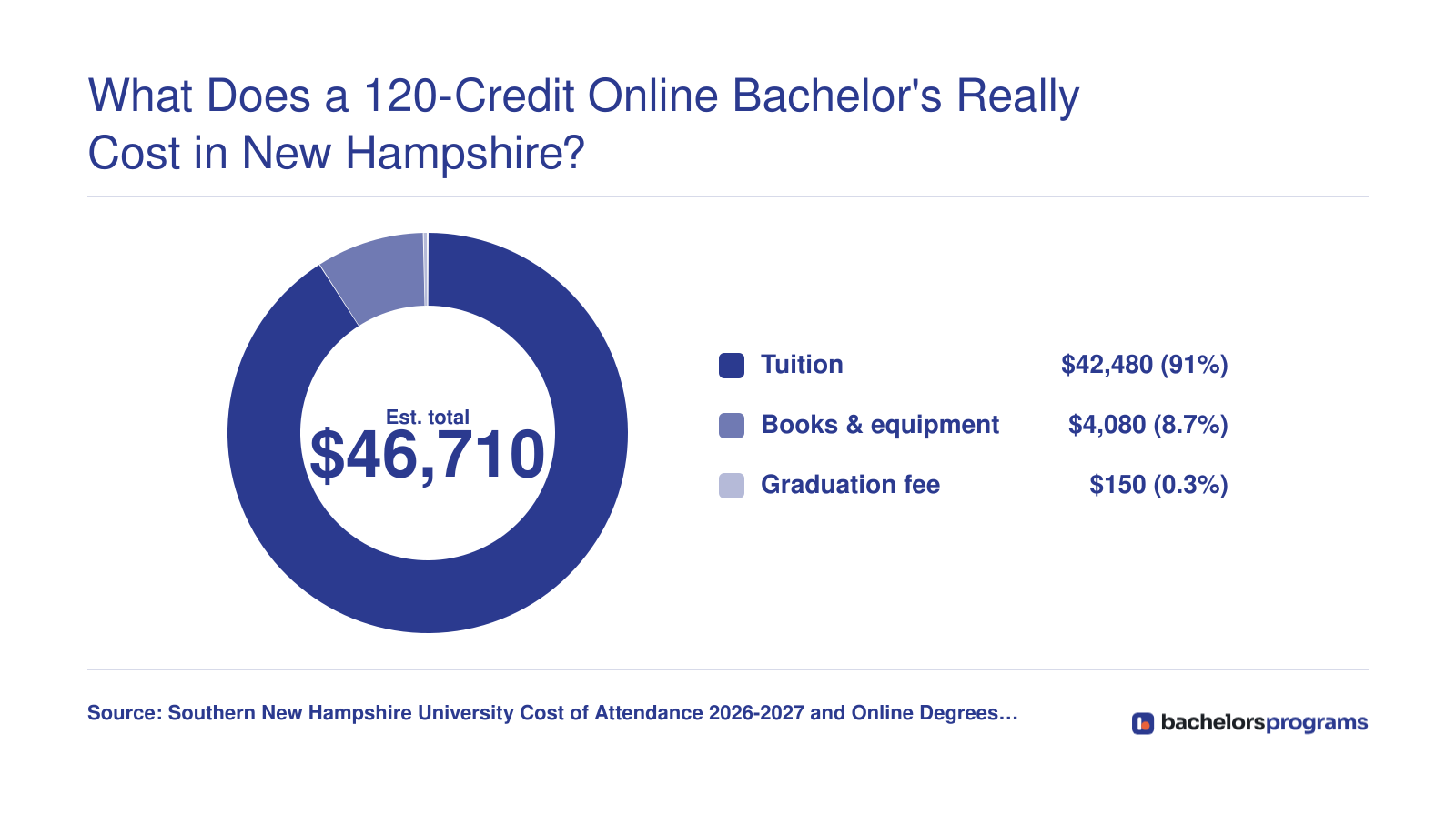
Southern New Hampshire University lists online undergraduate tuition at $354 per credit for 2026-2027, which works out to about $42,480 across 120 credits before any transfer credit is applied. That single figure sets the benchmark for the state, and the other New Hampshire providers land in a narrow band around it.
Per-Credit Rates at New Hampshire Online Providers
- University of New Hampshire College of Professional Studies Online: $345 per credit, with a $50 academic services fee and a $50 registration fee each semester, plus a $13 undergraduate CAPS fee. Application fee and admission deposit are $0.
- Southern New Hampshire University: $354 per credit, plus a $100 conferral fee at graduation. No undergraduate application fee is listed.
- Franklin Pierce University Online: $400 per credit, or roughly $48,000 for 120 credits.1
At UNH, New Hampshire residents and out-of-state students pay the same $345 per credit, so there is no residency surcharge on the online rate. Franklin Pierce does not publish a separate out-of-state rate for its online undergraduate tuition.2
Online Pricing vs. the On-Campus Sticker Price
Per-credit online rates generally sit below the published on-campus sticker price at the same institutions, largely because online students are not charged for campus services and housing. The gap matters most for out-of-state applicants: at UNH the online rate is flat regardless of residency, while on-campus tuition differs sharply between residents and non-residents. Read the online rate as its own number, not as a discount off the residential one.
Fees That Listings Often Omit
Tuition is only part of the bill. Watch for:
- Technology and course material charges, which some programs bundle and others bill per course.
- Proctoring fees for exams taken outside a testing center.
- Graduation and conferral charges, such as SNHU's $100 fee.
- Semester-based service and registration fees, which add up over a multi-year program.
Multiplying a per-credit rate by 120 gives you a ceiling, not a forecast. Transfer credit and prior learning assessment reduce the credits you actually pay for, so the real total usually falls well below that estimate.
What Does a 120-Credit Online Bachelor's Really Cost in New Hampshire?
This example prices a full 120-credit online bachelor's at Southern New Hampshire University using its 2026-2027 published rates. Tuition is 120 credits at $354 per credit. Books are SNHU's cost of attendance allowance of $816 per year for books, course materials, supplies and equipment, multiplied across five years at 24 credits per year, the course load its $8,496 annual tuition figure reflects. SNHU charges no application fee and a $150 graduation fee. It lists no separate technology or proctoring charge, and technology costs fall inside that combined equipment allowance. Treat the result as a sticker-price ceiling: transfer credits shrink the tuition slice directly, and grants or scholarships lower what you actually pay.
Financial Aid, Net Price and the Granite Guarantee
For most New Hampshire online students, the sticker price is the wrong number to plan around. Federal, state and campus aid can shrink the bill sharply, but each program has rules that trip up part-time adults.
Federal Aid Works the Same Online
Online students at accredited colleges file the FAFSA and can receive Pell Grants and federal Direct Loans just as campus students do. Enrollment level matters. Pell is prorated for less than full-time study, while Direct Loans require at least half-time enrollment. If you plan to take one course per term, ask the aid office whether that load keeps you loan-eligible.
The Granite Guarantee
The Granite Guarantee covers the gap between your grant aid and in-state tuition at the University of New Hampshire, Keene State College and Plymouth State University. You must be:
- A resident: New Hampshire residency is required.
- Pell-eligible: Federal Pell eligibility is a firm condition.
- A new or CCSNH student: You must pursue a bachelor's as a first-time college student or as a Community College System of New Hampshire graduate.
Online study is not disqualifying, and UNH College of Professional Studies (CPS) students can qualify if they meet every criterion. The catch for working adults: CPS requires continuous full-time enrollment, 12 credits each fall and spring, with no break except summer. Transfer eligibility varies by college, so confirm with the aid office.
Other State and Campus Aid
New Hampshire has no statewide entitlement grant. Need-based state money runs through UNIQUE, which participating colleges award to Pell-eligible residents.1 CPS lists $1,750 per semester for 2026-2027 with a January 31 deadline, and part-time awards are prorated. The New Hampshire Promise, for families with income of $100,000 or less, does not begin until fall 2027 and targets full-time first-year students and qualifying CCSNH transfers. Granite Edvance also offers a scholarship for New Hampshire students in four-year programs. At Southern New Hampshire University and New England College, ask about employer tuition partnerships and transfer scholarships.
Military Benefits
The GI Bill, Yellow Ribbon Program and military Tuition Assistance all apply to online study. Taking every course online changes the Post-9/11 GI Bill housing allowance, which drops to a reduced online-only rate well below the campus rate. Yellow Ribbon helps cover private tuition above the GI Bill cap only at participating schools, so confirm participation for your program.
Net Price, Not Sticker Price
Net price is the full cost of attendance minus grants and scholarships. Run each school's net price calculator with your own income and enrollment plans before comparing programs.
Transfer Credit and Credit for Prior Learning at NH Online Colleges
Transfer policy often decides how long an online bachelor's degree takes and what it costs. Most bachelor's degrees require about 120 credits, so every credit a school accepts is a course you do not pay for twice.
How the Schools Compare
- Southern New Hampshire University: Accepts up to 90 credits toward a bachelor's degree. Prior learning credit may come from military service documented on a Joint Services Transcript (JST), ACE-certified training, and DSST and CLEP exams.
- University of New Hampshire College of Professional Studies Online: Caps transfer at 60 credits for some bachelor of science programs and 90 credits for bachelor of arts and other bachelor of science programs. Bachelor's Completion programs accept an earned associate degree in full. Prior learning can include CLEP, DSST and AP exams, experiential-learning portfolios, workplace training, professional licenses and certifications, and military training.1
Caps differ by program, even within one university, so check the policy for the specific major rather than the school as a whole. Residency requirements, the number of credits you must complete at the school itself, are a separate limit. Ask for that figure in writing, because it sets the floor on what you will pay.
Community College Pathways
Students who start at a Community College System of New Hampshire (CCSNH) campus usually have the smoothest route into a University System of New Hampshire (USNH) school. These pathways typically work in one of two ways. Some guarantee admission once you finish an associate degree with a set GPA. Others apply the associate degree as a block, so general education requirements count as met. UNH's full acceptance of the associate degree in its completion programs is an example of the block approach. Agreements change, and they often apply only to certain majors. Confirm the current terms with both the community college and the university before you plan around them.
How Many Transfer Credits Can I Use?
For the two schools with published transfer limits, the ceiling runs from 60 to 90 credits. Many students land below that, because only courses with a qualifying grade that fit the new major are accepted. Credits from an associate degree in a related field usually transfer best. Older credits and courses outside your major are the most likely to be rejected or counted as general electives.
Before you apply, request an unofficial credit evaluation. Send your transcripts, JST, and any exam or certification records, and ask for a written estimate of accepted credits, remaining courses and total cost. The evaluation is usually free and non-binding, and it lets you compare programs on remaining credits instead of sticker price.
Questions to Ask Yourself
Have I asked, in writing, how many of my credits from CCSNH, military training, or CLEP exams this school will accept?
Does this program require a practicum, student teaching, or proctored exams I would have to attend in person in New Hampshire?
Am I eligible for the Granite Guarantee at a University System of New Hampshire campus, and would a private online school's flat rate beat it after aid?
If I am working toward licensure, will this degree qualify me in the state where I plan to actually work?
Fully Online vs. Hybrid: In-Person Requirements Listings Rarely Mention
Can you earn a bachelor's degree fully online in New Hampshire? For many business, psychology and liberal studies majors, yes. The answer gets more complicated in fields that lead to a license or a clinical credential, where a fully online listing can still carry required hours on site.
Where the on-site hours hide
Nursing is the clearest example. Southern New Hampshire University's online RN-to-BSN includes community-based clinical practice experiences, which SNHU describes as planned nursing-practice learning activities rather than the pre-licensure clinical work of a traditional program. The program description does not spell out a fixed hour count, so ask admissions. At UNH College of Professional Studies Online, the RN-to-BSN includes a 4-credit capstone practicum, and CPS guidance puts practicums at about 25 total hours per 8-week term and internships at 80 total hours per 16-week semester. Field applications must be approved before registration, and hours must fall inside the term, stay separate from your regular job, and be documented.
New England College markets its BSN as 100% online while requiring 124 credits, 36 of them in three paid clinical experiences as an employee of a partner organization. NEC says nearly 30% of credits are earned in a hospital setting. Education programs that lead to licensure typically include student teaching, and social work programs include field placement, so ask for the required hours and the settings.
Proctored exams and live sessions
Some online courses require synchronous class meetings, and some require proctored exams through remote proctoring software or an in-person testing center. Remote proctoring can carry a per-exam fee, and a testing center means travel. Get the format and any fee in writing.
Verification checklist
- Read the program catalog page for practicum, clinical, field or student teaching courses.
- Ask admissions how many on-site days are required and when synchronous sessions meet.
- Confirm placement support for out-of-area students, whether a current employer can serve as the site, and who approves hours before registration.
Admissions, Start Dates and Realistic Time to Completion
A traditional campus calendar gives you two entry points a year. Many online programs in New Hampshire keep a rolling door open instead, a difference that matters when you are fitting coursework around a job, a family or a military schedule.
Rolling Admissions and Frequent Starts
Southern New Hampshire University runs undergraduate terms of eight weeks with six starts a year, and admission is rolling; registration can stay open until the day before a term begins. UNH College of Professional Studies Online also reviews applications on a rolling basis and lets you apply at any point and enroll in whichever term suits you. The available 2026 sources do not pin down individual undergraduate term lengths at UNH CPS, so confirm those dates with an advisor before you plan around them. New England College and Plymouth State publish their own online calendars, so check each directly rather than assuming a shared rhythm.
What You Need to Apply
Neither SNHU nor UNH CPS charges an application fee for online undergraduate admission. At SNHU you need a high school diploma or GED; no test scores and no essay are required, and official transcripts are evaluated for possible transfer credit. UNH CPS asks for a high school diploma, homeschool equivalent or GED, plus official transcripts from each college you have attended if you want prior coursework reviewed. One caution: UNH CPS lists a $50 academic services fee per semester, separate from the free application.
How Long It Realistically Takes
Timelines depend less on the school than on how many credits you bring and how many courses you carry at once.
- First-time, full-time: about four years at a standard bachelor's pace.
- Transfer with an associate degree: commonly two to three years, depending on how many credits survive the evaluation.
- Part-time adult learner: one or two courses per term stretches the timeline well beyond four years. Eight-week terms compress the workload; they do not remove it.
What Bachelor's Graduates Earn After NH Online-Focused Colleges
Southern New Hampshire University, the state's largest online-focused school, reports lower median earnings than the University of New Hampshire, where former students earn a median of $66,479 at the same point.
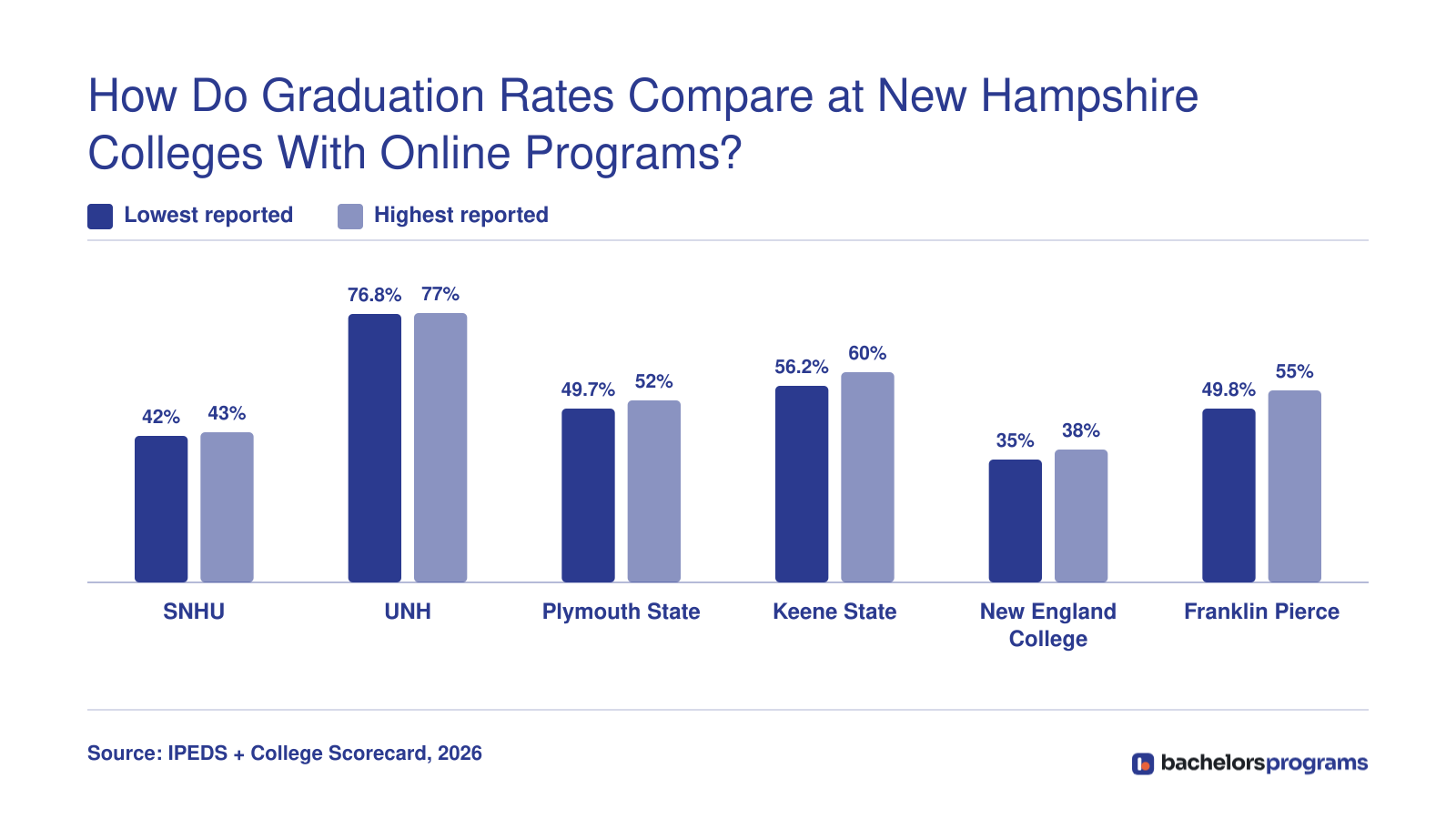
How Do Graduation Rates Compare at New Hampshire Colleges With Online Programs?
Published graduation rates for these schools shift by a few points depending on the data release and cohort, so the chart shows the lowest and highest rate reported for each. Standard graduation rates count only first-time, full-time students, which understates results at online-heavy schools like SNHU, where many students attend part time or transfer in. Before comparing schools, check the College Scorecard outcome measures for each one, which also track part-time and transfer students.
Debt, Outcomes and How to Judge an Online Program's Value
Sticker price tells you little about value; the better test is what you will owe, what you will earn, and whether students like you actually finish. College Scorecard offers a starting point for all three.
What the Scorecard Numbers Show
Average net price covers tuition, living costs, books, supplies and fees minus average grants and scholarships.2 It reflects full-time, first-time students receiving federal aid, so your own bill may differ.
- Southern New Hampshire University: average net price of $36,764.
- UNH College of Professional Studies Online: average annual net price of $11,339, median federal loan debt of $25,000, and retention of 62.5%.
- Plymouth State University: average net price of $19,216, median federal debt of $26,000, and first-year retention of 56%.1
- New England College: median federal debt of $26,000, with 73.4% of students borrowing federal loans.
Median debt lands in a narrow band of roughly $25,000 to $26,000 at the schools where it is shown1, while net price swings widely. Third-party data sites sometimes list slightly different figures for the same school, usually because of cohort or reporting-year differences, so confirm current numbers on Scorecard itself. A useful rule of thumb: total debt should stay below what you expect to earn in your first year of work. Check that against the earnings for your specific major.
A Four-Part Value Check
1. Total cost after transfer credit and aid. Subtract accepted credits and grants before comparing schools. 2. Graduation and retention rates. A low price means little if many students leave before finishing. 3. Program-level accreditation. Institutional accreditation is the baseline; fields like nursing, education and business may need an additional approval. 4. Scorecard earnings for your major. Institution-wide averages hide large differences between fields.
Where to Start, by Reader Type
- Pell-eligible NH residents: compare Granite Guarantee campuses first, since the guarantee can cut your net price below what the Scorecard average suggests.
- Transfer-heavy working adults: prioritize generous transfer caps and frequent start dates. Each accepted course shortens the degree and lowers the total bill.
- Licensure seekers: confirm program accreditation and any in-person clinical or practicum requirements before you look at price. A cheaper program that does not qualify you for the license costs more than any tuition savings.
Colleges in New Hampshire with the most bachelor's programs
| School | City | Type | Bachelor's programs | Online | Net price / yr | Grad rate |
|---|---|---|---|---|---|---|
| University of New Hampshire | Durham | Public | 119 | 31 | $23,805 | 76% |
| Southern New Hampshire University | Manchester | Private nonprofit | 87 | 72 | $36,708 | 43% |
| Keene State College | Keene | Public | 56 | 0 | $17,887 | 60% |
| New England College | Henniker | Private nonprofit | 55 | 24 | $26,972 | 35% |
| Saint Anselm College | Manchester | Private nonprofit | 52 | 0 | $34,779 | 80% |
| Plymouth State University | Plymouth | Public | 51 | 0 | $19,216 | 52% |
| Franklin Pierce University | Rindge | Private nonprofit | 44 | 9 | $27,154 | 54% |
| Dartmouth College | Hanover | Private nonprofit | 33 | 0 | $29,519 | 96% |
| University of New Hampshire at Manchester | Manchester | Public | 33 | 9 | $9,992 | 50% |
| Colby-Sawyer College | New London | Private nonprofit | 31 | 3 | $27,431 | 58% |
| Rivier University | Nashua | Private nonprofit | 30 | 2 | $28,082 | 52% |
| University of New Hampshire College of Professional Studies Online | Manchester | Public | 29 | 29 | $10,864 | 30% |
Program counts are the verified bachelor's listings in our directory; net price is the school-wide average a first-time undergraduate paid after aid, and graduation rate the share finishing within six years (College Scorecard).
Compare programs nationwide
Many New Hampshire residents study online. Every ranked list above has an online lens, or browse every field.
Online bachelor's degrees Browse all fields