Online Colleges and Bachelor's Degree Programs in Texas
Every verified bachelor's program at a college in Texas: 4,500+ programs at 130+ colleges, with the online options, net price and graduation rates behind each one.

Online enrollment at Texas public universities is now mainstream, and the gap between programs has widened with it. A working adult in Lubbock or a transfer student in the Rio Grande Valley can now finish a bachelor's degree without relocating or leaving a job, often through UNT, UTSA, UTRGV or TWU, each of which offers online or hybrid bachelor's options.
The catch is variation. Per-credit rates differ by residency, transfer policies differ by institution, and "online" can mean anything from fully asynchronous coursework to scheduled live sessions.
Most Texas bachelor's degrees require 120 semester credit hours, so how many credits you bring in usually matters more than which logo is on the diploma.
Key Points
- Most Texas online bachelor's degrees take 120 credits, roughly four years full-time.
- UNT's 2026-2027 resident budget lists $31,768 yearly off campus before grants.
- Texas public universities follow state rules for accepting community college credits.
Popular degrees in Texas
Bachelor's degrees in Texas by field
Business & Management
- Business Administration145 programs
- Marketing120 programs
- Management91 programs
- Finance80 programs
- Accounting77 programs
- Communication54 programs
- Human Resource Management or HR Management43 programs
- Sports Management42 programs
Science & Engineering
- Biology92 programs
- Mathematics76 programs
- Chemistry70 programs
- Biochemistry49 programs
- Physics42 programs
- Environmental Science39 programs
- Electrical Engineering or Electronics Engineering or Electronic Systems Engineering Technology37 programs
- Mechanical Engineering35 programs
Education & Teaching
- Science63 programs
- Elementary Education54 programs
- Mathematics Education44 programs
- Secondary Education42 programs
- English Education41 programs
- Physical Education35 programs
- History Education33 programs
- Early Childhood Education or Child Development31 programs
Liberal Arts & Humanities
- English78 programs
- Literature or English Literature70 programs
- History69 programs
- Spanish46 programs
- Philosophy32 programs
- General Studies29 programs
- Global Health or Health Studies23 programs
- Interdisciplinary Studies15 programs
Arts & Design
- Art or Art Studies77 programs
- Fine Arts or Studio Art71 programs
- Audio & Music37 programs
- Graphic Design36 programs
- Media Arts or Digital Media36 programs
- Art History22 programs
- Game Programming & Development17 programs
- Creative Writing14 programs
Computers & IT
- Computer Science99 programs
- Computer Information Systems44 programs
- Cybersecurity39 programs
- Information Technology32 programs
- Innovation or Technological Entrepreneurship26 programs
- Computer Engineering25 programs
- Software Development & Engineering24 programs
- Artificial Intelligence24 programs
Communications & Media
- Communications90 programs
- Journalism49 programs
- Public Relations26 programs
- Communication Disorders24 programs
- Speech Pathology24 programs
- Strategic Communications12 programs
- Professional Writing9 programs
- Technical Communication5 programs
Social Work & Social Sciences
- Sociology92 programs
- Political Science, Government58 programs
- Social Work44 programs
- Human Services10 programs
- Public Policy5 programs
Healthcare
- Exercise & Sports Science48 programs
- Health Sciences36 programs
- Public Health32 programs
- Nutrition29 programs
- Speech Pathology23 programs
- Health Education13 programs
- Community Health8 programs
- Health Informatics4 programs
Nursing
- Bachelor of Science in Nursing97 programs
- Nursing (RN to BSN)61 programs
- Accelerated BSN (ABSN)22 programs
- LPN/LVN to BSN9 programs
Criminal Justice & Law
- Criminal Justice62 programs
- Criminal Justice Administration25 programs
- Forensic Science21 programs
- Criminology16 programs
- Homeland Security11 programs
- Legal Services9 programs
- Legal Studies8 programs
- Corrections5 programs
Psychology
- General Psychology69 programs
- Sport Psychology6 programs
- Clinical Psychology3 programs
- Counseling Psychology3 programs
- Health Psychology2 programs
- Applied Behavior Analysis2 programs
- Applied Psychology1 program
- Industrial Organizational Psychology1 program
Natural & Applied Sciences
- Agriculture or Agricultural28 programs
- GIS and Geoscience16 programs
- Oceanography or Ocean or Marine Biology9 programs
- Neuroscience5 programs
- Applied Science3 programs
Religion & Theology
- Christian Studies or Religious Studies29 programs
- Christian Ministry or Ministry Leadership24 programs
Counseling
- Substance Abuse Counseling4 programs
- Behavioral Health Science1 program
How Online Bachelor's Degrees Work at Texas Colleges
Most online bachelor's degrees in Texas come from the same accredited universities that run traditional campuses. The differences that matter are who offers the program, how it is delivered, and how much of it is truly online.
Who Offers Online Degrees in Texas
Three types of institutions enroll online students in the state. Public universities anchor the market. These include campuses in the University of Texas and Texas A&M systems, plus the University of North Texas, Texas State University and Texas Woman's University. For Texas residents they usually carry the strongest pricing advantage, since in-state tuition rates often apply to online coursework as well.
Private nonprofit colleges make up the second group. Their tuition tends to run higher, though institutional scholarships can narrow the gap. For-profit schools round out the field, and they deserve the closest scrutiny on accreditation, cost and whether their credits will transfer.
Fully Online, Hybrid, or Degree Completion
Not every program labeled "online" is completely remote. Fully online programs deliver all coursework over the internet. Hybrid programs pair online classes with on-campus sessions, labs, student teaching or clinical placements, which is common in nursing, education and health fields. Degree-completion programs are built for students who already hold college credit or an associate degree and want to finish the remaining upper-division coursework.
Read the fine print on any listing. Orientation weekends, proctored exams or field placements can require travel, even when a program markets itself as online.
How Courses Are Scheduled
Many Texas universities run online courses on standard 16-week fall and spring semesters, with shorter summer sessions. Others use accelerated 7- or 8-week terms, a structure common in competency-based programs and in partnership programs that some public universities run with outside online providers. Shorter terms let you focus on fewer courses at once while still moving quickly, but the weekly workload is heavier.
Quick Pre-Application Checklist
- Accreditation: Confirm the school holds institutional accreditation from SACSCOC, the regional accreditor that covers Texas public universities.
- Residency rules: Check whether the program accepts students living outside Texas, since enrollment eligibility can vary by state.
- In-person requirements: Ask about campus visits, clinicals or placements before you apply.
- Tuition model: Find out whether the school charges per credit hour or a flat rate per term, which changes what a full course load costs.
What an Online Bachelor's Degree Costs at Texas Public Universities
Two students can sit in the same online seminar at a Texas public university and be charged rates that differ by hundreds of dollars per credit. Residency drives that gap, and any realistic cost estimate starts with a published rate card.
Published rates, by year
These figures come from each university's published schedule for the year noted. They are rates, not bills, and campuses revise them annually.
- Texas Woman's University (2026-27): $238 per credit for Texas residents and $666 for nonresidents, plus $81 per credit in university services fees and $35.71 in student services fees. Program fees add $8 per credit at the lower division and $15 at the upper division.1
- UTRGV (Fall 2026): $730 per credit for residents and $1,158 for nonresidents, tuition and fees combined, with the in-state charge capped at 12 credit hours per term.2
- UNT Dallas: $318.33 per credit for Texas residents and $441 for nonresidents, on the Dallas campus rather than the Denton campus.4
- UT Dallas (2026-27): a consolidated rate capped at 12 semester credit hours that includes tuition, mandatory fees and most course fees, with the distance-education fee billed separately.5
Rates at UTSA, Texas State, Lamar University, Texas A&M University-Central Texas and the UNT campus in Denton follow the same annual cycle, so confirm every figure with the bursar before you budget.
Do Texas residents pay less?
Yes, at every school with a published rate above, and the spread is wide. TWU's nonresident rate is close to triple its resident rate, and UTRGV's gap still runs several hundred dollars per credit. UNT Dallas applies an "Out of State Teaching Fee" in place of standard tuition and instructional fees for students who live outside Texas. None of the rate structures published here offers a separate reduced e-rate for out-of-state online students, so residency classification is what changes your bill.
Finding the lowest sticker price
TWU's $238 base tuition is the lowest here; a 12-credit term runs about $2,856 before fees. UTRGV carries the highest per-credit figure but bundles fees into it and stops charging in-state tuition past 12 credits, which rewards full-time enrollment.3 Compare either against net price, the figure after grants and scholarships, before calling one cheaper.
How Texas classifies you as a resident
Texas generally treats a student as a resident for tuition purposes after 12 months of domicile in the state, and the Core Residency Questions on ApplyTexas are what establish that classification. Living out of state while studying online usually means nonresident rates unless the university publishes a distance-education rate. TWU states that its tuition and fees apply regardless of study method or location1, while UT Dallas keeps its distance-education fee separate. Ask the residency office to confirm your classification in writing before you enroll.
Sticker Price vs. Net Price: The Real Cost of a Texas Online Degree
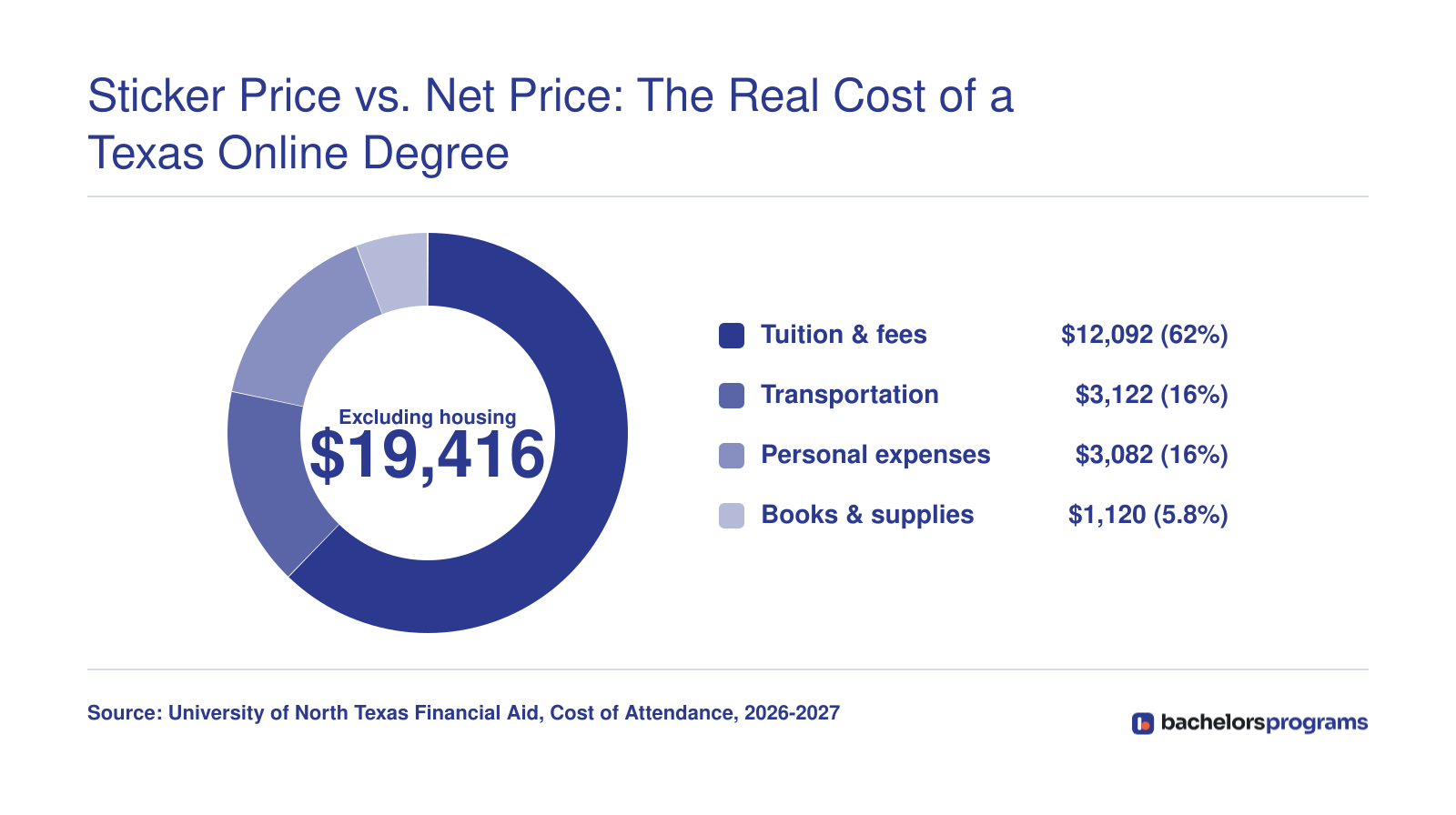
The University of North Texas publishes a 2026-2027 budget for Texas residents taking 15 hours per semester: $31,768 a year off campus before grants, including $12,352 for living expenses. Online students who stay where they already live can usually set that housing line aside. Tuition, fees and books still apply, and so do technology costs. UNT does not say whether its $1,120 books and supplies allowance covers technology, while UT Austin budgets $724 for books, course materials, supplies and equipment combined. Because grants can cut the remaining $19,416 sharply, compare schools by net price (what you pay after grant aid), not by sticker price, and check each school's net price calculator for your own figure.
Financial Aid and Texas State Grants for Online Students
Do online students in Texas qualify for the TEXAS Grant, and how do you apply for it? Eligibility depends on the award year, the college and your enrollment status, so the only reliable answer comes from the Texas Higher Education Coordinating Board and your college's financial aid office.
Start With the TEXAS Grant Rules
The TEXAS Grant is the state's main need-based grant for Texas residents, and its eligibility criteria, award amounts, and enrollment-hour requirements are set by THECB and can change between award years. Whether online and part-time students qualify is not uniform across institutions. Confirm the current rules directly at highered.texas.gov, then ask the financial aid office at the school you plan to attend how those rules apply to your specific program format.
Confirm TASFA and the Priority Deadline
Students who cannot file the FAFSA may qualify through the Texas Application for State Financial Aid. Verify your eligibility and the state's priority aid deadline on the THECB TASFA page, cross-check federal options at studentaid.gov, and find your target school's own aid deadline page. Submit as early as you can, and keep the confirmation you receive. Aid is often awarded until funds run out, so timing matters more than most applicants expect.
Ask About TPEG at Your College
The Texas Public Educational Grant is administered by each college rather than by the state, which means the rules vary by campus. Check the school's financial aid and scholarship page, then ask the aid office directly whether online and part-time students qualify, what funds remain for the current year, and which application steps you still need to complete.
Where to Look Next
- THECB (highered.texas.gov): TEXAS Grant and TASFA rules, deadlines, and eligibility.
- Federal Student Aid (studentaid.gov): FAFSA filing, loan limits, and federal grant programs.
- Your college: financial aid pages, online-program pages, and the aid office itself.
- TASFAA and similar associations: Texas-specific aid guidance and counselor resources.
- BLS.gov: wage and outlook data for the fields you are considering.
Get written confirmation from the aid office before you rely on any of it. Summaries from prior years go stale fast, and an email that states your award and enrollment requirements is worth more than any general guide.
Transferring Community College Credits Into an Online Bachelor's Program
Can you transfer community college credits into an online bachelor's program in Texas? Yes. If your credits come from a regionally accredited college and you are applying to a Texas public university, the state has written rules that make the process far more predictable than it is in most states. The catch is knowing which rules apply to your credits and how each university caps what it will take.
The Rules That Protect Your Credits
The strongest protection is the Texas Core Curriculum: 42 semester credit hours that transfer as a completed block between Texas public institutions and satisfy the receiving school's core requirements. Finish the core at a community college and you should not have to repeat it.
A Texas Field of Study Curriculum works the same way for a major. It is a defined set of lower-division courses that transfers as a block into the associated bachelor's degree, subject to whatever college-wide and major requirements remain. These curricula are authorized under Texas Education Code 61.823 and 19 TAC 4.32.1 Sitting underneath both is the Texas Common Course Numbering System, which identifies lower-division academic courses by a shared statewide number and title.1 A school that accepts these, as UNT does for successfully completed courses with direct equivalents, is telling you the credit will count before you ever apply.
How Many Credits Each University Takes
Caps vary, and they are not always the number printed in the marketing copy. At UNT, the online BAAS requires 120 semester credit hours, and the current program page allows up to 84 to be transferred from other approved institutions.2 UNT's articulation pathway documents describe up to 90 transferable hours while requiring at least 30 hours completed at UNT and at least 24 advanced-level hours there.3 Treat 84 as the general online figure and 90 as pathway-specific.
Texas State's online BAAS also totals 120 credits and advertises up to 90 transfer credits. Read the fine print: Texas State applies up to 72 semester credit hours from an accredited junior or community college, and students bringing more than 72 must work with an advisor on how the excess satisfies degree requirements. The 90 figure includes categories beyond community college coursework, such as up to 24 credits earned through prior learning assessment for work and life experience.
Lamar University is often mentioned in transfer conversations, but its published program pages do not state a single community college ceiling, so confirm your total with an advisor rather than assuming a number.
Three Steps Before You Apply
- Request an unofficial degree audit. Ask the transfer office to evaluate your transcript against the specific online program before you pay an application fee. You will see exactly which courses land as core, major, or elective credit.
- Check minimum grade rules. Credit is typically awarded for a passing grade, but many programs require a C or better in courses that satisfy major requirements.
- Look at degree-completion options. The BAAS and the BAT are built for students arriving with applied, workforce, or technical credits that a traditional bachelor's would treat as electives.
Asynchronous vs. Synchronous: Choosing a Format That Fits Your Schedule
Asynchronous programs let you study whenever you have time, while synchronous programs ask you to log in at fixed hours for live classes. That difference shapes your week more than almost any other program feature.
How the Two Formats Differ
In an asynchronous course, there are no set login times. Lectures are recorded, discussions happen on message boards, and you work toward weekly deadlines for readings, posts, quizzes and assignments.
A synchronous course schedules live sessions through video conferencing, often on the same day and time each week. Attendance may count toward your grade, and you interact with instructors and classmates in real time.
Many Texas programs blend the two. A degree can be mostly asynchronous yet include a handful of live sessions, and individual courses may differ by instructor and semester.
Hidden Requirements to Ask About
A program can be fully online and still require you to be somewhere, virtually or in person, at a set time. Ask admissions or an advisor about:
- Live orientations: Some programs require a scheduled virtual or in-person orientation before your first term.
- Proctored exams: Tests may be monitored online through webcam software or taken at an approved testing center.
- On-campus residencies: A few programs build in short campus visits for intensives or capstone work.
- Field placements: Nursing, education and social work degrees typically require clinical hours, student teaching or practicum placements at approved sites, usually during daytime hours.
Which Format Fits You
Asynchronous programs tend to work best for shift workers, parents and anyone whose availability changes week to week. The tradeoff is that you set your own pace without a class meeting to keep you on track.
Synchronous sessions suit students who need structure, accountability and regular conversation with faculty. If you have struggled to stay motivated in self-paced courses, a scheduled class time can help.
Where to Verify the Format
Do not rely on a program's marketing page alone. Check the university's course schedule, where online sections are usually tagged with a modality code such as "internet" or "online," along with any meeting days and times. Then review the program's distance-education page and ask an advisor whether any required courses in your degree plan meet live.
How Long an Online Bachelor's Degree Takes in Texas
A Texas online bachelor's degree takes about four years of full-time study, because most programs are built around 120 semester credit hours (SCH). Your own timeline depends on how many credits you bring in and how many you take each term.
Timelines by Student Type
- First-time students: Roughly four years at 15 credits per semester. Many students take longer because of lighter course loads or changes of major.
- Transfer students with an associate degree: Often about two additional years, provided the credits apply to your major and not just as general electives.
- Part-time working adults: Six to eight years is common at one or two courses per term. Fewer credits per term stretch the timeline directly.
- Accelerated 7- or 8-week terms: These let you finish more courses per year, and some students shorten their timeline this way. The gain depends on course availability, prerequisites, and whether you can sustain a heavier workload. Check each school's own term calendar.
What the Completion Data Shows
Federal graduation-rate reports measure completion at four, six, and eight years (100%, 150%, and 200% of normal time).1 The cohort covers only first-time, full-time students, so part-time students, transfers, and returning adults are left out.1 That matters for online learners, who often fall into those groups. At Texas State University, for example, the reported bachelor's graduation rate was 55% within 150% of normal time, covering 3,293 completers.2 Treat that as one campus snapshot, not a statewide average or an online-specific figure. No reliable statewide data separates online completion from campus completion.
Plan Credits Carefully
A drawn-out degree path costs more under Texas's excess-hours rule. Under Texas Education Code Section 54.014, a resident undergraduate who has previously attempted 30 or more hours beyond what the degree requires, at any Texas institution, may be charged a higher tuition rate.3 That rate cannot exceed the nonresident undergraduate rate.
To stay clear of it, confirm with an advisor which credits will count toward your major before you enroll, and avoid dropping courses or switching programs late.
The real cost and length of an online bachelor's degree in Texas come down to two things: how many of your credits transfer in, and your net price after grants and aid.
Accreditation and Admissions: What to Check Before You Enroll
UTRGV has held accreditation from the Southern Association of Colleges and Schools Commission on Colleges (SACSCOC) since 1932, with its most recent reaffirmation in 2020 and the next scheduled for 2027.1 That status is the model for how accreditation works across Texas public universities: the commission accredits the institution at the associate, bachelor's, master's and doctoral levels, and its scope expressly includes distance and correspondence education.2 In practice, an online degree from an accredited Texas public university carries the same institutional accreditation as the classroom version.2
Institutional vs. programmatic accreditation
Institutional accreditation is the baseline: it governs federal financial aid eligibility and whether other schools will accept your credits. Programmatic accreditation sits on top of it and matters in licensed fields. Nursing programs, including RN-to-BSN tracks, are typically accredited by CCNE or ACEN; business schools often hold AACSB accreditation; educator preparation programs may hold CAEP accreditation. If your field leads to a license or a certification exam, confirm the program-level credential separately rather than assuming institutional accreditation covers it.
Verify any claim yourself. The U.S. Department of Education's Database of Accredited Postsecondary Institutions and Programs (DAPIP) and the Council for Higher Education Accreditation (CHEA) both let you search by institution. Providers that advertise "accreditation" from an agency you cannot find in either database deserve skepticism, and credits from unrecognized schools rarely transfer anywhere.
What admissions typically requires
Most Texas public universities take applications through ApplyTexas, along with official transcripts from every college attended. Transfer GPA thresholds vary by how many credits you bring. UNT scales its requirement: 2.0 for applicants with 45 or more transferable hours, 2.25 at 31 to 44 hours, and 2.5 at 16 to 30 hours.3 Applicants with 15 or fewer hours need a 2.5 plus a 3.25 unweighted high school GPA, with test scores recommended rather than required.4 UNT does not require an associate degree.3 UTRGV asks for a 2.0 cumulative GPA on attempted transfer work from applicants with 24 or more college-level hours; those with fewer must also meet freshman criteria.5 An associate degree from an accredited college gives assured admission at UTRGV, and the university remains test optional for 2026-2027 admission, though scores may still be needed for certain scholarships and programs.6
Program-level exceptions exist, so check the requirements for your specific major. Confirm one last detail with each school: the diploma for an online degree normally matches the on-campus diploma, with no notation of delivery format.
What Texas Bachelor's Graduates Earn and Where They Work
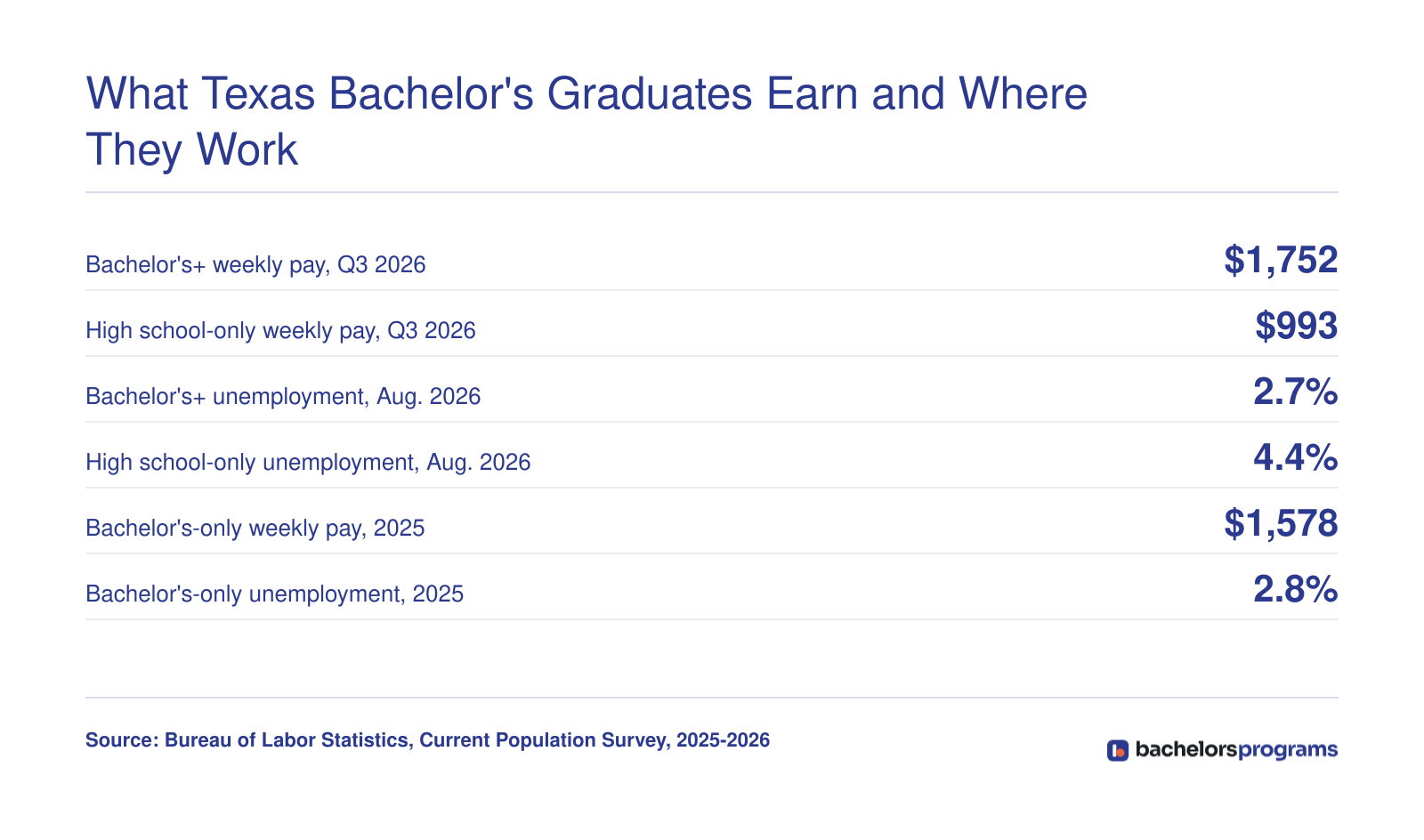
Federal labor data shows a clear pay and job-security gap between bachelor's degree holders and high school graduates aged 25 and older. These national Bureau of Labor Statistics figures cover all bachelor's graduates, not only online students, because outcome data specific to online programs, and to Texas graduates in particular, is limited. The 2025 annual estimates average 11 months because October 2025 survey data was not collected during the federal shutdown, so BLS cautions against comparing them strictly with other years.
Questions to Ask Yourself
Do my community college credits map to the Texas Core and my major's Field of Study?
Can my work schedule absorb live sessions, proctored exams or in-person placements?
Will I be classified as a Texas resident for tuition purposes?
Do I qualify for the TEXAS Grant, and can I keep it enrolled part time?
Colleges in Texas with the most bachelor's programs
| School | City | Type | Bachelor's programs | Online | Net price / yr | Grad rate |
|---|---|---|---|---|---|---|
| Tarleton State University | Stephenville | Public | 106 | 32 | $20,783 | 48% |
| Texas A&M University-College Station | College Station | Public | 102 | 0 | $21,315 | 84% |
| Texas State University | San Marcos | Public | 100 | 24 | $16,805 | 55% |
| Texas Tech University | Lubbock | Public | 100 | 28 | $19,070 | 69% |
| University of North Texas | Denton | Public | 99 | 10 | $15,649 | 61% |
| Baylor University | Waco | Private nonprofit | 94 | 2 | $41,104 | 80% |
| University of Houston | Houston | Public | 94 | 1 | $14,276 | 65% |
| Stephen F. Austin State University | Nacogdoches | Public | 93 | 8 | $14,260 | 53% |
| The University of Texas at San Antonio | San Antonio | Public | 89 | 10 | $10,836 | 53% |
| Sam Houston State University | Huntsville | Public | 89 | 18 | $16,404 | 55% |
| The University of Texas at Arlington | Arlington | Public | 86 | 11 | $13,951 | 54% |
| The University of Texas at Austin | Austin | Public | 86 | 1 | $19,857 | 89% |
| The University of Texas Rio Grande Valley | Edinburg | Public | 85 | 4 | $4,831 | 51% |
| Lamar University | Beaumont | Public | 85 | 39 | $9,366 | 37% |
| Texas Christian University | Fort Worth | Private nonprofit | 83 | 0 | $36,660 | 86% |
Program counts are the verified bachelor's listings in our directory; net price is the school-wide average a first-time undergraduate paid after aid, and graduation rate the share finishing within six years (College Scorecard).
Online Bachelor's Degrees in Texas: Common Questions
These answers cover the questions Texas online students raise most often about cost, residency, out-of-state enrollment, and keeping state grant aid. Rules vary by university, so confirm details with the school before you commit.
What is the cheapest online bachelor's degree in Texas?
Do Texas residents pay less tuition for online bachelor's programs?
Can students living outside Texas enroll in a Texas online bachelor's program?
Can you keep the TEXAS Grant if you drop to part-time or take a semester off?
Compare programs nationwide
Many Texas residents study online. Every ranked list above has an online lens, or browse every field.
Online bachelor's degrees Browse all fields