Online Colleges and Bachelor's Degree Programs in Nevada
Every verified bachelor's program at a college in Nevada: 250+ programs at 14 colleges, with the online options, net price and graduation rates behind each one.

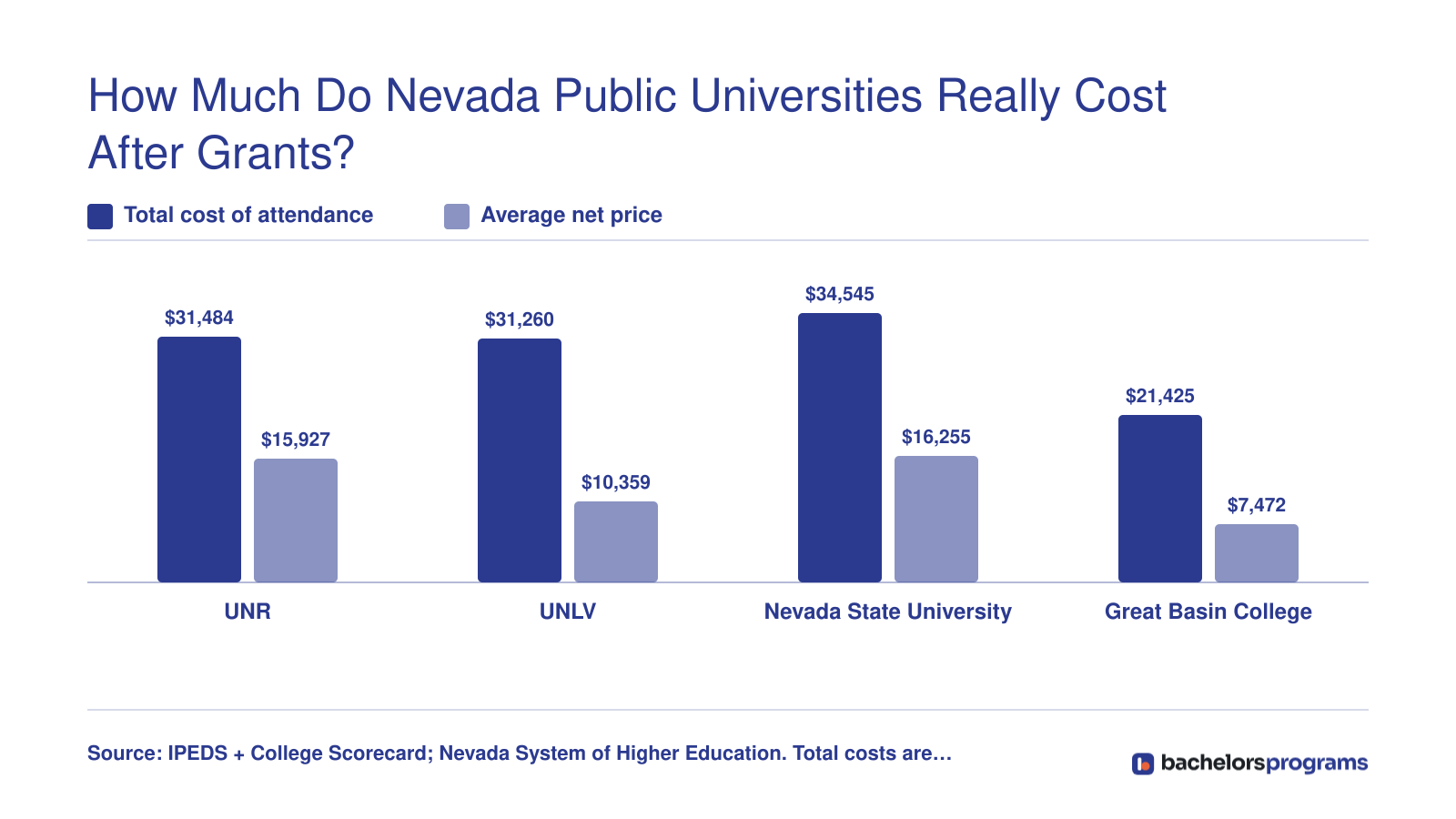
You can earn a bachelor's degree online in Nevada, and residents pay the same per-credit rate online as they do on campus. The variables sit elsewhere: UNR and UNLV add an online distance or technology fee of $144.25 per credit in 2025-26, rising to $156.50 in 2026-27; Great Basin College charges $7.50 per credit; and published cost of attendance at the state's public universities runs from about $31,260 to $34,545 a year before grant aid.
The Nevada System of Higher Education spans universities, a state college and community colleges, some of which award bachelor's degrees. Private and out-of-state online schools recruit the same students, but they sit outside NSHE's common course numbering, the mechanism that makes in-state transfer credit predictable.
Key Points
- Nevada residents pay the same per-credit tuition online as on campus.
- Sticker prices of $31,260 to $34,545 drop sharply after grants.
- The Nevada Promise Scholarship and Silver State Opportunity Grant both require FAFSA.
Popular degrees in Nevada
Bachelor's degrees in Nevada by field
Business & Management
- Finance8 programs
- Management6 programs
- Business Administration4 programs
- Human Resource Management or HR Management3 programs
- Marketing3 programs
- Construction Management3 programs
- Accounting2 programs
- Project Management2 programs
Science & Engineering
- Mathematics6 programs
- Biology4 programs
- Chemistry4 programs
- Environmental Science3 programs
- Biochemistry3 programs
- Natural Resources or Conservation3 programs
- Anthropology2 programs
- Electrical Engineering or Electronics Engineering or Electronic Systems Engineering Technology2 programs
Education & Teaching
- Secondary Education6 programs
- Elementary Education4 programs
- Science4 programs
- Early Childhood Education or Child Development3 programs
- Special Education3 programs
- English Education3 programs
- Mathematics Education3 programs
- History Education2 programs
Arts & Design
- Art or Art Studies6 programs
- Fine Arts or Studio Art6 programs
- Digital Photography3 programs
- Media Arts or Digital Media3 programs
- Graphic Design2 programs
- Art History2 programs
- architecture or architectural2 programs
- Cinematography1 program
Nursing
- Bachelor of Science in Nursing12 programs
- Nursing (RN to BSN)8 programs
- Accelerated BSN (ABSN)4 programs
- LPN/LVN to BSN1 program
Liberal Arts & Humanities
- English4 programs
- Literature or English Literature4 programs
- History3 programs
- Philosophy2 programs
- Spanish2 programs
- Gender & Sexuality Studies2 programs
- Interdisciplinary Studies1 program
- African and African American Studies1 program
Social Work & Social Sciences
- Sociology6 programs
- Social Work3 programs
- Political Science, Government3 programs
- Human Services2 programs
Communications & Media
- Communications3 programs
- Journalism3 programs
- Public Relations2 programs
- Communication Disorders2 programs
- Speech Pathology2 programs
- Social Media1 program
Computers & IT
- Computer Science4 programs
- Computer Engineering2 programs
- Computer Information Systems2 programs
- Cybersecurity1 program
- Software Development & Engineering1 program
- Information Technology1 program
- Innovation or Technological Entrepreneurship1 program
Healthcare
- Public Health3 programs
- Health Sciences3 programs
- Speech Pathology2 programs
- Exercise & Sports Science1 program
- Nutrition1 program
- Respiratory Care Therapy1 program
Psychology
- General Psychology3 programs
- Applied Behavior Analysis1 program
- Clinical Psychology1 program
- Developmental Psychology1 program
Criminal Justice & Law
- Criminal Justice3 programs
- Criminal Justice Administration1 program
- Fire Science or Fire Administration1 program
Natural & Applied Sciences
- Agriculture or Agricultural1 program
- Neuroscience1 program
Counseling
- Substance Abuse Counseling1 program
How Online Bachelor's Degrees Work in Nevada: Fully Online, Hybrid and Degree Completion
Some Nevada students want a degree they never have to drive to campus for. Others want online flexibility with a few required visits. Both exist, and the label on a program tells you which one you are getting.
Three Formats to Know
- Fully online: Every course, advising session and exam happens remotely, though some schools still require a proctored test.
- Hybrid: Most coursework is online, but you attend campus, lab or clinical sessions.
- Online courses only: A traditional on-campus degree where you can take some classes online. This is not a fully online degree.
Many Nevada offerings are degree-completion programs. They assume you already hold an associate degree or roughly 60 credits and need the upper-division coursework to finish a bachelor's.
Asynchronous vs. Live Sessions
Asynchronous courses let you watch lectures and submit work on your own schedule within weekly deadlines. That suits shift workers, including those on Las Vegas casino and hospitality schedules, and parents who study after bedtime. Live-session courses meet at set times by video. They offer more interaction but are harder to fit around a changing work calendar. Check the course schedule before you commit.
Common In-Person Requirements
Expect some physical presence even in online programs:
- Nursing clinicals at approved healthcare sites
- Student-teaching placements in a school
- Proctored exams, at a testing center or by webcam
- Orientation, sometimes virtual and sometimes on campus
Public, Private and Out-of-State Options
Nevada's public universities and state colleges usually charge the lowest per-credit rates to residents, and residency rules decide whether you pay in-state or out-of-state tuition. Private and out-of-state online colleges that enroll Nevada residents often charge one flat online rate regardless of where you live, so residency matters less, though the price can run higher. Any out-of-state school must hold state authorization to serve Nevada students, and that status can affect aid and licensure eligibility.
Can You Earn a Bachelor's Degree Completely Online in Nevada?
Yes, in some majors. Business, general studies and many degree-completion fields can be finished fully online. Clinical and licensure-track fields usually cannot. Confirm the exact format on each school's program page before you apply.
What an Online Bachelor's Costs in Nevada: Per-Credit Tuition and Online Fees
Nevada residents studying online pay the same per-credit rate as on-campus students, while non-residents at UNR, UNLV and Great Basin College pay an extra distance-education charge on top of the base per-credit fee. At the rates below, a resident's tuition for a 120-credit degree runs from about $15,240 at Great Basin College ($16,140 with its $7.50 per-credit fee) to about $36,420 at the 2026-27 rate of $303.50 per credit listed for Nevada State University and several community colleges, before books and other costs. Western Undergraduate Exchange pricing is not part of these schedules, so ask each school's admissions office whether it covers online-only enrollment.
| Institution | Resident Per-Credit Tuition | Non-Resident Per-Credit Tuition | Online/Distance or Tech Fee | Est. 120-Credit Resident Tuition | Fee Schedule Year |
|---|---|---|---|---|---|
| University of Nevada, Reno (UNR) | $281.00 (2025-26); $288.50 (2026-27) | Resident rate plus distance-education charge | $144.25 per credit (2025-26); $156.50 per credit (2026-27) | $34,620 at the 2026-27 rate | 2025-26 and 2026-27 (NSHE) |
| University of Nevada, Las Vegas (UNLV) | $281.00 (2025-26); $288.50 (2026-27) | Resident rate plus distance-education charge | $144.25 per credit (2025-26); $156.50 per credit (2026-27) | $34,620 at the 2026-27 rate | 2025-26 and 2026-27 (NSHE) |
| Nevada State University | $281.00 (FY 2025); $288.50 (FY 2026); $303.50 (FY 2027) | N/A | N/A | $36,420 at the FY 2027 rate | FY 2025 to FY 2027 (NSHE operating budget) |
| Great Basin College (GBC) | $127.00 | $127.00 per-credit fee plus $63.50 distance-education tuition | $7.50 per credit (applies to all GBC courses) | $15,240 | 2025-26 (GBC Fees Addendum) |
| College of Southern Nevada | $281.00 (FY 2025); $288.50 (FY 2026); $303.50 (FY 2027) | N/A | N/A | $36,420 at the FY 2027 rate | FY 2025 to FY 2027 (NSHE operating budget) |
| Western Nevada College | $281.00 (FY 2025); $288.50 (FY 2026); $303.50 (FY 2027) | N/A | N/A | $36,420 at the FY 2027 rate | FY 2025 to FY 2027 (NSHE operating budget) |
| Truckee Meadows Community College | $281.00 (FY 2025); $288.50 (FY 2026); $303.50 (FY 2027) | N/A | N/A | $36,420 at the FY 2027 rate | FY 2025 to FY 2027 (NSHE operating budget) |
How Much Do Nevada Public Universities Really Cost After Grants?
Published cost of attendance at UNR, UNLV and Nevada State University runs from $31,260 to $34,545 a year, but average net price, what students pay after federal, state and institutional grants and scholarships, is far lower, and lower-income students typically pay less than the average. UNLV's average net price of $10,359 is roughly one-third of its $31,260 total cost. Grant aid is common: in 2022-23, 89% of full-time, first-time undergraduates at Nevada State University and 65% at Great Basin College received grant or scholarship aid.
Financial Aid for Nevada Online Students: Millennium Scholarship, Nevada Promise and More
Both the Silver State Opportunity Grant and the Nevada Promise Scholarship require a completed FAFSA, so filing it is your first step regardless of how you take classes.1 The FAFSA also determines your eligibility for the federal Pell Grant, whose maximum award is reset each year. Online students in eligible programs at accredited colleges qualify for federal aid the same way campus students do.
Nevada's State Scholarships and Grants
Nevada's three main state programs work differently, and credit load matters more than delivery format.
- Silver State Opportunity Grant: Designed for low-income students at Nevada System of Higher Education (NSHE) community and state colleges. You need a Student Aid Index of 8,500 or less, enrollment in a degree or certificate program, at least 12 credits that count toward that program, and college readiness in math and English.1 Awards are prorated below 15 credits, so a 12- to 14-credit load earns a reduced grant, and fewer than 12 credits does not qualify.1 NSHE does not publish a separate rule for fully online students.
- Governor Guinn Millennium Scholarship: Run by the Nevada State Treasurer for Nevada high school graduates who meet academic requirements.5 Award amounts and credit-load minimums are set by program rules that can change, so confirm the current terms with the Treasurer's office before counting on this money for an online or part-time schedule.
- Nevada Promise Scholarship: A statewide program aimed at community college students.2 It doesn't fund the full bachelor's degree directly, but it can lower the cost of your first two years if you plan to transfer to a university.
Military and Veteran Benefits
Under state law, active members of the Nevada National Guard in good standing can take state-supported undergraduate and graduate courses without paying the registration fee or resident tuition.3 The waiver is available only for fall and spring semesters, and it explicitly covers distance education.3 You must keep a 2.00 semester GPA. It does not pay for the Health Service fee or travel, and it excludes law, medical and dental programs.4 The child or spouse of a Guard member killed in the line of duty may also qualify, generally for up to 10 years.4
Active-duty service members stationed in Nevada, along with their spouses and dependent children, pay in-state tuition.3 Veterans honorably discharged while stationed in Nevada are treated as residents, and any honorably discharged veteran is exempt from nonresident tuition within two years of discharge.3 GI Bill benefits can be combined with these rules, and many NSHE campuses also offer their own institutional scholarships.
Before You Enroll
Ask your school's financial aid office in writing whether each state award applies to your program's delivery format and your planned credits per term. The difference between 11 and 12 credits can determine whether you get a grant at all.
Transferring Credits Into a Nevada Online Bachelor's Program
Nevada's public system has spent years tightening how credits move between its community colleges and universities, which matters when you transfer into an online program. The Nevada System of Higher Education (NSHE) uses common course numbering, so equivalent courses share the same prefix, number, title and credits.1 A commonly numbered course generally transfers as the same course, and you typically cannot be made to retake it unless a higher grade is a published degree requirement.3
What the Associate Degree Guarantee Covers
The transfer degrees are the AA, AS and AB, each built on 60 credits.2 A transferable associate degree is the primary basis for admission with junior standing at another NSHE institution, regardless of your community college GPA.4 It also automatically satisfies lower-division general education at any NSHE school.
What it does not guarantee is that you have finished everything for your major. Prerequisites for a specific bachelor's program can still be missing, particularly in sciences, nursing-related fields and business. NSHE requires agreements for each bachelor's program with a matching associate program, including a year-by-year course outline.5 Following the agreement for your intended major should mean no lost credits, while a general associate degree without a major emphasis leaves more room for gaps.
Credit Limits and Residency
Vocational and community-service courses are the usual exceptions to transferability. Baccalaureate-level courses in a transfer degree should transfer at least as general electives. Each university also sets its own residency rule, meaning a minimum number of upper-division credits earned at the degree-granting school. Confirm that figure with your target campus, since it determines how much of your degree you must complete there.
Prior Learning and Old Credits
Adults returning after a gap should ask about CLEP exams, military transcripts and portfolio review, since policies vary by institution. Gather every old transcript early. Older credits may still count, though some programs review the age of science or technical courses.
Will My Community College Credits Transfer?
Follow these steps before you apply:
- Run a degree audit: Ask your current college to map completed courses against the bachelor's major you want.
- Use the transfer tool: Check the NSHE transfer and articulation resources and the published agreement for your major.
- Request an evaluation: Ask the university's admissions or transfer office for an unofficial review of your transcripts before you commit.
- Get advising at both schools: Written confirmation protects you if course requirements change.
Accreditation and Licensure: How to Verify a Nevada Online Program
Accreditation is the single credential that determines whether your online degree counts for federal aid, transfer credit, graduate school admission, or a professional license. Verify it before you apply, not after you enroll.
Institutional accreditation in Nevada
Nevada's public institutions are accredited by the Northwest Commission on Colleges and Universities (NWCCU), the regional accreditor for the Northwest1. The University of Nevada, Reno has held NWCCU accreditation since 1938, UNLV since 1964, the College of Southern Nevada since 1975, and Nevada State University since 2006. Accreditation is not permanent: NWCCU schedules recurring evaluations, with UNLV's last review in spring 2025 and the next set for fall 20272, Nevada State evaluated in fall 20253, and Western Nevada College reviewed in spring 2026 with a follow-up in spring 20274. Confirm current status with the accreditor rather than relying on a school's marketing page.
Programmatic accreditation
Institutional accreditation alone does not qualify you for licensure in a regulated field. Nursing programs should carry CCNE or ACEN accreditation: UNLV's School of Nursing is CCNE-accredited through June 30, 2034, with its next on-site evaluation in fall 2033, and the Orvis School of Nursing at UNR is also CCNE-accredited. UNLV states its BSN aligns with Nevada licensure requirements under NRS 632 and NAC 632. Look for CAEP for teacher preparation, ABET for engineering and computing, and AACSB for business. Verify these with the programmatic accreditor directly, since a school's regional accreditation says nothing about a specific program.
A three-step check
- Step one: Search the school's legal name in DAPIP, the U.S. Department of Education's accreditation database, to see its accreditor, accreditation dates, and any warning, probation, show-cause, or termination action.
- Step two: Cross-check in CHEA's directory, then confirm against the accreditor's own current listing.
- Step three: For licensure fields, look the program up in the CCNE, ACEN, CAEP, ABET, or AACSB directory.
Red flags and out-of-state schools
Treat unrecognized accreditors as disqualifying. Credits from such schools frequently fail to transfer to NSHE institutions and may not satisfy Nevada licensure boards. State authorization is a minimum operating requirement, not a quality judgment. Nevada participates in NC-SARA through the Nevada Commission on Postsecondary Education, but participation is institution-by-institution, so check your out-of-state school in the NC-SARA directory.
Nevada Nursing and Teaching Licensure for Online Graduates
Admission Requirements and Deadlines for Online Applicants
Nevada's public universities publish separate rules for first-year and transfer applicants. Confirm the current requirements with each school, because online and degree-completion programs can add their own steps.
- Transfer GPA and credit thresholdAt UNLV, transfer admission needs 24 transferable semester credits with at least a 2.50 cumulative GPA in those credits. Applicants with fewer than 24 credits are reviewed under first-year requirements.
- Upper-division transfersUNR accepts transfers with more than 60 credits, but at least 60 credits toward the degree must come from a four-year institution. Transfers with 60 or more credits must declare a major by the end of their first semester.
- Adult and second-chance applicantsUNLV lets students who fall short of the transfer GPA take courses elsewhere, raise their GPA and reapply as transfers.
- Fall deadlinesUNLV's first-year priority date is November 15, and its final first-year deadline is June 1. Its transfer priority date is March 15, and its final transfer deadline is July 1. UNR's fall transfer deadline is also July 1.
- Spring deadlinesSpring applications are due December 1 at UNLV and December 15 at UNR. Ask online programs whether they offer accelerated sessions with later start dates.
- Transcripts and residencySend official transcripts from every college you have attended. Be ready to document Nevada residency to qualify for in-state tuition.
- FAFSAFile the FAFSA as early as possible and meet each school's financial aid priority date, which can come well before the admission deadline.
Graduation Rates, Career Outcomes and Online Student Support
When you weigh an online bachelor's degree, completion and retention data from Nevada's public universities tells you more than a program's marketing page. They show how often students actually finish and how much support they may need along the way.
What Nevada's Completion and Retention Numbers Show
At UNLV, the six-year graduation rate for full-time, first-time students rose from 47.1% for the 2015 cohort to 51.6% for the 2019 cohort, then settled at 50.9% for 2020. The university's one-year retention rate has held between roughly 77% and 79% from 2020 through 2025. UNR reports a six-year rate of about 61%.1 These figures use the federal IPEDS definition: completion within 150% of normal time, or six years for a bachelor's degree.2 Transfer students and part-time learners often need longer, so the published rates understate how many eventually finish.
Earnings After Graduation
The Census Bureau's American Community Survey is the most consistent source for comparing Nevada earnings by education level. Across recent releases, median annual earnings for bachelor's degree holders in the state have run above those for high school graduates, though the gap varies widely by field, age and year. A degree is not a guarantee of higher pay in every occupation, so compare program-level outcomes when a college publishes them. Check the latest Nevada ACS table rather than relying on a national average.
Support Services Online Students Should Expect
Ask any online program what it provides before you enroll. A strong program typically offers:
- Advising: A dedicated advisor who understands online and transfer credit policies.
- Tutoring and writing help: Online tutoring, writing centers and subject-specific coaching.
- Library access: Full remote access to databases, e-books and research help.
- Career services: Resume review, job fairs and employer connections for online students.
- Disability services: Accommodations arranged remotely, not only on campus.
Ask whether career services are staffed for online learners or shared with campus students, and confirm that advising is available in the evenings if you work. Request completion and retention data specific to online students when the program tracks it. Campus-wide rates are a starting point, not a verdict on the online experience.
The Bachelor's Degree Earnings Gap in Nevada
A bachelor's degree carries a clear pay advantage in Nevada.
How to Choose the Right Nevada Online Bachelor's Program
Choosing an online bachelor's program means weighing five factors against your own situation: whether the degree will be recognized, what it will really cost, how much of your past work counts, how the courses are delivered, and whether the school helps students finish. Work through them in this order, because a problem at the top of the list cannot be fixed by a strength lower down.
The Five-Part Checklist
- Accreditation and licensure fit: Confirm regional accreditation, and for nursing or teaching, confirm the program leads to Nevada licensure.
- Total net cost after aid: Compare your out-of-pocket cost once grants and scholarships are applied, not the published tuition rate.
- Transfer credit accepted: Ask how many of your credits apply to the major, not just to the degree overall.
- Format and in-person requirements: Check for on-campus residencies, clinical hours, student teaching, proctored exams and fixed login times.
- Support and outcomes: Look at graduation rates, advising for online students, and career services access.
A Simple Starting Framework
Nevada residents who already have college credits should usually compare the NSHE options first. Public universities in the system tend to offer the clearest path for community college credits and in-state pricing, and that combination often decides the cost question before anything else does. Private and out-of-state schools make the most sense when they offer a major NSHE does not, or a schedule that fits work and family better, such as start dates throughout the year.
Before You Apply
Pick two or three schools and request two things from each:
- An unofficial transcript evaluation, so you see which credits are accepted before you commit.
- Net price calculator results, so you can compare real costs side by side.
Put the answers in one simple comparison chart. Differences in accepted credits and net cost can add up to a full semester or thousands of dollars.
Build your shortlist from the college and program listings on this page. Use them to find programs in your field, then run each one through the checklist above.
Colleges in Nevada with the most bachelor's programs
| School | City | Type | Bachelor's programs | Online | Net price / yr | Grad rate |
|---|---|---|---|---|---|---|
| University of Nevada-Las Vegas | Las Vegas | Public | 83 | 20 | $10,359 | 51% |
| University of Nevada-Reno | Reno | Public | 78 | 5 | $15,927 | 61% |
| Nevada State University | Henderson | Public | 45 | 3 | $14,068 | 34% |
| Great Basin College | Elko | Public | 17 | 16 | $8,471 | 41% |
| College of Southern Nevada | Las Vegas | Public | 8 | 4 | $6,615 | 19% |
| Truckee Meadows Community College | Reno | Public | 8 | 5 | $8,312 | 32% |
| Western Nevada College | Carson City | Public | 3 | 2 | $12,732 | 41% |
| Chamberlain University-Nevada | Las Vegas | Private for-profit | 3 | 2 | $27,073 | 20% |
| Las Vegas College | Las Vegas | Private for-profit | 2 | 2 | $29,880 | — |
| Roseman University of Health Sciences | Henderson | Private nonprofit | 2 | 2 | — | — |
| Touro University Nevada | Henderson | Private nonprofit | 2 | 2 | — | — |
| Galen Health Institutes-Las Vegas | Las Vegas | Private for-profit | 2 | 1 | $24,190 | — |
| Carrington College-Las Vegas | Las Vegas | Private for-profit | 1 | 1 | $43,570 | — |
| Arizona College of Nursing-Las Vegas | Las Vegas | Private for-profit | 1 | 0 | $30,921 | 82% |
Program counts are the verified bachelor's listings in our directory; net price is the school-wide average a first-time undergraduate paid after aid, and graduation rate the share finishing within six years (College Scorecard).
Nevada Online Bachelor's Degree FAQs
These answers sum up the cost, residency, aid and community college questions Nevada online students ask most. Confirm current figures with the school you are considering.
How much does an online bachelor's degree cost in Nevada?
Do online students pay in-state tuition at Nevada public universities?
Can I use the Millennium Scholarship if I study part-time or online?
Can I earn a bachelor's from a Nevada community college online?
Compare programs nationwide
Many Nevada residents study online. Every ranked list above has an online lens, or browse every field.
Online bachelor's degrees Browse all fields