Best Computer Science Degree Programs
Compare 1,500+ accredited Computer Science programs at 1,050+ colleges, with net price after aid, graduation rates, earnings and debt from IPEDS and the U.S. College Scorecard.

Prestige rankings of computer science departments reward graduate research output, not what an undergraduate pays. The price spread in this field is real: one public university here charges out-of-state students $47,265 in tuition and fees for a CS bachelor's, while a small Baltimore college charges $9,780 flat, in-state or out.
The ranking below judges bachelor's programs, online and on campus, on College Scorecard outcomes: net price, typical debt, and early earnings, alongside ABET status and BS-versus-BA structure.
Debt is the figure applicants skip most often, and the one that stays longest.
Key Points
- Princeton's average net price is $6,128, despite tuition above $62,000.
- Selectivity ranges widely, from Stanford's 4% admit rate to near-open admission.
- A "fully accredited" label usually signals institutional, not ABET, accreditation.
The 10 Best Computer Science Degree Programs, Ranked
These ten programs run from a 4% admit rate at Stanford to a near-open-admission program for Jewish women in Baltimore, so the right fit often sits further down the list than you would guess. Each card adds program-level median earnings four years after finishing and median debt where it is published, along with the admission and Pell figures that show who actually enrolls. Start with the standout line on every card: it names the one thing that school does better than anyone else here.
University of California-Berkeley
#1Berkeley, CA · ~$13,000/yr (est.)
Best for: California community college transfers
Berkeley's computer science major runs through the Electrical Engineering and Computer Science department, with a defined lower- and upper-division path, dedicated advising, and a junior transfer route. It graduates 93% of students and admits roughly 11% of applicants, pairing intense selectivity with a large, well-supported undergraduate body, and about 70% of students are Pell-eligible. Research, an honors program, study abroad and tutoring sit alongside the degree. Standout: the highest four-year median earnings among the public universities here, at $204,379.
- Junior transfer pathway into the CS major
- Transfer applicants need 60 UC-transferable semester units
- Admits directly into the major, no undeclared entry
- Dedicated advising for academic planning and enrollment
- No SAT or ACT scores used in admission decisions
- Guidance on declaring the major and enrolling in CS classes
- Median earnings of $204,379 four years after finishing
- Median debt for CS completers: $13,900
Women's Institute of Torah Seminary and College
#2Baltimore, MD · $10,000 – $15,000/yr (est.)
Best for: Jewish women entering technology careers
The Women's Institute of Torah Seminary and College in Baltimore offers a Bachelor of Arts in Computer Science that pairs technical training with a liberal arts core and 36 credits of advanced Jewish studies. It graduates 100% of students and admits close to everyone who applies (98%), making it the most accessible entry point on this list. A 9 to 1 student-faculty ratio and a required senior seminar project keep the experience small and hands-on. Standout: a CS credential designed specifically for Jewish women entering a field where women remain underrepresented.
- 120 total credit hours, 36 of them in the major
- Coursework in Java, Python, data structures and networks
- 36 credits of Jewish studies required alongside the major
- At least 30 credits must be taken at WITS
- 9 credits of advanced mathematics required
- Senior seminar project builds a portfolio piece
- Double major in Judaic Studies available
- Prepares graduates for business, industry and government roles
Princeton University
#3Princeton, NJ · ~$6,000/yr (est.)
Best for: Research-bound students wanting a thesis
Princeton's computer science program combines a rigorous core with interdisciplinary work and a required senior thesis, so every major leaves with independent research behind them. It graduates 98% of students, second only to WITS here, and admits about 5% of applicants. Students work closely with faculty advisers, can study abroad, and receive support for conference travel. Standout: every CS major completes independent work and a thesis, which is unusually research-heavy for an undergraduate degree.
- Independent work and a senior thesis required of every major
- Coursework spans core theory through emerging applications
- Interdisciplinary study built into the major
- Study abroad and conference funding supported
- Faculty advisers guide thesis research
- Median earnings of $217,973 four years after finishing
Stanford University
#4Stanford, CA · $10,000 – $15,000/yr (est.)
Stanford's CS major requires 93 units in the major and offers ten subplans, from artificial intelligence and computational biology to an individually designed option. It graduates 92% of students and admits about 4% of applicants, the most selective program in this ranking. A three-unit senior project capstone and a 3.6-GPA honors thesis option give students room to build depth, and the degree prepares graduates for industry, law, government or graduate study. Standout: the breadth of subplans, including a build-your-own path.
- 93 units in the major, 180 university units overall
- Senior capstone project required (3 units)
- Subplans range from AI to computational biology to HCI
- 26 units of math and 11 units of science required
- Honors program requires a 3.6 GPA and a thesis
- Median earnings of $214,907 four years after finishing
- Median debt for CS completers: $12,000
Massachusetts Institute of Technology
#5Cambridge, MA · ~$20,000/yr (est.)
MIT's Course 6-3 in Computer Science and Engineering is an intensive, build-first degree: 177 units in the major, two communication-intensive subjects, and access to the Undergraduate Research Opportunities Program. It graduates 96% of students and admits about 5% of applicants. Students can focus their electives in computer science, artificial intelligence and decision making, or electrical engineering, and the program sits inside the Schwarzman College of Computing. Standout: the highest four-year median earnings in this ranking, at $225,141.
- Course 6-3 requires 177 units in the major
- Elective focus in CS, AI and decision making, or EE
- Two communication-intensive subjects inside the major
- Undergraduate Research Opportunities Program access
- Part of the Schwarzman College of Computing
- Median earnings of $225,141 four years after finishing
- Median debt for CS completers: $12,000
University of Illinois Urbana-Champaign
#6Champaign, IL · ~$14,000/yr (est.)
Illinois Urbana-Champaign's B.S. in Computer Science sits in the Siebel School of Computing and Data Science and requires no prior programming experience, which widens the on-ramp for beginners. It graduates 85% of students and admits about 42% of applicants, a realistic target for strong students who cannot count on a single-digit admit rate. Nine concentration options, a 95% internship or co-op rate, and guaranteed admission to the school's master's programs for eligible graduates make a strong value case. Standout: a built-in pipeline from the bachelor's into a master's degree.
- No prior programming experience required
- Nine concentration options, including AI and cybersecurity
- Guaranteed master's admission for eligible graduates
- 95% of students complete an internship or co-op
- Median earnings of $181,981 four years after finishing
- Median debt for CS completers: $20,500
University of California-Los Angeles
#7Los Angeles, CA · $13,000/yr (est. net price)
UCLA's Bachelor of Science in Computer Science is a broad, rigorous degree in the foundations of computing, delivered inside one of the largest public research universities in the country. It graduates 93% of students and admits about 9% of applicants, the most selective of the UC campuses ranked here. Students build analytical and problem-solving depth in a large research setting with a well-known alumni base. Standout: the lowest admission rate among the UC schools on this list.
- Offered as a stand-alone Bachelor of Science major
- Curriculum covers the foundations of computing
University of Maryland-College Park
#8College Park, MD · $16,000/yr (est. net price)
Maryland's B.S. in Computer Science pairs a general track with named specializations in cybersecurity, data science, quantum information and machine learning. It graduates 89% of students and admits about 45% of applicants, the most accessible admission rate among the big public flagships listed. Benchmark reviews at 45 and 75 credits keep students on pace, and 12 upper-level credits must come from outside computer science. Standout: the largest CS graduating cohort here, at 954 completions.
- Tracks: General Track plus cybersecurity, data science, quantum and ML
- Benchmark reviews at 45 and 75 credits
- Minimum grade of C- in CMSC131, CMSC132, CMSC330 and CMSC351
- 12 upper-level credits required outside computer science
- Exemption exams available for prior coursework
- Median earnings of $137,931 four years after finishing
- Median debt for CS completers: $20,000
University of California-Irvine
#9Irvine, CA · $14,000/yr (est. net price)
UC Irvine's B.S. in Computer Science builds a foundation in programming, data structures, algorithms and architecture, then opens into seven focus areas, from AI and machine learning to networks and cybersecurity. It graduates 87% of students and admits about 29% of applicants. Two required project-based courses and an optional joint CS and engineering degree give students applied experience before they graduate. Standout: required project courses plus a joint engineering degree option.
- Seven focus areas, from AI to networks and security
- Two required project-based design courses
- Joint computer science and engineering degree option
- Sample four-year plan laid out by quarter
- Median earnings of $127,404 four years after finishing
- Median debt for CS completers: $15,500
University of California-San Diego
#10La Jolla, CA · $10,000 – $15,000/yr (est.)
UC San Diego's B.S. in Computer Science is the largest undergraduate major in the department, with a rigorous math and programming foundation and upper-division work in algorithm design and large-scale software systems. It graduates 86% of students and admits about 27% of applicants. Three focus tracks (systems, theory, and applications of computing) plus cross-disciplinary electives from cognitive science, electrical engineering, linguistics and mathematics give the degree unusual breadth. Standout: graduate-level courses can count toward the undergraduate major.
- Three focus tracks: systems, theory, and applications
- Cross-disciplinary electives in cognitive science, ECE and math
- Graduate-level courses can count toward the major
- CSE Honors Program for high-achieving students
- Transfer students get tailored multi-year plans
- Median earnings of $159,487 four years after finishing
- Median debt for CS completers: $16,550
Cost & outcomes by school
Federal data for the highest-earning Computer Science programs, independent of the ranking above. Earnings are this field's bachelor's graduates four years after completing where the Scorecard reports them, else the school's undergraduate median.
| School | Net price / yr | Grad rate | Earnings | Debt | Grads/yr | Format |
|---|---|---|---|---|---|---|
| Carnegie Mellon University PA | $31,944 | 94% | $268,121 | $21,442 | 315 | Campus |
| Massachusetts Institute of Technology MA | $20,111 | 96% | $225,141 | $11,077 | 362 | Campus |
| Princeton University NJ | $6,128 | 98% | $217,973 | $10,320 | 194 | Campus |
| Pomona College CA | $19,285 | 93% | $217,051 | $11,782 | 77 | Campus |
| Stanford University CA | $13,807 | 92% | $214,907 | $10,399 | 446 | Campus |
| Brown University RI | $25,184 | 96% | $214,479 | $11,500 | 286 | Campus |
| Williams College MA | $17,716 | 94% | $209,574 | $12,208 | 68 | Campus |
| University of California-Berkeley CA | $13,481 | 93% | $204,379 | $13,750 | 1,029 | Campus |
| Harvard University MA | $19,066 | 98% | $203,169 | $14,000 | 264 | Campus |
| Dartmouth College NH | $29,519 | 96% | $201,702 | $18,490 | 156 | Campus |
| California Institute of Technology CA | $16,075 | 94% | $200,511 | — | 88 | Campus |
| Harvey Mudd College CA | $35,924 | 92% | $198,257 | $22,949 | 54 | Campus |
Sources: U.S. Department of Education. Net price, graduation rate, earnings and debt: College Scorecard (earnings and debt for this field's bachelor's graduates where reported, else school-wide); graduates: IPEDS. A dash means no figure is reported.
Cost, debt & payoff
Median earnings of this field's bachelor's graduates (4 yrs after completing, else the school's undergraduate median) vs. their median federal loan debt · U.S. College Scorecard
Across these programs the median graduate earns about $62,377 and finishes with roughly $23,026 in debt — a ratio that clears a common rule of thumb (keep debt below first-year salary). Net price and debt vary widely school to school, so check the per-school figures in the table above before you shortlist.
Our Method: Ranking CS Programs on Student Outcomes, Not Prestige
Most CS rankings still lean on peer reputation and graduate research output, which tells an undergraduate little about the bill or the paycheck. We started from the other end: what a student pays, what a graduate earns, and whether students actually finish.
The ranking weighs these factors:
- Net price after aid: what families pay once grants are applied, not sticker tuition.
- Graduation and retention: how many students finish, and how many return after the first year.
- Program-level earnings and debt: median pay and federal borrowing for computer science bachelor's graduates, from the College Scorecard.
- Pell grant share: a signal of access for lower-income students.
- Format availability: whether a campus, online or hybrid route exists.
Treat the order as a guide to outcomes, not a verdict on teaching quality.
How current the figures are
Institution-level figures come from the 2024 Scorecard snapshot. Program-level earnings and debt come from the 2022 outcomes release, so very recent hiring swings are not captured.
Caveats to keep in mind
Graduation rate, retention and net price describe the whole institution, not the CS major alone. Earnings windows also differ by program: some schools report pay one year after completion, others four or five years. Compare those figures across schools with that gap in mind.
Online vs. On-Campus Computer Science Degrees: Cost, Flexibility and Accreditation
Is an online computer science degree actually cheaper than going to campus? Often the sticker price is lower, but the answer depends on how you measure cost and what you need from the program.
Cost: Per-Credit Rates vs. Net Price
Online programs publish a per-credit rate. For 2026, Oregon State Ecampus lists $480 per quarter credit for its Computer Science B.S. Arizona State University Online charges $580 per credit plus program fees. Penn State World Campus lists $644 per credit for students with 59 or fewer accumulated credits and $692 at 60 or more, though that program is Information Sciences and Technology, not a straight CS degree.
These rates are not the net price figures in the rankings above. Net price is the federal Scorecard average after grants and scholarships, drawn mostly from on-campus students. Per-credit tuition is a rate before aid. Quarter credits and semester credits also differ, so multiply by the credits a degree requires before comparing totals.
Flexibility, Support and Accreditation
The ranked schools include campus options and online options, and several offer both. Weigh these differences when comparing formats.
- Schedule: Online courses suit work and family; campus courses follow a fixed timetable.
- ABET availability: Do not assume an online track carries the same accreditation as the campus one. Check ABET's search tool for the exact program.
- Recruiting and internships: Campus students get career fairs, on-site employers and easier peer networking.
- Support: Ask online programs about tutoring hours, advising and how quickly instructors respond.
- Labs and projects: Campus teams meet in person. Online teams collaborate through code repositories and video, which mirrors remote work.
Who Each Format Suits
Online study fits working adults and career changers who need to keep earning and can manage their own time. Campus study fits first-time students who want structured recruiting pipelines, in-person teamwork and a direct route to internships. If you are unsure, favor the format that gives you ABET accreditation and a clear path to your first tech job.
ABET-Accredited Computer Science Programs: Why It Matters and How to Check
The question with ABET is not whether a college is legitimate. It is whether one specific program has passed an extra, discipline-level review that certain employers and evaluators care about.
Two Layers of Accreditation
Every legitimate college holds institutional (regional) accreditation, which covers the school as a whole. ABET is a separate, optional layer. Its Computing Accreditation Commission reviews individual computing programs at the associate, bachelor's and master's levels.1 A U.S. search of ABET's bachelor's computer science category returns 187 programs, and that search can include programs offered 100% online.2
Where Online Programs Stand
Status varies among online options. Arizona State University describes its online BS in Computer Science as ABET accredited. Old Dominion University's BS in Computer Science, which runs 120 credits online, is accredited by the Computing Accreditation Commission. A 2026 listing marks Boise State, George Mason and UT Arlington as ABET accredited in both online and campus formats. The same listing marks the online programs at Champlain College and Davenport University as not ABET accredited. A separate 2026 review counted 34 of 56 online bachelor's CS programs as ABET accredited.
When It Matters Most
ABET carries the most weight for certain federal and defense jobs, some graduate admissions and international credential evaluations, and engineering-adjacent employers. If any of those paths interests you, treat ABET as a must-have.
How to Verify in Three Steps
- Search by school: Look up the institution in ABET's Accredited Program Search, including any campus ranked on this page.
- Match the degree name: Confirm the listed program is the exact degree you plan to earn, not a similarly named major.
- Check delivery mode or campus: A campus listing does not automatically cover an online version. Use ABET's online search, which covers programs evaluated as 100% online, or confirm your campus appears.
Related Articles
Computer Science Degree Cost, Debt and Earnings: Best-Value Picks
Every best-value pick below is a private university with published tuition and fees above $62,000, yet financial aid brings the average net price down to between $6,128 at Princeton and $16,075 at Caltech. That gap is why sticker price is a poor guide to value: a public school with lower tuition can still cost a family more if it offers less need-based aid, so the better test is what you actually pay against what graduates earn and owe. According to the U.S. Department of Education's College Scorecard, computer science graduates at these schools earned a median of more than $138,000 one year after finishing, while median federal debt sat near $10,000 where it is reported. Treat the value ordering as directional rather than a guarantee, because the earnings-to-debt measure behind it uses school-wide earnings for all graduates ten years after entry, not computer science majors alone.
| School | Location | Average Net Price | CS Median Earnings, 1 Year After Graduation | CS Median Earnings, 4 Years After Graduation | Median Federal Debt at Completion | Median 10-Year Monthly Payment |
|---|---|---|---|---|---|---|
| California Institute of Technology (Caltech) | Pasadena, CA | $16,075 | $173,344 | $200,511 | N/A | N/A |
| Princeton University | Princeton, NJ | $6,128 | $146,624 | $217,973 | $10,320 (school-wide) | N/A |
| Stanford University | Stanford, CA | $13,807 | $138,613 | $214,907 | $10,399 | $110 |
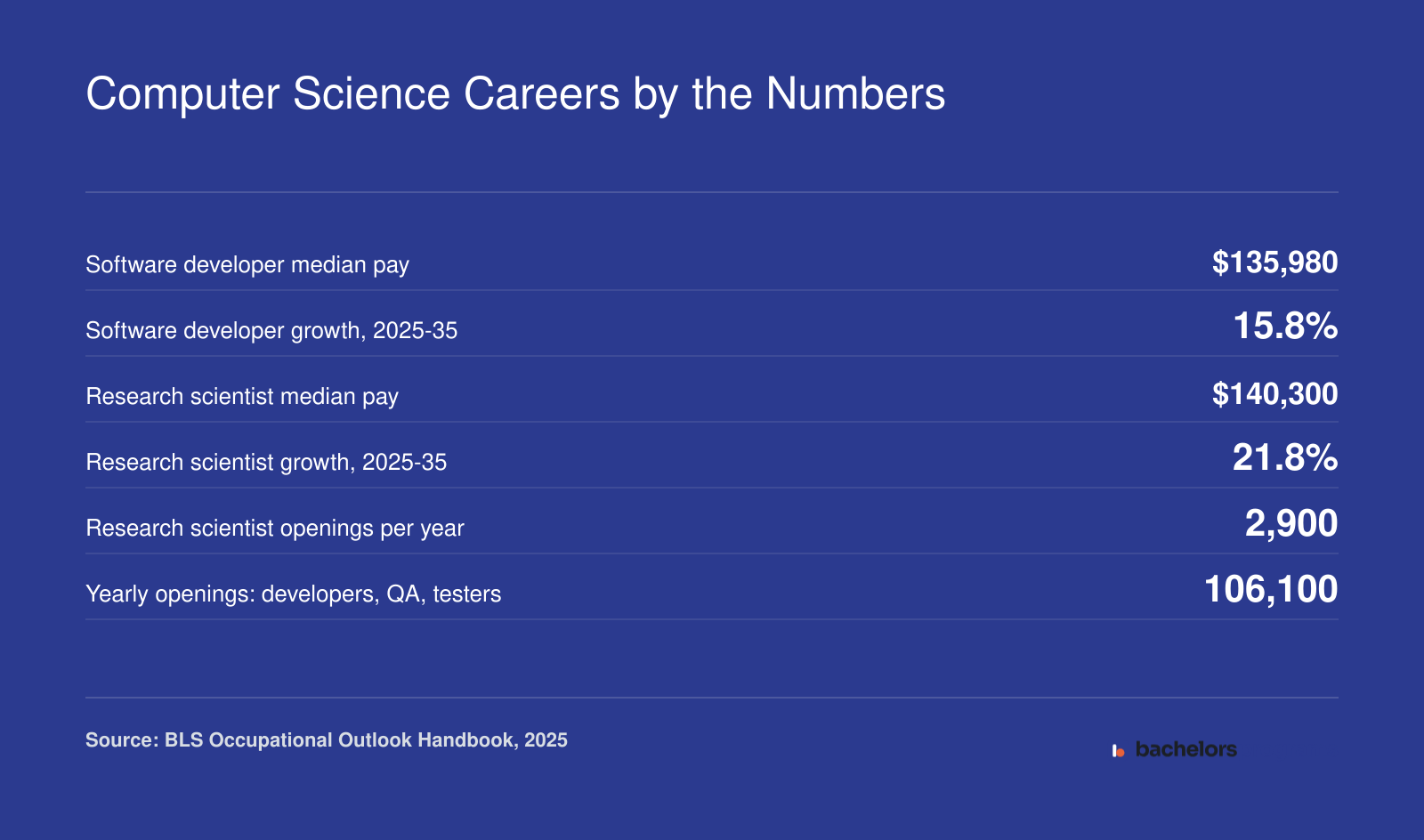
Computer Science Careers by the Numbers
These Bureau of Labor Statistics figures are national wages and projections for two core computer science occupations, using May 2025 pay data and 2025-2035 job projections. They cover everyone in those jobs nationwide, so they are not the same as the program-graduate earnings shown in the cost and value table elsewhere in this article. Use them to gauge where a CS degree can lead, not what a specific program's graduates earn.
Questions to Ask Yourself
Do you want AI or machine learning research work, or product and design roles?
Will your target employer or graduate path expect an ABET-accredited degree?
Do you need asynchronous online classes, or on-campus recruiting for your first internship?
How many of your existing credits will a CS department actually accept toward the major?
Computer Science programs by state
Quick Answers: What Students Ask Before Picking a CS Program
These are the questions prospective CS students raise most often. Each answer is short, and the sections below go deeper on online formats and ABET accreditation.
Are online computer science degrees ABET accredited?
What is the difference between a BA and BS in computer science?
How much math do you need for a computer science degree?
Can community college credits transfer into a computer science bachelor's program?
Do employers view an online computer science degree differently from a campus degree?
Compare Computer Science programs on the data that matters
Explore more Computers & IT majors or browse every field of study.
All Computers & IT programs Browse every field of study