Best LPN to BSN Programs
Compare 220+ accredited LPN to BSN programs at 210+ colleges, with net price after aid, graduation rates, earnings and debt from IPEDS and the U.S. College Scorecard.

Average net price among the schools ranked here runs from roughly $6,555 a year at California State University-Fullerton to about $57,632 at Felbry College in Columbus, a spread wide enough to decide which program is realistic for a working nurse.
The narrower question is which bachelor's program gets you to NCLEX-RN eligibility and a BSN fastest without discarding the practical nursing credit you already hold. The programs themselves range from fully online coursework with clinicals placed near you to cohort-based campus pathways and hybrid advanced-placement tracks.
Credit for an LPN license is awarded program by program, and the schools granting the most of it usually attach the tightest conditions.
Key Points
- Full-time LPN to BSN students typically finish in 24 to 36 months.
- Mt. Hood's itemized nursing estimate runs about $9,726, mostly clinical fees.
- Credit for an LPN license varies by school and often carries conditions.
Top 10 LPN to BSN Schools for 2027, Ranked
The strongest LPN to BSN options in this group share three traits: a net price that stays manageable after aid, a graduation record that suggests students actually finish, and a schedule built for people who are already working shifts. Every card below flags the delivery format so you can scan for online, campus or blended programs quickly. Approximate average net prices after aid and institution-wide graduation rates are included where the data supports them.
Chamberlain University-Missouri
#1St. Louis, MO · ~$31,000/yr (est.)
Best for: Working LPNs wanting online coursework
Chamberlain is a nursing-focused institution, and its St. Louis location serves Missouri LPNs through an online LPN to BSN option with a short in-person skills immersion. Licensed practical and vocational nurses skip proficiency tests and skills validations, and can earn prior-learning credit for experience they already have. The school graduates about 50% of its students, and the average net price after aid runs near $21,000. Median earnings for nursing graduates land around $96,000 four years after finishing.
- LPN to BSN option inside the BSN, 122 total credit hours
- Up to nine or ten prior-learning credits for licensed LPNs
- Trims roughly 16 weeks off the standard three-year BSN
- Six start dates per year; $0 application fee
- Online coursework plus a brief in-person skills immersion
- Entrance exam required: HESI, TEAS, ACT or SAT
- 900+ clinical partner sites nationwide
- NCLEX-RN prep and virtual simulation built in
California State University-Fullerton
#2Fullerton, CA · $7,000 – $20,000/yr (est.)
Best for: California LVNs eyeing public health certification
Cal State Fullerton runs one of the largest nursing programs in California, and its LVN to BSN pathway is reserved for students who already hold a vocational nursing license. The upper-division track is campus-based, with labs and clinical practicums capped by a senior practicum. The university graduates about 70% of its students, and in-state students pay an approximate average net price near $6,600 after aid. Nursing graduates report median earnings of roughly $119,000 four years after finishing.
- Upper-division LVN to BSN pathway, 120 total units
- Approved by the California Board of Registered Nursing
- Eligible for public health nurse certification
- Capstone senior practicum required
- Prerequisite courses and criminal background check required
- Campus-based, with labs and supervised clinical practicums
- Prepares graduates to test for the California RN license
Bolivar Technical College
#3Bolivar, MO · ~$28,000/yr (est.)
Best for: Missouri LPNs wanting small-campus support
Bolivar Technical College is a small, single-campus school in southwest Missouri where class sizes stay tight and instructors are reachable one on one. Its LPN to RN bridge is a one-year, on-campus program for Missouri-licensed LPNs, with NCLEX preparation built into every term. The college reports a 98% NCLEX pass rate and 92% employment for 2024 graduates, and its institution-wide graduation rate sits near 92%. Average net price after aid comes to about $15,000.
- One-year, on-campus bridge for Missouri-licensed LPNs
- Exclusive NCLEX prep running through every term
- Small classes with tutoring and Success Labs support
- Reports a 98% NCLEX pass rate and 92% job placement
- General education classes taught on campus
- Entrance exam and prerequisite courses required
- Leads to registered nurse roles in hospitals, clinics, long-term care
Unitek College
#4Fremont, CA · $25,000/yr (est. net price)
Unitek College runs nursing and allied health programs across several California campuses, and its Fremont location delivers the LVN to BSN advanced placement pathway in a hybrid format. Classes mix online coursework with skills labs and clinical shifts, and faculty coaching continues through NCLEX-RN preparation. The college graduates about 73% of its students, and the average net price after aid is roughly $10,700.
- Advanced placement: skip the first three semesters
- 82 total credits: 60 nursing core, 22 general education
- Finish the BSN in as little as two years
- Active California LVN license and BLS certification required
- TEAS score of 58.7% or higher, taken within 24 months
- Hybrid format with skills labs, simulation and clinicals
- Entrance exam plus background and drug screening
- Faculty coaching and NCLEX-RN exam preparation
Southern Utah University
#5Cedar City, UT · $7,000 – $21,000/yr (est.)
Southern Utah University is a public university in Cedar City with a health-professional bridge that welcomes LPNs alongside paramedics and respiratory therapists. The program is fully face to face, combining live classes, a hands-on skills lab and clinical rotations across Utah. The university graduates about 61% of its students, and average net price after aid is roughly $12,500. Nursing graduates report median earnings near $75,000 four years after finishing.
- Designed for licensed LPNs, paramedics and respiratory therapists
- Complete in less than 16 months with a summer start
- Full face-to-face format with skills lab and clinicals
- Clinical placements across long-term care, home health and acute care
- 3.0 GPA minimum and prerequisite courses required
- Cohort-based structure with one start date per year
- $40 application fee; path to graduate study
University of Arkansas
#6Fayetteville, AR · ~$18,000/yr (est.)
The University of Arkansas delivers its LPN to BSN bridge entirely online, with clinical practicums arranged in the student's own area. The public flagship graduates about 71% of its students, and the average net price after aid is around $21,500. Nursing graduates report median earnings near $85,000 four years after finishing. The online program currently admits students from Arkansas, Alabama, Kansas, Missouri and Texas, so check state eligibility before applying.
- 100% online coursework with clinicals arranged in your area
- 120 total credit hours; full-time and part-time options
- Four clinical practicums including a capstone
- TEAS entrance exam and 2.5 GPA minimum
- Transfer credits accepted; dedicated program advisers
- Synchronous and asynchronous course options
- Fall start; part-time load recommended for working LPNs
- State eligibility limited; verify before applying
California State University-San Marcos
#7San Marcos, CA · $10,000/yr (est. net price)
Cal State San Marcos sits in northern San Diego County and runs a cohort-based LVN to BSN pathway for California-licensed vocational nurses seeking a first bachelor's degree. Students take daytime classes and off-site clinicals every semester, with placements across San Diego and Riverside counties. The university graduates about 55% of its students, and average net price after aid is roughly $17,350. Nursing graduates report median earnings near $120,000 four years after finishing.
- Three-year, full-time cohort for California-licensed LVNs
- 56 units of nursing coursework
- Direct entry for transfer students
- Clinical placements every semester in San Diego and Riverside counties
- Daytime courses with weekend clinicals possible
- One fall start date per year
- Cohort model with consistent peer support
California State University-Channel Islands
#8Camarillo, CA · ~$10,000/yr (est.)
CSU Channel Islands is a small public university in Camarillo with an advanced placement LVN to BSN track inside its nursing major. Students finish prerequisites, then move into upper-division coursework with hospital and community clinical placements. The university graduates about 51% of its students, and average net price after aid is roughly $15,000. Nursing graduates report median earnings near $113,000 four years after finishing.
- Advanced placement track for licensed vocational nurses
- Approved by the California Board of Registered Nursing
- Prepares graduates to sit for the NCLEX-RN
- Cohort-based; nursing admission on a space-available basis
- Prerequisite courses required before the nursing major
- Hospital and community clinical sites
- Faculty advisor support once admitted to the major
California State University-East Bay
#9Hayward, CA · $8,000 – $20,000/yr (est.)
Cal State East Bay anchors the East Bay's public nursing pipeline from its Hayward campus, and its LVN to BSN pathway sits inside the pre-licensure BSN program. LVNs train in a simulation and interventions lab, then complete clinicals in local hospitals, community health agencies and retirement communities. The university graduates about 48% of its students, and average net price after aid is roughly $16,500. Nursing graduates report the highest median earnings in this group, near $151,000 four years after finishing.
- Five semesters of nursing courses after prerequisites
- Simulation and interventions lab on campus
- Clinicals in local hospitals, community agencies and retirement communities
- Open to licensed vocational nurses
- Coursework in health assessment, research and leadership
- Community engagement built into nursing courses
- Scholarships available for nursing students
Felbry College
#10Columbus, OH · $55,000 – $60,000/yr (est.)
Felbry College is a small, career-focused school in Columbus, Ohio, built around health sciences and nursing. Its LPN to BSN tract awards nursing credit for licensure, exempts LPNs from proficiency exams, and runs blended and residential formats with day and evening classes. The college graduates about 91% of its students, and average net price after aid is roughly $17,000.
- 10 nursing credits awarded for LPN licensure
- Exempt from nursing proficiency exams
- Blended and residential formats with day and evening classes
- Transfer general education and science credits
- $200 NCLEX-RN fee reimbursement
- 10-to-1 clinical faculty ratio
- Job placement assistance for graduates
- Military benefits accepted; financial aid and scholarships
Cost & outcomes by school
Federal data for the highest-earning LPN to BSN programs, independent of the ranking above. Earnings are this field's bachelor's graduates four years after completing where the Scorecard reports them, else the school's undergraduate median.
| School | Net price / yr | Grad rate | Earnings | Debt | Grads/yr | Format |
|---|---|---|---|---|---|---|
| West Coast University-Anaheim-Orange County CA | $32,879 | 60% | $102,672 | $32,946 | 2,566 | Campus |
| American University of Health Sciences CA | — | 50% | $93,610 | $40,326 | 208 | Campus |
| Chamberlain University-Missouri MO | $30,716 | 100% | $92,405 | $20,919 | 130 | Online |
| Chamberlain University-Michigan MI | $28,045 | 100% | $92,405 | $20,919 | 278 | Campus |
| Chamberlain University-Virginia VA | $33,199 | 100% | $92,405 | $20,919 | 288 | Hybrid |
| Chamberlain University-Illinois IL | $31,837 | 42% | $92,405 | $20,919 | 13,716 | Hybrid |
| Chamberlain University-California CA | $36,559 | — | $92,405 | $20,919 | 480 | Hybrid |
| Chamberlain University-Louisiana LA | $30,791 | — | $92,405 | $20,919 | 238 | Online |
| Chamberlain University-Georgia GA | $33,188 | 50% | $92,405 | $20,919 | 716 | Online |
| Chamberlain University-Arizona AZ | $40,096 | 50% | $92,405 | $20,919 | 472 | Hybrid |
| Chamberlain University-Florida FL | $31,269 | 33% | $92,405 | $20,919 | 400 | Campus |
| Loma Linda University CA | — | — | $89,816 | $20,854 | 586 | Campus |
Sources: U.S. Department of Education. Net price, graduation rate, earnings and debt: College Scorecard (earnings and debt for this field's bachelor's graduates where reported, else school-wide); graduates: IPEDS. A dash means no figure is reported.
Cost, debt & payoff
Median earnings of this field's bachelor's graduates (4 yrs after completing, else the school's undergraduate median) vs. their median federal loan debt · U.S. College Scorecard
Across these programs the median graduate earns about $50,716 and finishes with roughly $21,500 in debt — a ratio that clears a common rule of thumb (keep debt below first-year salary). Net price and debt vary widely school to school, so check the per-school figures in the table above before you shortlist.
What Earned a Spot: Our LPN to BSN Ranking Criteria
How can an LPN tell whether a bridge program is worth the money and the time? Start with four questions: can you afford it, will you finish it, is it properly accredited, and does the format fit a working nurse's life?
The Four Pillars
- Affordability: Net price (what students pay after grants) and typical debt for program completers matter more than sticker tuition.
- Outcomes: Graduation rate and graduate earnings, wherever the federal data publishes them.
- Accreditation: CCNE, ACEN or state board approval, which affects licensure and later graduate study.
- Format flexibility: Online coursework, local clinical placement, part-time pacing and start dates.
NCLEX-RN Pass Rates to Check
Pass rates are the number worth checking yourself, because state boards publish them school by school. Recent results show how wide it runs. Central Connecticut State University reported 87% first-time passers in 2026.1 Loma Linda University posted 91.39% and Long Beach City College 92.86% for California's 2024/2025 reporting period, while Samuel Merritt University's BSN figure was 79.25% for the same period.2 Albertus Magnus College's LPN-to-BSN listing in Connecticut shows no data for 2025 or 2026.1
Honest Limits
Most state-board figures cover a school's BSN graduates generally, not LPN-to-BSN cohorts alone, and reporting years differ by state. Utah's board, for instance, updated its page on October 31, 2026, without tying its figures to a specific year.3 Graduation rates are institution-wide, so they describe the whole school, not the bridge track. Net price shifts with household income and aid, so treat published numbers as a starting point and confirm them with each school's admissions office.
LPN to BSN Program Cost: Net Price, Debt and Monthly Payments
Net Price Across the Ranked Schools
What an LPN to BSN program actually costs is the money it takes to move from a practical nursing license to a bachelor's degree. That includes tuition, required fees, and any loans you take on to cover the gap. Sticker prices tell only part of the story, so start with net price: the average annual cost after grants and scholarships.
Across these ranked schools, average net price runs from roughly $5,463 a year at Miami Dade College to about $30,716 at Chamberlain University. Treat these as approximate, institution-wide averages. They reflect all undergraduates, not nursing students alone.
Debt and Monthly Payments
Program-level figures for bachelor's nursing graduates are more telling. Miami Dade College posts the lowest median federal debt at completion, $9,687, with a median 10-year monthly payment of $103. Southern Utah University follows at $11,000 ($117 a month), then California State University-Fullerton at $12,500 ($133). At the high end, Northern Kentucky University graduates carry a median $23,050, or about $244 a month.
Per-Credit Tuition and Transfer Credit
Published 2026 pricing for LPN to BSN bridges is inconsistent. Depending on the source, public online programs are quoted anywhere from $200 to $600 per credit. Private nonprofit and for-profit programs commonly land between $550 and $1,200 or more. Public in-state tuition is usually the cheapest route. Billing units also differ (semester, quarter, six-month term), so compare full program totals rather than headline rates.
Transfer credit is where the real savings happen, because every credit you skip is a credit you never pay for. The University of Louisville charges $375 per credit and awards a 30-credit professional nursing portfolio, which the school says saves $11,250. Utah Valley University grants 22 credits for LPN coursework. Oklahoma City University lets NLN exams cover up to 13 credits, and Chamberlain offers up to nine proficiency credits.
Aid Levers for Working LPNs
- Employer tuition assistance: Some hospitals and long-term care employers help pay for RN education, so ask HR before you enroll.
- Pell Grants: File the FAFSA every year. Students enrolled less than full time may still qualify for a reduced award.
- Nursing scholarships: Several schools here advertise scholarships. Also check state nursing programs and professional associations that support nurses returning to school.
Where Does the Money Go Beyond Tuition?
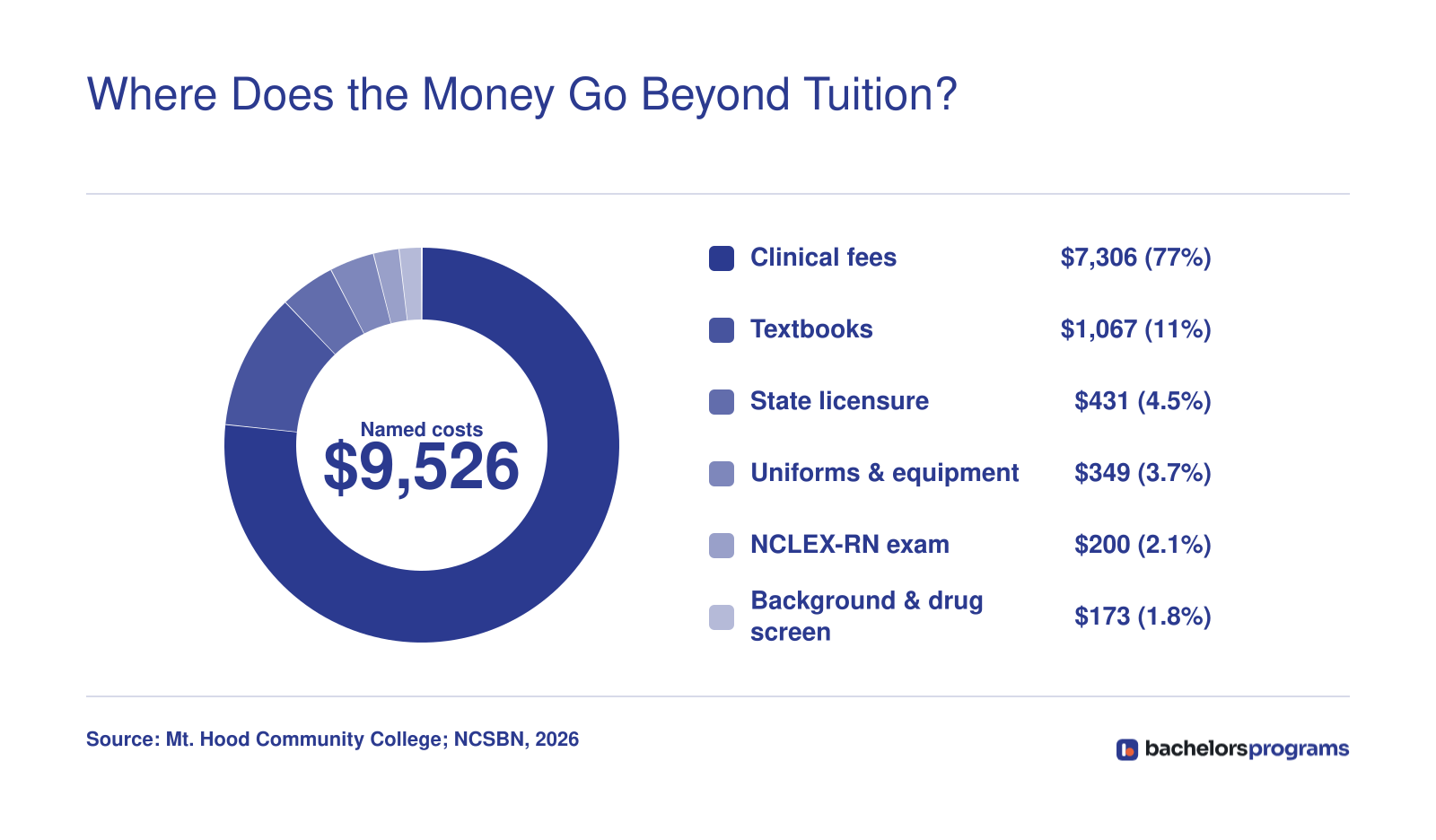
Tuition after transfer credit is only part of the bill. Mt. Hood Community College's itemized nursing estimate comes to about $9,726 before variable clinical travel, and clinical fees make up most of it. That figure belongs to one Oregon school, not a national average, because schools bundle background checks, testing and lab fees differently. Other schools price the same items differently: Gordon State College puts textbooks at $500-$1,000 and background checks and drug screens at $80-$150, and lists student health insurance at $2,936 for 2025-2026. NCSBN charges $200 to register for the NCLEX-RN in the U.S., and that fee rises to $350 on Feb. 1, 2027. Gas and parking for clinical rotations come on top of all of this.
Related Articles
How Long an LPN to BSN Takes: Full-Time vs. Part-Time Timelines
How many years does an LPN to BSN actually take once your license is in hand? Full-time students typically finish in 24 to 36 months, and accelerated tracks that run through summers can compress that to 18 to 24 months. Ohio State's bridge, for example, is structured as two years of full-time study including summer terms. Part-time students working as LPNs should plan on 36 to 54 months.
Why Credit Totals Swing From 90 to 122
Most BSN degrees land between 120 and 130 total credits; Ohio State and College of Saint Mary both sit at 122. What changes is how much of that you have already earned. Programs commonly award 15 to 30 credits for prior practical nursing education, but the range is wide: Broward College grants as few as 10, while Lakeview College of Nursing may award up to 48 in its pathway. Add in general education you completed for your LPN certificate, and the credits remaining typically fall between 60 and 90. State board requirements for clinical hours (often 500 to 2,000) also push totals up in some states.
Prerequisites Can Add a Semester
Anatomy and physiology I and II, microbiology, chemistry, statistics, English composition, psychology, and sociology are the usual gatekeepers, and most schools want a C or higher in each. College of Saint Mary requires 31 prerequisite credits with sciences completed within five years of matriculation. If you arrive missing two or three of these, expect one extra semester before upper-division nursing courses open up.
A Realistic Part-Time Timeline
An LPN working full-time shifts might spend the first semester clearing microbiology and statistics, then move into the bridge sequence at two courses per term. Nursing coursework and clinicals follow over roughly eight to ten terms, with summers used to catch up. Total elapsed time: about four years, with the license and paycheck intact the whole way.
Turning Your LPN License Into BSN Credit
Programs award LPN credit unevenly, and the schools that grant the most of it usually attach the most conditions.
Three ways LPN credit gets awarded
- Advanced placement or block credit: tied to an active license, a completed LPN program, recent employment, documentation, or a minimum GPA. Northern Michigan University awards 7 credits automatically when LPN graduation, licensure, or documented LPN work falls within five years of BSN admission.
- Credit by exam or a validation course: the NLN NACE or NACE II, or an institution-specific test. The school sets the passing score, the courses covered, and the credits issued. Northern State University allows up to 4 prior-learning credits this way at $150 per course, on top of a 3.0 GPA and 1,000 or more direct-care hours in the prior two years.
- Direct transfer of prior coursework: general education and science courses are typically reviewed separately from nursing courses, and substitutions are sometimes allowed.
How much credit, and what caps apply
A commonly reported range is about 14 to 30 semester credits. A 2026 overview of the pathway puts the typical award at 15 to 30, with some schools granting as few as 10 and others up to 48 toward a 60-credit nursing component. Ohio State University awards 20 credit hours after required summer coursework. West Coast University awards 9 credits after two specified courses, inside a 120-credit BSN.
Time limits are school-specific. West Coast and Lakeview College of Nursing both apply a five-year limit to science prerequisites, and no national rule governs this.
The bridge course comes first
Most programs require a transition course, skills lab, or pathophysiology before RN-level clinicals and before credit posts. Austin Peay State University awards up to 16 semester hours for LPN coursework and experience, then 11 more after its transition course, within a 30-credit prior-learning cap.
Get evaluated before you apply
Ask two or three programs for an unofficial transcript evaluation before you apply. Awards vary enough that the same license can be worth single digits at one school and several semesters at another.
The RN Pay Bump That Makes the Bridge Pay Off
Moving from an LPN license to RN practice brings one of the largest pay jumps in nursing.
CCNE and ACEN Accreditation Checks to Run Before Applying
Accreditation and state approval are separate checks, and a program can hold one without the other. Run each of these before you apply.
- Look up CCNE or ACEN status on the accreditor's directorySearch CCNE by institution, state or program, or ACEN by program name, location or type. Confirm a baccalaureate listing for the exact campus and delivery format, then note the status and review information. Candidate status is not accreditation.
- Verify state board of nursing approvalFind the program on the approved-program list in its home state as a prelicensure RN program, not just a general university listing. For an online or out-of-state program, also ask your own state's board how it evaluates that education.
- Confirm NCLEX-RN eligibility where you'll workAccreditation alone does not guarantee you can sit for the NCLEX-RN. The board in the state where you plan to practice sets licensure requirements.
- Check institutional accreditationInstitutional accreditation is separate from CCNE or ACEN status. Confirm it before counting on credit transfer or financial aid.
- Ask about probation and pass ratesAsk directly whether the program is on probation, conditional status or warning. Request its latest NCLEX-RN pass rate.
LPN to BSN programs by state
Quick Answers for LPNs Weighing a BSN
These answers cover the questions LPNs ask most often before committing to a bridge program. Details vary by school and state, so confirm specifics with each program you consider.
Is an LPN to BSN worth the extra semesters compared with stopping at an ADN?
Can you finish an LPN to BSN online while still working full-time shifts?
Are LVN to BSN programs any different from LPN to BSN programs?
Do you take the NCLEX-RN partway through the program or only after earning the BSN?
Compare LPN to BSN programs on the data that matters
Explore more Nursing majors or browse every field of study.
All Nursing programs Browse every field of study