Online Colleges and Bachelor's Degree Programs in Delaware
Every verified bachelor's program at a college in Delaware: 260+ programs at 6 colleges, with the online options, net price and graduation rates behind each one.

Can a working adult in Delaware finish a bachelor's degree entirely online without paying private-college prices? Often yes, but the arithmetic is less tidy than the marketing. Wilmington University, Delaware State University, the University of Delaware and Delaware Tech dominate most shortlists, and their per-credit rates, residency rules and aid packages diverge sharply.
The flexibility question comes first: fully remote, hybrid, synchronous. Then the bill after state and institutional aid, the credits you can carry in, what admissions asks for, and whether the degree satisfies a license requirement.
Delaware's small in-state market is the constraint. With fewer local options, transfer policy and authorization rules, not abundance, set your timeline.
Key Points
- Wilmington University charges $429 per credit hour for 2025-2026.
- Delaware joined SARA in 2016, so member schools can enroll residents online.
- Delaware state aid targets full-time campus students, often excluding online adults.
Popular degrees in Delaware
Bachelor's degrees in Delaware by field
Business & Management
- Marketing10 programs
- Business Administration6 programs
- Finance6 programs
- Human Resource Management or HR Management6 programs
- Accounting5 programs
- Management5 programs
- Sports Management4 programs
- Communication4 programs
Science & Engineering
- Biology5 programs
- Anthropology4 programs
- Natural Resources or Conservation4 programs
- Environmental Science3 programs
- Geography3 programs
- Chemistry3 programs
- Electrical Engineering or Electronics Engineering or Electronic Systems Engineering Technology2 programs
- Physics2 programs
Education & Teaching
- Early Childhood Education or Child Development4 programs
- Elementary Education4 programs
- Mathematics Education3 programs
- Science3 programs
- Educational Studies or Education Studies3 programs
- Special Education2 programs
- English Education2 programs
- Secondary Education1 program
Computers & IT
- Cybersecurity4 programs
- Computer Science3 programs
- Artificial Intelligence3 programs
- Data Analytics3 programs
- Software Development & Engineering2 programs
- Information Technology2 programs
- Innovation or Technological Entrepreneurship2 programs
- Cloud Computing1 program
Communications & Media
- Communications10 programs
- Journalism3 programs
- Public Relations2 programs
- Speech Pathology1 program
- Strategic Communications1 program
Liberal Arts & Humanities
- English5 programs
- Literature or English Literature3 programs
- History2 programs
- Philosophy1 program
- Spanish1 program
- Interdisciplinary Studies1 program
- African and African American Studies1 program
- Global Health or Health Studies1 program
Arts & Design
- Game Programming & Development2 programs
- Fashion Design2 programs
- Art or Art Studies2 programs
- Media Arts or Digital Media2 programs
- Fine Arts or Studio Art2 programs
- Game Art & Design1 program
- Audio & Music1 program
- Animation1 program
Criminal Justice & Law
- Criminal Justice3 programs
- Legal Studies3 programs
- Legal Services2 programs
- Paralegal1 program
- Corrections1 program
- Criminology1 program
- Criminal Justice Administration1 program
- Forensic Science1 program
Healthcare
- Nutrition4 programs
- Public Health3 programs
- Health Sciences2 programs
- Exercise & Sports Science1 program
- Health Informatics1 program
- Speech Pathology1 program
Social Work & Social Sciences
- Sociology4 programs
- Human Services3 programs
- Political Science, Government3 programs
- Social Work1 program
- Public Policy1 program
Nursing
- Bachelor of Science in Nursing4 programs
- Nursing (RN to BSN)2 programs
- Accelerated BSN (ABSN)2 programs
Natural & Applied Sciences
- Agriculture or Agricultural2 programs
- Oceanography or Ocean or Marine Biology2 programs
- GIS and Geoscience1 program
- Neuroscience1 program
Psychology
- General Psychology4 programs
Are There 100% Online Bachelor's Degrees in Delaware?
Yes, a Delaware institution can deliver a bachelor's degree entirely online, but the flexibility you are shopping for is exactly what the word "online" fails to guarantee. Some programs are entirely remote, while others blend remote coursework with clinical hours, student teaching or exams you have to sit in person.
Three formats, three very different commitments
- Fully online: Wilmington University's RN-to-BSN is delivered 100% online.1 Registered nurses who already hold a bachelor's in another field complete 31 nursing-core credits inside a 120-credit degree.2
- Hybrid: Wilmington's B.S. in K-6 and B.S. in 6-8 education each require three practicum courses. Every practicum pairs seminars with clinical experience: at least 60 supervised hours in a Birth-Grade 12 classroom, 30 seminar hours, and two lessons that you plan and teach.3 Coursework can run face-to-face or online, but the school-observation piece happens in the county where seminars are attended, so the online option does not remove the in-person placement.
- Campus-required: these programs keep labs, intensives or clinicals on site. The available research does not confirm which Delaware bachelor's degrees fall entirely into this category, so treat an "online" label as a question to ask, not a promise.
Where in-person requirements hide
Clinical and practicum hours, student teaching, internships and proctored exams are the four components prospective students most often overlook. Delaware State University lists Accounting, Liberal Studies, Management (General Management), Psychology, Public Health and Social Work as online, but the sources available do not establish, for each one, whether every field experience can be completed remotely or whether proctored assessments are required. University of Delaware Professional & Continuing Studies offers more than 30 online programs and lets students register for distance-learning courses without formal admission, which is useful but is not evidence that an entire bachelor's can be finished online.
Proctoring policy is usually set course by course. Remote proctoring is common today, but confirm it rather than assume it.
Get the answer in writing
Before you pay a deposit, ask admissions one direct question: "Does any course, lab, practicum or exam in this degree map require me to be on site?" Request the reply by email, with the specific course numbers listed. That document is what protects you if a requirement surfaces two semesters in.
What Online Bachelor's Degrees Cost in Delaware: Per-Credit Tuition at Major Schools
Wilmington University charges $429 per credit hour for 2025-2026, the lowest per-credit rate among the Delaware schools with published figures here.1 Delaware State University comes in at $544, and Goldey-Beacom College at $567. Those are the most recent rates available to us, so treat them as a starting point. Because 2026-27 rates may now be posted, confirm every number on the school's bursar or tuition page before you budget.
Per-Credit Rates, Fees and 120-Credit Estimates
The 120-credit figures below are sticker-price estimates only (per-credit rate times 120). They come before transfer credit, scholarships and aid, and they leave out the fees.
- Wilmington University: $429 per credit, with no separate out-of-state rate. A $30 per-semester fee applies.2 Estimated 120-credit tuition: $51,480.
- Delaware State University: $544 per credit, with a $60 per-semester fee. Only the in-state figure is reported here, so ask whether online students from outside Delaware pay a different rate. Estimated 120-credit tuition: $65,280.
- Goldey-Beacom College: $567 per credit for in-state and out-of-state students alike, plus a $150 academic-year fee.3 Estimated 120-credit tuition: $68,040.
Why Fees Change the Real Price
Fees are charged per term or per year, not per credit, so your pace matters. Take two courses a semester and you pay Wilmington's $30 fee across more semesters than a full-time student who finishes the same credits sooner. Check each school's fee schedule for technology, online course or registration charges that may not appear in the headline rate.
Delaware Tech and the University of Delaware
This comparison does not include a verified current per-credit rate for Delaware Technical Community College or the University of Delaware, so look those up directly on their tuition pages. Delaware Tech deserves a closer read if you plan to transfer. Its per-credit rate covers only the first 60 credits of a transfer pathway. The remaining credits are billed at the four-year school's rate, so a realistic total blends two prices. A student who completes an associate degree at Delaware Tech and then moves to Wilmington would pay Wilmington's rate on roughly the second half of the degree.
How to Use These Numbers
The estimates show relative cost, not what you will actually pay. Most students bring in transfer credit, receive grants, or take fewer than 120 credits at the school itself. Request a written cost estimate from each admissions office, and ask whether the online rate differs from the on-campus rate for your specific major. Some programs, such as nursing or other clinical tracks, carry their own per-credit charges that sit outside the general figures above.
Do Online Students Pay In-State Tuition? Sticker Price vs. Net Price in Delaware
Resident or Not, the Rate Depends on the School
Delaware's public universities do maintain resident and nonresident classifications. At the University of Delaware, in-state status generally requires 12 consecutive months of Delaware domicile by the first day of classes plus 183 days of predominant physical presence, and the university may bill nonresident rates while a reclassification request is under review. Delaware State University publishes its online undergraduate tuition by credit load at $544 per credit rather than in separate resident and nonresident columns, with a $50 registration fee, a $60 distance education fee and a $250 technology fee added. Private institutions such as Wilmington University and Goldey-Beacom College typically publish a single rate instead of a public in-state versus out-of-state split.
Studying Online Through an Out-of-State School
Delaware is a small state, and plenty of residents complete a bachelor's online through schools in Pennsylvania, Maryland or further afield. Those students pay that institution's out-of-state rate, not a Delaware rate, so a per-credit figure quoted for a Delaware campus often will not apply to them.
Sticker Price Is Not Net Price
Average annual net price across all income levels runs about $16,337 at the University of Delaware, $19,832 at Delaware State, $20,210 at Wilmington and $17,045 at Goldey-Beacom.1 Averages hide what aid does. UD's published figures fall to roughly $5,566 for families earning $0 to $30,000 and $10,783 for $30,001 to $48,000; Goldey-Beacom shows $15,802 and $12,687 for the same brackets.1 UD's bracket amounts differ between sources and reporting years,2 so read them as directional rather than exact.
The takeaway: compare net price and the total credits you must finish, not the per-credit headline.
Financial Aid, SEED, Inspire and Other Delaware Grants for Online Students
Delaware's state aid rules were written for students enrolled full time on a Delaware campus, so online adult learners often find themselves shut out of programs they assumed they qualified for.
Start With the FAFSA, Not the State Forms
Federal aid has no residency test. If your online program sits at an accredited, Title IV-eligible school, you can be considered for Pell Grants and federal student loans just as a classroom student would be. Loans carry an enrollment condition: you generally need at least half-time status, so confirm how your school defines half time for an online term before you plan on borrowing. File the FAFSA early regardless, because Delaware's needs-based awards depend on a FAFSA filed before the state deadline.
What Delaware's Programs Actually Require
The Delaware Higher Education Office administers nine state scholarships, and most share three filters: Delaware residency, demonstrated need, and a FAFSA on file. The Scholarship Incentive Program is the best known, a $1,000 needs-based award. It requires full-time undergraduate enrollment at an accredited Delaware institution, with a narrow out-of-state exception for a program not offered by a publicly assisted Delaware college.1 Applications opened December 1, 2025, and close May 15, 2026, at 4:30 p.m.
SEED is tuition assistance tied to Delaware Technical Community College and the University of Delaware's Associate in Arts program, and it expects full-time degree-seeking enrollment.2 Adults must show five consecutive years of Delaware residency before enrolling.2 INSPIRE provides free four-year tuition for eligible Delaware residents at Delaware State University. The Educator Support Scholarship, aimed at future teachers, requires full-time undergraduate or graduate study and shares the same May 15 deadline.
Part-time online students should treat every one of these as conditional. Nothing in the published rules creates a general online or part-time exception, so ask each institution whether your enrollment fits an eligible category before you count on the money.
Military and Veteran Benefits
If you served, the GI Bill and Yellow Ribbon participation at your chosen school can change the math considerably, and tuition assistance may apply if you are still serving. Ask the school's certifying official which benefits extend to online terms.
Your Next Three Steps
- File the FAFSA now rather than near the deadline.
- Apply through the Delaware Higher Education Financial Aid Portal before May 15; late applications are not accepted.
- Ask the aid office directly about institutional grants reserved for part-time online students.
Transferring Credits Into an Online Bachelor's Degree in Delaware
Transfer credit decides whether a Delaware bachelor's degree gets cheaper or stays expensive, and the ceilings differ sharply by school. None of it is automatic, so the rule is simple: get a written evaluation before you pay an application fee.
How Many Credits Each Delaware School Will Take
Wilmington University accepts up to 90 credits toward a bachelor's degree, a ceiling that includes coursework from other colleges and alternative-learning credit; associate degrees cap at 30.1 You still need 30 credits in residence at Wilmington, though active-duty service members (including covered reservists and Guard members on active duty) have residency capped at no more than 25% and may complete it at any time.
The University of Delaware publishes residency rules rather than one institution-wide maximum: 90 credits must be earned at UD, or 30 of your last 38, with major and minor requirements layered on top. Certain VA beneficiaries (Chapters 33, 30, 35 and 31) may receive residency credit after certification. Delaware State University requires pre-approval through its Approval to Transfer Credits form, and department chairs decide what counts.
The Delaware Tech Route: Associate Degree First
Delaware Technical Community College is the most common on-ramp into a four-year program. Articulation and dual-admission agreements are the mechanism that makes the transfer clean, but the terms are set campus by campus and revised year to year, so ask both schools for the current agreement in your major before you count on it. Financially, the logic holds regardless: community college credits generally cost less per credit than university rates, so finishing an associate degree first shortens the more expensive stretch.
Faster Routes: Exams, Portfolios and Military Credit
- Exams: Wilmington reviews CLEP, DSST, AP and IB, and states up to 75 CLEP/DSST credits subject to degree applicability.1 Some education courses may not accept them because of Delaware licensure requirements.
- Military training: Wilmington evaluates Joint Services Transcripts, CCAF records and ACE recommendations.2 UD requires a JST or CCAF transcript and awards up to 6 credits after basic and leadership training. DSU accepts JST, CCAF and ACE-recommended credit.
- Portfolios: where a school offers prior-learning assessment, documented work experience can convert to credit.
Show the Math, Then Ask for an Evaluation
At any per-credit rate, transferring 60 credits removes half the remaining tuition bill. Request an unofficial transcript evaluation first, confirm which credits count toward the major rather than electives, and only then apply.
Admissions Requirements and Start Dates for Online Bachelor's Programs
Requirements vary by school and major, so treat this as a starting checklist and confirm details on each admissions page before you apply.
- High school diploma or GEDRequired as the baseline. At Delaware State University Online, applicants with fewer than 30 college credits must also submit a high school transcript or GED.
- Official transcripts from prior collegesSend transcripts from every school attended. Delaware State does not automatically accept courses more than 10 years old. Goldey-Beacom College generally requires a C- or better in courses taken within the past 10 years.
- Minimum GPADelaware State's general undergraduate page lists a 2.0. Wilmington University has no general published minimum but requires a 3.0 for certain College of Education and Liberal Arts programs. The University of Delaware sets GPA standards by major, such as 3.0 for Accounting.
- Test scoresWilmington does not require the SAT. SAT/ACT scores are optional at the University of Delaware and Goldey-Beacom.
- Transfer and adult applicant waiversRequirements often ease as you earn credits. The University of Delaware does not require a high school transcript once you have 24 or more earned credits. Delaware State requires SAT/ACT scores from transfers who have fewer than 12 credits with a 2.0 or higher.
- Application feeThe fee is $35 at Wilmington and Delaware State and $75 at the University of Delaware.
- Program-specific prerequisitesSome degree-completion programs require a professional credential, such as an active RN license for RN-to-BSN tracks. Some majors also require specific prerequisite courses.
- Start dates and deadlinesWilmington uses rolling admission, with classes starting every 8 weeks. Delaware State Online also uses 8-week terms, and its next start is January 11, 2027, with a December 31 deadline. The University of Delaware suggests transfer deadlines of November 1 for spring and June 1 for fall.
Accreditation and Licensure: Vetting Online Colleges That Serve Delaware
Institutional Accreditation
Accreditation is a third-party quality review, and it affects your wallet. Schools must hold recognized institutional accreditation to take part in federal student aid, and other colleges generally accept transfer credits only from accredited institutions. The University of Delaware, Delaware State University and Delaware Technical Community College are all accredited by the Middle States Commission on Higher Education, the regional accreditor for the Mid-Atlantic.1 Out-of-state online schools should hold accreditation from a federally recognized accreditor too.
Programmatic Accreditation
Some careers add a second layer: accreditation of the specific program. Employers and licensing boards often look for it.
- Nursing: CCNE or ACEN.
- Teacher education: CAEP.
- Engineering: ABET.
- Business: AACSB or ACBSP.
Licensure Is State-Specific
This is where online students get caught. An online nursing, teaching or counseling degree from an out-of-state school may not lead to a Delaware license. State reciprocity agreements (SARA) let an approved school serve Delaware residents, but they do not mean a program meets Delaware board requirements for clinical hours, student teaching, practicums or exams. Federal rules require schools that take federal aid to disclose, for programs built or advertised around a license, whether the program meets, does not meet, or has not been determined to meet requirements in your state. Look for the school's professional licensure disclosure and find the Delaware entry. Then confirm with the Delaware Board of Nursing, the Department of Education or the relevant counseling board. A disclosure describes educational alignment, not a guarantee that a board will license you.
A Two-Minute Vetting Routine
- Federal database: Search the school in the U.S. Department of Education's DAPIP database to confirm its accreditor and status.
- Accreditor directory: Look the school up on the accreditor's own site, such as the Middle States institution directory, and check for any warnings or sanctions.
- State authorization page: Open the school's authorization and licensure disclosure pages and look for Delaware.
If any of the three comes up empty or unclear, ask admissions for the answer in writing before you pay a deposit.
Delaware State Authorization for Online Colleges at a Glance
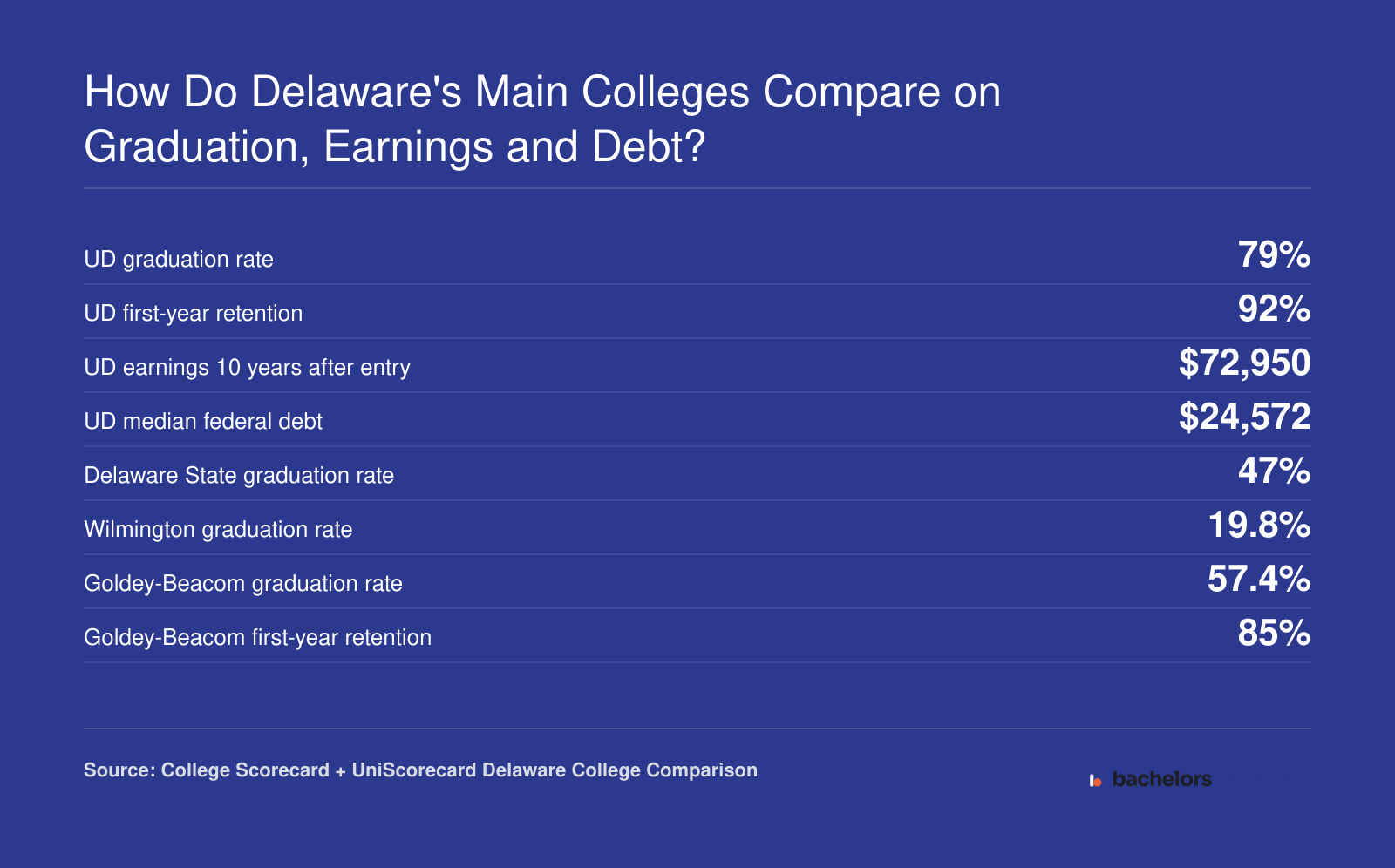
How Do Delaware's Main Colleges Compare on Graduation, Earnings and Debt?
University of Delaware figures come from the U.S. Department of Education's College Scorecard (most recent year available). The other schools' rates come from a 2026 Delaware college comparison whose cohort definitions may differ, so treat side-by-side comparisons as directional. Institution-wide rates track mostly first-time, full-time students and may not reflect adult online learners, so ask each school for completion data specific to its online programs.
Online Learning Formats and Student Support: What to Expect
Advising access, not the learning platform, decides whether most working adults finish an online bachelor's degree. Every school uses a polished portal. Far fewer give you a real person who answers on a Tuesday night.
Synchronous vs. Asynchronous
Synchronous courses meet in real time on a fixed schedule. They build community and keep you on pace, but they punish unpredictable schedules. Asynchronous courses give you weekly deadlines and no required login time.
- Shift workers and parents: Asynchronous is usually the safer choice, since you can study after a shift or after bedtime.
- Full-time employees with steady hours: Either works. A live evening session can add structure if you tend to procrastinate.
Accelerated Blocks vs. 15-Week Semesters
Seven- or eight-week blocks let you finish courses faster and focus on one or two at a time. The catch is intensity: a single missed week can mean a large share of the course. A traditional 15-week semester spreads the same material out, which is gentler if work or family demands spike. Be honest about your calendar before choosing speed.
Support Services Worth Verifying
These services track closely with completion for online adults:
- A dedicated online advisor who stays with you
- 24/7 tutoring
- A library with full remote access
- Tech support with posted hours
- Career services open to online students
- Disability services that handle remote accommodations
Don't stop at "yes, we offer that." Ask which of these are staffed evenings and weekends, and how quickly advisors reply. If you work days, a support office that closes at 5 p.m. is effectively unavailable to you.
What Delaware Bachelor's Graduates Earn
Earnings data offers one way to weigh the long-term value of a Delaware college, though these figures reflect each institution as a whole rather than its online programs specifically.
How to Choose the Right Online Bachelor's Option in Delaware: A Decision Checklist
Choosing where to earn a bachelor's online in Delaware comes down to four decisions: which credits you already own, what you will actually pay after aid, whether the degree leads to a license you need, and how fast you can finish. Everything else, including brand name and marketing copy, is secondary. Here is how that plays out depending on where you are starting.
Match the path to your starting point
- You have 60+ credits or an associate degree: Prioritize generous transfer caps and accelerated terms over everything else. A school that accepts 90 credits and runs eight-week sessions will beat a slightly cheaper school that caps transfer at 60 and runs 16-week semesters, because you are paying for fewer remaining credits and finishing sooner.
- You are starting from zero: A Delaware Tech pathway is usually the cheapest honest route. Complete the associate degree at community college rates, then move into a bachelor's completion program with a transfer agreement already in place. Confirm the agreement in writing before your first term, not after.
- You need a professional license: Confirm Delaware licensure eligibility before you look at price. A nursing, education, counseling or social work program that does not satisfy the relevant Delaware board is not a bargain at any per-credit rate.
Budget against net price, not per-credit headlines
Per-credit tuition is a useful comparison tool, but it is not what you pay. Multiply the rate by the credits you still need after your transfer evaluation, then add technology, online course and graduation fees, then subtract grants and scholarships you realistically qualify for. Two programs with similar advertised rates can finish thousands of dollars apart once transfer credit and aid are applied. Also verify the fine print on state aid: programs such as the Scholarship Incentive Program may carry enrollment-intensity or in-state institution conditions, and part-time online students are the ones most often caught out by those rules.
The final checklist
Before you deposit anywhere, you should be able to check off every line below:
- Institutional accreditation verified through the accreditor, not the school's own page
- SARA participation or Delaware state authorization confirmed for your state of residence
- Any in-person requirements (labs, clinicals, student teaching, residencies) identified and mapped
- A written transfer credit evaluation in hand
- Per-credit tuition plus all fees totaled across your remaining credits
- FAFSA and Delaware Higher Education Office deadlines noted on a calendar
- A specific start date chosen, with the application deadline that precedes it
- Academic advising access confirmed, including who you contact and how quickly they respond
One concrete next step: contact two or three schools this week and request an unofficial transcript evaluation plus an itemized cost estimate for your remaining credits. Compare those two documents side by side. That comparison, not a brochure, should decide where you apply.
Colleges in Delaware with the most bachelor's programs
| School | City | Type | Bachelor's programs | Online | Net price / yr | Grad rate |
|---|---|---|---|---|---|---|
| University of Delaware | Newark | Public | 99 | 0 | $17,799 | 81% |
| Wilmington University | New Castle | Private nonprofit | 57 | 57 | $15,644 | 20% |
| Delaware State University | Dover | Public | 55 | 1 | $13,910 | 39% |
| Goldey-Beacom College | Wilmington | Private nonprofit | 32 | 0 | $15,554 | 57% |
| Strayer University-Delaware | Wilmington | Private for-profit | 21 | 21 | $22,593 | — |
| Delaware Technical Community College-Terry | Dover | Public | 4 | 4 | $11,578 | 23% |
Program counts are the verified bachelor's listings in our directory; net price is the school-wide average a first-time undergraduate paid after aid, and graduation rate the share finishing within six years (College Scorecard).
Compare programs nationwide
Many Delaware residents study online. Every ranked list above has an online lens, or browse every field.
Online bachelor's degrees Browse all fields