Online Colleges and Bachelor's Degree Programs in South Carolina
Every verified bachelor's program at a college in South Carolina: 1,650+ programs at 30+ colleges, with the online options, net price and graduation rates behind each one.

Online study in South Carolina has shifted from a campus alternative into the main route for adults who already hold some college credit.
The University of South Carolina's Palmetto College runs bachelor's completion degrees online for students who arrive with an associate degree, and at many South Carolina schools "online" still means hybrid or completion coursework, not a four-year freshman track.
That distinction drives cost, aid eligibility, and scheduling. Net price, state grants like SC WINS and Lottery Tuition Assistance, transfer credit, admission rules, and completion outcomes separate a degree worth finishing from one that stalls.
Key Points
- USC's online completion programs charge $433.25 per credit plus $13 tech fee.
- Technical college first, then online completion, is often the cheapest route.
- State aid can cover online courses, depending on residency and credit load.
Popular degrees in South Carolina
Bachelor's degrees in South Carolina by field
Business & Management
- Business Administration63 programs
- Marketing44 programs
- Accounting33 programs
- Finance28 programs
- Management28 programs
- Logistics & Supply Chain Management23 programs
- Sports Management21 programs
- Communication20 programs
Education & Teaching
- Science40 programs
- Secondary Education38 programs
- Early Childhood Education or Child Development32 programs
- Elementary Education24 programs
- English Education23 programs
- Special Education21 programs
- Mathematics Education20 programs
- Physical Education15 programs
Science & Engineering
- Biology30 programs
- Mathematics30 programs
- Chemistry26 programs
- Biochemistry20 programs
- Environmental Science12 programs
- Physics12 programs
- Electrical Engineering or Electronics Engineering or Electronic Systems Engineering Technology11 programs
- Biomedical Science or Pharmacology9 programs
Arts & Design
- Fine Arts or Studio Art38 programs
- Art or Art Studies36 programs
- Graphic Design18 programs
- Media Arts or Digital Media18 programs
- Audio & Music16 programs
- Art History9 programs
- Digital Photography6 programs
- Game Programming & Development4 programs
Liberal Arts & Humanities
- English31 programs
- Literature or English Literature29 programs
- History23 programs
- Spanish19 programs
- Global Health or Health Studies11 programs
- Philosophy9 programs
- Interdisciplinary Studies9 programs
- General Studies6 programs
Computers & IT
- Computer Science30 programs
- Cybersecurity16 programs
- Information Technology14 programs
- Innovation or Technological Entrepreneurship13 programs
- Computer Information Systems12 programs
- Computer Engineering8 programs
- Software Development & Engineering6 programs
- Artificial Intelligence6 programs
Healthcare
- Public Health18 programs
- Health Sciences17 programs
- Exercise & Sports Science16 programs
- Nutrition10 programs
- Speech Pathology4 programs
- Health Informatics3 programs
- Community Health2 programs
- Health Education2 programs
Social Work & Social Sciences
- Sociology30 programs
- Political Science, Government24 programs
- Human Services6 programs
- Social Work5 programs
- Public Policy1 program
Communications & Media
- Communications23 programs
- Journalism17 programs
- Public Relations9 programs
- Professional Writing3 programs
- Communication Disorders3 programs
- Speech Pathology3 programs
- Strategic Communications2 programs
Criminal Justice & Law
- Criminal Justice25 programs
- Criminal Justice Administration9 programs
- Forensic Science8 programs
- Criminology6 programs
- Homeland Security4 programs
- Legal Services3 programs
- Legal Studies2 programs
- Cybercrime1 program
Nursing
- Bachelor of Science in Nursing23 programs
- Nursing (RN to BSN)15 programs
- Accelerated BSN (ABSN)5 programs
- LPN/LVN to BSN1 program
Psychology
- General Psychology30 programs
- Clinical Psychology3 programs
- Forensic Psychology2 programs
- Sport Psychology1 program
- Counseling Psychology1 program
Religion & Theology
- Christian Studies or Religious Studies13 programs
- Christian Ministry or Ministry Leadership9 programs
Natural & Applied Sciences
- Oceanography or Ocean or Marine Biology4 programs
- Agriculture or Agricultural2 programs
- GIS and Geoscience1 program
- Neuroscience1 program
Counseling
- Mental Health Counseling1 program
How Online Bachelor's Degrees Work in South Carolina: Fully Online, Hybrid, and Degree Completion
The label on a program page tells you less than its requirements do, so learn the three formats before you compare schools.
Three Formats, Defined
- Fully online: Coursework, advising, and exams happen remotely, with no required campus visits.
- Hybrid: Most work is online, but you attend some in-person sessions, labs, or orientations.
- Degree completion: Built for students who already hold college credits and want to finish a bachelor's without starting over. USC Palmetto College is the best-known South Carolina example, designed for working adults who have earned an associate degree or a block of transfer credits.
Read Past the Label
Program pages often blur these terms. A degree advertised as "online" may still require an on-campus orientation, proctored in-person exams, clinical hours, or student teaching in a local school. Any of those makes it effectively hybrid, and the travel and scheduling costs are yours. Before you apply, ask the admissions office for a written list of every in-person requirement from first term to graduation.
Online and On-Campus Are Not Identical
The same degree at the same school can differ by delivery. Online versions may carry a different per-credit rate or fee structure, use different start dates, and run in shorter terms, such as seven or eight weeks, rather than a full semester. Pacing changes the workload: two accelerated courses at once can feel heavier than the same two courses spread across 15 weeks. Compare the online price sheet and academic calendar, not the campus versions.
The Sectors You'll Compare
Three groups enroll South Carolina residents in online bachelor's programs:
- Public universities and regional campuses: Usually the lowest in-state tuition and the clearest transfer routes.
- South Carolina private colleges: Higher sticker prices, but often more institutional aid and smaller online cohorts.
- National online universities: Flexible start dates and large course catalogs, with pricing and transfer policies that vary widely.
Cost, aid, and outcomes are where these three groups diverge most.
South Carolina Online College Tuition Comparison: Public, Private, and National Options
Online tuition in South Carolina is usually billed per credit hour, so compare the per-credit rate plus any technology fee: at the University of South Carolina's online degree completion programs, $433.25 in tuition and a $13 technology fee per credit (2026-27) come to about $13,390 for a 30-credit year, before books, proctoring, or other course costs. Some schools charge technology fees per credit hour and others charge a flat amount each semester, such as the $200-per-term fee listed for USC's Palmetto Pathway, and USC Aiken's online listing shows the same rate for in-state and out-of-state RN-to-BSN students, so residency does not always change the price of an online program. Each figure below shows its academic year, and published rates change, so confirm every number (and check private colleges and national online universities the same way) on the school's bursar page before you budget.
| Institution | Sector | In-State Online Per-Credit Rate | Out-of-State Online Per-Credit Rate | Online/Technology Fees | Academic Year |
|---|---|---|---|---|---|
| University of South Carolina Online Degree Completion Programs | Public | $433.25 | N/A | $13.00 per credit hour | 2026-27 |
| University of South Carolina Aiken Online | Public | $66.00 (as listed for RN-to-BSN; verify full tuition with the bursar) | $66.00 (as listed for RN-to-BSN) | $13.00 per credit hour | 2024-25 |
| Clemson University Online Undergraduate Programs | Public | N/A | N/A | $10.00 per credit hour | 2025-26 |
| University of South Carolina Columbia (undergraduate) | Public | N/A | N/A | $17.00 per credit hour (part-time students) | 2026-27 |
| USC Palmetto Pathway (Palmetto College) | Public | N/A | N/A | $200 per semester ($400 per year) | 2025-26 |
Net Price and Affordable Paths to a Bachelor's Degree in South Carolina
Net price is what a year of college actually costs you after grants and scholarships are subtracted from the full cost of attendance: tuition, fees, books, and living expenses. It belongs in your comparison spreadsheet because two schools with very different sticker tuition can cost about the same once aid is applied. The federal College Scorecard publishes an average net price for most accredited colleges, so look it up for every school on your short list.
Read the Average Net Price Carefully
Treat that average as a starting point, not a quote. It is calculated for first-time, full-time undergraduates and usually covers the institution as a whole, not its online students specifically. Adult learners, transfer students, and part-time enrollees may pay more or less. A calculator built from your own income and plans gives a more personal number. Many published figures are billed charges, not net prices. The University of South Carolina lists 2026-2027 in-state tuition of $12,288 for the year, before any grants.
Budget for the Costs Online Students Overlook
Tuition is not the whole bill. Plan for:
- Technology fees: USC's online degree-completion programs list a $156 technology fee for full-time students or $13 per credit below full time. The Columbia campus lists a $400 annual technology fee.
- Course materials: USC Aiken charges $25 per credit for its book program. Elsewhere, textbook costs vary by course and major, so ask each program for an estimate.
- Proctoring: some online courses require paid remote or in-person exam proctoring.
- Equipment: a dependable laptop and high-speed internet are nonnegotiable.
The Lowest-Cost Route: Start Local, Finish Online
The clearest savings in South Carolina come from splitting the degree. For 2026-2027, in-county tuition at the state's technical colleges runs roughly $181 to $203 per credit (Horry-Georgetown at $181, Piedmont at $202.50), with most fees billed separately. USC Palmetto College, which runs online degree-completion programs, charges in-state students $433.25 per credit below a full-time load, or $5,199 per full-time semester.
The rough math: 60 lower-division credits at about $200 per credit come to around $12,000 in tuition, while the same 60 credits at Palmetto College's per-credit rate would run about $26,000. That is a potential tuition savings of roughly $14,000 before aid, assuming your credits transfer cleanly. Rates shift with county, residency, and course load, so confirm current numbers with each school before you enroll.
South Carolina State Financial Aid for Online Students: SC WINS, Lottery Tuition Assistance, LIFE, and More
Yes, South Carolina state aid can apply to online coursework, but eligibility usually turns on three things: SC residency, enrollment at an eligible South Carolina institution, and how many credit hours you carry, since some awards publish no part-time option. If you start at a technical college, SC WINS ends when you leave the SC Technical College System, while the LIFE Scholarship (which sets separate criteria for two-year and four-year schools) and the SC Need-based Grant (available at eligible public institutions) can continue after you transfer into a four-year online program. File the FAFSA first, because Lottery Tuition Assistance and the Need-based Grant require it, and confirm online and part-time eligibility with your school's financial aid office, since the state's published summaries do not address fully online enrollment for every program.
| Program | Annual Award Amount | Who Qualifies | Online / Part-Time Eligibility | Key Deadline or Requirement |
|---|---|---|---|---|
| SC WINS Scholarship | Up to $5,000 after all other scholarships and grants are applied; may cover tuition, fees, and course-related expenses | Students pursuing a professional certificate, industry-recognized credential, diploma, or degree at one of the 16 SC Technical College System colleges; does not carry over to a four-year school | State summary covers credit-seeking students but does not say whether fully online or part-time enrollment qualifies; confirm with your college | Maintain a 2.0 GPA each academic year; limited to one certificate, diploma, or degree unless an additional credential advances the same field of study |
| Lottery Tuition Assistance | $80 per credit hour, applied toward tuition | U.S. citizens or eligible permanent residents who are SC residents, file the FAFSA, enroll as degree-seeking students at an eligible institution, and meet satisfactory academic progress and other aid rules | Part-time students qualify with at least 6 credit hours per term; state summary does not exclude online coursework | File the FAFSA every year and be enrolled in at least 6 credit hours at disbursement; cannot be combined with HOPE, LIFE, or Palmetto Fellows |
| LIFE Scholarship | Up to $5,000 | SC residents at an eligible SC institution. Two-year schools: 3.0 UGP GPA. Four-year schools: meet two of three criteria (3.0 UGP GPA, 1100 SAT or 22 ACT, top 30% of graduating class) | State materials do not say whether fully online students qualify and identify no part-time award option | Enroll in a degree-seeking program at an eligible SC institution and meet the GPA and academic criteria for your school type; separate two-year and four-year criteria allow use after transfer |
| Palmetto Fellows Scholarship | Up to $6,700 in year 1; up to $7,500 in years 2 to 4 | Students with a 3.5 UGP GPA, 1200 SAT or 25 ACT, and top 6% class rank in grade 10, 11, or 12, plus general state scholarship requirements | State materials do not say whether fully online students qualify and identify no part-time eligibility | Meet all academic criteria and enroll in a degree-seeking program at an eligible SC institution; no separate 2026 application deadline listed in state materials |
| SC Need-based Grant | Up to $3,500 full-time; up to $1,750 part-time | SC residents with demonstrated financial need enrolled as degree-seeking students at an eligible public institution, including public four-year schools after transfer | Part-time degree-seeking students qualify for up to $1,750; online students are not excluded, but the institution and program must be eligible | File the FAFSA each year to confirm need, maintain a 2.0 GPA, and earn 24 credit hours |
Federal Aid and Military Education Benefits for Online Students in South Carolina
Federal student aid and military benefits come from Washington or from South Carolina's service-member programs, and much of that money works for online study. Pell Grants and federal loans apply to online programs at accredited institutions, the same as for on-campus ones. Part-time enrollment prorates Pell, so a student taking fewer credits receives a smaller award than a full-time student.
Post-9/11 GI Bill and Online Housing
The Post-9/11 GI Bill pays tuition and fees, and a monthly housing allowance (MHA) for eligible students. For fully online students, the VA pays 50% of the national average rate, capped at $1,198 per month in 2026.1 Adding one in-person class can qualify a student for the higher resident rate tied to where most coursework takes place.1 Other rules affect the check:
- Enrollment must be more than half-time.2
- No housing pay during school breaks.2
- Partial months are prorated.2
- Eligibility percentage can reduce the amount.
Yellow Ribbon and State Benefits
The Yellow Ribbon Program helps cover tuition and fees that Post-9/11 benefits leave uncovered at private, out-of-state, or graduate programs. The school contributes a set amount and the VA matches it, up to the remaining tuition and fees.3 Participation is school- and program-specific, and nonmandatory fees are not covered.3 It does not raise the online housing allowance.3 Santee Cooper-Myrtle Beach, for example, is listed as not participating, so check the VA's comparison tool for each school.
South Carolina adds its own help:
- SCNG CAP: Active drilling Army or Air Guard members who finish Basic Training and AIT/IADT may receive up to 100% of tuition and fees in 2026-20275, with limits of $12,000 per year, $4,000 per semester full-time, and $25,000 lifetime.4 Awards cannot exceed cost of attendance, and the program applies only at eligible South Carolina institutions. Confirm that a specific online program qualifies.
- Children of certain veterans: Free tuition at state-supported colleges and technical schools, with approval from the South Carolina Department of Veterans Affairs.6 Ask whether online courses are covered.
Many military-friendly schools also waive application fees or award credit for military training listed on the Joint Services Transcript (JST), which can shorten a degree.
Transfer Credits and Online Degree-Completion Pathways in South Carolina
Starting over costs more time and money than transferring in, and in South Carolina transferring is usually the cheaper route. Transferring is not the same as counting toward your major.
USC Palmetto College Entry
USC Palmetto College is the University of South Carolina system's route for online degree completion, built for students who bring college credit with them. Palmetto College sets a minimum of 45 transferable college credits for entry, so check your own transcript against that number before planning around it. In general, an associate degree or a stack of scattered credits gives you a stronger starting point than a thin transcript, but the program's own audit decides what applies.
How the Statewide System Works
South Carolina's Statewide Articulation Agreement guarantees transfer among public two- and four-year institutions for a list of 86 courses approved by the Commission on Higher Education.1 Examples include ACC 101 and 102, HIS 102 and 201, MAT 110, 111, 120 and 122 (3 credits each), plus AST 101, AST 102 and BIO 101 (4 credits each). Technical college students are the main beneficiaries.
Two rules matter most:
- Grade floor: Courses generally need a C (2.00 on a 4.00 scale) or better to transfer.1
- Elective risk: A course can transfer yet count only as elective credit, not as a major requirement.
SC TRAC is the state's searchable articulation tool. It shows course equivalencies and statewide transfer blocks, which can apply toward graduation requirements for a covered major once you are admitted to that institution and major. Transferred grades do not enter your new GPA, and transfer does not waive the school's own admission or graduation standards.
Credit for Prior Learning and Residency Limits
Many South Carolina public universities consider CLEP, DSST, AP, military training and portfolio assessment, but policies differ by school, and we could not confirm what Palmetto College accepts in every online completion program. Ask for the written policy and the maximum awarded for each type.
Residency rules also set a ceiling. Schools typically require a minimum number of credit hours earned at the degree-granting institution, and that number is not uniform across the state. Even generous transfer acceptance will not let you skip it.
A Practical Step Before You Apply
Request an unofficial transcript evaluation before submitting an application. Then ask a more specific question than "how many credits transfer?" Ask how each credit applies to your intended major, general education requirements and electives, and how many semesters remain afterward. Compare that answer across two or three schools. The difference in remaining credits is often where the real savings are.
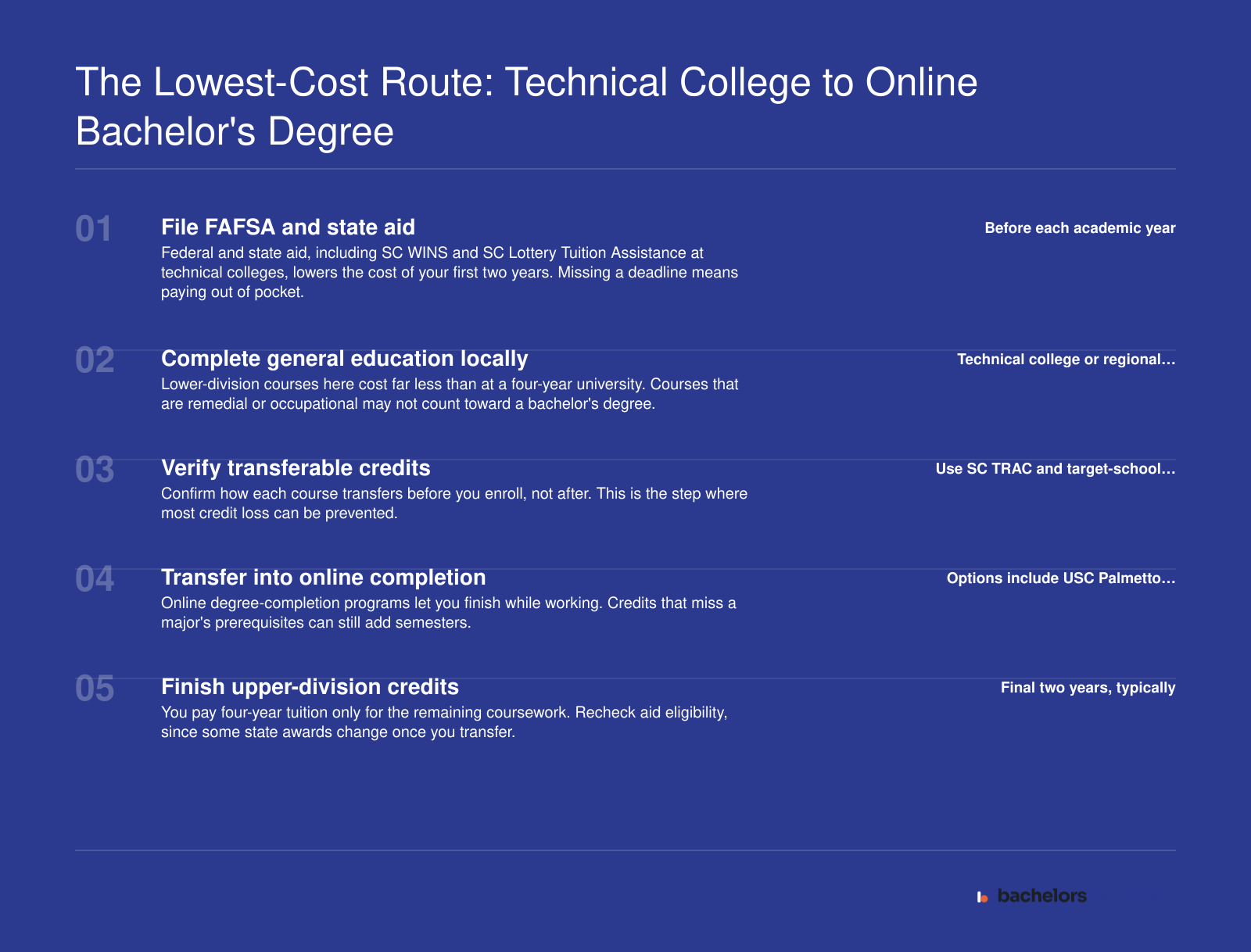
The Lowest-Cost Route: Technical College to Online Bachelor's Degree
For many South Carolina students, the cheapest path to a bachelor's degree starts at a technical college or regional campus and ends in an online completion program. Each step below notes where the savings come from and where credits can be lost.
Admissions, Deadlines, and Online Program Requirements
Each South Carolina school sets its own online admission rules, and they often differ for first-year and transfer applicants. Confirm these items with the admissions office before you enroll.
- First-year vs. transfer statusCoastal Carolina counts anyone who attended another regionally accredited college after high school as a transfer applicant. With 24 or more transferable credits, you need at least a 2.0 GPA and good standing at your last school. Verify which category you fall into.
- Credit and GPA thresholdsUSC Palmetto College's online bachelor's programs are mainly degree completion for students with 45 or more college credits. GPA and prerequisites vary by program, so confirm them with an advisor.
- Transcripts and feesSend official transcripts from every college you attended. Palmetto applicants send them to the degree-granting USC campus and pay a $40 to $65 fee, depending on the program.
- Test scoresAt Coastal Carolina, transfer applicants with fewer than 24 credits must also submit a high school transcript and SAT or ACT scores, unless they are 22 or older. Ask whether your program is test-optional.
- Deadlines and start datesUSC Aiken Palmetto's deadlines are July 15 for fall and December 1 for spring. Late applications roll to the next semester. Spring 2027 classes begin January 11. Coastal Carolina's spring deadline is December 1, and its fall date appears as both June 1 and July 1, so confirm which date applies.
- Term length and live sessionsAsk whether courses run in accelerated 7- or 8-week terms or full semesters. Also ask whether any classes require synchronous log-ins at set times.
- Proctored examsCheck whether exams require proctoring software, a webcam, or a testing center, and whether proctoring carries extra fees.
- In-person placementsInternships, clinicals, and student teaching are typically arranged near your home. They may need to be at South Carolina sites. Confirm who secures your placement.
South Carolina Teacher Certification for Online Education Graduates
South Carolina Online College Graduation Rates and Student Outcomes
The graduation rate printed beside a South Carolina college usually describes its freshmen, not its online students, so the most flexible programs often look weaker on paper than they are in practice. Read the published numbers as institutional context, then ask the program itself for the figures that actually describe your cohort.
What the published rates actually count
The federal six-year graduation rate follows first-time, full-time students who started in a fall term and measures the share who finished at the same school within 150% of normal time, about six years for a bachelor's. Transfer students, part-time adults, and people who stop out and return are largely invisible to it, and online completers are often all three. IPEDS Outcome Measures cast a wider net: part-time and transfer-in students are included, the window stretches to eight years, and the results separate graduates from transfers, withdrawals, and students still enrolled.
How South Carolina institutions compare
University of South Carolina Upstate reports a 58% graduation rate and a 70% first-year retention rate, with eight-year outcomes showing roughly 58% graduated, 26% transferred, and 15% withdrew, and the remainder still enrolled. USC Aiken, a Palmetto College campus, is reported at about 40% graduation, and roughly 36% of its students study fully online. USC Beaufort is reported near 34%. Treat all three as rough institutional context: reporting years and whether any figure describes online students specifically are not clearly established in public sources.
Ask for the online program numbers
Completion data for online-only students is rarely published. Ask an admissions counselor for the completion and retention rates of the specific online bachelor's program rather than the university overall, how many students entered each of the last two or three cohorts, and the typical time to finish. At Palmetto College campuses, ask separately, since those completion tracks generally assume about 45 prior college credits.
Why finishing beats format
Employers verify the degree, not the classroom. A program with a modest published rate that lets you stay employed and finish in two years usually beats a stronger-looking rate at a school you cannot practically attend. One recent count of distance-education completions in the state found 3,334 degrees awarded in 2023, including 1,429 bachelor's, up 37% from 2019.
What a Bachelor's Degree Is Worth in South Carolina
Use national benchmarks as a starting point, then narrow to your field and region.
How to Choose and Verify an Online College in South Carolina
Start With Accreditation
Accreditation decides whether your credits transfer, whether you qualify for federal aid, and whether employers and licensing boards will recognize your degree. Most South Carolina colleges are regionally accredited by the Southern Association of Colleges and Schools Commission on Colleges (SACSCOC). Don't rely on a school's marketing page for this. Look the institution up in the accreditor's own online directory and confirm its status is current.
If your career requires a license or a specific credential, check programmatic accreditation too:
- Nursing: CCNE or ACEN accreditation for RN-to-BSN and BSN programs
- Business: AACSB or ACBSP accreditation, which some employers and graduate programs look for
- Education: CAEP accreditation and state approval if you plan to teach in South Carolina
Get the Format in Writing
"Online" can mean very different things. Ask an admissions counselor to confirm in writing whether the program is fully online or hybrid, and to list every in-person requirement: campus orientations, proctored exams, residencies, clinical hours, practicums, or student teaching placements. Nursing and education majors should also ask where placements happen and who arranges them. A written answer protects you if a requirement surfaces halfway through the program.
Compare the Numbers Side by Side
Brand recognition and advertised per-credit tuition tell you little about what you'll actually pay or how fast you'll finish. Build a simple comparison of your top choices that includes:
- Net price: your cost after grants and scholarships, not sticker tuition
- Transfer credit: how many of your existing credits count toward the major, not just toward electives
- Start dates: how many entry points the school offers each year and how long each course runs
- Fees: technology, online course, and graduation fees that add up every term
A school with higher tuition that accepts more of your credits can cost less overall and get you to graduation sooner.
Our Recommendation
For most South Carolina residents who already have college credits or an associate degree, an in-state public degree-completion program is the best place to start. Public universities in the state offer in-state rates, qualify for state aid programs, and generally work with transfer pathways from South Carolina technical colleges. National online universities make the most sense when no South Carolina school offers your major online, or when you need a schedule that local programs can't match.
Your Next Step
File the FAFSA now so your aid eligibility is established before you apply. Then request a transcript evaluation from two or three schools on your shortlist. Comparing those evaluations alongside each school's aid offer will show you which program gets you to a bachelor's degree for the least time and money.
Colleges in South Carolina with the most bachelor's programs
| School | City | Type | Bachelor's programs | Online | Net price / yr | Grad rate |
|---|---|---|---|---|---|---|
| University of South Carolina | Columbia | Public | 106 | 9 | $22,811 | 79% |
| Winthrop University | Rock Hill | Public | 86 | 4 | $15,343 | 57% |
| Anderson University | Anderson | Private nonprofit | 84 | 19 | $23,544 | 66% |
| Clemson University | Clemson | Public | 83 | 1 | $22,253 | 87% |
| Coastal Carolina University | Conway | Public | 81 | 4 | $13,966 | 49% |
| College of Charleston | Charleston | Public | 74 | 7 | $18,960 | 66% |
| Francis Marion University | Florence | Public | 68 | 1 | $11,386 | 43% |
| North Greenville University | Tigerville | Private nonprofit | 67 | 6 | $21,063 | 55% |
| Bob Jones University | Greenville | Private nonprofit | 64 | 0 | $16,641 | 65% |
| Lander University | Greenwood | Public | 60 | 13 | $15,363 | 50% |
| Charleston Southern University | Charleston | Private nonprofit | 59 | 12 | $21,666 | 47% |
| Newberry College | Newberry | Private nonprofit | 58 | 15 | $21,656 | 45% |
| University of South Carolina-Upstate | Spartanburg | Public | 57 | 18 | $13,557 | 43% |
| South Carolina State University | Orangeburg | Public | 57 | 10 | $18,097 | 37% |
| Coker University | Hartsville | Private nonprofit | 53 | 15 | $20,286 | 40% |
Program counts are the verified bachelor's listings in our directory; net price is the school-wide average a first-time undergraduate paid after aid, and graduation rate the share finishing within six years (College Scorecard).
Compare programs nationwide
Many South Carolina residents study online. Every ranked list above has an online lens, or browse every field.
Online bachelor's degrees Browse all fields