Best Psychology Degree Programs
Compare 1,300+ accredited General Psychology programs at 1,200+ colleges, with net price after aid, graduation rates, earnings and debt from IPEDS and the U.S. College Scorecard.

A University of Florida online BA in psychology carries an average net price of $4,815 a year, while Harvard's campus track averages $19,066. Psychology ranks among the most popular majors in the country, yet cost, completion odds and early pay diverge sharply from one school to the next.
Median earnings one year after graduation run from $23,744 to $41,299 across the programs ranked here, which mix campus degrees with fully online study. Accreditation claims and the BA versus BS choice shift the math further.
One constraint holds everywhere: a psychology bachelor's does not qualify anyone to practice as a psychologist or licensed counselor. That work requires a graduate degree and supervised clinical hours.
Key Points
- APA accredits 440 doctoral programs but no psychology bachelor's degrees.
- Rankings use federal College Scorecard outcomes rather than reputation surveys.
- Clinical licensure demands graduate study and supervised hours beyond the bachelor's.
Best Psychology Degree Programs for 2027: Our Top 10
The ten programs below span the range of what a psychology bachelor's looks like in 2026, from research-intensive public universities to a compact private degree with required methods training and a fully online option from a flagship campus. Each card shows net price after aid, overall graduation rate, admission rate, and format, with program-level earnings included where the federal data publishes them.
Women's Institute of Torah Seminary and College
#1Baltimore, MD · $10,000 – $15,000/yr (est.)
Best for: Women pairing psychology with Judaic studies
The Women's Institute of Torah Seminary and College is a small Baltimore institution where the psychology major sits inside a dual liberal arts and Jewish studies curriculum rather than standing alone. Students write a senior research thesis and can add a 135-hour field placement, and the psychology ethics coursework is tied directly to Jewish law. Its admission profile is unusually accessible for a private college, which makes it a realistic entry point for students who want a values-driven program.
- 120-credit degree with a required senior research thesis
- 36 credits of Jewish studies built into the degree
- Course in psychology ethics and Jewish law
- Optional 135-hour field placement
- Double major option in Judaic Studies
- Independent study and internship options
- Prepares graduates for business, industry or graduate study
University of California-Los Angeles
#2Los Angeles, CA · $13,000/yr (est. net price)
Best for: Research-bound students exploring psychobiology
UCLA treats psychology as a science and splits it into three separate majors, psychology, cognitive science, and psychobiology, so students can dial in as much biological and computational depth as they want. Laboratory courses and faculty-led research participation are part of the experience, and community internships add fieldwork in human services settings. In 2026 the department added enrollment planning workshops to help psychology, psychobiology, and cognitive science majors sequence their coursework. Psychology graduates here reported a median of $61,050 four years after finishing.
- Three majors: psychology, cognitive science and psychobiology
- Coursework in psychobiology, learning and memory, perception and clinical psychology
- Laboratory courses and faculty-led research participation
- Fieldwork and community internships available
- Departmental Honors Program
- Psychology Undergraduate Research Conference
- 2026 enrollment workshops for planning major coursework
Rice University
#3Houston, TX · ~$13,000/yr (est.)
Best for: Small-cohort learners wanting close mentorship
Rice keeps the psychology major deliberately compact at 15 courses (47 credit hours) inside a 120-credit degree, which leaves room for a second major or a broad elective run. Core statistics and research methods courses cannot be replaced by transfer credit, a signal of how seriously the department treats methodological training. Classes are small, qualified students can pursue a departmental honors thesis, and faculty work spans consciousness, health, and brain science.
- 15 courses and 47 credit hours inside a 120-credit degree
- Core statistics and research methods cannot be replaced by transfer credit
- Honors thesis available for qualified students
- Electives across social, cognitive and clinical psychology
- Small classes and close faculty mentorship
- Faculty research spans consciousness, health and brain science
University of Florida
#4Gainesville, FL · ~$4,800/yr (est.)
The University of Florida awards its psychology bachelor's through UF Online, so students anywhere can earn the same degree campus graduates receive without relocating to Gainesville. The curriculum pairs psychology coursework with statistics, math, and biology, and upper-division transfer applicants need 60 or more credits plus a 2.75 GPA across prerequisites. As a large public university with a fully online pathway, it is one of the stronger value plays on this list. Online psychology graduates reported a median of $57,053 four years after finishing.
- Fully online, same degree awarded to campus graduates
- Prerequisites include statistics, pre-calculus, biology and general psychology
- Upper-division transfer applicants need 60+ credits and a 2.75 GPA
- Four core psychology areas plus elective coursework
- Ranked third for best online bachelor's in psychology by U.S. News (2025)
- Faculty expertise across five specialization areas
- Preparation for law school, medical school and business school
Harvard University
#5Cambridge, MA · $15,000 – $20,000/yr (est.)
Harvard's general track is the least prescriptive psychology major here: students choose two foundational courses from six options covering cognition, social psychology, development, psychopathology, and cognitive neuroscience. Statistics and research methods are required, a sophomore tutorial anchors the major, and an optional thesis is available for students who want a research capstone. The design favors breadth over specialization, and graduates move into business, law, medicine, and academia.
- Choose two foundational courses from six options
- Foundations include cognitive neuroscience and psychopathology
- Statistics and research methods required
- No thesis or capstone required; optional thesis available
- Sophomore tutorial on contemporary issues in psychology
- Prepares graduates for business, law, medicine and academia
Hillsdale College
#6Hillsdale, MI · $30,000 – $35,000/yr (est.)
Hillsdale's psychology major is explicitly a liberal arts program, bridging natural science and philosophy instead of training students narrowly for one job title. Core work covers statistics, research methods, and the main subfields, with advanced options in clinical and industrial/organizational psychology for students eyeing applied careers. A senior comprehensive exam caps the degree, and honors students can add a practicum, research project, or thesis with distinction.
- Minimum 30 credit hours in psychology
- Senior comprehensive exam required
- Advanced options in clinical and industrial/organizational psychology
- Honors requires a 3.0 overall and 3.5 departmental GPA
- Honors students may add a practicum, research project or thesis
- Core work in developmental, social, abnormal and cognitive psychology
University of California-Irvine
#7Irvine, CA · $14,000/yr (est. net price)
UC Irvine runs its psychology B.A. across 13 courses (52 units), with four upper-division cores in developmental, abnormal, health, and social psychology before students specialize. Field study placements reach hospitals, community health clinics, counseling centers, legal settings, schools, and social service agencies, which is unusually wide for a public program. A 2026 ranking update placed the program 12th nationally and sixth among public universities, though the curriculum structure itself has not changed. Psychology graduates reported a median of $56,380 four years after finishing.
- 13 courses totaling 52 units
- Four upper-division cores: developmental, abnormal, health and social psychology
- Specialty group in pre-clinical psychology and psychopathology
- Four concentration options
- Field study in hospitals, clinics, counseling centers and legal settings
- Undergraduate research with faculty available
- Ranked 12th nationally in a 2026 psychology program ranking
Florida State University
#8Tallahassee, FL · ~$11,000/yr (est.)
Florida State's psychology major gives students a broad background across the field and then asks them to specialize in human behavior or animal behavior. Advanced students can join Honors in the Major, work in a faculty lab, and write an honors thesis, and the same department runs a separate behavioral neuroscience major for students who want the biological side. It is a large public program with a wide course catalog and an accessible admission profile. Psychology graduates here reported a median of $54,728 four years after finishing.
- Two specializations: human behavior or animal behavior
- Honors in the Major with faculty-supervised research and thesis
- Separate behavioral neuroscience major in the same department
- Psychology minor available
- Broad foundation across many areas of psychology
California Polytechnic State University-San Luis Obispo
#9San Luis Obispo, CA · ~$17,000/yr (est.)
Cal Poly awards a B.S. in psychology, and laboratory work and internships are treated as hallmarks rather than optional extras. The 120-unit program requires research methods, biopsychology, cognition, mental and physical health, and social and personality psychology, plus 6 units of internship and a senior project. Graduates head into mental health, social services, public health, and education, or into counseling, clinical, or experimental graduate programs. Psychology graduates reported a median of $60,466 four years after finishing.
- 120-unit Bachelor of Science with a senior project
- 6 units of internship required
- Coursework in biopsychology, cognition and research methods
- 40 units of upper-division coursework
- Laboratory experiences and internships are program hallmarks
- 2.0 GPA minimum to graduate
University of Georgia
#10Athens, GA · ~$14,000/yr (est.)
Georgia's psychology B.S. is organized around the American Psychological Association's five undergraduate learning goals, so the degree maps cleanly onto what graduate programs expect applicants to know. Students can add a neuroscience emphasis, and undergraduates can earn academic credit for research through PSYC 4960H and the CURO program. Introductory courses run large while major courses average around 35 students, so the experience narrows as you advance. Psychology graduates reported a median of $59,446 four years after finishing.
Cost & outcomes by school
Federal data for the highest-earning General Psychology programs, independent of the ranking above. Earnings are this field's bachelor's graduates four years after completing where the Scorecard reports them, else the school's undergraduate median.
| School | Net price / yr | Grad rate | Earnings | Debt | Grads/yr | Format |
|---|---|---|---|---|---|---|
| Stanford University CA | $13,807 | 92% | $124,080 | $12,000 | — | Campus |
| Bentley University MA | $37,930 | 87% | $120,959 | $25,023 | 1 | Campus |
| Worcester Polytechnic Institute MA | $43,071 | 90% | $103,470 | $27,000 | 5 | Campus |
| Georgia Institute of Technology GA | $12,116 | 94% | $102,772 | $21,672 | — | Campus |
| Columbia University in the City of New York NY | $21,590 | 96% | $102,491 | $21,500 | — | Campus |
| Rensselaer Polytechnic Institute NY | $36,228 | 84% | $102,051 | $23,750 | 4 | Campus |
| Harvard University MA | $19,066 | 98% | $101,817 | $14,000 | — | Campus |
| Brown University RI | $25,184 | 96% | $93,487 | $11,428 | — | Campus |
| Northeastern University MA | $30,915 | 91% | $92,538 | $24,250 | — | Campus |
| Washington University in St Louis MO | $21,786 | 94% | $91,787 | $17,500 | 6 | Campus |
| Rice University TX | $13,370 | 95% | $89,718 | $12,505 | 71 | Campus |
| Johns Hopkins University MD | $18,809 | 94% | $87,555 | $10,250 | — | Campus |
Sources: U.S. Department of Education. Net price, graduation rate, earnings and debt: College Scorecard (earnings and debt for this field's bachelor's graduates where reported, else school-wide); graduates: IPEDS. A dash means no figure is reported.
Cost, debt & payoff
Median earnings of this field's bachelor's graduates (4 yrs after completing, else the school's undergraduate median) vs. their median federal loan debt · U.S. College Scorecard
Across these programs the median graduate earns about $49,763 and finishes with roughly $23,625 in debt — a ratio that clears a common rule of thumb (keep debt below first-year salary). Net price and debt vary widely school to school, so check the per-school figures in the table above before you shortlist.
Behind the List: How Federal Outcome Data Set the Order
Psychology's best-known rankings are built for doctoral applicants, not for the undergraduates who fill most of its lecture halls.
Every position on this list traces to federal College Scorecard outcomes rather than reputation surveys or faculty peer votes. The inputs are plain: average net price after grant aid, institution-wide graduation and retention rates, program-level earnings and median federal debt where a school publishes them, and whether the degree runs online, on campus, or both. Cost and earnings carry weight because a bachelor's student commits money and years to both. A department's scholarly prestige, the measure that drives peer-assessment rankings, says little about what a 19-year-old will pay or take home after commencement.
What the Numbers Cannot Tell You
Net price is an average across all undergraduates, not a promise about your own aid package. Graduation rates describe the whole institution, so a strong psychology department inside a weak completion record still shows the school-wide figure. Retention adds an early signal about fit and support, before anyone is close to finishing. And program-level earnings appear for some psychology departments and not others, so the schools without that line are judged on the measures they do report.
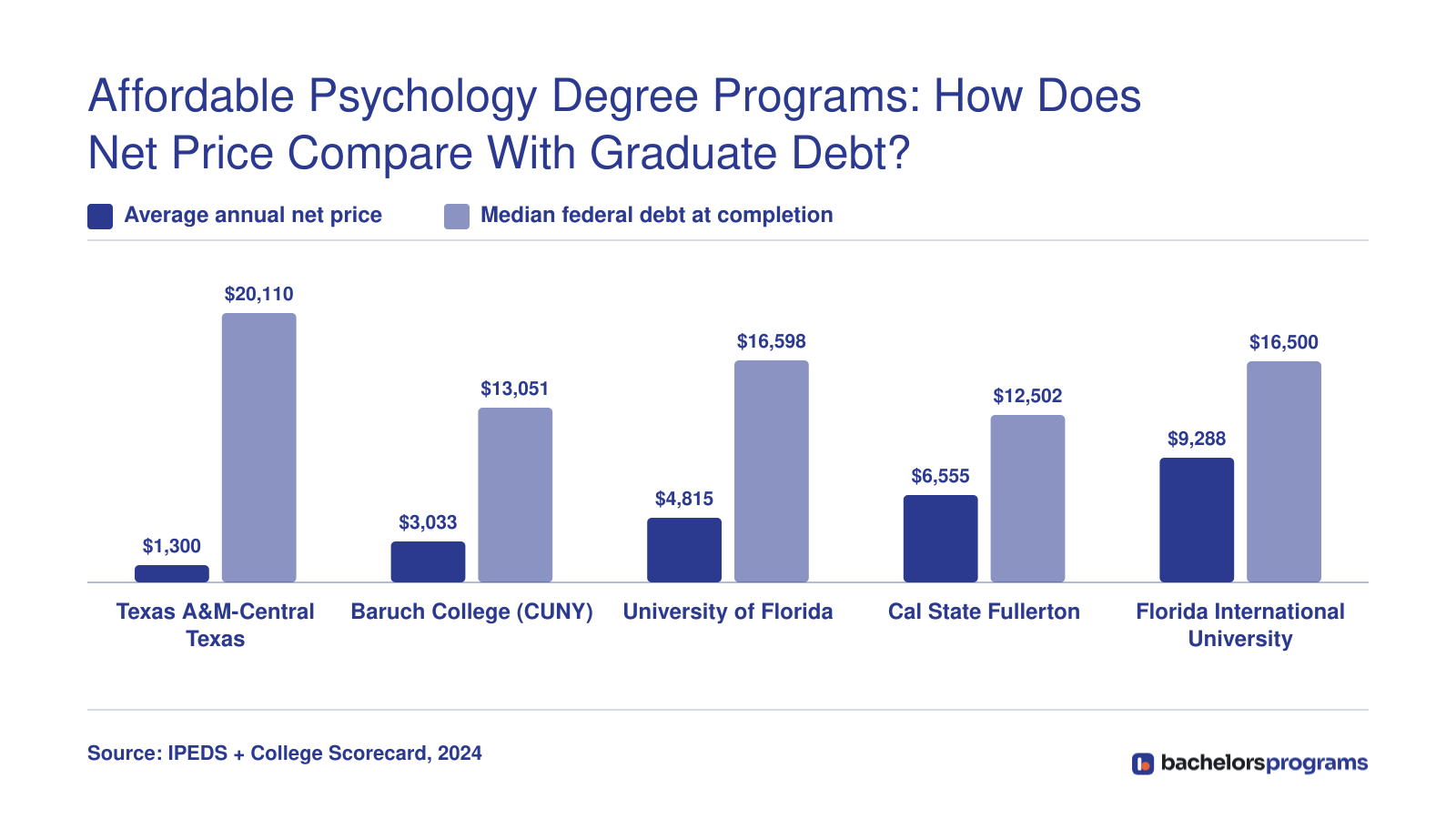
Affordable Psychology Degree Programs: How Does Net Price Compare With Graduate Debt?
Net price is an average cost after grants and scholarships, so your own aid package may come in higher or lower. These figures show how the lowest-cost programs here compare once federal borrowing is counted. Median program-level debt runs from $12,502 at Cal State Fullerton to $20,110 at Texas A&M University-Central Texas, or roughly $133 to $213 a month on a 10-year repayment plan. Median earnings one year after graduation range from $26,003 at the University of Florida to $35,149 at Baruch College, which keeps those payments a modest share of early pay.
Online vs. Campus Psychology Degrees: Transfer Credit, Pace, and Hands-on Access
Format comes down to three trade-offs: how much of your prior coursework travels with you, how fast you can move, and how much lab or field experience you can reach.
Transfer Credit and Residency Rules
Large online providers tend to be generous up front and strict at the finish. ASU Online's BA in Psychology requires 120 credits, accepts up to 90 transfer credits, and still requires at least 30 ASU credits.1 A separate rule caps community college credit at 64 semester credits, which can push the ASU-side minimum higher for students arriving with a two-year degree.1 Penn State World Campus requires at least 19 psychology credits, including 9 at the 300 or 400 level, completed in the department.2 Oregon State Ecampus requires 45 of your final 75 credits to be taken at Oregon State, online or on campus.3
Pace and Time to Finish
Term structure drives your calendar more than anything else. ASU Online runs 7.5-week classes, so a motivated full-time student can stack several starts per year. Penn State's online courses typically run 12 to 15 weeks across three semesters annually, with estimated completion of two to three years at six courses per semester, three to four years at four or five, and five or more years at two or three.2 Timelines shift with transferred credits and course availability.
Research, Internships, and Cost
Research experience carries real weight in graduate admissions, and campus students get it by walking into a lab. Online students should ask how the department places distance learners in research, remotely on faculty projects or at approved local sites, and how internships and practicums are supervised. Cost structure differs too: per-credit pricing at online providers versus campus fees, housing, and activity charges.
Use the Format field in the ranking to see which programs are offered online, then check residency rules before you assume your existing credits will apply.
Accredited Online Psychology Degree Programs: What Accreditation Actually Covers
The American Psychological Association accredits 440 doctoral programs, 705 doctoral internships and 169 postdoctoral residencies, along with a limited number of master's programs. It does not accredit bachelor's degrees. Any online psychology bachelor's program that advertises "APA accreditation" is misusing the term; at this level, what matters is institutional accreditation from a recognized agency.
Institutional Accreditation Is the One That Counts
APA's Commission on Accreditation is a programmatic accreditor working in graduate health service psychology, and participation is voluntary. Institutional accreditation is separate: it covers the whole college or university. Since 2020 the federal government no longer distinguishes between "regional" and "national" accreditors, so that older vocabulary is outdated. What remains is the list of agencies recognized by the U.S. Department of Education or the Council for Higher Education Accreditation (CHEA), and that recognition is what graduate schools, employers and financial aid offices check.
Verify Before You Enroll
Look up any online school in the Department of Education's Database of Accredited Postsecondary Institutions and Programs (DAPIP) or CHEA's directory. If the agency named on the school's website appears in neither, treat the degree as a risk: your credits may not transfer and graduate admissions offices may not accept the credential. Unrecognized accreditors often mimic legitimate names, so check the agency itself rather than the school's summary of it.
Why It Matters for Your Next Step
Institutional accreditation protects the chain of later steps. Credits need to move into a master's or doctorate, and licensure as a psychologist in most states requires a doctorate from an APA- or CPA-accredited program. Graduate psychology programs set their own policies on where your bachelor's degree came from, so confirm the current admissions requirement with each program rather than assuming a universal rule.
Related Articles
Questions to Ask Yourself
Do you picture yourself running experiments in a lab or sitting with clients?
Do you plan to become a licensed therapist?
If you study online, where will your research experience come from?
Are you drawn to workplace psychology more than mental health care?
What Can You Do With a Psychology Degree?
The U.S. Bureau of Labor Statistics figures below describe each occupation nationwide, so read them as wages and growth for everyone in the field, not as earnings for graduates of the programs ranked here. A bachelor's in psychology can lead directly to roles such as human resources specialist, market research analyst, or social and human service assistant, while counselor and psychologist positions require graduate study. Common next steps include a master's in counseling, a Master of Social Work (MSW), graduate study in industrial-organizational (I/O) psychology, or a doctoral degree in clinical psychology.
| Occupation | Median Annual Wage | Projected Growth (10-Year) | Typical Entry-Level Education |
|---|---|---|---|
| Psychologists | $99,110 (May 2025) | 6% (2025 to 2035) | Master's or doctoral degree in psychology |
| Market research analysts | $83,630 (2024) | Much faster than average (2024 to 2034) | Bachelor's degree |
| Human resources specialists | $75,940 (May 2025) | 6% (2025 to 2035) | Bachelor's degree |
| Substance abuse, behavioral disorder, and mental health counselors | $59,190 (2024) | 16.8% (2024 to 2034) | Master's degree |
| Social and human service assistants | $45,930 (May 2025) | 7% (2025 to 2035) | High school diploma or equivalent |
A psychology bachelor's is a launchpad, not a license: it opens the door to graduate study and to people-facing work, while clinical practice waits for the graduate credential and supervised hours.
How to Choose a Psychology Program: Your Pre-Application Checklist
Before you submit a single application, work through these checks. Each one filters out programs that look good on paper but won't fit your goals, credits, or budget.
- Verify institutional accreditationLook up every school on your list in the U.S. Department of Education or CHEA accreditation databases. Don't rely on a program's own website. Unaccredited credits rarely transfer and may not count toward graduate admission.
- Get transfer credit terms in writingIf you're bringing community college coursework or prior credits, ask the admissions office for a written evaluation before you enroll. Verbal estimates can change once you're admitted.
- Confirm research access for your formatAsk whether undergraduate research labs or faculty-mentored projects are open to students in your format, online or on campus. Research experience matters if graduate school is on your radar.
- Check for built-in internships or practicumPrograms that place internships or practicum hours inside the curriculum give you applied experience without forcing you to arrange it on your own.
- Match concentrations to your goalsMake sure the school offers the track you need, such as neuroscience, clinical, counseling, or industrial-organizational psychology, rather than a single general option.
- Weigh acceptance rate and net price, then request informationCompare each school's acceptance rate against your academic profile and its net price against your budget. Then request program information from the schools on your shortlist.
General Psychology programs by state
Psychology Degree Questions Students Ask Most
These answers cover the questions prospective psychology students raise most often. Requirements vary by school, degree level, and state, so confirm details with each program before you apply.
What is the best degree to get in psychology?
What are the best psychology colleges that are not Ivy League?
Can you get a psychology degree online?
Do you need a psychology bachelor's to get into a psychology master's or PhD program?
Compare General Psychology programs on the data that matters
Explore more Psychology majors or browse every field of study.
All Psychology programs Browse every field of study