Online Colleges and Bachelor's Degree Programs in Mississippi
Every verified bachelor's program at a college in Mississippi: 820+ programs at 18 colleges, with the online options, net price and graduation rates behind each one.

Does an online bachelor's degree in Mississippi cost the same whether you live in Gulfport or across the state line? At Mississippi State, online undergraduates pay one per-credit rate, with no nonresident surcharge.
"Online" is not one format. A university can run one major fully online and another as a hybrid that expects campus visits.
A program count tells you how many options exist, not what any of them will cost. What decides your bill is narrower: per-credit tuition and residency rules, Pell and state aid, community college transfer, and terms to finish. About a quarter of Mississippi adults hold a bachelor's degree, and stretching four years into six costs twice, in additional tuition and in wages forgone.
Key Points
- Mississippi State's 2026-2027 online rate is $452 per credit, regardless of residency.
- Mississippi's articulation agreement governs community college transfer into eight public universities.
- Check each major: some run hybrid despite a school's online branding.
Popular degrees in Mississippi
Bachelor's degrees in Mississippi by field
Business & Management
- Business Administration27 programs
- Marketing22 programs
- Accounting16 programs
- Healthcare Administration or Healthcare Management15 programs
- Finance12 programs
- Management12 programs
- Communication10 programs
- Logistics & Supply Chain Management9 programs
Education & Teaching
- Science19 programs
- Secondary Education17 programs
- Elementary Education14 programs
- Mathematics Education12 programs
- English Education11 programs
- Early Childhood Education or Child Development10 programs
- Physical Education10 programs
- Child Development6 programs
Science & Engineering
- Biology16 programs
- Mathematics15 programs
- Chemistry14 programs
- Physics8 programs
- Biochemistry8 programs
- Anthropology4 programs
- Geosciences4 programs
- Electrical Engineering or Electronics Engineering or Electronic Systems Engineering Technology4 programs
Liberal Arts & Humanities
- English15 programs
- History13 programs
- Literature or English Literature13 programs
- Spanish9 programs
- General Studies5 programs
- Philosophy3 programs
- Interdisciplinary Studies3 programs
- Global Health or Health Studies3 programs
Arts & Design
- Art or Art Studies13 programs
- Fine Arts or Studio Art13 programs
- Graphic Design9 programs
- Audio & Music7 programs
- Media Arts or Digital Media6 programs
- Creative Writing4 programs
- Digital Photography3 programs
- Art History3 programs
Communications & Media
- Journalism15 programs
- Communications12 programs
- Public Relations7 programs
- Speech Pathology5 programs
- Communication Disorders4 programs
- Professional Writing3 programs
- Social Media2 programs
- Strategic Communications2 programs
Criminal Justice & Law
- Criminal Justice14 programs
- Forensic Science8 programs
- Criminal Justice Administration7 programs
- Paralegal4 programs
- Legal Studies4 programs
- Legal Services3 programs
- Criminology2 programs
- Homeland Security2 programs
Computers & IT
- Computer Science10 programs
- Cybersecurity6 programs
- Information Technology5 programs
- Innovation or Technological Entrepreneurship5 programs
- Computer Engineering4 programs
- Computer Information Systems4 programs
- Software Development & Engineering2 programs
- Artificial Intelligence2 programs
Healthcare
- Exercise & Sports Science10 programs
- Public Health7 programs
- Speech Pathology5 programs
- Health Education5 programs
- Nutrition3 programs
- Health Sciences3 programs
- Health Informatics2 programs
- Community Health2 programs
Social Work & Social Sciences
- Political Science, Government11 programs
- Sociology10 programs
- Social Work9 programs
- Human Services1 program
- Public Policy1 program
Nursing
- Bachelor of Science in Nursing15 programs
- Nursing (RN to BSN)8 programs
- Accelerated BSN (ABSN)5 programs
- LPN/LVN to BSN2 programs
Psychology
- General Psychology14 programs
- Applied Behavior Analysis2 programs
- Applied Psychology1 program
Natural & Applied Sciences
- Agriculture or Agricultural4 programs
- GIS and Geoscience3 programs
- Oceanography or Ocean or Marine Biology3 programs
- Applied Science1 program
Fully Online, Hybrid, or Online Courses: What 'Online' Means at Mississippi Colleges
The flexibility you are shopping for lives at the program level, not the university level. A Mississippi school can promote a full online division and still run the major you want as a hybrid that expects you on campus several times a term. That gap between the marketing page and the degree requirements is where online students get caught out.
Three formats, three different commitments
- Fully online programs: All coursework is delivered at a distance. The University of Southern Mississippi defines its fully online majors as 100% online with no face-to-face classes, and Mississippi State's Bachelor of University Studies, a 120-credit degree, is described as 100% online.
- Hybrid programs: Most instruction happens online, but the degree builds in required in-person sessions. Mississippi State notes that online status varies by program and that some online offerings include internships, field experiences, or in-person coursework.
- On-campus programs with online courses: The degree is residential; individual sections just happen to run online. This is the format most often mistaken for a distance program.
Read the catalog page for your specific major and concentration, not the university's general online portal. The portal describes the delivery option; the catalog describes the requirement.
Asynchronous versus synchronous
Asynchronous courses post lectures and assignments weekly, so you can work around a shift schedule. Synchronous courses meet live at a fixed hour. If you work nights, travel, or live outside Central time, a single required live session can quietly make a degree unworkable. Ask whether live meetings are required or optional before you enroll.
Campus visits, orientation, and proctoring
Southern Miss requires orientation for new degree-seeking students in a fully online program1, but it can be completed as a two-hour live webinar with real-time Q&A2 or as a self-paced module; in-person options at Hattiesburg and Gulf Park exist for students who want them3. Students enrolled in Hattiesburg- or Gulf Park-based academic programs must attend in-person orientation there even if their classes are online3. Beyond orientation, the usual exceptions to a no-visit promise are proctored exams, clinical placements, student teaching, and lab intensives. Proctoring is typically handled either by remote software that monitors your webcam and screen or by an approved testing center near you; policies differ by course, so confirm rather than assume.
Three questions to email an admissions counselor
- Can I complete every requirement of this specific major without setting foot on campus?
- Are any course sections synchronous, and at what times?
- How are exams proctored, and does that cost me a fee?
Online Tuition at Mississippi Universities: Per-Credit Rates and Residency Rules
Mississippi State University lists $452 per credit hour for online undergraduate coursework in 2026-2027, and nonresidents pay that identical $452, with no separate out-of-state surcharge applied.1 That single detail explains why price shopping for an online degree in Mississippi works differently than it does for a campus seat.
Published Per-Credit Rates
- Mississippi State University: $452 per credit for residents and nonresidents, plus a $25 per credit distance fee, bringing the posted total to $477 per credit hour.1
- University of Mississippi (UM-Rankin): $416.25 per credit for Mississippi residents and $1,256 per credit for nonresidents in spring 2026.2 This rate is tied to the Rankin location, so confirm it applies to the specific program you want.
- University of Southern Mississippi: $433.59 per credit for the online Information Technology bachelor's. The posted figure does not spell out whether distance fees are folded in.
For Jackson State, Delta State, Mississippi University for Women, Alcorn State, and Mississippi Valley State, current online per-credit figures were not available from published bursar pages at the time of writing. Call the bursar's office and ask for the distance-education rate sheet in writing before you compare.
Does Residency Change What You Pay?
It depends entirely on the school. Mississippi State is the clear example of a flat online rate: the nonresident charge is zero, so a student in Memphis or Mobile pays what a student in Starkville pays. Ole Miss, by contrast, maintains a sharply different nonresident rate at UM-Rankin, roughly three times the resident figure. Never assume "online" means "in-state price." Ask the admissions office to confirm your residency classification in writing before you enroll.
A 120-Credit Estimate
Multiply the per-credit rate by 120, the standard bachelor's credit load, and you get a tuition-only floor. No books, no technology charges, no living costs.
- Mississippi State: about $54,240 in tuition, or roughly $57,240 with the distance fee included.
- Ole Miss at the resident rate: about $49,950 in tuition, closer to $53,950 once the online class fee is counted.
- Southern Miss Information Technology: about $52,031.
The resident Ole Miss rate is the lowest sticker figure here, but fees reshuffle that order quickly, and almost nobody pays for all 120 credits. A student arriving with 60 transferred community college hours halves every number above.
Fees That Stack On Top
Online students at Mississippi State face a $25 per credit distance fee, with additional course-level distance charges that vary by section. Ole Miss adds $33.33 per credit for online classes, a $50 nonrefundable registration fee, and special course fees running anywhere from $5 to $500 per hour, which its own cost calculator excludes from the estimate it shows you.3
What a Bachelor's Degree Is Worth in Mississippi
About 25.1% of Mississippi residents hold a bachelor's degree or higher, so the credential still sets graduates apart in the state's job market.
Financial Aid for Online Students: Pell, MTAG, HELP, and Adult-Learner Support
The published tuition figure is almost never what a Mississippi online student actually pays. Sticker price is the advertised cost of credits and fees before any assistance is applied; net price is what remains after grants and scholarships that never have to be repaid. Federal aid is the first layer for most online students: enrollment at least half-time (generally six credit hours a term) at an accredited institution typically keeps you eligible for Pell Grants and federal student loans, and studying at a distance does not by itself disqualify you.
Mississippi's state grants are built around full-time enrollment
The state's three best-known undergraduate programs are administered through the Mississippi Office of Student Financial Aid, and the Institutions of Higher Learning board materials describe each as a full-time program:
- MTAG (Mississippi Tuition Assistance Grant): For full-time Mississippi residents with at least a 15 ACT and/or a 2.5 GPA. Students who qualify for the maximum Pell Grant are not eligible under current law.1
- MESG (Mississippi Eminent Scholars Grant): A merit award for full-time students with at least a 29 ACT and a 3.5 high school GPA, intended to keep high achievers in state.1
- HELP Grant: A full-tuition scholarship for financially needy, college-ready residents, requiring full-time enrollment, at least a 20 ACT, a 2.5 GPA, and completion of a college-preparatory curriculum. Unlike MTAG, maximum-Pell students can still qualify for HELP if they meet its academic standards.1
That full-time condition matters enormously for working adults. If you plan to take two courses a term, assume these state grants are off the table and build your budget around Pell, federal loans, employer tuition assistance, and institutional awards instead. Award amounts, renewal rules, and any reduced-enrollment provisions are set administratively and change, so confirm current terms with the state financial aid office rather than trusting secondhand figures.
Adult learners and returning students
Mississippi runs Complete 2 Compete, a statewide initiative aimed at adults who accumulated college credit but left without finishing a degree. Benefits and eligibility are handled case by case through campus coaches, so contact the program or your target university's adult-learner office to learn what applies to your transcript. Many public universities also attach scholarships to community college transfer agreements; ask the admissions office what transfer awards exist before you enroll.
The action step
File the FAFSA as soon as it opens for your enrollment year, then complete the Mississippi state aid application. State deadlines arrive earlier than most students expect and the posted date for the coming year is published by the Office of Student Financial Aid. Submit well ahead of it; late applications are the most common reason eligible Mississippians lose grant money.
Transferring Community College Credits Into an Online Bachelor's Program
One Agreement, Eight Universities
Mississippi's statewide articulation agreement between the Institutions of Higher Learning and the Mississippi Community College Board governs transfer into the state's eight public universities, and those universities are required to follow it.1 An Associate of Arts or Associate of Science from a Mississippi community or junior college carries its core curriculum forward: courses graded C or better inside those degrees are accepted as transferable.2 The guarantee stops at the course level, though. Whether a particular course satisfies a major requirement still depends on the receiving university's program, so the same transcript can land differently in two departments.1
Credit Caps and the Residency Floor
Generally up to one-half of a bachelor's degree hours may transfer, and the University of Mississippi spells that out as one-half of total graduation requirements in your curriculum.3 At least 25 percent of degree credits must be earned in residence at the awarding university, which works out to 30 credits on a 120-credit degree.2 Prior learning assessment does not count toward that residency share; competency-based credit may.2 Southern Miss adds its own layer: 21 of the final 30 coursework hours must be taken there, and USM online hours count as residency.4
No Associate Degree? Other Routes In
- Course-by-course evaluation, with each course matched against a specific requirement
- Credit for prior learning, including portfolios and standardized exams such as CLEP and AP; Mississippi State adopted a new prior-learning policy effective January 30, 20265
- Military learning, which IHL permits to count for up to 90 undergraduate credit hours2
- Degree-completion formats such as Bachelor of Applied Science or University Studies tracks, built to absorb technical and workforce credit
Ole Miss admits transfer students who hold an associate degree or at least 30 credits toward a bachelor's from a regionally accredited institution, with a 2.0 cumulative GPA.6
Before You Apply
Request an unofficial transcript evaluation first. Most universities publish a transfer equivalency tool that shows how courses from Mississippi community colleges have transferred in the past; running your transcript through it costs nothing and can change which program you choose. Then confirm the residency math with an advisor in writing.
How Many Transfer Credits Do Mississippi Online Programs Accept?
Figure on up to half of your degree, roughly 60 credits on a 120-credit bachelor's, and up to 90 credits for military learning. Because that half is a ceiling tied to your specific curriculum rather than a fixed statewide number, the evaluation, not the catalog, gives you the real answer.
How Long Does an Online Bachelor's Degree Take in Mississippi?
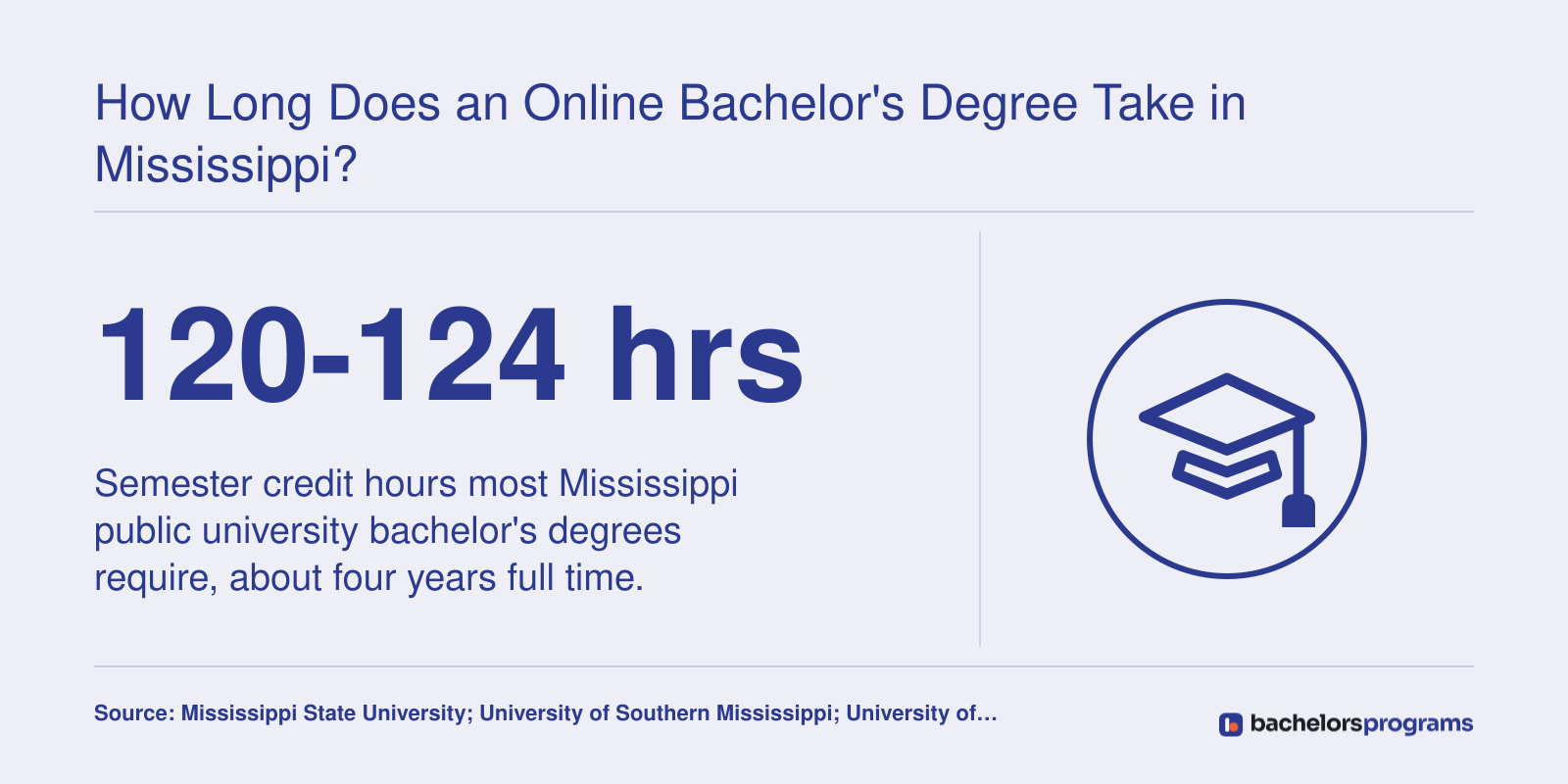
Most Mississippi public universities set bachelor's degrees at 120 to 124 semester hours, and Southern Miss notes that most of its degrees need at least 124. At about 15 credits a semester, a first-time freshman typically finishes in four years. A transfer student with an associate degree and roughly 60 credits left can often finish in about two years of full-time study, because Mississippi State's online Bachelor of University Studies and Ole Miss's Bachelor of University Studies each accept up to 60 community college hours. Part-time students take longer, in proportion to how many credits they carry each term. Students who want more flexibility can use Mississippi State's Mini Terms, two 8-week fall sessions of up to 7 credits each, offered online or in the classroom for selected courses. MSU's online Bachelor of University Studies also lets you start in fall, spring, or summer. These are typical paces based on credit loads, not guarantees. Residency rules, such as MSU's requirement that your final 30 hours be earned there, along with course sequencing and course availability, all shape your actual timeline.
Admission Requirements and Deadlines for Mississippi Online Programs
Mississippi's public universities follow uniform admission standards from the Institutions of Higher Learning (IHL), and each campus adds its own paperwork and timing. Online applicants should check these items before applying.
- 3.20 GPA pathwayFreshmen with an unweighted 3.20 GPA who complete the College Preparatory Curriculum can be admitted without ACT or SAT scores, though scores may still be required for course placement.
- 2.50 and 2.00 GPA pathwaysA 2.50 GPA requires an ACT composite of 16, and a 2.00 GPA requires an ACT composite of 18.
- Core curriculum and placementThe College Preparatory Curriculum is required, and IHL sets a minimum ACT subtest score of 17 in math, English and reading for placement, which individual universities may raise.
- Transfer standardFull transfer admission requires at least 30 transferable hours and a 2.0 cumulative GPA on college-level work, as determined by the admitting university.
- Southern Miss transfersApplicants with fewer than 30 semester hours also submit a high school transcript and need an overall 2.0 on all attempted coursework or an approved associate degree.
- Adult learnersAdults work from an individualized plan, and applicants without a high school diploma submit a state-approved equivalency exam plus ACT or SAT scores.
- Official transcripts and feeSouthern Miss requires official final transcripts from every college attended, does not accept faxed copies, and charges a nonrefundable $35 application fee.
- DeadlinesSouthern Miss wants applications and credentials 20 days before the requested session, while Ole Miss lists February 1 as a suggested priority date and accepts its own application or the Common Application.
Graduation Rates, Retention, and Outcomes Beyond Price
The sticker price of an online degree is the easiest number to compare and the least reliable guide to what it will cost you in time and lost opportunity. A low per-credit rate means little if the program has weak retention, slow credit transfer, or graduates who struggle to earn back the investment.
What Published Rates Can Tell You
Federal cohort data gives a partial answer, as long as you read the date. A 2017 IPEDS reporting cycle showed Mississippi State University with a 60% overall graduation rate and 80% first-year retention.1 A 2020 report for the University of Mississippi showed 61% graduation and 85% full-time retention, close to a comparison group at 87%.2 Those figures are not a current scorecard for either campus. They are directional evidence: most full-time starters come back for year two, and about 60% finish within the federal reporting window.
Retention matters because stop-out is expensive. Students who leave with debt and no credential carry the cost without the earnings premium. Graduation rate matters because it captures the cumulative effect of advising, course availability, and financial pressure, not just admission standards.
Who the Six-Year Rate Leaves Out
Official graduation rates track first-time, full-time students. Online learners often start part time, transfer in credits, or stop and restart, so the published rate may not describe their path. When you evaluate a school, look past the headline number. College Scorecard provides transfer-out data and completion breakdowns for Pell recipients, which are more useful for adult learners and community college transfers.
Licensure Programs Add Their Own Gate
Some online bachelor's programs have requirements that sit outside the graduation rate. RN-to-BSN tracks generally require an active registered nurse license before clinical coursework. Online teaching degrees must include state-approved student teaching, and the placement is usually arranged with a Mississippi school district. Confirm those requirements in writing before you enroll.
One Comparison to Make This Week
Choose three Mississippi schools you are seriously considering and open their College Scorecard pages side by side. Compare the graduation rate and median earnings for graduates, then check whether the online program you want appears in the school's reported data. A program with a modest tuition advantage but a weak completion record is rarely the cheaper choice.
Mississippi Teacher Licensure Through an Online Degree
How to Choose a Mississippi Online College: A Decision Framework
Two ways to pick a Mississippi online college: sort by the lowest published per-credit rate, or sort by the program that will accept your credits, support you through the term, and hold up on a transcript. The first takes an afternoon. The second takes a checklist.
Start with accreditation, both kinds
Confirm the school holds regional accreditation from SACSCOC (Southern Association of Colleges and Schools Commission on Colleges) by looking it up in the U.S. Department of Education database instead of trusting a marketing page. Then check programmatic accreditation for your field: CCNE or ACEN for nursing, AACSB for business, CAEP for education. A degree from an unaccredited program can cost you licensure eligibility or graduate admission, no matter how good the coursework felt.
If you do not live in Mississippi
Ask whether the program is authorized to enroll students in your state. Authorization rules vary, and a Mississippi university that is wide open to you at home may carry limits elsewhere. Settle that question before you pay an application fee or transfer credits in.
Judge the support, not the portal
Look for advisors assigned by program rather than a general call center, tutoring, library and database access, career services, and technical support hours that extend past a Monday-to-Friday workday. Ask how exams are proctored and what happens when a required course fills before you register.
Match the format to where you are starting
- Transfer students: prioritize written articulation agreements and how many credits land in the major, not just the total accepted.
- Adults returning to school: prioritize asynchronous delivery and 7- or 8-week terms that let you pause and restart without losing a semester.
- First-time students: prioritize graduation and retention rates and the quality of advising, since those predict whether you finish.
Online and hybrid formats both count here, and some programs still require labs, practicums, or a campus visit for exams. Do not assume the online route is cheaper or faster. Compare total cost of attendance, including fees, against the credit hours you must complete, then choose.
Colleges in Mississippi with the most bachelor's programs
| School | City | Type | Bachelor's programs | Online | Net price / yr | Grad rate |
|---|---|---|---|---|---|---|
| University of Mississippi | University | Public | 98 | 14 | $13,314 | 72% |
| University of Southern Mississippi | Hattiesburg | Public | 96 | 25 | $21,708 | 49% |
| Mississippi State University | Mississippi State | Public | 92 | 18 | $17,595 | 67% |
| Jackson State University | Jackson | Public | 65 | 8 | $23,836 | 51% |
| Delta State University | Cleveland | Public | 63 | 24 | $13,540 | 48% |
| Mississippi Christian University | Clinton | Private nonprofit | 59 | 6 | $27,712 | 59% |
| William Carey University | Hattiesburg | Private nonprofit | 56 | 24 | $14,258 | 60% |
| Mississippi University for Women | Columbus | Public | 49 | 9 | $12,411 | 47% |
| Belhaven University | Jackson | Private nonprofit | 46 | 9 | $15,676 | 49% |
| Blue Mountain Christian University | Blue Mountain | Private nonprofit | 41 | 11 | $24,016 | 55% |
| Alcorn State University | Alcorn State | Public | 38 | 1 | $13,265 | 57% |
| Millsaps College | Jackson | Private nonprofit | 29 | 1 | $26,034 | 57% |
| Strayer University-Mississippi | Jackson | Private for-profit | 27 | 27 | — | — |
| Tougaloo College | Tougaloo | Private nonprofit | 27 | 0 | $17,043 | 33% |
| Rust College | Holly Springs | Private nonprofit | 25 | 1 | $12,587 | 12% |
Program counts are the verified bachelor's listings in our directory; net price is the school-wide average a first-time undergraduate paid after aid, and graduation rate the share finishing within six years (College Scorecard).
Mississippi Online Bachelor's Degree FAQs
These answers cover the questions Mississippi online students ask most often about residency, campus requirements, aid, transfer credit, and diplomas. Policies differ by school and program, so confirm details with your institution before you enroll.
Do online students in Mississippi pay out-of-state tuition?
Can you complete a bachelor's degree entirely online in Mississippi without campus visits?
Can I use MTAG or HELP if I attend an online program part-time?
Can I transfer credits from an out-of-state community college or an older degree into a Mississippi online program?
Will my diploma say "online"?
Compare programs nationwide
Many Mississippi residents study online. Every ranked list above has an online lens, or browse every field.
Online bachelor's degrees Browse all fields