Best Accounting Degree Programs
Compare 1,300+ accredited Accounting programs at 1,200+ colleges, with net price after aid, graduation rates, earnings and debt from IPEDS and the U.S. College Scorecard.

What does a bachelor's in accounting cost after aid, and what do graduates earn four years later?
Dozens of programs bill themselves as top-ranked. Net price after aid across the schools ranked here runs from about $3,000 to $15,700 a year, while median pay four years after graduation spans roughly $88,000 to $101,000 at the campuses that report it. Cost and earnings rarely track together. Nearly every program here is campus-based, so online routes get weighed on their own terms.
The math also does not stop at four years. Most state boards still require 150 credit hours for CPA licensure, which pushes many graduates into a fifth year or a master's.
Key Points
- Top-paying programs' graduates earn roughly 6 to 12 times their median debt.
- Two CPA Exam sections had sub-44% pass rates through Q3 2026.
- States are adding alternatives to the traditional 150-credit CPA rule.
Top 10 Accounting Degree Programs at a Glance
Ten bachelor's accounting programs, compared on what they cost, how many students finish, and where graduates land. Each card gives the format, location, price after aid, and graduation rate, plus the accounting-specific details that actually separate these schools from one another.
University of Florida
#1Gainesville, FL · ~$7,000/yr (est.)
Best for: CPA-bound students in Florida
The Fisher School has taught accounting since 1923, and its Bachelor of Science in Accounting pairs a broad business core with financial reporting, auditing, and federal tax coursework. A combined 3/2 pathway admits qualified juniors early to the master's program, covering the 150 credits CPA licensure requires. Accounting graduates earned a median $65,144 one year after finishing.
- 120 total credit hours
- 3.0 GPA minimum
- Combined 3/2 pathway to the master's degree
- Prepares students for the CPA exam
- Accounting taught at UF since 1923
- ETS Business Field Test required
- Prepares for entry-level public accounting roles
CUNY Bernard M Baruch College
#2New York, NY · $7,000 – $15,000/yr (est.)
Best for: Aspiring auditors in New York City
Zicklin's Accountancy BBA is one of the country's largest accounting pipelines, awarding more than 600 degrees in a recent year, and its Manhattan address puts public accounting internships close at hand. Three admission paths lead into Zicklin, and majors need a 2.5 GPA across four core accounting courses to finish. Accounting graduates earned a median $54,281 one year after finishing.
- 124 total credit hours
- 2.0 GPA minimum to graduate
- 57 liberal arts credits required
- 2.5 GPA required across four core accounting courses
- Three admission paths into the Zicklin School
- Prepares students for CPA licensure
- Macaulay Honors direct admission available
- Term-by-term sample schedule published
University of Georgia
#3Athens, GA · ~$14,000/yr (est.)
Best for: Data-inclined future accountants
The Terry College major requires 24 hours of upper-level accounting, including three terms of intermediate accounting plus auditing, tax, and accounting information systems with data analytics. Admission takes a 2.6 GPA, a statement of purpose, and an accounting exam, and a Double Dawgs pathway runs straight into the MAcc. Accounting graduates earned a median $64,058 one year after finishing.
- 120 total credit hours
- 2.6 GPA minimum for major admission
- ACT or SAT scores required
- 24 hours of required accounting coursework
- 12-hour Area of Emphasis in Business Analytics
- Double Dawgs pathway to the MAcc
- Beta Alpha Psi and NABA chapters on campus
- Accounting Career Fair each fall
University of Washington-Seattle Campus
#4Seattle, WA · ~$14,000/yr (est.)
Foster's accounting major, delivered as a BA in Business Administration, is built for students who want accounting fluency without a public accounting career, so electives lean toward planning, decision-making, and control. Upper-division admission is competitive, and the school offers about 90 undergraduate scholarships plus honors options. Accounting graduates earned a median $62,731 one year after finishing.
- 180 total credit hours on the quarter system
- 2.0 GPA minimum
- Autumn and winter quarter starts
- Designed for non-CPA accounting careers
- Flexible selection of accounting electives
- Competitive upper-division admission
- About 90 undergraduate scholarships available
- Honors options available
University of Virginia
#5Charlottesville, VA · $22,000/yr (est. net price)
McIntire's accounting concentration sits inside the B.S. in Commerce, after two years of liberal arts coursework, and covers financial reporting, auditing, federal taxation, and government and nonprofit accounting. Virginia's CPA rules call for 24 accounting semester hours, 21 of them above the introductory level, and the concentration is designed to satisfy them. Graduates move into audit, tax, advisory, and controller roles.
- Accounting concentration inside the B.S. in Commerce
- 24 accounting semester hours for CPA eligibility
- 21 of those hours above the introductory level
- Coursework in auditing, federal taxation, and financial reporting
- Can be combined with a Finance concentration
- Prepares students for auditor, tax adviser, and controller roles
University of Maryland-College Park
#6College Park, MD · $16,000/yr (est. net price)
Smith's accounting major splits into a Public Accounting track built for CPA exam preparation and a Business and Accounting Advisory track for industry, government, and nonprofit roles. Both take 120 credits, and the school is explicit that Maryland licensure requires 150. The major also runs at the Universities at Shady Grove. Accounting graduates earned a median $69,821 one year after finishing.
- 120 total credit hours
- Tracks: Public Accounting; Business and Accounting Advisory
- Public Accounting track aligns with CPA exam preparation
- Maryland CPA license requires 150 credit hours
- Also offered at the Universities at Shady Grove
- Emphasizes ethical decision-making and professional writing
- Prepares for private, government, and nonprofit accounting
Florida State University
#7Tallahassee, FL · ~$11,000/yr (est.)
Florida State admits students to upper-division accounting only after a B or better in both introductory courses and a passing score on the FSU Accounting Competency Exam. A combined bachelor's/master's pathway lets up to nine credits count toward both degrees, which helps with Florida's CPA education requirement. Accounting graduates earned a median $55,626 one year after finishing.
- Four-year academic map across eight semesters
- B or better required in ACG 2021 and ACG 2071
- FSU Accounting Competency Exam required for upper division
- Combined bachelor's/master's pathway
- Up to nine credits count toward both degrees
- Beta Alpha Psi chapter and Meet the Firms event
- Internship and international programs available
- MAcc satisfies Florida's CPA education requirement
Hillsdale College
#8Hillsdale, MI · $30,000 – $35,000/yr (est.)
Hillsdale's accounting major sits inside a classical liberal arts curriculum, pairing tax law and auditing with required work in foreign language, science, or mathematics. The private Michigan college keeps the cohort small, runs an accounting honor society, and brings executives to campus for its Food For Thought series. Students can take accounting as a major or a minor.
- Offered as a major and a minor
- Coursework in tax law and auditing
- Required work in foreign language, science, or mathematics
- Accounting honor society for academic excellence
- Food For Thought executive speaker series
Brigham Young University
#9Provo, UT · $15,000 – $20,000/yr (est.)
The Marriott School runs one of the strongest accounting placement networks in the West, with on-campus internships, field studies, and a dedicated advisement center behind the degree. Students join the Accounting Society, Beta Alpha Psi, and Women of the School of Accountancy. Accounting graduates earned a median $68,393 one year after finishing.
- On-campus internships and field studies
- Accounting Society student organization
- Beta Alpha Psi honors society chapter
- Women of the School of Accountancy
- CareerLaunch and Handshake placement tools
- Placement profiles published for graduates
- Dedicated advisement center
- Financial aid available to eligible students
University of Illinois Urbana-Champaign
#10Champaign, IL · ~$14,000/yr (est.)
Illinois's BS in Accountancy blends audit, tax, and data analytics with a full business core in finance, marketing, operations, and economics, and it is a steady pipeline into large public accounting firms. The degree takes 124 credit hours, with study abroad, minors, and internships available. Accountancy graduates earned a median $74,731 one year after finishing, the highest one-year figure on this list.
- 124 total credit hours
- Coursework in audit, tax, and data analytics
- Full business core in finance, marketing, operations, economics
- Careers in audit, corporate accounting, tax, and consulting
- Study abroad and internships available
- Government and nonprofit career paths
- Builds leadership and communication skills
Cost & outcomes by school
Federal data for the highest-earning Accounting programs, independent of the ranking above. Earnings are this field's bachelor's graduates four years after completing where the Scorecard reports them, else the school's undergraduate median.
| School | Net price / yr | Grad rate | Earnings | Debt | Grads/yr | Format |
|---|---|---|---|---|---|---|
| Georgetown University DC | $40,815 | 95% | $141,931 | $17,500 | 48 | Campus |
| Bucknell University PA | $40,766 | 86% | $130,990 | $26,881 | 21 | Campus |
| Santa Clara University CA | $50,062 | 88% | $130,087 | $18,625 | 48 | Campus |
| Boston College MA | $41,704 | 91% | $126,461 | $18,000 | 140 | Campus |
| Lehigh University PA | $36,931 | 88% | $125,874 | $23,179 | 52 | Campus |
| Babson College MA | $40,514 | 93% | $123,938 | $20,000 | — | Campus |
| Washington and Lee University VA | $23,781 | 94% | $118,946 | $16,750 | 57 | Campus |
| University of Notre Dame IN | $26,780 | 95% | $115,909 | $19,000 | 72 | Campus |
| University of Richmond VA | $31,309 | 85% | $112,202 | $20,500 | 45 | Campus |
| The College of New Jersey NJ | $27,646 | 86% | $111,509 | $23,894 | 59 | Campus |
| University of Pennsylvania PA | $28,699 | 97% | $111,371 | $15,715 | 20 | Campus |
| Stevens Institute of Technology NJ | $41,346 | 87% | $108,772 | $27,000 | — | Campus |
Sources: U.S. Department of Education. Net price, graduation rate, earnings and debt: College Scorecard (earnings and debt for this field's bachelor's graduates where reported, else school-wide); graduates: IPEDS. A dash means no figure is reported.
Cost, debt & payoff
Median earnings of this field's bachelor's graduates (4 yrs after completing, else the school's undergraduate median) vs. their median federal loan debt · U.S. College Scorecard
Across these programs the median graduate earns about $66,108 and finishes with roughly $23,250 in debt — a ratio that clears a common rule of thumb (keep debt below first-year salary). Net price and debt vary widely school to school, so check the per-school figures in the table above before you shortlist.
How We Ranked These Accounting Schools (And How That Differs From U.S. News)
Our ranking starts with outcomes a family can verify: net price after aid, institution-wide graduation and retention rates, earnings for graduates of the specific program, median federal debt at completion, and admissions selectivity. We publish no percentage weights, because the right balance shifts with what a student needs. Each factor appears plainly in the profiles so you can judge which one matters most for you.
Where the Numbers Come From
Two federal sources do most of the work. The College Scorecard supplies program-level and institution-level outcomes, including what graduates earn and what they owe. IPEDS supplies cost data. Net price is an average, not a quote, and it moves with family income, so treat it as a starting comparison rather than a final bill.
How This Differs From Reputation Rankings
U.S. News & World Report's 2026 Best Undergraduate Accounting Programs ranking rests on a peer assessment survey. Deans and senior faculty at AACSB International-accredited business programs rate overall academic quality from 1 to 5, with a "don't know" option, and the magazine trims the two highest and two lowest scores before averaging. Public Accounting Report's Annual Professors Survey takes a similar approach from inside the discipline, asking accounting faculty which programs they hold in high regard.
Neither survey asks what graduates earn or how much debt they carry out the door. Reputation rankings tell you who is famous. Outcome data tells you who pays off. Read the second one before you sign for a loan.
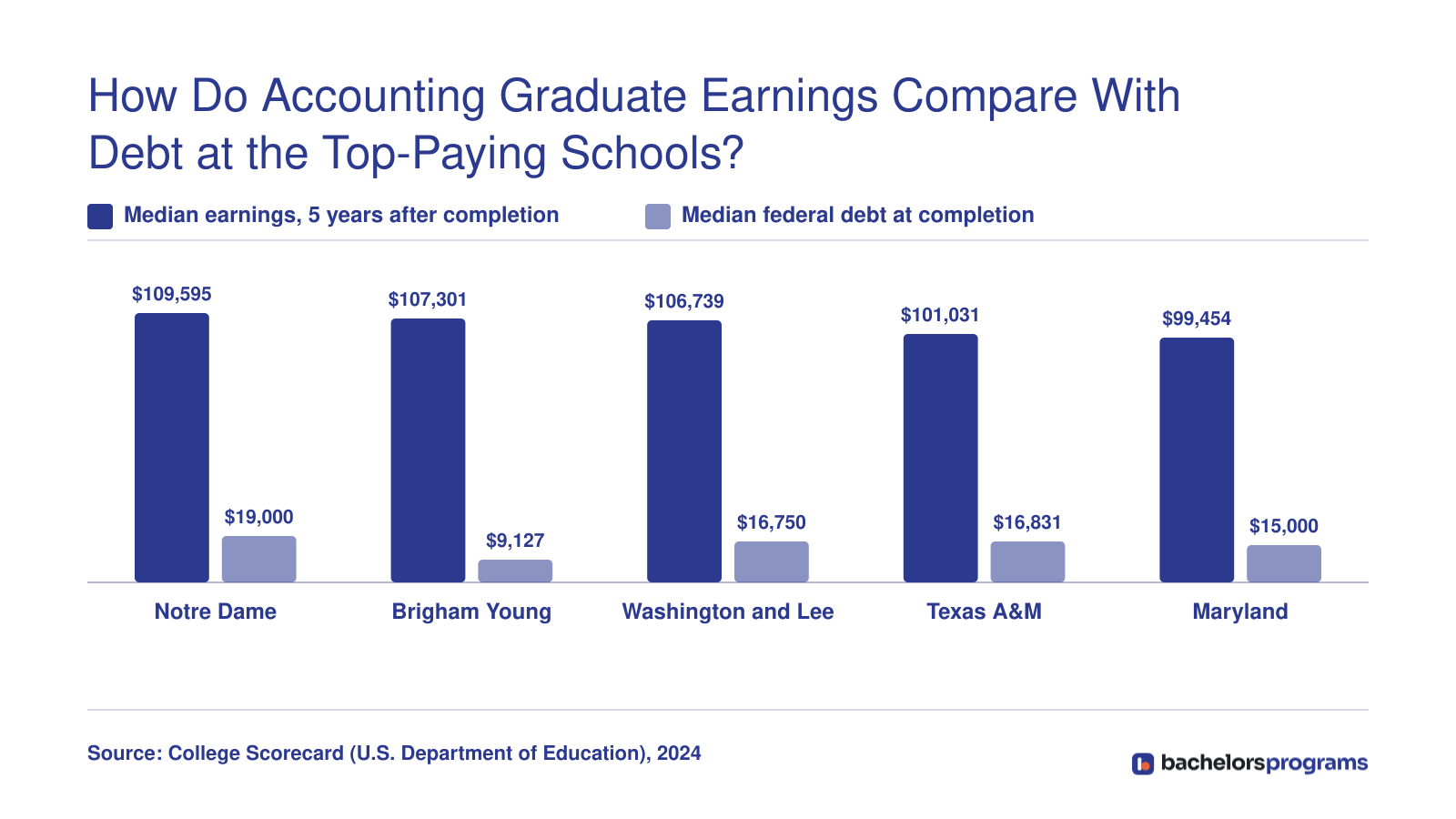
How Do Accounting Graduate Earnings Compare With Debt at the Top-Paying Schools?
At the highest-earning accounting programs, graduates' median pay five years after finishing is roughly 6 to 12 times their median federal debt at completion. To make the debt side concrete: Notre Dame's median debt of $19,000 works out to about $201 a month on a standard 10-year repayment plan, and BYU's $9,127 comes to about $97 a month. Both earnings and debt are measured for each school's accounting program specifically, not for the university as a whole.
Best Online Accounting Degree Programs vs. Campus Programs
Online accounting degrees are a legitimate route to the CPA, but they trade campus recruiting access for lower cost and flexibility. Every school ranked here is listed as a campus program, so students who need to study remotely should look at dedicated online options such as UCF Online, Penn State World Campus, ASU Online and Western Governors University (WGU).
What Online Tuition Actually Costs
Online programs usually quote tuition per credit, which makes them easier to compare. Published rates for 2026 and 2026-27 include:
- UCF Online: $179.19 per credit for Florida residents. UCF's own pages list conflicting nonresident rates (one shows $715.80 per credit), so confirm directly.1
- Penn State World Campus: $644 per credit with 59 or fewer credits, rising to $692 at 60 or more.2
- ASU Online: $580 per credit. ASU states that online students taking up to 11 credits a semester are not charged out-of-state tuition.
- WGU: a flat $3,850 per six-month term, so your effective per-credit cost falls the more courses you finish.3
Out-of-state campus tuition and fees run $35,124 at the University of Illinois Urbana-Champaign and $59,512 at the University of Virginia, so the savings for nonresidents are clear.
Transfer Credit Can Cut the Bill
Transfer policy matters as much as the rate. ASU Online accepts up to 64 credits from two-year colleges, sets no fixed limit on four-year credits, and requires 30 credits earned at ASU toward its 120-credit degree. WGU says credits from accredited associate and bachelor's programs can "almost always" transfer, though it publishes no numeric maximum.3 Finishing general education at a community college first is one of the most reliable ways to lower total cost. Request a formal transfer evaluation before enrolling.
The Honest Trade-Off
Campus programs typically deliver stronger Big Four recruiting, career fairs and chapters of groups like Beta Alpha Psi. The University of Georgia, for example, holds an accounting career fair each fall. Online programs win on flexibility, which matters most for working adults.
State CPA boards generally do not distinguish online from campus degrees when the school is regionally accredited. Check your board's specific accounting coursework rules either way.
Related Articles
CPA Education Requirements in Large Accounting States
CPA rules are shifting as states add alternatives to the traditional 150-credit rule, and effective dates differ by state. The details below reflect board and NASBA information for 2026. Confirm the current rule with your state board before you choose a program. NASBA's state board directory links to every board, including those not covered here.
State-by-State Snapshot
- Pennsylvania: 120 semester credits to sit for the exam, 150 for licensure.1 No 120-credit experience option appears in the state's licensure snapshot. Candidates need at least one full year and 1,600 hours of qualifying experience.1
- Texas: 150 semester hours for licensure and one year of experience.2 Confirm exam-eligibility credits with the Texas State Board of Public Accountancy.
- New York: 150 semester hours for licensure, with one year of full-time experience (or part-time equivalent).3 A grandfathered 120-semester-hour pathway exists, but it requires at least two years of experience.3
- California: One year of general accounting experience is the minimum.4 Check the California Board of Accountancy for the current credit rules.
- New Jersey: 150 semester hours, including 24 in accounting and 24 in general business.5 A newer pathway allows 120 credits plus two years of experience.5
Where the Coursework Is Most Demanding
New Jersey stands out. Its specified 24 accounting hours and 24 business hours leave less room for electives than a general 150-credit total suggests. Check any program's course map against that split before you enroll.
Pennsylvania is notable for a different reason. It lets you sit for the exam at 120 credits, but you still need 150 to license. A bachelor's degree alone gets you to the exam, not to the license.
Other Large Markets
Florida, Illinois, Ohio, Georgia, and North Carolina all have large accounting job markets. Look up their current credit and experience rules through NASBA or each state's board of accountancy rather than assuming they match the states above.
If you plan to move after graduation, expect to meet the licensing rules of the state where you apply.
Through the first three quarters of 2026, two CPA Exam sections drew cumulative pass rates below 44%: Financial Accounting and Reporting and Business Analysis and Reporting. Auditing and Attestation sat right at 50%. That is worth asking about: when comparing accounting programs, request the CPA pass rates of each school's own graduates.
B.S. vs. B.A. vs. BBA vs. B.Acc.: What Is the Best Accounting Degree?
The four labels differ in focus and in how many credits go to accounting, but the label matters less than whether your curriculum covers the accounting and business credit hours your state board requires. Check that coursework list before you compare degree names, and plan for the 150 semester hours most states require for CPA licensure, since a standard 120-credit degree falls short. Specializations such as tax, audit, forensic accounting, and accounting analytics typically sit inside any of these degrees as electives or concentrations. Tax leads toward advisory and compliance work, audit toward external or internal auditing, forensic accounting toward fraud examination and investigations, and analytics toward data-driven advisory and financial analysis roles. So what is the best accounting degree? For most future CPAs, a B.S. or BBA in accounting, ideally with a path to 150 credits, is the strongest choice.
| Degree | Typical focus | Accounting coursework depth | Fit for the CPA path | Best suited for |
|---|---|---|---|---|
| B.S. in Accounting | Technical, career-focused study of auditing, taxation, financial reporting, and strategic decision-making | 63 credits of accounting and business coursework in a 120-credit program | Designed for CPA candidates, though extra coursework may still be needed for jurisdiction-specific rules | Students wanting a technical curriculum and a direct route toward CPA licensure |
| B.A. in Accounting | Accounting within a liberal-arts-oriented curriculum | 42 credits toward the major in a 120-credit program | Less directly aligned; additional coursework is required for CPA eligibility | Students curious about accounting who are not initially planning to become CPAs |
| BBA in Accounting | Broad business foundation (management, marketing, economics, finance) plus a formal accounting concentration | Full accounting concentration; exact credit requirements vary by school | Can satisfy requirements if it includes the required accounting and business courses; a typical 120-credit BBA leaves a 30-hour gap to 150 | Students targeting staff accounting, controllership, financial analysis, or management-oriented roles |
| Bachelor of Accounting (B.Acc.) | Dedicated professional accounting: financial and managerial accounting, auditing, taxation, business law | Comparable to other dedicated accounting bachelor's degrees, roughly 120 credits of accounting and related business courses | Standard undergraduate foundation, but a typical 120-credit degree is below the 150 hours most states require | Students wanting a dedicated professional accounting degree for entry-level roles or later CPA coursework |
Questions to Ask Yourself
Will you sit for the CPA exam in a state that still requires 150 credits?
Is a combined bachelor's and master's track worth the extra year of tuition?
Do you need on-campus recruiting access, or does flexibility matter more?
Which accounting specialty are you actually aiming at?
Accounting programs by state
Accounting Degree FAQs
These answers cover the questions readers ask most about CPA licensure, online study, and program length. CPA rules are set state by state, so confirm details with your state board of accountancy before you enroll.
Do I need a master's degree to become a CPA?
Can you become a CPA with an online accounting degree?
How long does a bachelor's in accounting take, and can transfer credits shorten it?
Can I qualify for the CPA exam if my bachelor's degree is in another field?
Compare Accounting programs on the data that matters
Explore more Business & Management majors or browse every field of study.
All Business & Management programs Browse every field of study