Online Colleges and Bachelor's Degree Programs in Colorado
Every verified bachelor's program at a college in Colorado: 1,150+ programs at 40+ colleges, with the online options, net price and graduation rates behind each one.

In Colorado, the College Opportunity Fund stipend applies per credit hour at public institutions, but only if you claim it, and only on eligible courses. Online flexibility is nearly universal now. What separates schools is sticker price per credit, how many transfer credits a school will actually apply, and whether a program labeled online still requires periodic campus visits for labs, practicums or exams.
That last point catches transfer students and working adults who assume fully online means fully remote. Accreditation from the Higher Learning Commission is the baseline for Colorado public universities, and it is the credential that travels with the transcript.
Key Points
- The College Opportunity Fund stipend lowers tuition for residents at public colleges.
- Finishing a 60-credit transfer degree with designation guarantees junior standing.
- Colorado State University Global runs 8-week courses with 12 starts yearly.
Popular degrees in Colorado
Bachelor's degrees in Colorado by field
Business & Management
- Business Administration43 programs
- Marketing29 programs
- Management19 programs
- Accounting16 programs
- Economics15 programs
- Finance13 programs
- Communication11 programs
- Human Resource Management or HR Management10 programs
Science & Engineering
- Biology20 programs
- Mathematics17 programs
- Biochemistry17 programs
- Chemistry17 programs
- Anthropology14 programs
- Physics14 programs
- Geosciences12 programs
- Electrical Engineering or Electronics Engineering or Electronic Systems Engineering Technology9 programs
Education & Teaching
- Secondary Education22 programs
- Science18 programs
- English Education14 programs
- Elementary Education11 programs
- Early Childhood Education or Child Development10 programs
- Mathematics Education10 programs
- Special Education9 programs
- History Education8 programs
Liberal Arts & Humanities
- English21 programs
- Literature or English Literature15 programs
- History14 programs
- Spanish13 programs
- Philosophy12 programs
- Gender & Sexuality Studies7 programs
- Humanities5 programs
- Interdisciplinary Studies5 programs
Arts & Design
- Fine Arts or Studio Art25 programs
- Art or Art Studies23 programs
- Audio & Music10 programs
- Art History10 programs
- Media Arts or Digital Media8 programs
- Graphic Design7 programs
- Creative Writing4 programs
- Game Programming & Development3 programs
Computers & IT
- Computer Science28 programs
- Cybersecurity13 programs
- Innovation or Technological Entrepreneurship10 programs
- Computer Engineering8 programs
- Computer Information Systems8 programs
- Artificial Intelligence7 programs
- Software Development & Engineering5 programs
- Information Technology4 programs
Social Work & Social Sciences
- Sociology28 programs
- Political Science, Government16 programs
- Public Policy6 programs
- Human Services5 programs
- Social Work5 programs
Communications & Media
- Communications19 programs
- Journalism16 programs
- Strategic Communications6 programs
- Public Relations4 programs
- Technical Communication4 programs
- Communication Disorders3 programs
- Speech Pathology3 programs
- Professional Writing1 program
Nursing
- Bachelor of Science in Nursing28 programs
- Nursing (RN to BSN)14 programs
- Accelerated BSN (ABSN)8 programs
- LPN/LVN to BSN2 programs
Healthcare
- Exercise & Sports Science10 programs
- Health Sciences8 programs
- Public Health7 programs
- Nutrition3 programs
- Speech Pathology3 programs
- Health Informatics2 programs
- Respiratory Care Therapy1 program
- Health Education1 program
Criminal Justice & Law
- Criminal Justice9 programs
- Criminology7 programs
- Forensic Science2 programs
- Fire Science or Fire Administration2 programs
- Legal Services1 program
- Cybercrime1 program
- Homeland Security1 program
- Criminal Justice Administration1 program
Psychology
- General Psychology17 programs
- Sport Psychology2 programs
- Health Psychology1 program
- Addiction Psychology1 program
- Industrial Organizational Psychology1 program
- Counseling Psychology1 program
Natural & Applied Sciences
- GIS and Geoscience7 programs
- Agriculture or Agricultural3 programs
- Applied Science1 program
- Neuroscience1 program
Counseling
- Mental Health Counseling5 programs
- Substance Abuse Counseling2 programs
- Behavioral Health Science1 program
How Online Bachelor's Degrees Work in Colorado: Fully Online, Hybrid and Accreditation
Colorado's public and nonprofit universities hold regional accreditation from the Higher Learning Commission, the same stamp their brick-and-mortar degrees carry. Confirm it before you compare formats or prices.
Three formats, three levels of campus time
Most Colorado online bachelor's programs fall into one of three shapes:
- Fully online: Coursework and exams happen remotely, often asynchronously, so you can set study hours around a job.
- Hybrid: Part of the term runs online and part meets on campus on a published schedule, typically one evening a week or a Saturday block.
- Online with in-person requirements: The classroom work is remote, but specific courses require labs, clinical placements, student teaching or supervised internships.
That third category is where surprises happen. A business or criminal justice degree may be fully remote; a nursing or education degree usually is not. Delivery mode can also shift inside one degree, with general education online and upper-division major courses residentially taught.
How to check what a program really requires
Read the program page, then open the catalog entry, which often carries a delivery-mode note the marketing page leaves out. Then ask admissions a direct question: "Which courses in this degree require me to be on campus or in a field placement, and how are those arranged?" Get the answer in writing. Ask too whether online sections use the same faculty as the campus sections, and whether online students pay the same per-credit rate.
Accreditation and your diploma
Regionally accredited Colorado universities do not print "online" on the diploma; it matches the campus version. Verify any institution in the U.S. Department of Education's DAPIP database before you enroll. Accreditation is institutional rather than programmatic, so check separately for specialized accreditation if your field requires it.
If you live outside Colorado
Confirm the school is authorized to enroll residents of your state, either through State Authorization Reciprocity Agreement membership or a separate state approval. Ask admissions directly rather than assuming.
What an Online Bachelor's Degree Costs in Colorado: Tuition per Credit Hour
The lowest sticker price per credit is not always the lowest bill. Residency, the College Opportunity Fund (COF) and add-on fees can move your total as much as the base rate does. The rates below come from each school's official tuition page. Each rate below includes a 120-credit estimate (rate × 120). Transfer credit lowers that total, since you pay only for the credits you complete at the new school.
Published Online Tuition Rates
- CSU Global (2026-27, Tuition and Aid page): $385 per credit for all undergraduates regardless of residency, effective for students starting July 2026. Estimated 120-credit tuition: $46,200.
- CU Denver/CU Online (online undergraduate program page): $403 per credit for Colorado residents with the COF and $623 for nonresidents.1 Estimated 120-credit tuition: $48,360 resident, $74,760 nonresident.
- MSU Denver (2026-27, Undergraduate Tuition and Fees schedule): $326.25 per credit resident student share after the $116 COF reduction, or $442.25 before it.2 Estimated 120-credit tuition: $39,150 with COF, $53,070 without.
- Regis University (2026-27, Adult Undergraduate and Graduate Cost of Attendance): $599 to $975 per credit for accelerated, evening and online programs, depending on the program.3 Estimated 120-credit tuition: $71,880 to $117,000.
Flat Rates Versus Residency Pricing
CSU Global and Regis charge one rate no matter where you live. Regis is private, so it does not price by state residency. CU Denver and MSU Denver use resident and nonresident pricing, and their resident figures assume the COF stipend is applied.
That split matters most for out-of-state students. CSU Global's flat $385 runs $238 per credit below CU Denver's nonresident rate. For a Colorado resident using the COF, MSU Denver posts the lowest base rate here.
Fees to Budget For
- Technology fees: MSU Denver lists a Student Technology fee separately from tuition.
- Online course or program fees: MSU Denver adds a $20-per-credit Online Education Program Fee for students registered only in online classes, roughly $2,400 across 120 credits. CSU Global lists $0 in mandatory student and per-course fees.
- Graduation fee: Many schools charge one at degree conferral, so check the bursar page before your final term.
- Other mandatory fees: MSU Denver also lists student affairs, bond, athletic and health and wellbeing fees. For CU Denver and Regis, ask admissions whether the per-credit rate includes every mandatory charge.
Net Price, Financial Aid and the College Opportunity Fund Stipend
"Do online courses at a Colorado public college qualify for the College Opportunity Fund stipend, and what is the per-credit amount for 2026?" That is the right question; a blog post is the wrong place to answer it. The state sets the stipend amount, the eligibility rules and the treatment of online enrollment, and revises them from year to year, so verify rather than trust a fixed number.
Verify the College Opportunity Fund Directly
COF is a Colorado state aid program: you apply and authorize the stipend, and it is applied toward in-state undergraduate tuition at participating schools.1 Start at the Colorado Department of Higher Education (cdhe.colorado.gov) and the official COF program site. Confirm the current per-credit amount and the eligibility rules in force for the year you enroll, and ask specifically whether online and hybrid courses qualify the same way as on-campus ones. Then call your school's financial aid office, because the institution applies the stipend and knows how it interacts with your schedule and residency status.
Check State Grants and Scholarships
CDHE publishes the Colorado Student Grant and the Colorado Opportunity Scholarship Initiative (COSI) on its own pages. Read eligibility, award ranges and application steps there rather than in a third-party summary. COSI is administered through institutions, community organizations and scholarship partners rather than from a single statewide office, so terms vary by program. For the 2025-2026 year, CDHE reports $6.5 million allocated across Colorado counties and institutions for matching student scholarship grants that pair community scholarships with tuition support.2
Confirm FAFSA or CASFA Before Deadlines
Completing the FAFSA also puts you in line for state grants. Students who are not eligible for federal Title IV aid, including undocumented students and mixed-status families, may use the CASFA for state and institutional aid only; the participating institution determines eligibility and awards, and the CASFA itself does not award aid. Do not file the CASFA if you qualify for federal aid through the FAFSA. Ask your financial aid office which application applies to you, then track both state and institutional deadlines.
Your Contact Checklist
- CDHE: confirm current COF, Colorado Student Grant and COSI rules and deadlines.
- Official COF site: confirm the per-credit stipend and whether online courses qualify.
- School financial aid office: ask "which application applies to me," how the stipend posts to your account, and what institutional aid you may still claim.3
- COSI program administrators: ask what each scholarship partner requires and whether online enrollment is accepted.
The Bachelor's Degree Earnings Premium in Colorado
A bachelor's degree is associated with a clear earnings gap over a high school diploma among Colorado adults.
Military, Veteran and Employer Tuition Benefits for Colorado Online Students
Military education benefits are tuition money tied to your service record, and Colorado online students can draw on three sources at once: the federal government, the state, and sometimes an employer. Knowing which ones stack, and which replace one another, keeps you from leaving aid unclaimed.
Federal Benefits and the Online Housing Rule
The Post-9/11 GI Bill pays tuition and fees plus a monthly housing allowance. For students taking only online courses, the VA bases that allowance on half the national average, capped at $1,198 per month in 2026; your actual payment can be lower. Adding at least one in-person class may qualify you for the higher resident rate, though VA rules on mixed schedules are specific. Military Tuition Assistance is separate, and CSU Global accepts federal TA, Colorado National Guard TA and VR&E Chapter 31 benefits. Yellow Ribbon is voluntary for schools: CSU Global does not participate, saying eligible Post-9/11 students can still have qualified tuition charges covered.
Colorado's Guard Waiver and Per-Credit Rates
Colorado replaced its State Tuition Assistance Program with a Tuition Waiver under SB 25-247 on July 1, 2025. Eligible Guard members who apply and are approved may have 100% of tuition covered, but mandatory fees, textbooks and related costs are not.1 The old program's $5,000 per semester ceiling does not describe the 2026 benefit. Published military rates matter too: at CSU Global, active-duty, Guard and Reserve undergraduates pay $250 per credit against a $385 standard rate, and veterans $346.50.
Employer Aid and One Practical Step
Several large Colorado employers and statewide programs offer tuition assistance or partner discounts; ask HR for the written policy before you enroll. Then request an official evaluation of your Joint Services Transcript and any ACE-recommended credit before your first term, so military training counts toward the degree rather than sitting unused.
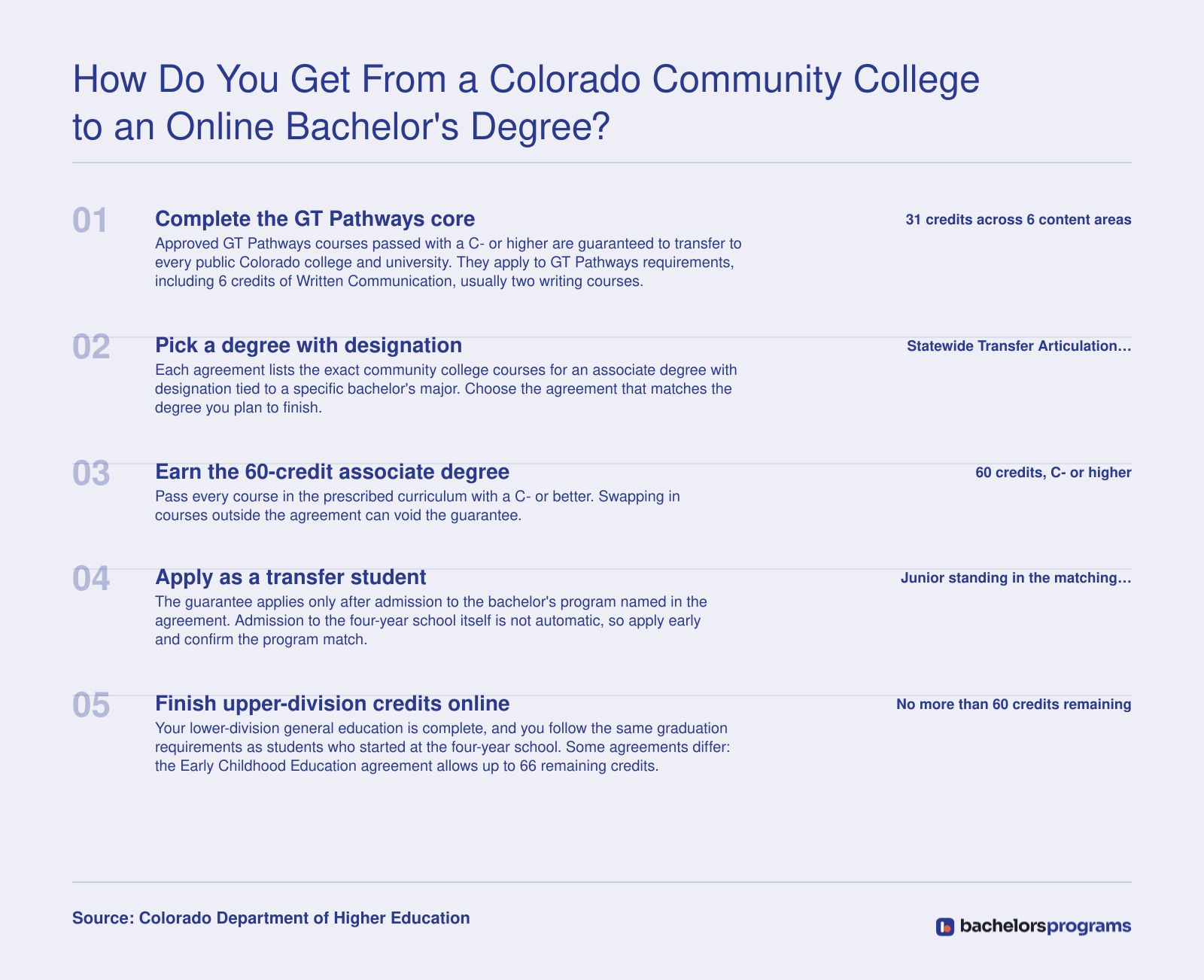
How Do You Get From a Colorado Community College to an Online Bachelor's Degree?
Following a Statewide Transfer Articulation Agreement is the surest way to keep every credit you earn. Students who complete the prescribed 60-credit degree with designation and are admitted to the matching bachelor's program are guaranteed junior standing. Students who transfer course by course without a plan risk credits that do not count toward their major.
Transfer Credit Rules: GT Pathways, Credit Caps and Prior Learning
A Colorado community college student entering a public online bachelor's program plays by statewide rules. A student carrying credits into a private or out-of-state online school negotiates with that school alone. Which situation you are in decides how much of your past work counts.
The Statewide Guarantees
Under Colorado law and Department of Higher Education policy, credits earned at a Colorado community college transfer to public four-year institutions, and GT Pathways strengthens that promise. GT Pathways is a 31-credit general education core spanning six content areas.1 Pass a GT Pathways course with a C- or better and it is guaranteed to transfer and satisfy the matching requirement at every public Colorado college and university, provided it is not duplicative and you use it within 10 years of completion.1
Statewide Transfer Articulation Agreements go further. Complete a designated 60-credit associate degree at a Colorado community college, gain admission to the corresponding bachelor's program, and you enter with junior standing.2 The full associate degree applies toward the bachelor's, and the receiving school may require no more than 60 additional credits, for 120 total.
Caps, Residency and Grades
Guarantees cover the general education core, not every credit you have ever earned. Institutions still set their own caps and residency rules. For reference, CSU Global accepts up to 90 total transfer credits, including up to 64 from community colleges and up to 60 from nontraditional sources. CU Denver generally caps transfer credit at 60 to 90 depending on the program, expects regionally accredited coursework from the past 10 years and a 2.0 overall GPA. MSU Denver has set no overall transfer limit since Fall 2022 but does maintain a residency requirement, and its minimum transfer grade is C-, consistent with state policy.4
Credit for Prior Learning
Colorado public institutions must accept prior learning assessment credit granted for GT Pathways requirements when it transfers from another Colorado public institution, and they cannot bar you from attempting general education requirements that way.3 Common instruments include CLEP and DSST exams, portfolio assessment, military training and industry certifications.
Private and out-of-state online schools are not bound by these agreements. Ask for an unofficial transfer evaluation before you apply, and remember the arithmetic: each accepted credit is tuition you do not pay at the per-credit rate in the cost table above.
How Long It Takes to Finish an Online Bachelor's Degree in Colorado
Colorado online providers run on different calendars: Colorado State University Global offers 8-week courses with monthly starts (12 per year), while many campus-based programs still follow 16-week fall and spring semesters, so shorter terms let you take fewer courses at once while still finishing more courses per year if you enroll continuously. Accelerated means more courses per year, not fewer credits; a 120-credit bachelor's degree still requires 120 credits no matter how compressed the terms are. The timelines below are general estimates that depend on course load, transfer credit and breaks between terms, so confirm your own plan with an advisor.
| Student Path | Credits Typically Remaining | Common Term Format | Typical Time to Finish |
|---|---|---|---|
| First-time, full-time student | About 120 (full degree) | 16-week semesters or 8-week terms | About 4 years (CSU Global's computer science degree, for example, is traditionally designed as a four-year program) |
| Part-time working adult | About 120, minus any prior college credit | 8-week terms with monthly starts | Often longer than 4 years; depends on how many courses you take each term and whether you study year-round |
| Transfer student with an associate degree | About 60 (associate-degree credits applied, as on CSU Global's Colorado community-college pathway) | 8-week classes | Roughly 2 years at a full-time pace; longer part-time |
| Degree completion with 90 or more credits | About 30 or fewer (CSU Global accepts up to 90 transfer credits) | 8-week classes, start any month | Often around 1 year full-time; the CSU Pueblo pathway notes that transfer credit can shorten time but does not publish a fixed timeline |
| Accelerated 8-week format | Still 120 total, minus transfer credit | 8-week accelerated terms, 12 starts per year | Can be faster than a semester schedule when you enroll continuously; pace depends on courses per term, not reduced credits |
Admission Requirements for Online Bachelor's Students in Colorado
Admission rules differ by school, but most Colorado applications ask for the same core items. Check each school's current admissions page before you apply.
- High school diploma or GEDRequired for first-time applicants. CSU Global, Colorado's online-focused public university, accepts a GED that meets the College Board minimum.
- Minimum high school GPA (first-time applicants)CSU Global asks for a 2.80 GPA plus at least two years of work experience. CU Denver and Colorado Mesa review high school grades and coursework, and Colorado Mesa also uses recommendations, without a single published cutoff.
- SAT/ACT optionalUnder state law, Colorado public four-year schools do not require test scores from applicants with fewer than 24 college credits. CU Denver may still consider scores if you submit them.
- 24 credits for transfer reviewColorado uses 24 semester credits as the line between first-time and transfer review. CSU Global requires 24 semester (36 quarter) credits to apply as a transfer, while CU Denver reviews applicants with fewer credits partly on their high school record.
- Transfer GPACSU Global requires a 2.30 cumulative GPA and good standing. Colorado Mesa generally expects 2.40 but still encourages students below that to apply.
- Official transcriptsSend transcripts from your high school and every college you attended.
- FAFSA or CASFAFile the FAFSA, or Colorado's CASFA if you can't file the FAFSA, early to qualify for state and federal aid.
Outcomes, Earnings and Employer Value of a Colorado Online Degree
Do employers care whether your Colorado bachelor's degree was earned online?
Most do not ask. The diploma and transcript come from the same accredited university that awards the on-campus degree, so what an employer sees is the institution's name, the degree and the coursework, not the delivery format. That is why comparing schools matters more than comparing modalities.
What Graduates of Colorado Public Universities Earn
College Scorecard reports median earnings 10 years after entry for the whole institution, not for an online cohort:
- Colorado State University Global: $76,813 in median earnings, with $25,000 in median federal debt at graduation.
- Colorado State University-Pueblo: $55,563, with $21,500 in median federal debt.
- University of Northern Colorado: $52,231, with $20,470 in median federal debt.
These are 2022-23 figures covering each institution's full graduating population, including on-campus students. CSU Global, which teaches mostly online, posts the highest median of the three, but its student body and program mix differ from a traditional campus, so a straight ranking across these schools is not apples to apples. Read the numbers as a sense of direction, not a promise about any single program.
Where Format Matters: Licensure
Teaching, nursing, counseling and social work are the exceptions to the idea that format is irrelevant. Colorado licenses these professions through approved programs, and most require supervised field placements or practicums completed in person, often in a Colorado school district, clinic or agency. Before enrolling, confirm with the program and with the state licensing board that the degree leads to licensure where you plan to work. A program approved in another state may not qualify you here.
The practical takeaway: an online degree from a Colorado public university is judged on the school's reputation and your own record, not on how you attended. The earnings data above supports the value of the credential in general; it does not show that online graduates out-earn classroom graduates, and no figure here should be read that way.
Colorado Teacher Licensure at a Glance for Online Graduates
How to Choose the Best Online and Hybrid Bachelor's Option in Colorado
A Colorado resident enrolling at a public university pays the College Opportunity Fund stipend rate and, at many campuses, a resident tuition rate that sits well below the nonresident sticker price. That single fact changes how you answer the question of the best online college in Colorado: it depends on who you are, not on one ranking.
Match the School to Your Situation
- First-time students: a public Colorado university that charges resident tuition and applies the College Opportunity Fund stipend. Those two levers do more for your net price than a small scholarship will.
- Transfer students: a school that honors the Statewide Transfer Articulation Agreements, so a 60-credit associate degree blocks into the bachelor's without losing ground.
- Working adults: 8-week terms with monthly starts, which let you enroll year-round instead of waiting for a fall or spring semester.
- Veterans: a school participating in Yellow Ribbon or offering a military tuition rate, since the Post-9/11 GI Bill alone may not close the gap at a private institution.
Online and Hybrid, Not "100% Online"
Frame every option as online or hybrid. Many strong Colorado bachelor's programs include some in-person requirement: a lab science, a practicum, a clinical rotation, or a teacher-licensure field placement. Ask the program directly which courses require a campus visit or a proctored site, and how often.
A Five-Item Decision Checklist
1. Accreditation: regional accreditation from the Higher Learning Commission, which covers Colorado institutions. 2. Delivery format: the actual share of coursework that is asynchronous versus scheduled, and any required in-person components. 3. Total cost: tuition per credit hour multiplied by remaining credits after transfer evaluation, minus institutional aid and state grants. 4. Transfer evaluation in writing: a written credit evaluation before you enroll, not a verbal estimate. 5. Outcomes: institution-wide graduation rates and earnings data, which you can compare across schools even when program-level figures are thin.
Your Next Step
File the FAFSA (or the CASFA if you are a Colorado ASSET student), submit the College Opportunity Fund application, and then request a written transfer evaluation from two or three schools at once. Three evaluations side by side tell you more about cost and time to graduation than any marketing page will.
Colleges in Colorado with the most bachelor's programs
| School | City | Type | Bachelor's programs | Online | Net price / yr | Grad rate |
|---|---|---|---|---|---|---|
| Colorado State University-Fort Collins | Fort Collins | Public | 105 | 20 | $21,279 | 67% |
| Metropolitan State University of Denver | Denver | Public | 101 | 22 | $15,327 | 32% |
| University of Northern Colorado | Greeley | Public | 93 | 13 | $17,760 | 51% |
| University of Colorado Colorado Springs | Colorado Springs | Public | 79 | 47 | $15,788 | 47% |
| Colorado Mesa University | Grand Junction | Public | 75 | 2 | $15,103 | 41% |
| University of Colorado Boulder | Boulder | Public | 73 | 0 | $25,346 | 74% |
| Colorado State University Pueblo | Pueblo | Public | 72 | 15 | $10,051 | 40% |
| University of Colorado Denver/Anschutz Medical Campus | Denver | Public | 69 | 27 | $11,900 | 46% |
| University of Denver | Denver | Private nonprofit | 68 | 4 | $36,131 | 76% |
| Colorado Christian University | Lakewood | Private nonprofit | 57 | 18 | $29,500 | 64% |
| Fort Lewis College | Durango | Public | 52 | 0 | $17,296 | 36% |
| Western Colorado University | Gunnison | Public | 49 | 4 | $16,425 | 51% |
| Adams State University | Alamosa | Public | 42 | 6 | $12,980 | 39% |
| Regis University | Denver | Private nonprofit | 42 | 5 | $18,397 | 61% |
| Colorado College | Colorado Springs | Private nonprofit | 28 | 0 | $33,375 | 88% |
Program counts are the verified bachelor's listings in our directory; net price is the school-wide average a first-time undergraduate paid after aid, and graduation rate the share finishing within six years (College Scorecard).
Compare programs nationwide
Many Colorado residents study online. Every ranked list above has an online lens, or browse every field.
Online bachelor's degrees Browse all fields