Online Colleges and Bachelor's Degree Programs in Wyoming
Every verified bachelor's program at a college in Wyoming: 100+ programs at 6 colleges, with the online options, net price and graduation rates behind each one.

Relocating to Laramie for a four-year residential degree works for a recent high school graduate. It rarely works for a Casper welder, a Gillette paraprofessional, or a Cheyenne parent finishing a bachelor's after years of credits. Wyoming is the least populous state, with long drives between campuses, so many adults complete a degree online or in a hybrid format.
The field is small: one public university, the University of Wyoming, plus community colleges that now offer applied bachelor's degrees. With so few options, cost, transfer rules and format decide most choices.
That also means Wyoming residents can often start at a community college and finish at a state institution without leaving their county.
Key Points
- Laramie County Community College charges residents $160.75 per credit, nonresidents $384.75.
- Starting at a community college is usually the cheapest bachelor's route.
- Hathaway Scholarship enrollment rules can catch adult and part-time online learners.
Popular degrees in Wyoming
Bachelor's degrees in Wyoming by field
Business & Management
- Management6 programs
- Organizational Leadership4 programs
- Marketing3 programs
- Human Resource Management or HR Management3 programs
- Logistics & Supply Chain Management3 programs
- Entrepreneurship2 programs
- Finance1 program
- Statistics1 program
Science & Engineering
- Electrical Engineering or Electronics Engineering or Electronic Systems Engineering Technology1 program
- Astronomy & Space Studies1 program
- Physiology1 program
- Mechatronics or Robotics1 program
- Natural Resources or Conservation1 program
- Animal Science1 program
- Chemistry1 program
- Geography1 program
Education & Teaching
- Early Childhood Education or Child Development2 programs
- Physical Education1 program
- Special Education1 program
- Mathematics Education1 program
- History Education1 program
- Secondary Education1 program
- English Education1 program
- Elementary Education1 program
Arts & Design
- Art or Art Studies3 programs
- Fine Arts or Studio Art1 program
- Interior Design1 program
- Art History1 program
- Fashion Design1 program
- Audio & Music1 program
- Graphic Design1 program
Liberal Arts & Humanities
- Literature or English Literature1 program
- Native American Studies or American Indian or Indigenous1 program
- Gender & Sexuality Studies1 program
- Spanish1 program
- Humanities1 program
- General Studies1 program
- English1 program
- History1 program
Communications & Media
- Journalism3 programs
- Speech Pathology1 program
- Communication Disorders1 program
Computers & IT
- Innovation or Technological Entrepreneurship2 programs
- Computer Engineering1 program
- Software Development & Engineering1 program
- Computer Science1 program
Criminal Justice & Law
- Criminal Justice2 programs
- Criminology1 program
- Criminal Justice Administration1 program
Nursing
- Bachelor of Science in Nursing1 program
- Nursing (RN to BSN)1 program
- Accelerated BSN (ABSN)1 program
Social Work & Social Sciences
- Political Science, Government1 program
- Sociology1 program
- Social Work1 program
Natural & Applied Sciences
- GIS and Geoscience1 program
- Agriculture or Agricultural1 program
Healthcare
- Nutrition1 program
How Online and Hybrid Bachelor's Degrees Work in Wyoming
In Wyoming, an online bachelor's degree is rarely just a website and a login. The label covers three arrangements, and knowing which one you are signing up for avoids most of the surprises that surface a few weeks into the term.
Three Formats Worth Telling Apart
- Fully online: coursework is delivered remotely with no required campus visits.
- Hybrid: most work happens remotely, but some courses include campus, lab or site visits.
- Degree completion: built for students who arrive with an associate degree, so you take upper-division major coursework rather than a full four years.
Live Sessions or Your Own Schedule?
The University of Wyoming separates the two. A synchronous online course holds live, scheduled virtual meetings, though with no location-specific attendance requirement. An asynchronous online course has no required meetings, but it is not self-paced: faculty interaction and defined due dates still apply. Faculty members choose the delivery format course by course, so there is no campus-wide rule that every online class runs one way. Community college bachelor's programs vary too.1 At least one Wyoming college runs its bachelor's core in an eight-week adaptive hybrid model where students move between face-to-face class, live Zoom during regular class time, and online work completed anytime that week.2
The In-Person Pieces People Miss
Clinical hours for nursing, student teaching for education, and practicums in other applied majors usually have an on-site component that no delivery format removes. Proctored exams are the other common in-person requirement. The University of Wyoming contracts Honorlock for proctored testing inside WyoCourses, and whether a specific course requires proctoring depends on that course. UW also supports Respondus LockDown Browser, but the browser alone is not proctoring. The Monitor add-on is, and UW covers 200 free seats each year before students pay, with seats occasionally running out during an exam, which is why UW steers students toward Honorlock.
Wyoming Online Bachelor's Tuition: Per-Credit Rates at UW and Community Colleges
Wyoming's public tuition ranks among the lowest in the country, and residency is the biggest cost variable: at Laramie County Community College, a nonresident pays $384.75 per credit compared with $160.75 for a resident. The figures below come from the tuition and fee pages of Laramie County Community College and Sheridan College, the statewide community college rate for fall 2026, and annual tuition and fee ranges for first-time, full-time students compiled by the University of Wyoming Office of Institutional Analysis. None of these schedules lists separate pricing for online or Bachelor of Applied Science courses, so degree totals are estimates based on about 60 upper-division credits for a BAS and 120 credits at UW. Confirm any distance-education or course fees with the school before you enroll.
| Institution | Degree Type / Format | Resident Tuition per Credit | Nonresident Tuition per Credit | Online or Mandatory Fees | Estimated Total Degree Cost |
|---|---|---|---|---|---|
| University of Wyoming | Public university; annual tuition and fees for first-time, full-time undergraduates taking 30 credits (no separate online rate in the cited data) | N/A | N/A | N/A | $5,791 to $7,768 per academic year across reported years; about $23,200 to $31,100 for 120 credits at 30 credits per year (estimate) |
| Laramie County Community College | Wyoming community college; tuition and mandatory fees charged per credit hour; BAS online pricing not listed separately | $160.75 per credit hour (current published rate) | $384.75 per credit hour (current published rate) | $7.77 student fees; published per-credit totals include tuition and mandatory fees | Published annual cost: resident $4,822, WUE $6,502, out-of-state $11,542; about $9,645 resident or $23,085 nonresident for 60 credits (estimate) |
| Sheridan College | Wyoming community college; general tuition and fees, not BAS-specific or online-specific pricing | $168 per credit hour (includes $56 per-credit fee) | N/A | $56 per credit hour, included in the resident rate; lab and course fees are extra | $2,672 per academic year for two 15-credit semesters with the Bighorn Mountain Advantage; about $10,080 for 60 credits at the standard resident rate before that benefit (estimate) |
| Casper College | Wyoming community college; annual tuition and fees for first-time, full-time undergraduates taking 30 credits | N/A | N/A | N/A | $4,110 to $4,962 per academic year across reported years; about $8,220 to $9,924 for 60 credits (estimate) |
| Wyoming community colleges (statewide rate) | Systemwide community college tuition; individual colleges add their own fees | $112 per credit hour beginning fall 2026 (up from $105) | N/A | Not included; varies by college | About $6,720 in tuition alone for 60 credits, before fees (estimate) |
Finding the Cheapest Online Bachelor's Degree in Wyoming
The cheapest online bachelor's degree for a Wyoming resident is almost always one that starts at a community college. Per-credit rates in the table above show why: community college tuition sits well below university rates, and the first two years of a bachelor's are the easiest credits to buy at the lower price.
Why 2+2 and BAS Routes Win
A 2+2 path means finishing an associate degree at a Wyoming community college, then completing the final two years online through the University of Wyoming. You pay the lower rate for roughly half your credits, and you only pay university rates for upper-division coursework. A community college bachelor of applied science, where one exists in your field, can be cheaper still, because every credit stays at community college pricing. Four years at a single institution rarely beats either route on price unless heavy scholarships change the math.
Hidden Costs That Change the Ranking
Per-credit tuition is only part of the bill. Before you compare programs, ask about:
- Course and technology fees: Many online courses add a per-credit or per-course fee on top of tuition.
- Proctoring fees: Some exams require a paid online proctoring service or an approved testing site.
- Required on-site sessions: Hybrid programs can mean fuel, lodging and time off work, which adds up quickly across Wyoming's long distances.
- Clinical or field placements: Nursing, education and similar programs may require in-person hours, sometimes unpaid and far from home.
A program with a slightly higher per-credit rate and no travel can cost less than a cheaper one that demands repeated trips.
Sticker Price vs. Net Price
Published tuition and fees make up the sticker price. Net price is what remains after grants and scholarships are subtracted, and it is the number that actually decides affordability. Two programs with different sticker prices can land close together once aid is applied, and a low-priced school with little aid can cost more than expected. Hathaway, the FAFSA and other aid are what move your net price.
My recommendation: for most residents, the lowest-cost bachelor's starts at a community college. Confirm the transfer pathway with your target university before you enroll, so every credit counts.
Hathaway Scholarship, FAFSA and Other Financial Aid for Wyoming Online Students
Wyoming online students can combine state, federal and veteran aid, but each source has its own enrollment rules. Check them before you register for a term.
Hathaway Scholarship Rules That Catch Adult Learners
The Hathaway Scholarship is built for Wyoming high school graduates who attend an eligible in-state institution. Its tiers include Honors, Performance, Opportunity and Need-Based awards. The Provisional Opportunity award covers four full-time semesters in a Wyoming community college certificate or degree program. Dollar amounts change, so confirm current figures with the Wyoming Department of Education or your school's aid office.
Two rules matter most for adults. First, the rules define part-time as at least 6 but fewer than 12 semester hours per term, excluding remedial courses, and award treatment can change when you drop below full-time.1 Second, eligibility has time limits tied to your high school graduation date. Need-based awards also end if your annual unmet need is $2,000 or less.1 The published rules do not clearly settle whether fully online or Bachelor of Applied Science coursework qualifies at a given college, so get a written answer before you register.
FAFSA, Pell Grants and State Need-Based Aid
Federal Pell Grants and student loans apply to eligible online programs at accredited schools, and the FAFSA is also the starting point for most school-based aid. Wyoming Community College Commission programs, including Wyoming Works, and college foundation scholarships may add need-based help. Their eligibility and award amounts vary by program and college, so ask each financial aid office what applies to online enrollment.
Veteran Benefits
The Post-9/11 GI Bill can pay net tuition and mandatory fees at a public institution, sent directly to the school.2 The payment percentage depends on service length; for example, 90 to 179 days of qualifying service pays 50 percent and 180 to 544 days pays 60 percent.3 Online-only students receive a housing allowance based on the national average, capped at $1,261 per month for August 1, 2026 through July 31, 2027.3 That figure is a maximum, not a guarantee. Books and supplies pay up to $41.67 per credit for up to 24 credits a year. I could not confirm whether a Wyoming state veterans tuition benefit covers online or part-time enrollment, so ask the school's veterans office.
Four Actions to Take
- File early: Submit the FAFSA as soon as it opens each cycle.
- Verify Hathaway first: Confirm eligibility and time limits before dropping to part-time.
- Ask about transfer aid: Ask the University of Wyoming about scholarships for community college graduates.
- Coordinate benefits: Have the school certify GI Bill enrollment before the term starts.
Transferring Credits and Associate Degrees Into a Wyoming Online Bachelor's
An associate degree or prior college credit will usually transfer into a Wyoming online bachelor's program, but how much of it counts toward your major depends on the degree type and the program.
The Statewide Framework
Wyoming's statewide articulation agreement covers AA and AS graduates of any of the state's seven community colleges. To qualify, you need at least 64 college-level credits and a 2.0 GPA. The agreement sets no cap on community college credits transferable to the University of Wyoming (UW).
Block transfer means UW treats your general education as complete instead of checking it course by course. That benefit applies when you finish the 30-credit Wyoming Common General Education Core plus UW's additional 3-credit college-level math. You can take that math at the community college or after you transfer. Students without an AA or AS get no block treatment. UW evaluates their courses one at a time using the Wyoming Higher Education Transfer Guide.
AA/AS Versus AAS
AA and AS degrees are built for transfer. AAS degrees are career-focused, and they are the usual on-ramp to community college BAS programs. At UW they move less predictably. Some plans, such as the 2026 Secondary Career and Technical Education B.A.S., accept an AAS. Others, such as the 2025-2026 Psychology B.S. plan, list only AA, AS, AB, or ADN. A course can also transfer without satisfying a major or upper-division requirement, and the receiving institution makes the final call.
Credit Limits and Residency
Residency rules are set by program. In the two UW plans above, you need 120 total credits, 42 of them upper-division, with 30 earned at UW. Other programs may differ, so check yours.
Prior learning can shorten the path too. Ask whether your school awards credit for military training, CLEP exams, or portfolio-based prior learning, since policies vary. If you finish a degree's worth of credits at UW after starting at a community college, Wyoming Reverse Transfer may award your associate degree. It requires at least 15 Wyoming community college credits and 60 combined credits.
Before You Enroll
Run your transcript through UW's transfer equivalency tool, then meet with an admissions or transfer advisor in your intended major. Ask for a written degree plan showing which courses apply and how many credits remain.
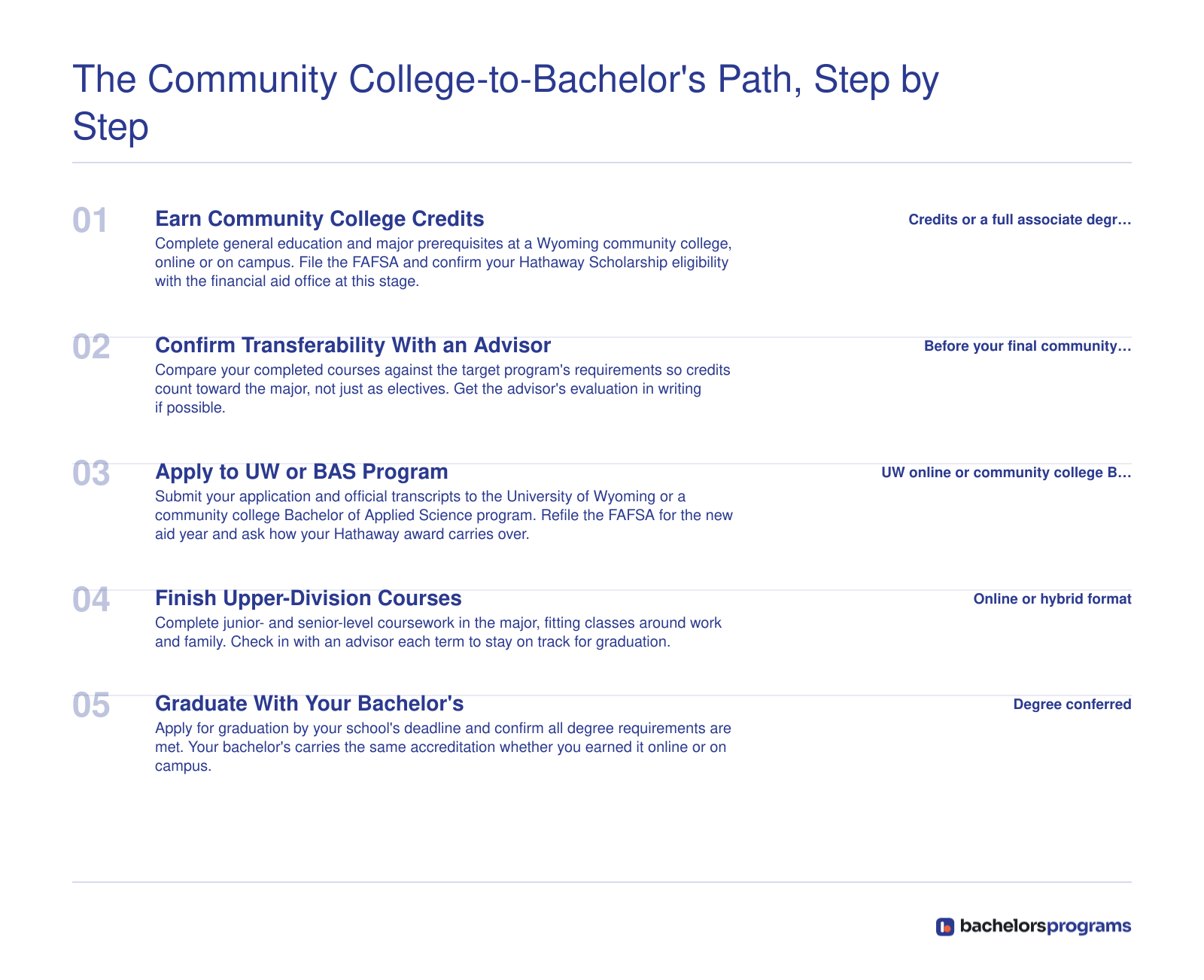
The Community College-to-Bachelor's Path, Step by Step
The transfer section above explains how credits move. This timeline shows the order to follow, from your first community college course to a finished bachelor's, and where financial aid fits along the way.
Accreditation: How to Verify a Wyoming Online Program
Accreditation is an outside review that confirms a school or program meets quality standards, and it decides whether credits transfer, whether federal aid applies, and whether employers and licensing boards accept your degree. The University of Wyoming's online bachelor's programs are accredited.1 UW has held institutional accreditation from the Higher Learning Commission (HLC) since January 1, 1923.1 Its most recent reaffirmation was 2019-2020, and the next is scheduled for 2029-2030.1 That accreditation covers approved online delivery. Wyoming's community colleges are also HLC institutions, and a college that adds a bachelor of applied science needs HLC approval for the change in degree level. Confirm each college's current status yourself before enrolling.
Programmatic Accreditation
Institutional accreditation is only the first layer. Some fields add a second review of the specific program, and that review can determine whether you can sit for a licensing exam.
- Nursing: Look for CCNE or ACEN. UW's Fay W. Whitney School of Nursing is CCNE-accredited, so ask whether the online RN-to-BSN track falls under that accreditation.
- Education: Look for CAEP or state approval. UW education programs leading to Wyoming teacher certification are approved by the Professional Teaching Standards Board. UW pages name both CAEP and AAQEP, so ask the college which applies now.
- Business: AACSB is the most recognized business accreditor. Check UW's College of Business directly on the AACSB site rather than assuming it.
Verify in Two Minutes
- Search the school's name in the HLC institution directory and confirm the status reads Accredited.
- Search your school by name in DAPIP, the U.S. Department of Education's database of accredited institutions and programs.
- Open the programmatic accreditor's own site (CCNE, ACEN, CAEP or AACSB) and search for the program by name.
Out-of-State Online Providers
Many out-of-state schools advertise to Wyoming residents. Wyoming participates in SARA, the interstate agreement that lets approved institutions offer online courses across state lines. SARA covers state authorization, not quality. A SARA-approved school can still lack the programmatic accreditation your career requires, so run the same three checks on any provider that contacts you first.
Wyoming Teacher Licensure at a Glance
Admissions Requirements for Adult, Transfer and Out-of-State Online Students
Requirements differ by school and by program. Use this checklist to gather documents early, and confirm each item with the admissions office before you apply.
- University of Wyoming transfer standardsHave your cumulative transfer GPA and total transferable credits ready. UW sets its own minimums and testing policy, so check its current transfer page before you apply.
- BAS prerequisites at community collegesGeneral admission is typically open, but BAS programs add requirements. Central Wyoming College's transfer pathway expects an associate degree of at least 60 credits from an accredited school. Laramie County Community College accepts an AAS, industry credentials or significant work experience and requires a separate application for each BAS program. Casper College expects its first BAS cohort in fall 2027.
- Deadlines and start termsConfirm current deadlines and whether the program admits in fall, spring, summer or accelerated terms. Dates from past years may not still apply.
- Transcripts and prior learningRequest official transcripts from every college you attended. Add a military transcript or other prior-learning records if you want them evaluated for credit.
- Out-of-state enrollmentAsk whether the school can enroll students in your state through SARA. For licensure programs, confirm the degree meets your state's requirements.
- Residency for tuition and HathawayIn-state tuition depends on each school's residency rules. Hathaway eligibility is tied to Wyoming residency and high school completion.
Outcomes, Completion Time and Support for Online Students
Speed to graduation depends less on the degree itself than on how many credits you can carry at once, so plan around the pace your life actually allows rather than the pace a brochure implies.
How Long a Bachelor's Takes Online
A degree-completion program, or a Bachelor of Applied Science built on an associate degree, takes about two years of full-time study, roughly 60 credits at a normal load. Part-time students carrying one or two courses per term should plan for a longer runway, often several additional years, and should map that timeline with an advisor before the first registration.
Support Services You Should Expect to Be Remote
The University of Wyoming says online students receive the same student-success resources as campus students. Advising is mandatory before registration: declared majors meet with college or department advisors, while undeclared and General Studies students work through ACES. Direct questions to [email protected] or (307) 766-3991. Tutoring runs 24/7 in all subjects, though the catalog describes free tutoring as concentrated at the 1000 and 2000 levels, rounded out by supplemental instruction. Writing Center consultations happen virtually, library access is open online around the clock, research librarians staff 8 AM to 8 PM seven days a week apart from holidays, and books can be mailed to you with a free return label. Career services cover resumes, mock interviews, job fairs and internship searches.
Clinicals, Internships and Student Teaching
Internship credit rules belong to each college and department, and no single university-wide placement process exists, so begin with your advisor, a faculty mentor or ACES. The catalog recognizes faculty-supervised internships, clerkships, clinical experience and cooperative programs in settings around Wyoming, and the College of Education points to online, community-based options for place-bound residents. A placement near your own community may be possible in some programs, but it is not guaranteed, and licensure rules can add requirements.
Reading Graduation Rates Carefully
Most published graduation rates combine online and on-campus students, and separate completion data for distance learners is rarely reported. Ask a program directly how its online students finish and how long they take.
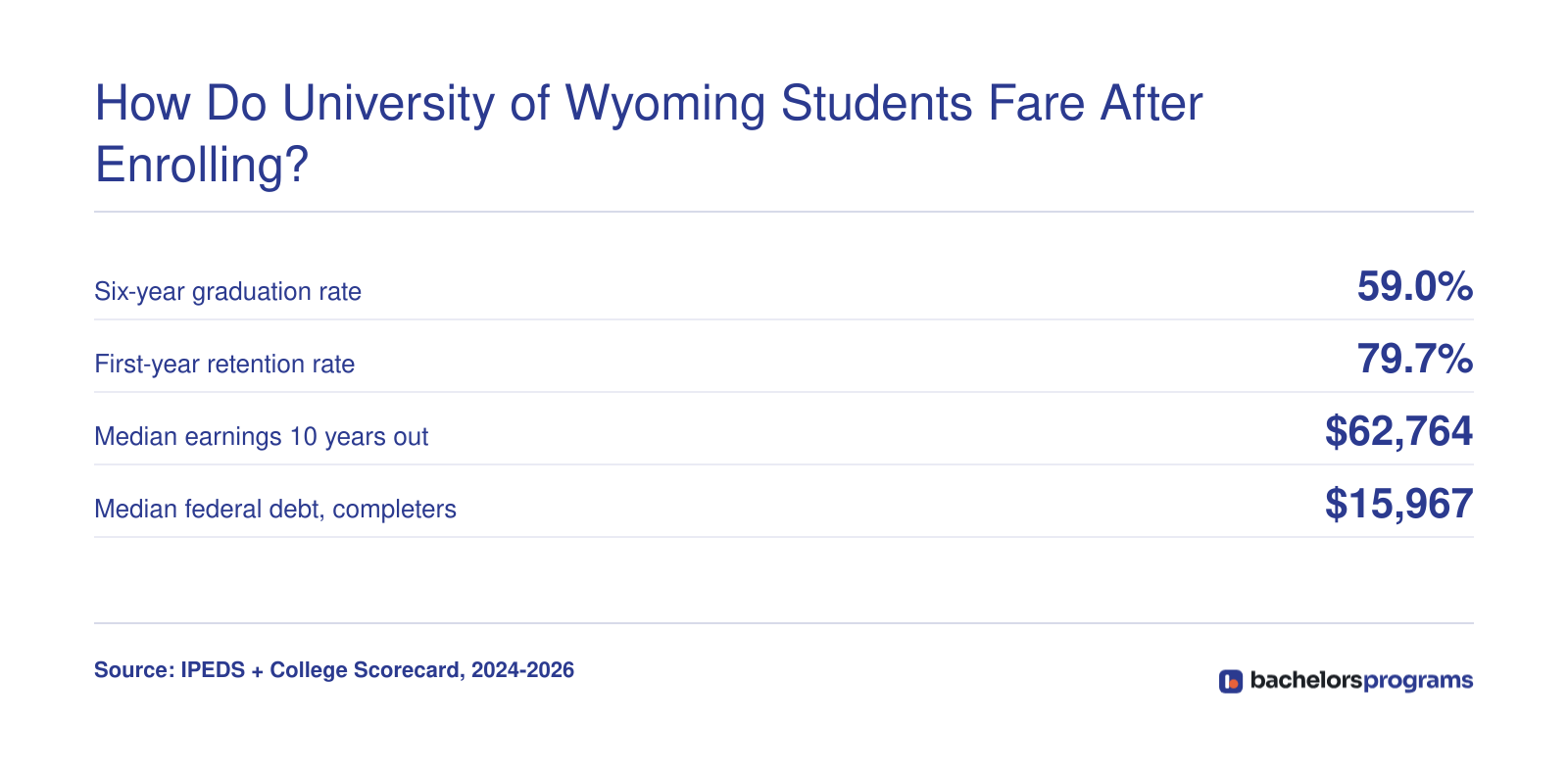
How Do University of Wyoming Students Fare After Enrolling?
These four figures, drawn from 2025-26 and 2024-25 IPEDS reporting and 2026 College Scorecard data, cover all University of Wyoming students, not online-only students. The earnings figure reflects federally aided students who were working and not enrolled in further study 10 years after entry, and the debt figure reflects borrowers who completed. Treat these as a campus-wide benchmark when you compare UW's online bachelor's options with other schools.
How to Choose the Right Wyoming Online Program
Work through the decision in this order. Each step can rule out options before you spend time on the next.
Start With Accreditation and Licensure
Confirm regional accreditation first. If you want a teaching license or plan to apply to graduate school, check that the program meets Wyoming's licensure requirements or the admission standards of your target graduate program. A cheap degree that does not lead to your goal costs more than an expensive one that does.
Then Cost, Transfer and Format
Next, price the program at your residency rate, not the sticker price. Then ask how many of your existing credits will count, because transfer acceptance changes both cost and time to finish. Last, look at format. Some courses are asynchronous, while others meet at scheduled times, and some programs require on-site labs, practicums or exams.
Match Your Profile to a Path
- AAS holders: A community college bachelor of applied science is usually the most direct route, since it is built to accept applied credits.
- AA or AS holders: University of Wyoming online degree completion is the stronger fit, especially if you want licensure or a graduate degree afterward.
- Nonresidents: Compare UW's nonresident rate against in-state tuition and online options at public universities in your home state before you commit.
Your Next Steps
- Request an unofficial transfer evaluation from your top two choices.
- File the FAFSA, which opens the door to federal aid and most state aid.
- Confirm your Hathaway Scholarship status and whether it applies to your program.
- Ask each program which courses require live sessions or in-person attendance.
Pick two programs, send those requests this week, and compare the answers side by side. The replies will show you which school is serious about adult learners. Once you have compared them, apply before the next deadline.
Colleges in Wyoming with the most bachelor's programs
| School | City | Type | Bachelor's programs | Online | Net price / yr | Grad rate |
|---|---|---|---|---|---|---|
| University of Wyoming | Laramie | Public | 82 | 24 | $13,599 | 59% |
| Central Wyoming College | Riverton | Public | 10 | 8 | $11,634 | 37% |
| Northwest College | Powell | Public | 3 | 2 | $7,463 | 49% |
| Western Wyoming Community College | Rock Springs | Public | 3 | 3 | $6,591 | 33% |
| Laramie County Community College | Cheyenne | Public | 2 | 1 | $7,287 | 38% |
| Sheridan College-Northern Wyoming Community College District | Sheridan | Public | 1 | 1 | $9,346 | — |
Program counts are the verified bachelor's listings in our directory; net price is the school-wide average a first-time undergraduate paid after aid, and graduation rate the share finishing within six years (College Scorecard).
Compare programs nationwide
Many Wyoming residents study online. Every ranked list above has an online lens, or browse every field.
Online bachelor's degrees Browse all fields