Best Marketing Degree Programs
Compare 2,000+ accredited Marketing programs at 1,250+ colleges, with net price after aid, graduation rates, earnings and debt from IPEDS and the U.S. College Scorecard.

Marketing teams now screen entry-level candidates for analytics fluency as often as for creative instinct.
Net price after aid at the schools ranked here runs from $3,033 at CUNY Baruch to $19,095 at FIT, while median earnings one year after graduation span $37,663 to $61,578, a gap near $24,000.
Format explains little of that spread: a fully online BBA and a flagship campus program can carry the same business-school accreditation and still differ by five figures in what graduates pay.
Key Points
- Texas A&M University-Central Texas leads affordability at $1,300 net per year.
- University of Pennsylvania marketing graduates earn a median $82,553 one year out.
- University of Florida out-of-state tuition, $28,659, dwarfs the $6,381 in-state rate.
Top 10 Best Marketing Schools Ranked for 2027
These ten programs span public flagships, urban business schools, and a fully online option, so the list mixes campus, online, and hybrid formats rather than sorting by delivery mode alone. Every entry is a bachelor's degree in marketing or a marketing concentration inside a business degree. Read the format and cost notes together, because a low published tuition in one state can cost more than a private option once aid and living expenses are counted.
University of Florida
#1Gainesville, FL · ~$7,000/yr (est.)
Best for: Students who want AI woven into marketing
The University of Florida pairs a large research university setting with a marketing major that folds artificial intelligence into the standard curriculum. Students can take coursework in person, online, or in a hybrid mix, and JPMorganChase is a recurring recruiter, with more than 650 alumni working there. Freshmen can select marketing when they apply. Median earnings one year after finishing were $56,454.
- 120-credit, four-year campus program
- AI integrated across the marketing curriculum
- Coursework in machine learning and predictive analysis
- Scholarships ranging from $500 to $2,000
- Sales and retail internships; Miller Retail Center
- American Marketing Association chapter on campus
- Electives in digital marketing, retail, sales, and brand strategy
Florida State University
#2Tallahassee, FL · ~$11,000/yr (est.)
Best for: Working students who want flexible advising
Florida State's College of Business runs marketing alongside eight other majors on a shared business core, and every student gets an advisor who meets in person or over Zoom. Marketing is a specialized-admission major rather than an open declaration, and it leads to a Bachelor of Science. Combined Pathways and the Degree in 3 option let students move faster. Median earnings one year after finishing were $49,808.
- Marketing is one of nine majors in the College of Business
- Shared business core before marketing coursework
- Every student gets an academic advisor, in person or on Zoom
- Degree in 3 accelerated option available
- Combined Pathways lets students start graduate work early
- Prepares for brand management, market research, sales, and digital marketing
University of Georgia
#3Athens, GA · ~$14,000/yr (est.)
Best for: Sales-minded students adding digital marketing depth
The University of Georgia awards a Marketing BBA from a 120-hour curriculum in the Terry College of Business, with roughly 850 undergraduates enrolled in the major. Admission is selective: a 2.6 GPA, completed prerequisites, SAT or ACT scores, and a short statement of purpose. Two emphasis areas, Professional Selling and Digital Marketing, let students aim at sales roles or digital work. Median earnings one year after finishing were $51,951.
- 120 credit hours; 24 hours of required major courses
- 12 hours of marketing electives
- Emphasis areas in Professional Selling and Digital Marketing
- 2.6 GPA, prerequisites, and SAT or ACT required
- 300 to 400 word statement of purpose required
- Internship requires at least 200 hours of work
- Pi Sigma Epsilon chapter and Terry Sales Competition
- Double Dawgs accelerated pathway and study abroad at Oxford
University of Washington-Seattle Campus
#4Seattle, WA · ~$14,000/yr (est.)
The University of Washington's Seattle campus houses marketing inside a business administration degree built on a shared core in accounting, finance, economics, statistics, and management. Students then move into consumer marketing and market intelligence coursework, a marketing management lab, and a 10-credit capstone. Admission asks for a 3.0 GPA and prerequisite courses. Median earnings one year after finishing were $51,530.
- Marketing concentration inside the Business Administration major
- 15 credits of marketing core coursework
- Business core in accounting, finance, economics, statistics, and management
- Marketing management lab plus a 10-credit capstone
- 3.0 GPA and prerequisite courses required for admission
- Internships and independent research available
- Five concentration options within the business degree
Florida International University
#5Miami, FL · ~$9,000/yr (est.)
Florida International University offers its marketing BBA both on campus in Miami and fully online, and the business school keeps tuition among the lowest in the country. The 120-credit degree requires 21 credits of marketing coursework, with electives that stretch into sports marketing, retail, international marketing, and even esports. Median earnings one year after finishing were $40,839.
- 120 total credit hours, 21 of them in marketing
- Required courses include Professional Selling and Consumer Behavior
- Also requires Marketing Research and Analysis and Marketing Strategy
- Electives in digital, international, sports, retail, and esports marketing
- Minimum grade of C required in marketing courses
- Employers include advertising agencies, consulting firms, hospitals, and nonprofits
- Fully online, with start dates in fall, spring, and summer
- Each student is assigned a success coach
- American Marketing Association top 10 chapter
- Online students follow the same curriculum as campus students
CUNY Bernard M Baruch College
#6New York, NY · $7,000 – $15,000/yr (est.)
Baruch College, part of the City University of New York, delivers a marketing management BBA from its Manhattan campus in the Newman Vertical Campus. Students choose from five tracks that run from general marketing to marketing analytics, and honors students can add a thesis or supervised project. Internships are open to qualified advanced students in every track, and the major appears on the transcript with the chosen track.
- Choose from five tracks, including Digital Marketing and Marketing Analytics
- Honors thesis or supervised project worth 6 elective credits
- Internships available to qualified advanced students in every track
- Transcript shows the major plus the chosen track
- Classes meet at the Newman Vertical Campus in Manhattan
- General track covers consumer behavior and marketing strategy
Fashion Institute of Technology
#7New York, NY · $6,000 – $17,000/yr (est.)
The Fashion Institute of Technology, part of SUNY, specializes in creative and business programs tied to the fashion, advertising, and media industries in New York City. Its marketing degree centers on direct and interactive marketing, with student teams building campaigns for real companies and presenting them to industry representatives. Faculty ties to Marketing EDGE and the Direct Marketing Club of New York open doors to an annual career conference. Median earnings one year after finishing were $37,663.
- Coursework in database marketing and direct response copywriting
- Internet marketing, market research, and media management courses
- Student teams build campaigns for real products and companies
- Campaigns are presented to industry representatives
- Faculty ties to Marketing EDGE and the Direct Marketing Club of New York
- Annual career conference draws more than 400 students
- Summer study abroad in London and Copenhagen
University of Maryland-College Park
#8College Park, MD · $16,000/yr (est. net price)
The University of Maryland's Robert H. Smith School of Business teaches marketing as an analytical major, and the degree is also offered at the Universities at Shady Grove in Montgomery County. Students build foundations in consumer analysis, research methods, and strategy, then add electives in digital marketing, retail management, sales management, or global marketing. Median earnings one year after finishing were $61,578.
- 18 total credit hours in marketing
- Three core marketing courses required
- Also offered at Universities at Shady Grove in Montgomery County
- Analyze survey data using the 4Ps and STP frameworks
- Write professional-grade business documents and presentations
- Careers in sales, advertising, retailing, and marketing research
- Faculty research shapes consumer studies coursework
- Focus on fair pricing and social benefit
- Bachelor's and master's degrees completable in five years
- Careers in brand management and advertising
- Internship can count toward major credit
- Track centers on consumer behavior and consumer insight
Strayer University-Florida
#9Tampa, FL · ~$16,000/yr (est.)
Strayer University's Florida campus serves working adults, and its marketing concentration is delivered fully online with fall starts and one-on-one academic coaching. Business programs hold programmatic accreditation from the Accreditation Council for Business Schools and Programs, and the university accepts military benefits and employer tuition reimbursement. Up to 28 transfer classes can count toward the degree, and general education courses carry no cost.
- 40 courses, priced at $1,555 per course
- Up to 28 transfer classes accepted
- No-cost general education courses
- One-on-one academic coaches and career planning services
- More than 500 employer partners
- Military benefits and employer tuition reimbursement accepted
- Accredited by the Accreditation Council for Business Schools and Programs
- One-time $150 conferral fee
Ohio State University
#10Columbus, OH · $17,000/yr (est. net price)
Ohio State's Fisher College of Business requires a real marketing project of every major and lets students choose a track in research analysis, sales client management, communications, or product development. Internships are not required, though about 95 percent of students complete one, and many turn them into full-time offers. More than 35 student organizations and a global business office support study abroad. Median earnings one year after finishing were $56,465.
- Tracks in research analysis, sales client management, communications, product development
- Major requires a real marketing project
- 95 percent of students complete at least one internship
- Internships often convert into full-time offers
- Study abroad through the Office of Global Business
- More than 35 business student organizations
- Four honors programs available
Cost & outcomes by school
Federal data for the highest-earning Marketing programs, independent of the ranking above. Earnings are this field's bachelor's graduates four years after completing where the Scorecard reports them, else the school's undergraduate median.
| School | Net price / yr | Grad rate | Earnings | Debt | Grads/yr | Format |
|---|---|---|---|---|---|---|
| Carnegie Mellon University PA | $31,944 | 94% | $114,862 | $21,750 | — | Campus |
| Brigham Young University UT | $15,564 | 81% | $112,596 | $11,000 | 129 | Campus |
| University of Pennsylvania PA | $28,699 | 97% | $112,211 | $17,412 | 53 | Campus |
| Stevens Institute of Technology NJ | $41,346 | 87% | $108,772 | $27,000 | — | Campus |
| Boston College MA | $41,704 | 91% | $106,353 | $18,000 | 97 | Campus |
| Georgetown University DC | $40,815 | 95% | $105,944 | $17,000 | 65 | Campus |
| Cornell University NY | $28,690 | 95% | $104,043 | $14,000 | — | Campus |
| Worcester Polytechnic Institute MA | $43,071 | 90% | $103,470 | $27,000 | — | Campus |
| Georgia Institute of Technology GA | $12,116 | 94% | $102,772 | $21,672 | — | Campus |
| Rensselaer Polytechnic Institute NY | $36,228 | 84% | $102,051 | $23,750 | — | Campus |
| Washington University in St Louis MO | $21,786 | 94% | $100,489 | $17,500 | 68 | Campus |
| Texas Christian University TX | $36,660 | 86% | $97,148 | $19,500 | 199 | Campus |
Sources: U.S. Department of Education. Net price, graduation rate, earnings and debt: College Scorecard (earnings and debt for this field's bachelor's graduates where reported, else school-wide); graduates: IPEDS. A dash means no figure is reported.
Cost, debt & payoff
Median earnings of this field's bachelor's graduates (4 yrs after completing, else the school's undergraduate median) vs. their median federal loan debt · U.S. College Scorecard
Across these programs the median graduate earns about $59,781 and finishes with roughly $23,250 in debt — a ratio that clears a common rule of thumb (keep debt below first-year salary). Net price and debt vary widely school to school, so check the per-school figures in the table above before you shortlist.
How We Ranked These Marketing Programs
Sticker tuition tells you what a school charges. Net price shows what students pay once grants and scholarships are subtracted. Our ranking leans on the second, along with a few other measurable inputs.
What Goes Into the Ranking
- Net price: the average cost after aid, not the published tuition rate.
- Graduation rate: the share of students who finish at the institution.
- Program earnings: College Scorecard earnings for marketing graduates specifically.
- Median federal debt: what borrowers typically owe at graduation.
- Admissions selectivity: how competitive entry is.
Why These Measures
Sticker price rarely matches what families pay, so net price gives a more honest cost comparison. Earnings work the same way. A school-wide average blends engineering, nursing, and every other major, which can say little about a marketing graduate's outcome. Program-level figures describe marketing graduates specifically.
Where the Data Falls Short
Graduation rate covers the whole school, not just the marketing department. Net price is a sector or income-band average, not a personal quote, so your own aid offer will differ. And some programs have no published Scorecard earnings because too few graduates were tracked. Where a figure is missing, we leave it out rather than estimate it.
What We Left Out
We did not use reputation surveys, and no school paid for placement. Many competing lists blend subjective scores or sponsorships into their order without saying so. Every input is a public, checkable number, so you can see why a program sits where it does and weigh what matters most to you.
Most Affordable Marketing Degree Programs
These public universities post the lowest average net price among the marketing programs on this page, based on 2024 IPEDS and College Scorecard data from the U.S. Department of Education. Texas A&M University-Central Texas leads at $1,300 a year for its AACSB-accredited BBA in Marketing, while Baruch College and the University of Florida pair low costs with strong graduation rates and large Pell Grant populations. The cheapest option is not automatically the best value, so weigh these costs against the first-year earnings figures in the earnings section below.
| School | Location | Sector | Average Net Price | Graduation Rate | Pell Grant Share | Median Graduate Debt |
|---|---|---|---|---|---|---|
| Texas A&M University-Central Texas | Killeen, TX | Public | $1,300 | N/A | 82% | $17,750 |
| CUNY Bernard M. Baruch College | New York, NY | Public | $3,033 | 72% | 90% | $11,512 |
| University of Florida | Gainesville, FL | Public | $6,541 | 91% | 67% | $15,000 |
Marketing Degree Tuition and Financial Aid: Sticker Price vs. What You Actually Pay
Published tuition is the first number families see, but it rarely reflects what they pay.
Sticker Price vs. Net Price
At the University of Florida, tuition and fees run $6,381 for in-state students and $28,659 for out-of-state students. Grants and scholarships bring the average net price down to $6,541. Florida State reports $6,517 in state, $21,683 out of state, and an average net price of $11,297. Those gaps are why comparing only published tuition can make a program look less affordable than it is. Net price is not the full cost of attendance, either: room, board, books, and travel can add thousands.
Where the Aid Comes From
Marketing undergraduates draw on the same core aid sources as other majors: - Pell Grants: need-based federal grants; the maximum for 2026-27 is $7,395,2 and some students can receive up to 150% of a yearly award if they attend an additional term in the same school year.3 - State grants: many states run their own need-based programs. - Institutional merit aid and business-school scholarships: often awarded by the college or department, sometimes with separate applications. - Federal loans: borrowed money that must be repaid, unlike grants and scholarships.
File Early, Then Watch the Repayment Number
The 2026-27 FAFSA became available on October 1, 2025.1 The federal deadline is June 30, 2027, but state and college deadlines can be earlier1: New Jersey's Tuition Aid Grant deadline, for instance, is April 15, 2027.4 Missing a state deadline does not affect federal aid eligibility, but it can cost you state or institutional money. File early, because some aid is limited.
Cost becomes real at repayment. For the median borrower at the University of Florida, the monthly payment on a standard 10-year plan runs about $162. That is a manageable number for many marketing graduates, but it depends on borrowing less than the sticker price suggests.
Related Articles
AACSB-Accredited Marketing Programs: Why It Matters
AACSB accreditation is a specialized seal of approval for a business school, not for an entire university. It is granted by AACSB International, the business-school accreditor, after a review of the school's curriculum, faculty, learning outcomes, strategy, and record of continuous improvement.
Two Different Seals of Approval
U.S. institutional accreditation, often still called regional accreditation, is recognized by the U.S. Department of Education4 and evaluates the whole college or university: its resources, teaching, graduation outcomes, administration, and financial viability. AACSB looks only at business education.4 The two are complementary, and a university can hold both. One caveat: AACSB normally accredits a school's business offerings as a whole, but it also allows single-unit accreditation,5 so confirm your specific program falls under the accredited unit.
How Selective Is It?
AACSB currently accredits about 1,072 business schools in 70 countries,1 or roughly 6% of business schools worldwide.2 Accreditation grew 14.3% over the five fiscal years from 2021-22 through 2025-26,3 so the seal is becoming more common, but it remains a minority distinction.
What It Signals
AACSB status tells employers and graduate admissions offices that a business program has undergone external review against business-specific standards. Some employers use it as a screening signal, some MBA programs view it as evidence of rigor, and some corporate tuition-reimbursement policies favor accredited business programs. Treat it as a useful tiebreaker, not a guarantee of a job, a raise, or admission.
How to Verify a School
Use AACSB's online accredited-schools directory. Search the institution's name, then check whether the listing covers the business school or only a specific unit. Ask admissions to confirm in writing that your intended marketing major sits inside the accredited unit. Among the schools ranked here, the University of Washington's marketing program is explicitly noted as AACSB accredited; for any school where that is not stated, verify it yourself before you apply.
Online vs. Campus Marketing Degrees: How the Formats Compare
The schools ranked here include online, campus, and mixed-format options, so the choice usually comes down to how you work and learn, not to credential quality. Employer surveys suggest the delivery format matters little once a school is accredited, and the diploma typically does not say whether you studied online. The bigger difference is how much effort you must put into internships and networking on your own.
| Factor | Online Marketing Degree | Campus Marketing Degree |
|---|---|---|
| Flexibility | Study around work and family, often with asynchronous coursework | Fixed class times and a set location, with a more structured routine |
| Cost | Can reduce commuting and housing costs; compare per-credit rates and fees | Tuition plus housing, transportation, and campus living expenses in many cases |
| Networking | Relies on discussion boards, virtual events, and your own outreach; in one survey, 45% of students found internship leads through personal networking | Face-to-face contact with classmates, professors, and local employers is built in |
| Internship access | Internships and prior work projects were the most successful job-search method for business students, yet only about a quarter used them (2024) | Same pattern: fewer than 30% of business students used school career services as a job-search method (2024) |
| Employer perception | 79% of HR professionals saw accredited online degrees as equal in quality to on-campus ones (2023); 87.4% of employers had hired online graduates (2025) | The reference standard employers compare against; 61% of HR leaders judged online degrees equal to it (2023) |
| Pay and hiring outcomes | All surveyed employers reported paying new hires with online degrees the same as those with in-person credentials (2025) | Same pay, since employers reported no difference in starting pay by format |
| Pacing | Often offers accelerated terms or part-time options, so you can speed up or slow down | Usually follows a traditional semester calendar with a cohort timeline |
| Diploma wording | Typically does not say the degree was earned online | Standard diploma from the same institution |
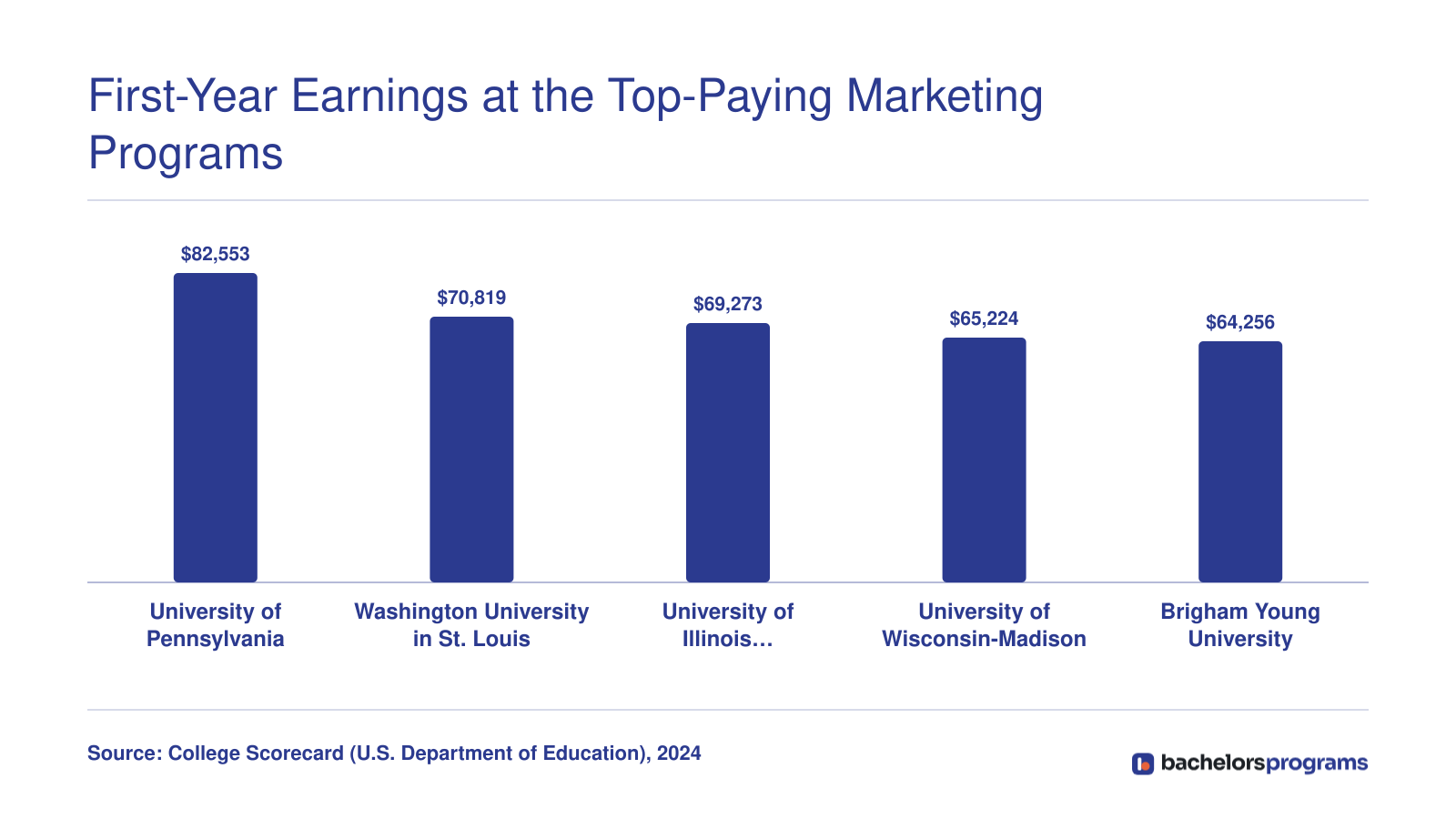
First-Year Earnings at the Top-Paying Marketing Programs
These bars show median earnings 1 year after finishing the program for marketing bachelor's graduates at the highest-earning schools in College Scorecard data. University of Pennsylvania graduates lead at $82,553, while Brigham Young University graduates earn $64,256, a gap of roughly $18,300. Early-career pay is only a starting point, but a spread that wide is a useful signal of how strongly a program's recruiting pipeline, employer network and curriculum can shape your first job offer.
Marketing Manager Median Pay
Marketing management is where many marketing graduates aim to land, and federal wage data shows why the role draws so much interest.
Marketing programs by state
Marketing Degree FAQs
These answers cover the questions prospective marketing majors ask most. Credit requirements and transfer rules vary by school, so confirm details in each program's 2026 catalog before you apply.
How long does it take to get a bachelor's degree in marketing?
What is the difference between a BBA and a BS in marketing?
Can you get a marketing degree online?
How much do marketing majors make after graduation?
Compare Marketing programs on the data that matters
Explore more Business & Management majors or browse every field of study.
All Business & Management programs Browse every field of study