Online Colleges and Bachelor's Degree Programs in Nebraska
Every verified bachelor's program at a college in Nebraska: 870+ programs at 20 colleges, with the online options, net price and graduation rates behind each one.

A Nebraska resident can start an online bachelor's degree for about $202 per credit hour at a state college, or pay two to three times that at a private or out-of-state provider. The published rate is only the first number that matters; mandatory fees, transfer credit and state aid move the real price more than the sticker does.
The University of Nebraska campuses, the Nebraska State College System, private nonprofits and out-of-state online schools all enroll working Nebraskans, and each route handles credit transfer and term length differently. Adults holding a full-time job rarely choose on tuition alone. They choose on how many of the credits they already hold survive the transfer.
Key Points
- Online tuition runs $201.90 (Wayne State) to $316 (Peru State) per credit.
- File the FAFSA by May 1 for 2026-27 Nebraska Promise awards.
- Former UNO aid recipients typically earn $60,448 about a decade after enrolling.
Popular degrees in Nebraska
Bachelor's degrees in Nebraska by field
Business & Management
- Business Administration27 programs
- Marketing22 programs
- Accounting16 programs
- Management15 programs
- Finance14 programs
- Communication11 programs
- Sports Management9 programs
- Analytics8 programs
Education & Teaching
- Secondary Education16 programs
- Science16 programs
- Special Education15 programs
- Elementary Education15 programs
- English Education12 programs
- Mathematics Education12 programs
- Physical Education11 programs
- History Education8 programs
Science & Engineering
- Biology21 programs
- Mathematics17 programs
- Chemistry17 programs
- Environmental Science10 programs
- Biochemistry9 programs
- Physics7 programs
- Natural Resources or Conservation5 programs
- Anthropology4 programs
Liberal Arts & Humanities
- History16 programs
- English16 programs
- Literature or English Literature13 programs
- Spanish10 programs
- Philosophy6 programs
- General Studies5 programs
- Interdisciplinary Studies5 programs
- Global Health or Health Studies4 programs
Arts & Design
- Art or Art Studies14 programs
- Fine Arts or Studio Art14 programs
- Graphic Design11 programs
- Audio & Music6 programs
- Media Arts or Digital Media6 programs
- Art History4 programs
- Illustration3 programs
- Interior Design3 programs
Communications & Media
- Communications19 programs
- Journalism14 programs
- Public Relations7 programs
- Strategic Communications5 programs
- Communication Disorders3 programs
- Speech Pathology2 programs
- Business Communications1 program
Computers & IT
- Computer Science14 programs
- Cybersecurity8 programs
- Computer Information Systems6 programs
- Software Development & Engineering5 programs
- Information Technology5 programs
- Artificial Intelligence3 programs
- Data Analytics3 programs
- Innovation or Technological Entrepreneurship2 programs
Healthcare
- Exercise & Sports Science13 programs
- Health Education9 programs
- Public Health8 programs
- Health Sciences6 programs
- Nutrition5 programs
- Speech Pathology2 programs
- Respiratory Care Therapy1 program
- Community Health1 program
Nursing
- Bachelor of Science in Nursing16 programs
- Nursing (RN to BSN)7 programs
- Accelerated BSN (ABSN)6 programs
- LPN/LVN to BSN4 programs
Criminal Justice & Law
- Criminal Justice10 programs
- Criminology5 programs
- Criminal Justice Administration5 programs
- Forensic Science3 programs
- Legal Studies3 programs
- Legal Services2 programs
- Security Management2 programs
- Paralegal1 program
Social Work & Social Sciences
- Sociology14 programs
- Social Work6 programs
- Political Science, Government6 programs
- Human Services1 program
Psychology
- General Psychology16 programs
- Forensic Psychology2 programs
- Applied Behavior Analysis2 programs
- Applied Psychology1 program
- Addiction Psychology1 program
- Sport Psychology1 program
- Developmental Psychology1 program
Natural & Applied Sciences
- Agriculture or Agricultural5 programs
- GIS and Geoscience3 programs
- Neuroscience2 programs
How Online Bachelor's Degrees Work in Nebraska: Public, Private and Out-of-State Options
A Nebraska online bachelor's degree is a four-year credential earned mostly or entirely through internet-based coursework, but "online" covers several formats, and the type of school you choose shapes which one you get.
The Four Routes
- University of Nebraska Online: The system's online offerings run through UNO, UNK and UNL, which share a public-university structure and in-state pricing logic.
- Nebraska state colleges: Chadron State, Peru State and Wayne State each offer online bachelor's options, often aimed at degree completers and working adults.
- Private nonprofits: Bellevue University is the clearest example of a Nebraska private school built around online learning, and it lists more than 80 fully online programs across degree levels.1
- Out-of-state providers: Schools based elsewhere can enroll Nebraska residents, but confirm they are authorized to serve you and compare their pricing to in-state options.
Fully Online, Hybrid and Online With Visits
Fully online means every course happens remotely. Bellevue's Anytime Online format is asynchronous, with no scheduled class times and no required live attendance. Hybrid blends online instruction with in-person sessions. Bellevue's Connected Campus format, for example, pairs online teaching with on-campus labs and hands-on work.
The third category is online with required visits, and it is where students get surprised. A few real examples from Bellevue show the range:
- Its RN to BSN is fully online and asynchronous, with no clinicals and no travel, but it includes a 36-hour practicum that can be completed at your current workplace or a local health agency with director approval.2
- Its Health Science degree is advertised as 100% online, yet it includes a mandatory laboratory component, and the program page does not spell out where that lab takes place.3
- Secondary education is listed as on-campus, a reminder that teacher preparation typically involves student teaching in a school.
Bellevue also notes that certain degrees may not offer every course online, and its catalog labels some programs "Online/On-Campus."4
What to Do Before You Apply
No single answer covers every public school, so read each program page directly. Look for orientations, labs, practicums, student teaching and proctored exams. If the page is silent, email admissions and ask for the requirement in writing.
Accreditation and State Authorization for Nebraska Online Students
Out-of-state online enrollment is now routine in American higher education rather than exceptional: NC-SARA counted more than 1.6 million out-of-state distance education students in fall 2024, up from the 1.5 million-plus reported two years earlier.1 That volume rests on two separate approvals students should learn to check independently: accreditation and state authorization.
Accreditation applies to the institution, not the delivery mode
The Higher Learning Commission is the regional institutional accreditor serving Nebraska, and it evaluates a college as a whole rather than course by course. A degree you finish online from an HLC-accredited Nebraska university or state college carries the same accreditation as the version taught in a classroom in Lincoln or Wayne. Your diploma and transcript typically do not flag the format at all.
Programmatic accreditation sits on top of that and is where the real variation lives. Business programs may hold AACSB accreditation, nursing programs CCNE or ACEN, and teacher preparation CAEP. These matter when a credential feeds into licensure or a graduate application: state nursing boards, teacher certification offices and many master's programs screen for the specialty accreditor by name, not just the institutional one.
What SARA does and does not cover
Nebraska joined the State Authorization Reciprocity Agreement on August 11, 2014, through MHEC, with the Coordinating Commission for Postsecondary Education serving as the state portal agency.1 Chadron State, Peru State, Wayne State, the University of Nebraska and its Kearney and Omaha campuses are among the SARA-approved institutions in the state.
For you, that reciprocity cuts both ways. A student living in another member state can generally enroll in a Nebraska institution's online program without that state's separate authorization process, and a Nebraskan can enroll out of state on the same terms. SARA covers interstate distance education only. It does not automatically authorize clinical placements, internships at a physical site, or professional licensure in your state, so verify those separately with the program.
A two-step verification check
- Step one: Search the school in the HLC directory and confirm its current accreditation status.
- Step two: Confirm the institution appears on the NC-SARA institution list before you pay a deposit.
Nebraska Online College Tuition per Credit Hour
Published online undergraduate tuition at Nebraska's public universities and state colleges runs from $201.90 per credit hour at Wayne State College to $316 at Peru State College. Each rate applies to the academic year shown beside the school's name. Residency matters at the University of Nebraska campuses: Kearney charges Nebraska residents $303 per credit and nonresidents $464 for 2026-27, and Omaha lists $264 and $830 for 2025-26, so confirm which rate applies to you before comparing schools. Treat the per-credit price as a starting point, because fees can add meaningfully to the total. Kearney's $15 per credit online fee adds $1,800 across a 120-credit degree, Chadron State includes its fees in the listed rate, and Nebraska Wesleyan charges a $120 annual fee.
| Institution | Sector | Online Tuition per Credit Hour | Nonresident Online Rate | Mandatory Online/Tech Fees |
|---|---|---|---|---|
| University of Nebraska at Kearney (2026-27) | Public | $303.00 | $464.00 | $15.00 per credit hour |
| University of Nebraska at Omaha (2025-26) | Public | $264.00 | $830.00 | N/A |
| Chadron State College (2025-26) | Public | $277.85 | N/A | Included in tuition |
| Peru State College (2025-26) | Public | $316.00 | N/A | N/A |
| Wayne State College (2025-26) | Public | $201.90 | N/A | N/A |
| Nebraska Wesleyan University (2025-26) | Private nonprofit | N/A | N/A | $120 per year |
What Does a 120-Credit Online Bachelor's Degree Really Cost in Nebraska?
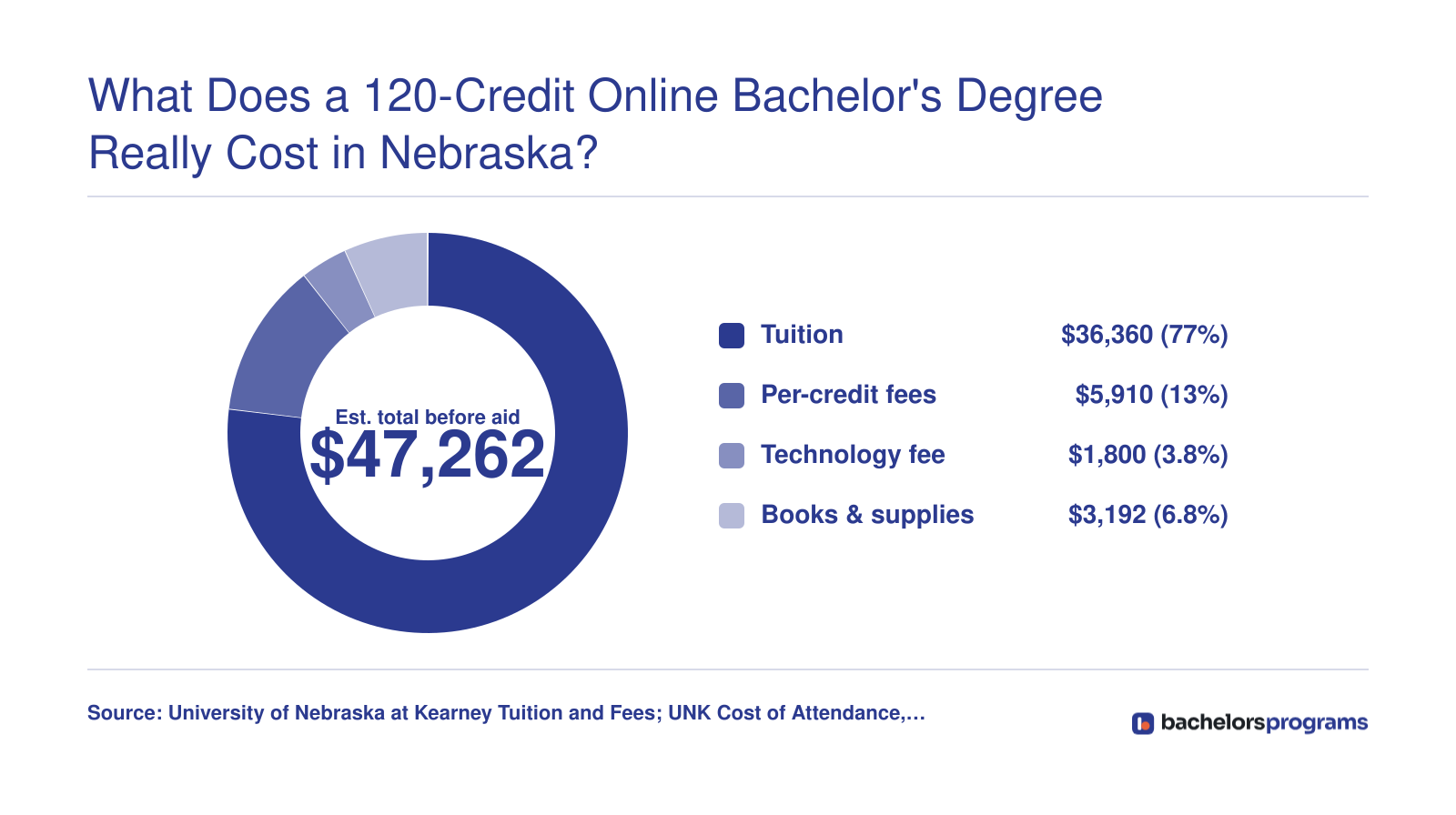
At 2026-27 Nebraska resident rates for University of Nebraska at Kearney online undergraduates ($303 per credit in tuition plus $64.25 in published per-credit fees), and with UNK's $798 yearly books-and-supplies estimate counted over four years, a full 120-credit online degree comes to roughly $47,262 before financial aid. If you transfer in 60 credits, you pay for only 60 at UNK, which cuts tuition from $36,360 to $18,180 and halves the per-credit fees. To find your real net price, subtract grant aid such as the Nebraska Promise, which can cover eligible tuition but not fees or books. Course lab fees and a $4-per-semester records fee are not included in this estimate.
Financial Aid, the Nebraska Opportunity Grant and Other State Scholarships
The University of Nebraska lists May 1 as the FAFSA deadline for its 2026-27 Nebraska Promise awards2, and that date is a reasonable target for anyone applying to a Nebraska school. Federal Pell Grant eligibility itself does not hinge on whether your classes meet in a lecture hall or a learning management system, and part-time students can qualify for a prorated award. State and institutional funds, by contrast, are often limited and awarded until they run out, so filing early matters more than filing on time.
The Nebraska Opportunity Grant
The state's main need-based program goes to Nebraska residents who have high financial need, have not already earned a bachelor's or higher, and attend an eligible Nebraska college or university.1 That last condition is the one online shoppers miss: the grant is tied to Nebraska institutions, so enrolling in an out-of-state online program takes you out of the pool. Award amounts and minimum enrollment levels are set year to year, so confirm the current figures and whether your specific online program qualifies with the financial aid office before you count on the money.
Career Scholarships and the Nebraska Promise
Nebraska Career Scholarships target high-wage, high-skill, high-demand fields and are renewable.1 At community colleges the award reaches up to $15,000 per year; at private colleges, up to $10,000.1 The funds can cover tuition, fees, required tools and equipment, books, and room and board. Eligible program lists, income rules and deadlines change, so check the current cycle.
The University of Nebraska's Nebraska Promise covers tuition for full-time undergraduates carrying at least 12 credits a semester, with a 2.5 GPA, an annual FAFSA, and family adjusted gross income at or below $65,000 (Pell eligibility also qualifies you).2 It pays up to 15 credits a semester and 30 a year, excludes summer, and requires no separate application. Students taking all their classes online can receive it, though distance-education fees still apply. It is a tuition commitment rather than a check: Pell, Opportunity Grants and military waivers count toward what the university owes you.
Military and Guard benefits
GI Bill benefits and Yellow Ribbon participation vary by campus, so ask the veterans services office directly. Nebraska National Guard Tuition Assistance pays 75 percent of tuition at the Nebraska resident rate, capped at 1,200 members per state fiscal year.3 Enlisted members who already hold a bachelor's are ineligible, only credit-bearing degree requirements qualify, each course is funded once, and recipients agree to three more years of service.3 Applications are due June 5, September 5, December 5 and March 5 for their respective terms, with class lists submitted within 10 working days of approval.4
Transferring Community College Credits and Earning Credit for Experience
Transfer credit now decides both the price and the pace of a Nebraska bachelor's degree, and the state's colleges treat it as a recruiting tool.
Nebraska's public two-year colleges, including Metropolitan, Southeast, Central and Northeast, maintain articulation agreements with University of Nebraska campuses and the state college system, and credits earned at those schools generally do transfer. The agreement is not an automatic guarantee: transfer hours are evaluated course by course, and an advisor must approve how a given class counts toward a specific requirement. A published pathway tells you what should count; the transcript review decides what does.
Caps, Residency and Minimum Grades
At the University of Nebraska, Lincoln, students may bring in up to 60 semester hours from two-year colleges and 90 from four-year colleges, but must still complete at least 30 hours in UNL credit.1 Inside some colleges the residency rule is tighter. In the College of Agricultural Sciences and Natural Resources, 18 of those 30 hours must be at the 300 level or above, and at least 9 hours in the major, capstone included, must be taken at UNL no matter how much transfers in.1
Bellevue University accepts up to 60 semester credits from an associate degree and, through an articulation network of more than 150 colleges, many community college graduates transfer a full associate degree.2 Bachelor's residency there is at least 30 credits, though it varies by degree from 15 to 49.2 Coursework below a C- generally does not transfer. Concordia University Nebraska requires 30 credits in residence, 15 of them in the major.5
Degree Completion and Prior Learning
Associate degree holders should start with completion programs, where an AA or AS usually satisfies most of general education and what remains is upper-division and major coursework. A full associate degree can still leave major, upper-level or residency requirements unmet, so confirm the gap in writing.
For learning outside the classroom, UNL and Bellevue both accept CLEP, and Bellevue adds DSST and AP.3 Bellevue also evaluates ACE and NCCRS credit recommendations, accepts military credit, and awards portfolio credit when a student submits a portfolio, a learning narrative and supporting documentation.4 UNL's agriculture college accepts up to 15 hours of military credit.1
Ask for a written pre-evaluation before you enroll. It is the only reliable way to know how many credits you will actually carry into the degree.
Eight-Week Terms, Asynchronous Classes and Time to Completion
Flexibility and structure pull in opposite directions in online learning: the more freedom a format gives you, the more discipline it asks of you. Nebraska providers sit at different points on that spectrum, so it helps to know how terms and delivery work before you enroll.
Term Lengths and Start Dates
University of Nebraska Online offers both full semesters and eight-week sessions.1 In fall 2026, the first eight-week session runs August 24 to October 16, and the second runs October 26 to December 18.2 The full semester runs August 24 to December 18.2 Shorter terms pack the same content into half the time, so one eight-week course feels like two semester courses running at once.
Bellevue University uses open enrollment, with its next start date on November 30, 2026.3 Its most widely used format, Anytime Online, sets weekly assignment deadlines rather than meeting times.4
Asynchronous vs. Synchronous Delivery
Most Nebraska online coursework is asynchronous. UNK Online is fully asynchronous with no required live meetings, and UNO's fully online courses work the same way. Hybrid formats add some live time: UNO Hybrid Remote is at least 75% asynchronous, and UNK Blended is at least 67% online with scheduled meetings capped at 33%. Bellevue's Connected Campus option requires live attendance.4
Expect proctoring to vary by course. At UNK, it is course-specific, so check each syllabus. Programs with field components, such as education or nursing, may also require in-person placements.
How Long It Takes
- First-time students: About four years at full-time pace.
- Transfers with 60 credits: Roughly two years.
- Part-time students: Longer, depending on how many courses you carry each term.
A Pacing Tip for Working Adults
In eight-week sessions, start with one or two courses at a time. One course is a manageable test of your schedule. Two can work if your job hours are predictable. Adding a third often backfires because each week of an eight-week course carries double the weekly load. Since new sessions begin often, you can keep steady momentum without overloading any single term.
Admissions Checklist for Nebraska Online Bachelor's Programs
University of Nebraska Online applies the same admission requirements as its campuses, though individual programs can add conditions. Bellevue University uses open enrollment. Work through these items before your target start date.
- Application and feeSubmit the school's online application and pay any listed fee. Bellevue asks applicants to send transcripts to [email protected].
- High school diploma or GEDUniversity of Nebraska Online requires a high school diploma or equivalent.
- Official college transcriptsRequest transcripts from every college you attended. Bellevue evaluates them for transfer credit.
- GPA and academic standingConfirm your program's transfer GPA expectations. At the University of Nebraska, borderline applicants may be admitted after transcript review and completion of prerequisites.
- Test scoresUniversity of Nebraska eligibility can be met with top-half class rank, an ACT of 20 or an SAT of 950, so scores are one route rather than the only one. These criteria may not apply if you graduated before 1997.
- FAFSAFile in January for aid in the coming academic year.
- Military documentsHave your DD-214, Joint Services Transcript and GI Bill Certificate of Eligibility ready. Bellevue awards credit for military training and charges $250 per credit for eligible service members and spouses who provide proof of status.
- Deadlines and start datesFor University of Nebraska programs, apply May to August for fall, December to January for spring and April to May for summer. Some programs use rolling admissions. Bellevue's next semester starts November 30, 2026, and its military cohorts begin monthly.
- Online student supportAsk about academic advising, tutoring, tech help and library access before you enroll.
Graduate Earnings at a Nebraska Public University
Former UNO students who received federal aid earn a typical $60,448 a year about a decade after enrolling.
Graduation Rates, Outcomes and Choosing the Right Fit
A six-year graduation rate is the share of first-time, full-time freshmen who earn a bachelor's degree within six years of starting. First-year retention is the share who come back for a second fall. Both numbers describe an entire campus, not its online students specifically, who are often older, part-time or transferring in and may not be counted in these cohorts at all.
What Nebraska's Public Campuses Report
- University of Nebraska-Lincoln: 69% of the fall 2019 entering class graduated within six years,1 and 86.1% of fall 2024 freshmen returned or graduated by fall 20252, according to the university's 2025-2026 Common Data Set.
- University of Nebraska at Kearney: 57.7% six-year rate (2023-24).
- Wayne State College: 52.1% six-year rate (2022-23) and 72% retention for fall 2024 freshmen.
- Chadron State College: 50.4% six-year rate (2022-23).
- University of Nebraska at Omaha: 47.1% six-year rate (2022-23).
- Peru State College: 37.6% six-year rate (2022-23) and 54% retention for fall 2024 freshmen.
Most of these figures come from Nebraska's 2026 performance report, which counts completion within 150% of normal time.3 Cohort years and definitions don't line up exactly with UNL's numbers, so treat the list as a rough signal rather than a head-to-head score.
Is There a Best Online College in Nebraska?
Honestly, no single school is best for everyone. The right choice depends on the credits you already have, what you can afford per credit hour, how generously a school accepts transfer work and whether its course format fits your week.
Matching a Program to Your Situation
- First-time students: Favor schools with strong retention, assigned advisors and full-time cohorts, since structure matters most in year one.
- Community college transfers: Ask how many of your credits count toward the major rather than general electives, and check for articulation agreements with your community college.
- Working adults: Look for eight-week terms, asynchronous classes, start dates throughout the year and credit for prior learning through exams or portfolios.
- Military students and veterans: Confirm the school evaluates your Joint Services Transcript for credit and has a dedicated office to process GI Bill and Tuition Assistance benefits.
Whatever your path, ask admissions for completion data on students like you. A campus-wide rate is a starting point, not the full picture.
Questions to Ask Yourself
Will my community college or military credits count toward this degree, and how many upper-division credits remain?
Is the program truly online, or will I need to travel for orientation, proctored exams, clinicals or student teaching?
Does attending an in-state school let me keep the Nebraska Opportunity Grant or Nebraska Promise?
If I plan to be licensed, does the program meet Nebraska board requirements?
Colleges in Nebraska with the most bachelor's programs
| School | City | Type | Bachelor's programs | Online | Net price / yr | Grad rate |
|---|---|---|---|---|---|---|
| University of Nebraska at Omaha | Omaha | Public | 100 | 20 | $13,441 | 47% |
| University of Nebraska-Lincoln | Lincoln | Public | 95 | 1 | $17,747 | 67% |
| University of Nebraska at Kearney | Kearney | Public | 72 | 12 | $16,242 | 58% |
| Creighton University | Omaha | Private nonprofit | 70 | 0 | $31,568 | 83% |
| Wayne State College | Wayne | Public | 62 | 4 | $15,360 | 52% |
| Nebraska Wesleyan University | Lincoln | Private nonprofit | 48 | 4 | $18,327 | 66% |
| Bellevue University | Bellevue | Private nonprofit | 47 | 34 | $17,550 | 33% |
| Chadron State College | Chadron | Public | 47 | 10 | $12,549 | 50% |
| Concordia University-Nebraska | Seward | Private nonprofit | 47 | 2 | $23,965 | 65% |
| Doane University | Crete | Private nonprofit | 42 | 7 | $26,364 | 57% |
| College of Saint Mary | Omaha | Private nonprofit | 42 | 2 | $16,590 | 61% |
| Union Adventist University | Lincoln | Private nonprofit | 39 | 0 | $23,716 | 52% |
| Peru State College | Peru | Public | 38 | 15 | $11,632 | 38% |
| Midland University | Fremont | Private nonprofit | 33 | 2 | $26,267 | 42% |
| York University | York | Private nonprofit | 31 | 5 | $20,951 | 52% |
Program counts are the verified bachelor's listings in our directory; net price is the school-wide average a first-time undergraduate paid after aid, and graduation rate the share finishing within six years (College Scorecard).
Nebraska Online College FAQs
These answers cover the questions Nebraska online students ask most often about enrollment, cost and state aid. Prices are 2026-27 figures from school and state sources and can change, so confirm them with your school before you apply.
Can out-of-state students enroll in Nebraska online programs?
How much does an online bachelor's degree cost in Nebraska?
Can I use the Nebraska Opportunity Grant at an out-of-state online college?
Do Nebraska residents pay in-state tuition at out-of-state online schools?
Compare programs nationwide
Many Nebraska residents study online. Every ranked list above has an online lens, or browse every field.
Online bachelor's degrees Browse all fields