Online Colleges and Bachelor's Degree Programs in North Carolina
Every verified bachelor's program at a college in North Carolina: 2,550+ programs at 60+ colleges, with the online options, net price and graduation rates behind each one.

What does an online bachelor's degree in North Carolina actually cost a resident? East Carolina University published $185.50 per credit for distance education in Spring 2026, and a single statewide agency, not the campus, decides who qualifies for in-state rates. That gap between a quoted per-credit rate and the final bill is where most comparisons fall apart.
Residency rules, transfer credit, and state grants can move the total by thousands, and accreditation is a separate test: a degree that satisfies a licensure board differs from one that merely enrolls you. A program's published rate is a starting point, rarely the number a working adult or community college transfer ends up paying.
Key Points
- East Carolina University charged residents $185.50 per online credit in Spring 2026.
- One state agency, the Residency Determination Service, decides in-state tuition status.
- NC's transfer agreement moves Associate in Arts and Science degrees as blocks.
Popular degrees in North Carolina
Bachelor's degrees in North Carolina by field
Business & Management
- Business Administration75 programs
- Marketing56 programs
- Accounting42 programs
- Sports Management36 programs
- Management35 programs
- Finance30 programs
- Communication29 programs
- Economics27 programs
Science & Engineering
- Biology62 programs
- Chemistry51 programs
- Mathematics47 programs
- Biochemistry28 programs
- Environmental Science22 programs
- Natural Resources or Conservation20 programs
- Physics19 programs
- Anthropology17 programs
Education & Teaching
- Science68 programs
- Elementary Education41 programs
- Secondary Education40 programs
- Special Education27 programs
- English Education25 programs
- Mathematics Education25 programs
- Physical Education21 programs
- History Education20 programs
Liberal Arts & Humanities
- English54 programs
- History43 programs
- Literature or English Literature40 programs
- Spanish26 programs
- Philosophy18 programs
- Interdisciplinary Studies18 programs
- Global Studies16 programs
- Global Health or Health Studies13 programs
Arts & Design
- Fine Arts or Studio Art48 programs
- Art or Art Studies45 programs
- Audio & Music21 programs
- Graphic Design20 programs
- Media Arts or Digital Media18 programs
- Art History14 programs
- Creative Writing9 programs
- Interior Design8 programs
Computers & IT
- Computer Science44 programs
- Cybersecurity23 programs
- Information Technology18 programs
- Innovation or Technological Entrepreneurship17 programs
- Computer Information Systems13 programs
- Artificial Intelligence12 programs
- Software Development & Engineering10 programs
- Data Analytics8 programs
Social Work & Social Sciences
- Sociology47 programs
- Political Science, Government39 programs
- Social Work26 programs
- Human Services10 programs
- Public Policy9 programs
- Disability Studies1 program
Healthcare
- Exercise & Sports Science37 programs
- Public Health23 programs
- Health Sciences17 programs
- Health Education15 programs
- Nutrition11 programs
- Community Health7 programs
- Speech Pathology5 programs
- Respiratory Care Therapy3 programs
Communications & Media
- Communications54 programs
- Journalism25 programs
- Public Relations12 programs
- Professional Writing7 programs
- Communication Disorders6 programs
- Strategic Communications6 programs
- Speech Pathology5 programs
- Social Media2 programs
Nursing
- Bachelor of Science in Nursing50 programs
- Nursing (RN to BSN)25 programs
- Accelerated BSN (ABSN)17 programs
- LPN/LVN to BSN6 programs
Criminal Justice & Law
- Criminal Justice30 programs
- Criminal Justice Administration14 programs
- Criminology11 programs
- Forensic Science10 programs
- Homeland Security5 programs
- Corrections2 programs
- Fire Science or Fire Administration2 programs
- Security Management1 program
Psychology
- General Psychology46 programs
- Applied Psychology2 programs
- Forensic Psychology1 program
- Counseling Psychology1 program
Religion & Theology
- Christian Studies or Religious Studies26 programs
- Christian Ministry or Ministry Leadership9 programs
Natural & Applied Sciences
- Agriculture or Agricultural12 programs
- GIS and Geoscience8 programs
- Oceanography or Ocean or Marine Biology4 programs
- Applied Science1 program
- Neuroscience1 program
Counseling
- Substance Abuse Counseling1 program
How Online Bachelor's Degrees Work in North Carolina
Most online students want flexibility, but a program page's label does not always say how much of it you will get. Learning the vocabulary lets you screen programs in minutes.
Delivery Formats to Recognize
- Fully online: Every course runs online. Check the fine print for proctored exams or an orientation visit.
- Hybrid: Some classes meet on campus, usually weekly or monthly, and the rest run online.
- Online courses only: The school offers some online classes, but the degree cannot be finished without substantial campus attendance.
Watch for phrases like "online with residency weekends" or "blended." They mean required travel, which adds cost and requires time off work.
Synchronous vs. Asynchronous
Synchronous courses have set login times for live lectures or discussions. Asynchronous courses let you work through material on your own schedule, within weekly or monthly deadlines. If you work rotating shifts or have children at home, set meeting times can become a real obstacle. Look for programs that say "asynchronous" outright, and ask whether any required courses meet live.
Hidden In-Person Requirements
Even a fully online degree can include on-site components:
- Proctored exams at a testing center or through remote monitoring software
- Clinical placements for nursing and other health programs
- Student teaching for education degrees
- Short orientation or capstone visits
Nursing and education programs almost always require field hours, and those placements typically happen at sites in North Carolina. Ask an advisor how placements are arranged and whether you must find your own site.
Public, Private, and For-Profit Schools
Public UNC System universities generally charge per-credit or flat-rate tuition with lower in-state pricing, tend to be the most transfer-friendly for community college graduates, and hold regional accreditation. Private nonprofits often cost more per credit but may offer generous institutional aid and flexible transfer policies. For-profit schools vary widely in price, can be stricter about accepting outside credits, and sometimes hold national rather than regional accreditation, which can limit how far your credits travel.
UNC System campuses list their online programs through a shared portal called UNC Online, which makes side-by-side comparison easier.
What an Online Bachelor's Degree Costs in North Carolina: Per-Credit Tuition Compared
East Carolina University charged North Carolina residents $185.50 per credit for distance education in Spring 2026, the lowest published online per-credit rate among the schools compared here.1 For a resident, a UNC System campus at its in-state rate is the cheapest route. The private nonprofits with large online programs list rates roughly twice as high or more.
Public Universities: In-State vs. Out-of-State
ECU's Spring 2026 distance-education rates show how wide the residency gap is:
- In-state: $185.50 tuition per credit, or $206.33 once distance-education technology, campus security and graduation fees are added.1
- Out-of-state: $863.71 tuition per credit, or $884.54 with the same fees.1
ECU's Fall 2026 page uses different numbers. The $185.50 resident rate applies only to students in eligible Fixed Tuition Program cohorts, and fall nonresident tuition is $889.63.2 Do not mix terms when you budget. Undergraduate billing also caps at 12 credits, and students who take more than one Main Campus class or live on campus are billed at Main Campus rates.
UNC Greensboro publishes annual undergraduate tuition of $5,625 for in-state students and $23,108 for out-of-state students.3 Its official page does not give an online per-credit figure, so confirm that with the bursar. I could not confirm 2026 online per-credit rates for several other UNC campuses, which is another reason to check each school's own tuition page.
Private Nonprofits: Flat Online Rates
The private schools below publish one online rate, with no separate in-state and out-of-state pricing identified:
- Gardner-Webb University: $395 per credit for 2026-27, though its online undergraduate pricing varies by program category and some programs cost more.4
- Campbell University: $400 per credit for Adult & Online Education undergraduate programs, Summer 2026 through Summer 2027.5
- University of Mount Olive: $455 per credit for all online undergraduate courses in 2026-27.6
A flat rate helps out-of-state students, who pay about $400 per credit at Campbell instead of more than $860 at a public campus. It does nothing for residents, who pay about double the public in-state rate.
What These Rates Leave Out
Per-credit tuition is only the starting figure. Mount Olive adds a $150 general fee and a $50 technology fee each semester, and textbooks are extra. ECU's fall page lists First Day course materials at $21 per credit, though students can opt out.2 The next section breaks down these mandatory fees and distance-education charges.
Every rate above comes from the school's own bursar or tuition page for the academic year noted. Confirm the current figure there before you commit, because schools revise rates each term or year.
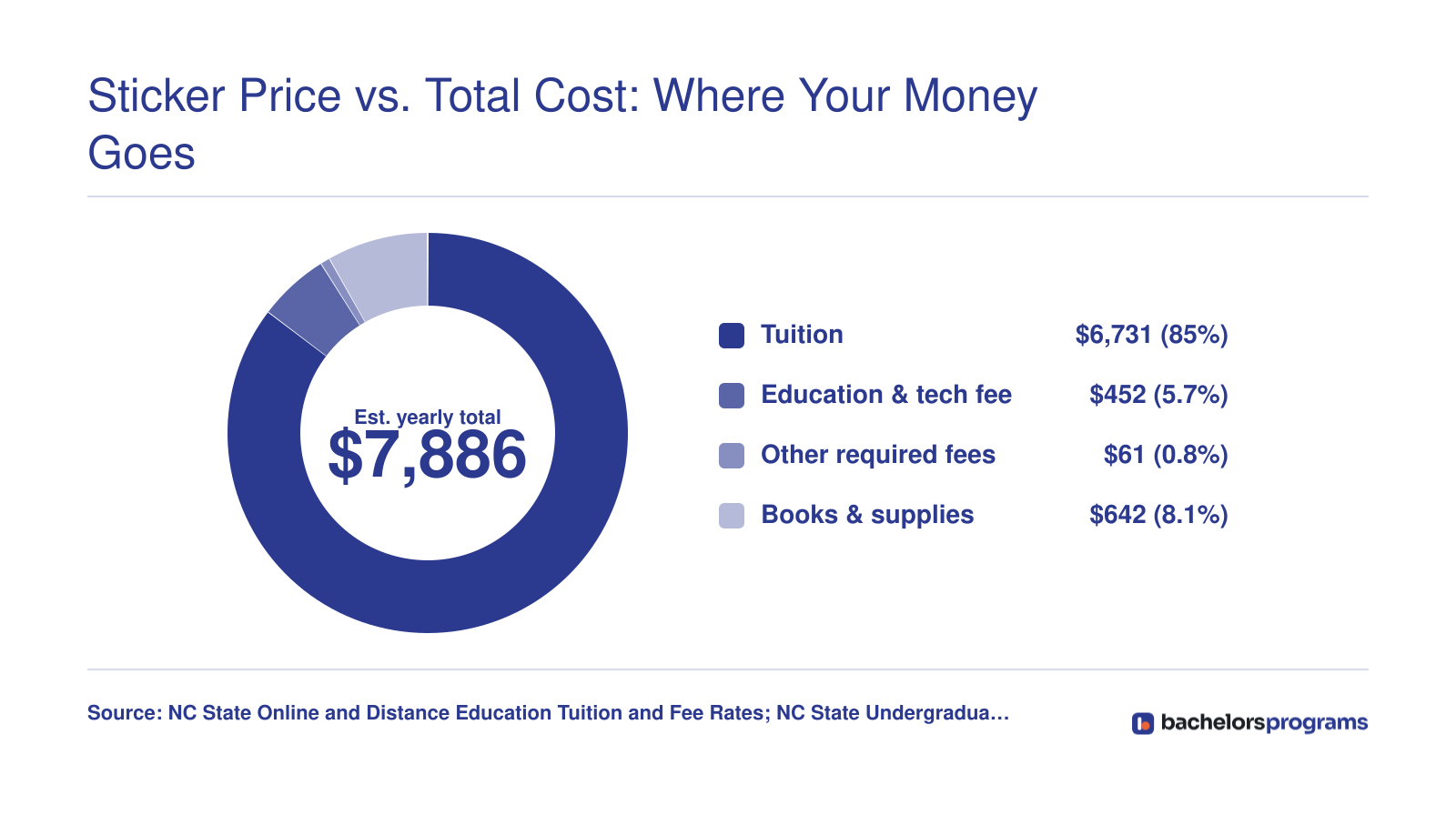
Sticker Price vs. Total Cost: Where Your Money Goes
Here is one year of full-time online study at NC State University for a North Carolina resident in 2026-27, built from its published distance-education rates (12 credits per semester, two semesters) plus the $642 books-and-supplies allowance from its undergraduate cost-of-attendance budget. Housing and food are left out because online students living at home do not pay them to the university. NC State's full undergraduate budget adds $8,738 for housing and $6,684 for food, for a resident total of $28,490, which is one reason an online student's real cost can run well below the on-campus figure.
In-State Tuition for Online Students: How NC Residency Rules Work
North Carolina does not let each college decide who pays in-state tuition; a single state agency makes that call for every public campus.
One Statewide Decision, Not a Campus One
The Residency Determination Service (RDS) classifies students and separates residence, where you physically are, from domicile, where you intend to stay. In-state rates generally require NC domicile for at least 12 consecutive months before the term begins, plus intent to remain permanently or indefinitely. Living in NC only to attend college does not establish domicile. RDS weighs the whole picture: driver's license, vehicle and voter registration, employment and tax records, a lease or deed, financial independence or a parent's domicile, and community ties. Campuses then verify your residency certification number.
Online Study and Moves Mid-Program
Enrolling online from a NC address is evidence, not a verdict. Out-of-state students in fully online programs generally stay nonresident unless they qualify independently or fit a statutory exception. Moving to NC mid-program does not reset your rate immediately; the 12-month clock runs to the start of the term you are classified for.
Out-of-State Rates and Military Rules
UNC campuses bill distance education per credit and publish separate resident and nonresident rates that vary by program. Private colleges often charge one flat rate regardless of residency. Military families have paths in: the CHOICE Act covers active duty members with 30 or more days at a permanent NC duty station, plus spouses and dependents; NC National Guard members get in-state rates; veterans with 90 honorable days plus a qualifying NC connection also qualify.2 UNC-Chapel Hill's Yellow Ribbon match covers up to $5,000 of out-of-state difference for eligible Post-9/11 students.
NC Promise and Online Delivery
NC Promise sets $500 per semester for in-state undergraduates and $3,500 for nonresidents at Elizabeth City State, UNC Pembroke, Fayetteville State, and Western Carolina.1 Confirm whether a fully online program is billed at the Promise rate or at a separate distance-education rate.
Net Price, Financial Aid, and North Carolina State Grants for Online Students
Online students in North Carolina can draw on much of the same federal and state money as classroom students. What changes is the paperwork and the fine print.
Federal Aid: FAFSA, Pell, and Direct Loans
Eligible online students at accredited schools use the same FAFSA as everyone else. For 2026-27 (July 1, 2026 to June 30, 2027), the maximum Pell Grant is $7,395.1 Pell is generally for undergraduates with exceptional financial need who don't yet hold a bachelor's degree. Part-time students can qualify, though the amount depends partly on enrollment status.1 Lifetime eligibility is capped at 12 full-time terms, roughly six years.1 In some cases students can receive up to 150% of their scheduled award in a year, such as extra summer Pell.2
Direct Loans work differently for working adults: they generally require at least half-time enrollment, which many schools define as six credit hours a term. Confirm your school's definition before registering for a single course.
The Next NC Scholarship
The state's main grant is the Next NC Scholarship, administered through the College Foundation of North Carolina (CFNC). Requirements for 2026:
- Residency: North Carolina resident, with a high school diploma or equivalent.
- Income: Student Aid Index of 7,500 or less and household adjusted gross income of $80,000 or less.3
- Schools: One of the 16 UNC System universities or any of the 58 community colleges. Private nonprofit colleges are not eligible.
- Enrollment: At least six credit hours per semester. Part-time students at that level qualify for a partial award.
- Award size: At least $3,000 at community colleges and at least $5,000 at UNC universities, combining Pell and state aid.
CFNC's rules tie eligibility to an eligible undergraduate program, and they don't specifically bar online study. They also don't confirm that every fully online student at every eligible campus qualifies, so ask the financial aid office directly. Current rules for the NC Need-Based Scholarship were not confirmed, so check CFNC for details.
Military and Veteran Benefits
North Carolina has a large military community, and many online students use the GI Bill, military Tuition Assistance, or the Yellow Ribbon Program at participating schools. Ask each school's veterans office how benefits apply to online courses, because housing allowances and coverage can differ from on-campus rules.
Net Price and Deadlines
Sticker price is the published tuition. Net price is what remains after grants and scholarships. Institutional aid for online students varies widely, so run each school's net price calculator rather than comparing list prices.
For Next NC, CFNC lists June 1 for UNC System universities.4 Its 2026 toolkit lists August 15 for community colleges, though some CFNC pages show June 1 for both.5 After the priority date, applications are reviewed in order received and funded as available, and schools may set earlier dates. File the FAFSA as early as possible.
Transfer Credits, Articulation Agreements, and Prior-Learning Credit
The CAA: A Block Transfer, Not a Course-by-Course Guess
North Carolina's Comprehensive Articulation Agreement, revised and effective in Spring 2026, covers two degrees: the Associate in Arts (A10100) and the Associate in Science (A10400). A student who completes either with grades of C- or better in CAA coursework satisfies the Universal General Education Transfer Component as a block and enters a UNC institution at junior standing, once admitted. The CAA caps transfer at 64 semester hours toward a UNC bachelor's degree, though program-specific articulations can allow more.
What the agreement does not do is guarantee admission to a university or to a competitive major. Campus ceilings still apply on top of the statewide cap, and they differ. UNC-Chapel Hill, for instance, stops posting transfer credit after 75 semester hours2, and its limits should not be read as a systemwide number. Private colleges participate through the Independent Comparable Articulation Agreement, which mirrors the CAA's protections but binds only the institutions that sign on.
Residency Rules Are Set Campus by Campus
There is no single systemwide residency minimum for a bachelor's degree. Requirements are institution- and degree-specific. UNC Pembroke asks for 25% of bachelor's-degree credits earned in residence3, and its policy also references a one-third requirement that is worth confirming directly with the registrar before you enroll. For private colleges, community college officials describe transfer caps commonly landing in the 60-to-70 semester hour range4, with last-hours-in-residence rules that vary school to school.
Military and Prior-Learning Credit
Veterans and service members should submit a Joint Services Transcript or an Air University transcript; Community College of the Air Force coursework is treated as transfer credit.4 UNC Pembroke evaluates military training against ACE credit recommendations, the UNC Military Equivalency System, and existing articulation agreements3, and accepts ACE recommendations for other prior learning as well. CLEP exams and portfolio assessment are the common routes for working adults, but receiving institutions may re-evaluate prior-learning credit and usually want official documentation.
Degree-Completion Programs Built for Returning Adults
If you left college with credits but no degree, look for online completion programs that accept block transfer of an AA or AS and enroll you as a junior. Ask whether the school publishes Transfer Guides for your intended major.
Ask for an unofficial transcript review before you apply, and ask how long a formal review takes at your school, since timelines vary and some credits get re-evaluated after admission.
Accreditation and Licensure: Making Sure Your Online Degree Counts
Institutional accreditation and career-specific program approval are two different things, and an online bachelor's degree needs both. Most nonprofit colleges in North Carolina hold regional accreditation from SACSCOC, but that alone does not make you eligible for a license.
Verify the School First
Look up the institution in the SACSCOC directory and in the U.S. Department of Education's DAPIP database. Match the exact legal name, confirm the status reads "Accredited," and check that the degree level you want is covered. Also confirm the online degree is awarded by that institution itself, not a partner, platform, or separately branded entity. A logo or a similar-sounding name on a website proves nothing.
Check Programmatic Approval
The requirements differ by field, so verify them with the state agency directly.
- Nursing: An RN-to-BSN generally does not make you NCLEX-RN eligible. A prelicensure program must be approved by the North Carolina Board of Nursing and include theory, lab, simulation, and supervised clinical work.1 CCNE and ACEN are the national nursing accreditors, and state rules require national accreditation for many programs starting in 2030.2
- Teaching: The deciding factor is an NC-approved educator preparation program (EPP) or approved alternative route.3 Check the NCDPI approved-program listing for your exact licensure area. CAEP is a quality signal, not a replacement for state approval.
- Social work: Look for CSWE accreditation. A bachelor's degree typically leads to bachelor-level work, while clinical licensure generally requires graduate study and supervised experience. School social work is a separate NCDPI route.4
- Business: AACSB or ACBSP accreditation is a useful mark of quality, though not a legal requirement.
Red Flags
- An accreditor not recognized by the Department of Education or CHEA
- Guaranteed credit for "life experience"
- High-pressure enrollment tactics and deadlines
What Employers See
Diplomas and transcripts from accredited NC institutions generally do not label a degree as online. Employers and graduate schools see the institution's name and the degree, which is why verifying accreditation matters more than the delivery format.
Graduation Rates, Student Debt, and Earnings: Judging an Online Program's Value
Three questions settle whether an online bachelor's program is worth it: Do most students finish, how much do they borrow, and what do they earn afterward? The data exists, but you have to look it up yourself, school by school, and read the fine print on who is counted.
Start With Three Public Sources
- College Scorecard (collegescorecard.ed.gov): the fastest first stop. Search the institution and pull its graduation rate, median federal debt for completers, and median earnings for former students.2 Filter by field of study when you want program-level numbers rather than the whole school.
- IPEDS Outcome Measures: the federal dataset built for exactly the students most school-wide rates miss, including part-time and transfer entrants. Use it when a school's headline graduation rate seems to describe someone other than you.
- School disclosure pages: every institution posts consumer information, and many post fact books. These often carry the online and adult-learner numbers that never make it into a national profile.
Compare Like With Like
Most published graduation rates describe first-time, full-time students who started straight out of high school. If you are transferring in with 60 credits or studying online while working, that cohort's experience may look nothing like yours. Check whether a rate covers first-time full-time students or transfer and adult learners before you compare two schools. The UNC System also publishes performance metrics for its public universities, with 2023 data setting the current baselines and 2026 data establishing baselines for the 2027-29 performance period, which is useful context for how the system tracks completion.1
Add Earnings and Licensure Context
Use BLS.gov and O*NET to see what occupations in your intended field typically pay in North Carolina, then check the relevant professional association for licensure rules that affect your degree's usefulness. Marketing claims and rankings are starting points, not evidence. Ask admissions directly for cohort-specific completion rates and median debt figures, in writing, and treat any number they cannot document as unverified.
What North Carolina Bachelor's Graduates Earn
For prospective students weighing an online bachelor's degree in North Carolina, the University of North Carolina System's own outcomes data offers a useful benchmark.
How to Choose the Right Online Program in North Carolina
Which online bachelor's program fits your situation, and which one just looks good on a brochure? The answer depends on who you are as a student.
Match the Program to Your Situation
- First-time students: Start with the UNC System campuses that offer online degrees, and check whether your program qualifies for NC Promise, the state's low flat tuition for in-state undergraduates at select campuses.
- Community college transfers: Look for degree-completion programs that honor the Comprehensive Articulation Agreement (CAA), which guides how North Carolina community college credits move to UNC campuses.
- Working adults: Favor asynchronous classes and 8-week terms, so you can take one course at a time and still finish on pace.
- Veterans: Ask whether the school participates in Yellow Ribbon and how it awards credit for military training.
- Out-of-state students: Compare flat-rate private universities against the out-of-state rate at public campuses. Some privates charge the same per credit no matter where you live.
A Quick Decision Checklist
Before you commit, confirm each of these in writing:
- Accreditation: The school holds regional accreditation, and any program-specific accreditation your field requires.
- Total cost after aid: Compare what you would pay after grants and scholarships, not the sticker price.
- Transfer evaluation: Get an official credit review before you enroll.
- In-person requirements: Check for labs, residencies, internships, or proctored exams.
- Licensure approval: If the degree leads to a license, confirm it meets the requirements in the state where you will practice.
- Start dates: Make sure the intake schedule fits your timeline and your aid deadlines.
Questions to Ask Admissions
Admissions counselors answer what you ask, so ask specific questions:
- What is the graduation rate for online students, as opposed to the campus-wide rate?
- What is the full per-credit cost once technology, course, and student fees are included?
- How many of my credits will transfer, and can I see that evaluation before I pay a deposit?
- What hours are advising, tutoring, and tech support available, and do they cover evenings and weekends?
- Do online students pay in-state tuition, and how does the school confirm residency?
A school that answers these clearly and in writing is usually one that supports its online students well. Vague answers are a signal to keep comparing.
Questions to Ask Yourself
Do I already hold an NC community college AA or AS degree that could transfer as a complete general-education block?
Will RDS classify me as a North Carolina resident, or am I paying out-of-state rates that make a flat-rate private school cheaper?
Does my target career require NC licensure, and is this specific program approved for it?
Can my schedule handle synchronous sessions or clinical hours, or do I need fully asynchronous courses?
Colleges in North Carolina with the most bachelor's programs
| School | City | Type | Bachelor's programs | Online | Net price / yr | Grad rate |
|---|---|---|---|---|---|---|
| Appalachian State University | Boone | Public | 127 | 17 | $16,836 | 75% |
| University of North Carolina at Charlotte | Charlotte | Public | 104 | 23 | $15,435 | 69% |
| University of North Carolina at Greensboro | Greensboro | Public | 104 | 30 | $10,965 | 56% |
| North Carolina State University at Raleigh | Raleigh | Public | 99 | 3 | $17,303 | 85% |
| East Carolina University | Greenville | Public | 98 | 20 | $15,739 | 63% |
| North Carolina A & T State University | Greensboro | Public | 84 | 10 | $10,846 | 57% |
| Western Carolina University | Cullowhee | Public | 83 | 8 | $13,315 | 60% |
| University of North Carolina Wilmington | Wilmington | Public | 81 | 7 | $20,109 | 71% |
| Elon University | Elon | Private nonprofit | 77 | 0 | $41,555 | 84% |
| University of North Carolina at Chapel Hill | Chapel Hill | Public | 73 | 0 | $11,655 | 91% |
| North Carolina Central University | Durham | Public | 69 | 8 | $15,359 | 42% |
| High Point University | High Point | Private nonprofit | 67 | 0 | $38,707 | 74% |
| University of North Carolina at Pembroke | Pembroke | Public | 62 | 11 | $10,260 | 44% |
| Winston-Salem State University | Winston-Salem | Public | 61 | 16 | $13,479 | 47% |
| Methodist University | Fayetteville | Private nonprofit | 60 | 18 | $24,704 | 44% |
Program counts are the verified bachelor's listings in our directory; net price is the school-wide average a first-time undergraduate paid after aid, and graduation rate the share finishing within six years (College Scorecard).
Online Bachelor's Degrees in North Carolina: Common Questions
These answers cover the questions adult learners and transfer students ask most often. Admissions rules, terms, and deadlines differ by school, so confirm current details with the admissions office before you apply.
Which North Carolina colleges offer fully online bachelor's degrees?
Can I finish an online bachelor's degree in North Carolina in less than four years?
What are the admissions requirements for online bachelor's programs in NC for transfer and adult students?
How often do online programs start, and when are application deadlines?
Compare programs nationwide
Many North Carolina residents study online. Every ranked list above has an online lens, or browse every field.
Online bachelor's degrees Browse all fields