Accelerated Bachelor's Degree Programs
Programs whose published length is three years or less, or that describe themselves as accelerated, fast-track or degree-completion formats. Facts come from each program's own page, so the lists are conservative.
"Accelerated" is a marketing label, not a regulated term. The U.S. Department of Education does not define it, and no accreditor approves a program on speed. Two bachelor's degrees carrying the same word on the brochure can differ by two years and five figures in tuition.
The question worth asking is narrower: what did the school compress, the credit count or the calendar? A program that starts students at zero credits and finishes in 2.5 years has cut terms, not coursework. One that admits only students holding 60 credits has cut neither. That distinction drives cost, financial aid, and how employers read the transcript.
Key Points
- Starting from zero credits, expect roughly 2.5 to 3.5 years year-round.
- Your school's accreditor, not the program's pace, determines whether the degree counts.
- Online accelerated per-credit rates range from the low $300s to over $1,200.
Business & Management
Science & Engineering
Education & Teaching
Liberal Arts & Humanities
Arts & Design
Computers & IT
Communications & Media
Social Work & Social Sciences
Healthcare
Criminal Justice & Law
Psychology
Natural & Applied Sciences
Religion & Theology
Counseling
What an Accelerated Bachelor's Degree Actually Means
A bachelor's degree in the United States is conventionally 120 semester credits (180 quarter credits), a convention set by accreditors and states, not by federal statute. An accelerated bachelor's degree is any program that lets you reach that credential, or an approved shorter version of it, on a faster calendar. The label describes scheduling, not a single design, so the useful question is which lever a school is actually pulling.
Three levers schools pull
- Compressed terms: Courses run 5 to 8 weeks instead of the standard 15 or 16, so a full-time load moves faster and terms stack more tightly across the year.
- Year-round enrollment: No summer break. Students take classes in fall, spring, and summer so a four-year sequence finishes sooner.
- Reduced-credit degrees: Programs built on 90 to 119 credits instead of 120, cutting both tuition and time.
The first two change pace. Only the third changes the size of the degree itself, and that is the one with real regulatory weight.
Why 120 credits persists, and where it bends
The Higher Learning Commission lists 60, 120, and 30 semester credits as the commonly accepted minimums for associate, bachelor's, and master's degrees, and treats bachelor's programs below 120 as a category that may require review or approval.1 SACSCOC's board approved a reduced-credit policy in March 2026: degrees under 120 credits must still reach at least 90, are limited to specialized or applied workforce fields that prepare students for direct employment, require prior Substantive Change approval, and must disclose that the degree may not satisfy some graduate or professional admissions requirements.2 NECHE sets a 120-credit minimum3 but permits institution-specific modified degrees through its innovation policy.4 HLC reported in 2026 that institutions in a dozen states had approval for reduced-credit bachelor's programs.5 State authorization runs separately: Connecticut keeps 120 credits as a regulation, not a statute, and has not approved a 90-credit bachelor's6, while North Dakota approved a public-institution pilot and Minnesota revised its standards to allow reduced-credit degrees.5
Where the marketing outruns the design
Many programs combine all three levers; others pull only the first. A school can advertise an accelerated bachelor's degree that simply compresses 120 credits into shorter terms with no summer off, which shortens the calendar but not the credit count. Before you assume a degree is shorter, confirm total credits required, term length, and whether the program runs year-round.
Accelerated vs. Degree-Completion Programs: Who Each One Serves
The two labels are often used interchangeably, but they describe different starting points. A first-degree accelerated program is built for students who have few or no college credits, while a degree-completion program is built for adults who already hold substantial credit or an associate degree. Details vary by school, so confirm each requirement on the program's own admissions page.
| Factor | Accelerated First-Degree Program | Degree-Completion Program |
|---|---|---|
| Who it serves | Students starting a bachelor's degree with little or no prior credit who want a shorter path | Adults returning with earlier college credit or an associate degree who want to finish a bachelor's |
| Typical admission requirements | High school diploma or equivalent; standard first-year admission criteria | Minimum transferable credit, often around 54 semester units, or a completed associate degree |
| Starting point | Freshman-level coursework, often with a compressed or year-round schedule | Upper-division coursework, after prior credits are applied to general education and electives |
| Credit structure | Some schools offer a 90-credit bachelor's degree, about 25% fewer than the traditional 120 | Remaining credits depend on how many prior credits the school accepts toward the 120-credit standard |
| Course format | Often condensed terms, heavier course loads, and online or hybrid options | Often online, evening, or hybrid, built around working adults |
| Typical time to finish | As few as three years for a 90-credit degree | Often three to four semesters with 54 or more transferable units; about two years or less with roughly two years of credit |
| Reliance on transfer credit | Low. Most credits are earned in the program itself | High. Finishing time depends on how many prior credits transfer and apply |
| Main risk to check | Heavy workload and fewer breaks, so confirm the pace fits your schedule | Lost credits, so request a transfer evaluation before you enroll |
How Long Does an Accelerated Bachelor's Degree Take?
Your timeline depends mostly on how many credits you bring. Starting from zero credits with year-round enrollment, plan on roughly 2.5 to 3.5 years. Students who arrive with 60 or more credits can often finish in about 12 to 24 months. Claims of "finish in two years" usually assume a heavy transfer load, so check what the promise depends on.
Transfer Caps and Residency Set the Floor
No national rule governs how much credit a school accepts. Limits vary by institution, accreditor and credit type. Published policies show the range:
- Thomas Edison State University: reportedly accepts up to 117 credits.
- Excelsior University: reportedly accepts up to 113 credits, with the final 7 or more in residence typical.
- Charter Oak State College: reportedly accepts up to 105 credits and requires the final 15 or more.
- Penn State World Campus: requires at least 30 credits in residence, typically the final 30.
- Western Governors University: accepts transfer for up to 75% of a program and requires 25% in residence.
Across schools, residency commonly runs about 25% to 30% of the degree. In a 120-credit bachelor's, that means roughly 30 to 36 credits must be earned at the awarding school. Those credits cannot be shortcut, so they set your minimum time to degree.
Where Prior-Learning Credit Comes From
Credit can come from several sources:
- Exams: CLEP ($89 in 2026) and DSST ($85) typically award 3 to 12 credits per exam. Many schools limit credit by examination to 30 credits or fewer.
- Military training: ACE-evaluated training can count, though no universal limit exists. Thomas Edison accepts ACE and NCCRS recommendations up to a combined 90 credits.
- Portfolio assessment: Awards typically run 12 to 30 credits and are the most restricted source. SUNY Empire State University caps prior-learning requests at 20 credits.
- Associate degrees: Credit under state transfer agreements often applies in full, but confirm how it maps to your major.
Combined caps matter too. American Public University notes that accrediting guidelines limit non-traditional credit to no more than 60 semester hours toward a bachelor's, combined across categories. University of St. Francis caps its approved forms (CLEP, DANTES, military and others) at 33 semester hours collectively.
Why Continuous Enrollment Matters
In a 7 to 8 week term format, one skipped term can add months. Required courses may be offered only on certain start dates, and prerequisites can leave you waiting for the next opening. A realistic timeline assumes you enroll every term.
Are Accelerated Bachelor's Degrees Accredited?
An accelerated program and a standard-pace program at the same school answer to the same accreditor. Pace does not decide accreditation. The institution's accreditor does, and an accelerated bachelor's from an accredited institution is the same degree as its standard-pace counterpart.
Institutional vs. Programmatic Accreditation
Institutional accreditation evaluates the whole school.1 You will still hear the old labels, "regional" and "national," but they are no longer the preferred federal categories. The practical difference remains: schools and graduate programs are often more willing to accept credits and degrees from some institutional accreditors than from others. Ask any school you plan to transfer into or apply to what it accepts.
Programmatic accreditation reviews a specific program or discipline.2 Examples include CCNE or ACEN for nursing, ABET for engineering, and AACSB or ACBSP for business. A school can be institutionally accredited without every program holding this second credential. If your career depends on licensure or employer expectations, check the program-level status separately.
Reduced-Credit Programs Still Need Approval
A program that trims credits or compresses the calendar is not exempt from review. Accreditors treat a new program or a substantial change in length or credit load as a substantive change, which can require advance notice, a report, prior approval, or a site visit. Exact rules vary by accreditor, and no single national credit threshold applies. A school cannot simply remove credits on its own and keep its status.2
Red Flags to Watch For
The U.S. Department of Education recognizes accreditors mainly for federal student-aid eligibility.1 CHEA is a nongovernmental body that also recognizes accreditors. Their recognition is not identical, so check each list, and confirm the scope covers the degree level and delivery format, including online.3
- Unrecognized accreditor: The agency appears on neither the Department's nor CHEA's list.
- Accreditation mill: Accreditation is granted quickly, for a fee, with little review of academics.
- Vague claims: The school says it is "fully accredited" but won't name the accreditor.
- Missing program credential: A licensure-track program does not list the specialized accreditor your profession expects.
If you cannot verify the accreditor on one of those recognized lists, treat the program with caution regardless of how short or cheap it is.
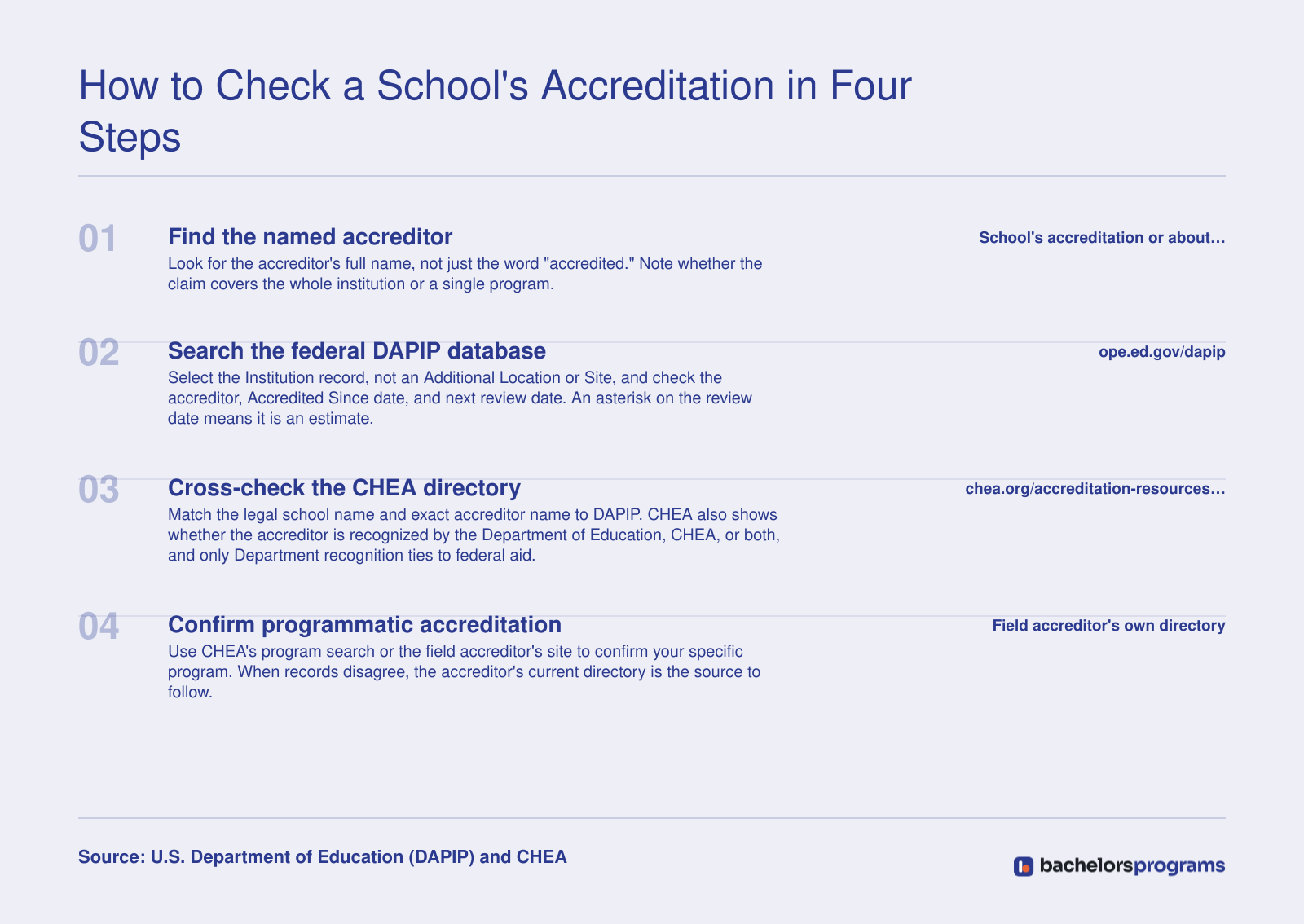
How to Check a School's Accreditation in Four Steps
Run these checks in order, because each one confirms something the step before it cannot. If a program appears on a school's promotional page but not on the accreditor's list, check spelling, former names, mergers, and branch campuses, then ask admissions in writing which body accredits that specific program. Until the accreditor's own current directory confirms it, treat the claim as unverified.
What to Verify on an Accelerated Program's Admissions Page
An "accelerated" label tells you little until you confirm the details. Check each of these on the admissions page, or ask an advisor to put the answer in writing.
- Total credits and residency requirementConfirm whether the degree requires the standard 120 credits or a reduced total, and how many credits you must complete at this school.
- Term length and start datesNote how long each term runs and how many start dates the program offers per year.
- Transfer policyFind the maximum credits accepted, the minimum grade required, and any age limit on older coursework.
- Prior-learning creditCheck whether CLEP exams, military training, or portfolio assessment count, and how many credits these can supply.
- Full cost, not headline tuitionMultiply the cost per credit by the credits you still need, then add technology, assessment, and graduation fees.
- Federal financial aid eligibilityConfirm that this specific program format qualifies for federal aid and how aid is paid across short terms.
- Named accreditationLook for the institutional accreditor named explicitly, plus any programmatic accreditation your field requires.
- Completion-time claimsIf the school advertises "graduate in X months," find the assumptions behind it, such as transfer credits, course load, and continuous enrollment.
Does Faster Mean Cheaper? Cost and Financial Aid
Finishing sooner and paying less often go together, but they are not the same thing. A compressed schedule saves money only when it also cuts the number of credits you pay for or gets you earning sooner.
Where the Savings Actually Come From
An eight-week course usually costs the same per credit as a 16-week version of that course. The real savings levers are structural:
- Fewer total credits: A 90-credit bachelor's degree removes roughly a year of coursework compared with the standard 120-credit model, so you pay for about a quarter fewer credits.
- Transfer and prior-learning credit: Community college coursework, military training, and credit by exam or portfolio review can shrink what remains. Every credit a school accepts is a credit you don't buy.
- Earlier entry into the workforce: Graduating a semester or a year early means less time with reduced income and earlier access to roles that require a bachelor's degree.
What Tuition Looks Like Now
College Board's Trends in College Pricing puts average published tuition and fees for 2025-26 at $11,950 for in-state students at public four-year schools, up $340 from the prior year.1 State averages range widely, from $6,360 to $18,090.1 Private nonprofit four-year schools average $45,000, about 3.8 times the public in-state figure.2 These are sticker prices before grants, not what most students actually pay.
Online and adult degree-completion programs do not have a reliable national per-credit average, so treat any single figure you see with caution. Programs charge by the credit, by the term, or through a flat-rate subscription that lets you take as many courses as you can finish in a set period. Subscriptions reward students who can carry a heavy load. They cost more per course if work or family slows you down. Compare each school's published rate rather than relying on a generic range.
How Federal Aid Works in Accelerated Formats
Accredited programs at participating schools can qualify for Title IV federal aid, but how the school structures its calendar shapes how that aid arrives. Standard and nonstandard term programs typically disburse by term. Nonterm and some subscription models often release aid only after you complete a set number of credits and weeks, which can delay later payments if you fall behind.
Two Pell Grant rules matter here. Pell carries a lifetime limit equal to roughly six years of full-time awards, so earlier college attempts count against it. Year-round Pell can let eligible students enrolled at least half-time receive additional funding for a third term in an award year, which suits programs that run continuously. Rules and enrollment-status calculations vary by program structure, so confirm the details with the school's financial aid office before you enroll.
Price the Whole Degree
Build your own estimate instead of comparing per-credit rates in isolation:
- Credits remaining after transfer, multiplied by cost per credit
- Plus technology, application, graduation, and course material fees
- Minus grants, scholarships, and employer tuition assistance
Employers can provide up to $5,250 per year in tax-free educational assistance under IRS Section 127, which can cover a large share of an affordable online program. Ask HR whether your employer offers it and whether the program must be preapproved.
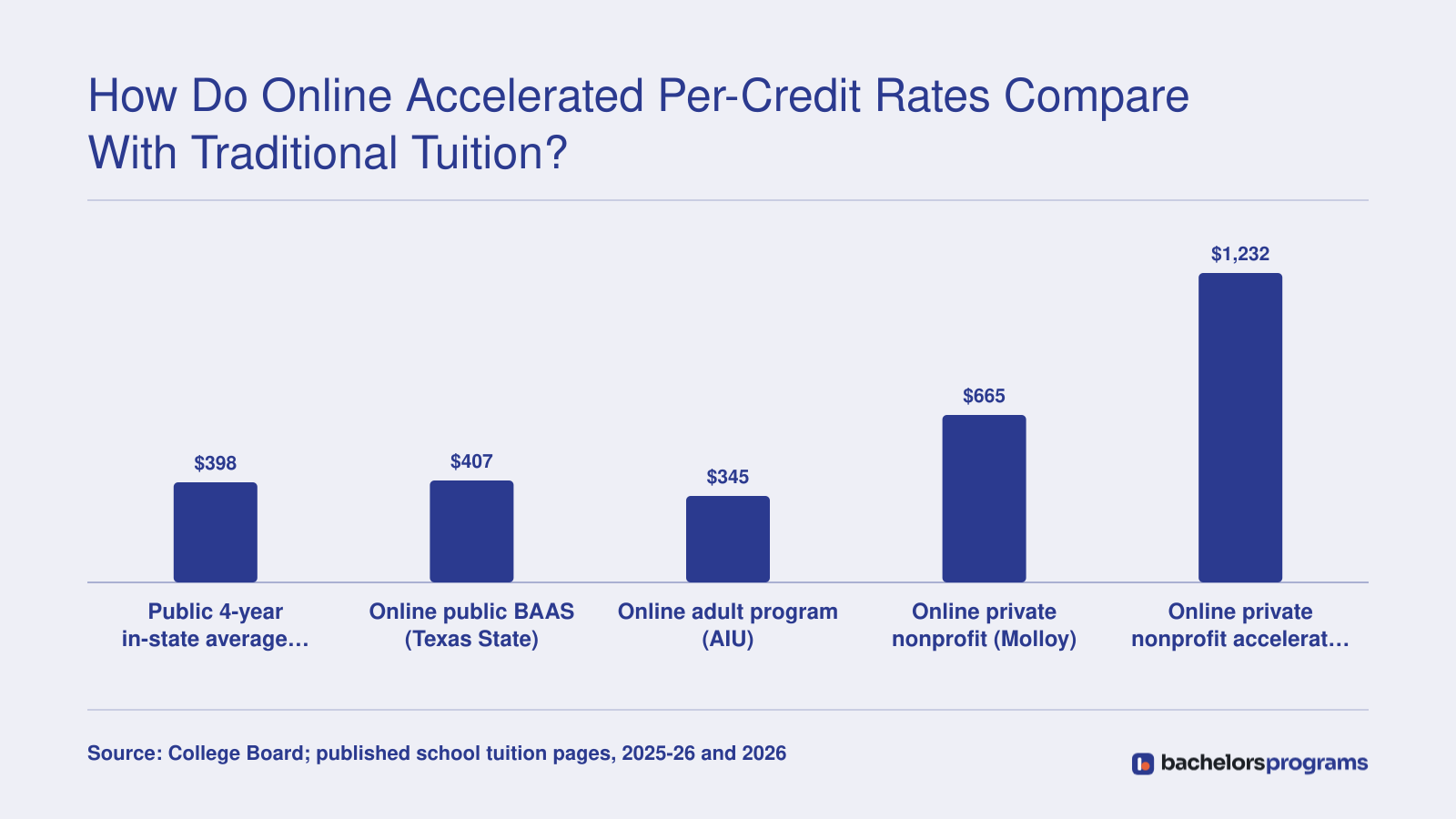
How Do Online Accelerated Per-Credit Rates Compare With Traditional Tuition?
Published per-credit rates for online accelerated and adult-completion programs vary widely, from the low $300s to over $1,200. Flat-rate models fall outside this chart because they don't bill by the credit: Western Governors University charges $3,850 per six-month term, and Newlane University charges $39 a month. Your total bill depends on how many credits you still need, not the per-credit rate alone, so multiply the rate by your remaining credits after transfer and prior-learning credit are applied.
What a Bachelor's Degree Adds Over a Career
Lifetime earnings are one way to measure what a bachelor's degree is worth, whatever pace you take to finish it.
Workload, Employer Perception, and Graduate School Eligibility
An accelerated bachelor's degree does not reduce the work a degree requires. It moves the same credit load into fewer, longer class sessions, so the hours per week rise even as the calendar shortens. That trade is the one to plan around.
The Hours Behind the Credits
Federal credit-hour rules tie one credit to roughly 45 total hours of study across a term, counting class time and out-of-class work. Compress a 3-credit course into eight weeks and those 135 hours land in about 56 days, or 15 to 18 hours a week for that single course. Two courses at once put a full-time worker near 34 hours of study on top of a 40-hour job. That is why many accelerated programs recommend starting with one course per term and why advisors ask about work schedules before registration.
What Employers Actually See
Diplomas and transcripts typically record the degree, the major, the institution and the date. They do not print "accelerated." An employer reading a resume generally sees an accredited bachelor's degree, not a compressed schedule.
Survey evidence on how employers view online or adult-earned degrees from accredited schools is mixed but trending positive. GMAC's 2026 Corporate Recruiters Survey found 61% of employers value online and in-person programs equally, up from 55% two years earlier, though those respondents hire mainly for graduate management roles. A 2026 Harris Poll conducted for University of Phoenix, surveying 502 U.S. hiring leaders at large employers, reported 98% saying online credentials are more credible than a decade ago. Ithaka S+R's 2026 experiment found a modest penalty for online bachelor's applicants, 48.4% selected against 51.6% for comparable in-person applicants, with no gap in business, health care and education. Read these as signals, not guarantees.
Graduate School and Licensure
Several graduate programs, state licensing boards and professional exams specify coursework, total credit hours or programmatic accreditation rather than a degree label. A 90-credit bachelor's can fall short of a specific prerequisite, and some boards require particular clinical or practicum hours on top of an accredited degree. Confirm requirements with the graduate school or board directly before you enroll.
Setting Realistic Expectations
National Student Clearinghouse counted 43.1 million adults in 2025 who had enrolled and stopped without earning a credential, 37.6 million of them under 65. That is a population count, not a completion rate, and no national figure isolates adults 25 and older in accelerated formats. Assume at least one term will slip, and ask about withdrawal, re-entry and refund policies before the first class.
Questions to Ask Yourself
Does the graduate program or license you want require programmatic accreditation or a full 120-credit degree?
Can you reliably protect 15 to 20 study hours per week for each compressed course?
Does your employer's tuition assistance cap how many credits it covers per year?
Would a 90-credit degree or a completion program save you more, given the credits you already have?
Is an Accelerated Bachelor's Right for You?
An accelerated bachelor's rewards students who arrive with credits already in hand and a schedule they control. It punishes students who need the structure, pacing, and campus resources that a traditional term provides. The format is not better or worse than a four-year path; it is a different fit, and the honest question is which description sounds more like you.
Who Tends to Finish Faster
Three groups consistently get the most out of these programs. Working adults with prior college credit benefit the most, because every transferred course removes tuition and weeks from the plan. Service members and veterans often arrive with credit recommendations from the American Council on Education for military training and occupational experience, which can satisfy a meaningful share of general education or elective requirements. Self-directed learners who can sustain study through summer and winter terms also do well, since the speed of an accelerated program comes mostly from refusing to take a term off.
Who Should Take the Standard Pace
If your placement testing points toward developmental math or writing, build that foundation first; compressed terms give you fewer weeks to absorb difficult material. If you want the residential experience, a faculty-supervised research project, a competitive internship pipeline, or a study abroad term, a traditional calendar leaves room for those and a seven-week term usually does not. And if your target is a state license or a graduate program with specific course requirements, check the required credit sequence before you shorten anything. Some boards and admissions committees expect a standard 120-credit transcript with named prerequisites, and a lean completion track can leave gaps you later pay to fill.
Your Next Three Moves
- Request an unofficial transfer evaluation. Most admissions offices will review your transcripts before you apply and tell you roughly how many credits transfer. That number, not the marketing copy, determines your timeline.
- Price what is actually left. Take the remaining credits from that evaluation, multiply by the per-credit rate, and add the technology, application, graduation, and course-material fees. Compare that total, not the sticker tuition.
- Confirm accreditation yourself. Look the institution up in the federal Database of Accredited Postsecondary Institutions and Programs and verify any programmatic accreditation your field requires.
When you are ready to compare programs, narrow your options by subject first, then apply the three checks above to every program you shortlist.