Online Colleges and Bachelor's Degree Programs in California
Every verified bachelor's program at a college in California: 4,350+ programs at 180+ colleges, with the online options, net price and graduation rates behind each one.

Public or private is the first cost decision in California online education. A community college baccalaureate adds $84 per upper-division unit on top of applicable fees by statute; a private nonprofit can charge many times that for the same upper-division credits. Accreditation, aid eligibility, and transfer rules diverge just as sharply.
Net price after Cal Grant and Pell, the number of lower-division units that actually transfer, and whether a program is fully online rather than hybrid decide what a degree costs and how long it takes. California's separate oversight of out-of-state providers adds another check. Admission standards and graduation outcomes vary by campus, not by the online label.
Key Points
- Community college units plus a CSU finish is usually the cheapest route.
- Cal Grant eligibility depends on your school and program, not online format.
- Most California public and nonprofit universities hold WSCUC regional accreditation.
Popular degrees in California
Bachelor's degrees in California by field
Business & Management
- Business Administration144 programs
- Marketing112 programs
- Management93 programs
- Accounting64 programs
- Communication56 programs
- Economics56 programs
- Finance55 programs
- Healthcare Administration or Healthcare Management37 programs
Science & Engineering
- Biology90 programs
- Mathematics71 programs
- Chemistry66 programs
- Physics64 programs
- Biochemistry58 programs
- Anthropology51 programs
- Environmental Science50 programs
- Electrical Engineering or Electronics Engineering or Electronic Systems Engineering Technology38 programs
Liberal Arts & Humanities
- English80 programs
- History66 programs
- Literature or English Literature66 programs
- Philosophy58 programs
- Spanish57 programs
- Gender & Sexuality Studies34 programs
- African and African American Studies29 programs
- Global Studies25 programs
Arts & Design
- Art or Art Studies84 programs
- Fine Arts or Studio Art73 programs
- Media Arts or Digital Media48 programs
- Audio & Music47 programs
- Art History46 programs
- Graphic Design40 programs
- Creative Writing20 programs
- Game Art & Design19 programs
Education & Teaching
- Science60 programs
- Early Childhood Education or Child Development37 programs
- Mathematics Education27 programs
- Elementary Education26 programs
- Child Development25 programs
- English Education21 programs
- Physical Education17 programs
- Special Education16 programs
Computers & IT
- Computer Science79 programs
- Computer Engineering34 programs
- Innovation or Technological Entrepreneurship32 programs
- Artificial Intelligence24 programs
- Cybersecurity22 programs
- Computer Information Systems20 programs
- Software Development & Engineering16 programs
- Information Technology16 programs
Social Work & Social Sciences
- Sociology106 programs
- Political Science, Government63 programs
- Social Work28 programs
- Public Policy17 programs
- Human Services8 programs
- Disability Studies2 programs
Communications & Media
- Communications71 programs
- Journalism47 programs
- Public Relations25 programs
- Communication Disorders19 programs
- Speech Pathology14 programs
- Strategic Communications9 programs
- Professional Writing3 programs
- Social Media2 programs
Healthcare
- Public Health40 programs
- Health Sciences36 programs
- Exercise & Sports Science33 programs
- Nutrition20 programs
- Speech Pathology14 programs
- Respiratory Care Therapy9 programs
- Community Health8 programs
- Health Education6 programs
Nursing
- Bachelor of Science in Nursing73 programs
- Nursing (RN to BSN)49 programs
- Accelerated BSN (ABSN)19 programs
- LPN/LVN to BSN17 programs
Criminal Justice & Law
- Criminal Justice40 programs
- Criminology21 programs
- Criminal Justice Administration21 programs
- Legal Services10 programs
- Legal Studies7 programs
- Homeland Security6 programs
- Forensic Science6 programs
- Paralegal4 programs
Psychology
- General Psychology70 programs
- Industrial Organizational Psychology6 programs
- Sport Psychology4 programs
- Clinical Psychology4 programs
- Counseling Psychology4 programs
- Child Psychology3 programs
- Applied Psychology3 programs
- Forensic Psychology2 programs
Natural & Applied Sciences
- Oceanography or Ocean or Marine Biology23 programs
- Agriculture or Agricultural20 programs
- GIS and Geoscience16 programs
- Neuroscience16 programs
- Applied Science3 programs
Religion & Theology
- Christian Studies or Religious Studies33 programs
- Christian Ministry or Ministry Leadership17 programs
Counseling
- Mental Health Counseling2 programs
- Substance Abuse Counseling1 program
How Online Bachelor's Degrees Work in California
An online bachelor's degree in California is a four-year undergraduate degree in which most or all coursework is delivered over the internet, offered by a public, private nonprofit, or for-profit college. Which sector runs the program shapes what you pay, how much state aid you can receive, and who checks the school's quality.
The Three Sectors
Public options include the California State University (CSU) system and the baccalaureate programs a few California Community Colleges now offer. Private nonprofit colleges set their own tuition, which is usually higher, but they often discount it with institutional aid. For-profit colleges are owned by investors, and their prices and outcomes vary widely.
Sector matters in three ways. Public tuition is generally the lowest. Maximum Cal Grant awards are larger at private nonprofit colleges than at public ones, though the sticker price there is higher. Oversight also differs by sector, and it gets its own section later.
What "Online" Can Mean
The label on a school website covers several formats:
- Fully online: No required campus visits, though classes may still meet at scheduled times by live video.
- Hybrid: Most work is online, but some campus days, labs, or clinical hours are required.
- Self-paced or competency-based: You move forward by passing assessments rather than by following a weekly class calendar.
Check the program page for "synchronous" sessions or in-person lab requirements before assuming a degree fits around a work schedule.
Where Public Online Options Come From
Many CSU online programs are degree-completion programs built for students who already have credits, often from a community college. They are frequently run through self-support or extended education units, so they charge a per-unit price instead of standard campus tuition. That price can differ from what a residential CSU student pays, so compare the total for the units you still need.
The University of California offers very few fully online bachelor's degrees. For most Californians looking for a public online option, the realistic routes are CSU completion programs and community college baccalaureates.
What an Online Bachelor's Costs for California Residents
For most California residents, the cheapest online bachelor's degree usually comes from taking lower-division units at a community college and then finishing upper-division work through a CSU campus or a California Community College baccalaureate, where state law adds $84 per upper-division unit on top of the regular enrollment fee. CSU bills state-support tuition per semester in two tiers, so a student taking 6.1 or more units pays the same $3,419 whether enrolled in 7 or 15 units, which makes full-time study much cheaper per unit than the $1,981 part-time tier. Mandatory campus fees are often billed to online students too, and technology, online course, or proctoring fees may apply, so treat these published sticker prices as a starting point: your net price after Cal Grant, Pell, and institutional aid is usually lower, and private nonprofit and for-profit per-credit rates should be checked directly with each school.
| Option | Example Institution | How Tuition Is Charged | Published Tuition (CA Resident) | Notable Extra Fees |
|---|---|---|---|---|
| CSU state-support tuition (systemwide) | California State University system | Annual undergraduate tuition, billed by term (2026-27) | $6,838 per year (CSU Costs page, 2026-27) | Campus mandatory fees average $2,194 per year (CSU average based on 2025-26) |
| CSU state-support tuition (campus example) | California State University, Sacramento | Per semester, two tiers by unit load (2026-27) | $1,981 for 0 to 6 units; $3,419 for more than 6 units (Sacramento State Catalog, Fees and Refunds) | Mandatory campus fees of $1,409 per semester |
| CSU state-support tuition (campus example) | California State University, East Bay | Per semester, two tiers by unit load (2026-27) | $1,981 for 0 to 6 units; $3,419 for 6.1 or more units (Cal State East Bay Registration and Tuition Fee Information) | Mandatory campus fees of about $789.50 per semester; published totals are $2,770.50 (0 to 6 units) and $4,208.50 (6.1 or more units) |
| CSU Fully Online course sharing | California State University system (CSU Fully Online) | For eligible full-time CSU students, added fully online units are included in home-campus full-time tuition | No additional base tuition per term (CSU Fully Online FAQs, current) | Some courses carry course-specific or materials fees; nonresidents pay host-campus nonresident per-unit fees |
| California Community College baccalaureate | California Community Colleges (statewide baccalaureate programs) | Per unit | Upper-division units: regular enrollment fee plus $84 per unit (rate set in state law, California Legislature, SB 960 and bill text) | Lower-division units carry the regular per-unit enrollment fee; campus-specific fees may also apply |
Financial Aid for Online Students: Cal Grant, Pell, and Net Price
An online format does not by itself cost you California financial aid; the school and the program do.
Can I use a Cal Grant for an online degree?
Often, yes. Cal Grant rules turn on where you enroll and who you are, not on how classes are delivered.1 You must attend a qualifying California college, enroll at least half time in an eligible undergraduate degree or certificate program, be a California resident, show financial need, stay within income and asset limits, and not already hold a bachelor's degree. Award amounts differ between private nonprofit and for-profit schools and public campuses, so check the California Student Aid Commission's current schedule instead of assuming a figure.
Aid at a glance
- Cal Grant A: A need-based state grant aimed at tuition and fees. It requires a verified Cal Grant GPA.
- Cal Grant B: Aimed at students from the lowest-income households and often tied to help with non-tuition costs. Same application and GPA requirements.
- Federal Pell Grant: The maximum is $7,395 for the 2026-27 award year.3 Your amount depends on your Student Aid Index, the school's cost of attendance for your program, and how many credits you take. Federal Student Aid does not set a general online exclusion.3
- Middle Class Scholarship: For California residents in bachelor's programs at UC, CSU, or California Community Colleges. Amounts vary with cost of attendance, other aid, and state budget funding, and online eligibility is not separately confirmed.2
- CSU State University Grant or institutional aid: Campus-administered need-based aid. Availability and amounts are set by each school.
FAFSA, CADAA, and deadlines
Most students apply with the FAFSA. Students who are not eligible for federal aid but qualify under AB 540 use the California Dream Act Application (CADAA). Both make you eligible for state aid, but Cal Grant also requires a verified GPA, which your school or high school typically submits to the Commission.1 The Middle Class Scholarship generally follows a March 2 filing date, and Cal Grant priority timing is similar. Dates can shift by year, so confirm the current deadline with the Commission and file early.
Net price is the number that matters
Net price is the cost of attendance minus grants and scholarships, before loans. Sticker tuition says little. Use the net price calculator that federal rules require every college to publish, and compare the results side by side.
A warning on self-support programs
Some online programs, especially self-support or extended-education offerings at public universities, are priced and funded separately from state-supported degrees. They may not accept Cal Grant, Middle Class Scholarship, or institutional grants. Before you enroll, ask the financial aid office in writing which awards apply to your exact program.
Regional vs. Programmatic Accreditation: How to Check Any California Online College
Are online colleges in California regionally accredited? Most public and nonprofit universities in the state are accredited by the WASC Senior College and University Commission (WSCUC)1. That includes the University of Southern California, Chapman University, Claremont McKenna College, Cal State LA and Cal State Stanislaus. California community colleges, such as Allan Hancock, Chaffey and Crafton Hills, are accredited by the Accrediting Commission for Community and Junior Colleges (ACCJC), whose recognized scope includes distance education3. Some online schools that enroll Californians hold accreditation from an agency based in another region, which is acceptable as long as that agency is federally recognized.
Institutional vs. Programmatic Accreditation
Institutional accreditation (what people usually mean by "regional") covers the school as a whole. Programmatic accreditation is a separate review of a single department or degree. An online bachelor's can come from a fully accredited university and still lack programmatic status. Common examples:
- Business: AACSB accredits business schools and programs.
- Nursing: CCNE and ACEN accredit nursing programs, such as an RN-to-BSN.
- Engineering and computing: ABET accredits specific programs, not entire institutions.
Programmatic status matters most when a license, graduate school or employer expects it. Nursing and engineering are the clearest cases. In business, AACSB carries weight with some employers and MBA programs but is rarely required.
How to Verify a School and Program
- Search the U.S. Department of Education's DAPIP database by the school's exact legal name and campus. The data comes from recognized accreditors and state agencies but is not audited, so treat it as a starting point.
- Confirm in the accreditor's own directory. The WSCUC directory shows current status, commission actions and scope. ACCJC keeps its own listing.
- Check the AACSB, CCNE, ACEN or ABET directory for the exact degree title, level and online offering. One accredited program does not cover the rest of the school.
- Be wary of any accreditor not recognized by the Department of Education or CHEA. A school can claim to be "fully accredited" by an agency that carries little weight.
Why Nonprofit vs. For-Profit Matters
Tax status affects more than reputation. Credits from some for-profit schools, especially those without institutional accreditation from a recognized regional agency, may not transfer to a CSU or UC campus. For-profit tuition often runs higher than public options. Cal Grant awards at private for-profit schools are generally smaller than at private nonprofits, so check the current award for your specific school before you enroll.
California's Oversight of Private and Out-of-State Online Colleges
From Community College to an Online Bachelor's: Transfer Pathways
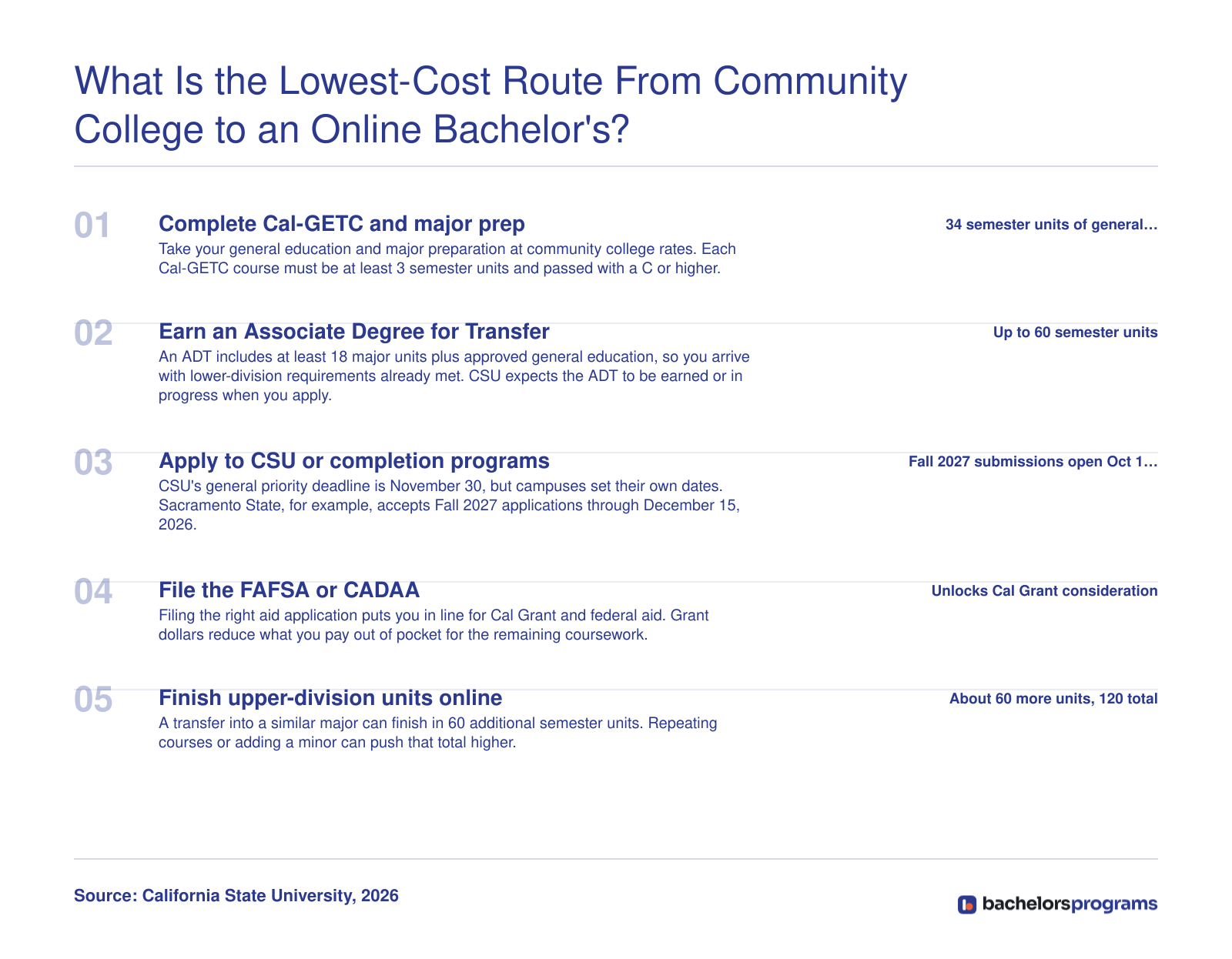
The transfer route into a California bachelor's degree shifted in fall 2025, when Cal-GETC became the single lower-division general education pattern the state's community colleges offer students who plan to transfer to a CSU or UC campus.5
Do California community college credits transfer?
Yes, and the Associate Degree for Transfer carries the strongest version of that guarantee. An ADT is built from 60 semester units, including at least 18 in the major, and it carries guaranteed priority admission to a CSU campus for students who meet CSU minimum eligibility, complete an approved general education pattern, and apply by the deadlines.1 Note the limits: the guarantee covers a CSU campus, not a particular campus or major, and impacted programs can still turn you away. Once you are admitted to a similar program, you are guaranteed to finish within 60 additional semester units, for 120 total, provided you stay continuously enrolled in the same major and avoid repeats or added minors.1
Cal-GETC handles the general education side. It fully certifies lower-division GE for the CSU, but not upper-division or graduation requirements; CSU guidance still points to 9 semester units of upper-division GE.2 Cal-GETC courses generally carry at least 3 semester units per area, and an online or hybrid course satisfies an area only when it has been approved through CSU or UC review.3 Modality alone proves nothing.
The unit caps that shape your timeline
CSU accepts a maximum of 70 transferable semester units from a community college.4 That cap is separate from the ADT's 60-unit structure and from the 60-additional-unit guarantee, and coursework beyond it may still satisfy some subject or major requirements, so confirm treatment with the receiving department. Residency is a separate check: CSU and most private nonprofits require part of the degree completed in residence, and each publishes its own figure.
Finishing a degree you already started
Cal State Online and campus Extended Education, continuing education, and professional studies units run bachelor's completion programs for adults with some college but no degree. Ask specifically whether the program awards credit for prior learning or military service; some do, some do not.
How long does it take?
- Full-time, from scratch: about four years.
- Full-time transfer with 60 units: about two years.
- ADT pathway: 60 additional semester units after transfer, 120 total.
- Part-time or stop-out enrollment: longer, and the 60-unit completion guarantee depends on continuous enrollment.
What Is the Lowest-Cost Route From Community College to an Online Bachelor's?
For most California students, the least expensive path to a bachelor's runs through a community college first. Completing lower-division work there, then finishing upper-division units online, can trim both tuition and time to degree. Each step below builds on the one before it.
Admission Requirements for First-Time and Transfer Online Students
California State University admission rules depend on whether you are entering as a first-time freshman or as a transfer student. Online study is not a separate admissions category, so the program type and the campus decide what you need.
- First-time freshmen: courseworkYou need a high school diploma or an accepted equivalent such as the GED, HiSET or TASC. You also need the 15-unit a-g course pattern, with a C or better in each course.
- First-time freshmen: GPA and testingCalifornia high school graduates and residents need at least a 2.50 a-g GPA. Nonresidents need at least 3.00. CSU is test-free for fall 2026 and does not require essays. SAT or ACT scores may be used only for math or writing placement after you are admitted.
- Upper-division transfersYou need 60 transferable semester units (90 quarter units), including 30 units of general education. You also need a minimum 2.00 GPA, good standing at your last college and a C- or better in the Golden Four: written communication, oral communication, critical thinking and quantitative reasoning. These requirements are generally due by the end of spring for fall entry.
- Lower-division transfersApplicants with 59 or fewer semester units are reviewed case by case, and some campuses restrict or do not accept them.
- Online degree-completion programsMost are designed for students who already hold an associate degree or substantial college credit. Expect 60 or more units beyond general education, completed over two to four years. Some programs add major prerequisites, minimum grades or a separate application deadline, so contact the campus offering the program.
- Documents to gatherPrepare official transcripts and residency documentation if you are seeking in-state tuition. You will also need a FAFSA or, if you are eligible, a California Dream Act Application (CADAA) for financial aid.
- SelectivityThe GPA minimums make you eligible to apply but do not guarantee admission. Impacted campuses and majors may require higher grades. Online completion programs often face less competition, but confirm each program's criteria on the campus page.
Graduation Rates, Earnings, and How Employers View Online Degrees
Outcomes data, not the word "online," should decide where you enroll. Nationally, 25.6% of undergraduates were enrolled exclusively in distance-education courses in 2023-24 (IPEDS).1 That figure is national, and no California-specific share was available, so treat it as context rather than a state benchmark.
What California Transfer Data Shows
California State University reports that its transfer students graduate at rising rates. The systemwide two-year rate reached 44% in the 2025 update, up from 31% in 2015, and the four-year rate reached 79%, up from 73%.2 CSU's 2025 goals were 45% and 85%.2 A separate 2025 report gives slightly different numbers (45.6% and just under 77%), likely because of differences in cohorts or methods. For California Community College transfers specifically, 41.5% of the fall 2021 cohort finished within two years, compared with 40.3% for fall 2020.3 These figures cover CSU students overall, not online students alone.
How to Check Any School on College Scorecard
Search the school on the federal College Scorecard and look at four measures:
- Graduation rate: The share of students who finish within the reporting window. Compare schools at the same credential level.
- Retention: The share who return after the first year. A low number signals students leaving early.
- Median earnings: What former students earn after leaving school. Check the reporting year and who is counted.
- Median debt: Federal loan debt, which does not capture private loans.
Institution-level numbers blend every program at a school. Program-level data, where available, is more useful because earnings and debt vary widely by field. Confirm the current definitions in the Scorecard data documentation.
What Employers See
Diplomas from accredited public and nonprofit schools generally do not say "online." Employers tend to look at accreditation and the school's reputation, so confirm both before you apply.
Red Flags
Be wary of low graduation rates, weak retention, and debt that is high relative to earnings. These warnings matter most at for-profit schools, where heavy borrowing paired with modest outcomes is a recurring pattern.
The Earnings Gap a Bachelor's Degree Can Close in California
For California adults weighing an online degree, Census data shows how much a bachelor's degree can change typical earnings.
How to Confirm a Program Is as Online as It Claims
A program labeled "online" can still require travel, fixed class times, or local placements, so verifying the format means asking specific questions before you apply. Hybrid and fully online are different things, and neither is automatically cheaper or faster. What matters is whether the real requirements fit your life.
Check the On-Campus and Live Requirements
- Campus visits: Ask whether any orientation, residency weekend, or capstone presentation must happen in person, and how often.
- Exams: Find out if exams are proctored in person at a testing center or online, and who pays proctoring fees.
- Live sessions: Ask whether classes meet at set times (synchronous) or let you work on your own schedule. Live sessions can be hard to manage across time zones or work shifts.
Ask About Local Placements
Internships, practicums, clinicals, and student teaching usually must be completed in person near where you live. Ask who arranges the placement: the school, or you. Some programs have placement coordinators, while others expect students to find their own site and supervisor. In fields like nursing, education, and social work, this can be the biggest hidden hurdle to finishing.
Look at Term Structure and Course Offerings
Compare how terms are built. Semesters, quarters, and 8-week sessions each change your pace and workload. Ask when new cohorts start, and how often required courses are offered. If a core class runs only once a year, missing it can delay graduation by a full term or more.
Get Answers in Writing
Ask an admissions advisor to send responses by email instead of relying on a phone call. Request the program's published degree plan and a list of all fees. Then ask directly whether online students pay campus-based charges, such as student services, health, or facilities fees, since these can add to the total even when you never set foot on campus.
A program that answers clearly and puts details on paper is usually easier to trust. Hesitation or vague language about requirements is worth noting before you enroll.
Colleges in California with the most bachelor's programs
| School | City | Type | Bachelor's programs | Online | Net price / yr | Grad rate |
|---|---|---|---|---|---|---|
| California State University-Northridge | Northridge | Public | 99 | 2 | $7,021 | 57% |
| California Baptist University | Riverside | Private nonprofit | 99 | 25 | $26,285 | 62% |
| San Jose State University | San Jose | Public | 98 | 6 | $13,760 | 69% |
| San Diego State University | San Diego | Public | 97 | 5 | $15,364 | 76% |
| California State University-Sacramento | Sacramento | Public | 92 | 8 | $9,338 | 56% |
| California State University-Fresno | Fresno | Public | 90 | 1 | $7,000 | 57% |
| California State University-Chico | Chico | Public | 89 | 7 | $14,480 | 63% |
| California State University-Long Beach | Long Beach | Public | 88 | 4 | $10,440 | 69% |
| San Francisco State University | San Francisco | Public | 86 | 1 | $12,278 | 50% |
| California State Polytechnic University-Pomona | Pomona | Public | 84 | 0 | $11,531 | 68% |
| California State University-Fullerton | Fullerton | Public | 83 | 4 | $6,555 | 70% |
| California State University-East Bay | Hayward | Public | 82 | 29 | $9,320 | 48% |
| California State Polytechnic University-Humboldt | Arcata | Public | 79 | 5 | $13,171 | 49% |
| California State University-Los Angeles | Los Angeles | Public | 79 | 1 | $3,967 | 53% |
| California Polytechnic State University-San Luis Obispo | San Luis Obispo | Public | 79 | 0 | $16,665 | 86% |
Program counts are the verified bachelor's listings in our directory; net price is the school-wide average a first-time undergraduate paid after aid, and graduation rate the share finishing within six years (College Scorecard).
Online Bachelor's Degrees in California: Common Questions
These answers cover the questions California students ask most often before enrolling online. Details vary by school and program, so confirm specifics with the college before you commit.
How long does it take to finish an online bachelor's degree in California?
Can I use a Cal Grant for an online degree?
Can an out-of-state online college enroll me if I live in California?
Do I have to pay campus fees if I never set foot on campus?
Will my diploma say "online"?
Compare programs nationwide
Many California residents study online. Every ranked list above has an online lens, or browse every field.
Online bachelor's degrees Browse all fields