Online Colleges and Bachelor's Degree Programs in Maryland
Every verified bachelor's program at a college in Maryland: 1,100+ programs at 20+ colleges, with the online options, net price and graduation rates behind each one.

University of Maryland Global Campus alone enrolls 49,664 undergraduates, most of them studying fully online. That reflects who actually pursues a bachelor's degree in Maryland: working adults, transfer students arriving with credit, and military-connected learners.
The colleges and fields listed here are a starting point. Fit comes down to per-credit price against net price, the state grants you qualify for, how many existing credits transfer, and whether "online" means fully online or a hybrid with required campus sessions.
Maryland's statewide transfer policy protects credit earned at in-state community colleges, which means where you start a degree can shape the cost as much as where you finish it.
Key Points
- Most Maryland online bachelor's degrees require 120 credits; transfer credit shortens that.
- Maryland state grants through MHEC require residency and an eligible Maryland school.
- UMGC, Maryland's online public university, enrolls 49,664 undergraduates.
Popular degrees in Maryland
Bachelor's degrees in Maryland by field
Business & Management
- Marketing27 programs
- Business Administration26 programs
- Accounting20 programs
- Management18 programs
- Finance16 programs
- Economics16 programs
- Communication15 programs
- International Business11 programs
Science & Engineering
- Biology25 programs
- Mathematics23 programs
- Chemistry19 programs
- Biochemistry16 programs
- Environmental Science15 programs
- Physics14 programs
- Geography10 programs
- Anthropology8 programs
Liberal Arts & Humanities
- History21 programs
- English21 programs
- Literature or English Literature21 programs
- Philosophy15 programs
- Spanish13 programs
- Humanities7 programs
- Global Studies7 programs
- Global Health or Health Studies6 programs
Arts & Design
- Art or Art Studies27 programs
- Fine Arts or Studio Art15 programs
- Graphic Design12 programs
- Art History12 programs
- Media Arts or Digital Media11 programs
- Audio & Music10 programs
- Illustration5 programs
- Game Programming & Development4 programs
Education & Teaching
- Science20 programs
- Elementary Education13 programs
- Secondary Education12 programs
- Special Education11 programs
- English Education11 programs
- Mathematics Education11 programs
- Early Childhood Education or Child Development8 programs
- History Education7 programs
Computers & IT
- Computer Science33 programs
- Cybersecurity12 programs
- Artificial Intelligence12 programs
- Computer Information Systems10 programs
- Innovation or Technological Entrepreneurship9 programs
- Information Technology8 programs
- Computer Engineering7 programs
- Software Development & Engineering5 programs
Communications & Media
- Communications21 programs
- Journalism15 programs
- Public Relations7 programs
- Speech Pathology4 programs
- Communication Disorders3 programs
- Strategic Communications3 programs
- Professional Writing2 programs
- Business Communications2 programs
Social Work & Social Sciences
- Sociology22 programs
- Political Science, Government18 programs
- Social Work10 programs
- Public Policy4 programs
- Human Services3 programs
Healthcare
- Public Health8 programs
- Health Sciences8 programs
- Exercise & Sports Science6 programs
- Speech Pathology4 programs
- Health Education3 programs
- Nutrition2 programs
- Community Health2 programs
- Health Informatics1 program
Nursing
- Bachelor of Science in Nursing17 programs
- Nursing (RN to BSN)9 programs
- Accelerated BSN (ABSN)4 programs
- LPN/LVN to BSN1 program
Criminal Justice & Law
- Criminal Justice10 programs
- Criminal Justice Administration5 programs
- Criminology3 programs
- Legal Studies3 programs
- Legal Services2 programs
- Homeland Security2 programs
- Forensic Science2 programs
- Paralegal1 program
Psychology
- General Psychology22 programs
- Applied Psychology2 programs
- Counseling Psychology1 program
Natural & Applied Sciences
- Oceanography or Ocean or Marine Biology5 programs
- Neuroscience3 programs
- GIS and Geoscience2 programs
- Agriculture or Agricultural2 programs
Counseling
- Substance Abuse Counseling2 programs
How Online Bachelor's Degrees Work in Maryland: Fully Online, Hybrid, and Online-Course Options
Three Formats, Plainly Defined
Fully online means every requirement can be finished without visiting a campus. Hybrid means some sessions are required in person. A third group is campus programs that offer only certain courses online. A school can call itself an online college without every major being fully online.
Maryland shows the range. University of Maryland Global Campus (UMGC), a public University System of Maryland school, is online-first, and the Maryland Higher Education Commission says most of its programs are fully online.1 Morgan State lists fully online bachelor's degrees in cloud computing and applied liberal studies, each 120 credits.2 McDaniel College, by contrast, offers online courses but no degree you can finish entirely online, according to the sources reviewed.2
Asynchronous vs. Synchronous
Asynchronous classes let you complete lectures and assignments by weekly deadlines, at any hour. That suits shift workers and parents of young children. Synchronous classes meet live at set times, which gives more interaction but less flexibility. Check the schedule before you register, since many programs mix the two.
Hidden In-Person Requirements
A "fully online" label can still come with obligations. Look for:
- Proctored exams: These may be taken remotely with monitoring software or at an approved testing center.
- Labs: Science and technology courses sometimes require hands-on sessions.
- Clinical or student-teaching placements: Nursing and education degrees typically involve supervised work at a local site, even when coursework is online. Frostburg State is listed with an online nursing option, but confirm how clinicals are arranged.2
- Orientation visits: Some schools ask for a one-time campus stop.
Policies vary by school and by major, so do not assume one rule covers a whole institution. On the program page, look for the delivery label, the course schedule, and any note about residencies or practicums. Then compare it against the catalog.
One Step Before You Apply
Ask admissions in writing whether your specific major can be completed with zero campus visits, including exams and placements. A written reply gives you something to point to if requirements change later.
What Online Bachelor's Degrees Cost in Maryland: Per-Credit Tuition at Public and Private Schools
How much does an online bachelor's degree cost per credit in Maryland? The answer depends on whether you enroll at a public or private nonprofit, and whether the school charges Maryland residents less than out-of-state students.
Per-Credit Rates at a Glance
- University of Maryland Global Campus (public): UMGC's Tuition Rates and Fees page lists $337 per credit for Maryland residents and $499 per credit for out-of-state students in fall 2026. At 120 credits, that is an estimated $40,440 in tuition for residents for 2026-2027, before fees and aid.
- Notre Dame of Maryland University (private nonprofit): The university's Tuition & Fees page lists $1,090 per credit for online undergraduates in 2026-2027, the same rate regardless of residency.1 Estimated 120-credit tuition for 2026-2027: $130,800.
- Capitol Technology University (private nonprofit): Capitol's undergraduate Tuition & Fees page lists $460 per credit for online students from fall 2026 through summer 2027, with one rate for all states.2 Estimated 120-credit tuition: $55,200.
Those figures cover tuition only, leaving out fees, books, and technology charges, and assuming no transfer credit and no aid. A student who brings 60 transfer credits buys 60 credits, not 120, so the tuition estimate drops by half at the same per-credit rate.
Residency, Military, and Other Public Rates
Maryland residency for in-state online tuition generally follows domicile. You need to show that Maryland is your permanent home, not just a campus address. UMGC is the clearest example of a public online rate that splits by residency: Marylanders pay $337 per credit in fall 2026 while out-of-state students pay $499. Notre Dame of Maryland and Capitol Technology charge one online rate to everyone, so your state of residence does not change the tuition line.
Active-duty military, veterans, and Maryland National Guard members may qualify for rates that differ from the published in-state figure. Ask the bursar or military services office for the current schedule before you budget.
Other Maryland publics, including Frostburg State, Towson, University of Baltimore, and Morgan State, publish their own per-credit tables. Their online rates can differ from on-campus rates and may carry separate in-state and out-of-state columns, so confirm the exact charge on the bursar page for the term you plan to start.
Sticker Price vs. Net Price: Finding an Affordable Online Bachelor's Degree in Maryland
The tuition a Maryland college advertises and the amount you actually pay can differ by thousands of dollars, and online students often spot the gap only after they register. Closing that gap comes down to three moves: compare net price instead of sticker price, know which fees survive online study, and transfer as many credits as you can before you enroll.
Sticker Price Is Not Your Bill
Sticker price is the published rate before anyone helps you. Net price is the figure left after federal grants, state grants, and institutional scholarships are applied. Because Maryland's need-based aid is generous relative to many states, the net figure for a lower-income student can land far below the published rate, while a higher-income student may pay close to full freight. Pull each school's average net price by income band from the College Scorecard and compare that figure, not the tuition line on the website.
Fees That Survive the Online Discount
Online study removes room and board, not every charge. Expect application fees, per-credit technology or online-course fees, proctoring charges for exams, and digital course materials. For 2026-2027, the University of Maryland Global Campus charges a $15 per-credit technology fee, though undergraduate military students and students covered by certain corporate agreements are not assessed it. Frostburg State charges $222 a year for full-time students, or $20 per credit hour part time.1 Ask whether a program uses low-cost or zero-cost course materials, which can erase several hundred dollars a year.
Transfer Credit Is the Biggest Lever
Maryland community college in-county rates for 2026 run roughly $99 to $146 per credit before mandatory fees.2 Thirty credits completed at those rates costs about $2,970 to $4,380, and those credits replace 30 credits you would otherwise buy at a four-year per-credit rate. Sixty credits compounds the savings.
Three Moves Before You Commit
- Run the net price calculator: every participating Maryland school must post one, and it takes about ten minutes.
- Confirm residency classification: in-county and in-state rates depend on documentation, and reclassification after the first term is harder than getting it right upfront.
- Ask about employer partnerships: several Maryland institutions discount tuition for employees of partner organizations, and the discount is rarely advertised on the program page.
Financial Aid and Maryland State Grants for Online Students
Financial aid for an online bachelor's degree in Maryland comes in three layers: federal aid, state grants run by the Maryland Higher Education Commission (MHEC), and money from outside the state system. Online students at accredited schools that participate in federal student aid use the same process as on-campus students.
Start With the Application
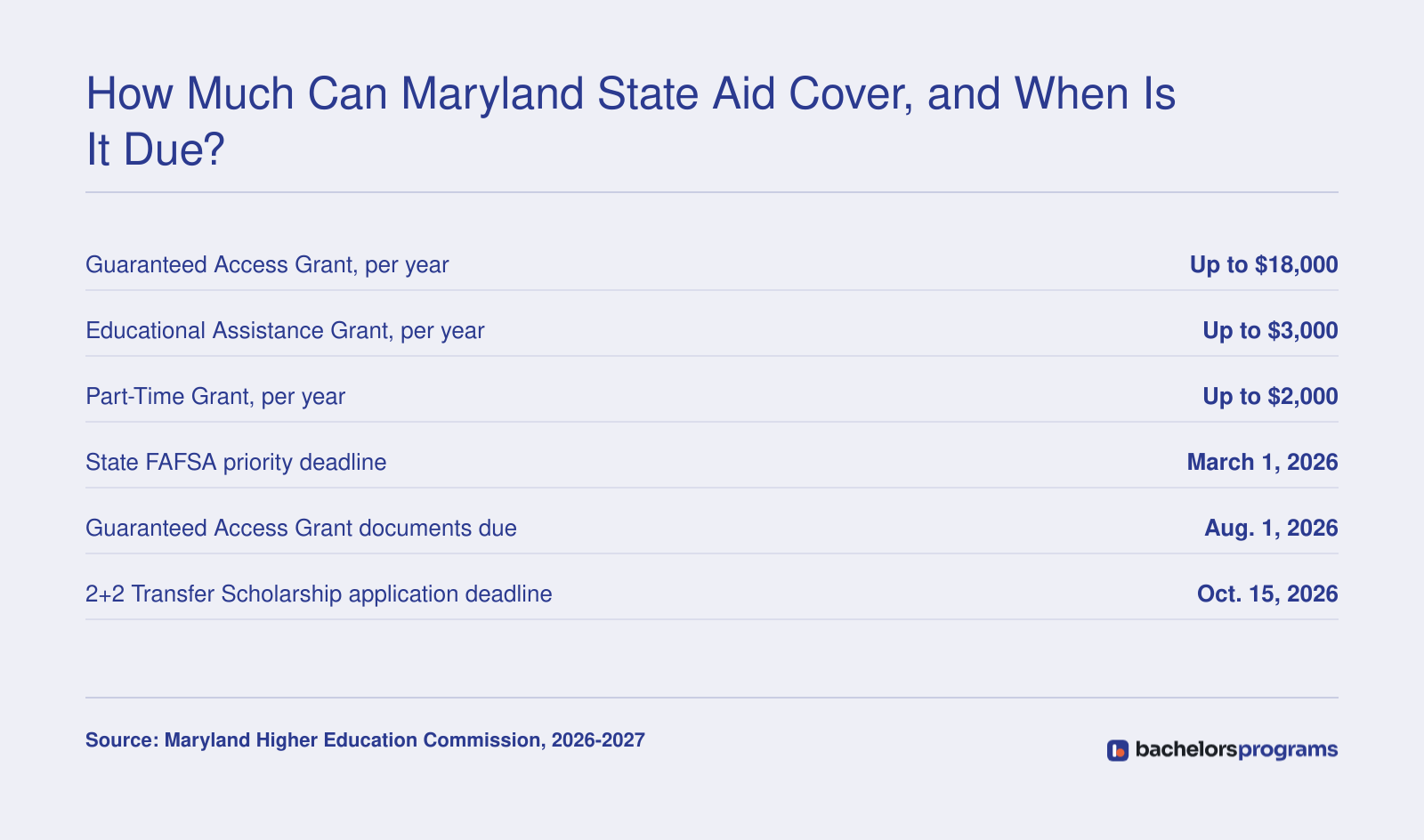
File the FAFSA to qualify for Pell Grants and federal loans. Maryland residents who can't file the FAFSA can use the Maryland State Financial Aid Application, now branded MHEC One-App.6 For the 2026-27 year, the priority deadline for the main state grants was March 1, 2026.3 Treat that date as a warning: Maryland aid is limited, and late filers often miss out. Confirm the next cycle's date with MHEC before you apply.
Maryland State Grants
- Guaranteed Access Grant: The most generous award, worth up to $18,000 per year for four years.2 It is for Maryland residents with significant financial need who attend full-time and are under 26 at first award.1
- Educational Assistance Grant: A need-based award for students at eligible Maryland institutions.5
- Part-Time Grant: Open to degree-seeking undergraduates, including dually enrolled high school students. The school determines who receives it, which matters for working adults taking one or two courses at a time.
- 2+2 Transfer Scholarship: Aimed at community college students moving on to a four-year school. The 2026-27 application closed October 15, 2026, with supporting documents due November 15.3
- Workforce Shortage Student Assistance Grant: Has its own application, due July 1 for 2026-27, and does not require a FAFSA.7
Enrolling online does not disqualify you from state aid.4 Whether a given online program qualifies depends on the program and institution, so ask the financial aid office whether your specific degree counts as an eligible undergraduate program.
The Residency Catch
Most state aid requires Maryland residency and attendance at an eligible Maryland institution. An out-of-state online school generally won't qualify, even if it advertises to Maryland students. If state grants are central to your plan, that favors Maryland-based online programs.
Aid Beyond the State
- Military benefits: Service members can use Tuition Assistance, and veterans and families may qualify for GI Bill benefits at approved schools.
- Employer assistance: Many employers reimburse tuition. Get the policy in writing, including any grade requirements or repayment terms, before you enroll.
- Institutional scholarships: Some schools offer awards for transfer students and adult learners. These are often not advertised prominently, so ask admissions directly.
For current award names and amounts, check MHEC's Office of Student Financial Assistance. Amounts and rules change yearly, so use the 2026-27 figures here as a guide, not a guarantee.
How Much Can Maryland State Aid Cover, and When Is It Due?
These figures come from the Maryland Higher Education Commission for the 2026-2027 award year. Grant amounts are annual maximums, and actual awards depend on financial need and available funding. Every program requires Maryland residency and enrollment at an eligible Maryland school, so confirm that your online program qualifies before you count on state aid.
Transferring Community College, Military, and Work Credit to a Maryland Online Bachelor's Program
How many community college credits will a Maryland four-year school actually accept? Under the Maryland Higher Education Commission's transfer policy (COMAR 13B.06.01) and the Transfer with Success Act, a Maryland community college student with an associate degree, or 56 semester hours and a 2.0 GPA, generally cannot be denied direct transfer to a public four-year school unless capacity is exceeded.1 Courses in a recommended transfer program ordinarily apply to a related bachelor's degree, and associate degree holders typically enter with junior standing.
The Credit Ceiling and Residency Limits
Community college credit at Maryland publics is generally limited to about half the bachelor's requirement, capped at 70 credits, and it applies to the first two years of study.1 Applicability still depends on prerequisites, program requirements, and capacity. Residency rules matter too: every school requires a minimum number of credits earned in-house, which can shrink the amount of transfer credit that counts. At University of Maryland Global Campus (UMGC), for example, 30 credits of a bachelor's must be completed at the school.
Check Your Courses in ARTSYS
ARTSYS is the state's course-transferability and advising system.1 Look up your courses before you register, then plan with an advisor. It shows how courses transfer, but it does not guarantee admission, completion of a major, or that every course will fill a specific degree requirement. If you plan to teach, choose an Associate of Arts in Teaching or another articulated pathway early, so your credits line up with the receiving program from the start.
Credit for Military Service and Work Experience
Prior learning can shorten a degree further. Common routes include:
- Military training: Credit follows ACE recommendations, usually documented on the Joint Services Transcript. UMGC evaluates military school and occupational credit against the ACE Military Guide, and some undergraduate business and leadership programs may award up to 12 credits to service members at E5 or above.
- Exams and portfolios: CLEP and DSST exams, course challenges, and portfolio assessment can earn credit, though availability varies by program.
- Workplace learning: UMGC allows up to 6 credits per semester and 15 total.
UMGC's stated limits are a useful benchmark. It accepts up to 70 credits from approved two-year colleges and up to 90 credits from approved four-year institutions or combined sources such as exams, military, and noncollegiate training. Exact amounts depend on your program and an official evaluation.
Get an Evaluation First
Request an unofficial transfer evaluation before you apply. It turns a vague estimate into a credit-by-credit count, so your time-to-degree and cost projections reflect what will really transfer.
How Long It Takes to Get an Online Bachelor's Degree in Maryland
How long does it take to earn an online bachelor's degree in Maryland? Most programs require 120 credits, so the answer depends on your pace each term and how much credit you bring in.
Credits Per Term
Federal reporting treats four years as the normal time to a bachelor's degree at a standard term-based school, which means eight semesters.2 At University of Maryland Global Campus (UMGC), 12 credits a semester counts as full-time. In an 8-week session, 6 credits (two courses) counts as 100% pursuit, and 3 credits counts as 60%. UMGC's 4-week courses are shorter, but it recommends just one course (3 credits) at a time.
Realistic Timelines
These are arithmetic estimates from the 120-credit baseline, not guarantees:
- First-time, full-time: 12 to 15 credits a semester takes about 4 to 5 years.
- First-time, part-time: 6 credits a semester takes about 10 years if you skip summers, or closer to 6 to 7 with summer enrollment.
- 60-credit transfer, full-time: about 2 to 2.5 years.
- 60-credit transfer, part-time: about 3 to 5 years, depending on summers.
- Accelerated 8-week terms, year-round: 30 to 36 credits a year puts a first-time student near 3.5 to 4 years, and a transfer student near 2 years.
Not every Maryland provider uses UMGC's formats, so check each school's calendar.
What National Data Shows
The National Student Clearinghouse found that 2024-25 first-time bachelor's recipients had a median elapsed time of 3.7 years across all enrollment patterns.1 Students who were predominantly part-time (at least 80% of their enrolled time) had a median of 11.9 years.1 Transfer students took 5.7 years elapsed, versus 3.7 for non-transfer students, though their active enrollment time was 4.7 years. Elapsed time includes any gaps between terms, which is common among working adults.
Ways to Finish Sooner
Prior-learning credit and year-round terms are the two main shortcuts. Credit for military training, work experience, or exams lowers the number of credits remaining, and summer sessions keep you moving when a traditional calendar would pause. Most online schools set no fixed deadline for finishing, but some limit how long older credits stay valid, so confirm that policy before you rely on credits earned years ago.
Accredited Online Colleges in Maryland: How to Vet a Program
An online bachelor's degree in Maryland can be affordable, flexible, and still fail you if its accreditation does not match the career you have in mind. Convenience and cost matter, but the credential has to hold up in front of an employer, a licensing board, or a graduate admissions office.
Start With Institutional Accreditation
Most Maryland degree-granting colleges hold institutional accreditation from the Middle States Commission on Higher Education. Search the MSCHE Institution Directory using the exact legal name, not the name in the advertisement, then open the Statement of Accreditation Status. Confirm the phase reads "Accredited," check the status line (for example, "Accreditation Reaffirmed"), and note the dates granted and reaffirmed.1 An old directory hit proves little: Maryland University of Integrative Health's record shows accreditation ceased January 25, 2026, and the institution was no longer MSCHE-accredited as of January 26, 2026.2
Then cross-check the same institution in the U.S. Department of Education's DAPIP database, searching by exact name and city. Confirm the accreditor listed is recognized by the department and that addresses, status, and dates line up. MSCHE and DAPIP sometimes use different legal names or wording, so compare the two rather than assuming a match.
Out-of-State Providers and NC-SARA
If you are enrolling from Maryland in a school based elsewhere, check the Maryland Higher Education Commission's list of out-of-state institutions registered to offer online education in the state. Registration covers fully online delivery only. It is not institutional authorization and does not extend to hybrid, clinical, internship, or in-person work. The commission's published list runs through June 30, 2025, so confirm the current registration period before relying on it. Maryland participates in NC-SARA, which matters for complaint resolution, but verify the state's current status and the provider's separate approval instead of inferring one from the other.
Programmatic Accreditation and Red Flags
Institutional accreditation is the floor, not the ceiling. Business programs often carry AACSB or ACBSP review, engineering and computing ABET, RN-to-BSN CCNE or ACEN, and education CAEP. Ask which applies to your major when licensure is the goal.
Walk away when an accreditor is not recognized by the Department of Education or CHEA, when an advisor pushes you to enroll before you have written answers, or when questions about transfer credit get vague.
Maryland Teacher Certification and Online Education Degrees
Online College Admissions Requirements in Maryland
Most Maryland online bachelor's programs ask for the same core documents. Gather these early so that transcripts and financial aid paperwork don't delay your start date.
- High school diploma or GEDFirst-year applicants need one. Many online-first schools have open or near-open admission, so meeting this baseline is often the main hurdle.
- Official transcripts from every college attendedRequest them from each institution, even if you earned only a few credits there. Once transfer applicants pass a credit threshold, schools often weigh their college GPA more than high school records.
- Minimum GPA and test policyMany Maryland schools are test-optional. Selective programs may still set a GPA floor, so check each program's stated minimum.
- Proof of Maryland residencySchools need it before they charge in-state online tuition, and the state needs it before awarding aid. Have your residency documents ready when you apply.
- Application deadlines and start datesOnline programs often use rolling admission and offer several starts per year. Apply 4 to 8 weeks before your target term to leave time for transcripts and aid.
- Adult learner supportAsk about academic advising, online tutoring, career services, and military or veteran offices before you commit.
Graduate Earnings at a Large Maryland Online Provider
University of Maryland Global Campus (UMGC), the state's online public university, enrolls 49,664 undergraduates, most of whom study fully online.
Graduation, Debt, and Earnings: How to Choose the Right Maryland Online Program
The federal numbers families use to judge a college were not designed with online students in mind. That mismatch matters in Maryland, where several large online providers serve transfer students, working adults, and part-time learners. Four federal indicators still deserve a close read, provided you know what each one measures.
Four numbers to read together
Graduation rate, retention, median federal debt, and median earnings form a useful set. Graduation rate shows how many first-time, full-time students finish within the federal window. Retention shows whether new students return for a second year. Median federal debt captures borrowing among federal aid recipients, not total cost. Median earnings shows what graduates of a specific program earn at a measured point after leaving.1
At UMGC, one of the state's largest online providers, program-level records for the bachelor's in computer and information sciences list median earnings of $101,498 and median debt of $18,362.1 The university's overall median federal debt is listed at $24,075.1 Read those as program and institution records, not a guarantee for every major.
Why graduation rates can mislead
The standard federal graduation rate has traditionally tracked first-time, full-time students, so it can undercount transfer and adult learners who make up much of an online school's enrollment.3 IPEDS Outcome Measures was built to widen the lens.2 It includes degree- or certificate-seeking undergraduates beyond that cohort, counts part-time and transfer-in students, and reports completion at four, six, and eight years.3 Ask for those figures alongside the traditional rate.
A decision checklist
Run this checklist before you commit:
- Format: Confirm the major is available fully online, hybrid, or through online courses with required visits.
- Net price: Compare cost after Maryland state aid, not sticker price, and include fees.
- Transfer credit: Get a written evaluation before you enroll.
- Accreditation: Verify the institution and, where relevant, the program.
- Debt vs. earnings: Compare borrowing and earnings for your intended program, not the whole school.
Use the college and credential listings on this page to start comparing specific programs, then apply the same four-number test to each one.
Colleges in Maryland with the most bachelor's programs
| School | City | Type | Bachelor's programs | Online | Net price / yr | Grad rate |
|---|---|---|---|---|---|---|
| University of Maryland-College Park | College Park | Public | 99 | 0 | $15,678 | 89% |
| Towson University | Towson | Public | 90 | 1 | $17,413 | 70% |
| Salisbury University | Salisbury | Public | 81 | 0 | $17,743 | 68% |
| Frostburg State University | Frostburg | Public | 70 | 2 | $16,715 | 50% |
| Loyola University Maryland | Baltimore | Private nonprofit | 58 | 0 | $30,574 | 79% |
| Morgan State University | Baltimore | Public | 56 | 5 | $14,985 | 41% |
| Bowie State University | Bowie | Public | 54 | 2 | $19,298 | 38% |
| University of Maryland-Baltimore County | Baltimore | Public | 47 | 0 | $16,467 | 70% |
| University of Maryland Eastern Shore | Princess Anne | Public | 46 | 7 | $13,338 | 35% |
| Mount St. Mary's University | Emmitsburg | Private nonprofit | 45 | 3 | $22,655 | 65% |
| Coppin State University | Baltimore | Public | 41 | 2 | $9,977 | 26% |
| Hood College | Frederick | Private nonprofit | 40 | 0 | $20,873 | 57% |
| Stevenson University | Owings Mills | Private nonprofit | 39 | 8 | $26,505 | 69% |
| Johns Hopkins University | Baltimore | Private nonprofit | 38 | 0 | $18,809 | 94% |
| McDaniel College | Westminster | Private nonprofit | 36 | 0 | $21,916 | 63% |
Program counts are the verified bachelor's listings in our directory; net price is the school-wide average a first-time undergraduate paid after aid, and graduation rate the share finishing within six years (College Scorecard).
Compare programs nationwide
Many Maryland residents study online. Every ranked list above has an online lens, or browse every field.
Online bachelor's degrees Browse all fields