Online Colleges and Bachelor's Degree Programs in New Jersey
Every verified bachelor's program at a college in New Jersey: 1,600+ programs at 30+ colleges, with the online options, net price and graduation rates behind each one.

For New Jersey's working adults and transfer students, the open question is less whether a bachelor's can be finished online than what it will cost. Thomas Edison State University, a public institution built for adult learners, accepts up to 117 credits from four-year schools, while Rutgers Online caps transfer at 90. NJIT charges $603 per online credit in 2026-2027, the same rate for in-state and out-of-state students.
Options include public universities, private nonprofits and TESU, though many programs labeled online still require live sessions or a campus visit.
The real price depends on credits still owed, fees stacked on tuition and whether state grant aid covers a part-time schedule.
Key Points
- You can finish a bachelor's fully online through TESU, Rutgers or Rowan.
- NJIT charges $603 per online credit for 2026-2027, regardless of residency.
- Thomas Edison State accepts up to 117 transfer credits; Rutgers Online, 90.
Popular degrees in New Jersey
Bachelor's degrees in New Jersey by field
Business & Management
- Business Administration42 programs
- Marketing38 programs
- Finance32 programs
- Accounting28 programs
- Management24 programs
- Communication22 programs
- Logistics & Supply Chain Management17 programs
- Healthcare Administration or Healthcare Management16 programs
Science & Engineering
- Mathematics30 programs
- Biology24 programs
- Chemistry23 programs
- Biochemistry20 programs
- Physics15 programs
- Anthropology13 programs
- Environmental Science13 programs
- Engineering Technology8 programs
Liberal Arts & Humanities
- English27 programs
- Literature or English Literature23 programs
- History21 programs
- Spanish18 programs
- Humanities12 programs
- Philosophy12 programs
- Global Health or Health Studies12 programs
- African and African American Studies10 programs
Arts & Design
- Art or Art Studies26 programs
- Fine Arts or Studio Art24 programs
- Graphic Design20 programs
- Media Arts or Digital Media15 programs
- Audio & Music11 programs
- Art History10 programs
- Digital Photography8 programs
- Game Art & Design8 programs
Computers & IT
- Computer Science31 programs
- Cybersecurity22 programs
- Information Technology14 programs
- Innovation or Technological Entrepreneurship13 programs
- Artificial Intelligence11 programs
- Computer Information Systems10 programs
- Software Development & Engineering8 programs
- Computer Engineering5 programs
Education & Teaching
- Elementary Education20 programs
- Secondary Education17 programs
- Science17 programs
- Mathematics Education12 programs
- English Education11 programs
- Physical Education10 programs
- History Education8 programs
- Special Education7 programs
Communications & Media
- Communications37 programs
- Journalism24 programs
- Public Relations12 programs
- Social Media5 programs
- Professional Writing4 programs
- Communication Disorders3 programs
- Speech Pathology3 programs
- Strategic Communications2 programs
Healthcare
- Health Sciences22 programs
- Exercise & Sports Science18 programs
- Public Health14 programs
- Nutrition6 programs
- Health Education6 programs
- Community Health5 programs
- Speech Pathology3 programs
- Respiratory Care Therapy3 programs
Nursing
- Bachelor of Science in Nursing34 programs
- Nursing (RN to BSN)18 programs
- Accelerated BSN (ABSN)18 programs
- LPN/LVN to BSN2 programs
Social Work & Social Sciences
- Sociology29 programs
- Political Science, Government20 programs
- Social Work14 programs
- Public Policy4 programs
- Human Services3 programs
- Disability Studies2 programs
Criminal Justice & Law
- Criminal Justice22 programs
- Criminal Justice Administration12 programs
- Criminology9 programs
- Homeland Security7 programs
- Forensic Science7 programs
- Corrections4 programs
- Legal Studies4 programs
- Cybercrime2 programs
Psychology
- General Psychology24 programs
- Forensic Psychology2 programs
- Industrial Organizational Psychology1 program
- Applied Behavior Analysis1 program
- Developmental Psychology1 program
Natural & Applied Sciences
- GIS and Geoscience5 programs
- Oceanography or Ocean or Marine Biology5 programs
- Neuroscience4 programs
Religion & Theology
- Christian Studies or Religious Studies7 programs
- Christian Ministry or Ministry Leadership1 program
Counseling
- Mental Health Counseling1 program
Can You Earn a Bachelor's Degree Fully Online in New Jersey?
Yes, you can earn a bachelor's degree fully online in New Jersey, though not every program marketed as online is free of in-person requirements. Thomas Edison State University, Rutgers Online and Rowan University all offer bachelor's programs designed for distance delivery. Other options across the state are hybrid, mixing online coursework with campus or site-based work.
Fully Online and Hybrid Options
Thomas Edison State University is built primarily around online bachelor's completion, and its standard majors generally require no campus attendance. Rowan University advertises more than 65 online programs delivered in an entirely virtual format, including bachelor's degrees in psychology, cybersecurity, liberal studies and construction management. Rutgers Online also lists fully online bachelor's programs. Kean, NJIT, Fairleigh Dickinson and Montclair State offer online and hybrid options, but delivery format varies by major, so check each program individually.
Majors That Usually Require In-Person Work
Some fields depend on supervised, hands-on practice that can't happen entirely from home. Expect site-based components in:
- Nursing and health programs: clinical hours at approved facilities
- Teacher preparation: student teaching and classroom practicums
- Lab sciences and engineering: lab work or technical training
- Social work and other licensure fields: supervised field placements
Even at largely online schools, these placements are often arranged at an approved location near you. Some programs also require proctored exams or an orientation.
Studying From Outside New Jersey
New Jersey participates in the National Council for State Authorization Reciprocity Agreements (NC-SARA) through the New England Board of Higher Education.1 SARA covers distance education across state lines, which helps member institutions enroll students in other member states.2 Licensure-track programs follow stricter rules. Because nursing, teaching and counseling requirements differ by state, a school may decline applicants from states where its program doesn't meet local licensing standards.3
How to Verify a Program Before You Apply
- Check the delivery label: Look for "fully online," "hybrid" or "blended" on the specific program page, not just the school's general online homepage.
- Ask admissions directly: Confirm whether any campus visits, in-person orientations, proctored exams or placements are required.
- Confirm authorization for your state: If you live outside New Jersey, ask whether the program can enroll students in your home state and whether it leads to licensure there.
How Online Learning Works at New Jersey Colleges
New Jersey's online bachelor's programs come in two basic shapes: the course you complete on your own schedule, and the course that meets live at a set hour. Which one a program leans on shapes everything else, from how you pace your week to how quickly you can finish.
Asynchronous vs. Synchronous
Asynchronous sections post lectures, readings and discussion boards with deadlines but no fixed class time. They suit shift workers, parents and anyone whose week changes unpredictably. Synchronous sections hold weekly live sessions, usually in the evening, and reward learners who want real-time discussion, faster answers and the accountability of showing up. Many programs blend both, recording live sessions for later viewing.
Accelerated Terms vs. 15-Week Semesters
Seven- and eight-week terms with several start dates a year let you stack two courses at a time and still look full time. Traditional 15-week semesters move slower and leave more room for a bad week.
Either way, ask the financial aid office how it counts your enrollment. Aid disbursement, Satisfactory Academic Progress pace and some state grant rules key off your enrollment level, full time or part time, and a stacked accelerated schedule does not always count the same as a standard semester load.
Public, Private Nonprofit and For-Profit
Public universities typically post the lowest per-credit rates for in-state students and hold the strongest articulation agreements with New Jersey community colleges. Private nonprofits cost more before institutional aid but often discount heavily and run smaller classes. For-profits enroll year-round and advise aggressively, though credit moving in and out can be rockier; confirm regional accreditation before you commit.
What Support Is Included
Most programs run on Canvas, Blackboard or D2L, with online tutoring, advising and library database access bundled in. Proctoring is the common surprise: remote proctoring software or testing-center fees may be billed per exam. Ask up front what tuition covers and what arrives as a separate fee.
Total Cost of an Online Bachelor's Degree in New Jersey: Tuition and Fees Compared
The total cost of an online bachelor's degree in New Jersey is the per-credit tuition an online program charges, multiplied by the credits you still need, plus any mandatory online or technology fee. Several New Jersey public universities publish one online rate for all students, but the credit count is where transfer students gain or lose the most.
Published per-credit rates
- Kean Online: $528.01 per credit for in-state and out-of-state students in 2026-2027, plus a mandatory $96.66 per-credit online and technology fee, for an effective $624.67 per credit (Kean University, Tuition and Fees 2026-2027).
- Rowan Online: $609.23 per credit for in-state and out-of-state students, per the school's published online undergraduate rate for 2026-2027 (Rowan Online, Tuition & Fees).
- NJIT: $603 per credit for in-state and out-of-state students, per NJIT's published 2026-2027 e-tuition rate (NJIT, Tuition & Costs).1
Rowan, NJIT and Kean charge one flat online rate regardless of residency, so the in-state discount question does not change the tuition line. Confirm current fees directly with each school. Private nonprofit programs use the same arithmetic; compare their published online rate on the same per-credit basis.
What 60 and 120 credits cost
Assuming every credit is billed at the published online rate and excluding books, supplies and other fees, the estimates are:
- Kean Online: about $37,480 for 60 credits and about $74,960 for 120 credits at the effective $624.67 rate.
- Rowan Online: about $36,554 for 60 credits and about $73,108 for 120 credits.
- NJIT: about $36,180 for 60 credits and about $72,360 for 120 credits.
These totals are estimates based on the cited 2026-2027 rates. The 60-credit figure assumes a transfer student enters with roughly two years of credit, such as an associate degree. A first-time student pays the 120-credit total; a transfer student pays only for credits not covered by transfer credit. That difference is usually the largest driver of total cost.
Why transfer status changes the bill
Most online bachelor's programs require 120 credits, so the total depends on how many credits transfer. Students who completed an associate degree or about 60 college-level credits at a regionally accredited institution can cut the bill roughly in half at the same per-credit rate. Students who lose credits to non-transferable technical courses pay for more terms. Ask for a written transfer evaluation before enrolling.
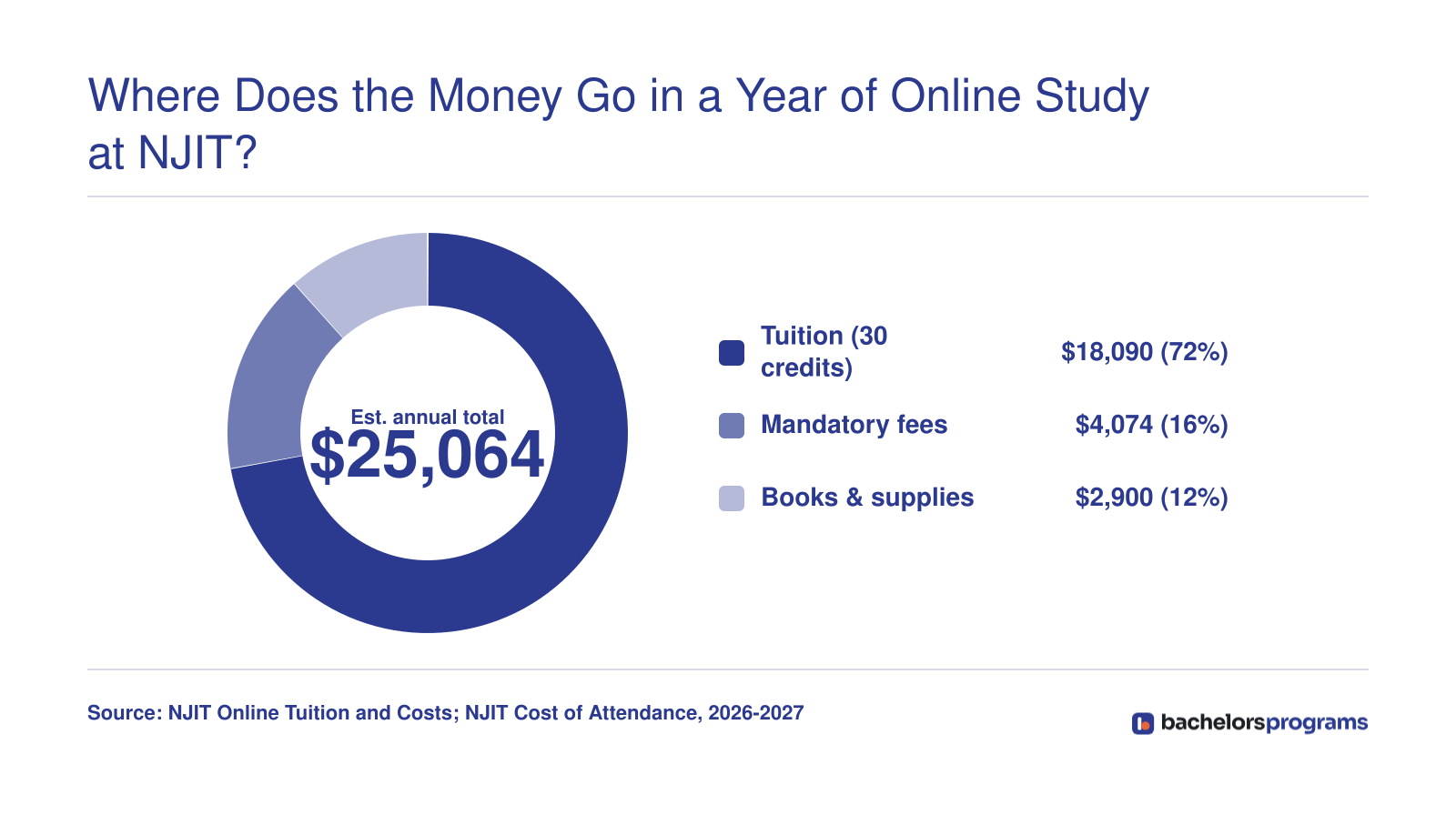
Where Does the Money Go in a Year of Online Study at NJIT?
This breakdown uses New Jersey Institute of Technology's published 2026-2027 rates for a 30-credit year: $603 per credit online tuition (the same for in-state and out-of-state students, with no flat-rate option), plus the $4,074 in fees and the $2,900 books and supplies estimate from NJIT's full-time undergraduate cost of attendance. Online students skip housing and commuting costs, but NJIT does not say whether fully online students pay the full fee amount. Technology costs fall inside the books and supplies allowance, which must cover renting or buying a computer. NJIT publishes no separate proctoring charge, and it notes that all expenses are estimates that vary by program and year.
Financial Aid, NJ TAG and Net Price for Online Students
Financial aid for online students in New Jersey is the same mix of federal grants, state grants and school awards that on-campus students use, but eligibility often turns on enrollment level and the college's approved status rather than on the delivery format. Start by confirming how each program you are considering is classified.
Federal Aid and the TAG Residency Rule
Online students at accredited schools can generally apply for federal aid through the FAFSA. The Federal Pell Grant maximum for 2026-27 is $7,395.1 It goes mainly to undergraduates with exceptional need who have no prior bachelor's degree,2 and the actual amount depends on your Student Aid Index, the school's cost of attendance, and whether you study full or part time.
The state's Tuition Aid Grant (TAG) is need-based and goes to New Jersey residents at approved New Jersey institutions. Residency is generally measured by living in the state for a period before enrolling (commonly 12 months), so confirm your status with HESAA. TAG is primarily a full-time undergraduate award, and HESAA lists awards from $1,280 to $14,404 for 2026-27.3 Whether a fully online format qualifies depends on the approved institution, the program and your enrollment level, so ask the financial aid office before assuming either way.
Other New Jersey Programs
- Part-Time TAG: Available for county college students taking 6 to 11 credits.
- Garden State Guarantee: Lets residents with an adjusted gross income of $0 to $65,000 pay $0 in tuition and fees in the third and fourth years at in-state public four-year schools. It requires 12 or more credits per semester and a first bachelor's degree, and it covers up to four semesters or 128 credits.
- Community College Opportunity Grant, NJ STARS and Educational Opportunity Fund: Each has its own enrollment and eligibility rules, and these can include full-time or campus-based requirements. Check current terms with HESAA and your college before you plan around them.
Deadlines to Meet
For 2026-27, HESAA set April 15, 2026 for TAG renewals and September 15, 2026 for new fall and spring applicants.3 Both have passed. A spring-only applicant still has until February 15, 2027. Apply with the FAFSA or the NJ Alternative Financial Aid Application, and file as early as you can for the next award year, since federal and state timelines differ.
Why Net Price Beats Sticker Price
Sticker price is what a school advertises. Net price is what remains after grants and scholarships, and it is the number that decides what you actually borrow. A school with higher tuition can cost less once state and institutional aid are applied. Every college must post a net price calculator. Enter your household income and enrollment plans, then compare results across schools, treating them as estimates rather than offers.
A Practical Tip
Employer tuition assistance and military education benefits can often be combined with grants. Ask your HR department and the school's veterans office, then tell the financial aid office so awards are coordinated.
Transfer Credit and Prior Learning: Which New Jersey Colleges Make It Easiest
A guaranteed statewide agreement and a school's own generous policy are two different things. New Jersey offers both, and which one you lean on shapes how many credits you keep.
The Statewide Framework
The Comprehensive Statewide Transfer Agreement, known as the Lampitt Law, took effect in September 2008.1 It covers A.A. and A.S. degrees from New Jersey community colleges transferring to New Jersey public four-year institutions.2 In practice, the associate degree (60 to 64 credits, depending on the college) is treated as the first two years of the bachelor's, protecting about 60 credits and up to half the degree.1 Rutgers, Rowan, Kean and Montclair State all participate.3
The limits matter. The law does not protect A.A.S. or A.F.A. degrees, and it does not guarantee admission.1 Alignment counts too: A.A. degrees pair with B.A. programs, and A.S. degrees with B.S. programs. Upper-division licensure programs and externally accredited majors carry exceptions. NJTransfer, the state's transfer-information system, is the place to check course equivalencies before you apply.
Where Credit Goes Furthest
Thomas Edison State University is the standout for flexibility. It advertises up to 105 transfer credits, or 114 with Edison Accelerate. An eligible New Jersey community college associate transfers in full as 60 credits and satisfies general education in its bachelor's programs. Confirm whether the maximum applies to your specific major, since that detail is not uniform in published materials.
For Rutgers, Rowan, Kean, Montclair State and Fairleigh Dickinson (a private university outside the Lampitt framework), maximums and residency rules can vary by campus, school and major. Ask each admissions office for a written evaluation rather than relying on a general figure.
Prior Learning Assessment
Credit for what you already know can shorten a degree further. Thomas Edison State University may award credit for:
- Work experience: Documented through portfolio courses PLA-1000 and PLA-2000.
- Military service: Based on a Joint Service Transcript, a Community College of the Air Force transcript or a Coast Guard Institute transcript. Service before 1986 requires a DD-214.
- Professional training and licensure: Evaluated for college-level equivalence.
CLEP and DSST exams are common ways to earn credit elsewhere, but policies differ by school, so verify acceptance before you test.
Two Traps to Avoid
First, every degree has a residency requirement: a minimum number of credits you must earn at the degree-granting school. Ask for the exact number, because published sources do not give a universal one.
Second, credits accepted are not the same as credits applied to your major. A course can transfer as a general elective and still leave required major courses unfilled. Request a degree audit that shows what remains before you commit.
Transfer Credit Policies at New Jersey Online Programs Compared
Thomas Edison State University and Rutgers Online publish the most detailed transfer rules among New Jersey online providers, and TESU accepts up to 117 credits from four-year schools compared with 90 at Rutgers Online. If you hold 60 or more credits, especially from a community college, start with an adult-focused degree-completion school like TESU before weighing a traditional research university. Before applying anywhere, including Rowan Global, Kean, Fairleigh Dickinson, Saint Peter's and NJIT, send the admissions or transfer office unofficial transcripts from every college you attended, along with any CLEP, DSST or Joint Services Transcript (JST) records, and ask for a written preliminary evaluation showing which credits count toward your major and not just toward general electives.
| School | Max Transfer Credits | Credits Required in Residence | Community College Credit Cap | Exam Credit (CLEP/DSST) | Military/ACE Credit | Portfolio/PLA |
|---|---|---|---|---|---|---|
| Thomas Edison State University | Up to 117 (from four-year institutions) | Varies by degree and transfer evaluation | Up to 80 | CLEP, DSST and TESU's own TECEP exams | Accepted (JST, CCAF or Coast Guard Institute transcripts; ACE-recommended training may qualify) | Accepted through TESU Portfolio Assessment |
| Rutgers Online | Up to 90 (from a four-year college, or a combination of two-year and four-year credit) | Varies by program (the 12-credit figure is a transfer admission threshold, not a residency rule) | Up to 60 | CLEP in applicable programs; Rutgers-Newark arts and sciences allows up to 24 CLEP credits at or above the 50th percentile | Accepted in applicable programs (JST reviewed with ACE recommendations; Rutgers-Camden liberal studies recognizes military training) | Accepted at Rutgers-Newark University College (up to 45 prior-learning credits, 2024-2025 catalog); confirm for your specific program |
Admissions Requirements and Timelines for New Jersey Online Programs
Thomas Edison State University (TESU) publishes the most detailed 2026 admissions requirements for online bachelor's study in New Jersey, so the checklist below uses its policies as the reference point. Rutgers Online, Rowan Global and Kean Online set their own rules and calendars, so confirm requirements with each school before you apply.
- Application and feeTESU charges a $50 undergraduate application fee, which is nonrefundable where applicable.
- Secondary credentialYou need a high school diploma, a GED or a state-compliant home-school diploma.
- Age and self-directionTESU's general criteria call for applicants to be at least 20, or at least 16 with proof of self-direction such as military service, an apprenticeship, six transferable college credits earned with a C or higher, or six AP credits. Confirm with TESU, since its pages differ on the minimum age.
- Younger first-time studentsStudents ages 16 to 20 are limited to 9 credits in their first semester, while adult degree-completers bring prior coursework for evaluation.
- Official transcriptsSend transcripts from every college you attended. Transfer evaluation typically takes about 10 business days after all transcripts arrive.
- GPA and transfer creditsTESU's general undergraduate application does not set a minimum GPA or a required number of transfer credits. Check the requirements for your specific program.
- SAT/ACTNot required. TESU markets its online bachelor's degrees as having no entrance exam.
- Deadlines and start datesAdmission is rolling, with 12 undergraduate terms a year and monthly starts. Admission decisions typically arrive in 3 to 5 business days.
Accreditation, Graduation Rates and Student Outcomes
The Middle States Commission on Higher Education accredits New Jersey's major online bachelor's providers, including Rutgers, NJIT, The College of New Jersey and William Paterson University.1 Each has distance education approved within its scope. That approval is the baseline: an online bachelor's degree from these schools carries the same institutional accreditation as the on-campus version, and regional accreditors review distance learning as part of the institution's scope rather than as a separate stamp.
Verify the School, Not the Website
Before you apply, confirm the institution in the U.S. Department of Education's Database of Accredited Postsecondary Institutions and Programs (DAPIP). Search the official legal name, confirm the campus or location because similarly named institutions differ, check that the accreditor listed is recognized by the Department, and read the status, effective dates, and any limitations or conditions. Then cross-check the current Middle States record for distance education and approved credential levels. DAPIP is compiled from agency and state reports, is not audited, and implies no endorsement, so contact the accreditor directly if anything is unclear. Note the distinction between candidate and accredited status: Manara College in Paterson was granted candidate status in June 2025, and candidate status is not accreditation, nor is distance education approved there.2
When Programmatic Accreditation Matters
Institutional accreditation covers the whole college. Programmatic review covers the program, and it matters most where a license or exam gatekeeps the job. Nursing programs hold CCNE or ACEN accreditation, and state boards of nursing look for it. Business programs may hold AACSB or ACBSP recognition, which some employers and graduate schools weigh. Engineering technology programs may seek ABET accreditation. If your goal is licensure or a credential, verify the specific program, not just the college.
Reading Graduation Rates Honestly
College Scorecard reports outcomes eight years after a student attends, and you can filter by students who started at the institution, transferred in, or both, and by full-time, part-time, or both.3 Results split into graduated, withdrew, transferred, and still enrolled. A low figure at an adult-serving online school often reflects part-time and transfer-in enrollment rather than failure, so check which cohort the number describes before drawing conclusions. For program-level earnings and median debt, use the Scorecard's field-of-study view, which is more useful than a single school-wide average.
Graduation, Retention, Debt and Earnings at New Jersey Online-Serving Institutions
Outcome numbers change every year, and they are not calculated the same way at every school. Rather than rely on a number that may be stale by the time you read it, pull current figures and compare schools on equal footing.
Start with the College Scorecard
The U.S. Department of Education's College Scorecard lists each institution's graduation rate, retention rate, median federal debt and median earnings. Look up every school you are considering, including Thomas Edison State University, Rutgers, Rowan, Kean, Fairleigh Dickinson, NJIT and Montclair State, and use the same cohort year and the same definitions for each one. A comparison only works when the measures match.
Verify on the school's own pages
Cross-check the federal data against what the college publishes:
- Consumer information: Look for the required disclosures page, which often lists completion and retention rates.
- Institutional research: This office usually posts enrollment and outcome reports.
- Financial aid: Ask how debt figures are calculated and what typical borrowers owe.
- Career services: Request graduate outcome surveys, placement information and employer connections.
For state-level context, check the New Jersey Office of the Secretary of Higher Education. Accreditor websites also post disclosures about institutional standing and student achievement.
Cross-check career and salary claims
For pay and job outlook in the field you want to enter, use the Bureau of Labor Statistics (BLS.gov) and its Occupational Outlook Handbook, O*NET for job duties and skills, and New Jersey's state labor market information. Professional associations in your field often publish salary surveys too.
Your checklist
- Confirm what each metric measures. Graduation rate, for example, may count only first-time, full-time students, which can leave out many online learners.
- Check the cohort years and the timeframe behind the debt and earnings figures.
- Compare schools using the same data source and year.
- Ask admissions, financial aid or career services for the most current numbers, and ask specifically about online students.
If a school cannot explain its numbers clearly, treat that as useful information in itself.
How to Choose the Right Online Program in New Jersey
The cheapest sticker price and the fastest path to a degree are rarely the same program. Sort them in a fixed order, starting with the credits you already hold.
Start With the Credits You Already Have
If you carry a lot of transfer or prior-learning credit, put transfer caps and residency requirements ahead of everything else. A school that accepts most of your coursework and asks for a small number of credits in residence will usually beat a lower per-credit rate that makes you repeat classes. Compare those two rules before you look at anything else.
Filter by Net Price and Remaining Cost
Per-credit tuition tells you little on its own. Multiply by the credits you still need, add fees, then subtract grants to get net price and total remaining cost. Confirm your eligibility for New Jersey TAG and federal aid before you commit, since both change the math. Aid rules vary by school and enrollment status, so check each one directly.
Match the Format to Your Life
Look at how the program actually runs:
- Pacing: asynchronous courses suit unpredictable shifts, while scheduled live sessions suit people who want structure.
- Terms and starts: accelerated terms and frequent start dates can shorten your timeline.
- In-person pieces: some majors require labs, clinicals, practicums or proctored exams, so ask what they are and where they happen.
Run a Final Checklist
Before you apply, verify each of these:
- Regional accreditation for the institution.
- Programmatic accreditation, if your field requires it for licensure or hiring.
- State authorization, if you live outside New Jersey.
- A transcript evaluation in writing, not a verbal estimate.
- Scorecard earnings for your field of study, to see what graduates tend to make.
Your Next Step
In a single week, request unofficial transfer evaluations and net price estimates from two or three schools. Putting the answers side by side shows how many credits each school accepts, what you would owe, and how long you would take to finish. The differences are usually clearer than any brochure makes them, and the best fit tends to be obvious once the numbers sit next to each other.
Colleges in New Jersey with the most bachelor's programs
| School | City | Type | Bachelor's programs | Online | Net price / yr | Grad rate |
|---|---|---|---|---|---|---|
| Rowan University | Glassboro | Public | 98 | 13 | $22,408 | 67% |
| Saint Peter's University | Jersey City | Private nonprofit | 81 | 9 | $12,199 | 58% |
| Montclair State University | Montclair | Public | 80 | 13 | $15,566 | 65% |
| Kean University | Union | Public | 78 | 5 | $12,447 | 47% |
| Rutgers University | New Brunswick | Public | 77 | 5 | $24,406 | 84% |
| Stockton University | Galloway | Public | 74 | 1 | $20,670 | 69% |
| Fairleigh Dickinson University-Metropolitan Campus | Teaneck | Private nonprofit | 69 | 8 | $15,404 | 53% |
| Monmouth University | West Long Branch | Private nonprofit | 67 | 0 | $30,988 | 72% |
| Seton Hall University | South Orange | Private nonprofit | 65 | 0 | $31,446 | 70% |
| William Paterson University of New Jersey | Wayne | Public | 65 | 22 | $18,745 | 44% |
| The College of New Jersey | Ewing | Public | 64 | 1 | $27,646 | 86% |
| Rider University | Lawrenceville | Private nonprofit | 61 | 4 | $24,792 | 61% |
| Ramapo College of New Jersey | Mahwah | Public | 58 | 1 | $18,173 | 70% |
| Fairleigh Dickinson University | Madison | Private nonprofit | 57 | 7 | $22,829 | 67% |
| New Jersey Institute of Technology | Newark | Public | 55 | 0 | $16,504 | 73% |
Program counts are the verified bachelor's listings in our directory; net price is the school-wide average a first-time undergraduate paid after aid, and graduation rate the share finishing within six years (College Scorecard).
Common Questions About Online Bachelor's Degrees in New Jersey
These answers cover the questions online students ask most often before enrolling. Policies vary by college and by program, so treat each answer as a starting point and confirm details with the school or agency named.
Can out-of-state students enroll in online programs from New Jersey colleges?
Does my diploma say "online" if I earn my degree online from a New Jersey college?
Can I use NJ TAG if I study online part-time?
How long does an online degree-completion program take with 60 transfer credits?
Compare programs nationwide
Many New Jersey residents study online. Every ranked list above has an online lens, or browse every field.
Online bachelor's degrees Browse all fields