Online Colleges and Bachelor's Degree Programs in Arkansas
Every verified bachelor's program at a college in Arkansas: 1,050+ programs at 20+ colleges, with the online options, net price and graduation rates behind each one.

Can you finish a bachelor's degree online in Arkansas without overpaying or losing credits you already earned? For most students the answer depends on two numbers: the published price per credit hour and the price left after grants and scholarships. At the University of Arkansas, for example, approved online programs charge $277.84 per credit hour for Fall 2026, and that rate is only the starting point.
Arkansas public universities carry most of the online and hybrid bachelor's options, with a few private colleges adding their own. Sticker price, fees, aid eligibility, and transfer credit evaluation each change what a degree costs you in the end.
The credits a school accepts often move the final bill more than the advertised rate does.
Key Points
- University of Arkansas online tuition: $277.84 per credit hour for Fall 2026.
- Act 566 makes a general education core fully transferable starting Fall 2027.
- Online courses at accredited Arkansas colleges count toward Pell Grant eligibility.
Popular degrees in Arkansas
Bachelor's degrees in Arkansas by field
Business & Management
- Business Administration38 programs
- Marketing30 programs
- Accounting19 programs
- Management19 programs
- Finance17 programs
- Logistics & Supply Chain Management11 programs
- Sports Management11 programs
- Entrepreneurship11 programs
Science & Engineering
- Biology24 programs
- Chemistry18 programs
- Mathematics16 programs
- Physics12 programs
- Electrical Engineering or Electronics Engineering or Electronic Systems Engineering Technology10 programs
- Biochemistry10 programs
- Anthropology9 programs
- Natural Resources or Conservation9 programs
Education & Teaching
- Science23 programs
- Elementary Education19 programs
- Secondary Education19 programs
- Physical Education15 programs
- English Education14 programs
- Mathematics Education12 programs
- History Education9 programs
- Special Education7 programs
Arts & Design
- Art or Art Studies21 programs
- Fine Arts or Studio Art17 programs
- Audio & Music12 programs
- Graphic Design11 programs
- Media Arts or Digital Media7 programs
- Game Programming & Development6 programs
- Art History5 programs
- Game Art & Design4 programs
Liberal Arts & Humanities
- English18 programs
- History16 programs
- Literature or English Literature16 programs
- General Studies10 programs
- Spanish10 programs
- Philosophy8 programs
- Interdisciplinary Studies7 programs
- Global Studies5 programs
Computers & IT
- Computer Science15 programs
- Innovation or Technological Entrepreneurship10 programs
- Cybersecurity9 programs
- Artificial Intelligence9 programs
- Computer Engineering6 programs
- Computer Information Systems6 programs
- Software Development & Engineering4 programs
- Information Technology3 programs
Communications & Media
- Journalism20 programs
- Communications12 programs
- Public Relations6 programs
- Communication Disorders6 programs
- Speech Pathology5 programs
- Strategic Communications4 programs
- Social Media2 programs
- Professional Writing1 program
Nursing
- Bachelor of Science in Nursing19 programs
- Nursing (RN to BSN)11 programs
- LPN/LVN to BSN11 programs
- Accelerated BSN (ABSN)4 programs
Healthcare
- Exercise & Sports Science11 programs
- Health Education10 programs
- Nutrition6 programs
- Public Health5 programs
- Speech Pathology5 programs
- Health Sciences3 programs
- Respiratory Care Therapy1 program
- Community Health1 program
Social Work & Social Sciences
- Political Science, Government16 programs
- Sociology13 programs
- Social Work10 programs
- Human Services2 programs
Criminal Justice & Law
- Criminal Justice14 programs
- Criminology6 programs
- Criminal Justice Administration6 programs
- Forensic Science3 programs
- Corrections2 programs
- Homeland Security2 programs
- Cybercrime1 program
- Security Management1 program
Psychology
- General Psychology19 programs
- Applied Psychology1 program
- Addiction Psychology1 program
- Counseling Psychology1 program
Natural & Applied Sciences
- Agriculture or Agricultural13 programs
- GIS and Geoscience5 programs
- Neuroscience1 program
- Oceanography or Ocean or Marine Biology1 program
Religion & Theology
- Christian Ministry or Ministry Leadership6 programs
- Christian Studies or Religious Studies5 programs
Counseling
- Substance Abuse Counseling2 programs
How Online Bachelor's Degrees Work in Arkansas: Fully Online, Hybrid, and What to Verify
An online degree can be genuinely flexible, but the word "online" on a program page covers very different arrangements. Knowing the format before you apply saves you from surprises on your schedule and your budget.
Three Formats, Plainly Defined
- Fully online: Coursework is delivered remotely, with no required trips to campus. Some programs still require in-person placements.
- Hybrid: Part of the coursework happens on campus or at a set site, and the rest is remote.
- Online-supported: A mostly on-campus degree that uses online courses or learning platforms for some classes.
Class timing matters as much as format. Asynchronous classes let you watch lectures and submit work on your own schedule within deadlines, which suits a full-time job. Synchronous classes meet live at set times, so you need an employer who can accommodate those hours.
Do Fully Online Bachelor's Programs Exist in Arkansas?
Yes. UA Grantham, part of the University of Arkansas System, is described as 100 percent online and offers associate, bachelor's and graduate programs aimed at working adults. The University of Arkansas at Fayetteville also runs online degrees, such as its B.S.E. in Educational Studies for Paraprofessionals. The UA System says its institutions generally offer both fully online pathways and individual online courses that count toward on-campus degrees. Check each school's program page for the exact format of the degree you want, since not every school publishes that detail clearly.
What to Verify Before You Apply
- Campus visits: Look for any required orientation, residency, or lab session.
- Proctored exams: Ask whether exams are proctored and who pays. UA Fayetteville lists a $25 online proctoring fee for credit by examination and a general $50 proctoring fee for 2025-262, and some colleges set their own rates. Fees vary by course and college, so confirm yours.
- Placements: Ask whether clinicals, student teaching, or internships are required, and who arranges them.
When "Online" Is Not 100% Remote
Nursing, education, and lab sciences are the usual exceptions. UA Fayetteville's online education degree for paraprofessionals is fully online, yet it requires current paraprofessional employment for 9 internship credits and does not include licensure. Its online LPN-to-BSN requires clinical hours at sites with an active UA affiliation, and students secure their own placements and preceptors. UA also lists fees for student teaching ($250 per semester) and off-campus practicum or clinical sites ($150 per semester) for specified programs.1
Published proctoring and placement policies differ by school and program, so confirm them with the admissions office in writing before you commit.
What Online Bachelor's Degrees Cost in Arkansas, and the Cheapest Options
At the University of Arkansas, an undergraduate admitted to an approved online program pays $277.84 per credit hour for Fall 2026, the same rate whether the student lives in Fayetteville, in another Arkansas county, or out of state.
The Published Rates, Side by Side
These are the figures the university publishes for online study, including its 2025-26 program-specific schedules.1 Treat the year label as part of the number.
| Rate (University of Arkansas) | Per credit hour |
|---|---|
| Approved online program, any residency (Fall 2026) | $277.84 |
| Standard undergraduate, out of state, not in an approved online program (Fall 2026) | $1,020.11 |
| Online fees, approved online programs (Fall 2026) | $55.38 total |
| Walton College of Business (2025-26) | $376.09 in state / $1,493.44 out of state |
| Architecture and Engineering (2025-26) | $352.86 / $1,295.54 |
| Nursing (2025-26) | $358.00 / $1,309.24 |
| Developmental instruction (2025-26) | $134.55 / $672.54 |
One Flat Rate, or Two Tiers?
UA Fayetteville is the clean case of a flat online rate: approved online programs charge the Arkansas-resident rate regardless of residency, while the $1,020.11 figure applies to out-of-state undergraduates outside those programs. That gap matters more than the headline number, because a student who is not in an approved online pathway faces roughly 3.7 times the per-credit cost. Other Arkansas public universities publish their own schedules, and some keep separate in-state and out-of-state tiers for distance students, so confirm the rate on the institution's own tuition-and-fees page for the year you enroll.
Program Fees Move the Real Cost
The base rate is not the bill. The university notes that business, engineering, nursing, and law carry additional tuition and fees, and the difference is large: at 120 credits, the business rate adds about $11,790 in tuition over the base rate. If your major sits inside one of those schools, budget from the program rate, not the standard one.
So What Is the Cheapest?
On the verified numbers, the lowest-cost path to a bachelor's degree through online study at an Arkansas public is the approved online rate at UA Fayetteville: $277.84 per credit, or $33,340.80 in tuition for 120 credits before fees. The Fall 2026 online fee schedule lists $30 off-campus, $5.38 library, $18 network and data systems, and $2 online facilities, $55.38 in total.2 The page does not state whether that total is charged per credit hour or per term, so ask before you build a budget; at per credit hour it would add about $6,646 across the degree. Note too that the 2025-26 fee policy published different library and network amounts ($4.98 and $16.00) alongside a $30 Global Campus fee, which is why the year label matters.2
The lowest per-credit figure on the schedule, $134.55, is developmental instruction, which is preparatory coursework rather than bachelor's-level credit, so it does not make a degree cheaper. Transfer credit shifts the arithmetic more than the rate does: a student arriving with 60 credits pays for 60, not 120. Compare total cost after fees for the credits you actually need, and get a transfer evaluation in writing.
Sticker Price vs. Net Price: What Do Arkansas Students Actually Pay?
Published tuition is the charge for instruction, and fees cover services or facilities. Net price is what remains after grants and scholarships, so compare schools such as Arkansas State, Central Arkansas, UA Little Rock, Arkansas Tech, and UA Fort Smith on net price rather than sticker price. College Navigator's net price figures are based on first-time, full-time undergraduates who receive aid, so adult, transfer, and part-time online learners may see a different cost.
Financial Aid for Online Students: FAFSA, Arkansas Challenge, and State Grants
Federal student aid follows the student, not the classroom: at an accredited Arkansas college, online courses count toward Pell Grant eligibility the same way campus courses do.
Start With the FAFSA
The Free Application for Federal Student Aid is the gateway to Pell Grants, federal loans, and most state and institutional aid, and Arkansas colleges use the same form for their own awards. Pell eligibility scales with enrollment intensity, so a student carrying six credits receives a partial award rather than nothing. That detail matters for adults splitting time between a job and a degree. File every year you enroll, even part time.
The Arkansas Academic Challenge Scholarship
Funded by the state lottery, Academic Challenge is Arkansas's flagship grant.1 Applicants need 12 months of Arkansas residency, U.S. citizenship or permanent resident status, no prior bachelor's degree, and no more than 120 attempted credits. The award is built around full-time, continuous enrollment: 12 credits the first semester, 15 in later semesters, 27 credits completed in the first year and 30 each year after, with a 2.5 GPA to renew. Apply by July 1, 2026 for the annual or fall award, or Jan. 10 for spring.1 Those credit rules are written for students entering college straight out of high school, and the state publishes no separate part-time track, so adults and returning students should confirm their eligibility with the Arkansas Division of Higher Education before counting on the money.
ArFuture, Workforce Challenge, and Other Ways to Cut Cost
- Arkansas Future Grant: covers tuition and fees at two-year schools or pays $3,800 at a four-year institution, up to 75 credit hours, and part-time students are eligible.2 It funds certificates and associate degrees in advanced manufacturing, construction trades, healthcare, information technology, and logistics, which makes it a practical first leg toward a bachelor's. Fall applications typically close July 15, spring Jan. 10.4
- Arkansas Workforce Challenge: requires six months of residency, a high school diploma or equivalent, and enrollment in an ADHE-approved high-demand program; current Academic Challenge recipients are excluded.3 Apply at least 30 days before classes start.
- Military and employer aid: the GI Bill, Arkansas National Guard tuition assistance, and employer tuition benefits can stack against tuition. Ask the financial aid office how each one coordinates with state grants.
File the FAFSA and the state YOUniversal application as early as you can. Several Arkansas awards are deadline-driven or first-come, so filing early is often the cheapest move you will make all year.
Transfer Credits and Degree Completion Paths in Arkansas
Arkansas is tightening the rules connecting its two-year and four-year colleges: Act 566 of 2025 requires that, beginning with students entering in Fall 2027, a minimum general education core be fully transferable among state-supported institutions.1 Until that takes effect, the rules that govern your credits are the ones already on the books.
How ACTS Works, and Where the Guarantee Stops
The Arkansas Course Transfer System (ACTS) publishes course-by-course equivalencies across the state's public colleges and universities.2 When a community college course appears in ACTS with a matching course at the receiving university, that course is guaranteed full credit.2 The guarantee stops there. It does not promise the course satisfies a particular degree, major, or program requirement, and courses listed as "No Comparable Course" are not covered at all.2 The receiving institution decides how a course applies, so look up each course you plan to transfer by name and number in ACTS before you register, not after.
Associate Degrees and Block Transfer
Arkansas public institutions recognize the associate of arts, associate of science, and associate of arts in teaching as transfer degrees. Those degrees carry the state minimum core, defined as 60 semester hours of lower-division coursework that includes a 35-hour general education core plus major prerequisites.1 Block transfer means the receiving school accepts the completed package as satisfying its own general education requirements rather than re-evaluating courses one at a time. At UA Little Rock, a transfer student from an Arkansas public college who completes a designated associate degree, or 60 hours including that core, is treated as having met all of the university's core requirements.3
Caps, Residency, and Credit for Prior Learning
There is no single statewide maximum on community college credit. UA Little Rock will apply otherwise-unassigned transfer credits as lower-level electives up to 60 credit hours,3 and it accepts transfer applications from students with at least 12 transferable hours; below that threshold you apply under freshman standards.4 Residency rules can matter more than caps: UCA requires at least 15 hours in the major and 9 in the minor taken in residence, which limits how much of a major you can finish elsewhere.5
Adults returning without a degree can often finish through a bachelor of general studies or a degree-completion program, and many institutions award credit for prior learning through CLEP exams, evaluated military training, and portfolio review. Whatever your path, request an unofficial transcript evaluation from the admissions office before you apply. It tells you which credits land where while you can still adjust your plan.
How Do You Get From Some College to a Finished Bachelor's Degree in Arkansas?
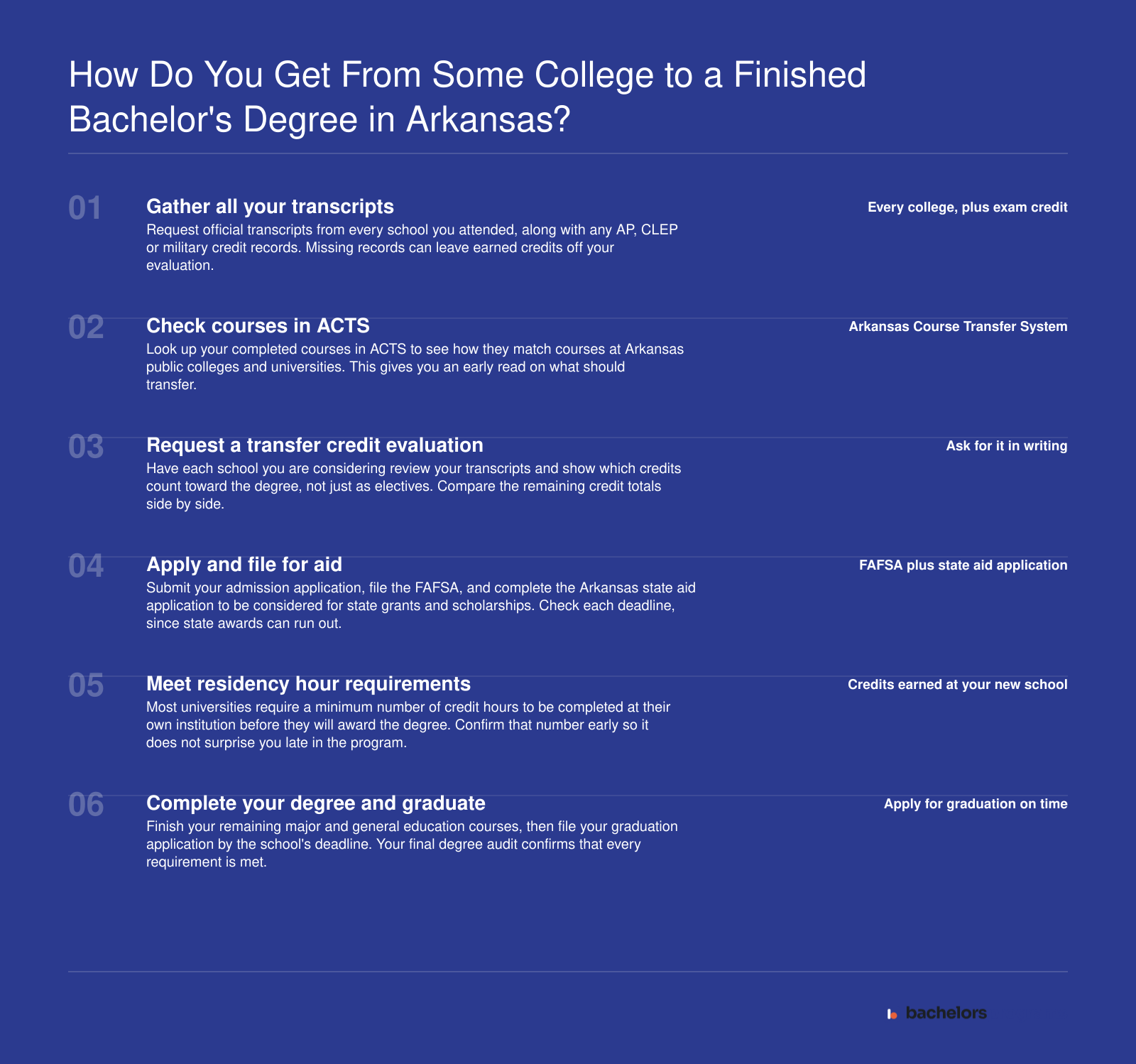
The transfer path follows a set order, and the credit evaluation is the step that matters most. How many of your past credits a school accepts decides how many courses you still owe, which sets both your finish date and your total cost. Get that evaluation in writing before you commit to a program.
Admissions Requirements and Start Dates for Online Programs
Admission rules differ by school and sometimes by program, so treat the details below as a starting checklist and confirm current requirements with each admissions office before you apply.
- First-time freshmenArkansas State University asks every freshman applicant for official ACT or SAT scores. Admission is automatic with a 3.0 cumulative high school GPA, an ACT superscore of 19 or higher, or an SAT score of 990 or higher. Other schools set their own freshman GPA and testing policies, so check whether a school requires scores or is test-optional.
- Transfer studentsAt A-State, applicants with 13 or more transferable credits need a 2.0 cumulative GPA on all transferable coursework. UCA also requires a 2.0 on all transfer work. Arkansas Tech requires a 2.0 cumulative college GPA and eligibility to re-enroll at your last school. UA Grantham accepts transfer courses graded C or higher, and at least 25% of your degree credits must be earned there.
- Deadlines: rolling vs. fixedMany online programs set a deadline for each term instead of one annual cutoff. A-State's online BS in Digital Technology and Design closes applications about two weeks before each start, for example December 28, 2026 for a January 11, 2027 start. Programs with rolling admission review files as they arrive, but applying early still leaves time for financial aid and transcript processing.
- Start termsUA Grantham offers monthly starts and eight-week courses, and new bachelor's students begin with a one-credit onboarding course. A-State's Digital Technology and Design program has multiple starts, including October 12, 2026, and March 8, 2027. UA Little Rock runs nine-week summer terms and a Fall 2 session that began October 7, 2026.
- Documents to prepareRequest official transcripts from every school you have attended. UCA specifically requires transcripts that include high school concurrent credit. If you are claiming in-state tuition, gather proof of Arkansas residency. Also ask whether you need to submit immunization records as an online-only student.
Graduation and Retention Rates at Arkansas Colleges Offering Online Degrees
How many students who start a bachelor's degree at an Arkansas university actually finish it? At the state's two large public universities with extensive online offerings, roughly four in ten finish within six years. The Arkansas Department of Higher Education's Annual Report of Student Retention and Graduation shows a six-year graduation rate of 41.3% for Arkansas State University and 41.9% for the University of Central Arkansas, both for the Fall 2018 entering class.
What These Rates Measure
Federal graduation and retention figures follow first-time, bachelor's-degree-seeking undergraduates. Retention is the share of a fall cohort still enrolled the next fall. The six-year graduation rate is the share who complete at the institution where they started within 150 percent of normal time.
That design leaves out many online learners. Transfer students, part-time students, and adults returning after some college are not counted in the standard rate. A school with a large online completion population can look weaker or stronger than it really is for those students.
A Better Lens for Transfer and Part-Time Students
IPEDS Outcome Measures widens the picture. It reports award rates at four, six, and eight years, separates full-time from part-time first-time students, and shows the highest award earned: certificate, associate's, or bachelor's. If you are a part-time or returning student, look at the Outcome Measures figures for your type of student before you lean on the headline graduation rate.
Comparing Other Arkansas Schools
For Arkansas Tech, UA Little Rock, UA Fort Smith, Southern Arkansas, Henderson State, UA Pine Bluff, Harding, Ouachita Baptist, or any other school you are weighing, College Navigator is the place to check. It draws on IPEDS data, and the most recent release shown is the 2024-25 collection, published in January 2026. Pull retention and graduation figures for each school side by side, and note which cohort year each number reflects.
Questions to Ask an Advisor
A low first-year retention rate does not condemn a school, but it should prompt questions:
- Why do students leave? Ask whether the main causes are cost, academic readiness, or life circumstances.
- What support exists online? Look for dedicated advising, tutoring, and early-alert systems for distance students.
- How do online students fare? Ask whether the school tracks completion for online or transfer students separately.
- How long do part-time students typically take? Get a realistic timeline, not the catalog's ideal one.
Accreditation and Licensure: What to Check Before You Enroll
Accreditation is an outside review confirming that a college meets quality standards. Licensure approval is a separate state decision: a program must be approved before it can lead to a professional license in a field such as teaching or nursing. Check both before you enroll in an online bachelor's program in Arkansas.
Are Online Degrees From Arkansas Colleges Accredited?
At legitimate schools, yes. Arkansas public universities fall under the Higher Learning Commission (HLC). HLC accredits the whole institution, so an online degree carries the same standing as the on-campus version.1 HLC records show recent activity at two of the state's largest schools:
- Arkansas State University: HLC approved a change request in 20242, and the school is listed for a Year 10 Comprehensive Evaluation in 2026.1
- University of Arkansas, Fayetteville: The school appeared under reaffirmation of accreditation in HLC's August 2026 actions.3
Review cycles differ by school, so confirm each school's current status rather than assume it.
Regional vs. National Accreditation
"Regional" accreditors such as HLC have traditionally reviewed most public and nonprofit universities. "National" accreditors often reviewed career-focused or for-profit schools. Federal rules now call both "institutional" accreditors, but the practical gap persists. Many universities and graduate programs decline credits or degrees from nationally accredited schools. If you plan to transfer or earn a master's, regionally accredited is the safer choice.
Program Accreditors and Licensure Approval
For licensed or competitive fields, look for a second layer:
- Nursing: Look for CCNE or ACEN accreditation. Programs leading to initial RN licensure also need Arkansas State Board of Nursing approval.
- Education: CAEP accreditation helps, but approval from the Arkansas Division of Elementary and Secondary Education (DESE) is essential. DESE must approve a program before it prepares candidates for Arkansas licensure.4 It does not accept out-of-state preparation programs for direct licensure.5 Its June 2025 approved list includes Arkansas State, Arkansas Tech, Henderson State, Southern Arkansas, UCA, and several University of Arkansas campuses.6 Approval is program-specific, though, so confirm your exact online track.
- Business: Look for AACSB or ACBSP.
If you live outside Arkansas, read the school's state authorization (SARA) and professional licensure disclosures. They show whether a program meets requirements in your state. Teachers already licensed elsewhere can apply for Arkansas reciprocity instead.5
How to Verify
Search the Council for Higher Education Accreditation (CHEA) directory or the U.S. Department of Education's accreditation database. Then confirm the listing in the accreditor's own directory and on DESE's approved-program list. If a school can't point you to a current listing, look elsewhere.
Arkansas Teacher Licensure at a Glance
How to Choose: Public, Private, and Online-First Schools in Arkansas
The right Arkansas online bachelor's program is the one whose total cost after fees, aid, and transfer credit is lowest for you, not the one with the lowest advertised per-credit rate. Arkansas has three distinct kinds of online providers, and each fits a different reader.
The three provider types
- Public universities: Lower in-state tuition, eligibility for Arkansas state aid, and transcript-friendly transfer policies under the Arkansas Course Transfer System (ACTS), which maps how core courses move between public institutions. Transfer caps at publics are usually the most generous.
- Private colleges: Higher sticker prices, but often substantial institutional aid that can close the gap. Ask for the net price calculator result and any adult-completion discount before you rule them out.
- Online-first institutions: Frequent start dates, flat per-credit pricing regardless of residency, and asynchronous coursework. Convenience is real, but you must confirm regional accreditation and check the graduation rate rather than the marketing page.
Match the school to your situation
- Transfer students: Prioritize publics that honor ACTS and publish a clear maximum on accepted credits, including credits for prior technical coursework.
- Working adults: Look for asynchronous delivery, accelerated 7- or 8-week terms, and a flat online rate that does not add campus fees you will never use.
- Military students: Ask about military tuition rates, credit for military training evaluated through ACE, and deferment policies.
Compare on the numbers, not the brochure
Line up two or three programs and compare total cost including fees, the net price you would actually pay after aid, retention and graduation rates, and regional accreditation. A cheap per-credit rate at a school with weak completion outcomes is not a bargain.
Next steps
File the FAFSA and the Arkansas state aid application in the same cycle. Request a transcript evaluation in writing before you enroll so you know your credit total. Confirm any in-person requirements, such as practicums, labs, or proctored exams. Then put 2-3 programs side by side on cost, credit transfer, and outcomes before you commit.
Colleges in Arkansas with the most bachelor's programs
| School | City | Type | Bachelor's programs | Online | Net price / yr | Grad rate |
|---|---|---|---|---|---|---|
| University of Arkansas | Fayetteville | Public | 107 | 22 | $18,209 | 71% |
| Arkansas State University | Jonesboro | Public | 88 | 39 | $12,366 | 55% |
| University of Central Arkansas | Conway | Public | 85 | 11 | $16,511 | 54% |
| University of Arkansas at Little Rock | Little Rock | Public | 81 | 32 | $17,248 | 42% |
| Harding University | Searcy | Private nonprofit | 77 | 3 | $22,130 | 69% |
| Arkansas Tech University | Russellville | Public | 74 | 19 | $12,970 | 49% |
| Southern Arkansas University | Magnolia | Public | 62 | 10 | $14,027 | 49% |
| Ouachita Baptist University | Arkadelphia | Private nonprofit | 59 | 1 | $22,409 | 61% |
| University of Arkansas-Fort Smith | Fort Smith | Public | 55 | 9 | $10,574 | 38% |
| University of Arkansas at Pine Bluff | Pine Bluff | Public | 52 | 4 | $12,653 | 40% |
| University of Arkansas at Monticello | Monticello | Public | 48 | 4 | $14,287 | 49% |
| John Brown University | Siloam Springs | Private nonprofit | 44 | 5 | $20,397 | 72% |
| Henderson State University | Arkadelphia | Public | 33 | 1 | $23,405 | 37% |
| Philander Smith University | Little Rock | Private nonprofit | 30 | 1 | $14,224 | 30% |
| University of the Ozarks | Clarksville | Private nonprofit | 28 | 0 | $17,360 | 52% |
Program counts are the verified bachelor's listings in our directory; net price is the school-wide average a first-time undergraduate paid after aid, and graduation rate the share finishing within six years (College Scorecard).
Compare programs nationwide
Many Arkansas residents study online. Every ranked list above has an online lens, or browse every field.
Online bachelor's degrees Browse all fields