Online Colleges and Bachelor's Degree Programs in Idaho
Every verified bachelor's program at a college in Idaho: 510+ programs at 11 colleges, with the online options, net price and graduation rates behind each one.

Idaho is big, thinly populated, and short on campuses within driving distance of many towns, so online study often decides whether finishing a bachelor's degree is realistic at all. Yet flexibility has a price, and the published 2026 online rates run from $89 per credit at BYU-Idaho to $491 per credit at the University of Idaho.
Lists of Idaho colleges and degree fields are easy to find. What those lists can't show is real cost after aid, how transfer rules apply to your credits, which programs are truly online, and what graduates earn.
That gap matters because "online" on a program page can still mean a campus residency, a clinical placement, or a fixed live-class schedule.
Key Points
- Per-credit online tuition ranges from $89 (BYU-Idaho) to $491 (University of Idaho).
- Idaho's Opportunity Scholarship for Adult Learners pays up to $3,500 yearly.
- Under State Board policy, an accredited AA or AS meets general education.
Popular degrees in Idaho
Bachelor's degrees in Idaho by field
Business & Management
- Business Administration13 programs
- Marketing10 programs
- Accounting7 programs
- Management7 programs
- Communication6 programs
- Economics6 programs
- Finance5 programs
- Digital Media or Digital Marketing5 programs
Science & Engineering
- Biology13 programs
- Physics12 programs
- Chemistry10 programs
- Mathematics7 programs
- Environmental Science6 programs
- Anthropology5 programs
- Geosciences5 programs
- Electrical Engineering or Electronics Engineering or Electronic Systems Engineering Technology5 programs
Education & Teaching
- Elementary Education9 programs
- Science7 programs
- Early Childhood Education or Child Development6 programs
- Secondary Education6 programs
- Special Education5 programs
- English Education5 programs
- History Education5 programs
- Mathematics Education4 programs
Liberal Arts & Humanities
- English9 programs
- General Studies8 programs
- Literature or English Literature7 programs
- History6 programs
- Philosophy5 programs
- Spanish4 programs
- Global Studies4 programs
- Humanities3 programs
Arts & Design
- Art or Art Studies10 programs
- Fine Arts or Studio Art8 programs
- Graphic Design5 programs
- Audio & Music4 programs
- Media Arts or Digital Media4 programs
- Creative Writing3 programs
- Illustration3 programs
- Digital Photography2 programs
Computers & IT
- Computer Science9 programs
- Artificial Intelligence5 programs
- Computer Engineering5 programs
- Cybersecurity4 programs
- Software Development & Engineering3 programs
- Information Technology2 programs
- Web Development2 programs
- Innovation or Technological Entrepreneurship2 programs
Communications & Media
- Communications14 programs
- Public Relations4 programs
- Professional Writing3 programs
- Social Media3 programs
- Journalism2 programs
- Business Communications1 program
- Technical Communication1 program
- Communication Disorders1 program
Healthcare
- Exercise & Sports Science6 programs
- Public Health4 programs
- Health Sciences4 programs
- Nutrition2 programs
- Respiratory Care Therapy2 programs
- Community Health2 programs
- Health Education1 program
Social Work & Social Sciences
- Sociology7 programs
- Political Science, Government7 programs
- Social Work5 programs
- Public Policy1 program
Criminal Justice & Law
- Criminal Justice5 programs
- Criminology4 programs
- Paralegal2 programs
- Legal Services2 programs
- Fire Science or Fire Administration2 programs
- Corrections1 program
- Homeland Security1 program
- Criminal Justice Administration1 program
Nursing
- Bachelor of Science in Nursing6 programs
- Nursing (RN to BSN)5 programs
- LPN/LVN to BSN2 programs
- Accelerated BSN (ABSN)2 programs
Psychology
- General Psychology7 programs
- Health Psychology1 program
- Industrial Organizational Psychology1 program
- Sport Psychology1 program
Natural & Applied Sciences
- GIS and Geoscience3 programs
- Agriculture or Agricultural2 programs
- Applied Science1 program
How Online Bachelor's Degrees Work in Idaho: Fully Online, Hybrid, Asynchronous and Synchronous
Do online bachelor's degrees in Idaho require live class sessions, or can you finish on your own schedule? The answer depends on the delivery format, and four terms below show how schools signal which one applies.
The Four Labels, in Plain Terms
- Fully online: no campus visits; coursework, exams and advising all happen remotely.
- Hybrid: mostly online, with required in-person labs, clinicals, residencies or testing sessions.
- Asynchronous: you complete weekly work when you choose, within posted deadlines.
- Synchronous: you attend live class sessions at fixed times, usually set to the campus's time zone.
Why the Label Matters
A program marketed as "online" can still hold live evening sessions on Mountain Time, require a proctored exam at a testing center, or place you in a clinical site for a full semester. For a working adult in Boise balancing a job and family, or a student in a rural county hours from the nearest campus, those details decide whether the degree is actually finishable. Asynchronous sections tend to suit shift workers and caregivers; synchronous ones suit students who want direct, real-time access to instructors.
Who Offers What
Idaho's public universities run online divisions that carry the same regional accreditation as their campus programs. Adult degree-completion programs are built around transfer credit plus evening or asynchronous coursework. The BYU-Idaho and BYU-Pathway model bundles online certificates and degrees into a low per-credit structure with a faith-based curriculum.
Before you apply, open the program's format page and scan the course schedule for the words "live," "residency," "practicum" and "proctored." Those four terms tell you more about your weekly life than the marketing page does.
What an Online Bachelor's Degree Costs in Idaho: Per-Credit Tuition, Fees and Totals
Published 2026 online rates range from $89 per credit at BYU-Idaho to $491 per credit at the University of Idaho. Boise State and the University of Idaho charge out-of-state online students the same flat rate as Idaho residents, while Idaho State charges nonresidents $1,432 per credit once fees are included. Per-credit tuition is only part of the cost: Idaho State adds a $98.88 per-credit consolidated fee and the University of Idaho adds a $35 per-credit web-based course fee, so compare totals with fees included. Degree-completion students who transfer in 60 or more credits pay roughly half the 120-credit estimates below (about $23,700 at Boise State's rate), and Lewis-Clark State College applicants should confirm current online tuition and fees directly with the college.
| Institution | Online Per-Credit Tuition (Idaho Resident) | Out-of-State Online Rate | Online/Distance Fees | Estimated 120-Credit Tuition |
|---|---|---|---|---|
| Boise State Online (rates checked July 2026) | $395 | $395 (no added out-of-state tuition) | $0 (no added fees) | $47,400 |
| University of Idaho Online (rates checked October 2026) | $491 | $491 (same rate regardless of residency) | $35 per credit web-based course fee; standard online course fees included in listed rate | $58,920 before the $35 per-credit web-based course fee |
| Idaho State University Online (rates checked October 2026) | $376.12 tuition; $475.00 with mandatory fees | $1,333.12 tuition; $1,432.00 with mandatory fees | $98.88 per credit consolidated fee (facilities, technology and activity) | $45,014.40 resident tuition; $57,000 with mandatory fees |
| BYU-Idaho Online / BYU-Pathway Worldwide (rates checked October 2026) | $89 (domestic online rate) | $89 (domestic online rate) | Not separately published in the tuition schedule | $10,680 |
Net Price, Financial Aid and Idaho State Grants for Online Students
Idaho's Opportunity Scholarship for Adult Learners pays up to $3,500 per academic year and can be renewed for up to four years1, but the money only reaches students who file the FAFSA and apply through Scholarship Idaho. That makes the federal form the first move, even for an adult taking one course at a time. The 2026-27 FAFSA opened on October 1, 20253, and the Opportunity Scholarship's FAFSA deadline is March 1, 2026, at midnight Mountain Time.2 Late filings cannot be considered.
Sticker price versus net price
Sticker price is the published per-credit rate on a program page. Net price is what a student actually pays after federal Pell grants, state aid, institutional scholarships and tuition waivers are applied. For an online learner paying in-state or out-of-state rates, that gap can cover most of the bill, so compare schools on net price rather than the advertised rate.
Who the adult-learner track is built for
- Residency: Idaho resident, with graduation or near-graduation from an Idaho high school, an Idaho home school transcript, or an Idaho GED or high school equivalency credential.
- Timing: a break of at least 24 months, at least 24 college credits earned before it, no current enrollment, and no more than two classes completed in the last 24 months.
- Academics: a 2.5 unweighted cumulative GPA to apply, and 2.7 to keep the award.1
- Enrollment: at least 6 credits per term, which counts as part-time. The award funds a certificate, a first associate's degree or a first bachelor's degree, and a graduation plan is required.
- Deadlines: December 1 for spring, April 15 for summer and July 1 for fall.
Part-time study qualifies, but ask the financial aid office to confirm that your specific online format counts before you enroll.
LAUNCH is not a bachelor's grant
Idaho LAUNCH is built around short, in-demand career and technical training rather than four-year degrees. Do not budget a bachelor's around it. Confirm with the State Board of Education whether any program you are considering falls inside its current scope.
Watch the credit minimums
Institutional scholarships, departmental awards and employer tuition benefits frequently require a minimum number of credits per term, and some pay a flat amount only at full-time load. If you plan to take one course at a time, ask whether the award shrinks or disappears.
Transfer Credit, Prior Learning and Degree Completion Paths in Idaho
Transfer in Idaho has shifted from course-by-course negotiation to a statewide competency guarantee. Under the State Board of Education's articulation and transfer policy, a student who earns an AA or AS from an institutionally accredited institution has met the general education requirement at any Idaho public institution, and the receiving college cannot layer on additional general education coursework.1
The Statewide General Education Guarantee
Completion of the 36-credit General Education Matriculation framework carries the same protection, even without a full associate degree.2 Students who transfer before finishing an associate degree still keep what they earned: each completed GEM course satisfies its matching competency at the next Idaho public institution, and GEM courses earned inside an AAS count the same way.2 The common course index makes this concrete.3 Indexed 100- and 200-level courses are accepted as direct equivalents, matched on prefix, number, title and GEM area4, and indexed courses awarded through prior-learning assessment transfer as equivalent credit as well.
Credit for What You Already Know
Boise State awards credit for college-level knowledge gained through work, military service and training, industry certifications, licenses and volunteer work. CLEP and DSST exams are accepted, military training is evaluated against ACE recommendations with a Joint Services Transcript or CCAF record required, and a portfolio process can convert experience into a course challenge. That prior-learning credit is marked "TE" on the transcript, stays out of the GPA and does not count toward residency.
Completion Degrees for Adults
Transfer maximums and residency minimums are set campus by campus rather than statewide, so get both figures in writing before you apply. Adults holding some college credit and no degree should ask specifically about bachelor of applied science and general studies completion programs, which fold technical and workforce credits into a four-year credential. They suit students who already carry an AAS or a stack of career coursework and want a bachelor's without repeating lower-division work.
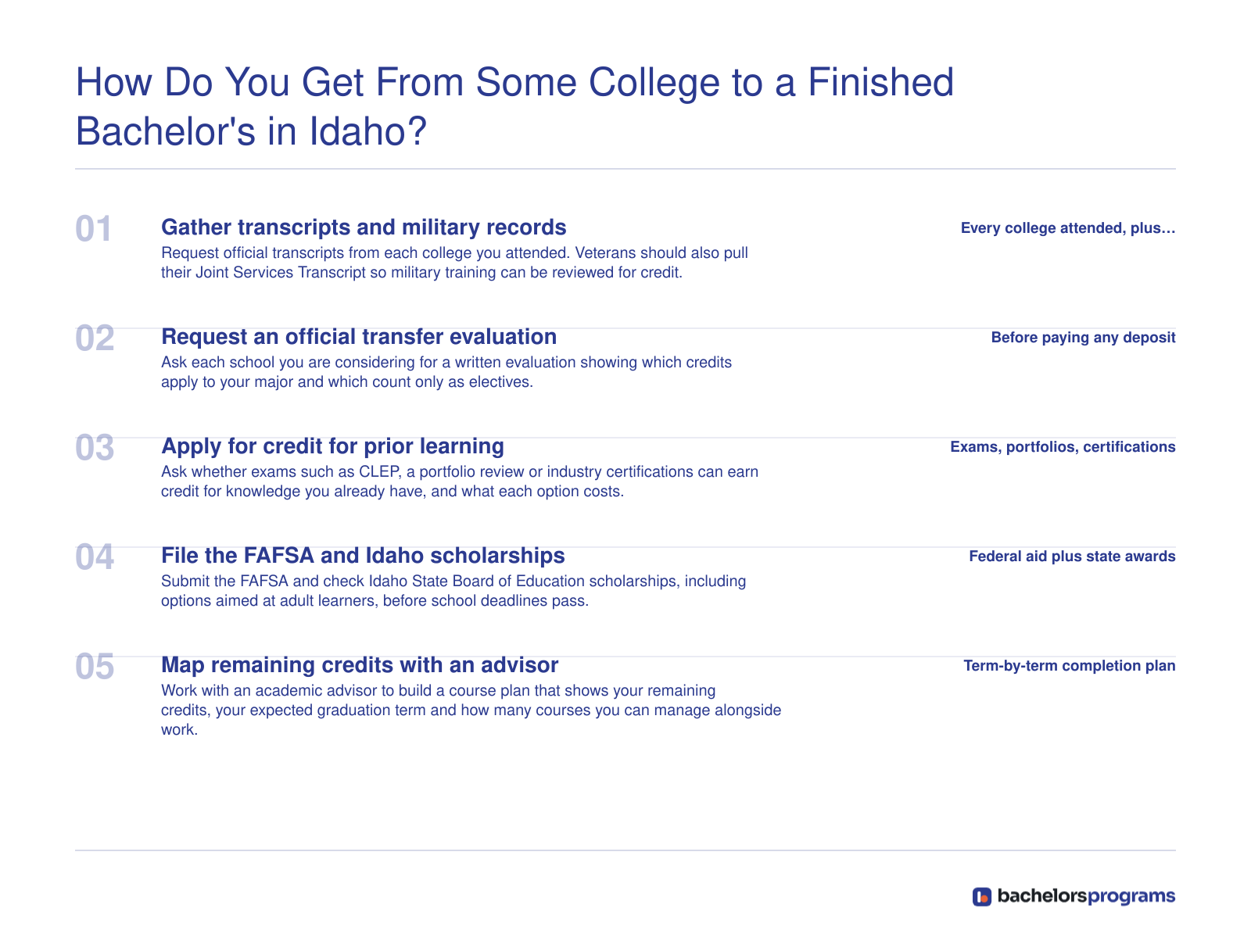
How Do You Get From Some College to a Finished Bachelor's in Idaho?
Returning adults usually finish faster when they handle paperwork in the right order. Ask for an official transfer evaluation before you pay any enrollment deposit, so you know exactly how many credits a school will accept before you commit money.
Which Idaho Colleges Offer 100% Online Bachelor's Degrees, and Where Hybrid Requirements Remain
Programs Most Often Finished Without Campus Visits
In Idaho, the bachelor's programs most reliably completed from home are degree-completion and general professional programs in business, accounting and interdisciplinary studies. Boise State University's Online Degree Pathway runs fully online classes in 7- or 15-week formats, with pathways in Business Management, Accountancy, Social Work and Advanced Medical Imaging. Many of Boise State's online bachelor's programs require an associate degree (A.A. or A.S.) or at least 60 transferable credits before you start. Its Interdisciplinary Professional Studies B.A. is a degree-completion program that can be taken online or in a hybrid format. The University of Idaho lists its 120-credit Interdisciplinary Studies B.S. as available online as well as in Moscow.
Where In-Person Requirements Remain
An "online" label usually describes the coursework, not every requirement. Expect hands-on components in these areas:
- Social work: Boise State's B.A. in Social Work delivers coursework 100% online with no campus visits, but students complete supervised field work in their local community, and the university handles site approval.
- Education: Boise State's Elementary Education B.A. requires a senior-year internship 2 to 4 days per week and a full-time semester of student teaching, with placements within 50 miles of Boise State. The University of Idaho's Elementary Education B.S. requires three supervised practicums and a full semester of student teaching.
- Science labs: The University of Idaho's Medical Sciences B.S. option in Coeur d'Alene combines videoconferencing and online courses with in-person labs on that campus.
- Nursing and internships: RN-to-BSN programs generally include clinical or practicum hours, and some majors require internships. These can often be arranged near home, but policies differ by school.
"Online" Can Still Mean Scheduled or Proctored
Some online courses include live (synchronous) class sessions at set times, and some require proctored exams, either through a webcam service or at an approved testing site. Neither is unusual, but both affect your schedule if you work full time.
How to Verify Before You Apply
- Read the format statement: Look for wording such as "100% online," "hybrid" or "some campus visits required" on the program page.
- Ask in writing: Email admissions to confirm whether any travel, live sessions, labs or placements are required, and where they take place.
- Check state authorization: If you live outside Idaho, confirm the school is authorized to enroll online students in your state, especially for programs that lead to a license.
Accreditation and Program Approval to Check Before You Enroll
Accreditation takes minutes to check, and many online students skip it. Boise State, for example, is listed by the Northwest Commission on Colleges and Universities (NWCCU) as accredited since 1941, with its latest evaluation in Spring 2026 and the next due in Spring 2029.1
Institutional Accreditation
NWCCU is the regional accreditor for Idaho. Check each school you are considering, including the other public universities, Lewis-Clark State and BYU-Idaho, rather than assuming. Institutional accreditation affects federal financial aid eligibility, whether another college will accept your credits, and whether a graduate program will recognize your degree. Idaho also requires degree-granting institutions operating in the state to be fully accredited by a Board-recognized accreditor and to be registered with the State Board of Education.2
Programmatic Accreditation
In some fields, the program matters as much as the school.
- Nursing: CCNE or ACEN. Boise State's online RN-BS is CCNE-accredited through 2030.
- Business: AACSB or ACBSP.
- Education: CAEP or state program approval.
- Social work: CSWE, which licensure boards commonly expect.
Ask each program which of these it holds. Do not assume one school's status applies to another.
Out-of-State Students and Licensure
Idaho's State Board of Education is the state's portal entity for NC-SARA, and Boise State states that it is a member. SARA membership does not change any state's professional licensing rules.3 Programs that lead to licensure must disclose, before you enroll, the states where they have determined the program meets educational requirements. If your state's requirements are later found unmet, written notice is due within 14 calendar days.3 These disclosures cover educational requirements only. The licensing board makes the final decision on whether you receive a license.
Verify in Two Minutes
1. Search the school in the NWCCU institutional directory and confirm its status. 2. Look it up in the U.S. Department of Education's DAPIP database to confirm a recognized accreditor. 3. Find the program's own accreditation statement and its licensure disclosure for your state.
Idaho Licensure Considerations for Online Nursing and Education Graduates
Admissions, Start Dates and Online Student Support Checklist
Before you apply, confirm what the school expects from your applicant type and what it provides once you enroll. Use this checklist to compare online programs side by side.
- First-time studentsExpect to submit a high school diploma or GED. Many schools now admit test-optional, so check whether SAT or ACT scores are required or only considered.
- Transfer studentsSend official transcripts from every college attended, and confirm the minimum transfer GPA and how many credits the school will accept toward your major.
- Adult and degree-completion applicantsAsk whether a separate adult or completion pathway exists, with flexible admission criteria or credit for prior learning.
- Start datesMany online programs offer several start dates a year, often in 7- or 8-week terms, so you may not need to wait for fall.
- Student supportVerify that online advising, tutoring, library access, disability services and career services are all available to distance students.
- TechnologyPlan for reliable broadband, which can be limited in rural Idaho. You will also need a webcam for proctored exams and familiarity with the school's learning management system.
Graduation Rates, Student Debt and Career Outcomes for Idaho Bachelor's Graduates
Boise State University and the University of Idaho each report a 62% graduation rate, three points above the 59% midpoint College Scorecard lists for four-year colleges nationally. Boise State's rate covers students who started there, full- and part-time, and is measured eight years after they attended, so it is a broad institutional signal rather than a four-year finish rate.1
Debt and Earnings in Context
The federal College Scorecard reports $19,678 in typical undergraduate debt for completing Boise State borrowers and a $224 typical monthly payment on the standard 10-year plan.1 The University of Idaho reports $14,831 and $233 monthly. Debt definitions and borrower groups vary between pages, so compare the payment burden against earnings rather than treating either total as a full cost of attendance. The University of Idaho also lists a separate $21,982 figure in its family-income breakdown, showing how much the measured population changes the total.
Typical yearly earnings are listed at $64,791 for Boise State, $60,330 for Idaho and $60,428 nationally.1 These are useful context, not a guaranteed 10-year return; the public files do not establish that every displayed earnings figure shares the same cohort year or measure. College Scorecard institution files cover 1996-97 through 2025-263, and earnings data were last refreshed in June 20244, so older and newer figures can sit side by side.
Why Headline Rates Miss Online Adults
Scorecard graduation rates mostly track first-time, full-time students, so they understate outcomes for transfer and online adult learners. A 2026 Idaho State Board of Education report offers a different view: 36% of scholarship recipients earned a bachelor's by the end of their fourth year.2 The report does not identify the scholarship program, cohort or comparison group, so use it as context, not a ranking.
What to Ask Before You Enroll
Request completion rates specific to online and transfer students, not just the all-student average. Ask how the program counts part-time starters, whether withdrawal for a term breaks enrollment, and what share of online students finish within six years. For debt, ask for median borrowing among graduates in your intended program and the typical monthly payment at current rates. Those program-level answers will tell you more about value than any single institutional headline.
What a Bachelor's Degree Is Worth in Idaho
Nationally, a bachelor's degree is linked to a substantial earnings advantage over a high school diploma alone.
Colleges in Idaho with the most bachelor's programs
| School | City | Type | Bachelor's programs | Online | Net price / yr | Grad rate |
|---|---|---|---|---|---|---|
| Brigham Young University-Idaho | Rexburg | Private nonprofit | 94 | 2 | $8,221 | 56% |
| Boise State University | Boise | Public | 88 | 21 | $21,610 | 60% |
| Idaho State University | Pocatello | Public | 87 | 17 | $12,193 | 39% |
| University of Idaho | Moscow | Public | 86 | 10 | $14,831 | 57% |
| Northwest Nazarene University | Nampa | Private nonprofit | 63 | 3 | $29,580 | 71% |
| Lewis-Clark State College | Lewiston | Public | 54 | 16 | $15,635 | 40% |
| The College of Idaho | Caldwell | Private nonprofit | 32 | 0 | $19,481 | 63% |
| Eagle Gate College-Boise | Boise | Private for-profit | 3 | 3 | $30,241 | — |
| College of Eastern Idaho | Idaho Falls | Public | 1 | 0 | $8,778 | — |
| College of Southern Idaho | Twin Falls | Public | 1 | 1 | $6,095 | 33% |
| College of Western Idaho | Nampa | Public | 1 | 1 | $8,500 | — |
Program counts are the verified bachelor's listings in our directory; net price is the school-wide average a first-time undergraduate paid after aid, and graduation rate the share finishing within six years (College Scorecard).
Online Colleges in Idaho: Frequently Asked Questions
Are online students charged the same tuition and fees as campus-based students?
Can I get college credit for work experience or military training in Idaho?
Does the Western Undergraduate Exchange (WUE) discount apply to online bachelor's programs at Idaho schools for students from other western states?
If I move to Idaho while studying online, when do I qualify for in-state tuition and Idaho state scholarships?
Compare programs nationwide
Many Idaho residents study online. Every ranked list above has an online lens, or browse every field.
Online bachelor's degrees Browse all fields